In several ways, 2017 will be my final season as a working person.
That’s not to say I won’t continue to work hard in life. According to the Social Security Administration I have a lot of life to live —19.2 years on average. Longevity’s secret is no secret: as long as life holds, engage in it and don’t stop until the final curtain.
By year’s end, my spouse and I will be in a position to slow down and work on projects better aligned with our interests. We won’t be rich, but that was never a goal.
A constant theme is embedded in the thousands of posts I’ve made over the last ten years: Radix malorum est Cupiditas, money (or greed) is the root of all evil. We managed cash flow well during our lives together with almost never a bounced check. Yet currency has been little more than sunlight, reasonably available if one is willing to join in society. Its value is as part of photosynthesis in the botany of our lives.
On the final workingman’s lap some things are clear.
My work at the home, farm and auto supply store is needed to provide health insurance until we both are on Medicare. Health insurance has been the biggest and most unpredictable expense since leaving my transportation career in 2009. I compare my experience to co-workers from Mexico. When they need significant healthcare, they travel home to take advantage of Mexico’s free clinics. In the United States health insurance is pay to play. Premiums contribute to many jobs: physicians, nurses and lab technicians, of course. But also to corporate entities with their executives, sales representatives, manufacturing staff, actuarial workers and legal counsel. By my calculation, monthly premiums for an individual health insurance policy are roughly ten percent higher than Medicare’s cost of service. My lowly paid work will continue at least one more year.
I hope this year’s growing season will produce in abundance. If last year created one of the best gardens ever, I plan to make this one even better. What I don’t or can’t grow will be acquired from two barter arrangements with Community Supported Agriculture projects. If my execution of garden work isn’t flawless, decades of experience should serve us well. Knowing what to do and when makes a big difference.
Our logistics system needs attention. Downsizing possessions, maintaining the house and its mechanical systems, and ensuring cost-effective transportation enter into this year’s plans. Because of the low cost of storage (i.e. loss of usable space), and the value of having built a new house needing few repairs, these tasks have been delayed.
Writing will continue to be important next year, both here and on social media. Writing has been a way to work through problems and relieve stress. When I write a fixed piece — a guest column for a newspaper — I write with confidence. When I start with a blank Microsoft Word document, ideas rise from a deep well of experience. As I mature as a short-form writer, increasing readership will be important.
I feel a sense of limited opportunity as the final months before great change come into focus. There are only so many days to get things done. The feeling is encouragement to make the most of my time. A sense of hope pervades everything and for that I am thankful.
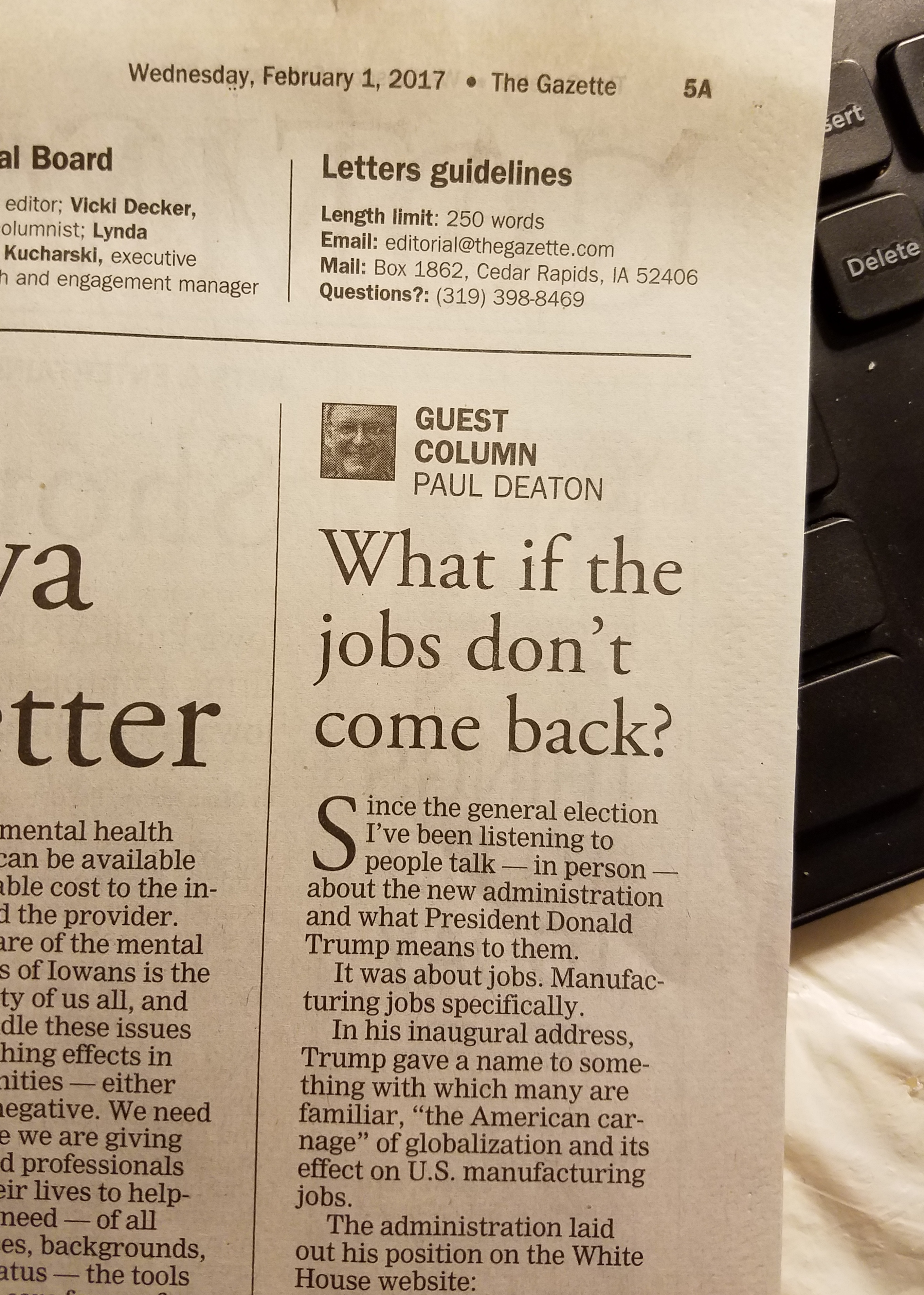
Since the general election I’ve been laying low, listening to people talk — in person — about the new administration and what President Donald J. Trump means to them.
It was about jobs.
Most supporters found a lot of what the president said and stands for to be objectionable, yet voted for him because of the hope for jobs — a central campaign theme. Manufacturing jobs specifically.
In his inaugural address, Trump gave a name to something with which many are familiar, “the American carnage” of globalization and its impact on U.S. manufacturing jobs.
An issue page of the White House web site the administration laid out his position:
Since the recession of 2008, American workers and businesses have suffered through the slowest economic recovery since World War II. The U.S. lost nearly 300,000 manufacturing jobs during this period, while the share of Americans in the work force plummeted to lows not seen since the 1970s, the national debt doubled, and middle class got smaller. To get the economy back on track, President Trump has outlined a bold plan to create 25 million new American jobs in the next decade and return to 4 percent annual economic growth.
As a deal-maker, the president asserts he knows how to do it. His plan is not yet public so it’s difficult to evaluate.
I’ve worked manufacturing jobs during my life and as a director of a logistics company that evaluated countless others. While living in Indiana I interviewed thousands of people impacted by the exodus of jobs in the rust belt as part of a global restructuring of workforce and business operations. In this sense Trump is right about the carnage: real people were negatively impacted by loss of U.S. jobs. I met many of them.
At the same time, finding cheap labor and developing new technologies enabled companies to be competitive in a global marketplace. However, Trump’s “carnage” launched with intensity because of Ronald Reagan’s policies, not Obama’s. I believe Trump’s assertion about jobs is a bait and switch.
On Friday, Jan. 27, the White House announced a “Manufacturing Jobs Initiative.” Andrew Liveris of Dow Chemical Company is convening a panel of business leaders to advise the president. For the most part, it is a who’s who of companies that benefited from globalization. I am doubtful this group can do much besides inform the president what regulations and tax codes need revision to encourage large companies to locate manufacturing plants on U.S. soil. The two token AFL-CIO members represent labor interests on the panel, but even they are part of a gigantic dog and pony show expected to accomplish little in terms of direct results impacting real people.
The metrics to evaluate Trump’s job creation performance already exist in the Labor Department jobs report which shows the millions of jobs created during the Obama administration. Assume the methodology remains constant, fill out the chart as time passes and new results are in, and there is an objective basis on which to evaluate performance. A similar metric holds true for economic growth. We should have a solid couple years in before the 2020 campaign begins. Thumbs up or thumbs down. It should be that simple.
Trump’s discussion of bringing manufacturing jobs “back” is a bait and switch. Globalization of the manufacturing processes and automation that includes robots doing repetitive tasks has eliminated many manufacturing jobs permanently. It will eliminate more.
Like it or not, with Wall Street alumni occupying four key positions in the administration, whatever jobs are created are likely to be similar to those created under Obama.
I am not hopeful for resurgence in manufacturing jobs, nor was this my issue during the 2016 campaign. However, Trump’s assertions about job creation came from the lips of every Trump voter with whom I spoke, no exceptions.
If Democrats hope to win the next presidential election we need to understand why friends, neighbors and work colleagues voted for Trump. In part, it was about jobs that won’t be back the way we knew them, regardless of campaign promises.
~ An edited version of this post first ran in the Cedar Rapids Gazette Feb. 1, 2017
In this final 2016 post it was easier than last year to outline my writing plans.
The work I do to pay bills and support my writing has been tough mentally and physically. To cope with an aging frame and occasionally distracted mind I have had to focus. That meant planning, and then with discipline, working the plan. 2016 was a mixed bag and I expect to do better in 2017.
I seldom post about my personal life and family — at least directly. That leaves issues I confront every day as grist for the keyboard.
There are four broad, intersecting topics about which I’ll write during the coming year.
Low Wage Work and Working Poor
Not only do I earn low wages in all of my jobs, I meet a lot of people who do too. During the last four years I developed a framework for viewing how people sustain their lives without a big job or high salary. A focus on raising the minimum wage, wage theft or immigration status may be timely but most of what I read misses the mark. Stories fail to recognize the complexity with which low wage workers piece together a life. This subject needs more exposition and readers can expect it here.
Food Cultivation, Processing and Cooking
Living on low wages includes knowledge of how to grow, process and prepare some of our own food. My frequent posts on this topic have been intended to tell a story about how the work gets done. I plan to grow another big garden in 2017 and perform the same seasonal farm work. I sent off a membership form to Practical Farmers of Iowa this morning and expect my experience with that group to contribute to food related writing.
Nuclear Abolition
I renewed my membership in Physicians for Social Responsibility. We have a global footprint and as a member I have access to almost everything going on world-wide to abolish one of the gravest threats to human life. The president elect made some startling statements about nuclear weapons this month. The subject should hold interest and perhaps offer an opportunity to get something done toward abolition. The United Nations voted to work toward a new treaty to abolish nuclear weapons. They did so without the support of the United States or any of the other nuclear armed states. In that tension alone there should be a number of posts.
Global Warming and Climate Change
My framework has been membership in the Climate Reality Leadership Corps. Like with Physicians for Social Responsibility we have a global footprint with thousands of Climate Leaders. We have access to the latest information about climate change and its solutions. The key dynamic, however, is how work toward accepting the reality of climate change occurs on a local level. What researchers are finding is skepticism about the science of climate change originates in the personal experience of people where they live. If the weather is very hot and dry they tend to believe in climate change. If it is cold, they tend not to believe. Thing is, climate change and human contributions to it are not a belief system as much as they are facts. Global warming and climate change already affect us whether we believe or doubt.
So that’s the plan. While you are here, click on the tag cloud to find something else to read. I hope you will return to read more in 2017.
My birthday trip to the county seat included these real-world variations from yesterday’s plan:
Ordered a voter list for my precinct from the county auditor to start organizing for the 2018 election and beyond.
Noticed the new Zombie Burger and Shake Lab opened next to The Mill. It seemed wrong.
Renewed my library card. Rural residents can take advantage of the Iowa City Public Library. I check out eBooks from home using my card.
Walked past children playing on the pedmall. They were laughing.
Walked past Schaeffer Hall where I spent much time attending classes 45 years ago.
Viewed the Hawkeyes in Space exhibit at the Old Capitol Museum. It is a history of the University of Iowa Physics and Astronomy Department and their contributions to the national space effort beginning in 1951 with the arrival of James A. Van Allen.
Went to Prairie Lights Book Store and bought copies of The Last Love Song: A Biography of Joan Didion by Tracy Daugherty and Born to Run by Bruce Springsteen. I also read some remembrances of Burns Weston and called out a friend on her use of what I felt were excessive exclamation points.
Stopped at the HyVee grocery store on North Dodge Street to buy a few items for my birthday dinner. I also returned cans for deposit.
I arrived home in time to read and fixed a dinner which included a test run of a noodle kugel recipe I got from a Des Moines blogger’s web site. The recipe came out well and there are enough leftovers to last a week. Intended to be a side dish, noodle kugel includes a lot of protein which is needed in our vegetarian household.
The president-elect was busy on twitter again yesterday. Here’s my nascent idea on how to handle him from a Facebook post I made.
Donald J. Trump throws tweets out to media the same way chaff was used to foil radar in WWII. We are seeing what he wants us to see about his incoming administration. All the noise is obscuring the signal, which many of us are not going to like once it comes into focus.
The positive side here is no pretense of being a “compassionate conservative” like Bush II pretended he was. I expect Trump to throttle down immediately to rollback progressive reforms dating back to FDR. I’m keeping my powder dry until we know more specifics of his agenda
I’m taking my advocacy lead from Friends Committee on National Legislation. Diane Randall laid out an agenda which seems practical and makes sense. Her outline of how to deal with appointees who require U.S. Senate confirmation is spot on:
In these confirmation hearings, senators ask the nominees questions that establish a public record. One of the most effective ways FCNL can influence the public record is to encourage senators to ask particular questions. FCNL, along with many of our organizational partners, is preparing questions for senators to ask the nominees. These questions are specific to each nominee, concerning their positions on enforcing current laws and their positions with regard to the safety and well-being of specific populations, or on past statements they have made about the role of the agency they will be heading.
Based on the past public statements, or votes for the nominees who have served in Congress, we are particularly concerned about nominees who have stated their opposition to environmental regulations, full access to health care and protection of voting rights and religious freedom.
Following FCNL’s lead isn’t mutually exclusive, but would be a bit of sanity in what appears to the egregiously brazen impetus of the president-elect’s nominees who have track records running against the grain of progressive values.
It’s two days at the home, farm and auto supply store for me, followed by a three-day weekend. Stay tuned.
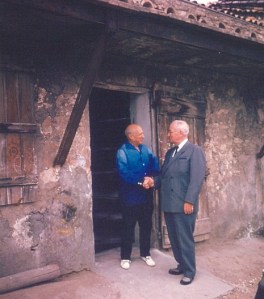
Picasso with Harry Truman in 1958, Vallauris, France Photo Credit – Truman Library
Today I celebrate my 65th birthday.
Some baking will be involved — maybe homemade pizza for supper or an applesauce cake. Maybe both. Maybe something else.
I plan a trip to the county seat, a tour of our yard and garden, and a walk by the lake — the beginnings of a late winter to-do list.
It’s all about anticipation in 2016’s pre-dawn darkness.
Yesterday historian Michael Beschloss posted this photo in social media. Seeking a copy for my birthday present, I searched the internet for the Harry S. Truman library and found the file. An 8 x 10 colored, glossy (or matte) copy could be mine for $20. Now that the image is posted I satisfied the urge and can spend my birthday money on something needed more.
In yesterday’s newspaper author Anne Keene wrote about the U.S. Navy Pre-flight School and Iowa’s participation as one of the sites during World War II.
“Before cadets could fly they had to graduate from ground school, where the Navy used hard-hitting sports such as football to build speed, agility and power for combat,” Keene wrote. “Pilots learned to swim and to survive in the outdoors along the wooded shores of Lake Macbride.”
In May 1942 John Glenn swam in the same waters I later did. My outing to Lake Macbride with a church group fixed Father in memory. He drove a group of us in a caravan from Davenport to Lake Macbride. He was also a fan of Glenn and the U.S. space program, taking us outside to watch the Telstar satellite pass over in the 1960s. I now see the same lake, which like all Iowa waters feeds a river of memories and experience into the vast gulf of commonality.
Mom sent me some birthday money, just as her mother did. It would be too plain to spend it all on groceries, fuel or sundries. I hope to spend part of it at a shop in the county seat later today on something I wouldn’t normally buy — a fit birthday project.
Wearing My Blue Shirt
I may buy a new blue button-down shirt since there is only one in my closet. It is my go-to garment for attending events and eventually it will wear out. I need socks which I last bought at the discount store on Highway One near the airport. If I feel up for a drive, I could visit Stringtown Grocery near Kalona. I want more dried chervil leaf and it’s the only local place that sells it. It would be a shame to use maternal gift money to make a payment on the credit card or buy dairy products.
It’s still dark outside.
Writing is brief respite and today’s birthday gift. Something to engage a mind resident in an aging frame, preparing for the day.
Would that writing were all that needed doing today. For now, it serves.
It’s Christmas Eve in Big Grove, the ambient temperature is about freezing, and we’re ready to bunker in, finish decorating our Christmas tree and prepare a traditional supper of chili and cornbread.
My Christmas wish is for peace on earth.
Elusive as that may have been during 2016, we can’t give up hope. Not now. Not like this.
As winter solstice brought longer days — increasing light imperceptible in each day’s cycle — it is time again to fly with eagles, gain a broader perspective, and thank people who are always in these written words if rarely mentioned — my wife Jacque, our daughter, my parents and my maternal grandmother.
Reading
I continue to read more on my phone and computer than I do full-length books. Nonetheless I managed thirteen books in 2016, the most important of which were authored by people I know: Connie Mutel and Ari Berman.
Methland by Nick Reding had the biggest influence, by a distance.
Here’s the list of books, most recent first:
Diet for a Hot Planet: The Climate Crisis at the End of Your Fork and What You Can Do About It by Anna Lappé; My Life on the Road by Gloria Steinem; Sapiens: A Brief History of Humankind by Yuval Noah Haran; Methland: The Death and Life of an American Small Town by Nick Reding; Give Us the Ballot: The Modern Struggle for Voting Rights in America by Ari Berman; A Sugar Creek Chronicle: Observing Climate Change from a Midwestern Woodland by Cornelia F. Mutel; Atlantic: Great Sea Battles, Heroic Discoveries, Titanic Storms, and a Vast Ocean of a Million Stories by Simon Winchester; And Then All Hell Broke Loose: Two Decades in the Middle East by Richard Engel; Slavery in the Upper Mississippi Valley, 1787-1865: A History of Human Bondage in Illinois, Iowa, Minnesota and Wisconsin by Christopher P. Lehman; The Diary of a Napoleonic Foot Soldier by Jakob Walter; Old Man River: The Mississippi River in North American History by Paul Schneider; MiniFARMING: Self-Sufficiency on 1/4 Acre by Brett L. Markham; and Fast Food Nation: The Dark Side of the All-American Meal by Eric Schlosser.
For the fourth year I edited Blog for Iowa while Trish Nelson took a break, writing at least one post each weekday during August. My book review of Give Us the Ballot ran in The Prairie Progressive, a guest column ran in the Cedar Rapids Gazette, and I wrote two letters to the editor of the Solon Economist since the general election. I cross posted Next for Iowa Democrats on Bleeding Heartland, my first post there.
More outside publication is planned for 2017.
Working
Income from five jobs helped financially sustain us in 2016. Work at the home, farm and auto supply store provided health insurance and a regular, predictably low paycheck. In descending order of income were jobs at Wilson’s Orchard, Local Harvest CSA, Blog for Iowa and Wild Woods Farm.
Each of these jobs was good for a reason. Blog for Iowa encouraged me to write every day. Farm work helped me connect with others in the local food movement. The home, farm and auto supply store provided a venue for conversations with low-wage workers. I’ll seek additional income in 2017 and maintain relationships with each of these organizations.
The common denominator among these jobs is interaction with people. As I enter my last year of work before “full retirement,” I seek that as much as income.
Gardening
2016 was another improved year in our home garden. Among many experiments were growing root vegetables in containers (a success with carrots and daikon radishes), growing squash in the unused storage plot, and using sections of 4-inch drainage tile to protect young seedlings. Failures included bell pepper plants which succumbed to weed competition, and loss of tomato yield due to a lack of attention. The best crops included broccoli, celery, eggplant, tomatoes, Bangkok peppers, turnips, basil, sage, oregano and kale.
Ancillary activities included distribution of kale and a few other vegetables to local library workers and friends, and weekly posts about the garden on Facebook.
We raised adequate produce to serve the needs of our kitchen. I also learned a lot through collaboration with friends and neighbors.
Apples
I followed the 2016 apple season at the orchard and continued to develop our home apple culture. Our apple trees did not produce a crop this year.
The last of the 2015 crop is peeled, sliced and frozen, or turned into applesauce and apple butter. We have enough frozen apples left for a Christmas Day dessert. This year’s orchard apples were mostly eaten fresh.
I made more apple cider vinegar. The process was simple: I added Jack’s heritage mother of vinegar to apple cider from the orchard in half-gallon ventilated jars and waited. This year I added an eighth-teaspoon of brewers yeast to each container at the beginning. The benefit was hastened alcohol production and a superior final product. I also learned that a cooler temperature slows alcohol production and this can produce a better result. Today there are two gallons of apple cider vinegar in the pantry and another gallon and a half in production.
Politics
The general election did not produce the result many people, including me, wanted.
At the same time, a lot of acquaintances seek to become active and “do something” during a Trump administration. There is plenty of work to resist the expected rollback of what we value in society. Specifically, work toward protecting the environment, reducing the number of nuclear weapons, and ensuring social justice.
My term as a township trustee ends Dec. 31, so regarding politics, I can be an unencumbered agent of change. The next step is to leverage the opportunity the general election brought with it.
Retirement
The time since my July 2009 retirement from CRST Logistics can be divided into clearly defined phases. First came a period of social activism characterized by work with community organizations. It lasted until the end of 2011. Next was the political year 2012. After that, life found me working low-wage jobs to support my writing. That’s where I am today. In 2016 came a realization that in order to spend more time writing, I have to get past the finish line to “full retirement” as defined by the Social Security Administration. For me that’s in December 2017. I took the first step by signing up for Medicare this month.
2016 was a time to learn, work on writing, and do things that matter. More than anything, I have been writing. Everything else provided a platform or material for it. If 2017 presents significant challenges, there should be plenty to write about.
A small group of writers met at The Java House in the county seat last night to consider what’s next. It was my first outing with friends since the general election.
Consensus was it’s too late to complain about the president elect and his coming administration. The election is over, the Electoral College meets Dec. 19 in each state to cast their votes, and electors are expected to vote for each state’s winners.
All of us supported Hillary Clinton yet Donald Trump’s margin of victory in Iowa was 9.4 points. The fact ours was one of six Iowa counties voting for Clinton was cold comfort.
At the same time there is energy from a variety of sources to resist Republicans and their agenda at all levels.
What are we willing to do?
As a low wage worker my main challenge is building bandwidth for community organizing. It won’t be easy in 2017, the last year before my “full retirement.” In addition to budgeting income from a half dozen seasonal jobs, I need time and energy to organize.
Other challenges include picking activities where my efforts can make a difference. I don’t know what exactly that means today. The focus should be less on issues and more about process — how we arrived in Trumpland, and how we get out.
Here is a short list of things a person can do:
Set aside regular time to work on community organizing.
Join together with friends to work on what matters most.
Set specific goals and timelines.
Meet new people.
Advocate for Democratic principles in public places, writing for publication in newspapers and participating in local media coverage of events.
Hold meaningful events that engage community members.
This list represents a small step toward being an occupier of the society Republicans have made on our historic turf. Something essential to sustaining a life in a turbulent world.
I’ve been in Davenport for just five days and already my mind is flooded with thoughts about projects to get involved with — many different activities. My mind is coming to be awake unlike it has been through the four years I have been in the Army. The potential for doing things is tremendous.
Northwest Davenport has changed during my absence. The Spudnut Shop is now a donut shop of a different name. Don’s Sport Shop now sells only bicycles. Northwest Drug Store closed its doors permanently and will be selling its goods within the week. Schlegel’s Rexall is now HAAG Drugstore, and Swan Drug Store sells more hospital hardware than anything.
Change is part of life and I guess it is to be expected. As you were — life is change. How it differs from the rocks.
It is about time to bring the writings in this journal to an end and begin filling the pages of a new book.
~ This is the second of a series of posts based upon writing in my journal.
Each week I dive into a sea of humanity and end up alone, in the morning, writing about what I have experienced.
Whether the output is political, journalistic, scientific, culinary, agricultural or just being alive, what I write is grounded in a contemporary life viewed through sixty-plus years of personal experiences. It’s all the same process.
Humans are a rough and rowdy bunch. It’s challenging to capture modern life in a way that does justice to its complexity. Photos are not enough, naturalism is fraught with issues. Endemic to it all is the platform and perspective our lives create which position us to view society in the raw.
It can wear a person out. It can also invigorate us.
Each week I’ve been exposed to thousands of people from all walks of life. It is difficult to understand every experience, nor would I want to. It is hard not to cling to positive experiences and ignore negative. Some I meet don’t get outside home much. Others spend much time in the public arena. There are friends, neighbors and relatives with everyone mixed into a seasonal soup of life. Each week represents different ingredients, different flavors.
What matters more to a writer is having something unique to say. We know better what is not unique — set pieces, articles written on contract, photos of cats posted in social media. What it is, and should be, is articulation of experience that creates an understanding of an aspect of a complicated society on our only home and water planet.
It is modern to take raw materials of life and craft them into something readable, usable, and of value. The process is not always positive and writers should be cognizant of their impact in a constantly changing society.
I recall June Helm with whom I studied anthropology. It is impossible for an anthropologist not to influence the culture he or she studies, Helm told us. I took two lessons from this. The transient writer must tread lightly where we travel and work hard to do justice to what has been studied and experienced. The emphasis should always be creating something of value to subjects and readers alike.
As I prepare for this week’s dive into humanity I’m not nearly rested enough. My bones and ligaments ache from age and overuse. My cardio-vascular system seems okay, but one never knows. I can’t see as well as I once did and the looking I’ve developed has me ignoring much that would engage me previously. Imperfect though my platform and perspective may be, I’m ready to jump from the cliff it represents, hoping to avoid the rocks, and go deep into the sea of humanity once again.
Two hours before my shift at the orchard I was feeling punk. I went to work anyway.
While ringing up a dozen customers I felt light headed and a bit nauseous so my supervisor sent me home. She didn’t want whatever I had to infect other workers. Good call on her part.
After two four-hour sessions of sleep, I feel much better and am ready to head over again later this morning. Before I do, some last thoughts about this 96-hour staycation in Iowa.
I’m lucky to have worked a full career that paid our mortgage and helped put our daughter through college. There are plenty of people who work low-paid jobs like mine who don’t have that kind of financial platform for support. To make up the difference between income and operating expenses we’ve taken on some debt. We feel it’s manageable and have a plan to pay it off. Like most anyone should, we watch our cash flow. We also have been able to weather multiple challenges in recent years that would have sent others to the poor house if such a thing still exists.
Everything on my “deal-with list” has been addressed. Some things — car repairs, understanding and signing up for Medicare, writing about the Cedar River flood — came easily. Others — financial planning, longer writing projects, producing value from life as a sixty-something — present longer term challenges. What I wrote on Sept. 11 proved to be useful.
The key to dealing with this and everything else on my deal-with list is to take care of myself and not freak out. That I have this blog helps with the not freaking out part. There is solace in work.
I haven’t freaked out and am taking better care of myself as the staycation ends.
Sliced Red Zeppelin Onions
Canned goods were moved to the lower level where the storage rack is once again full. The production was less than in previous years, but focused on items we will use well over the coming months. Gardening is a perpetual process and this year produced in abundance. The trouble was August when I worked four jobs without adequate time to reap what I sowed. It was a learning point more than disaster and local farmers helped me make up for what was missed at home.
Remaining is fall yard work, home maintenance, financial planning, and most importantly writing. The reason for retiring in July 2009 was to enable my writing. I’ve gotten better at it and am ready for something longer, maybe book-length, which can be promulgated. That and ensuring our sustainability in a turbulent world remain on the deal-with deescalated to to-do list on my white board.
Better prepared to tackle today’s challenges, I’m hopeful. Hopeful about the lives of family members. Hopeful about the community of friends and acquaintances we’ve built here in Big Grove. Hopeful our country will make sound decisions during the Nov. 8 election.
Whatever the outcomes, the brief vacation this week helped get me back to who I am. I’m thankful for that and ready to engage in society again.








 Journey Home
You must be logged in to post a comment.