Following are opening paragraphs to a chapter of my work in progress, A Working Life. They begin a section on moving to Big Grove Township in 1993. It occurred to me the second paragraph should happen and I spent an inordinate amount of time crafting it. This opening stands up, I believe.
Big Grove Township was established before Iowa Statehood. The first sawmill was built in 1839 by Anthony Sells on Mill Creek. Put the big groves of trees together with the sawmill and you have us. The oak, walnut, hickory, ash, elm, and cottonwood that once thrived among numerous pure springs were long gone when we bought our lot here. What dominates is the culture we and others brought with us to an area where what was native once existed in abundance yet no longer does. There is something essentially American in that.
Also quite American is forgetting about natives who lived here for thousands of years: ancient, unnamed hunter-gatherers, mound builders, and the Oneota culture, which flourished across the Upper Mississippi River Valley for several centuries and gave rise to the historic tribes later known as the Ioway, Meskwaki, and Sauk. Oneota peoples cultivated maize, beans, and squash; built villages along rivers and streams; and moved seasonally across a landscape defined not by fixed boundaries but by ecological, social, and ceremonial relationships.
Not far from here, a small museum once displayed cases of stone points, pottery, and tools gathered from nearby fields—fragments of those lives, removed from the ground and arranged for viewing, now gone themselves.
In such context, we moved to Big Grove Township in August 1993.
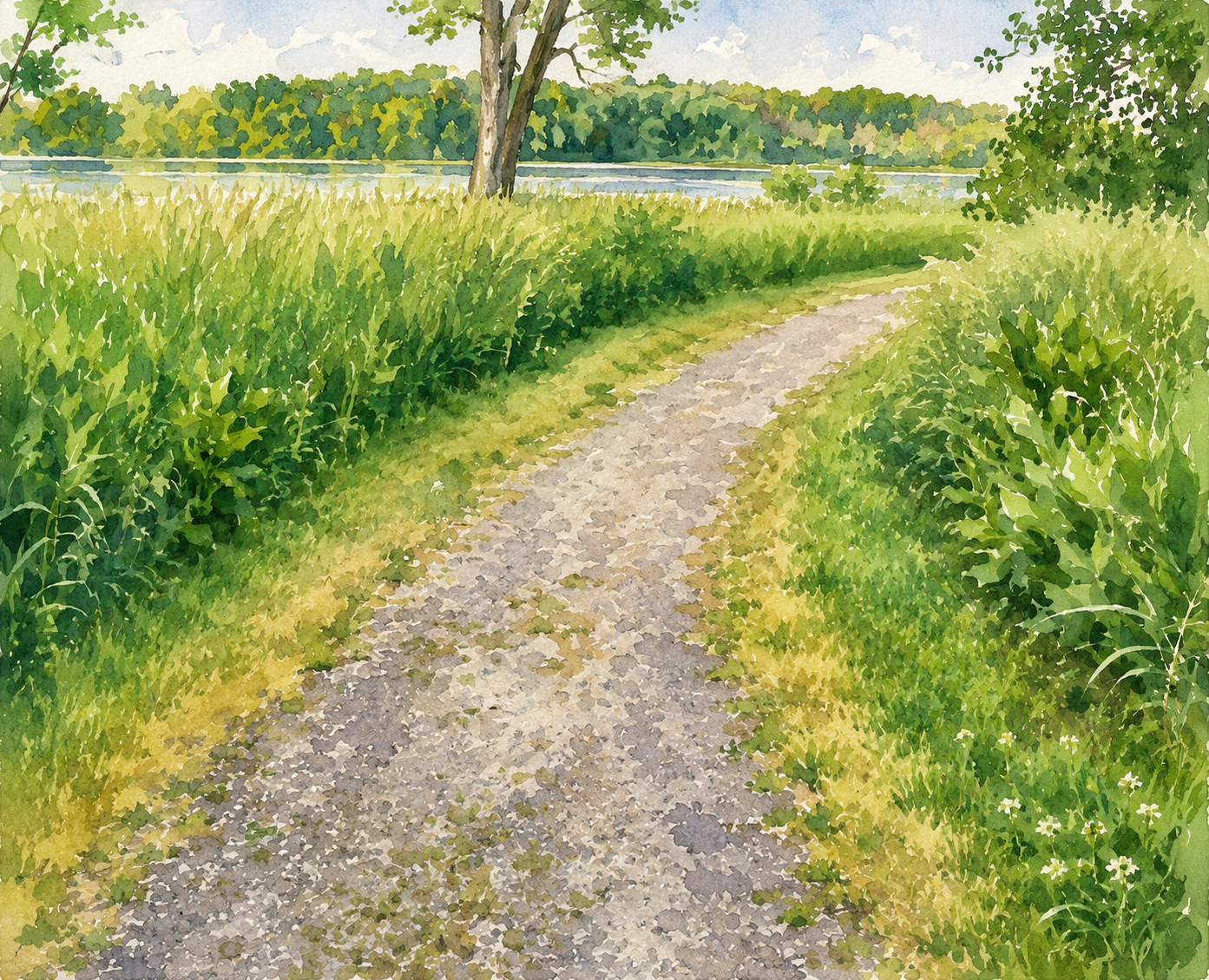
Trail walking before sunrise on April 9, 2026.Spring flowers.Spring garlic.Zestar! apple buds.Bluebell buds.Leeks, onions, turnips, and radishes planted on April 9, 2026.
(Washington, D.C.) — President Donald Trump’s April 7 threat that he might escalate U.S. attacks on Iran so that “a whole civilization will die tonight, never to be brought back again,” should profoundly alarm every U.S. and global citizen.
Whether Trump is threatening a massive conventional bombing campaign or making a veiled threat to use nuclear weapons to try to coerce Iran into submission, leaders of nuclear-armed states cannot, must not, threaten the end of “a whole civilization.”
Such threats are unacceptable and following through would be a massive war crime and humanitarian disaster. In addition, an attack on Iran’s Busherer Nuclear Power Plant would risk a radiological disaster in the region.
The only type of weapons in the U.S. arsenal that could destroy “a whole civilization” in a day would be nuclear weapons. Any use by the United States of nuclear weapons against Iran would permanently damage the United States’ reputation, shred its alliances, and would constitute a war crime for which everyone in the chain of command could be prosecuted.
Even if Trump is not considering the use nuclear weapons, but “only” intends to launch a massive conventional bombing against civilian targets in Iran, the effect would be the opposite of Trump’s ostensible goal: preventing Iran’s leaders from acquiring nuclear weapons.
Rather, it would reinforce the belief that the only way a nation can deter attack from an aggressive nuclear-armed state is to possess one’s own nuclear weapons. A further escalation of this war would thus provide further incentive for Iran – and possibly other states – to develop nuclear weapons.
During the course of the nuclear age, past U.S. presidents have issued veiled nuclear threats against smaller, less powerful but very determined nations only to learn that such threats do not lead them to capitulate. U.S. nuclear threats during the Korean War and later against China and the Soviet Union, as well as Nixon’s “madman” strategy, which involved a nuclear threat against North Vietnam and a massive strategic bombing campaign, failed to bend adversaries to U.S. goals.
We call on rational voices inside Trump’s circle of formal advisors, informal confidants, members of Congress from both parties, and global leaders to remind Mr. Trump that responsible leaders do not threaten to commit war crimes, that a further escalation of his illegal war would undermine U.S. and global security and risk the lives of innocent people in Iran and the Middle East, and that the responsible path forward and out of this war is to immediately end the hostilities.
My current book is heading for home and each new day of editing brings a sense of impending completion. Being a career logistician, I consider process: By June, copies for early readers; then another edit; then fund-raising, printing, and distribution. Having written it, the work ahead is answering questions about whether it is the best it can be.
What is this autobiography, with working title A Working Life: A Memoir, about?
A man who set out to write discovers the long experience of work and of living meaningful days in the American Midwest is the life of a writer.
While this sentence needs work, it is the product of writing the book, driven by its themes. Writing, work, and meaning made a permanent structure. Until I finished a first draft I did not recognize that. Now I can stand on it.
Begun in 2010, this work is having a long gestation. As the writing and editing ends, I understand more clearly what my life is about. Soon I can move on to the next project.
More than anything, I need closure. I can see now that by Labor Day I will be ready to let it go.
On Wednesday I received a COVID-19 booster, and it knocked me down. I felt fine the rest of the day, but on Thursday I could barely stay awake. Even three days later, on Saturday, I was still feeling the aftereffects. Except for when I actually tested positive for the coronavirus, vaccinations had never felt this way. I was out in the yard Saturday and feeling better in the afternoon. Now a blizzard is on its way to eastern Iowa late Sunday.
I don’t think much about aging, yet signs are present. Some joints are stiffer, I need a new pair of glasses, I can’t run as well as I could. Let’s not get into my organs, yet they are changing, too. My sleep pattern is to bed early, sleep for 4-5 hours, then wake to read for an hour, and catch an additional 2 hours of light slumber. The vaccination had me sleeping through the night on Thursday, but I’m already back to the usual. A person can live with all of this. Acceptance is better than fighting it.
While at the pharmacy checking in for my shot, we discussed how the bill would be paid. By reviewing my medical records, I knew the billed cost is around $200. With billing computerization through Medicare and my supplemental insurance, the attendant could look it up on the spot. Insurance paid for all of it. Without insurance, I would likely have skipped it. If this were a reasonable country with healthcare for all, such concerns wouldn’t exist.
I checked with the household on provisions, and we can last through the blizzard. Goodness knows there is plenty of indoors work to be done, even if I would rather be outside. I wonder if less tolerance for cold temperatures is also related to aging. I wonder if I’m losing my hearing or just getting cranky. A week before spring, it’s likely some of each.
Songbirds are arriving: sparrows, cardinals, blue jays, crows, woodpeckers, and more. In winter, geese dominated the lakes. Some remain year-round, but now they are joined by pelicans, gulls, and a variety of waterfowl moving through on the great migration. The number and variety of birds will grow in the weeks ahead. Spring is literally in the air.
This blog is where I write about Iowa, gardening, writing, politics, and whatever crosses my mind while walking on the state park trail.
This post is for new visitors. I have been writing a version of this blog since 2007, although older posts were taken off line in 2013. I post about whatever comes to mind, yet there will be some common themes this spring.
Until the June primary election, I’m filling in at Blog for Iowa. Each weekend I will cross-post those pieces here. They cover what I have been doing in the Democratic Party during the previous week, along with a special Iowa politics post on Sunday.
The ground is not ready for a shovel yet, but I’m planning a large garden. Some of my posts will be about that. I attempt to keep things different, and I’m beyond the standard photos of emerging plants and harvested produce. Growing food is one of life’s pleasures, and I’ve been doing it since the summer after my spouse and I married.
I also write about writing. Some of my most popular posts are when I take some current writing challenge and work my way through it.
Thousands of paper and digital photographs remain in shoeboxes and on the cloud. I started an archival process and write about it in a series called “A Life of Photos.”
I review things — books and events I attend, mostly. I also have an informal series called “We’re Going Home” in which I reflect on generational change caused by the death of people I know or who have had a profound effect on me.
I walk on the state park trail almost daily, usually at sunrise. Those walks give me time to think about issues, and some of those make it back to this blog.
I’ll be 75 years in December and I’m determined to make 2026 a productive year. Watch for it here.
If you’d like to know more, check the About page, located here.
Thanks for visiting. I hope you will find something and return often.
Following is a description of how I spent the bicentennial in 1976 from my book An Iowa Life: A Memoir. I was on military leave, in between Officer Candidate School and Infantry Officer Basic Course. This year is the 250th birthday of America. I’m not feeling celebratory and wish I could go back to those days when I slept on mother’s front porch through the holiday, away from neighborhood noise.
I stayed on at Fort Benning to take the Infantry Officer Basic Course and attend jump school. After OCS, life was less stressful as I prepared for my assignment in Germany.
I felt the beginnings of transformational change from being an observer of society to a participant.
I see myself more as a player in the show than as an observer and critic. I, too, am a pilgrim traveling on the road to Canterbury with the others. I am beginning to chip the yellow stains from my teeth in preparation for a big smile in greeting the people and animals I see. Life is alive again, and my spirit is tuned into the wavelength of the people again. (Personal Journal, Fort Benning, Georgia, June 6, 1976).
I spent the Bicentennial Independence Day at home in Davenport,
If you stop by my mother’s house you still may see the red, white, and blue décor where I slept this week during my leave time.
After running around the Assumption track a few times, I returned, bathed, and lay down on our ancestral glider. The glider where girls I have crooned and plots have made. I tried to read N. Scott Momaday’s Pulitzer Prize winner but nodded as I have so often done, waking with an urge to set ink to paper about an event from the past.
So, with Grandma sleeping inside and green maple leaves surrounding me, I will recount the vision I have just had.
Several years ago, while we were still in school, Tim Hawks invited me up to his family farm house near Belleview. Some friends of his from Georgetown were visiting and I brought my guitar along to make a little music. In DeWitt, I believe, we stopped and bought a kite to fly once we got out to the farm. When we arrived, we were greeted by the cat who had the house to himself for quite a while and was anxious to make our acquaintance. In we go and carry whatever it was we brought with us inside and got the heater going to provide a more comfortable evening for us. After this and a slight tour, we decided to go outside and fly the kites which we managed with little difficulty: one regular and one box kite. For some reason we decided to leave the kites out and reel them in in the morning before we left. As it got dark, we retired to the inside where we settled down making a little music together, Timothy disappearing to the upstairs after a while with my guitar to make some music on his own. When we woke the next day, we discovered several inches of snow on the ground and that our kites had come down. After a breakfast of pancakes, we policed up the kites and made our way back the treacherous road to the highway, our adventure on the farm complete. (Personal Journal, Davenport, Iowa, July 5, 1976).
When I returned to Fort Benning, I found spare time to write in my journal.
Following is an example of the format I’m using in the project mentioned yesterday. I modify it slightly as I get the experience.
March 1, 2026 Closed eyes and picked a book. Poem: Elsewheres Author: Donald Justice Source: Selected Poems, p. 63 Line: "The drip of something - is it water?- Reaction: There is a presence in this poem. I seek to replicate. Category: Resonance Acquired new after seeing Justice at the UPS Store in Coralville. Don't recall when, but he was moving to Chapel Hill, N.C. Would read more.
I have nine shelves of poetry, close to 600 books. When I want poetry, I walk over and grab a book. I haven’t read them all, and may not. They serve as a spring of imagery from which to refresh myself from time to time.
Roughly a fifth of them were purchased deliberately when I searched for a specific book of poetry. The rest are from remainder piles, used book stores, Goodwill, the Salvation Army, yard sales, and the community library used book sale. There was intent behind each selection based on what was available. The shelves are not as random as one may think.
When I encounter the 25 or so poems I once wrote, the words on the page come from a place of magic. I don’t know how I wrote them and couldn’t write them again. Words transcend the author. I’m better off leaving them where they are and writing something new.
To that end, I started a project of reading poetry. Each day I walk over to the shelves with eyes closed and pick a random book. Then I flip it open and read the first poem that appears. I select one line and write it down in a spiral notebook along with details of the encounter and my reaction. The notebook has 70 pages, so we’ll see where filling it takes me.
A septuagenarian is aware of the remaining viable days in a life. If I can restart writing poetry, it would be a productive use of some of mine. A person has to do something in life. For me, this is one thing.
You must be logged in to post a comment.