Only after a couple of days away from daily routine can a person begin to be themselves.
That’s where I am this morning.
I crave a place to work.
Desire is a blessing and a curse. When we want something, we set ourselves up for disappointment. We may get it, but can’t always get what we want.
It is a difficult path to nirvana. I do my best to void consciousness of self. It persists. There are selfies.
Like Eugene Henderson we feel restless and unfulfilled, harboring a spiritual void that manifests itself as an inner voice crying out I want, I want, I want.
Work is a cure for that.
Busy hands make happy children and happy children build a new world.
I first heard of the First Folio in Father Harasyn’s freshman high school English class in 1966 when we read and memorized parts of The Merchant of Venice. I can still hear the voices of friends who went to work in quarries, at construction sites, and driving trucks reciting Portia’s quality of mercy speech from memory. It was the deepest dive into a single Shakespearean play I’ve had. May mercy fall like gentle raindrops from heaven on the graves of my departed childhood friends.
I’m not hopeful of getting to the county seat to view the exhibit. Let’s face it, First Folio is not that rare and is one of the most cited texts on earth. It’s commonplace. I viewed a copy at the Library of Congress where it was displayed near their copy of a Gutenberg Bible, a much rarer document.
First Folio is no Beowulf
Of roughly 500-750 copies believed to have been printed in 1623, about 234 are known to have survived. The printing process was “revise as we go,” which yielded many variants. When we think of a literary tradition that includes Homer, Sophocles, Euripides, Aeschylus, Aristophanes, the Gutenberg Bible and the Beowulf poet, 234 extant copies is a lot. The First Folio is no Beowulf in terms of rarity of manuscript copies.
My English major nags at me to see the exhibit. Yesterday I asked an orchard co-worker if she had seen the First Folio. The dialogue which took place between customers, much modified, went like this:
Me: Have you seen the First Folio?
She: No, not yet. My professor said it’s not that special. Why would he say that?
Me: Cancel his tenure, fire him, and get him to work digging ditches.
She: (Silence).
Me: Too extreme?
She: Yes. An apology would suffice.
I took an undergraduate Shakespeare course from the late Sven Magnus Armens at the University of Iowa. Born in 1921 to Swedish immigrants in Cambridge, Mass., Armens was a Tufts and Harvard graduate who served in the Coast Guard during World War II. His papers are located in the University Library Special Collections Department and of more interest to me than the traveling First Folio exhibit. I haven’t seen them either.
Known for walking his Great Danes around Iowa City, Armens was a chain smoker and smoked during our class. His hands were stained with tobacco and his classroom notes yellowed with age. By the time I took his course, he’d been at Iowa 20 years. We knew class was over when he crumpled his empty cigarette pack and threw it in the corner waste basket. A Shakespeare class seemed obligatory for an English major. Armens filled a slot and seemed delayed from life outside the classroom as he took us through several plays. His physical presence was as important as the texts we studied.
If we view the world through the window of Shakespeare’s plays, as Erving Goffman has suggested in The Presentation of Self in Everyday Life, the First Folio is important. Perhaps because of the way western society came up, Shakespeare has been ingrained in our lives like few other literary works. If some are dismissive of First Folio, one concedes there are other, Shakespeare-less, world literary traditions.
It is hard to escape the grip Shakespeare has on our lives 400 years after his death. Whether to view the First Folio exhibit, or not to view, has become surrogate for the struggle to transcend our roots and see the world in a different way. That is so Shakespearean and perhaps why I’m torn. The act of viewing would be a concession to Shakespeare preeminence, something for which I’m not ready.
The book will be opened to Hamlet’s speech, “To be, or not to be,” so maybe I should just get over it and go.
A goal of a writer should be to provide unique insight into contemporary society informed by life events. If what’s written is not so informed, then why bother?
At the rate internet memes are cranked out and distributed in conventional social media channels, a primary source for contemporary information and opinion, it is not easy to differentiate oneself from the vociferous hoards. Like an amateur anthropologist it is difficult to avoid tainting the insight with questions asked.
At the same time, there is no such thing as “objective” reportage. Those who have been through “new journalism” know that by now. Unique is not equal to unbiased. Tainted can be akin to seasoned, as in adding chervil leaf to a soup or casserole. We bloggers should seek to be a cross between Margaret Mead, Howard Zinn, Joan Didion and Hunter S. Thompson, with a dash of Truman Capote, Molly Ivins or Tom Wolfe added for extra measure.
There are two parts of this: reading and writing. Of these, reading to inform one’s point of view is the critical aspect requiring diligence. Following are some authors you may not have heard of who are worth reading.
Arnie Alpert is Co-Director of the American Friends Service Committee’s New Hampshire Program. He recently participated in a two-week fact-finding trip to Mexico focused on human rights. He posts at https://inzanetimes.wordpress.com/. I met Arnie at FCNL in Washington, D.C. while advocating for the New START Treaty.
Carrie La Seur practices energy and environmental law on behalf of farmers, ranchers, and Native Americans, and does a little writing, from an office in Billings, Montana. I met Carrie while serving as a member of the Johnson County, Iowa Board of Health.
Leilani Münter is a biology graduate, professional race car driver and environmental activist. I attended Al Gore’s Climate Reality Project Training with Leilani and a thousand others in Chicago in 2013.
Paul Street is an independent radical-democratic policy researcher, journalist, historian, author and speaker based in Iowa City, Iowa, and Chicago, Illinois. He is the author of seven books. I met Paul at a reading from one of his books in Iowa City.
Rod Sullivan is a Johnson County, Iowa supervisor and blogger since 2007 at RodSullivan.blogspot.com. I met Rod while working on a campaign at the Johnson County Democrats office in Iowa City.
Lynda Waddington Sometimes dances in the rain. Often sings in the car. Always loves the journey. Columnist at The Cedar Rapids Gazette. Lynda was secretary of our Second Congressional District caucus for John Edwards.
The first leaves on our Autumn Blaze maple tree turned over the weekend — a reminder of summer’s imminent end.
A lesson learned this season was of the limits of worklife and the tendency to let personal things go when engaged in a big endeavor.
The garden, yard and house cleaning fell to the bottom of the priority list as I worked four jobs. It is ironic that in a year when my skills as a gardener improved, I was unable to keep up with the weeding and harvesting, which when combined with the lack of mowing for a month, created a jungle in our back yard. The birds and rabbits may be happy, but I was not.
Harvesting will continue. The garden paid for itself many times over. The question is what level of abundance is enough? I’m already thinking about preparing the plots for winter. It won’t be long before I pull the plants, stack the cages, roll up the fencing and mow. It assuages my guilt from leaving so much produce — tomatoes and pears especially — in the field.
Thunder and lightning blew past the orchard Sunday afternoon and I was released from work early. Because of the lightning, I skipped the greenhouse work at the farm — we don’t work when there is lightning. The storm created an opportunity to rest and after finishing my last post during Trish Nelson’s hiatus from Blog for Iowa, I did.
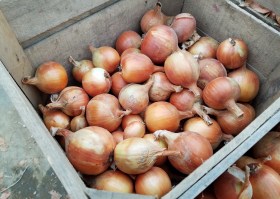
This week I hope to finish the onion trimming work and move on to what’s next. The presidential election is sucking up oxygen, so dealing with that is out there.
More importantly, what do I want to do next with my remaining years.
I used an on-line life expectancy calculator which determined I have a 75 percent chance of living past age 80, with an estimated life expectancy of 87 years. If that’s true, there’s a lot of living to do.
It will take a full day, maybe two, to clean up the tangled mess the yard and garden have become. Some time — not too much — must needs be spent learning to choose my occupations wisely.
SOLON, Iowa — While Trish Nelson takes a well-deserved break, I will attempt to fill her shoes at Blog for Iowa.
Delegates from the national party conventions dispersed last week and there is a lot to write about. Party and twitterverse aside, the telltale sign the election campaign shifted to a new phase was when a political friend called last Tuesday for help finding lodging for our Iowa Democratic Party organizer.
As politics takes a summer vacation in August for most Iowans, I want to cover as much ground as I can, and less of what everyone else is posting. Following is part of my storyboard.
I’ll cover each of the four Iowa congressional candidates at least once. This is mostly to learn what I don’t know. My Congressman Dave Loebsack was confident about his chances in the second district when I saw him in July. Monica Vernon is a hard worker and fighter, and the prospects look good for her winning against first term congressman Rod Blum. Jim Mowrer and Kim Weaver are running in the western half of the state, and those races will be informative. These four races are the most important, yet under-covered in the state.
Because of it’s high visibility, I’ll rely on the coverage of others for the U.S. Senate race. As primary winner Patty Judge attempts to upset incumbent Chuck Grassley it is unclear she has the organization to win or that he is truly vulnerable. A campaign operative told me convincing Iowa Democrats Grassley is vulnerable is a key challenge. My reaction when she spoke near my home July 17 was she needs to point out the faults of her opponent less and talk more about Democratic values. Let third parties do the work of calling out Grassley on his many flaws.
Here is an entire month of posting about the presidential contest in four sentences. “Republicans nominated Donald Trump and Mike Pence for president and vice president respectively at their national convention. If they think they are going to win this election solely by demonizing Hillary Clinton they are on crack. I disagree with them on virtually everything so that’s enough said about the mogul and his sidekick. The focus should be winning down-ticket races.”
There will be discussion of the 2020 presidential caucuses during the 2016 campaign and I land in the camp of eliminating Iowa’s first in the nation status. With due respect to Dave Redlawsk, author of Why Iowa: How Caucuses and Sequential Elections Improve the Presidential Nominating Process, the quadrennial presidential caucus should be the first casualty in blowing up the Iowa Democratic Party. I have long believed first in the nation helps Republicans more than Democrats and plan to lay out my case over the next few weeks. Shorter version: Democrats should stop helping Republicans organize in Iowa.
Iowa native Ari Berman posts constantly about the importance of voting rights after Chief Justice John Roberts gutted the Voting Rights Act in Shelby County v. Holder in 2013. What are the challenges to voting rights in Iowa? There has been a lot of posting about the Iowa Supreme Court decision about voting rights for convicted felons. There is more to elucidate.
What else?
At the county fair our group had a corn kernel vote on security issues. Air and water quality were most important to fair-goers’ sense of security by a distance. Forestry management is part of that discussion. People forget the state was once prairie with oak-hickory forests that stood and regenerated for millennia. What is surprising is how slight is the modern role of urban sprawl compared to pressure on forests. I hear almost no one discussing forestry management and its impact on air and water quality yet see farmers tear out riparian buffers on a regular basis to plant a few more rows of corn and beans. This issue needs a voice.
Our government insanely wants to spend more than a trillion dollars re-furbishing our nuclear arsenal. What we should be doing is eliminating it. I’ll share some of the work of my colleagues in International Physicians for the Prevention of Nuclear War during coming weeks.
Nuclear power is on the wane nationally and some attention should be paid to the Palo, Iowa plant. Their permit was extended to 2024, and already there are rumblings at the plant that the “good jobs” there will be going away. It is in Iowa’s best interests to shutter Duane Arnold Energy Center and I’ll explain why.
Lastly, we need an alternative to our industrial food production system. There is a nascent local foods movement, but its rise has not been fast enough. There are substantial questions about local foods sustainability in its present form. Issues like land ownership, creating markets, reducing the use of pesticides, and scalability are all unresolved. If the local foods movement does not work toward solutions, one questions whether it will exist as a distinct entity going forward.
These and other topics will be my summer. I hope readers will follow along as I do my best to make it worth while to return to Blog for Iowa often.
While Europeans vacation in Italy and the South of France, I’ll be writing some 12,000 words on Blog for Iowa. August is neither recess nor vacation for low-wage American workers.
I’ll have a chance to earn a little more money to pay corporations for things we need like fuel, communications, health care and insurance, loans, and electricity. There’s also taxes wanting cash.
It’s been a struggle to earn enough money to pay monthly bills, so if I write as well, my life can correctly be characterized as “struggling writer.”
Not sure I like the moniker.
Yesterday a fellow said I needed a haircut.
“I don’t have the money,” I said.
“Haircuts only cost $15,” he said.
“If you give me the $15, I’ll get a haircut.”
“It’s really about the money?”
“Yes it’s about the money.”
I work in low-wage jobs to understand what people experience. It’s an attempt to be grounded in society and inform my writing. With a comfortable platform, that includes a line of credit and no mortgage, good health, and two working cars, my family has it easier than most.
The main challenge of low-wage jobs has been physical. Assembling kits, selling produce, demonstrating products, lifting bags of bulk commodities, chainsawing trees, and farm work all required standing and use of upper body strength. I’m stronger than I was, but my aging joints are taking a toll.
Writing jobs have been good when I could get them. There was little money in freelancing while the newspapers sought to do more with less. I filled a specific need for editors, and once the need went away, so did the offer of stories.
In August I’ll post my articles on Blog for Iowa, then here a day later. This site is home for my writing, so most everything I write longer than 140 characters finds its way here.
A new writing adventure begins and I’m so looking forward to it.
My work as fill-in editor at Blog for Iowa begins in three weeks.
It has been easy to fill a story board with post ideas. What’s hard is picking what matters from flotsam and jetsam in a sea of social media.
A goal of Blog for Iowa is to “harness the power of the Internet to continue to build our Iowa grassroots communication network.” Our blog has its roots in the 2004 Howard Dean campaign, which innovated use of the Internet to organize and raise money in politics. Internet use has evolved since then with most news outlets having a presence. I don’t think we had today’s social media — Twitter, Facebook, Instagram, Snapchat and YouTube — in mind ten years ago.
That social media would be a source of stories is still new, but has gone mainstream. Often the stories I read in our local newspaper have their roots in an Internet discussion. If a person wants to write a decent blog post, at least one toe should be dipped in life to be grounded in reality. It would be better to immerse oneself totally in life and eschew the Internet as a primary source of stories.
To the extent writers do this, their work is more readable and that’s what I hope to accomplish in 23 posts this August.
The topics will be familiar. Publicize the campaigns of candidates for election to congress; the presidential election campaign; climate change; the local food movement; nuclear weapons modernization; voting rights; civil rights; drug abuse; working poor; and the Iowa legislature quickly fill the slots. The challenge is saying something others haven’t — grounded in conversations that take place in the course of daily lives.
This approach presumes a level of participation in society. The material is there. The trick is to harvest the stories, both positive and negative, without creating unnecessary friction, then tell them.
It can be done and it’s what I have in mind for August.
Supper was a leftover jar of bean soup, sage and cheddar biscuits, and apple crisp from last year’s crop.
It was delicious… an apple joke.
I set my alarm for 4 p.m. to begin two hours of cooking. I also wanted to hear Garrison Keillor’s radio show from Tanglewood. He’s retiring in July.
Keillor lucked into radio.
“Through a series of coincidences, I lucked onto this show, for which I had no aptitude to speak of, sort of like a kid in Port-au-Prince who’s never seen ice becoming captain of the Haitian Olympic hockey team,” Keillor wrote in an email sent Saturday afternoon. “I was never in theater, never sang in public, but I had grown up at the end of the radio era so I had some ideas about how it might sound. I was a plodder, but persistent.”
So did I luck into a pattern of preparing Saturday dinner with A Prairie Home Companion in the background. All of my other favorite Saturday shows on public radio are gone – likely as a result of budget cuts. Soon Keillor will be gone too. New times require new patterns and I’m okay with that.
Saturday’s harvest included a head of cauliflower, carrots, turnips, an onion, two bunches of celery, and lots of kale for the kitchen and to give to library employees. The herb garden is coming along. I didn’t pick basil but will need to soon.
Planting included an acorn squash seedling and some dill, both given to me by a library worker. The Swiss chard seedlings went into the ground, as did some more jalapeno peppers. I planted lettuce where the carrots grew. The overnight thunderstorm provided needed rain.
Turk’s Turban Squash Plant
The harvest was shortly after sunrise. I was out in time to see dew around the edges of the Turk’s Turban heirloom squash plant leaves. It’s as if the leaf was a large moisture collection device, and the drops waiting to get big enough to roll to the ground and provide moisture to the roots. Summer Saturday harvest is becoming one of my favorite times.
After lunch I organized and cleaned the garage, which is to say I put things away, swept the floor and laundered the rags. I decided to leave the bagging attachment on the John Deere for another pass at collecting garden mulch. It’s debatable whether more is needed. It can always be composted if not used.
It’s been a couple of tough weeks in the news, making it difficult to process what’s happened in society. The murders at Pulse Orlando kicked off a series of news cycles that have been enervating at best, at worst a beginning of the end of society as we know it.
There’s a lot to write about. The futile efforts of the U.S. Congress to call attention to gun violence and do something about it, the referendum in Great Britain about whether to leave the European Union, a slate of Supreme Court decision announcements, the peace agreement between the FARC rebels and the Colombian government, and more.
What caught my attention midst the swirl of current events was yesterday’s 140th anniversary of Custer’s last stand during the battle of Little Bighorn in southeastern Montana. During a visit to the battlefield it occurred to me Custer was a fool. The idea the Seventh U.S. Cavalry Regiment could prevail in that open terrain was ridiculous.
Little Big Horn was part of a genocide that began shortly after arrival of Europeans in the west. It found it’s last practical expression 14 years later in 1890 on the Pine Ridge Reservation at Wounded Knee. Leonard Peltier’s case notwithstanding, our war with native populations in the Americas is finished.
The removal of cultures is in many ways the history of the country. We removed native populations, trees and wildlife and called it “settling.” Surveyors laid out a pattern of land use that enabled us to settle the prairie and forget what once was here. Oak-hickory forests, tall grasses and bison as far as human eyes could see have been relegated to special heritage sites. It’s not all been good but it is what we live with.
As rain falls, reminding me to clean the gutters, it’s hard to miss the need to engage in society outside a surveyed lot in Big Grove. To sustain a single life requires engagement in everything around us and many things that no longer are here. At least that’s how I cope with American violence and sustain the will to do something more about it.
I’m as busy as ever figuring out what life is and what my life will be. In August I’ll be filling in for the editor of Blog for Iowa. Regular posting will resume no later than then.
Like the air traffic controller, we can only land one plane at a time. I need to focus on sustainability in a turbulent world for a while.
Click on the tags to read some of my archived posts while you are here. Also consider following me on twitter @PaulDeaton_IA.
That scholars would publish newly found material written by Walt Whitman is not surprising.
In a time where old newspapers are being digitized and new methods of scholarship seine existing publications like factory ships trawl the Bering Sea, Whitman’s voluminous work shows up.
My relationship with Whitman is comprised mostly of the 1983 visit my wife, her brother, and I made to Whitman’s home in Camden, N.J. It is a simple place, much neglected over the years. By then it was restored to be a fitting remembrance of his last days. It is the only home Whitman owned.
Whitman’s Last Home
It was easy to imagine supplicants waiting downstairs for their turn to meet with Whitman in his parlor/bedroom up the narrow stairway. More than the host of American writers who preceded him, Walt Whitman was tangible, with footprints in society. He left them everywhere.
I hope to return to reading Whitman’s work, even this newest publication.
Yet there is so much to do and take in — and even in good health, life is short. Nonetheless, a new Whitman book is news, and in the digital age, it is available for free to anyone with access to the internet. A type of democratization Whitman may have appreciated.










 Journey Home
You must be logged in to post a comment.