It’s funny how when one gets all the information the picture looks different.
Since I complained about the purchase of Dick Schwab and Katherine Burford’s property using conservation bond money after partial information was leaked via our local newspaper, I wanted to get back to you now that the purchase has been made public.
The fact Burford/Schwab donated the developed portion of the property mitigates my concern about how bond money is being used. In fact, because of that, the plan, as explained in the Press Citizen, complies with what I said in my March 7 email. “I hope and expect you to vote no on the acquisition of this property using conservation bond money.” My concerns are rendered moot because of the donation.
On reflection, this decision was a good one for which the board should be commended. It is also consistent with conversations I have had with Schwab about how he planned to dispose of his property.
While I continue to be dissatisfied by the partial leakage of information, I have no beef with you.
Thanks for your service on the board of supervisors.
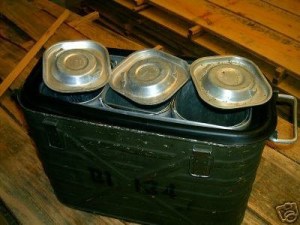
I first drank coffee in the Army… on top of a hill… during the dead of winter… from a mermite can.
Steam rising from the lid proved irresistible when ambient temperatures were below zero and we had just slept on the ground. What else were we going to do but drink coffee? It was there.
We each have a personal history of drinking coffee. I asked one of the greenhouse seeding crews if they remembered their first cup. Some had specific memories, others did not. For me, it was the windy hill in Germany back in 1976.
Coffee was first discovered in Ethiopia in the 11th Century and spread throughout the temperate zones of the planet. It is currently being grown in more than 60 countries. Brazil, Vietnam, Columbia, Indonesia and Ethiopia are the largest coffee producers by annual export weight. Coffee has become ubiquitous as any foodstuff can be.
Making Coffee
The sources of our coffee are under pressure because of climate change. Yields are declining in part because a warmer atmosphere holds more water vapor, creating unseasonable and extreme weather events. Likewise, warmer temperatures expanded the range of the coffee berry borer. Coffee rust is a detrimental fungus increasing its range as the planet warms and winters no longer kill it off in mountainous regions where coffee grows. The impact of global warming caused climate change is not trivial.
We would like to drink a cup of Joe without worry. When we go to the warehouse club there is a long, abundant aisle of coffee produced all over the world. A cup of coffee continues to be affordable at restaurants. It hardly seems like a problem. It isn’t… at least not now.
The science of global warming is virtually undisputed. What seems less certain is how it will impact our personal lives going forward. The Earth’s ecosystem is complex and specific regions have had different issues. We’ve had our share of droughts in Iowa, but there has also been enough rainfall to produce crops. Some days it seems the only persistent idea about Iowa’s climate is that rain remains. When it comes to coffee, what happens six inches in front of our noses is not as important as the global environment in which humans live.
There’s the rub.
With the 2016 election of a Republican to the White House, all eyes are diverted from our most pressing problems. Challenges to the study of climate change is one of those pressing problems and not only because I may be deprived of my daily cup of coffee.
The administration walked away from policy decisions we’ve made to reduce greenhouse gas emissions. It is cutting funding for climate research. It is censoring and targeting government scientists. One could reasonably say the government under Republicans has abandoned science as a consideration in policy-making.
As Americans, we know what to do. We must repudiate the direction Republicans are taking our society by voting them out in the 2018 and 2020 elections. I’d rather linger over my morning coffee than get involved in politics again. However, personal political engagement is the price of a livable future.
“Good navigators are always skeptical, not of the presences of things, but of what they see and understand. Good navigators are almost always lost.” ~Robert Finley
Green up has begun and everything seems ready to pop — even if it isn’t.
My usage of “green up” comes from the 1936 film The Trail of the Lonesome Pine,” in which June Tolliver said, “I ain’t marrying till green up,” delaying pending nuptials between her and cousin Dave Tolliver until after hog killing time. Waiting until green up is cause to delay not only weddings, but needed chores, engagement in society, and anything and everything until ambient temperatures warm and spring is in the air. It’s a lame excuse but we keep hoping it will work out after green up.
Demands on my time increased as tenure as a full-time employee at the home, farm and auto supply store draws to a close in seven days. If I’m lucky, and only partly as a result of planning, the most important things will fall into place. There’s also a lot not planned.
I hope to transform how to look at the world. Beginning March 18, my worklife will devote 56 hours each week to writing, food ecology and paid work. It’s a lot but I hope to increase that to 80 hours or more. Will determine if that’s possible in the process.
What I know is there’s much left to accomplish. That said, I don’t keep a bucket list. When young I meticulously kept a to-do list which helped my rise to a middle level of performance and productivity. The to-do list was always there, and rarely did I remove something without addressing it. I use no such device any more. I eschew lists. I abhor them. I can live my life without them and will.
What I hope is to continue to evaluate what and how I see in the world. It’s an imperfect process, one that requires attention and energy. Like green up it’s a path toward life’s potential. As June Tolliver found in the film, the unexpected can come into view. We must break the cycles of tradition and habit in order to see it.
Your vote on the acquisition of Dick Schwab’s property will make it easy for me to determine for whom to vote in this year’s June primary and who to support going forward.
I know the property involved better than most and have worked and spent time with Dick there. In my discussions with him he made it clear he would donate the property to what is now the Bur Oak Trust. I don’t know what changed his mind, but it is human to reap a profit and I’m not surprised he seeks a buyer as he makes his exit from Johnson County.
Maybe I misunderstood his intent. I’m human too.
It is not clear what portions of his property are included in this transaction, as I just found out about it in the newspaper tonight. It isn’t clear what exactly is proposed.
The fact is what I know of this property is well developed and does not seem a good use of the limited conservation bond funds set aside. I hope and expect you to vote no on the acquisition of this property using conservation bond money.
I don’t usually weigh in on your activities, but this one is important enough for me to do so.
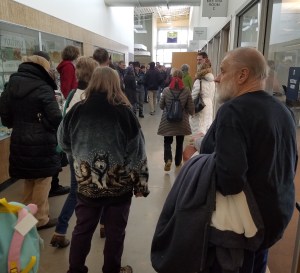
Democratic Committee Volunteers Meeting in North Liberty, Iowa
In September I asserted we should be working to stop nuclear weapons and protect the environment. A year into Trump’s first term it’s clear I understated this need.
The Trump administration rolled out it’s nuclear posture review and oh brother. Obama was bad enough with the $1 trillion modernization plan he negotiated with Arizona Senator Jon Kyl to get the New START Treaty ratified. Our new president is off the charts mad regarding the nuclear complex, or as Rolling Stone‘s Matt Taibbi described him, “insane and ignorant.” There’s a lot to do to resist.
On the environment, it’s as if the Trump administration handed the keys to the front door to the wolves who have been howling and trying to get inside where we live. Ryan Zinke at Interior has reduced the size of some national monuments to make way for exploitation of oil and gas deposits; Scott Pruitt at the Environmental Protection Agency seeks to roll back regulations that protect us to loosen the regulatory chains he claims bind business; Rick Perry at Energy seeks to change the paradigm of growing renewable energy resources to one of increasing stockpiles of coal, oil and uranium. The plan was preconceived and executed with dizzying speed.
What to do to resist?
The focus has to be on electing Democrats in the 2018 midterm elections. Reason doesn’t matter to the Trumpkins. They understand political power. All efforts for the next eight months should be toward re-taking the U.S. Senate and/or House of Representatives, and to make inroads in the state of Iowa by electing a Democratic Governor and re-taking the house or senate or both.
It’s really that focused, that simple. Will a Democratic government get us what we want? The Obama administration nationally and the Culver-Judge administration in Iowa stand as examples it won’t. Regaining political power will re-establish our dominance and hold the wolves at bay, and that may be the best we can hope for this year.
It would be something positive in a government currently overrun with pirates seeking to loot the treasury and pillage the commons. As a society we can do better than this. We must pick our battles carefully and from today’s vantage point there is a lot to bring us together to stem the tide against reason. Nuclear abolition and protecting the environment are both worth our efforts. There are broader currents to bring us together during this election cycle.
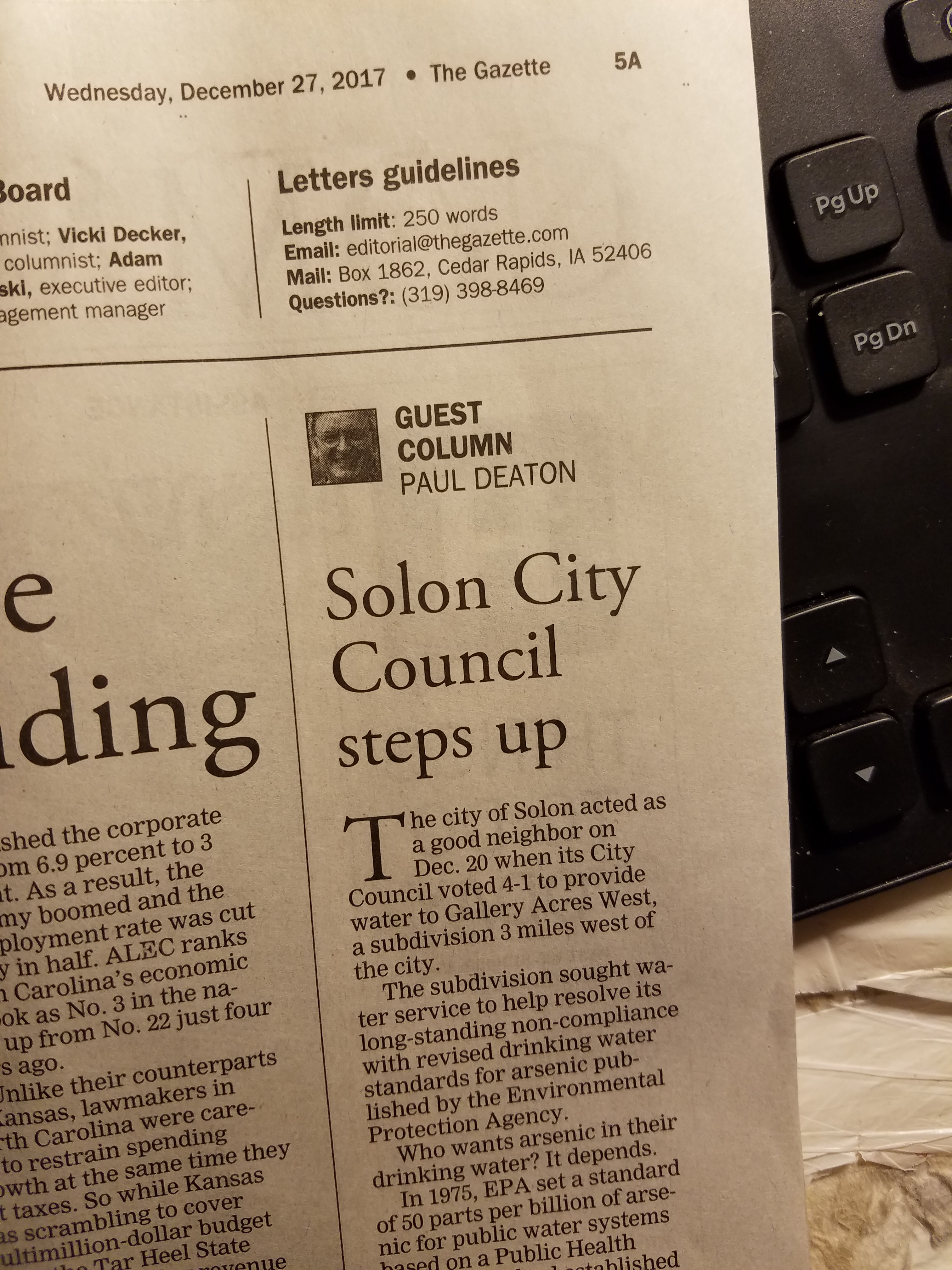
The City of Solon acted as a good neighbor on Dec. 20 when its city council voted 4-1 to provide water to Gallery Acres West, a subdivision three miles west of the city.
The subdivision sought water service to help resolve its long-standing non-compliance with revised drinking water standards for arsenic published by the Environmental Protection Agency.
Who wants arsenic in their drinking water? It depends.
In 1975, EPA set a standard of 50 ppb of arsenic for public water systems based on a Public Health Service standard established in 1942. In 1999, the National Academy of Sciences concluded 50 ppb did not achieve EPA’s goal of protecting public health and should be lowered as soon as possible to allay long-term risks of low level exposure to arsenic.
EPA now has a goal of zero arsenic in public water systems however the goal is not technically feasible. The agency acknowledged there is a trade off between the cost of removing arsenic and its public health benefits.
“After careful consideration of the benefits and the costs,” an EPA fact sheet issued in 2001 said, “EPA has decided to set the drinking water standard for arsenic higher than the technically feasible level of 3 parts per billion (ppb) because EPA believes that the costs would not justify the benefits at this level.”
After multiple public hearings, EPA set the rule for arsenic at 10 ppb and public water systems were given five years after the arsenic rule was published to comply.
Some of us who manage public water systems took the new rule seriously and endeavored to comply. Others did not, and that leads us to Gallery Acres West. Their water system had its first violation of the new arsenic standard in 2002, failed to take action to reduce arsenic in their water system, and in 2015 was threatened with legal action by the Iowa Department of Natural Resources to force compliance.
During an Oct. 30 telephone call, I asked Mark Steiger, president of the Gallery Acres West home owners association, why they had not complied with the 2001 arsenic rule. He told me it was the cost of compliance. With only 14 homes in their association compliance would run thousands of dollars per household. I get it. As president of a home owners association that managed the same compliance issue for our public water system with 85 homes, it cost us $2,823.83 plus interest per household to upgrade our treatment facility to remove arsenic. In Gallery Acres West’s trade off between the cost of arsenic removal and public health, cost trumped health and residents continue to use drinking water with high arsenic content and will until they hook up to Solon.
The proliferation of development in unincorporated areas raises an issue of the quality of management in home owners associations. There are perceived freedoms in living in a small, insular community away from city life. There is also a cost. Things that could be taken for granted in a municipality require attention and potential action in rural Iowa.
It’s a good thing Gallery Acres West is close to a municipality willing to do their work for them.
~ First published on Dec. 27, 2017 in the Cedar Rapids Gazette
I’m sitting in the back of my pickup truck, the tailgate is down. Gentle summer rain is falling. The tips of my toes are getting wet but I don’t mind. We need the rain.
In Des Moines political parties are holding their conventions. I followed the action on social media, but not closely.
Breeze from the rain is cooling my forehead. It feels quite good. It is much better than working on a computer, or thinking about politics.
This afternoon I tried pulling weeds in the garden. The ground was so dry they broke off at the surface. Now, after this long gentle rain, the roots should loosen and weeding be done more easily.
Wind is blowing from the west and my knees are getting spattered with rain. I still don’t mind.
Dozens of birds are out in yards around the neighborhood. They don’t mind rain either. All of nature seems to welcome the rain.
Lightning and boomers are starting to roll in. The rain continues to fall gently and steadily.
Some nights it is best to just listen to the rain, and so I will tonight.
Today is the first day of shotgun deer season. Until Dec. 17 Iowa shows its culture in tradition-laden, bloody and violent detail.
The deer population needs culling. The damage they do in nature and on farms goes mostly unnoticed by city dwellers. The closer one lives to the land, the more empathy there is with the deer hunt. My solution to deer over-population — re-introducing wolves — is not going to fly where cattle, hog and chicken producers and ranchers live.
Roughly a third of Americans say they or someone in their household owns a gun, according to PEW Research Center. Estimates vary but there is about one gun for every man, woman and child in the United States. Given that reality, hunting serves a purpose to promote education, safe gun ownership, and proper handling of firearms. Gun ownership rates have been in decline since the 1970s.
I encountered a herd of deer on my way back from the home, farm and auto supply store last night. I’m pretty sure they sense what is coming. Many of my colleagues at the store are deer hunters. In some cases, husband and wife hunt together and mount their trophies side by side in the living room. Last year’s Iowa deer harvest was reported by hunters as 101,397, a typical year.
Iowa’s hunting culture seems sane and a bit reassuring against last week’s tumultuous news cycle. Opening the Twitter app on my smart phone was like viewing a portal directly to hell. Reading this week’s news stories was like drinking from a fire hose that left me ragged and didn’t suppress the hellfire. I felt thirsty for more after each Twitter session.
Given that, what to write about?
Despite what’s been in the news ad nauseum (Republican Tax Bill, Flynn flipping in the Mueller probe; emoluments investigation; U.S. boycott of the Nobel Peace Prize award ceremony; Interior Department selling vast seams of coal from national monuments for $0.41 per ton; EPA discarding Obama era rules requiring mining companies to fund cleanup from hard rock mining) the story that stuck with me is related to how we can change all the junk we see. Elections still matter and the 2018 election matters a lot.
Brent Hayworth, reporter for the Sioux City Journal, wrote about a Nov. 30 meeting of 110 Democrats from South Dakota, Iowa and Nebraska held in Sioux City.
“Let’s do something and not just have lunch,” Linda Smoley, chairwoman of the Siouxland Progressive Women said. The group worked on strategy to turn out voters during the 2018 election.
Iowa Democratic Party Chair Troy Price attended the meeting.
“They said we would never win again, we could just go out to pasture,” Price said. “Democrats do what we always do — when we get knocked down, we get back up.”
This verbiage could have happened at any Democratic meeting after a tough election. Here’s what made the difference:
“In Iowa,” Hayworth wrote, “Price said a lesson from the 2016 election was the so-called coordinated campaign, where candidates tap the state party for help, ‘has not been working, it has been too top down.'”
This was a key learning experience for me during past campaigns. Price acknowledging it, and potentially doing something to change our political campaigns, validates the idea Iowa Democrats must and will find a new path forward to regain control of elected offices currently held by Republicans.
Good news during a hellish week. Better news than I expected.
Group of captured Allied soldiers on the western front during World War I representing eight nationalities: Anamite (Vietnamese), Tunisian, Senegalese, Sudanese, Russian, American, Portuguese and English. Photo Credit – Library of Congress
Most of Armistice Day was at home.
The forecast had been rain, however, a clear fall day unfolded and I planted garlic. Pushing cloves into the ground with my thumb and index finger, I made two rows and covered them with mulch retrieved from the desiccated tomato patch. It doesn’t seem like much, it’s my first garlic planting ever. If it fails to winter I have plenty of seed to replant in the spring.
Had I been more prescient about the weather I would have spent more time outside: mowing, trimming oak trees and lilacs, clearing more of the garden, and burning the burn pile. Neighbors were mowing. The mother of young children piled up leaves from the deciduous trees at the end of a zip line portending great fun. Instead, I spent the morning cooking soup, soup broth, rice and a simple breakfast.
Leaves of scarlet kale were kissed by frost leaving a bitter and sweet flavor. I harvested the crowns and bagged the leaves to send to town for library workers. Usable kale remains in the garden. It will continue to grow with mild temperatures. Leaves of celery grow where I cut the bunches. There is plenty of celery in the ice box so I didn’t harvest them and won’t until dire cold is in the forecast. An earlier avatar of gardener wouldn’t have done anything in the garden during November.
I picked up provisions at the orchard: 15 pounds of Gold Rush apples, two gallons of apple cider, two pounds of frozen Montmorency cherries, packets of mulling spices and 10 note cards. Sara, Barb and I had a post-season conversation about gardening, Medicare and living in 2017.
The morning’s main accomplishment was clearing the ice box of aging greens by producing another couple gallons of vegetable broth. I lost count of how many quart jars of canned broth wait on pantry shelves. For lunch I ate a sliced apple with peanut butter.
We live in a time when favorite foods are under pressure from climate change. Chocolate, coffee and Cavendish bananas each see unique challenges from global warming. In addition, recent studies show the higher concentration of carbon dioxide in the atmosphere is reducing the nutrient value of common foods. Our way of life has changed and will continue to change as a result of what Pope Francis yesterday called shortsighted human activity. He was immediately denounced in social media by climate deniers.
This week, Congressman Ron DeSantis (R-FL) introduced the HERO Act which purports to reform higher education. Specifically, the bill would open up accreditation for Title IV funding to other than four-year colleges and universities. In an effort to break up the “college accreditation cartel” DeSantis would keep current Title IV funding but add eligibility for other post K-12 institutions. States could accredit community colleges and businesses to be recipients of federal loans for apprenticeships and other educational programs.
Telling in all of this is that as soon as he introduced the bill, DeSantis made a beeline for the Heritage Foundation for an interview about it with the Daily Signal. Does higher education funding need reform? Yes. What are Democrats doing to effect change in higher education? That’s unclear. A key problem is progressives don’t have a network of think tanks and lobbying groups funded by dark money to counter the HERO act or the scores of other conservative initiatives gaining traction in the Trump administration.
Even though the 45th president seems an incompetent narcissist, the influence of a conservative dark money network within his administration is clear: in appointments to the Supreme Court and judiciary; in dismantling the Environmental Protection Agency, in undoing progress in national monuments and parks, in weakening the State Department, in potentially politicizing the 2020 U.S. Census, and much more. The reason for his success is his close relationship with wealthy dark money donors and the agenda they sought to implement since World War II.
Today is the 39th anniversary of my return to garrison from French Commando School. I returned with a clear mind, physically fit, and an awareness of my place in the world.
“I am ready to experience the things of life again,” I wrote on Nov. 12, 1978. “The time at CEC4 has cleansed me of all things stagnant. I will pursue life as I see it and make it a place where I pass with love and peace for all.”
We work for peace on the 99th anniversary of the Armistice. If people are not unsettled by evidence of climate change and a Congress that ignores it in favor of pet projects designed to please the wealthiest Americans, we haven’t been paying attention. The need to sustain our lives in a global society has never been clearer.
Water is life. We take its quality for granted if the source is a public water system.
Consumers rely on drinking water standards developed by the U.S. Environmental Protection Agency and enforced by the Iowa Department of Natural Resources. Where we live municipalities do a good job of compliance with drinking water standards. There are few standards for private wells and the experience is uneven at best in unincorporated areas with public water permits.
In January 2001 the U.S. Environmental Protection Agency issued a reference guide for compliance with the new standard for arsenic in public drinking water, reducing the allowable amount from 50 parts per billion to ten.
Arsenic is a naturally occurring element in many water systems. Neither number in the range seems like much, and at 10 ppb it isn’t. Public water systems have been required to comply with the new standard and if EPA persists in enforcing the new standard, all public water systems should be in compliance eventually.
Not so with private wells where testing and compliance is voluntary. A study published this month in Environmental Science and Technology estimates about 2 million people in the Unites States drink water from private wells with arsenic concentrations exceeding 10 ppb.
The change, initiated during the Bill Clinton administration, took time to develop and more time for communities to implement. The idea was to bring the United States into compliance with the World Health Organization standard for arsenic in drinking water. There are currently communities where the public water system does not meet the new arsenic standard, including one that has been the source of news here in Big Grove. Hopefully they are all working on complying.
There have been at least two deaths caused by cancer among the 85 homes on our public water system. Whether this experience is or isn’t connected to historic arsenic levels is a question that hasn’t been asked. I’m not sure of the merit of asking it, although there are studies with evidence supporting such a connection in larger communities. It is also unclear whether two deaths from anything would be statistically significant in a population of 300. In any case, our public water system has been in compliance with arsenic standards since the new treatment facility was brought on line more than ten years ago.
I doubt many home buyers look at public water or sewer records when considering buying a home even though the data is easily available on line. The proliferation of development in unincorporated areas raises an issue of the quality of management in home owners associations. The arsenic compliance experience demonstrates it is uneven at best.
People seek to escape municipalities. Gasoline remains inexpensive relative to average household income and there are perceived freedoms in living in a small, insular community away from city life. Commuting to a job within an hour’s drive from home is common in Iowa. There is a cost. Things that could be taken for granted in a municipality require attention and potential action in rural Iowa. Who has time for that?
The presence of arsenic in ground water is just one example of the issues of living in an unincorporated area. In a culture of affluence, the quality of water does not often come to the forefront. When it does there is a perception that money and technology will resolve it. That’s mostly true but it requires our engagement, something many people are unwilling to give.
It’s part of sustaining a life in a turbulent world.






 Journey Home
You must be logged in to post a comment.