Categories
Living in Society Sustainability

Letter to Elected Officials on the Iran Deal

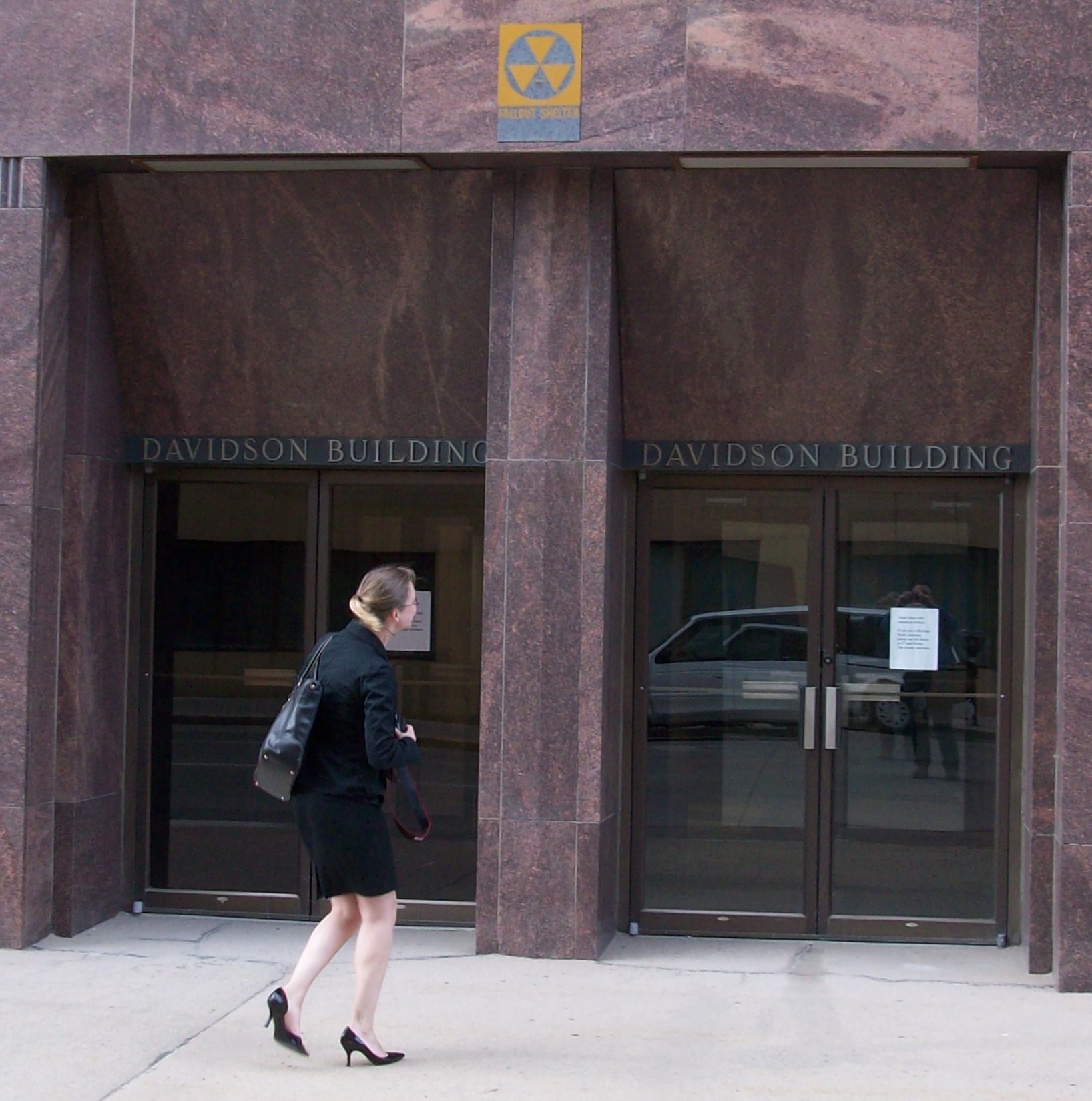
Photo Credit: Des Moines Register

The following message was sent to Senators Joni Ernst and Chuck Grassley, and to Congressman Dave Loebsack:

I urge you to protect and support the 2015 nuclear agreement between Iran and the P5+1 nations. Please refrain from any actions that would undermine it and encourage your Senate colleagues to do likewise.

I understand President Trump is expected to declare the Iran Deal is not in the U.S. national interest and withhold re-certification before the Oct. 15 deadline. If he does so, he would increase the threat of nuclear proliferation in an already dangerous world.

Four brief points:

1. A deal is a deal. There is no realistic option for renegotiating the current agreement, which is working effectively to block Iran’s pathways to a nuclear weapon.
2. Congress should not re-impose nuclear-related sanctions so long as the International Atomic Energy Agency confirms Iran is meeting its commitments under the agreement.
3. President Trump should focus on solving the North Korean nuclear crisis rather than provoking a proliferation crisis with Iran.
4. The administration should also focus efforts toward strengthening the Iran/P5+1 agreement with our international partners.

Thanks in advance for considering my message. Good luck with your deliberations on this complex topic.

Regards, Paul

Response from Senator Joni Ernst on Oct. 25, 2017:

Dear Mr. Deaton,

Thank you for taking the time to contact me about the Joint Comprehensive Plan of Action (JCPOA), commonly referred to as the “Iran deal.” It is important for me to hear from folks in Iowa on policy matters such as this.

On July 14, 2015, the Obama Administration announced they had reached a final deal with Iran on its nuclear program. At the time, I expressed concern that this agreement, which was reached as sanctions were crippling the Iranian economy, capitulated to Iran’s demands and threatened the security of the United States and our allies.

Overtly, the Iranian regime continues to exploit loopholes in JCPOA to advance its ballistic missile capability. Covertly, Iranian weaponization efforts are unknown, as military leaders have stated publicly they will refuse to allow International Atomic Energy Agency (IAEA) inspections of their sites. All the while, sanctions relief has fueled Iran’s support for its terrorist organization proxies engaged in malign activities in Iraq, Syria, Lebanon, Yemen, Afghanistan, and elsewhere – places where these groups are engaged in direct combat with American service members or our partners. Indisputably the JCPOA failed to meet its requirements to appropriately and proportionally contain Iran’s nefarious activities – the original purpose of the agreement.

As you may know, President Trump decided not to certify the deal under the Iran Nuclear Agreement Review Act on October 13, 2017. This action does not withdraw the U.S. from the JCPOA, but rather, it provides an opportunity for Congress to work with the Trump administration and our allies to fix the failures of the original agreement. I support the president’s decision and believe we will maintain a position of global leadership by upholding our obligations, while finally beginning to hold Iran accountable for not meeting the expectations of the international community.

I look forward to working with the Trump administration, my congressional colleagues and overseas partners to formalize a strategy that prevents Iran from obtaining a nuclear weapon and protects American interests. Feel free to contact my office with any further information, as I always enjoy hearing from Iowans.

Sincerely,

Joni K. Ernst
United States Senator

Response from Senator Chuck Grassley on Nov. 8, 2017

Dear Mr. Deaton:

Thank you for taking the time to contact me with your concerns. As your senator, it is important to me that I hear from you.

I appreciate hearing of your support for maintaining the Joint Comprehensive Plan of Action (JCPOA), otherwise known as the Iran nuclear deal. First, I’d like to take this opportunity to discuss the tenants of the Iran nuclear deal and why I have been against it from the beginning.

On April 2nd, 2015, President Obama and Secretary of State John Kerry announced the parameters for a potential deal with the Iranian government to end the country’s nuclear enrichment capabilities and attempts to obtain a nuclear weapon.

President Obama and Secretary Kerry both made important statements about the goal of negotiations leading to the conclusion of the JCPOA – the goal was to dismantle Iran’s nuclear program. Secretary Kerry himself said, in the fall of 2013, that Iran has “no right to enrich” and that a good deal with Iran “would help dismantle its nuclear program.”

In reality, the deal has failed to achieve its key objective of a denuclearized Iran. This deal, as it stands, puts Iran in a position of strength – economically and militarily – from which to further destabilize the Middle East.

The nuclear deal granted Iran a series of continuous sanctions relief in exchange for a reduction in nuclear enrichment capabilities while requiring the access of international inspectors to certify the country’s compliance with the deal’s terms. However, although the United States has granted Iran sanctions relief upwards of $160 billion dollars, the architecture of the agreement only requires Iran to temporarily reduce its nuclear weapons program. This temporary reduction in activities grants massive sanctions relief to a country which could ultimately decide to pursue its threatening activities once the agreement’s sunset clauses expire without any additional punishment.

Despite assurances that the deal would include “anytime, anywhere” inspections, the Obama administrated negotiated away from these provisions and provided Iran with a 24-day inspection delay following an announcement from International Atomic Energy Agency (IAEA) investigators of intent to inspect a site. Furthermore, the IAEA has not been able to conduct adequate inspections of Iranian Military sites where nuclear research is conducted. To a large extent, this deal requires the United States to accept, without good reason, that the Iranians are engaged in a good faith effort to not cheat.

On May 7th, 2015, the Senate passed the Iran Nuclear Agreement Review Act by a vote of 98-1 which provided an opportunity for Congress to express its approval or disapproval of the deal. Despite 98 Senators voting in favor of reviewing the agreement, a minority of Senators lead by then minority leader Senator Reid, voted to block debate, consideration and a vote on a resolution of disapproval.

Following the JCPOA’s implementation on January 16th, 2016, Iran has continued to engage in a number of activities violating key provisions of the agreement. Most notably, these include cheating on provisions requiring the country to limit its nuclear enrichment activities through centrifuge development, prohibitions on research technology procurement, and not adhering to limitations on the amount of heavy water that the JCPOA sets forth for Iran’s nuclear reactors.

On October 13th, 2017, President Trump announced his decision to decertify the JCPOA. President Trump asserted that the JCPOA does not address the full range of potential threats posed by Iran, or permanently ensure that Iran cannot develop a nuclear weapon. In short, Iran is not living up to the spirit of the deal and that continued sanctions relief provided to Iran is not “appropriate and proportionate” to the measures taken by Iran to terminate its illicit nuclear program.

President Trump’s decision to decertify the Iranian nuclear deal is in full accordance with the statutory requirements imposed on the deal by Congress under the Iran Nuclear Review Act. Under the Iran Nuclear Review Act, the President is required to recertify Iran’s compliance with the JCPOA every 90 days. The Iran Nuclear Review Act provides Congress 60 days to consider whether to re-impose sanctions waived under the JCPOA and or to modify the deal to ensure Iran’s compliance.

The United States has not formally withdrawn from the Iran nuclear deal. Rather, President Trump’s decision to decertify the deal now puts the onus on congress to address the shortcomings of the deal. Iran continues to be the world’s leading state sponsor of terrorism, and President Trump is right to point out the failings of the deal. I look forward to working with my colleagues to further curtail Iran’s dangerous and destabilizing behavior.

Rest assured, that as your senator I will continue to follow these developments.

Again, thank you for taking the time to contact me. Please keep in touch.

Sincerely,

Chuck Grassley

Response from Congressman Dave Loebsack on Nov. 2, 2017

Dear Mr. Deaton,

Thank you for contacting me about the Iran Nuclear Agreement, also known as the Joint Comprehensive Plan of Action (JCPOA). Your opinion is very important to me and my priority is to provide Iowa’s Second District with the best representation possible.

From the beginning, I have made it clear that I believe it is unacceptable for Iran to be allowed to develop nuclear weapons. Today, it is more important than ever that we continue to work towards that commonly held goal and ensure the safety of the American people.

Under the Iran Nuclear Agreement Review Act of 2015 (INARA), the President is required to publicly certify every 90 days that Iran is complying with the terms of the JCPOA. On Friday, October 13, 2017, President Trump announced that he is formally decertifying the nuclear deal with Iran. Decertification does not put the U.S. in violation of the JCPOA, but it does give Congress a 60-day window to reimpose the sanctions that were suspended by the deal.

I believe that the administration should be focusing its efforts on ensuring the conditions of the agreement are being thoroughly enforced. Instead, the administration has chosen to ignore the warnings of the White House’s own national security staff, sow uncertainty, and undermine our national security. I appreciate you reaching out to share your thoughts with me on the importance of the U.S. remaining part of the JCPOA. Please be assured that I will continue to monitor the situation closely, and will keep your thoughts in mind should legislation related to the JCPOA come before the House of Representatives for a vote.

Thank you again for contacting me about this important issue. I encourage you to visit my website at http://www.loebsack.house.gov and sign up for my e-newsletters to stay informed of the work I’m doing in Congress. I am proud to serve Iowa’s Second District, and I am committed to working hard for you.

Sincerely,

Dave Loebsack
Iowa’s Second District
Categories
Home Life Living in Society Sustainability

On Capitol Hill

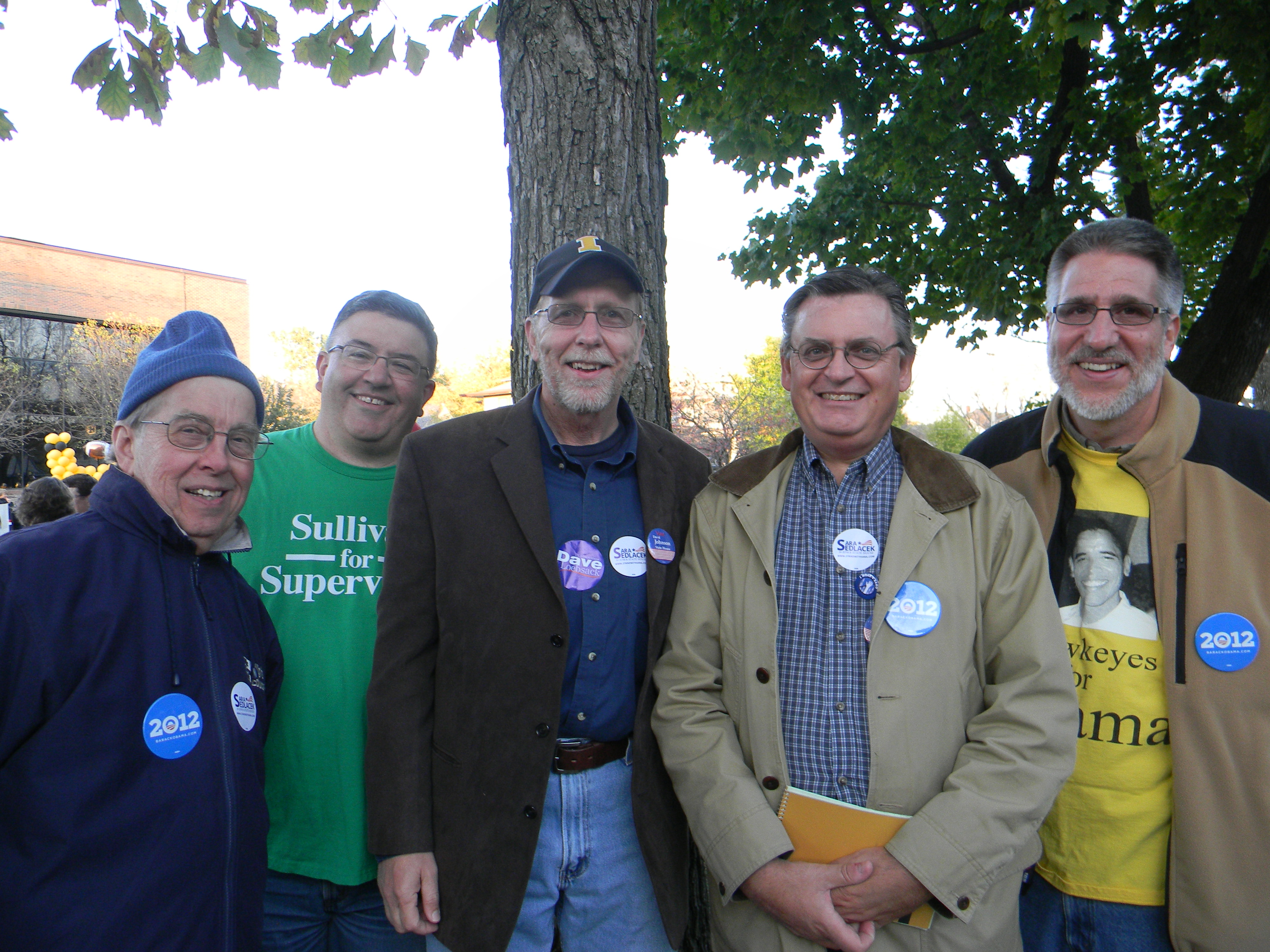
At the U Iowa Homecoming Parade Marshaling Area

Originally posted April 8, 2008. My only meeting with Congressman Dave Loebsack in his office on Capitol Hill.

This morning, I walked to DuPont Circle and took the Metro to the Capitol. The Metro ticket cost $1.65 so that was quite a bargain. I emerged from the station near the Longworth House Office Building where Congressman Loebsack’s office is on the fifth floor. I got in an hour early, so with the help of some construction workers, I located a coffee shop and waited for my appointment. As I walked back to the Longworth Building, there was a haze covering the top of the capitol dome. Tulips were in bloom. I cleared security and located the office.

I was able to meet with the congressman one-on-one. I had a few minutes to talk about politics with him before his chief of staff and legislative assistant joined us. He offered me a seat in his professor emeritus chair from Cornell College. It was cool!

We talked about a number of issues, and I joked that I had a very long list of talking points. He made me feel like we had all the time in the world, and that was also cool.

We talked about the transportation industry, and specifically about the energy policy, or lack thereof as it pertains to class eight vehicles. I explained that using food for fuel was not a sustainable answer to our oil dependence or to high diesel prices. I explained that biodiesel was not a solution for the trucking industry. He asked me if biodiesel was equivalent to food for fuel, and I showed some restraint and said I would get him an answer.

We talked about the California law that regulated particulate emissions in port areas. I asked him to support keeping the federal government out of this dispute between the state and port operators and truckers. I presented information about the health impacts of fine particulate matter from engine emissions on residents living near the ports. He could support the federal government keeping out of this situation. This led to a longer discussion about cutting the rain forests down to plant palm oil and jatropha plantations for biofuels and the related effect of removing capacity to absorb CO2 by doing this. I also gave them suggested reading of Carbon Free and Nuclear Free by Arjun Makhijani.

We discussed the US-India nuclear trade deal that is currently being debated in India. I explained that if this initiative was allowed to go forward, the rest of the world would view this as a form of nuclear proliferation and would set a poor example. He agreed.

We discussed the need to have a surge in diplomacy with Iran by holding talks without preconditions. I believe that if we focus our efforts on discussing preconditions, that no discussions would take place. Whereas if we had discussion and reached impasse, then we would gain respect in the world for having tried.

I asked him to cut all funding for reliable replacement warheads from the federal budget as was done last year. He said he would.

We discussed a number of other issues ranging from food deserts to public health to trucking to politics. It was a great start to the day and a memorable one.

Categories
Environment

September Has Been a Pisser

Backyard Fire After Irma

Last week was stressful as Hurricane Irma passed through central Florida over our daughter’s home.

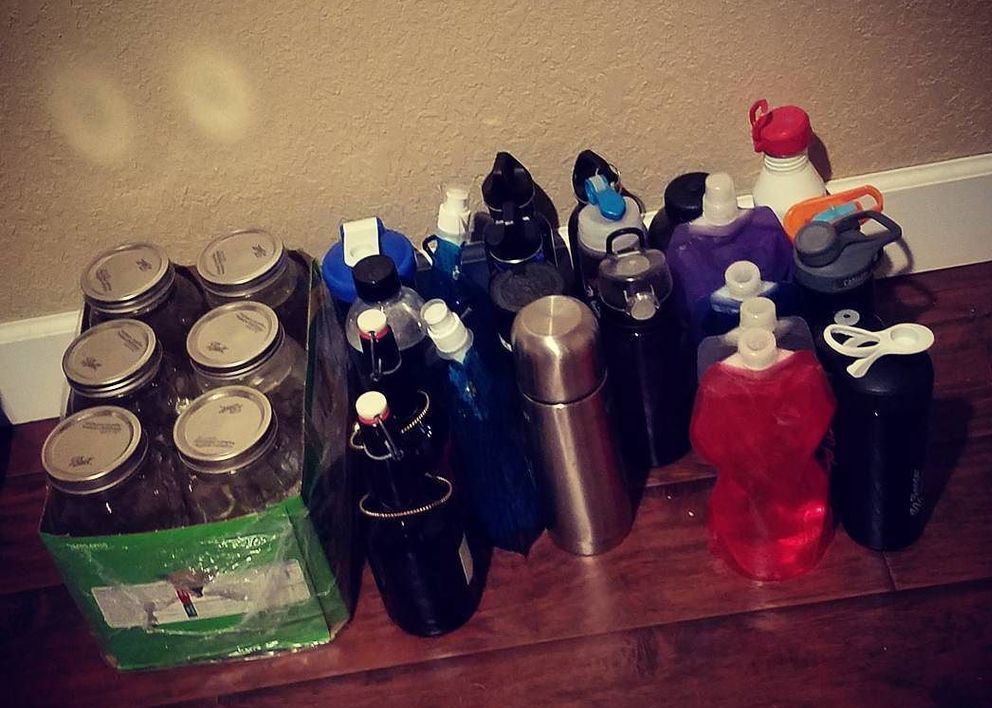
They boarded the windows, sandbagged the doors and laid in water and shelf stable food for when the electricity went out.

“The whole house has been playing Settlers of Catan, which we never get to play enough,” she texted. “Next up is Fluxx, a rules changing card game. The lights have been flickering slightly, but we still have power and water. Every so often, the outside sounds a bit like a car wash.”

She and her housemates weathered the hurricane, suffering minimal property damage. Her final message in the hurricane series was

Stay safe out there. If anything, I am reminded that everywhere in the US, there is some kind of emergency that can happen. Please, pack a Go Bag, prepare a plan, know where your evac locations are. I love you. Stay safe. Be prepared.

It turns out the previous board of directors for our sanitary sewer district failed to communicate new requirements to comply with ammonia nitrogen standards when they all resigned without notice. I emailed the Iowa Department of Natural Resources to learn more and there is a multi-year process for compliance added to our agenda. Stress level kicked up a notch with this.

The week ground down with efforts to meet my tomato contract. Farmer Kate and I traded my labor for her tomatoes. To finish the deal, I prepared seven quart jars of diced tomatoes each morning and water bath processed them in the evening. The work is not hard but it blocks out other things. A deal is a deal and she met her part of it with an abundance of organic tomatoes. On Friday before work at the home, farm and auto supply store I delivered two cases of canned tomatoes. We each should have plenty to make it until the next tomato season.

At Thursday’s county board of supervisors meeting a zoning application for a farm near here was considered and rejected unanimously. The controversy involves people I know in government and in the local food system. None of it is good for any of us.

“In one respect farming can be considered a tedious series of lawsuits, disputes and legal struggles,” I posted on Twitter. “Versaland bares that for all to see.”

I’m trying to understand the context and situation with more clarity and plan to write a longer post about local food in light of it.

September is always busy so there’s no surprise in any of the week’s activities and developments. Last night a group called the Iowa Faith and Freedom Coalition lavished praise and support for the 45th president. That was a pisser too.

Categories
Environment

Weathering Irma

Water for Hurricane Irma

Friends and family in the path of Hurricane Irma are well-informed of its danger and preparing for the worst this weekend.

Walt Disney World, where our daughter works, closes tonight at 9 p.m. until sometime Monday,  presumably Irma’s schedule as well.

She is working today then hunkering down with supplies of water and shelf-stable food should the electrical grid fail. The open question is how much rain and wind will pelt central Florida.

“It’s not a question of if Florida’s going to be impacted, it’s a question of how bad Florida’s going to be impacted,” William “Brock” Long, administrator of the Federal Emergency Management Agency, said Friday, according to the Washington Post.

Irma maintained wind speeds of over 185 miles per hour for more than a day, the first storm in the world to do so.

Since 2007 I visited Florida several times. Each time people I met at the auto shop, convenience stores, retail outlets and elsewhere spoke of Hurricane Andrew and how it changed their lives. Floridians know hurricanes well. Surviving Irma is the focus for the next three days.

Environmental Protection Administrator Scott Pruitt commented about the link between Irma and global warming:

“Here’s the issue,” Pruitt told CNN Thursday in a phone interview. “To have any kind of focus on the cause and effect of the storm; versus helping people, or actually facing the effect of the storm, is misplaced. What we need to focus on is access to clean water, addressing these areas of superfund activities that may cause an attack on water, these issues of access to fuel. … Those are things so important to citizens of Florida right now, and to discuss the cause and effect of these storms, there’s the… place (and time) to do that, it’s not now.”

The upshot is in a backhanded way, Pruitt acknowledges the need to evaluate causation of large tropical storms. I’m confident facts will lead him to how global warming made Irma and other recent tropical storms worse. I may be overly optimistic but the truth matters.

Our household will be following the progress of Irma as it makes landfall in Florida and over the next 48 hours. Hoping the people of Florida withstand the death, destruction and economic consequences of this next in a series of major storms. I expect Floridians will be resilient as this is not their first hurricane rodeo. I trust our daughter will do what’s needed to weather the storm.

Categories
Sustainability

Hand on the Button

Nuclear Spring in Sioux City

What do U.S. nuclear abolitionists do when the administration has no plans other than vaguely stated goals of “modernizing the nuclear complex” and spending money on a missile defense system that has never been proven to work?

Focus on a long term strategy toward the goal of nuclear abolition, using the United Nations Treaty on the Prohibition of Nuclear Weapons as a hook and the consequences of nuclear war as the message.

It’s a tough row to hoe because the United States and other nuclear states stand in opposition to the ban treaty promulgated at the U.N., now open to signature.

A colleague in the nuclear abolition movement reported July 14 from New York:

The emotional electricity in the room was palpable. Everyone could feel that history was being made in Conference Room 1 at the United Nations headquarters in New York. And when the vote tally came in, it was followed with a roar of approval in the room. Bucking intimidation from the nuclear-armed superpowers, 122 nations voted to adopt the Treaty on the Prohibition of Nuclear Weapons with one vote “no” and one abstention. It’s official: nuclear weapons are illegal!

I’ve never felt hopeful about the ban treaty because President Obama and his successor both indicated they would modernize our nuclear complex, investing more than a trillion dollars. President Trump’s recent statement while taking questions at his golf resort in Bedminster, New Jersey is disappointing on multiple levels.

“We are going to be increasing our budget by many billions of dollars because of North Korea and other reasons having to do with the anti-missile,” Trump said. “As you know, we reduced it by five percent, but I’ve decided I don’t want that. We are going to be increasing the anti-missiles by a substantial amount of billions of dollars.”

Modernization is not really his decision because the Congress must appropriate funds for it. It’s the normal checks and balances designed into our government by the framers of the constitution. However, what is in President Trump’s control is launching a nuclear war within a few minutes at his sole discretion. That can and should change.

Once accepted without vocal opposition, the president having his hand on the nuclear button should be challenged. No president should have sole discretion to unleash a human Armageddon that could end civilization as we know it.

There is chatter in the news media that President Trump won’t complete his full, four-year term. The better bet is he will and will mount a formidable campaign for re-election. Republicans in the Congress won’t impeach, and the 45th president won’t resign.

We shouldn’t be distracted by the hope this presidential term will soon be over. Regardless of who’s president, if the U.S. doesn’t sign on to the nuclear weapons ban, as it currently appears we won’t; if we won’t fulfill our obligation under the Non-Proliferation Treaty to which we are a party; others should be included in any decision to use nuclear weapons.

That change is something nuclear abolitionists can and should work on now.

To learn more, click on Martin Fleck’s report from the UN here.

Categories
Environment Kitchen Garden

Hurricane Weekend

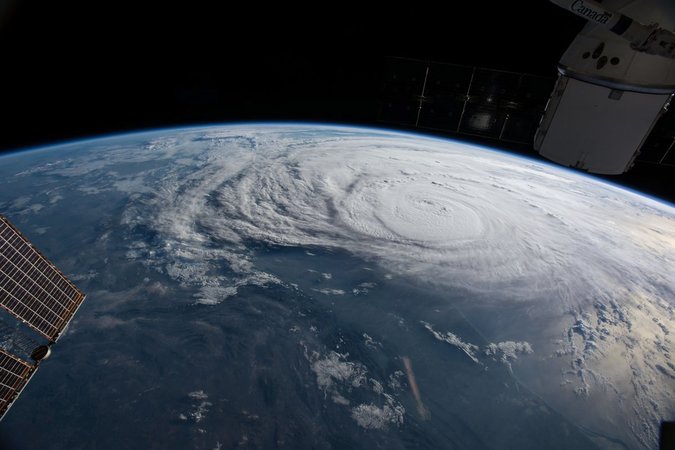
Hurricane Harvey from the International Space Station on Aug. 25, 2017. Photo Credit – NASA European Pressphoto Agency

Rain tapped the bedroom window this morning on the fringe of Hurricane Harvey.

It was a reminder of our connection to the oceans. They are absorbing heat from the atmosphere on a planet experiencing some of its warmest days in living memory. A warmer atmosphere holds more moisture and the result is intense storms like the Category 4 Hurricane Harvey.

In Iowa we adapt easily to hurricanes because of our distance from the coast. Needed rain benefits our gardens and farms. It recharges our surface aquifers. As the weather pattern moved over it seemed normal, not as devastating as it was when Harvey made landfall in Texas Friday afternoon.

Overcast skies and a slight rain depressed attendance at the orchard on Saturday. There were enough visitors to keep busy, especially in the afternoon when the sun came out. Sales seemed steady if light.

One of my favorite August apples is Red Gravenstein, a Danish cultivar. It was introduced to western North America in the early 19th century, according to Wikipedia, perhaps by Russian fur traders, who are said to have planted a tree at Fort Ross in 1811. Red Gravenstein is tart, juicy and crisp — great for eating out of hand.

The cider mill made the first press of apples for the sales barn. The gallon and half gallon jugs sold well. Over the years I’ve come to appreciate the changing flavor of our cider as we move through the apple harvest. I bought a gallon of cider and a dozen Red Gravenstein apples at the end of my shift.

I’ve been reading recipes for tomato catsup in old community cookbooks. After reviewing a dozen or so I went to the kitchen and created this sauce from the abundance of red bell peppers and tomatoes:

Red Pepper Sauce

Ingredients

Half dozen cored and seeded red bell peppers cut in quarters
Equal amount by weight of cored tomatoes one inch dice
One cup of malt vinegar
One teaspoon salt
One tablespoon refined sugar.

Process

Pour the vinegar into a saucepan and bring to a boil.
Add tomatoes and peppers.
Add sugar and salt.
Bring back to a boil and cook for 10-20 minutes until the vegetables are soft.

Strain the mixture. Retain the liquid to use as vinegar in salad dressings.
Run the vegetable mixture through a food mill and either serve immediately or bottle and refrigerate.

Recipe notes

To make a thicker sauce, either reduce it in the saucepan or add tomato paste.
I used malt vinegar because it was on hand. Absent malt vinegar I’d use homemade apple cider vinegar.

Categories
Environment

An Energy Revolution

Image of Earth 7-6-15 from DSCOVR (Deep Space Climate Observatory)

A recent article at Nuclear News reminds us the world is on the cusp of an energy revolution.

“The cost of renewables like solar and cell batteries for electric vehicles are making the carbon-based economy obsolete, with the turning point only a few years away,” author Christina MacPherson wrote.

The age of centralized, command-and-control, extraction-resource-based energy sources (oil, gas, coal and nuclear) will not end because we run out of petroleum, natural gas, coal, or uranium,” Stanford University professor Tony Seba recently said. “It will end because these energy sources, the business models they employ, and the products that sustain them will be disrupted by superior technologies, product architectures and business models. Compelling new technologies such as solar, wind, electric vehicles, and autonomous (self-driving) cars will disrupt and sweep away the energy industry as we know it.

Seba sees oil consumption collapsing after 2020.

I wrote about coal in 2009:

When we consider the use of coal in Iowa, there are many of us who remember the coal trucks plying the streets and alleys of our childhood, dropping loads of the black stuff down chutes leading to a basement coal bin and then to our gravity furnaces. Through the winter, people shoveled coal into burning embers to heat their homes. Coal ash was shoveled out and in the spring, it was tilled it into gardens and spread on fields. Coal ash was also sent to dumps. On the farm, coal was purchased with seeds, feed and grain. It was part of a background to life that did not consider the potential harm to human health we now know it represents.

Those born in the 1950s and before have living memory of how natural gas replaced coal for home heating. The conversion was driven by much lower natural gas cost compared to coal. Similarly, lower costs of renewables will drive the move away from fossil fuels. We are almost at that point, as MacPherson indicated, and the business community is recognizing the reality by investing in renewables.

A recent article by Eva Zlotnicka for Morgan Stanley reiterates this point.

Economics and improving technologies, not regulation, are the driving forces behind many of the sustainability trends in global markets today. Our energy commodities team’s fundamental analysis of power-generation economics shows that longer-term coal can’t compete with natural gas or renewables, even on an unsubsidized basis. In a recent report, the team cut its 2017 coal-burn forecast by  around 4%, and now sees only a modest year-over-year improvement, with most of those gains lost by 2018, due to ongoing competition from natural gas and renewables.

The 45th president made much of reviving the coal industry during his election campaign. The trouble for him is the market is heading a direction that not even he and his fossil fuel friends can stop. He can roll back all the regulations he likes and the market will continue to drive the switch to renewable energy.

Many of us were disappointed when President Trump announced his decision to exit the Paris Climate Agreement. It was all hat no cattle.

There is almost no disagreement in the scientific community that fossil fuel use contributes significantly to planetary warming and related climate change. However, that’s not the point. What gave rise to the Industrial Revolution continues to work, and as renewable energy costs decline and become cheaper than the cost of fossil fuels and nuclear, bankers, manufacturers, and service industries will convert because it makes business sense to do so.

Add the public health, environmental, business and economic value of renewables together and a scenario where energy companies may start divesting themselves of coal and oil operations emerges.

How will the U.S. exit the Paris agreement? 45 didn’t say. Will his administration follow the four-year exit process outlined in the agreement, or will he remove the United States from the U.N. Framework Convention on Climate Change (UNFCCC), exiting in about a year? If the drivers of transformation in our energy system are economic, what whit of difference does his decision make?

The agreement posed no financial risk to the United States, according to Morgan Stanley. It seems doubtful other nations will follow the United States out of the agreement, although some may. The pursuit of the goals in the Paris Agreement by remaining countries, combined with the efforts of U.S. states and cities acting on their own, offer the best chance to reduce carbon pollution in the atmosphere.

Nonetheless, an energy revolution is going on and at this point little politicians do seems able to stop it.

Categories
Living in Society Sustainability

Iran Deal Ad Nauseam

Photo Credit: Des Moines Register

I can’t believe we have to cover this Iran sh*t again.

Point 1: The 45th president doesn’t like the Iran Deal. While he twice certified Iran’s compliance with the July 14, 2015 agreement between Iran, the P5+1 (the five permanent members of the United Nations Security Council—China, France, Russia, United Kingdom, United States—plus Germany), and the European Union, each time his State Department under Rex Tillerson undercut any positives.

“Today I’d like to address Iran’s alarming and ongoing provocations that export terror and violence, destabilizing more than one country at a time,” Tillerson said in April after the first certification. According to Time Magazine, he proceeded to lay out a long list of bad things Iran is doing, from sponsoring terrorism to oppressing its own people to violating U.N. constraints on its missile program. When it came to the nuclear deal, he said it failed to ensure Iran won’t become a nuclear state in the future and said the administration was conducting a “comprehensive review of our Iran policy.”

The comprehensive review was ongoing when Tillerson made the second certification last week. The 45 administration proceeded to impose more sanctions on Iran.

We get it. 45 called the agreement “bad,” “horrible,” “stupidest deal,” etc.

Point 2: There was no question Iran was pushing the limit of the Nuclear Non-proliferation Treaty (NPT). I posted about this March 5, 2010:

The reason Iran is in the news is reasonably straightforward. As signatory of the NPT, Iran has the right to the peaceful use of nuclear technology. The trouble is that in 2003, the International Atomic Energy Agency (IAEA) determined that Iran had not been forthcoming about its uranium enrichment program, as required by the NPT. The IAEA conducted an investigation and their Board of Governors reported Iran’s noncompliance with the NPT to the United Nations Security Council. The Security Council demanded that Iran suspend its enrichment programs. The Council imposed sanctions after Iran refused to do so. When the uranium enrichment facility in Qom was made public in 2009, this heightened awareness of Iran’s apparent belligerence precipitated the current discussions between the parties about further sanctions and/or diplomacy. The corporate media latched on to an easy news story.

Point 3: President Barack Obama chose diplomacy. He initiated discussions about nuclear non-proliferation with Iran. Crazy, no? To actually talk to Iran and engage the European Union and the P5+1 states in the deal. The deal was consummated and is in effect. It stopped Iran’s nuclear program. As 45’s administration indicated with its certification of Iran’s compliance, the Iran Deal is working.

Point 4: While 45 hasn’t fulfilled a campaign promise to dismantle the Iran nuclear deal, he remains deeply suspicious of it according to a Sunday article in the Los Angeles Times. The war hawks in Washington, led by former U.N. ambassador John Bolton wanted 45 not to certify compliance. On its own terms the agreement has accomplished its purpose of preventing Iran from enriching uranium to develop technology to make a nuclear weapon, things of which they were well capable in 2009.

On any given day one might say, “who knows what the hell Trump will come up with?” In a dangerous world we should be thanking President Obama for avoiding war with Iran and stopping its nuclear program, something that can’t yet be said about his successor in the Oval Office.

Categories
Environment

Act On Climate — Scary Edition

Thunderstorm Rolling In

You may have seen David Wallace-Wells’ New York Magazine article titled, “The Uninhabitable Earth.”

It’s a scary article with frightful truths circulating on social media.

Half truths according to Michael E. Mann, director of Earth System Science Center at Penn State. Mann wrote onFacebook:

Since this New York Magazine article (“The Uninhabitable Earth”) is getting so much play this morning, I figured I should comment on it, especially as I was interviewed by the author (though not quoted or mentioned).

I have to say that I am not a fan of this sort of doomist framing. It is important to be up front about the risks of unmitigated climate change, and I frequently criticize those who understate the risks. But there is also a danger in overstating the science in a way that presents the problem as unsolvable, and feeds a sense of doom, inevitability and hopelessness.

The article argues that climate change will render the Earth uninhabitable by the end of this century. Extraordinary claims require extraordinary evidence. The article fails to produce it.

Read Mann’s full take-down here.

If we are clicking on New York Magazine for our information about the threats of climate change then now, more than ever, it’s clear mental health care is needed in whatever healthcare bill Congress passes this year.

Taking action on climate (or anything else) based on fear would be as scary as Wallace-Wells’ article.

On Sunday, Al Gore was in the news about his climate work.

“Those who feel despair should be of good cheer as the Bible says,” Gore told Lee Cowan of CBS News. “Have faith, have hope. We are going to win this.”

The need to act on climate is all around us according to Gore.

“It’s no longer just the virtually unanimous scientific community telling us we’ve got to change,” he said. “Now Mother Nature has entered the debate. Every night now on the television news is like a nature hike through the Book of Revelation. People who don’t want to use the phrase ‘global warming’ or ‘climate crisis’ are saying, ‘Wait a minute. Something’s going on here that’s not right.'”

Gore is right. Don’t despair. Act on climate.

If you don’t know what to do, The Climate Reality Project provides an action kit to get you started. Click here to find it.

Categories
Environment

Exiting Paris – Not the End of the World

Woman Writing Letter

We survived U.S. failure to ratify the Kyoto Protocol to limit greenhouse gas emissions and will survive if Republicans drag us out of the Paris Agreement after the 2020 general election, as was announced June 1 in Washington, D.C.

Make no mistake: it is a disappointment that Republicans plan to exit the agreement.

Outside the symbolism for their political party — which I can only characterize as a finger-involved and not-safe-for-work gesture to the rest of the world — the engine driving greenhouse gas reductions is picking up velocity and will not be stopped by any one person or group.

The United States is not the only country on Earth. 194 countries remain in the agreement as the U.S. joins Syria and Nicaragua as the only states outside it. China, India and the European Union have said they will step up to fill the leadership void the U.S. created by its announcement.

Here’s the bottom line: even without the federal government involved, cities, states, businesses, colleges, and citizens across the US are driving a shift to clean energy and bringing down emissions. Just like the Paris Agreement intended.

With Republicans stepping back, it’s up to the rest of us to step up in a big way and keep this momentum going if we want to protect our environment.

Earth is our only home. Consumerism, irresponsible development, environmental degradation and global warming have negatively impacted where we live.

Our work goes on. The Republican decision to exit the Paris Agreement is not the end of the world. Not even close.

~ Published in the June 8, 2017 edition of the Solon Economist