Categories
Home Life Work Life

Pressing the Limits

Garden Plot with Kale and Peppers

For the first time in a long time I missed work on Wednesday.

After a futile attempt to shave, shower and drive into the home, farm and auto supply store, I called off and slept until 2 p.m. — a total of 19 hours in bed.

I’m back to normal and scheduled four days vacation at the end of the month. If approved, I will use the time to catch up around the house and rest.

I don’t want to admit it, but 100 days of work may have been too much to attempt.

In an effort to understand low wage work life and the exigencies of lives where there is not enough income, I dealt with it as many do by adding more jobs. A predictable conclusion has been it doesn’t resolve the issue.

A key driver in the financial shortfall is buying health insurance, an expense that takes 34 percent of my wages from a full-time job. As the two of us approach Medicare age we’ll see some relief. We’ll also be approaching full retirement and presumably slowing our outside work. I look to my maternal grandmother’s example: she did alterations into her eighties. I expect to be doing something to earn money as long as I’m physically able. My current work on area farms is setting the stage for that.

Trying not to complain, these are observations about a life. In the spirit of Cotton Mather I’ve self-inoculated to see what happens. While believing in unlimited potential of a human, the brief illness is evidence of a physical limit. Knowing one’s limits will make us stronger and hopefully more effective.

We are well into the apple harvest at the u-pick orchard where I spend my weekends. It is an abundant crop and I enjoy interacting with hundreds of apple pickers each day. It is something like a fair, about which Garrison Keillor wrote in the Washington Post this week.

“The Fair is an escape from digitology and other obsessions, phobias and intolerances,” Keillor wrote, “also a vacation from the presidential election which has obsessed many people I know, including myself.”

The lone evidence of politics I spotted at the orchard last weekend was a single too-young-to-vote teen wearing a Trump T-shirt. Discussion of politics was completely absent within my hearing. I don’t know the demographics of apple pickers except from my own observations over the last four seasons. What I’d say is apple culture is an equalizer, something almost everyone with transportation can take part in and one in which I am happy to participate.

For me, it’s about forgetting a life that’s challenging and sometimes too hard for a shift at a time. It’s also about hope that society will find common ground.
Categories
Kitchen Garden

Poblanos, Onions and Pickles

Fermenting Dill Pickles

JOHNSON COUNTY, Iowa — In the margins of time between social engagements lives a local food movement available to all who seek it.

There is inadequate time in life’s span to become an enthusiast, however pursuit of local food culture is not only okay, it can be rewarded with meals that comfort more ways than imaginable.

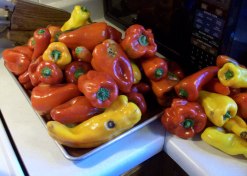
While Jacque was in town with her sister, I made last night’s supper of seconds of poblano peppers and yellow onions from the farm, a couple of links of vegetarian sausage, and a variety of home made pickles.

After removing bad spots from the onions and peppers, I cut them into thin strips and piled them on the cutting board. I cut the sausages on the bias and browned them in a pan. Once finished, I removed them to a paper napkin sitting on a plate and began sauteing the onions and peppers in olive oil, seasoning with a bit of cilantro, granulated garlic, salt and pepper.

While the vegetables were cooking I arranged three kinds of pickles, sweet, dill and daikon radish in a bowl. Once the vegetable mix was finished I spooned it into the bowl beside the pickles and topped it with the cooked sausage. With a glass of iced water, it made a meal.

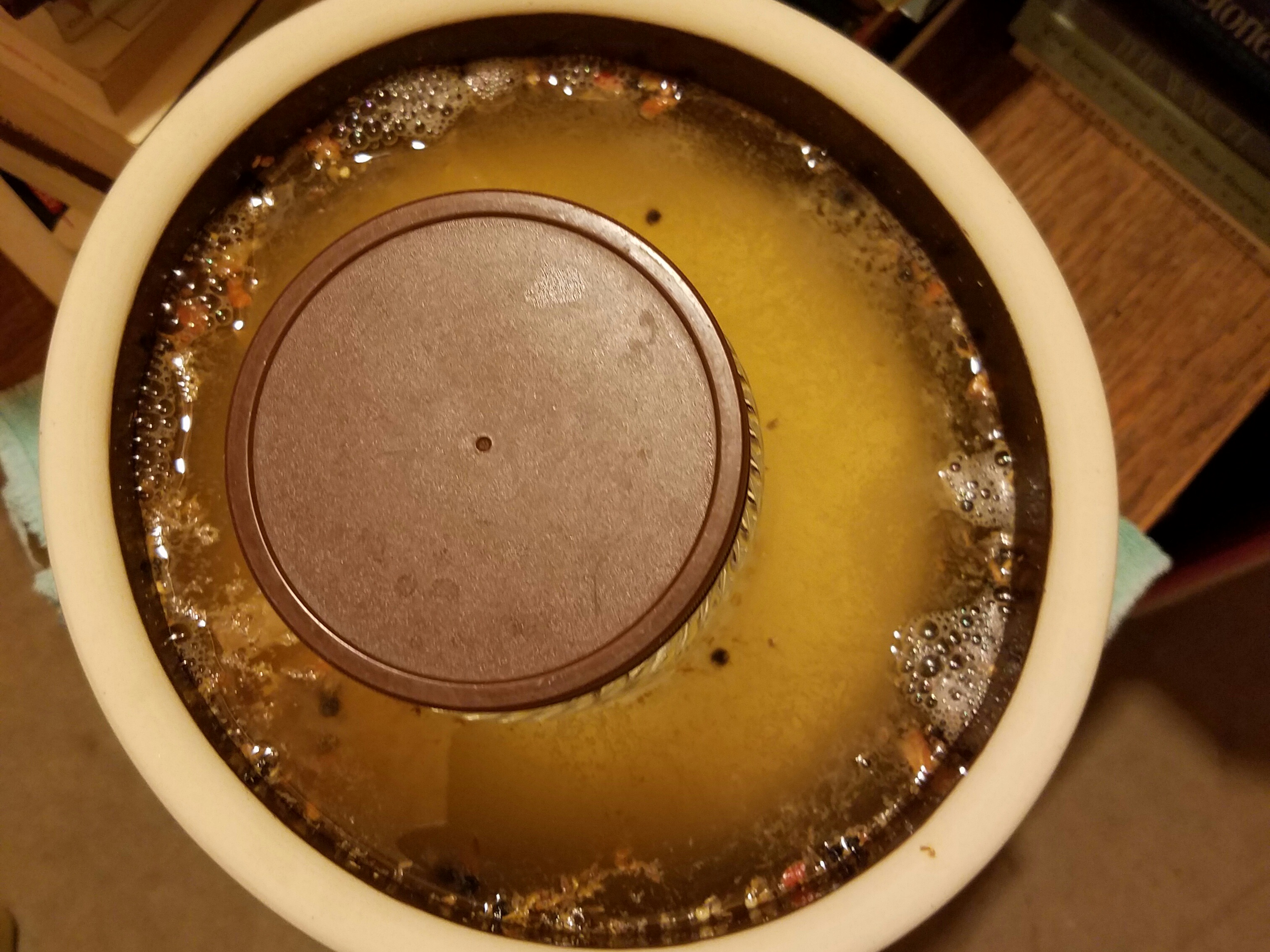
After dinner I went downstairs and checked the crock full of cucumbers. Fermentation bubbles had begun to appear after two days, indicating a successful pickling process. Patience is a key ingredient when making pickles. I hope I have enough of it on hand to make it 11 additional days when the dill pickles will be ready to eat.

Simple stir fries and pickles become a way of life when vegetables are available from the farm and garden in abundance. Cooking in the local food culture is an act of rebellion from a consumer culture that engendered us in the Western hemisphere. It represents taking control of our lives.

Do I always cook locally produced food at home? No. I pay attention to the seasonality of food and align with it as much as possible. I’ve found it makes for better ingredients and depending on the cook, for better eating.

There is more to the seasons of food than common affection for sweet corn and tomatoes. Learning more is a step toward living a better life and who doesn’t want to do that?

Categories
Work Life

Into Fall

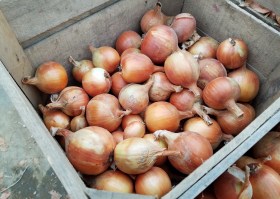
Box of Onions
Crate of Onions

The first leaves on our Autumn Blaze maple tree turned over the weekend — a reminder of summer’s imminent end.

A lesson learned this season was of the limits of worklife and the tendency to let personal things go when engaged in a big endeavor.

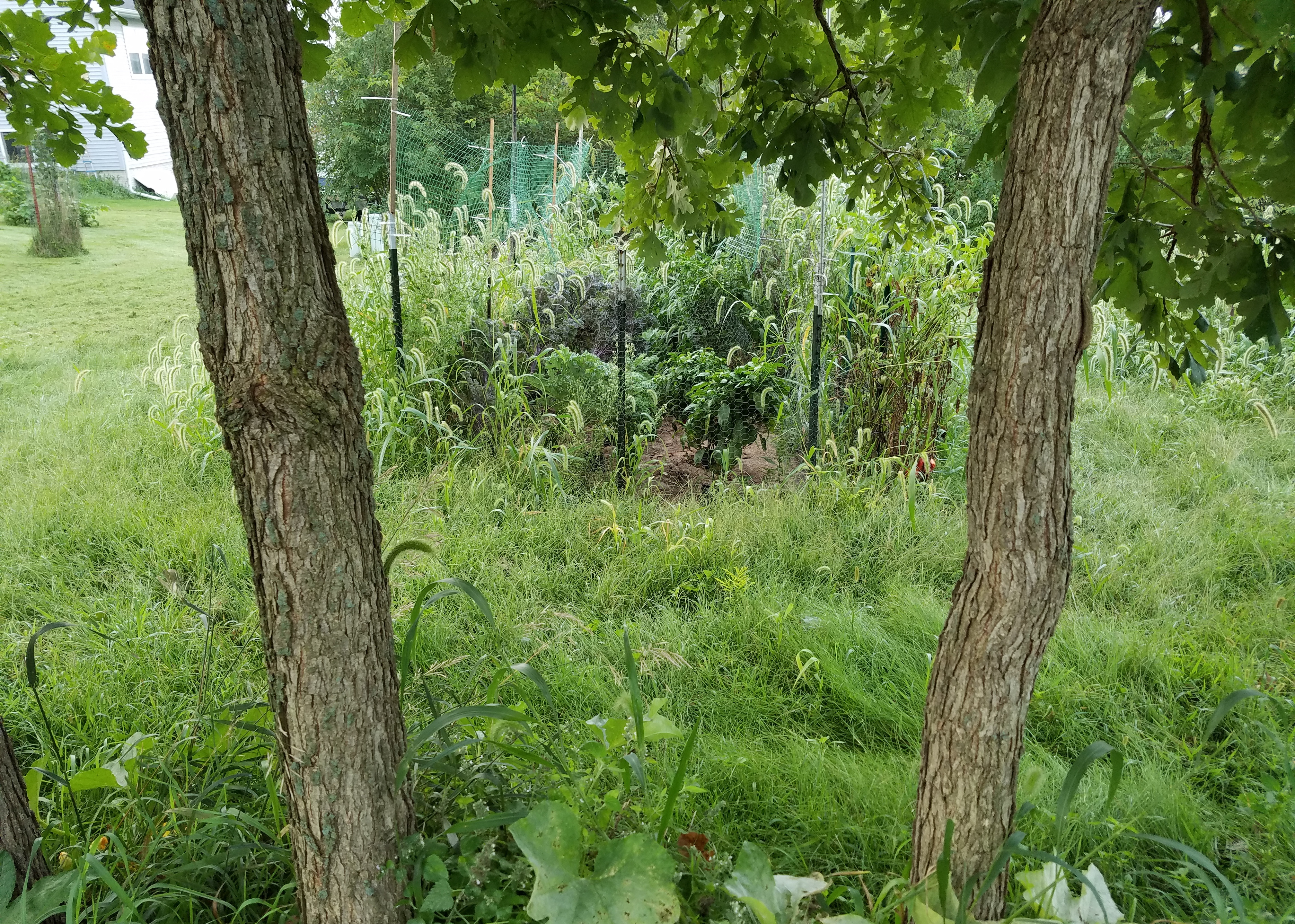
The garden, yard and house cleaning fell to the bottom of the priority list as I worked four jobs. It is ironic that in a year when my skills as a gardener improved, I was unable to keep up with the weeding and harvesting, which when combined with the lack of mowing for a month, created a jungle in our back yard. The birds and rabbits may be happy, but I was not.

Harvesting will continue. The garden paid for itself many times over. The question is what level of abundance is enough? I’m already thinking about preparing the plots for winter. It won’t be long before I pull the plants, stack the cages, roll up the fencing and mow. It assuages my guilt from leaving so much produce — tomatoes and pears especially — in the field.

Thunder and lightning blew past the orchard Sunday afternoon and I was released from work early. Because of the lightning, I skipped the greenhouse work at the farm — we don’t work when there is lightning. The storm created an opportunity to rest and after finishing my last post during Trish Nelson’s hiatus from Blog for Iowa, I did.

This week I hope to finish the onion trimming work and move on to what’s next. The presidential election is sucking up oxygen, so dealing with that is out there.

More importantly, what do I want to do next with my remaining years.

I used an on-line life expectancy calculator which determined I have a 75 percent chance of living past age 80, with an estimated life expectancy of 87 years. If that’s true, there’s a lot of living to do.

It will take a full day, maybe two, to clean up the tangled mess the yard and garden have become. Some time — not too much — must needs be spent learning to choose my occupations wisely.

Categories
Kitchen Garden Work Life

An Iowa Onion Trimmer

Curing Onions
Curing Onions

Between picture perfect onions and the compost heap lies an opportunity.

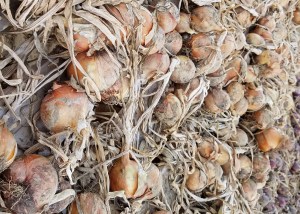
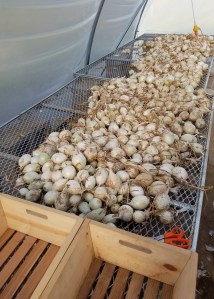
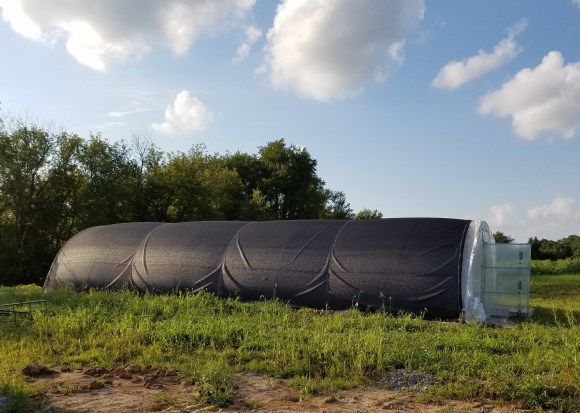
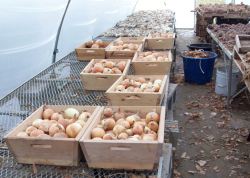
A friend grows onions using organic practices as part of a Community Supported Agriculture project. Onions are harvested from the field then dried in the greenhouse for storage. Sorting, trimming the tops and roots, and removing excess skin comes next.

As an experienced onion trimmer I work for farmers I know and trust. My compensation is an hourly rate above the current minimum wage plus all the seconds I can use. It’s a good deal, so I take it when offered. For an hour or two after a full time job at the home, farm and auto supply company, and on weekends after a shift at the orchard, I work in the onion shed.

Onion Trimming Work Station

The work is seasonal and temporary. Cognizant of potential competition from other itinerant workers, I work as quickly and as well as I can. The daily chore serves as respite from an intense schedule of lowly paid work that provides income destined mostly to corporations in exchange for stuff needed to operate the household: utilities, insurance, taxes, fuel and the like. I will have worked 100 days in a row by the November election — I’m not complaining, just sayin’.

At the end of each shift in the onion shed, I take home ten or more pounds of seconds. I remove the bad parts in our kitchen and am left with half the original amount in fresh onions. There’ no long term storage for these so they go into the ice box until used. If left on the counter, bad spots would quickly re-emerge.

Onion Shed
Onion Shed

I made and canned the first batch of vegetable soup with three pounds of fresh onions and a bit of everything on hand from the farm and garden. By the time the onions at the farm are in storage, there will be enough canned vegetable soup put up to last until the next growing season. Soup that can make a meal.

With the concurrent harvest of tomatoes and basil from our garden, I plan to make and can pints of marinara sauce using a simple, four-part recipe of tomatoes, onions, basil and garlic. Onion trimming blocks out time from vegetable processing, and some good ones will head to the compost bin before I can get to them. I am hopeful about getting a dozen pints of marinara sauce canned.

The life of an itinerant low wage worker lies on the margin between harvest and the compost bin, That’s true for a lot of professions, not just onion trimmers. If you think about it, that’s where we all live our lives in the 99 percent of the population that isn’t wealthy.

I’m okay with working a job with friends doing work that directly impacts our family’s sustainability. It may be easier to take a big job with responsibilities and varied compensation, but I’d rather deal with the questions like whether something can be made of each onion I encounter.

The pile of second represents hope in a tangible and meaningful way. What’s life for unless that?

~ Written for Blog for Iowa

Categories
Home Life

Perhaps It Was a Sign

Water Damaged Memorabilia Drying

For the first time since we covered our foundation with earth in 1993 we had water downstairs after a heavy rainfall.

Perhaps it was a sign.

As soon as we discovered the problem, we reacted. Later in the day I bought a 20-inch fan at the home, farm and auto supply store to circulate air as the cement floor dries. It’s muffling out every other sound as I write.

Most of our storage items are on pallets, and planning paid off. About half a dozen boxes on the floor did get damp. We caught it soon enough to remove the contents and dry papers out before getting ruined. My musical instruments were also on the floor, but they were dried off before wreckage.

Casualties included a small collection of Franklin Mint items, a box of letters from pre-email days, and a banker’s box full of political memorabilia going back to when I worked on LBJ’s 1964 campaign. It looks like everything will be okay.

We don’t plan to build an ark, and must figure out what is happening then take action. By the end of today, I’ll inspect the wall inside and out and develop an action plan. I’ve learned to pay attention when nature and the forces behind it give us a sign.

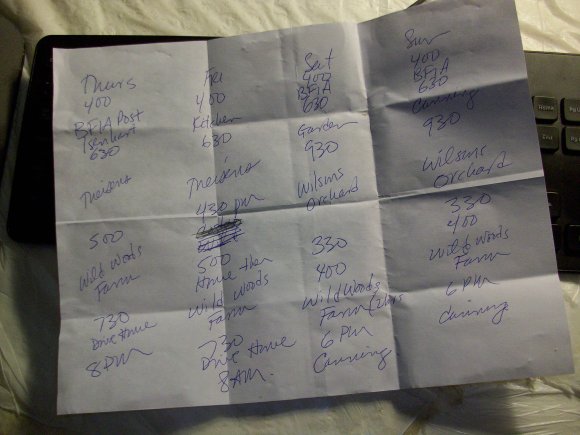
The last thing we needed was one more thing on the Big Grove do list. On Thursday I made a schedule at the home, farm and auto supply store during a break. It must now be modified.

Weekend Schedule Draft

With such a schedule it is hard to relax. In fact, it is easy to see why people turn to methamphetamine to get through everything that needs doing in 24 hours. Maybe I need to pull a couple of all nighters, as a substitute since I eschew meth and stimulants except coffee.

A friend of mine who attended Georgetown University continued the collegiate practice of pulling all nighters well into the 1980s as a way of catching up with things that could not be delayed. The trouble is there is no “next day” for me to crash with my constant schedule through the end of the apple season.

Mine is the situation of any low wage worker, and I don’t see it being fixed in the U.S. by the “fight for $15,” an advocacy effort to raise the minimum wage. I will suck the pap of life dry with constant activities regardless of economic status. What would help from government is hard to accomplish: universal health care; bolster Social Security so our pensions will be there;  and preserve and protect the commons. It doesn’t seem like too much to ask.

Onion Trimming Progress

Meanwhile, the onion trimming is going well. Instead of crossing the lakes after work, I head East on Interstate 80 to Highway One and spend a couple of hours in the nearby greenhouse.

I’m about a third of the way through summer onions, after which I’ll do storage onions. The crates are custom made and have slats in the bottom for aeration. As part of my compensation I keep the seconds, so there are plenty of onions in our house for the next few weeks.

It’s all part of sustaining a life in a turbulent world.

Categories
Writing

In An Iowa Kitchen

A Gardener's Breakfast
A Gardener’s Breakfast

The local food movement relies more on kitchens than grocery stores; more on gardens than commercial growers.

While use of locally sourced food by many restaurants has changed to include more of it, a local foods movement cannot be sustained by the hodge-podge of farmers, growers and entrepreneurs who sell locally produced food to restaurants, or for that matter, to grocery stores.

The problems include scalability and sustainability.

We are living in a time where demand for local food exceeds supply. Scaling up to meet demand requires a capital investment most small farmers can’t make. Sustainability relies on creating value along with the food in a way that cooks can afford it and farmers can make a reasonable return on their investment.

Someone recently asked if the area was becoming saturated with Community Supported Agriculture projects and if that’s why some are having trouble growing membership. An answer lies elsewhere. The market for local fresh food has grown so big corporations noticed.

Companies like Hy-Vee, have tapped into the fresh food market by increasing their number of suppliers and offering fresh and local food alongside wares from large commercial growers. They are sucking up market share like a vacuum cleaner as their business model is designed to do – putting pressure on small and mid-sized growers.

Corporate involvement in the local food market is a two edged sword. Growers can sell their best wares to companies like Hy-Vee and get a reasonable return. At the same time reliance on companies rather than CSA members can distract a farmer from his or her core business.

A solution? CSAs should stick to their knitting by getting payment up front and sharing the harvest with members… all of it. It may be tempting to sell some on the side to restaurants and grocery stores, but the further away from the model they get, instead of doing one thing well, everything they do can suffer. In addition, the market share they help corporations grow may be detracting from their core business.

There is nothing wrong with a farmer growing organic greens for restaurant salads and stir fries. In the end, each farmer must make ends meet, and operating a farm —even a small one — is an expensive operation with tight margins. My point is to focus on one thing and do it well.

It is one thing for a farmer to disassemble a barn and use the materials to create raised beds for a ten-person CSA. It is quite another to support a couple hundred families with the variety of produce the market demands. If you ask a hundred CSA members, as I have, why they belong, answers are all over the map. Some want assurance of a grower who uses organic methods to produce food. Some want variety unavailable at Aldi’s or Fareway. Others want to create a cooking experience with young children as part of their education. Most want to feel good about what they are doing with their lives.

One hopes we are beyond the discussion of “food miles” and on to the core value of the nascent local food economy: know the face of the farmer. It’s corollary is know how your food is grown. Try as they might with life-size cutouts of farmers in their stores, corporations have a hard time doing that. Their customers are too diverse, and they have to cater to everyone in the community. If a person combines these two ideas, knowing how our food is produced and creating demand for local, fresh food the local food movement has a chance.

A very few people strive to source every food ingredient locally. It is not with them the future of local food lies. The future of local food is within the potential of every Iowa kitchen.

To sustain the local foods movement requires consideration of what it means to belong to a CSA or buy from a farmers market. Can that fit into culinary habits in a way that is not an encumbrance to what most perceive as very busy lives?

Can kitchen cooks grow some of their own produce? Probably yes, even if it means only a large flower pot with some cherry tomatoes or an herb jar on a window ledge. Even these small things may be a step too far for some.

The trend in food includes extensive prep work done by machines and large companies. Heat and serve has become a by-line for many available grocery items. Along with taking the kitchen work out of meals, risks of contamination have been created and along with it the need for recalls from large processors whose products get contaminated by E. coli and listeria.

In a consumer society it will always be tough for small-scale producers to survive and thrive. That’s why I say the future of the local food movement rests in Iowa kitchens where cooks can use less processed foods and more fresh — secured by buying local and growing their own.

It’s work many can’t do because of choices made about careers and family. What may be the saving grace of the local food movement is the idea of taking control of our kitchens, in part by living and eating local as much as we can.

Categories
Home Life

Sleep Came Easily

Cherry Tomatoes from the Garden

Mounds of grass clippings blocked the John Deere’s steering as I mowed part of the lawn.

The temperature was ideal, the sky clear, and I was alert enough to safely operate the equipment.

To engage the steering I backed off and tried again.

Grass clippings lie in wind rows where I mowed last night. Using a rake and wagon I’ll transfer them to the garden for mulch.

In high summer a gardener/low wage worker/family member finds more to do than there is time. I managed to send a box of kale, fairy-tale eggplant and tomatoes to the library for the workers earlier in the day. They were appreciative.

The garden hose was coiled near the house for mowing. While driving past the garden I noticed the cucumber leaves drooping. I stopped, got the hose back out, and watered. I missed a lot of cucumbers during the morning harvest so I picked them. They filled a crate and created another thing to do.

Dinner was sweet corn on the cob and tomatoes with cheese plate, bread, and blueberry yogurt for dessert. The corn and tomatoes were filling, so I didn’t get to dessert.

After dinner I put cucumbers — newly harvested and those already in the ice box — on the counter after washing them. I sorted and found a place to put them. I hadn’t planned another task, but it needed doing. I’d say I’m in a pickle, and that’s more solution than problem.

As a result of my cucumbering, processing peppers and tomatoes got pushed back.

Sleep came easily after my eighteen hour day.

Categories
Home Life

Couple Hours to Myself

Gardener's Breakfast of tomato, salt, pepper and feta cheese.
Gardener’s Breakfast of tomato, salt, pepper and feta cheese.

Hope regular readers are well tolerating my posts from Blog for Iowa. They are different from what I normally write here, but then none of us is one-dimensional — I hope.

I got off work at the orchard a couple hours early. It’s the beginning of the season and we had plenty of staff to cover customers. The apples coming in are mostly tart and useful for baking, apple sauce and apple butter. We had ten varieties available today.

Had a great conversation with a gent who bought a large bag of Dolgo crabs for crab apple jelly. His recipe was basically this one.

“Don’t squeeze the jelly bag,” he cautioned. “The jelly will go cloudy.”

I wished him good luck as he headed for the sales barn exit.

We get a treat for each shift we work. I ate a Zestar apple. Before leaving I bought a 10-pound box of blue berries and on the way home secured a dozen ears of sweet corn at a roadside stand. Tonight’s dinner will be sweet corn on the cob and fresh tomatoes with blueberry yogurt for dessert.

Seconds Bell PeppersPlans for the unexpected mid day gap are to mow the lawn, gather the grass clippings, process bell peppers and Roma tomatoes, fix dinner and freeze some of the blueberries. The freezer is already packed, so I hope the peppers and blue berries will fit. I have no idea if everything will get finished.
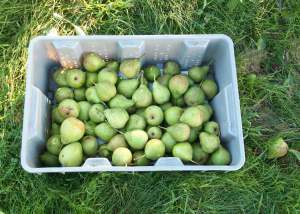
A storm blew down a pear tree branch. After inspecting the damage I picked the unripe fruit then cut the branch cleanly from the trunk. Once they ripen we’ll have more than enough for fresh and maybe some for pureed pear sauce. The tree is still loaded.

Crate of pears.
Crate of pears.

Working three jobs is challenging mentally, physically and every way in between. It’s hard to keep up and a couple of unexpected hours to myself was a welcome surprise.

Categories
Work Life

At the Apple Farm

Sign at Wilson's Orchard
Sign at Wilson’s Orchard

Between working opening day at the orchard and the kickoff of a friend’s political campaign I had two hours.

Day six of a hundred straight work days was about as good as it gets: a reunion with friends from last season, a chance to catch up and engage again in this apple life.

It’s not that the garden went neglected. I picked kale for the library workers and tomatoes, cucumbers and jalapeno peppers for the kitchen. There’s plenty of work to do around the house. Instead of doing it I crashed on the couch and slept deeply for an hour after my shift.

Refreshed enough to go at it again, I will — not later, but now.

Categories
Kitchen Garden

Cook or Quit

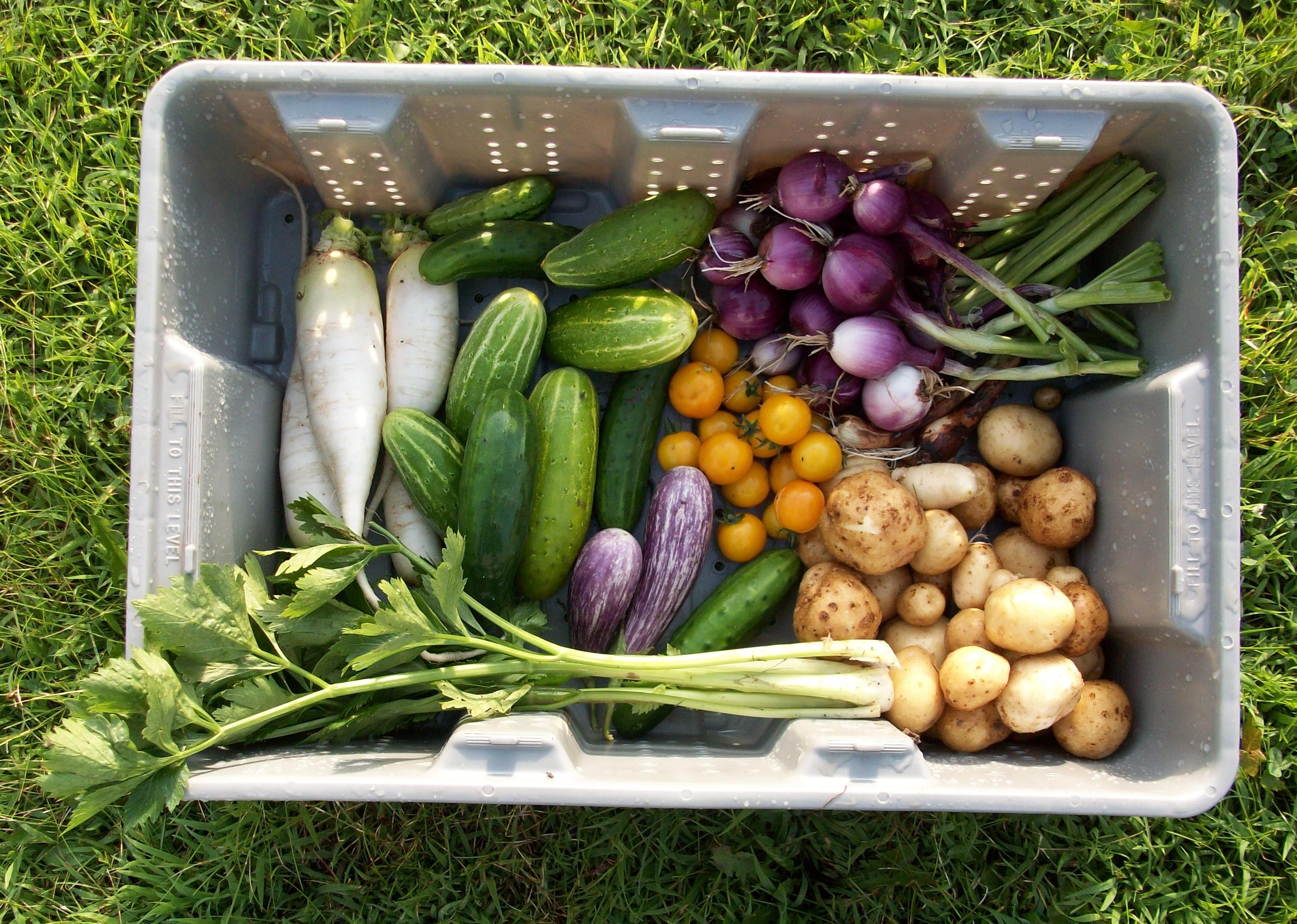
Harvest for the Weekend Kitchen

I put on my rubber boots and went to the garden in the predawn sunlight. I left a trail where my boots scraped against the dew drops formed on the lawn.

Fresh deer droppings lay moist under the oak trees and two rabbits stopped and watched as I made my way through the clover. I picked cherry tomatoes, jalapeno peppers, daikon radish and everything in this photo.

In the kitchen I made salsa using fresh ingredients, some old relish — everything that made sense. It was tasty and spicy, quite delicious.

The future of any local food movement is in the hands and kitchens of people who do these kinds of things.

If you ask my mother’s generation, “what is local food,” they often mention sweet corn and tomatoes. Hard to argue with the taste and seasonality of those two vegetables, but there is more.

Cooking goes against the grain of a global society increasingly and intentionally seeking to remove creative, engaged prep work from the kitchen and replace it with heat and serve processed food. Here’s an example.

While on break at the home, farm and auto supply store food preparation became a conversation topic as it often does.

A colleague explained how he bought a bag of prepared frozen meatballs from COSTCO and warmed them in his favorite barbecue sauce. He then took a small loaf of white bread, halved and toasted it, and spooned the meatballs on the bottom half making a meatball sandwich. He said it was really good as we listened.

If taste and ease of preparation is all we seek, the industrial food supply chain can meet our needs. In that case, when it comes to local food, what’s here becomes local.

I’ve been spending time in the kitchen this week. At 5 a.m. I stop what I’m doing and make breakfast. Stirfry, roasted vegetables, and because they are in season, fresh steamed green beans with every meal. It feels a little weird, but I felt better all day because I ate mostly what I grew before 7 a.m.

The local food movement is just not going to happen based on a small number of farmers, chefs and advocates and there’s the ceiling. If it becomes a part of our daily lives, which include vegetables from the garden, eggs from chickens we know and preparing food to taste, then the local food movement has a chance.

What it reduces to is either cook or quit.