Categories
Writing

In An Iowa Kitchen

A Gardener's Breakfast
A Gardener’s Breakfast

The local food movement relies more on kitchens than grocery stores; more on gardens than commercial growers.

While use of locally sourced food by many restaurants has changed to include more of it, a local foods movement cannot be sustained by the hodge-podge of farmers, growers and entrepreneurs who sell locally produced food to restaurants, or for that matter, to grocery stores.

The problems include scalability and sustainability.

We are living in a time where demand for local food exceeds supply. Scaling up to meet demand requires a capital investment most small farmers can’t make. Sustainability relies on creating value along with the food in a way that cooks can afford it and farmers can make a reasonable return on their investment.

Someone recently asked if the area was becoming saturated with Community Supported Agriculture projects and if that’s why some are having trouble growing membership. An answer lies elsewhere. The market for local fresh food has grown so big corporations noticed.

Companies like Hy-Vee, have tapped into the fresh food market by increasing their number of suppliers and offering fresh and local food alongside wares from large commercial growers. They are sucking up market share like a vacuum cleaner as their business model is designed to do – putting pressure on small and mid-sized growers.

Corporate involvement in the local food market is a two edged sword. Growers can sell their best wares to companies like Hy-Vee and get a reasonable return. At the same time reliance on companies rather than CSA members can distract a farmer from his or her core business.

A solution? CSAs should stick to their knitting by getting payment up front and sharing the harvest with members… all of it. It may be tempting to sell some on the side to restaurants and grocery stores, but the further away from the model they get, instead of doing one thing well, everything they do can suffer. In addition, the market share they help corporations grow may be detracting from their core business.

There is nothing wrong with a farmer growing organic greens for restaurant salads and stir fries. In the end, each farmer must make ends meet, and operating a farm —even a small one — is an expensive operation with tight margins. My point is to focus on one thing and do it well.

It is one thing for a farmer to disassemble a barn and use the materials to create raised beds for a ten-person CSA. It is quite another to support a couple hundred families with the variety of produce the market demands. If you ask a hundred CSA members, as I have, why they belong, answers are all over the map. Some want assurance of a grower who uses organic methods to produce food. Some want variety unavailable at Aldi’s or Fareway. Others want to create a cooking experience with young children as part of their education. Most want to feel good about what they are doing with their lives.

One hopes we are beyond the discussion of “food miles” and on to the core value of the nascent local food economy: know the face of the farmer. It’s corollary is know how your food is grown. Try as they might with life-size cutouts of farmers in their stores, corporations have a hard time doing that. Their customers are too diverse, and they have to cater to everyone in the community. If a person combines these two ideas, knowing how our food is produced and creating demand for local, fresh food the local food movement has a chance.

A very few people strive to source every food ingredient locally. It is not with them the future of local food lies. The future of local food is within the potential of every Iowa kitchen.

To sustain the local foods movement requires consideration of what it means to belong to a CSA or buy from a farmers market. Can that fit into culinary habits in a way that is not an encumbrance to what most perceive as very busy lives?

Can kitchen cooks grow some of their own produce? Probably yes, even if it means only a large flower pot with some cherry tomatoes or an herb jar on a window ledge. Even these small things may be a step too far for some.

The trend in food includes extensive prep work done by machines and large companies. Heat and serve has become a by-line for many available grocery items. Along with taking the kitchen work out of meals, risks of contamination have been created and along with it the need for recalls from large processors whose products get contaminated by E. coli and listeria.

In a consumer society it will always be tough for small-scale producers to survive and thrive. That’s why I say the future of the local food movement rests in Iowa kitchens where cooks can use less processed foods and more fresh — secured by buying local and growing their own.

It’s work many can’t do because of choices made about careers and family. What may be the saving grace of the local food movement is the idea of taking control of our kitchens, in part by living and eating local as much as we can.

Categories
Home Life

Sleep Came Easily

Cherry Tomatoes from the Garden

Mounds of grass clippings blocked the John Deere’s steering as I mowed part of the lawn.

The temperature was ideal, the sky clear, and I was alert enough to safely operate the equipment.

To engage the steering I backed off and tried again.

Grass clippings lie in wind rows where I mowed last night. Using a rake and wagon I’ll transfer them to the garden for mulch.

In high summer a gardener/low wage worker/family member finds more to do than there is time. I managed to send a box of kale, fairy-tale eggplant and tomatoes to the library for the workers earlier in the day. They were appreciative.

The garden hose was coiled near the house for mowing. While driving past the garden I noticed the cucumber leaves drooping. I stopped, got the hose back out, and watered. I missed a lot of cucumbers during the morning harvest so I picked them. They filled a crate and created another thing to do.

Dinner was sweet corn on the cob and tomatoes with cheese plate, bread, and blueberry yogurt for dessert. The corn and tomatoes were filling, so I didn’t get to dessert.

After dinner I put cucumbers — newly harvested and those already in the ice box — on the counter after washing them. I sorted and found a place to put them. I hadn’t planned another task, but it needed doing. I’d say I’m in a pickle, and that’s more solution than problem.

As a result of my cucumbering, processing peppers and tomatoes got pushed back.

Sleep came easily after my eighteen hour day.

Categories
Home Life

Couple Hours to Myself

Gardener's Breakfast of tomato, salt, pepper and feta cheese.
Gardener’s Breakfast of tomato, salt, pepper and feta cheese.

Hope regular readers are well tolerating my posts from Blog for Iowa. They are different from what I normally write here, but then none of us is one-dimensional — I hope.

I got off work at the orchard a couple hours early. It’s the beginning of the season and we had plenty of staff to cover customers. The apples coming in are mostly tart and useful for baking, apple sauce and apple butter. We had ten varieties available today.

Had a great conversation with a gent who bought a large bag of Dolgo crabs for crab apple jelly. His recipe was basically this one.

“Don’t squeeze the jelly bag,” he cautioned. “The jelly will go cloudy.”

I wished him good luck as he headed for the sales barn exit.

We get a treat for each shift we work. I ate a Zestar apple. Before leaving I bought a 10-pound box of blue berries and on the way home secured a dozen ears of sweet corn at a roadside stand. Tonight’s dinner will be sweet corn on the cob and fresh tomatoes with blueberry yogurt for dessert.

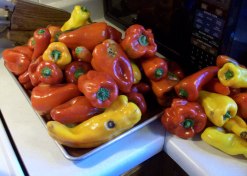
Seconds Bell PeppersPlans for the unexpected mid day gap are to mow the lawn, gather the grass clippings, process bell peppers and Roma tomatoes, fix dinner and freeze some of the blueberries. The freezer is already packed, so I hope the peppers and blue berries will fit. I have no idea if everything will get finished.
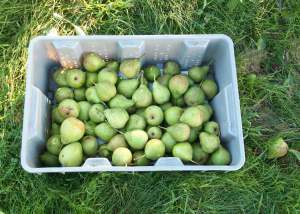
A storm blew down a pear tree branch. After inspecting the damage I picked the unripe fruit then cut the branch cleanly from the trunk. Once they ripen we’ll have more than enough for fresh and maybe some for pureed pear sauce. The tree is still loaded.

Crate of pears.
Crate of pears.

Working three jobs is challenging mentally, physically and every way in between. It’s hard to keep up and a couple of unexpected hours to myself was a welcome surprise.

Categories
Work Life

At the Apple Farm

Sign at Wilson's Orchard
Sign at Wilson’s Orchard

Between working opening day at the orchard and the kickoff of a friend’s political campaign I had two hours.

Day six of a hundred straight work days was about as good as it gets: a reunion with friends from last season, a chance to catch up and engage again in this apple life.

It’s not that the garden went neglected. I picked kale for the library workers and tomatoes, cucumbers and jalapeno peppers for the kitchen. There’s plenty of work to do around the house. Instead of doing it I crashed on the couch and slept deeply for an hour after my shift.

Refreshed enough to go at it again, I will — not later, but now.

Categories
Kitchen Garden

Cook or Quit

Harvest for the Weekend Kitchen

I put on my rubber boots and went to the garden in the predawn sunlight. I left a trail where my boots scraped against the dew drops formed on the lawn.

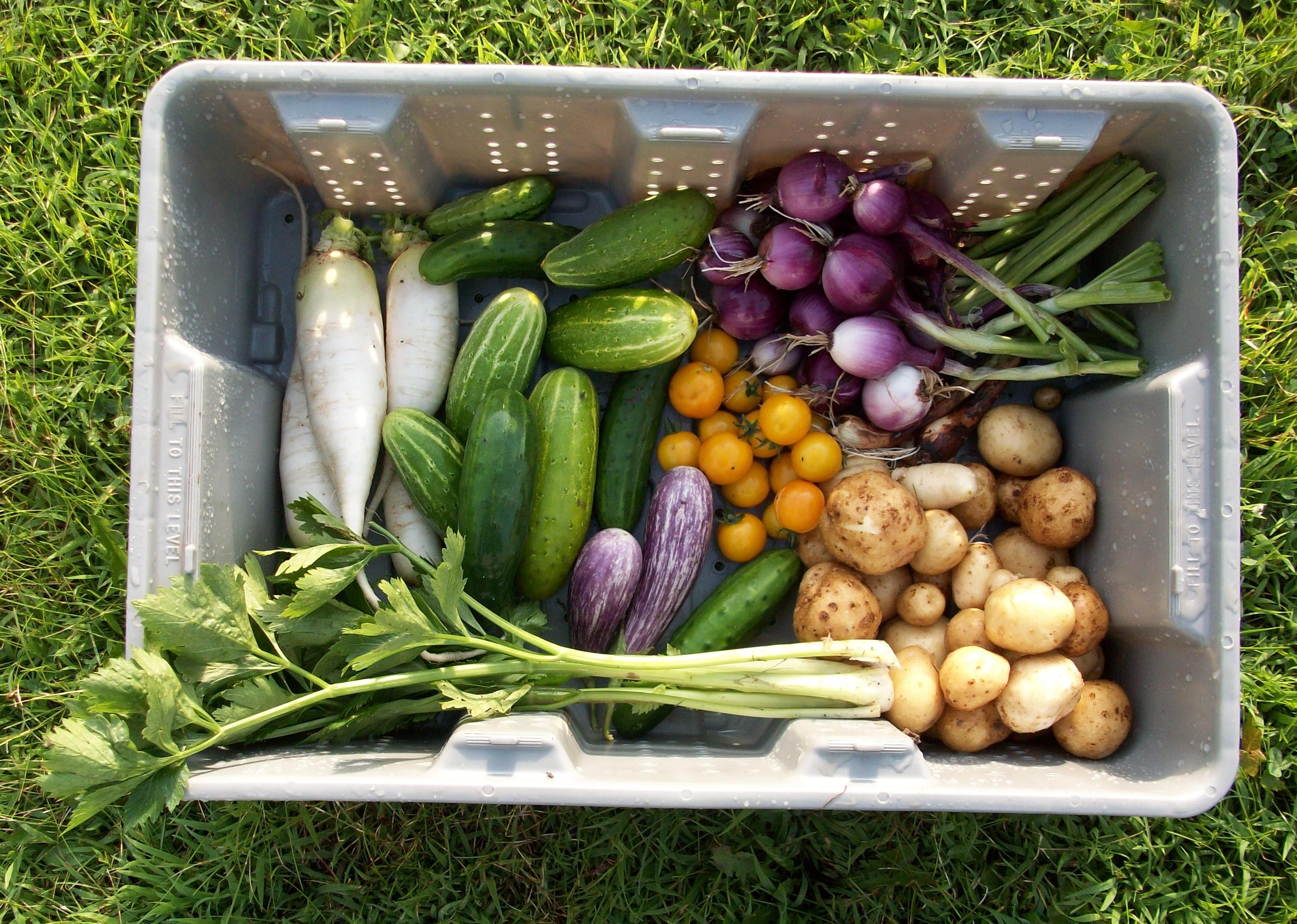
Fresh deer droppings lay moist under the oak trees and two rabbits stopped and watched as I made my way through the clover. I picked cherry tomatoes, jalapeno peppers, daikon radish and everything in this photo.

In the kitchen I made salsa using fresh ingredients, some old relish — everything that made sense. It was tasty and spicy, quite delicious.

The future of any local food movement is in the hands and kitchens of people who do these kinds of things.

If you ask my mother’s generation, “what is local food,” they often mention sweet corn and tomatoes. Hard to argue with the taste and seasonality of those two vegetables, but there is more.

Cooking goes against the grain of a global society increasingly and intentionally seeking to remove creative, engaged prep work from the kitchen and replace it with heat and serve processed food. Here’s an example.

While on break at the home, farm and auto supply store food preparation became a conversation topic as it often does.

A colleague explained how he bought a bag of prepared frozen meatballs from COSTCO and warmed them in his favorite barbecue sauce. He then took a small loaf of white bread, halved and toasted it, and spooned the meatballs on the bottom half making a meatball sandwich. He said it was really good as we listened.

If taste and ease of preparation is all we seek, the industrial food supply chain can meet our needs. In that case, when it comes to local food, what’s here becomes local.

I’ve been spending time in the kitchen this week. At 5 a.m. I stop what I’m doing and make breakfast. Stirfry, roasted vegetables, and because they are in season, fresh steamed green beans with every meal. It feels a little weird, but I felt better all day because I ate mostly what I grew before 7 a.m.

The local food movement is just not going to happen based on a small number of farmers, chefs and advocates and there’s the ceiling. If it becomes a part of our daily lives, which include vegetables from the garden, eggs from chickens we know and preparing food to taste, then the local food movement has a chance.

What it reduces to is either cook or quit.

Categories
Kitchen Garden

Farm Transition

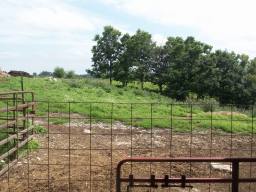
View from the Barn
View from the Barn

RURAL CEDAR TOWNSHIP — Yesterday was the Practical Farmers of Iowa field day at Carmen Black’s Sundog Farm.

Carmen and Susan Jutz explained their farm transition process in a simple duet about bankers, government agencies, insurance companies and community.

Like everything Susan has done since I met her almost 20 years ago, the transaction of selling the farm had a home made feel to it. It looks like Carmen will continue that localized and home made culture.

Attendees walked the farm, with Carmen and Susan explaining pest control practices. Highlights included treatment for flea beetles, tomato blight, worms and cucumber beetles.

What I hadn’t thought about was providing proper space for air to circulate among tomato plants to prevent spread of disease. The wall of cherry tomatoes that blew over in yesterday’s storm is a good example. The wind caught the entire planting like a sail. If they were separated more, wind might blow through them, leaving them upright.

Susan’s eventual departure from the farm is another instance of my generation going home. On Sundog Farm there is a chance for sustainability as Carmen adds farm management to her experience. Opportunities like this are rare and Carmen appears to be making the most of it.

Categories
Kitchen Garden Living in Society Social Commentary

High Summer Harvest

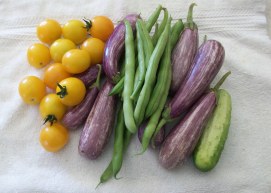
Cherry tomatoes, Fairy Tale eggplant, green beans and a pickling cucumber harvested July 16, 2016

Photographs of kale can only be interesting for so long.

The leafy green and purple leaves are producing in abundance — so much so I pick only what is needed, removing imperfect leaves from the plants to the compost heap.

Seven kale leaves stand in a jar of water on the counter to keep them fresh and ready to use.

If summer were only about kale, this one would be an unmitigated success.

Something else is going on.

This week I conversed with a group of twenty-somethings about the new application for smart phones, Pokémon Go. It was the most animated they had ever been. I asserted the application represented the beginning of the zombie apocalypse. They didn’t dispute it. One had already tried the game and moved on to something else. Apparently there are not that many Pokémon to find in rural Iowa.

The continuous stream of violence manifest its latest event Thursday with a terrorist attack in Nice, France. More than eighty people were killed and as many as 300 injured as a lone driver drove a large truck through a crowd gathered to view a Bastille Day fireworks display. The terrorist made it two kilometers before he was shot dead by law enforcement. French President Francois Hollande seeks to extend the existing state of emergency put in place after the November 2015 attacks in Paris.

In American political news, the Republican top of the ticket is set with Indiana Governor Mike Pence named presumptive presidential nominee Donald Trump’s running mate. The less said about this pair the better. Suffice it that I disagree with them on just about everything. The national political conventions are imminent, with the Republicans this week and Democrats the following. Something unexpected might happen at either convention.

In a strange turn of events, twice failed U.S. Senate candidate Tom Fiegen made a post on Facebook that blogger Laura Belin re-posted:

FB Post Belin

Belin makes sense if Fiegen, not so much. The episode represents further coarsening of Iowa politics. Fiegen likening an effort to persuade him on his presidential vote to sexual advances is plain weird. I know I wouldn’t want to get in the back seat with him on a dark gravel road. Whatever virtue he may have had vaporized after he quit being his own person and hitched his campaign wagon to Bernie Sanders. His current, post being a Democrat, rants serve as an example of how low politics has gotten. I know my mother said if you don’t have something nice to say about someone, don’t say anything, but Fiegen lives in our house district and may foment more ill will. I hope not.

Lastly, this week Deadhorse, Alaska set a record high for any Arctic Ocean location. Is it climate change? How could it not be.

At least for now there is plenty to eat and fewer photographs of cruciferous vegetables.

Categories
Kitchen Garden

Sundog Farm Field Day

Field Day FlyerMy friends Carmen and Susan are hosting a Practical Farmers of Iowa field day called “ZJ to Sundog: Sharing Knowledge and Passing on the Farm” at Sundog Farm on Sunday, July 17, from 2 until 5 p.m.

The transition in farm ownership has been a long time coming and Sundog Farm is finally here.

Susan Jutz began Local Harvest CSA on ZJ Farm in 1996. After almost 20 years building a successful business and farm, she began looking for an opportunity to transition her farm to the next generation. The process was completed in May 2016, when Susan sold her farm and business to Carmen Black.

Carmen grew up nearby, was friends with Susan’s children, and had Susan as her 4-H leader. She has worked on the farm with Susan for five years. ZJ Farm has been the site for numerous Practical Farmers field day programs; this event will be the farm’s first as Sundog Farm.

The event will include a field tour and discussion with Susan and Carmen about their systems for pest management in vegetable production, including cabbage worms, cucumber beetles, flea beetles and tomato blight. They will discuss field scouting, cultural pest management, products they’ve tried and those they prefer. During the second part of the program, they will share their farm transition story.

Carmen has been part of the farm since I began working there in 2013. She called Friday to ask for help to begin the clean up in preparation for the field day. I spent part of Saturday removing weeds from around the old grain silos and barns and edging some of the fields. I was reminded of how far the farm had come since its days of being a conventional livestock operation before Susan began farming there. Sundog Farm should look good by next Sunday, so come to the field day, learn a small part about Iowa’s ongoing farm land ownership transfer, and wish Carmen well.

A potluck follows the program; bring a dish to share and your own table service. Please RSVP for the meal by July 14 to Lauren Zastrow at (515) 232-5661 or lauren@practicalfarmers.org.

Hosts:
Susan Jutz and Carmen Black
ZJ Farm and Sundog Farm
5025 120th St. NE • Solon • 52333
(319) 331-3957 • localharvestcsa@southslope.net
solonsundogfarm.com

Categories
Kitchen Garden

Why Not More Celery?

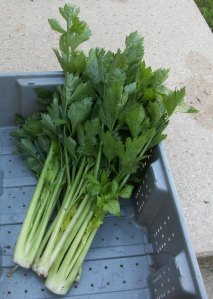
Freshly Picked Celery

Why don’t more Iowans grow celery?

More specifically, why don’t more Community Supported Agriculture projects produce it for members and local food farmers for restaurants and markets?

I’ve been asking this question of growers and the reaction has been surprise at my results and maybe an assertion they will try it. There is substantial demand for the aromatic vegetable in kitchens and restaurants yet the perception is celery doesn’t grow well in Iowa, so farmers mostly don’t.

Celery from my garden tastes better than regular or organic available at the grocery store. In addition, celery is in the Environmental Working Group’s Dirty Dozen fruits and vegetables for use of pesticides, ranking #5. Why buy California celery when we can produce our own at least part of the year? Having the best possible flavor is important to everything cooked with celery.

Celery takes about 120 days and requires adequate water, more than most vegetables. That means seeding trays planted in late February to produce the crop being harvested this weekend. I use Conquistador OG seeds from Johnny’s Selected Seeds in Winslow, Maine. (OG stands for organic). It took me a couple of years to get successfully from seedlings to the ground to a crop as I experimented with growing. This year’s crop has been the best ever.

I attribute success to using 4-inch drainage tile cut into 8-inch lengths to protect and support young seedlings. I mulch with grass clippings and weed regularly. Each morning I make sure a substantial dose of water is applied. Larger scale farmers shun this extra work, focusing more on crops that can be mechanized (like potatoes) or are popular among customers (like cabbage, tomatoes and peppers). The flavor of local celery, and growing it pesticide-free, make the extra work worth it.

Every head of celery will be used fresh this year. There were only a dozen from the garden in this experimental year and I shared some with library workers in town. Next year I plan to double production and if there is more than can be used fresh, preserve part of it.

In June at the Global Foods Market in Kirkwood, Missouri, I bought a jar of celery salad in a glass jar. The preparation uses celery, apple juice, walnut extract and vinegar and is an example of a shelf-stable item for winter consumption. For the time being, I expect to use everything fresh in soups, stir fry and Louisiana-style beans and rice.

If the local foods movement doesn’t wake up to celery, there is a market for sales to restaurants to pursue. If they don’t exploit it, I will.

Categories
Kitchen Garden

Spring Notes From the Garden

Broccoli in Cages
Broccoli in Cages

Spring ends and summer begins with a full moon illuminating our yard and garden. Predawn darkness mitigated by silvery reflected light.

As daylight shortens its span spring gardening went well, setting the stage for a bountiful harvest.

There is a lot to learn in the garden and here are some notes from 2016.

“Temperatures over the three spring months averaged 50.5° or 2.2° above normal while precipitation totaled 11.69 inches or 0.50 inches less than normal,” state climatologist Harry Hillaker wrote in his May weather summary. “This ranks as the 25th warmest and 62nd wettest spring among 144 years of state records.”

The importance of water management in gardening cannot be overstated. The added heat, especially in May, along with less rain, created conditions that put pressure on seedling expectations. Adequate watering when it wasn’t raining helped establish the crops for the season. I developed a habit of watering in the morning shortly after sunrise. While I am not sure if timing during the day makes a difference, the plants are growing well and appear lush.

Spacing seeds and seedlings properly is more important than I was willing to acknowledge. The garden produced enough spinach, radishes and turnip greens for the table, but production would likely have increased if I’d spaced the seeds according to the packages. I learned this lesson with seedlings at the farm and get my yardsticks out when transplanting seedlings.

Protecting seedlings from ground-based predatory critters improved the success of seedlings after transplant. The 4-inch drainage tile cut in short lengths around selected seedlings improved the survival rate over last year. Using old tomato cages wrapped in chicken wire enabled all of the broccoli to survive this year. The broccoli really looks good.

Every kale plant survived transplant, all but one tomato plant, all but one hot pepper. Basil and bell peppers were more challenging. Because I started more seedlings than needed, I was able to fill in the gaps when they failed. The bell peppers had become root bound, and appeared to experience shock after transplant. I replaced the ones that died and as of yesterday every spot has a good looking plant in it.

The experiment with container carrots can be deemed successful. The earliest carrots are producing and are so tasty it’s hard to leave them in the ground long enough to mature. The carrots are growing in soil with a high percentage of compost in it. The compost always seems dry underscoring the need for water management. I make sure they have a good daily soaking.

Water is important to celery crops. I harvested the first stalks over the weekend and they punctuated the flavor of the soup I made with them. I cut the first bunch well above the ground line to give the plant a chance to grow new leaves. Last year the stubble continued to produce into the warmer winter months.

Mulching everything with grass clippings is important. I used clippings from two passes over the yard and may do a third. The water retention properties fit into the water management system, especially during hot sunny weather.

On the longest day of the year the garden is off to a great start.