Categories
Home Life

Lifestyle Changes

Breakfast – Aug. 9, 2019

I took five sessions with a nutritionist and wellness professional, once individually and four times as part of a group. I email her questions and she quickly emails answers back.

Based mostly on blood test results, the clinic diagnosed me with Type II diabetes in May and like many, I immediately went into denial.

Listening to the professional — a person with lots of letters following her name on the business card she handed me — I’ve been able to lose 10 percent of body weight, exercise more, and feel better. Monday is a reality check as I have blood drawn for another test and a meeting with my care-giving team the following week.

Whether my diabetes can be controlled through lifestyle changes is an open question, the answer to which is I hope to avoid diabetes’s advancement and physiological deterioration. By finding it early, the diagnosis may be beaten back. Included in this sentiment is a bit of lingering denial that I have it, but I am less worried about that than other things.

When my then septuagenarian grandmother was diagnosed with diabetes I was in the U.S. Army, stationed in Mainz, Germany. One day without warning I received a large box from her with all of the instant pudding and gelatin desserts from her cupboard. She accumulated a trove of these small boxes during her food stamps shopping trips and felt she could no longer eat it and I could. Cookery was not my specialty then. I made and ate some of it, favoring the pudding. I don’t remember how much. I am about ten years younger than she was when she had her diagnosis.

The physician’s assistant made a short list of things I should do. I followed them as best I was able: a diabetes screening from an ophthalmologist, the nutrition classes, more exercise, and regular checkups. I avoided taking regular self-administered blood tests and medication, except for a daily low-dose aspirin. Based on the nutritionist’s recommendation, I started taking vitamin B-12, which seems to have improved my sleep. As a mostly ovo-lacto vegetarian I probably get enough B-12, but the supplement is inexpensive and the downside of taking it minimal. The nutritionist taught us about the USP label for dietary supplements and what it means.

The focus of counseling has been to count carbs and establish a carbohydrate budget for each meal, snacks, and for each day. Enjoy food more, including things culturally favored, but stay within the budget. That means one ear of sweet corn, two ounces of pasta, smaller portions of rice and noodles for meals. Nearly complete avoidance of simple sugars is recommended. When one of the group asked about something else — BMI, protein, weight loss or whatever — she steadfastly returned to the need to control glucose when diagnosed with diabetes. She acknowledged there were other weight and nutrition aspects to life, but we were there to learn about how to eat with our diagnosis. I’m trying to own “my diagnosis” but am not there yet.

I’m modifying my behavior although I could relapse at any moment. It hasn’t been easy. It may continue to be not-easy. As a gardener I have access to fresh vegetables that can fill my plate as in the photo of Friday morning’s breakfast. When I returned to work at the orchard, I told my supervisor I had to refrain from eating almost everything we make with the exception of apples. What will I do when winter comes? Near yesterday’s anniversary of the atomic bombing of Nagasaki, I’m thinking if it’s a nuclear winter I may not have to worry about it. However, using that as an excuse for denial of my diabetes diagnosis is pretty lame.

I’m pretty sure this won’t be the last impactful lifestyle change I have to make as I age. Big picture? I’m okay with that. It’s better than the alternative.
Categories
Environment Kitchen Garden Writing

Summer Hump, August Heat

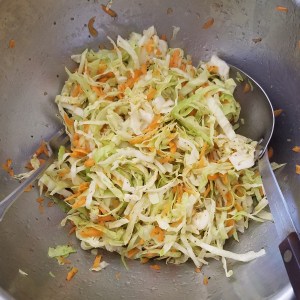
Mixing bowl with summer coleslaw made of local produce and my fermented apple cider vinegar.

Six weeks into summer 2019 we are over a hump, if not the halfway point.

I visited Paris in August 1974. It was hard to find a business open. Eschewing air conditioning we Americans find ubiquitous, Parisians fled the heat of August for the Mediterranean Coast and other breezy spots.

We could learn from that society.

My spouse visited her sister for the month of July. While she was gone I set the thermostat at 84 degrees compared to doing what we wanted in July 2018. The average monthly ambient temperature increased from 75 to 76 degrees Fahrenheit. Between running the air conditioner less and only one person active in the house, our electricity usage dropped by 37 percent in terms of kWh used. I appreciate the savings but I’d like her to return home more.

Summer in Big Grove Township has been reasonably nice with plenty of warm, sunny days, not enough rain, and an abundance from the garden. Friday the ditch had dried out enough I could mow the tall grass and get it looking more normal. The rabbit that lived there this year is likely frowning as rabbits do.

The yard grasses are in transition and need mowing, but not that much. I thought to do it yesterday and rolled up the garden hose near the house after watering in the morning. Not yet. Maybe today after my shift at the orchard. Maybe not as it is a low priority.

We planted our first garden in 1982 and grew or harvested something from our yard in the five places we lived since then. I’m getting better at it.

Cucumbers

We produced more cucumbers this year than we could eat and preserve. I determined a process using four varieties of seeds: two pickling, a Japanese-style cucumber and the utilitarian Marketmore. I made a gallon of fermented dill pickles as dill came in from my barter arrangement with Farmer Kate. The key to good pickles is the cucumber size. Once cucumbers get an inch in diameter they are too large for pickle making. Just don’t do it.

I made dishes of sliced cucumbers for potluck dinners, gave them away, and ate them as much as I could stand sliced raw, in mixed salads, and with lettuce greens when they were in season. There were plenty for sweet pickles but I overdid it last year and have more than a dozen leftover jars. I struck balance between the desire to use every bit of produce in the garden and how we eat them in season.

Tomatoes

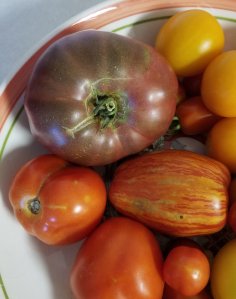
As I posted a couple days ago, we are waiting for tomatoes. The cherries are coming in Jasper, Taxi, Matt’s Wild, Grape, White Cherry and Clementine. The White Cherry, Jasper and Matt’s Wild are surprisingly sweet and delicious. The single Early Girl and Black Krim plants produced fruit. I’ve had a couple Speckled Roma which I found to have tough skin.

This year as last, I planted the rows too close together. I crawled under the seven-foot indeterminate vines and inspected. A lot of good sized fruit waits to ripen under the foliage.

The plants have less blight this year than last. I don’t know why but two things are different. We had extremely cold weather last winter. Perhaps the cold killed some of it off. I also applied diatomaceous earth to the ground after tilling to keep down the crawling bugs that love tomatoes. Perhaps it had an effect on the blight. So far, so good and if all continues to go well, we will have plenty of tomatoes for fresh eating, canning and gifts to friends.

Green Beans

By now we’ve usually had green beans but there are hardly any on the plants. The foliage looks great. There are flowers. No beans. Other area gardeners are experiencing the same thing with a reduction in yield. I picked exactly two beans from a 15-foot row.

Apples

After nearly perfect pollination and fruit setting the invasion of Japanese beetles has the apple trees looking like dirty brown lace. I wait for the fruit’s background color to get right and have been tasting them every other day. The first of two varieties is getting close. Fingers crossed.

A friend sprayed his apple tree with Sevin to kill a Japanese Beetle infestation. The pesticide works although it contains carbaryl, a known carcinogen banned in some European countries. “Aren’t you worried about eating the fruit?” I asked. “Nah!” he said. I continue to refrain from using insecticides, which offer a temporary abatement to the detriment of the environment and apple eaters.

It’s a race to ripeness with popilla japonica. If bugs eat too many tree leaves, inadequate sugar is produced for fruit to ripen. If fruit gets ripe on the tree and they can penetrate the skin, they will mass on it and eat it. There appears to be enough green leaf left to absorb sunlight adequately to ripen the apples. I plan to pick them the minute I find them ripe and ferment the juice to make apple cider vinegar. The second variety, Red Delicious, is for eating out of hand, and everything else apple-related.

The Joni Mitchell song comes to mind, “Give me spots on my apples but leave me the birds and the bees.” In our garden there are plenty of apples and an abundance of birds and bees with whom I enjoy co-existing.

Categories
Kitchen Garden

Waiting for Tomatoes

Bowl of Tomatoes July 30, 2019.

With late planting and heavy spring rain the garden has been a mixed bag. A highlight of every year is arrival of tomato season and planning the use of what I expect will be a good crop.

The first tomatoes have ripened, and now we wait for the slicers and plums.

We eat them fresh, give some away, and prepare canned sauce, juice and diced with the rest.

As my worklife slows down, it seems there is more work to do in the yard and garden. Growing tomatoes doesn’t seem like work.

My last summer post for Blog for Iowa runs Friday and I am ready for what’s next, including a return to my usual topics in this space. I cross post here what I write elsewhere so a trickle of BFIA articles will continue until they all have been posted.

I begin work at the orchard this weekend for the seventh consecutive season. Hopefully we’ll have ripe apples and great conversations with our guests. It is blueberry season in Michigan and this weekend we will offer them fresh for the last time this year. We’re hoping Pristine, Jersey Mac and Viking get ripe by the weekend so our guests can pick them.

In July I signed up for a nutrition class paid for mostly by Medicare. The goal is to watch my blood sugar levels and develop better eating and exercise habits. A by-product of the classes has been losing ten percent of my body weight. I feel better and hope to stave off diseases of aging such as heart disease, stroke, diabetes, eyesight deterioration, influenza, pneumonia and the like. Fingers crossed. I still have a lot I want to do and good health is an important prerequisite.

As the sun ascends on another brilliant Iowa day the garden needs watering, and I want to get a trail walk in before leaving for the home, farm and auto supply store. There is a long to-do list needing attention as well. Thanks for reading.

Categories
Writing

What’s Wrong With Our Food System?

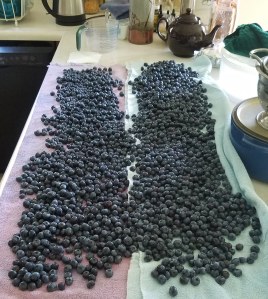
Drying 10 Pounds of Michigan Blueberries for Freezing

There is a strong argument nothing is wrong with our food system.

There is a strong argument everything is wrong with our food system.

To talk about a “food system” at all presumes a lot that may or may not be true.

It’s no secret large corporations increasingly control food production, distribution and marketing. Scalability is a key issue with providing nourishment for billions of people. The hand of large land owners, chemical companies, seed genetics companies, processors, banks, equipment manufacturers and consumer outlets runs throughout each household’s food ecology. Households have a food ecology even if they don’t speak of it using such fancy words. What appears at a meal is influenced at every point in the distribution chain by large corporations.

It’s also no secret farmers, especially small-scale farmers don’t earn a lot of money for their long hours each season. Neither do equipment manufacturing workers, seasonal farm help, truck drivers, grocery store workers, or restaurant workers. Whether one is a contractor for a large international meat-producing corporation or produces heirloom hogs for a meat locker, at the end of the day a diverse and ever changing personal economic structure is needed to ensure viability this year and in the near-term future. People struggle to make a living by farming alone.

At the same time, grocery stores are packed with food and if there remain some food deserts without one, enough food is produced in the United States to feed everyone. I met an executive from a large container manufacturing company when I worked in the Chicago Loop. He said the issue wasn’t having enough food, it was preserving and distributing what we already produce. That remains true, his statement representing another large corporation wanting a piece of the food supply action.

The deck is stacked against young farmers who want to produce food outside the mainstream. I’m thinking of friends that operate Community Supported Agriculture projects or grow specialty crops. Producing meat and vegetables for the local market has been a staple in society at least since medieval times. When there are a lack of well-paying jobs, or capital, if people have access to a piece of land for a season, attractive fruit and vegetables can be produced and sold at a margin that looks better because labor cost is removed from the calculus.

It goes without saying a farmer will work 60 or more hours a week, sometimes turning $100,000 per year in revenue derived from diverse sources (produce, livestock, grazing and retail sales) and living on a fraction of that. Land ownership? Only a small percentage of young farmers can afford to own land.

Consumers can afford a hodge-podgey food system with diverse sourcing, abundant supply, wide variety, and absence of much concern for how food arrived at our table. If corporations own equity in land, equipment and patented seed genetics, it’s hard to see that on our 9-inch dinner plate.

What matters more in this discussion is not whether a food system is good or bad, but whether that is even a thing. If each household develops its own food ecology, including best practices regarding water use, soil conservation, seed genetics and other resource use, that’s not good enough. If a food system exists, what it requires is scalability and that’s where corporations can and likely should play a role. Not evil corporations designed for extraction of resources and cash, but people joined together with common purpose regarding nourishing a growing population.

Asserting there is or isn’t a problem with our food system is itself a problem. It is much more fluid and undefined than that. Like vegetable farmers we need to accept each season for what it teaches us, hoping we can sustain ourselves for another season.

Additional Reading

Last Call for a Food Systems Revolution by Pallab Helder.

To Revive Rural America, We Must Fix Our Broken Food System by Austin Frerick.

World Hunger is on the Rise by Timothy A. Wise.

Twitter thread by Dr. Sarah Taber.

~ Written for Blog for Iowa

Categories
Environment Kitchen Garden

Heat is Here

July 18, 2019

I stood outside in early morning darkness where there was a refreshing yet decidedly warm breeze.

The overnight low was 80 degrees Fahrenheit. I’m not sure if that’s warm enough to hinder apple production but scientists believe at some point failure to cool adequately at night does impact taste and texture.

They don’t fully understand the impact of climate change on apple production. For the home fruit grower it’s one more thing for concern.

The breeze dissipated with arriving sun. The forecast is clear and hot with ambient temperatures rising to the mid-nineties. We’re getting used to the heat, especially after the 2012 drought.

After sunup I went to an apple tree, picked one and ate it. The sugars are beginning to form but it is still a “green” apple.

Tonight begins the two-day festival in the small city near which we live. The ambient temperature is expected to peak around 6 p.m. when things are just getting going. Tomorrow is the parade through town when it’s pushing 90 degrees. I’m not sure it is a good idea to attend this year so am skipping the famous hay bale toss tonight and will re-evaluate the parade in the morning. A friend from across the lakes in Big Grove Township is running for sheriff so I want to be there to support him.

It’s blazing hot! We have an air conditioner and refrigerator with an ice maker that both work. There are also three bushels of vegetables that need processing. There will be plenty of inside work to keep me busy now that the heat is here.

Categories
Kitchen Garden

Using It Up

Dinner July 13, 2019

The challenge for a gardener is to use or preserve the abundance in a way that makes sense.

At the beginning of a gardener’s life-long journey, what that means is not clear. Clarity approaches as our interaction with a kitchen garden matures, planting to meet the anticipated demands of modern living — season by season, meal by meal.

Gardening is as much about cooking and eating as it is about genetics, crop inputs, pest control and horticulture.

Saturday morning I made more basil pesto to freeze and started the first batch of dill pickles. Friday I pickled beets and dried parsley for the cupboard.

The photo represents dinner last night. The veggie burger and ketchup are processed foods and the vegetables are locally sourced. I grew the squash and peas, a farmer friend grew the onion and carrots. It was a satisfying, seasonal meal. Cooking techniques developed through years of practice and study made it possible to reduce the amount of time needed to prepare these dishes. At the end of the day, this meal was nothing, a throw-off addressing our need to eat. This meal was also everything.

People frequently post photos of their meals and we enjoy viewing them on social media. It is a natural impulse that say what I’ve done has meaning beyond a single meal or dish. In a search for truth and meaning in life eating is important, or as my colleague at the orchard Matt Steigerwald said, “food is important.”

Like so many things in life it reduces down to the question what will I do with my life today? Living with a kitchen garden and enjoying its production is one important thing among others.

Categories
Living in Society

At a Potluck Dinner

Mixed cucumbers and squash, July 12, 2019.

I sliced fresh cucumbers on the mandolin and dressed them with a mixture of olive oil, homemade apple cider vinegar, salt and pepper for the potluck.

Not sure how much to take, I used all the Tasty Jade Asian cucumbers I picked in the morning. It made a generous offering.

The dressing took place on the hood of my car in the parking lot for the event. Didn’t want the salad dressing to break, and the possibility of finding more ingredients along the route to the potluck kept options open until the last minute.

An octogenarian friend suggested it’s important to put your name on a potluck dish. I made a card, wrote the ingredients on it, and signed at the bottom. What’s in the dish seems more important than who made it, especially for people with dietary restrictions, but I seldom question my friend’s potluck wisdom. I made my name legible.

On a warm, summer afternoon in a park in North Liberty we gathered and enjoyed each other’s company. The potluck was the July meeting of our county’s Democratic central committee. It was an official meeting, but very informal. This being Iowa, a good percentage of the group included young political organizers for presidential campaigns, the Iowa Democratic Party, and other campaigns. There are a lot of elections between now and Nov. 3, 2020. By the way, Democrats, like most potluck attendees, are a bunch of gossips, the author included.

If people believe the way to learn about candidates and their policies is to attend large town hall meetings, they are wrong. Whatever I learned and continue to learn is done in small bits over a very long time with people I’ve come to know well. I didn’t realize that until I was able to suppress my driving social style and actually listen to people. Most elected officials are real people with real interests of their own. If they come to a potluck at all, that’s a sign they are accessible… and human.

There was no real news out of the potluck. It was the kind of warm summer evening of which there are too few in life. Suffice it there were many positive interactions before I headed home along Mehaffey Bridge Road.

Categories
Environment Kitchen Garden

Hot Weather Harvest

Neighbors Haying

On a fine summer day conditions were perfect to harvest hay and garlic.

My CSA friends recruited volunteers to bring in the garlic and across the county farmers were baling hay in large round and small rectangular bales.

On Independence Day farmers came to town to buy cultivators, salt blocks, pumps, feed, big pedestal fans, bedding (for horses), air compressor parts, nuts and bolts, and other stuff of life. At the home, farm and auto supply store we also sold a lot of propane, grills and kayaks, but that was not to farmers, as a farmer plans his/her kayaking and grilling ahead of time.

The rain has been good enough my garden doesn’t need much watering. Predatory insects are noticeably in abeyance, I suspect because of the polar vortex and extremely cold temperatures last winter. Tomatoes look as good as they have in years. It is already hard to use all the cucumbers. There will be green beans, okra, hot peppers, eggplant, squash, kale, carrots and more by the time August is finished.

We love summer.

Actually, we love life even in the extreme weather brought on by our own assault on nature. That we have perfect conditions for haying and garlic harvesting may well be an anomaly going forward. It was enjoyable this year and will be for however long it lasts.

I viewed the president’s speech on the environment on YouTube. It was not about climate change, human-made or other. In fact, the speeches by the president and about half a dozen others were devoid of any mention of the science of climate change, or solutions to solve the climate crisis.

I feel certain the bait shop owner from Florida has seen improvement in his local environment by the administration’s work on red algae. His speech was unprepared and somewhat random, but a slice of Americana available for public consumption and that, maybe, was the point. There was praise for the president from his staff, including the despised Andrew Wheeler, current head of the Environmental Protection Agency. If one adds up everything in the 56 -minute event, if we didn’t know the science of climate change, it would be believable. The climate crisis was absent from the environment Trump depicted and that is the problem with the Trump administration.

What bothered me the most, as it does any time I listen to the president, it’s the assertion that covers up a lie. Wheeler was bragging on how many super fund sites have been deleted from the list. Were they actually cleaned up or just declared clean and deleted?

I agree with Al Gore’s analysis:

Sometimes it’s hard to tell the origin of hot weather. Is it coming from Anthropogenic climate change, or from politicians in Washington, D.C.? Maybe a little of both.

Categories
Home Life

Sunday Drive for Ice Cream

Lake Macbride, July 8, 2019.

Sunday afternoon I was getting cabin fever so I drove to Ely, bought gasoline, played Powerball, and bought a pint of mint chocolate chip ice cream.

It is six miles to Dan and Debbie’s Creamery where I shop a couple of times a year. I’d go more often but I keep forgetting they are closed Monday until arriving when the building is locked up. I’m also avoiding sugar and carbohydrates for health reasons or I’d work harder at more frequent visits.

The ice cream was delicious. I debated whether to get a half gallon for $9 or a pint for $5. Economy would have me buying the larger size, but chances are I would have eaten the whole thing in one or two sittings. I managed to split the pint into two dessert-sized servings and fit it into my daily carb budget. I have a carb budget.

Wildflower

Sometimes one has to get out of the house.

My imagination let loose as I drove on Ely blacktop through the Atherton Wetland. So much so I didn’t notice whether flooding has receded, or whether people were using the ATV park.

When I reduced my schedule at the home, farm and auto supply store to leverage Social Security and phase into a slowdown, I had no idea how it would impact me. Mostly, I’m becoming more aware of who I am. It has taken time and I am not sure I fully realize what it means. One thing is certain, I’m not who I was.

This July hiatus is a chance to figure part of that out.

Not certain when it happened, my driving social-style is in remission. It may be gone completely. I no longer need to be in charge. I’m happy to follow the lead of others if they are competent. I take time for things I would not have had the patience. I did not see that coming.

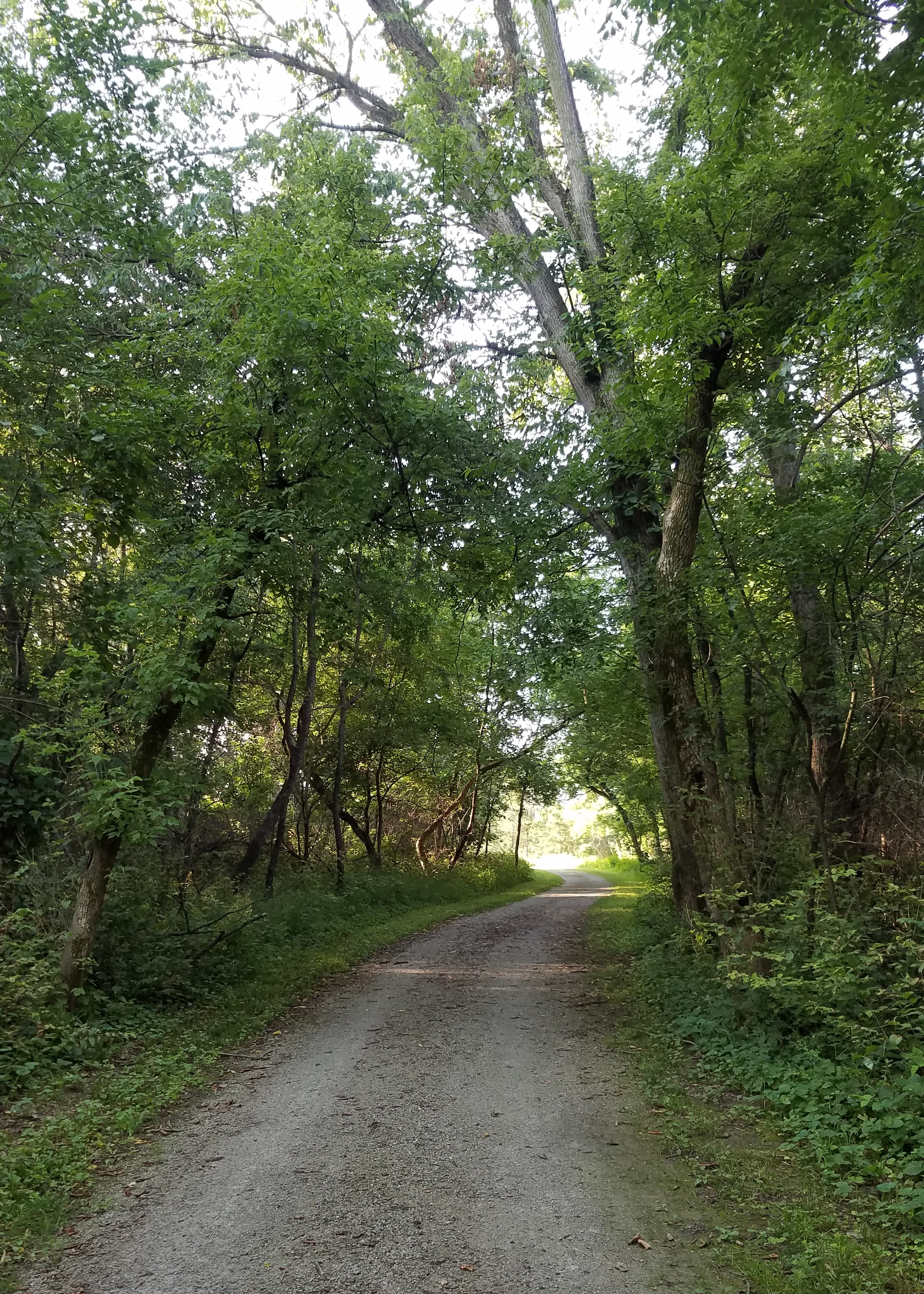
Lake Macbride State Park Trail, July 8, 2019.

With a form of financial security through a pension, the press of bills due without funds to pay them is also in remission (Thanks FDR for Social Security). Our consumer debt is going down: we gained almost $12,500 in net worth since my pension payments began and debt servicing picked up. Once the pressure of nose to the grindstone was relieved new possibilities opened up and there is more than financial improvement.

The biggest change is feeling comfortable staying home and working. I let one of my farmer friends know I would not likely be returning next year. At some point I’ll leave the home, farm and auto supply store to spend even more time at home. There is work here in the form of household repairs, reading, writing, gardening, cooking and such, to fill more time than I have left on this blue-green sphere.

In addition to the work, there’s the occasional chance to buy ice cream and become lost in the wetlands on my way home. I’m learning to see where I live again.

Categories
Kitchen Garden

Garlic Harvest 2019

Pulling Garlic

In a year of weird weather, garlic suddenly became ready to pull at Sundog Farm.

Some cloves began to burst and if the farmers couldn’t figure out exactly why, they decided to harvest it all before any more went past its prime.

It was a good call as the garlic heads brought to the barn were large and the crop was bigger than expected. It was an exceptional crop. The harvest took place on two days this week. I helped with the second.

Eight of us worked the field and racked the garlic for curing. It was hot work, and I couldn’t stand the sun and heat for long. After two and a half hours pulling garlic from the field, I changed to the racking operation in the barn to get out of the sun. There was plenty of work for everyone. Here are some photos of the operation.

Eight rows of garlic remained to pull on day two of the garlic harvest. The ground was wet so we pulled, shook off dirt on the roots, and let it dry in the sun for a bit.
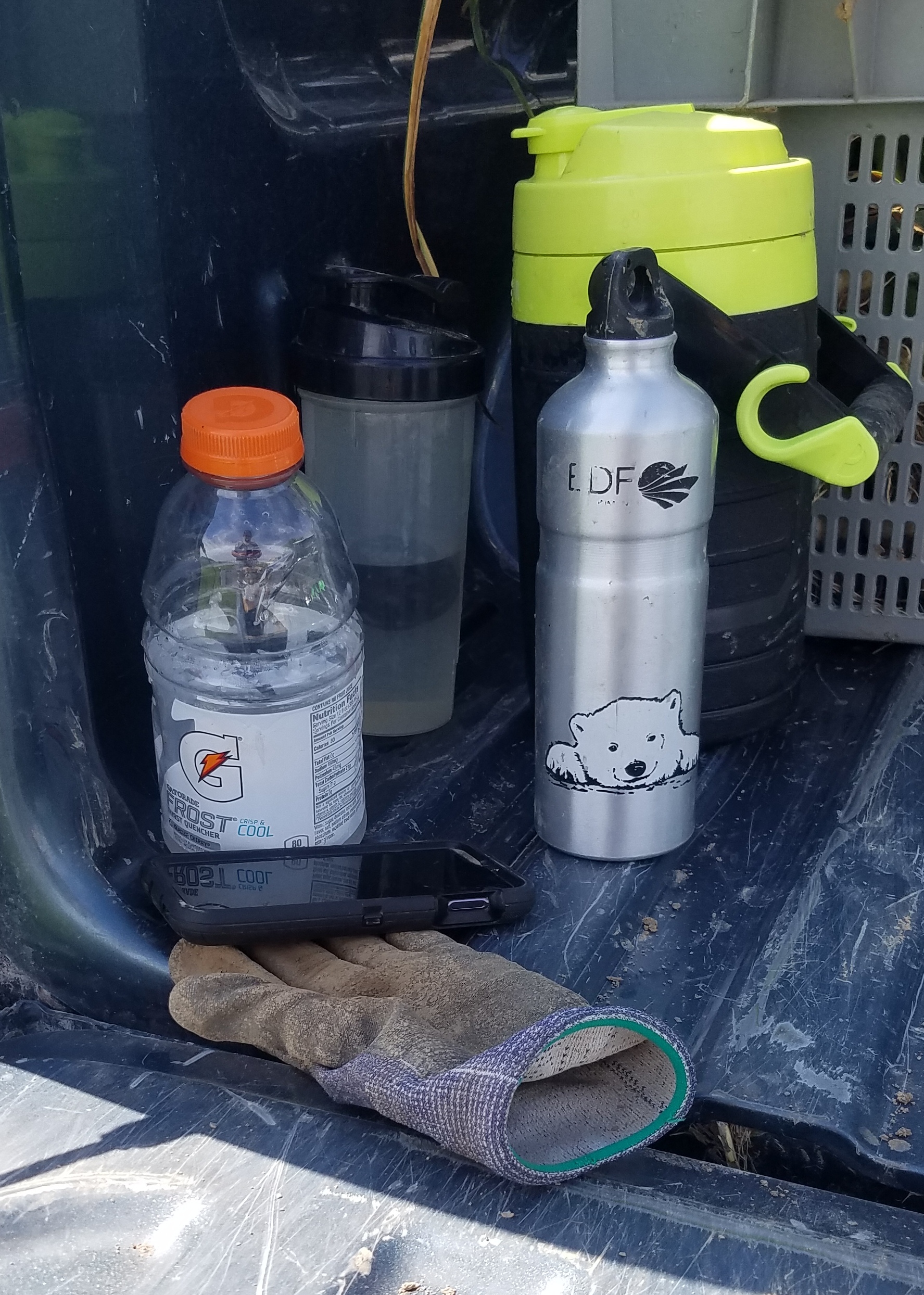
Staying hydrated is important and we refilled our water bottles multiple times over the morning.
After an hour or so, the stalks were cleaned of remaining dirt and hauled to the barn in a pickup truck.
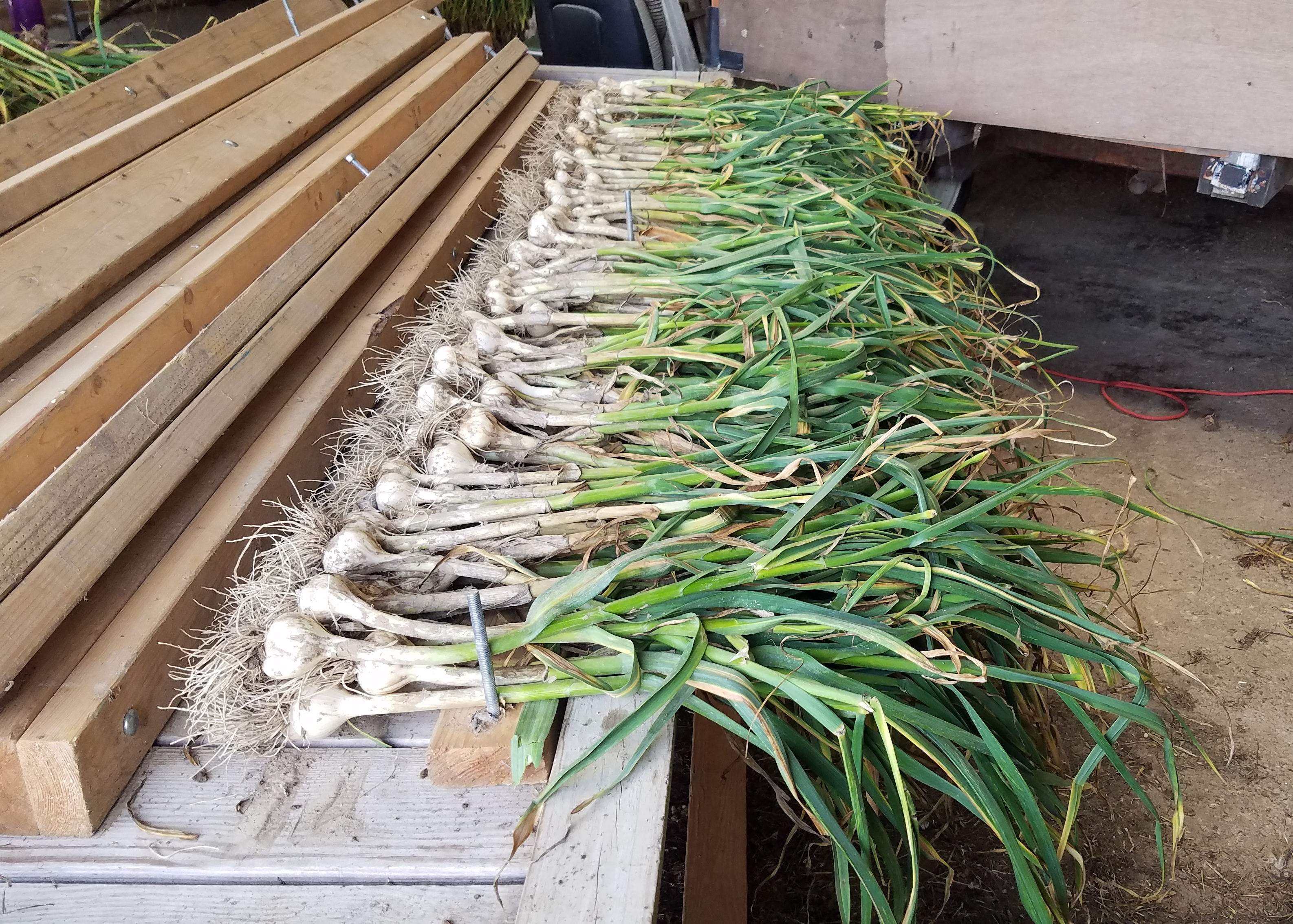
The stalks were inspected, sorted by quality and lined up along a two by four rack, three deep. Next a second two by four was placed on top and they were bolted together with three sets of nuts and bolts.
The individual racks were lined up on sawhorses where they will rest and dry until fully cured.
The farm crew got to take some fresh garlic home. Here are six heads I brought back. These are “seconds” that were a bit deformed or had been hit by the fork during harvest. They eat as well as any of them.

After clearing the field of garlic the crew met at the farm house where we ate lunch of grilled brats and hot dogs, fresh grilled vegetables, and pickled asparagus put up last year. The grilled onions had been picked just moments before hitting the grill. Days like this one feels something got accomplished.