Ed Fallon lives and works in Des Moines and has long been a friend of Blog for Iowa. Here’s an update on Ed’s current activities from an interview conducted last week via email.
We noticed you are affiliated with Bold Iowa. What is Bold Iowa and what attracted you to pitching your tent with them?
I continue to host the Fallon Forum and direct Bold Iowa. Bold Iowa grew out of the Bold Alliance, which was formed after the Keystone XL fight. Just a year after the alliance started, Jane Kleeb, founder of Bold Alliance, abandoned Alliance chapters in Iowa, Louisiana, Oklahoma and Virginia. We now operate as an independent organization.
What are you working on this summer and why?
We’re focused on supporting the landowners who have filed a lawsuit against the abuse of eminent domain to build the Dakota Access pipeline. Sierra Club is part of that suit. One of the ways we are supporting landowners is to raise awareness of the suit through The First Nation — Farmer Climate Unity March. We are also hosting a series of community forums, setting up editorial board meetings, sending out press releases, and encouraging people to write letters to the editor. If landowners and the Sierra Club prevail in the lawsuit, it could stop the oil from flowing through Iowa, North Dakota, South Dakota and Illinois.
Climate change has been in Iowa news this year more than recently. Have you noticed? If you’ve noticed, to what do you attribute the increased mentions in social and conventional media?
I’ve noticed, although the uptick has been small. Mostly, it seems some editorial boards and a few reporters are beginning to understand that climate change is not just another issue, that it’s a crisis that demands immediate attention.
What would you like our readers to do to support your causes during the remainder of 2018?
March with us Sept 1 – 8 from Des Moines to Fort Dodge, following the pipeline route through Story, Boone and Webster Counties. Contact media about the importance of the lawsuit and the urgency of climate action. Most important, vote in November for candidates who take climate change seriously.
Listen to the Fallon Forum live Mondays, 11:00-12:00 noon CT on La Reina KDLF 96.5 FM and 1260 AM (central Iowa). Add your voice to the conversation by calling (515) 528-8122.
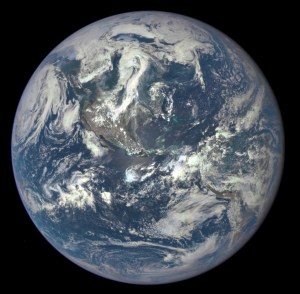
Image of Earth 7-6-15 from DSCOVR (Deep Space Climate Observatory)
Independence Day at the home, farm and auto supply store was a time to catch-up with organizing the warehouse, process expired pet food, reposition tall pallets of wood shavings, and generally clean up. The usual receiving activities slowed down as delivery drivers had the day off.
The store was pretty busy and comme d’habitude, management tried to feed us lunch: fried chicken with sides from a chain restaurant headquartered in Orange City.
I resisted. I also didn’t criticize because they were trying to be nice on the holiday we all had to work. We all should be nice when we can.
A couple of projects involved being outside in the blazing heat and humidity. I persisted and got the work done.
When working outside at home I get done early in the day to avoid mid day heat. I’ll work outside all day when the heat index is up to 90 degrees, but that’s the upper limit. With the heat and humidity we’ve been having that meant days indoors even though the sky was clear. It was weird.
According to this morning’s newspaper heat records are being set all over the world. In the Northern Hemisphere we’ve had the hottest weather ever recorded during the past week as a massive and intensive “heat dome” settled over the eastern United States.
In addition, the northeastern Atlantic Ocean is cooler than normal. Partly this means there may be less hurricane-strength storms this season. My worry is it’s being caused by melting of the Greenland ice sheet. If Greenland goes completely, the historical record shows the Atlantic meridional overturning circulation (AMOC) will slow down significantly or stop. That could mean disruption of the growing season in Europe and of their food supply. According to Scientific American, AMOC is the weakest it’s been in 1,600 years.
“The grand northward progression of water along North America that moves heat from the tropics toward the Arctic has been sluggish,” wrote Andrea Thompson. “If that languidness continues and deepens, it could usher in drastic changes in sea level and weather around the ocean basin.”
I think of the blue marble and how all of us on earth are connected.
“No single record, in isolation, can be attributed to global warming,” wrote Jason Samenow in the Washington Post. “But collectively, these heat records are consistent with the kind of extremes we expect to see increase in a warming world.”
There are so many signals and indicators of climate disruption in the global environment that such disclaimers may serve some editorial purpose but are immediately useless. The world is warming and there are consequences.
It’s about more than working outside on a humid and hot day at the home, farm and auto supply store.
Earth Day is and will always be about this photo taken by the Apollo 8 astronauts on the first manned mission to the moon.
“The vast loneliness is awe-inspiring and it makes you realize just what you have back there on Earth,” command module pilot Jim Lovell said from lunar orbit.
With a perspective six inches from our noses, we often forget who we are and how we fit into the vast reaches of the universe. We are a speck in a place larger than we can imagine.
When I participated in the first Earth Day as a senior in high school, the idea we should work together for peace, reduce pollution, and care for the environment seemed obvious. Even much reviled President Richard Nixon got it — society had to do something to address clean air, clean water and endangered species.
Earth Day is a chance to revisit this iconic photograph. When we consider a broader perspective, as the photograph encourages us to do, little has changed on Earth since it was taken. Our troubles seem petty compared to the overriding fact Earth is our only home. We are all in this together.
As much as societies seek to delineate metes and bounds, there are no borders on the globe. There is only one society of which we are all a part.
This Earth Day I’ll be working at home in my garden. A late spring created pent up demand for outdoors work. For the last four weeks, one excuse after another delayed needed work, yet now I’m ready to release the floodgates.
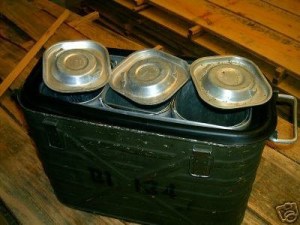
I first drank coffee in the Army… on top of a hill… during the dead of winter… from a mermite can.
Steam rising from the lid proved irresistible when ambient temperatures were below zero and we had just slept on the ground. What else were we going to do but drink coffee? It was there.
We each have a personal history of drinking coffee. I asked one of the greenhouse seeding crews if they remembered their first cup. Some had specific memories, others did not. For me, it was the windy hill in Germany back in 1976.
Coffee was first discovered in Ethiopia in the 11th Century and spread throughout the temperate zones of the planet. It is currently being grown in more than 60 countries. Brazil, Vietnam, Columbia, Indonesia and Ethiopia are the largest coffee producers by annual export weight. Coffee has become ubiquitous as any foodstuff can be.
Making Coffee
The sources of our coffee are under pressure because of climate change. Yields are declining in part because a warmer atmosphere holds more water vapor, creating unseasonable and extreme weather events. Likewise, warmer temperatures expanded the range of the coffee berry borer. Coffee rust is a detrimental fungus increasing its range as the planet warms and winters no longer kill it off in mountainous regions where coffee grows. The impact of global warming caused climate change is not trivial.
We would like to drink a cup of Joe without worry. When we go to the warehouse club there is a long, abundant aisle of coffee produced all over the world. A cup of coffee continues to be affordable at restaurants. It hardly seems like a problem. It isn’t… at least not now.
The science of global warming is virtually undisputed. What seems less certain is how it will impact our personal lives going forward. The Earth’s ecosystem is complex and specific regions have had different issues. We’ve had our share of droughts in Iowa, but there has also been enough rainfall to produce crops. Some days it seems the only persistent idea about Iowa’s climate is that rain remains. When it comes to coffee, what happens six inches in front of our noses is not as important as the global environment in which humans live.
There’s the rub.
With the 2016 election of a Republican to the White House, all eyes are diverted from our most pressing problems. Challenges to the study of climate change is one of those pressing problems and not only because I may be deprived of my daily cup of coffee.
The administration walked away from policy decisions we’ve made to reduce greenhouse gas emissions. It is cutting funding for climate research. It is censoring and targeting government scientists. One could reasonably say the government under Republicans has abandoned science as a consideration in policy-making.
As Americans, we know what to do. We must repudiate the direction Republicans are taking our society by voting them out in the 2018 and 2020 elections. I’d rather linger over my morning coffee than get involved in politics again. However, personal political engagement is the price of a livable future.
I’m sitting in the back of my pickup truck, the tailgate is down. Gentle summer rain is falling. The tips of my toes are getting wet but I don’t mind. We need the rain.
In Des Moines political parties are holding their conventions. I followed the action on social media, but not closely.
Breeze from the rain is cooling my forehead. It feels quite good. It is much better than working on a computer, or thinking about politics.
This afternoon I tried pulling weeds in the garden. The ground was so dry they broke off at the surface. Now, after this long gentle rain, the roots should loosen and weeding be done more easily.
Wind is blowing from the west and my knees are getting spattered with rain. I still don’t mind.
Dozens of birds are out in yards around the neighborhood. They don’t mind rain either. All of nature seems to welcome the rain.
Lightning and boomers are starting to roll in. The rain continues to fall gently and steadily.
Some nights it is best to just listen to the rain, and so I will tonight.
Group of captured Allied soldiers on the western front during World War I representing eight nationalities: Anamite (Vietnamese), Tunisian, Senegalese, Sudanese, Russian, American, Portuguese and English. Photo Credit – Library of Congress
Most of Armistice Day was at home.
The forecast had been rain, however, a clear fall day unfolded and I planted garlic. Pushing cloves into the ground with my thumb and index finger, I made two rows and covered them with mulch retrieved from the desiccated tomato patch. It doesn’t seem like much, it’s my first garlic planting ever. If it fails to winter I have plenty of seed to replant in the spring.
Had I been more prescient about the weather I would have spent more time outside: mowing, trimming oak trees and lilacs, clearing more of the garden, and burning the burn pile. Neighbors were mowing. The mother of young children piled up leaves from the deciduous trees at the end of a zip line portending great fun. Instead, I spent the morning cooking soup, soup broth, rice and a simple breakfast.
Leaves of scarlet kale were kissed by frost leaving a bitter and sweet flavor. I harvested the crowns and bagged the leaves to send to town for library workers. Usable kale remains in the garden. It will continue to grow with mild temperatures. Leaves of celery grow where I cut the bunches. There is plenty of celery in the ice box so I didn’t harvest them and won’t until dire cold is in the forecast. An earlier avatar of gardener wouldn’t have done anything in the garden during November.
I picked up provisions at the orchard: 15 pounds of Gold Rush apples, two gallons of apple cider, two pounds of frozen Montmorency cherries, packets of mulling spices and 10 note cards. Sara, Barb and I had a post-season conversation about gardening, Medicare and living in 2017.
The morning’s main accomplishment was clearing the ice box of aging greens by producing another couple gallons of vegetable broth. I lost count of how many quart jars of canned broth wait on pantry shelves. For lunch I ate a sliced apple with peanut butter.
We live in a time when favorite foods are under pressure from climate change. Chocolate, coffee and Cavendish bananas each see unique challenges from global warming. In addition, recent studies show the higher concentration of carbon dioxide in the atmosphere is reducing the nutrient value of common foods. Our way of life has changed and will continue to change as a result of what Pope Francis yesterday called shortsighted human activity. He was immediately denounced in social media by climate deniers.
This week, Congressman Ron DeSantis (R-FL) introduced the HERO Act which purports to reform higher education. Specifically, the bill would open up accreditation for Title IV funding to other than four-year colleges and universities. In an effort to break up the “college accreditation cartel” DeSantis would keep current Title IV funding but add eligibility for other post K-12 institutions. States could accredit community colleges and businesses to be recipients of federal loans for apprenticeships and other educational programs.
Telling in all of this is that as soon as he introduced the bill, DeSantis made a beeline for the Heritage Foundation for an interview about it with the Daily Signal. Does higher education funding need reform? Yes. What are Democrats doing to effect change in higher education? That’s unclear. A key problem is progressives don’t have a network of think tanks and lobbying groups funded by dark money to counter the HERO act or the scores of other conservative initiatives gaining traction in the Trump administration.
Even though the 45th president seems an incompetent narcissist, the influence of a conservative dark money network within his administration is clear: in appointments to the Supreme Court and judiciary; in dismantling the Environmental Protection Agency, in undoing progress in national monuments and parks, in weakening the State Department, in potentially politicizing the 2020 U.S. Census, and much more. The reason for his success is his close relationship with wealthy dark money donors and the agenda they sought to implement since World War II.
Today is the 39th anniversary of my return to garrison from French Commando School. I returned with a clear mind, physically fit, and an awareness of my place in the world.
“I am ready to experience the things of life again,” I wrote on Nov. 12, 1978. “The time at CEC4 has cleansed me of all things stagnant. I will pursue life as I see it and make it a place where I pass with love and peace for all.”
We work for peace on the 99th anniversary of the Armistice. If people are not unsettled by evidence of climate change and a Congress that ignores it in favor of pet projects designed to please the wealthiest Americans, we haven’t been paying attention. The need to sustain our lives in a global society has never been clearer.
Friends and family in the path of Hurricane Irma are well-informed of its danger and preparing for the worst this weekend.
Walt Disney World, where our daughter works, closes tonight at 9 p.m. until sometime Monday, presumably Irma’s schedule as well.
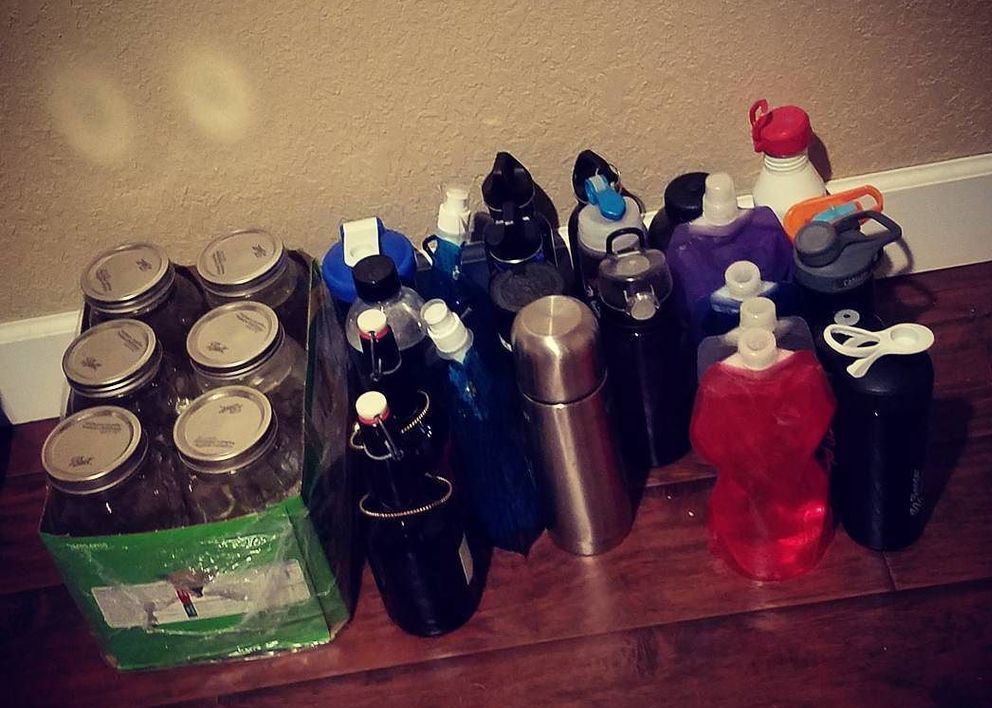
She is working today then hunkering down with supplies of water and shelf-stable food should the electrical grid fail. The open question is how much rain and wind will pelt central Florida.
“It’s not a question of if Florida’s going to be impacted, it’s a question of how bad Florida’s going to be impacted,” William “Brock” Long, administrator of the Federal Emergency Management Agency, said Friday, according to the Washington Post.
Irma maintained wind speeds of over 185 miles per hour for more than a day, the first storm in the world to do so.
Since 2007 I visited Florida several times. Each time people I met at the auto shop, convenience stores, retail outlets and elsewhere spoke of Hurricane Andrew and how it changed their lives. Floridians know hurricanes well. Surviving Irma is the focus for the next three days.
Environmental Protection Administrator Scott Pruitt commented about the link between Irma and global warming:
“Here’s the issue,” Pruitt told CNN Thursday in a phone interview. “To have any kind of focus on the cause and effect of the storm; versus helping people, or actually facing the effect of the storm, is misplaced. What we need to focus on is access to clean water, addressing these areas of superfund activities that may cause an attack on water, these issues of access to fuel. … Those are things so important to citizens of Florida right now, and to discuss the cause and effect of these storms, there’s the… place (and time) to do that, it’s not now.”
The upshot is in a backhanded way, Pruitt acknowledges the need to evaluate causation of large tropical storms. I’m confident facts will lead him to how global warming made Irma and other recent tropical storms worse. I may be overly optimistic but the truth matters.
Our household will be following the progress of Irma as it makes landfall in Florida and over the next 48 hours. Hoping the people of Florida withstand the death, destruction and economic consequences of this next in a series of major storms. I expect Floridians will be resilient as this is not their first hurricane rodeo. I trust our daughter will do what’s needed to weather the storm.
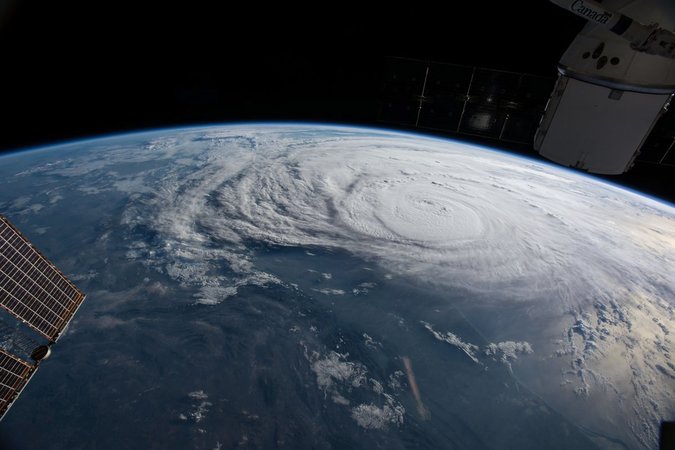
Hurricane Harvey from the International Space Station on Aug. 25, 2017. Photo Credit – NASA European Pressphoto Agency
Rain tapped the bedroom window this morning on the fringe of Hurricane Harvey.
It was a reminder of our connection to the oceans. They are absorbing heat from the atmosphere on a planet experiencing some of its warmest days in living memory. A warmer atmosphere holds more moisture and the result is intense storms like the Category 4 Hurricane Harvey.
In Iowa we adapt easily to hurricanes because of our distance from the coast. Needed rain benefits our gardens and farms. It recharges our surface aquifers. As the weather pattern moved over it seemed normal, not as devastating as it was when Harvey made landfall in Texas Friday afternoon.
Overcast skies and a slight rain depressed attendance at the orchard on Saturday. There were enough visitors to keep busy, especially in the afternoon when the sun came out. Sales seemed steady if light.
One of my favorite August apples is Red Gravenstein, a Danish cultivar. It was introduced to western North America in the early 19th century, according to Wikipedia, perhaps by Russian fur traders, who are said to have planted a tree at Fort Ross in 1811. Red Gravenstein is tart, juicy and crisp — great for eating out of hand.
The cider mill made the first press of apples for the sales barn. The gallon and half gallon jugs sold well. Over the years I’ve come to appreciate the changing flavor of our cider as we move through the apple harvest. I bought a gallon of cider and a dozen Red Gravenstein apples at the end of my shift.
I’ve been reading recipes for tomato catsup in old community cookbooks. After reviewing a dozen or so I went to the kitchen and created this sauce from the abundance of red bell peppers and tomatoes:
Red Pepper Sauce
Ingredients
Half dozen cored and seeded red bell peppers cut in quarters
Equal amount by weight of cored tomatoes one inch dice
One cup of malt vinegar
One teaspoon salt
One tablespoon refined sugar.
Process
Pour the vinegar into a saucepan and bring to a boil.
Add tomatoes and peppers.
Add sugar and salt.
Bring back to a boil and cook for 10-20 minutes until the vegetables are soft.
Strain the mixture. Retain the liquid to use as vinegar in salad dressings.
Run the vegetable mixture through a food mill and either serve immediately or bottle and refrigerate.
Recipe notes
To make a thicker sauce, either reduce it in the saucepan or add tomato paste.
I used malt vinegar because it was on hand. Absent malt vinegar I’d use homemade apple cider vinegar.
Image of Earth 7-6-15 from DSCOVR (Deep Space Climate Observatory)
A recent article at Nuclear News reminds us the world is on the cusp of an energy revolution.
“The cost of renewables like solar and cell batteries for electric vehicles are making the carbon-based economy obsolete, with the turning point only a few years away,” author Christina MacPherson wrote.
The age of centralized, command-and-control, extraction-resource-based energy sources (oil, gas, coal and nuclear) will not end because we run out of petroleum, natural gas, coal, or uranium,” Stanford University professor Tony Seba recently said. “It will end because these energy sources, the business models they employ, and the products that sustain them will be disrupted by superior technologies, product architectures and business models. Compelling new technologies such as solar, wind, electric vehicles, and autonomous (self-driving) cars will disrupt and sweep away the energy industry as we know it.
When we consider the use of coal in Iowa, there are many of us who remember the coal trucks plying the streets and alleys of our childhood, dropping loads of the black stuff down chutes leading to a basement coal bin and then to our gravity furnaces. Through the winter, people shoveled coal into burning embers to heat their homes. Coal ash was shoveled out and in the spring, it was tilled it into gardens and spread on fields. Coal ash was also sent to dumps. On the farm, coal was purchased with seeds, feed and grain. It was part of a background to life that did not consider the potential harm to human health we now know it represents.
Those born in the 1950s and before have living memory of how natural gas replaced coal for home heating. The conversion was driven by much lower natural gas cost compared to coal. Similarly, lower costs of renewables will drive the move away from fossil fuels. We are almost at that point, as MacPherson indicated, and the business community is recognizing the reality by investing in renewables.
A recent article by Eva Zlotnicka for Morgan Stanley reiterates this point.
Economics and improving technologies, not regulation, are the driving forces behind many of the sustainability trends in global markets today. Our energy commodities team’s fundamental analysis of power-generation economics shows that longer-term coal can’t compete with natural gas or renewables, even on an unsubsidized basis. In a recent report, the team cut its 2017 coal-burn forecast by around 4%, and now sees only a modest year-over-year improvement, with most of those gains lost by 2018, due to ongoing competition from natural gas and renewables.
The 45th president made much of reviving the coal industry during his election campaign. The trouble for him is the market is heading a direction that not even he and his fossil fuel friends can stop. He can roll back all the regulations he likes and the market will continue to drive the switch to renewable energy.
Many of us were disappointed when President Trump announced his decision to exit the Paris Climate Agreement. It was all hat no cattle.
There is almost no disagreement in the scientific community that fossil fuel use contributes significantly to planetary warming and related climate change. However, that’s not the point. What gave rise to the Industrial Revolution continues to work, and as renewable energy costs decline and become cheaper than the cost of fossil fuels and nuclear, bankers, manufacturers, and service industries will convert because it makes business sense to do so.
Add the public health, environmental, business and economic value of renewables together and a scenario where energy companies may start divesting themselves of coal and oil operations emerges.
How will the U.S. exit the Paris agreement? 45 didn’t say. Will his administration follow the four-year exit process outlined in the agreement, or will he remove the United States from the U.N. Framework Convention on Climate Change (UNFCCC), exiting in about a year? If the drivers of transformation in our energy system are economic, what whit of difference does his decision make?
The agreement posed no financial risk to the United States, according to Morgan Stanley. It seems doubtful other nations will follow the United States out of the agreement, although some may. The pursuit of the goals in the Paris Agreement by remaining countries, combined with the efforts of U.S. states and cities acting on their own, offer the best chance to reduce carbon pollution in the atmosphere.
Nonetheless, an energy revolution is going on and at this point little politicians do seems able to stop it.
It’s a scary article with frightful truths circulating on social media.
Half truths according to Michael E. Mann, director of Earth System Science Center at Penn State. Mann wrote onFacebook:
Since this New York Magazine article (“The Uninhabitable Earth”) is getting so much play this morning, I figured I should comment on it, especially as I was interviewed by the author (though not quoted or mentioned).
I have to say that I am not a fan of this sort of doomist framing. It is important to be up front about the risks of unmitigated climate change, and I frequently criticize those who understate the risks. But there is also a danger in overstating the science in a way that presents the problem as unsolvable, and feeds a sense of doom, inevitability and hopelessness.
The article argues that climate change will render the Earth uninhabitable by the end of this century. Extraordinary claims require extraordinary evidence. The article fails to produce it.
If we are clicking on New York Magazine for our information about the threats of climate change then now, more than ever, it’s clear mental health care is needed in whatever healthcare bill Congress passes this year.
Taking action on climate (or anything else) based on fear would be as scary as Wallace-Wells’ article.
On Sunday, Al Gore was in the news about his climate work.
“Those who feel despair should be of good cheer as the Bible says,” Gore told Lee Cowan of CBS News. “Have faith, have hope. We are going to win this.”
The need to act on climate is all around us according to Gore.
“It’s no longer just the virtually unanimous scientific community telling us we’ve got to change,” he said. “Now Mother Nature has entered the debate. Every night now on the television news is like a nature hike through the Book of Revelation. People who don’t want to use the phrase ‘global warming’ or ‘climate crisis’ are saying, ‘Wait a minute. Something’s going on here that’s not right.'”
Gore is right. Don’t despair. Act on climate.
If you don’t know what to do, The Climate Reality Project provides an action kit to get you started. Click here to find it.





 Journey Home
You must be logged in to post a comment.