This week is the biannual vendor show at the home, farm and auto supply store. We’ll be short staffed today and tomorrow while associates from Iowa and Wisconsin travel to Dubuque to attend seminars and discuss products and process with our vendors.
If it’s like last year, my work queue will build up and I won’t dig out until Thanksgiving. The days will pass quickly and my aura may be colored in shades of grumpiness.
Coffee helps.
This weekend — Labor Day weekend — is the unofficial end of summer and I’m ready to glean most of the garden leaving only kale and peppers until first frost arrives in October. I secured seed garlic from one of the farms and will plant in September. The garden has been successful, the most successful in memory. It has been encouragement to plan for next year.
Saturday and Sunday I made a large pot of vegetable broth with items mostly from the ice box: kale, collards, chard, celery, three kinds of summer squash, carrots and onions. The resulting product was dark and rich.
I made rice with the broth, poured some in canning jars, and made a big batch of lentil-potato-barley soup for work lunches. I used eight or ten leeks in the soup which made it slightly sweet. Growing leeks creates a wonderful availability for the kitchen.
Last night I picked tomatoes, peppers, celery and leeks while the water bath canner came up to temperature on the stove. I ate a Red Delicious apple from the tree. It was slightly sweet and mostly starchy. It is time to begin monitoring the fruit’s progress. The pear tree is close to ripe and will be picked this week.
There is plenty of kitchen work ahead.
So begins another day in the final lap of a working life. I’m heading to the kitchen where I’ll make a second pot of coffee before work. The hot beverage doesn’t resolve our challenges. It makes them more tolerable.
Hurricane Harvey from the International Space Station on Aug. 25, 2017. Photo Credit – NASA European Pressphoto Agency
Rain tapped the bedroom window this morning on the fringe of Hurricane Harvey.
It was a reminder of our connection to the oceans. They are absorbing heat from the atmosphere on a planet experiencing some of its warmest days in living memory. A warmer atmosphere holds more moisture and the result is intense storms like the Category 4 Hurricane Harvey.
In Iowa we adapt easily to hurricanes because of our distance from the coast. Needed rain benefits our gardens and farms. It recharges our surface aquifers. As the weather pattern moved over it seemed normal, not as devastating as it was when Harvey made landfall in Texas Friday afternoon.
Overcast skies and a slight rain depressed attendance at the orchard on Saturday. There were enough visitors to keep busy, especially in the afternoon when the sun came out. Sales seemed steady if light.
One of my favorite August apples is Red Gravenstein, a Danish cultivar. It was introduced to western North America in the early 19th century, according to Wikipedia, perhaps by Russian fur traders, who are said to have planted a tree at Fort Ross in 1811. Red Gravenstein is tart, juicy and crisp — great for eating out of hand.
The cider mill made the first press of apples for the sales barn. The gallon and half gallon jugs sold well. Over the years I’ve come to appreciate the changing flavor of our cider as we move through the apple harvest. I bought a gallon of cider and a dozen Red Gravenstein apples at the end of my shift.
I’ve been reading recipes for tomato catsup in old community cookbooks. After reviewing a dozen or so I went to the kitchen and created this sauce from the abundance of red bell peppers and tomatoes:
Red Pepper Sauce
Ingredients
Half dozen cored and seeded red bell peppers cut in quarters
Equal amount by weight of cored tomatoes one inch dice
One cup of malt vinegar
One teaspoon salt
One tablespoon refined sugar.
Process
Pour the vinegar into a saucepan and bring to a boil.
Add tomatoes and peppers.
Add sugar and salt.
Bring back to a boil and cook for 10-20 minutes until the vegetables are soft.
Strain the mixture. Retain the liquid to use as vinegar in salad dressings.
Run the vegetable mixture through a food mill and either serve immediately or bottle and refrigerate.
Recipe notes
To make a thicker sauce, either reduce it in the saucepan or add tomato paste.
I used malt vinegar because it was on hand. Absent malt vinegar I’d use homemade apple cider vinegar.
A co-worker asked if I needed to borrow another water bath canner to survive the season.
This year’s abundance of vegetables has been stunning. There is a lot to preserve including apples, pears, celery, peppers and a couple dozen pints of tomatoes.
I said no.
By the time I get home from a shift — either at the home, farm and auto supply store or the orchard — and start in the kitchen, I’ve found barely enough time to prep seven containers for a water bath batch. Although it seems like a second canner would increase production, the most time-consuming home canning work is done before turning on the stove. At best, we can only capture a part of seasonal abundance in jars. A second canner doesn’t resolve the issues created by low wage work and the time it absorbs in our days.
Canning Soup and Jalapeno Peppers
Being a low wage worker is an economic grind. One knows there will never be enough money to pay for what we need. Financial friction wears us down. Avoiding spending on anything not related to basic survival becomes a primary focus. This may seem negative, and it’s not all good. However, it’s a life with as much potential as any I’ve experienced. That’s not saying a lot for our society.
There is dignity in work whether it is paid or not. Each jar of applesauce put up contributes to our lives. In the twilight of a career as a wage worker life changes. Youthful ambition wears down. Unpaid work becomes more important to sustainability and displaces paid work in our days. There are expenses to be paid and they shift as full retirement approaches. Figuring out how to adjust and what to emphasize in a society wanting participation is challenging. Developing resilience under the weight of social responsibilities becomes key to sustainability.
After what for him is detailed consideration, our president chose perpetual war in Afghanistan as he announced last night. Dealing with constant negative information about the 45th president has become a grind as well. While Obama chose perpetual war, there were redeeming aspects of his presidency, including a sharing of important issues. There was a sense the country was heading is a positive direction, despite his many legislative setbacks. There is none of that with President Trump. We go deeper into the grinder.
A low wage worker withdraws into a small circle of family and friends. In so doing our circle of influence shrinks on its way to irrelevance. What remains is work: low wage jobs, fixing the toilet, cooking breakfast, cleaning the house, and tending the garden. Such activities fill our days and hinder our relevance in political life. At the same time, there is work in society that needs to be done.
To work on resilience, persistence and engagement is as important as anything we do. It sustains our lives in a turbulent world.
A gardener and farm worker has access to lots of summer vegetables, especially “farm seconds.” It is difficult to use them up before they turn to compost.
The recipe for roasted red pepper and tomato soup is simple and the results are sweetly tasty. It was born of an abundance of bell peppers and tomatoes.
I wouldn’t expect anyone to go to the market and buy ingredients for this dish. If one has the peppers and tomatoes, almost everything else is on hand in a well stocked kitchen.
Roasted Red Peppers
Make a batch or two of roasted bell peppers for the soup and to use in other dishes.
Preheat the oven to 450 Degrees Fahrenheit with the shelf in the middle position.
Cull the best red peppers from the lot, halve them and remove the membrane, core, seeds and any bad spots. Using a melon baller makes it super easy and more precise in removing all of the membrane. Peppers needn’t be perfectly halved. Put them skin side up on a piece of parchment paper on a baking sheet with sides. Nestle them close together to get as many as possible on the baking sheet.
Bake at temperature for 25 minutes and remove from the oven.
Using tongs, move the roasted peppers to a bowl and cover it with a plate. This process helps loosen the skin. Let them sit until they can be handled without burning fingers.
One-by-one take the pieces of pepper and remove the skin. Place them in a refrigerator dish and refrigerate until ready to use.
Roasted red peppers are an ice box staple during pepper season. For longer storage there are recipes for oiling and preserving them. They are so sweet and tasty they won’t last long in most households.
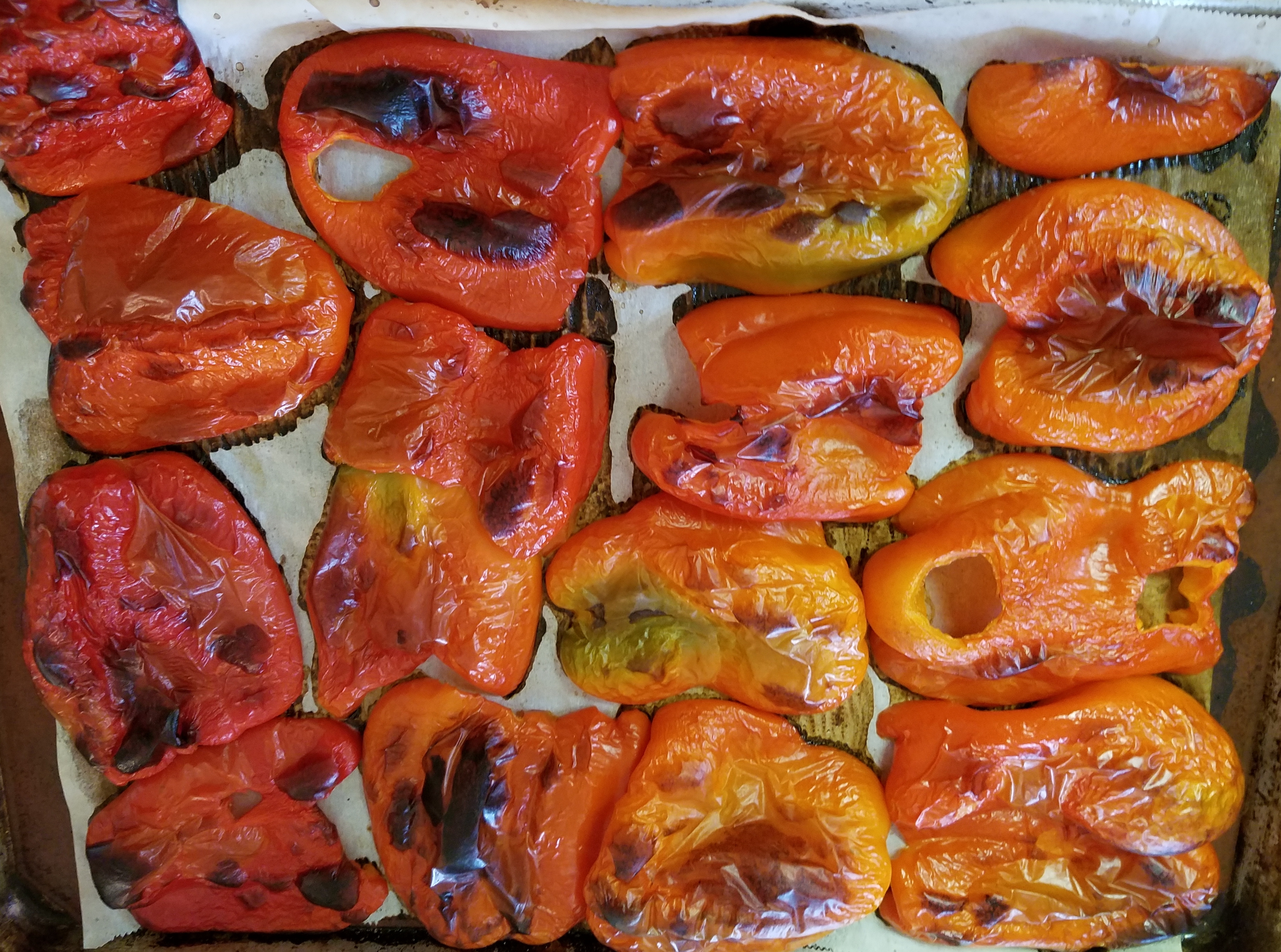
Roasted Red Peppers Before Removing Skin
Roasted Red Pepper and Tomato Soup
This recipe makes two quarts, enough to serve four – five people.
Add one cup vegetable broth to a Dutch oven and bring to a boil.
Add:
Equivalent of 5-6 large tomatoes, one-inch dice.
Enough roasted red peppers to approximately equal the weight of the tomatoes, maybe a little less.
Two tablespoons salted butter.
One six ounce can prepared tomato paste.
One teaspoon each dried spices including smoked paprika, granulated garlic and thyme. Fresh is better if you have it. Double the amount if you do. Herbs and spices are always to taste.
One tablespoon dried basil. Fresh basil is better. Double the amount if you have it.
Two tablespoons dried onion flakes.
One tablespoon sweetener. I used sugar because it was in the pantry.
Salt and pepper to taste.
Teaspoon of red pepper flakes, cayenne pepper or your favorite pepper spice (optional).
Stir to incorporate the ingredients, bring to a boil and turn down to a simmer. Cook until the tomatoes begin to soften. Don’t cook the tomatoes to death. You will want some bits of recognizable tomato granules in the final product.
Either transfer the mixture to a blender or use an immersion blender to smooth it to a pleasing texture. As mentioned, I like little bits of recognizable tomato and pepper.
Add one cup half and half and stir constantly until the soup is well-mixed and up to temperature.
Serve hot, garnished with fresh basil, a dollop of sour cream or snipped chives. Whatever looks appetizing and is available.
This recipe was fun to make and better than manufactured roasted red pepper and tomato soup in aseptic containers. Leftovers, if any, will keep for a couple of days.
The text message came while I worked at the home, farm and auto supply store. I saw it on my afternoon break.
“If you want to start tomatoes there is a crate on the packing shed floor you could pick up on way home from work,” Farmer Kate texted. “I’m not home but if you need help finding them let me know.”
We barter my labor canning for her tomatoes. Ready or not, the next aspect of the local food season begins with its quick-paced rush to beat spoilage.
When I picked up the tomatoes there was also a crate of bell pepper seconds unclaimed by CSA members. A farm worker offered them and I put the crate in the back of my Subaru.
On the way hope I spotted the librarian leaving the library for her car and swung by to offer some peppers. My sister in law was at our house when I arrived home. I offered her some too. They are so sweet — unlike what’s available at the grocery store. A gift to be shared.
The garden is coming in with more apples than can be picked before they drop. Pears are almost ready, there are tomatoes, celery, hot peppers, basil and more waiting to be harvested and processed. There will be more cucumbers for pickling. Sweet corn will run another week or two at the roadside stand and we want to put some up. Every night after work and most mornings before, I’m in the garden harvesting or in the kitchen making dishes and preserving the harvest. Right now tomatoes, peppers, sweet corn and apples are in the house waiting to be processed. It’s a mad rush.
It’s also a good life. Staying busy with useful work blocks out negativity from other sectors of society. It’s cultured and produces the tangible benefits of relationships, knowledge and good food for our table and those with whom we share.
For the rest of August and September, it’s work, kitchen, garden for me.
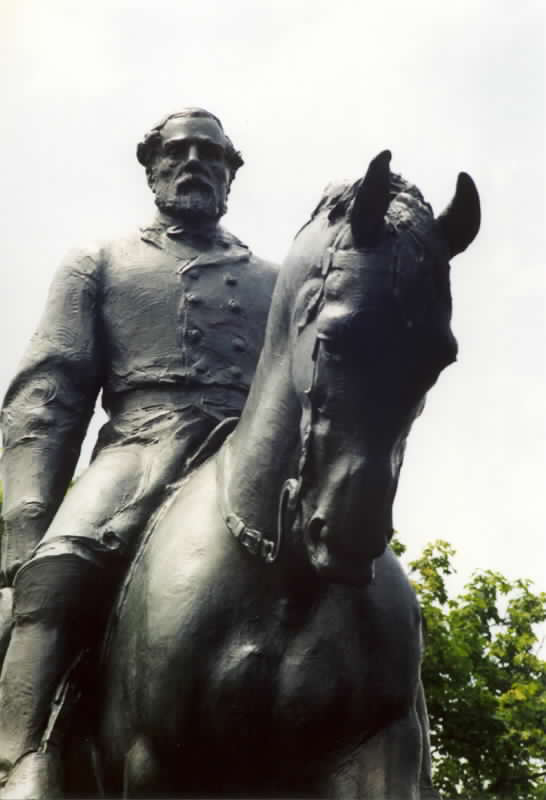
Statue of Robert E. Lee, Charlottesville, Virginia. Photo Credit – Leo Lentill, Wikimedia Commons
I was stationed at Robert E. Lee Barracks in Mainz-Gonsenheim, Germany during my military service as an infantry officer.
It seemed odd at first — that the American kaserne would be named for the commanding general of the Confederate Army of Northern Virginia — but it became background for what could be described as a politicized military presence in which drugs, domestic violence, alcoholism and prostitution — regardless of race or ethnicity — eclipsed such concerns. The post-Vietnam military was a pisser.
A descendant of Virginians, with family roots 100 years before the American Revolution, I came up learning a tolerance for the Confederacy as a way of seeking my own ethnicity. Over time I followed the advice of 1 Corinthians 13:11, King James version, “When I was a child, I spake as a child, I understood as a child, I thought as a child: but when I became a man, I put away childish things.” I now have no patience for those who would whitewash the peculiar institution that was part of antebellum Virginia.
My connections to the Old Dominion, now Commonwealth, have been numerous. In light of this weekend’s violent confrontation in Charlottesville, one comes to mind.
I met and worked with Virginian Mike Signer who came to Iowa to work on the John Edwards presidential campaign before the 2008 Iowa caucus. Later I worked on his campaign for lieutenant governor, canvassing a Virginia call list from a restaurant on the Iowa City pedmall. He lost that election but went on to become mayor of Charlottesville, Virginia where a statue of Robert E. Lee is the center of controversy that precipitated violence and at least three deaths over the weekend. Here’s his statement on Friday’s events:
I have seen tonight the images of torches on the Grounds of the University of Virginia. When I think of torches, I want to think of the Statue of Liberty. When I think of candelight, I want to think of prayer vigils. Today, in 2017, we are instead seeing a cowardly parade of hatred, bigotry, racism, and intolerance march down the lawns of the architect of our Bill of Rights. Everyone has a right under the First Amendment to express their opinion peaceably, so here’s mine: not only as the Mayor of Charlottesville, but as a UVA faculty member and alumnus, I am beyond disgusted by this unsanctioned and despicable display of visual intimidation on a college campus.
Racism stained our country indelibly. It continues to define us, as evidenced in Charlottesville. There are no “sides” to this conflict just an emerging realization this is not about remembrances of who led the Confederate Army of Northern Virginia during the Civil War. It’s about paying attention to racism in society and taking steps to confront it in our daily lives. That is easier said than done. In Iowa there is plenty of this work to be done.
Editor’s Note: This series of nine posts was written from Jan. 18, 2009 until March 15, 2009 as I considered my life and what else I might accomplish. They are consolidated below unedited and in the order I wrote them. I left my transportation career shortly after completing this series on July 3, 2009.
I. Each of us has a collection of moments from our lives that define who we are and what we can and will be. Our lives are not predetermined. We can effect change in ourselves and in our relationships in society. Too often, we can get caught up in the trivial and small minded conflicts of daily life. There are plenty of these. We need to be better than this for at stake is everything we hold to be important. Above all, we should strive to be engaged in our daily lives, less creatures of habit and more innovators of the ordinary. Today, in this moment, we have the power and potential to create a life beneficial to ourselves, but more importantly, beneficial to others. Defining moments have informed us in how to behave, and we owe it to ourselves to consider them from time to time.
My earliest defining moment was the day, at age 3-1/2, when a swing-set set up in the basement of our Madison Street home collapsed and injured my head. My parents were horrified. I remember the pool of blood on the basement floor, holding the thumb of the ambulance driver, taking ether dripped into a funnel to anesthetize me for the stitches to mend my gashed head. I am lucky to be alive. What I learned through the injury and recovery in the hospital was that there is an infrastructure of knowledge and caring to support us when things happen. I watched the routines of the hospital staff, the doctor checking up on me, changing room mates and bed linen, daily visits from my parents and the handling of my propensity to get out of bed and walk around. This experience assured me that although we are vulnerable, we are not alone.
Over the years, Doctor Kuhl would examine the scar on my forehead and talk about my recovery when I visited him in his office. Today, I don’t think of the scar, and suspect most people do not even notice it. What I do think about is that while we are not alone, we must be part of a society that helps protect those who are most vulnerable, including the injured and infirm. When I was very young, I made a withdrawal from this bank and now the debt needs repaying.
II. At Northwest Bank and Trust Company, while getting my first checking account, I was deprived of the knowledge that my father would die later that night at the meat packing plant. I had been working at a department store after school and had saved enough to want to spend some of it. The bank was open late on Fridays. I can still remember the light inside the bank and the help from the teller. To do this on my own was a big step and I knew it. As it turned out, it was a step I needed to take.
We were shocked when the knock came on the front door. Two men, Clarence from the union and another I can’t recall, were there to tell our mother what had happened. We kids waited in mom’s bedroom. We were all crying together that night. Life came at us that February morning, ready or not.
Death was somewhat abstract. We watched the fighting in Vietnam in the newspapers and on television. A grandparent had died and was buried at Saint Hyacinth’s in LaSalle. We heard about World War II from neighbors who had served. We knew we would not live forever, but we did not consider death as a present option. This started to change as I heard a newscaster report my father’s accident on television.
During the days leading up to the funeral an endless stream of people came to the house. Relatives, co-workers, friends with covered dishes and desserts, people from bars and restaurants near the plant, fellow students from the chiropractic college, our insurance agent, and many others. My father’s two brothers and sister came in their only joint visit to our house. My mother’s brothers and Aunt Dorothy drove non-stop from California. Even though my father had not finished his conversion to the Catholic faith, a funeral mass was held and the church was packed to capacity. Even the elementary school children filed into the balconies and back of the church. As I sat in the pew, listening to Monsignor Barnes, I realized that Dad’s death and his funeral were community events. I felt that I was part of the community and still do.
Whatever arguments I had with Dad ended that night. I still think of him from time to time and miss him when I do. I was lucky. Lucky that I was about to embark on my studies at the University of Iowa and lucky that mother had the means to support my brother and sister if I left. We talked about me staying to help instead of going to college. She released me from the nest and for that I will always be thankful.
As our lives continue, the lesson I learned that Friday night is that before you know it, life is over. If we want to accomplish something, we need to do it now, as there may not be a later. It is a lesson that I forget, but to which I always return. I had a hard taskmaster in that defining moment in 1969.
III. When news of the Woodstock Music and Art Fair hit the television, there were already tens of thousands of people in attendance. I was working at a department store and when Dennis offered to drive to Woodstock in exchange for gas money, I gave it consideration. I declined the opportunity because I was scheduled to work Saturday. His new GTO with the Hurst transmission would surely make it out to New York, but I had other things on my mind. Today and this weekend has felt like that August afternoon in 1969 with friends hopping planes and driving cars to the Washington DC to participate in Barack Obama’s inaugural events. Today, like then, I have to work. In a sense, not much has changed over the years.
Dennis and I did not go to Woodstock. What I learned was that the actual being there does not inhibit the participation. That decision making, the idea that the road to Woodstock started in a parking lot in Iowa made this remote event tangible and within the scope of our daily lives. I felt connected, even if I did not traverse the country to get there. As it turns out, Woodstock was so well documented that I learned enough about it to understand and participate vicariously. In the case of Woodstock, actually being on Yasgur’s farm did not matter and that is my point.
When we consider information about events arriving in our locale, that information has a basis in reality. As a participant in mass society much of what we learn and understand is molded by an ever changing media in many formats. In a sense, the gap between our inner eye and that of another is the same whether the person is sitting next to us on a couch or is a thousand miles away. When Rene Descartes said “I think, therefore I am,” he was not aware that there would be a Woodstock or an Obama inauguration but in that moment, in the parking lot of the Turn-Style department store, I became aware of the Cartesian outlook in a way that has become part of who I am. Living in society is not about us. It is about communicating through the unseen ether to others in engagement that is as old as civilization. It is something in which it is worth engaging.
IV. Richard Nixon announced his resignation from the presidency on August 8, 1974. I had no idea who Gerald Ford was, or what kind of leader he would be, but the next day, when he said, “My fellow Americans, our long national nightmare is over,” I packed my boy scout backpack and a baby blue bag my grandmother made for me with a couple of changes of clothes, a passport, $2,000 in American Express travelers checks, a sleeping bag and ten rolls of Kodak film and left for Europe.
After college, I shared an apartment with a fellow band member on Walling Court in Davenport, Iowa near the former home of jazz legend Bix Beiderbecke. I felt a strong sense of social responsibility and the moral outrage of youth in what I believed were the deception and lies of a man in whom the country had put its trust. Hearing Nixon’s address that night, in our small apartment was catharsis. I remember this feeling as I type here in Big Grove tonight. I was relieved that Nixon was leaving. More importantly, I felt that the many protests and demonstrations during the Vietnam war had finally borne fruit. Direct action to support a just cause could accomplish things, even force out a sitting president. It was a heady feeling. I wasn’t sure what would be next, but I felt that I could take a couple of months and find out what else was in the world.
That I began with Europe was no surprise: studying English literature in college, neighbors who had served in Europe during World War II and art history classes in high school and in Iowa City. Then, I believed that the United States was a derivative of the European experience. With my mother’s side of the family coming from Poland and my father’s from Virginia, it was not a stretch and my travels confirmed this. I saw Twelfth Night at the Royal Shakespeare Company in Stratford, England. I saw a poster of Bix Beiderbecke when I emerged from the Metro on the left bank in Paris. I ran into a friend from Davenport while taking a bus to the Piazza San Marco in Florence. I discovered a Europe that was familiar and a world small enough for these things to happen. At a youth hostel in Rome, a stranger took me over to the Vatican City and got me tickets for an audience with Pope Paul VI. I learned enough Italian so that when I traveled to Ravenna to see the Byzantine mosaics I could register for my room and order meals in the native language. I bought a cameo on the Ponte Vecchio in Venice, the same place mentioned by Shakespeare in The Merchant of Venice. Jacque wore that cameo at our wedding. I also saw the glockenspiel in Munich along with the place where the Israeli athletes were murdered by terrorists during the 1972 Olympic Games. I was moved by the Dachau concentration camp. I was enamored of the paintings by Vermeer. It was a busy trip, unplanned and random. With Eurail pass in hand, there was always another train to take me someplace new.
Yet it was that moment of seeing Nixon resign on television that opened up the possibilities of the world. I became aware that direct action, in concert with others I did not know, could engender change in society. I also learned that the people, places and things we read about can be grounded in a reality that is not that distant from where we live. We are connected to each other in unlikely ways.
I refused to purchase a copy of Nixon’s memoirs until after his death. I did not want him to benefit from my interest in his presidency. In a way, Richard Nixon, with his deceit, arrogance and imperial presidency, contributed to my awakening to the possibility of social change through direct action. This awakening led me to understand that what I had studied in school was grounded in reality. It was an unlikely connection for which, in retrospect, I am thankful.
V. In January of the bicentennial year I packed again and left for basic training at Fort Jackson, South Carolina. I had been living in a one room apartment near the Mississippi River and the combination of willingness to serve and the end of the Vietnam war led me to seek out the Army recruiter, enlist for Officer Candidate School and put aside concerns about risking my life by saying it was better for peace lovers to join the military and lead, rather than leave it to the likes of Lieutenant William Calley. Calley is the convicted war criminal who was responsible for the 1968 My Lai Massacre, and an example of what was worst about the military during the Vietnam era. We could do better than that.
The impression I made on the three member officer panel when I interviewed at the recruiting office could not have been good. It was probably the shoulder length hair, blue jeans and independent thinking that put them off. Truth is, they had a quota to meet, I met the requirements and had maxed out the proficiency tests. Even if I washed out of OCS, I would continue to have a military commitment as an enlisted service member and they had an enlisted recruitment goal as well. I was in.
Among the large group of us at Fort Jackson, I seemed to be the only one who had brought any money. I had withdrawn $200 from my bank account for expenses until payday came. I found that there was no significant need for money since food, shelter and clothing are complimentary with basic training. In fact, any outside clothes that we had brought had to be put in storage until we were finished with training. During the first week, we were eligible to take an “advance” and most did before we walked down to the post exchange. I bought a t-shirt with something like U S Army printed on it. Many spent every bit of the $25 advance as if it were the first money they had in months. For some, it probably was.
And that night came the shakedown. Two E-5’s who were on snowbird status, soon to leave the military, came into the barracks, turned on the lights and proceeded to inspect every soldier’s belongings, confiscating unauthorized food, adult magazines and other items deemed inappropriate for a soldier going into boot camp. This seemed odd in that these were the same non-commissioned officers who had walked us down to the PX, and they knew what we had bought. When they got to my area, one of them picked up my copy of the works of Geoffrey Chaucer, written in Middle English and thumbed through the hardbound book roughly, asking, “is this pornography?” I had bought the book for Stavros Deligiorgis’ course in Chaucer, and I recalled the professor reprimanding students who wrote notes in the margins. Given the nature of some of the characters and passages, and the frequent appearance of the Canterbury Tales on lists of banned books, I could have easily answer the sergeant’s question yes, but after consideration said “no” and this defined the moment.
The Canterbury Tales is not pornographic, but the actions of these two thugs may have been. I bit my tongue, holding back the moral outrage and blue language to survive the moment. These two piss ant crackers denigrated the best ideals of our armed forces and were emblematic of what was wrong with the post Vietnam military. I had walked among the graves of American soldiers at Arlington and the awe and respect I gained there was vaporized that night.
I took a breathe, and then realized that this was why I had enlisted. If we wanted to heal the wounds in the military, it was going to take a large rasher of tolerance to win the respect needed to effect change. If I was going to get into a position to influence the outcome of any future combat engagement, I had to get through training and not get kicked out for what would have been considered insubordination. Making change in society is partly about patience and perseverence. It is also about picking which fights to fight and that was the lesson I learned in this defining moment.
The early volunteer Army had its problems. When I was stationed in Germany, we found that the majority of our soldiers were tied into the illegal drug culture. It turned out that a group of non-commissioned officers was running a prostitution ring across the street from Lee Barracks. The deputy division commander, a brigadier general, was having an extramarital affair with an enlisted woman who worked for him. Those days were like excerpts from a painting by Hieronymus Bosch.
The coming of soldiers like Paul Gorman, John Galvin, Tom Carney and Norman Schwartzkopf represented a new path and one that ultimately transformed our military into a more effective organization. One that is more worthy of its heroic past. This work was difficult, and I was proud to have been a small part of it.
As we sat around camp fires, in jeeps in small villages and at the officers’ club, we knew that the next mission would be a war in the Middle East over oil. When I left the military, we were already evacuating Iran and getting ready for the conflict. Norman Schwartzkopf was a friend to many of my fellow officers, had received his first star and was heading our way. For me, oil was not worth fighting for. On a rainy October morning in 1979, I left for home, ready for what would be next.
VI. When I landed at McGuire Air Force Base, returning home from three years of living in Germany, my impression was that the United States was a dirty, cluttered place, ill settled and ill managed despite our 200 year history as a country. I compared this to Europe where I had walked along the crest of the Taunus mountains on a ruined wall where the northern border of the Roman Empire had once reached. My friends Larry and Debbie had an apartment in a castle built before the settlement at Jamestown. The United States seemed new, rough hewn and unfinished. I was hoping this applied only to New Jersey.
We arrived just after dawn, following the sunrise across the Atlantic and I immediately checked in at Fort Dix to finish my processing so I could get over to Elizabeth, New Jersey to pick up the yellow pickup truck I had shipped from Bremerhaven weeks earlier. My expectation was that I could get this done and get out of New Jersey that day and I did. I had taken 45 days of leave in conjunction with my separation, so I was still in the Army as I picked up my truck and headed west.
I don’t remember where I stopped, but late in the evening, jet lagged and tired, I got a hotel room for the night. I believe it was in Cambridge, Ohio. Almost thirty years later, it is hard to remember. I recall driving by Three Rivers Stadium where people were gathering for a game. I remember looking down a hill that led west and wanting to go there, despite my tired state.
I stopped in Springfield, Illinois to visit Dennis and Diana. Diana fed us cornbread and beans and Dennis and I saw the film Apocalypse Now in a theater. This film experience, after seeing half a dozen films in theaters in Germany and Patton with George C. Scott about a dozen times while on maneuvers, enthralled me, even if I did not understand Coppola’s work. It whetted my appetite for cinema in a way that few other events have affected me. I had been missing a lot while overseas.
Home again in Davenport, I rented an apartment at Five Points, which was a center for German immigrant culture while I was growing up. I had nothing but a few bags with me when I arrived in the apartment. I bought a desk and book shelves to set up a study. I bought a large round cocktail table like the ones fellow officers had in Mainz. I took delivery of the goods shipped from Germany and the items I had placed in storage before leaving for basic training. There were things from my mother’s house. I sorted through everything. I started attending a local film group’s screenings and tried to get involved in the local culture so as to start a new life. My friends had mostly gotten married while I was in Europe and I bought them all belated wedding gifts and made the rounds to catch up with them and learn about their new lives. I could not settle down.
I scheduled an event at my apartment for November 25, 1979, a wine tasting and dinner party. I was no cook, but planned on lasagna, since I could understand the recipe and had made it once while in Germany. I went to Gendler’s wine cellar and bought bottles of the various types of wine that were grown near my apartment in Germany. I invited people over, and found that I spent most of my time in the kitchen instead of with my guests. The dinner was well received and the drinking after culminated with a vote for the best and my cutting up my military identification card to signify my official exit from the active duty military.
Everyone stayed for a long time, my old friends from before the military, from high school, college and work. The evening was drawing to a close, and the men felt like they had not done enough drinking and asked me what else I had. What it was, inside my freezer, was a bottle of Jägermeister. The men gathered around the kitchen table and toasted the evening, our reunion and the days ahead. It was then that I knew it would be impossible to renew my life in the Quad Cities. It was a defining moment.
The feeling was described by Saul Bellow in his book Henderson the Rain King, “I want.” This desire had taken hold of me and I knew my life was not to be in Davenport. I went to Iowa City, applied to the Graduate College for the January session and was accepted into the American Studies program. I was eligible for the GI bill to help with the cost of the degree. I commuted for a while, then moved to Johnson County and have not looked back. For a moment, I felt my roots in that Five Points apartment, but the world was calling and I had to go and did.
VII. I got my masters degree in American Studies in a fever. I was determined to vindicate my undergraduate effort which was troubled by lack of direction and a desire to get out of school. I had money saved from my time in the Army and with the GI Bill, could afford to attend classes full time. I finished in 17 months with a 4.0 grade point average, without breaking a sweat.
I carried a clipboard I bought in Germany and kept notes on lined paper. I recall some classes favorably, especially Stow Persons’ class on American Intellectual History. But graduate school was about meeting a different group of people rather than the studies. I had a relationship with every person who attended the required American Studies seminar in the fall semester.
One of the many books I read was Berger and Luckmann’s The Social Construction of Reality. Wikipedia explains the book as follows: “The work introduced the term social construction into the social sciences. The central concept of The Social Construction of Reality is that persons and groups interacting together in a social system form, over time, concepts or mental representations of each other’s actions, and that these concepts eventually become habituated into reciprocal roles played by the actors in relation to each other. When these roles are made available to other members of society to enter into and play out, the reciprocal interactions are said to be institutionalized. In the process of this institutionalization, meaning is embedded in society. Knowledge and people’s conception (and belief) of what reality is becomes embedded in the institutional fabric of society. Social reality is therefore said to be socially constructed.”
What defined graduate school for me was gaining the understanding that while many talked about ideas, there was often no basis for their understanding of the subject. They would quote Berger and Luckmann’s work, but when asked, they said they had not actually read it. It turned out that I was one of a very small number who had.
This was the learning I had: that unless we are grounded in reality, the reality of the mundane, our conversation becomes nothing but the exhausted air of hollow lungs. I left graduate school convinced that I needed to get grounded and glad for the redemption of my undergraduate years.
VIII. Our relationship took a big step on our wedding day at the Unitarian Universalist Society of Iowa City on December 18, 1982. If one looks at the photograph of us standing in front of the church door, right after taking our vows, there is what happiness looks like. The day was also an embarkation on a search for truth and meaning in our lives like no other.
So, in the moment of that photograph, on a warm December day, with a small gathering of family and friends and a modest reception and wedding trip planned, we started the journey that together we continue. Words can’t capture how we felt except to say, it was a defining moment full of every potential that life offers.
IX. Through our lives, things happened, some more memorable than others. Who we are was defined when we were very young. In a lifetime, against the outlook of our youth, there are moments worth considering that have further defined our character. For me, after our wedding, it was finding the next job, the birth of our daughter, the decision to move to the Calumet region of Indiana, the decision to take a job at the oil company, spending a day with the president of the logistics company in West Chester, Pennsylvania, closing a $12 million dollar sale at work, our daughter’s high school graduation party, Grandma Perkins funeral and many more. At our core, some part of our childhood wonder persists and we measure ourselves against the hopes we had and the life we have realized. We are not ready to stop living.
Despite setbacks, much has been accomplished, and what is important is our life to come. We want, or need to be a part of society. What hurts most is when we are treated with disrespect in that society. Some disrespect is institutional and some is personal, and neither should prevent us from working in society towards a common good. This is our epiphany and our hope: our reason to continue living.
This month marks 25 years since I was first hired by my current employer. I have gained experience in our business and have been able to get by economically, even if I didn’t get ahead. Over the years, I left the company three times, in 1989, 1998 and 2003. Each time I left, someone asked me to come back and I did. That part of my life is drawing to an end.
Without a pension or substantial retirement savings, there will be no retirement for me as my mother has had, with income, health benefits and a stable economic life. When I consider social security, it has become the ultimate Ponzi scheme, designed with an outlook that has been proven unsustainable by our aging society and unsupportable by the young people who will have to pay into it. What I may have thought would be a “retirement” has become “changing jobs” and it getting to be time to make that change.
Accepting this situation, in late winter, in the morning quiet, getting ready to head into work for a Sunday session of finishing a software design project is a defining moment. What comes next will be up to us.
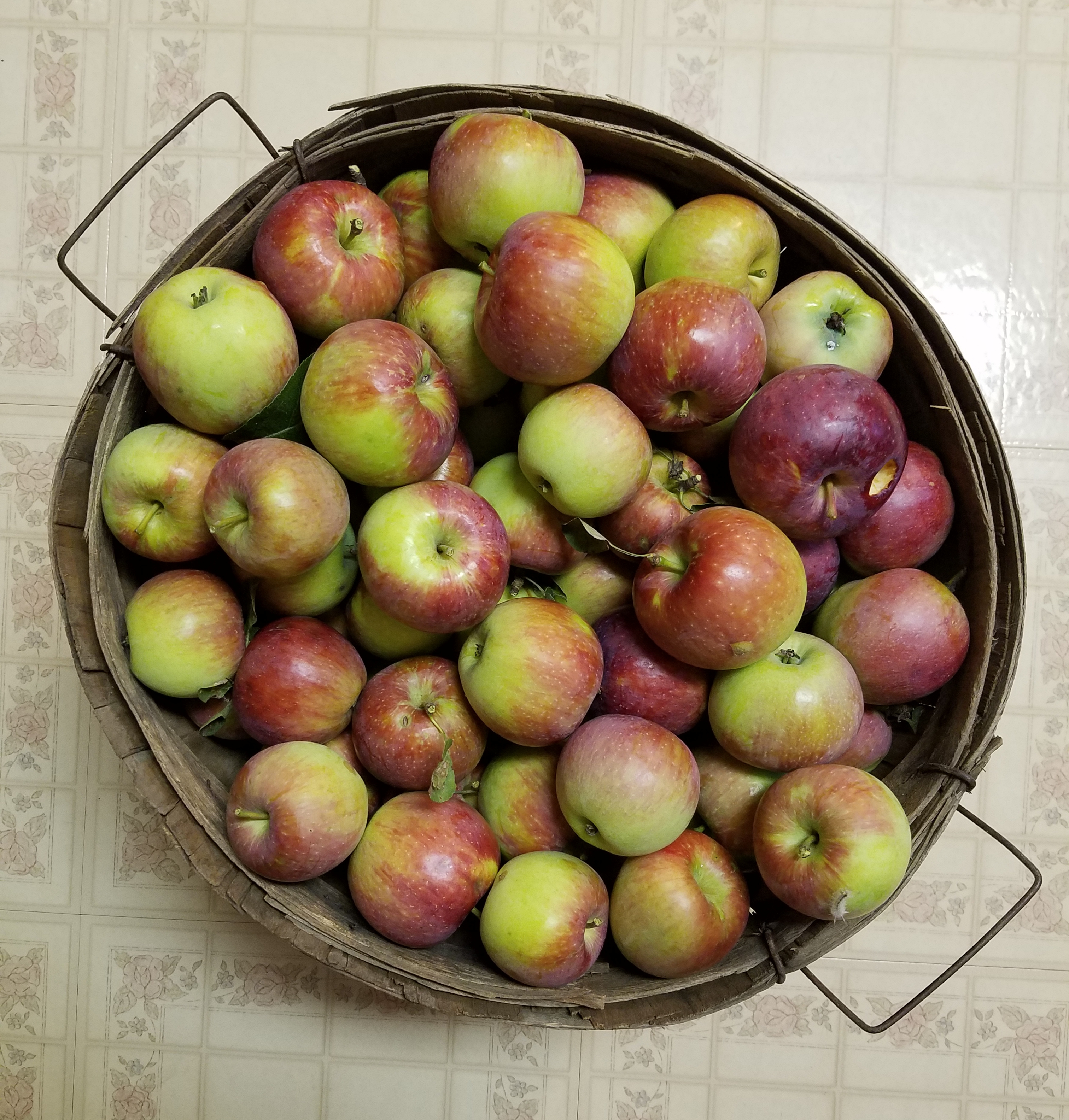
This year’s apple crop has been one of our best. That means an apple activity vortex beginning now until the last red delicious is picked in October.
The two earlier trees are ready to pick and best suited for eating out of hand, apple sauce, apple butter, apple juice for drinking and cider vinegar, and baked goods.
Red delicious apples are good for these products as well and hold up for slicing, freezing and drying. A bit of everything apple is planned this fall.
Working two paid jobs, seven days a week relegates apple chores, and other processing of pears, tomatoes, hot and bell peppers and the like to late at night or early in the morning. These will be busy days, no doubt.
Canning Soup and Jalapeno Peppers
I’m considering getting a second water bath canner to speed up the process. At seven jars per batch I’ve gotten the work done, but at 14 more may be accomplished in the same time. We’ll see how that goes. I’m ready to start canning.
Some lessons learned. In past years I’ve canned garden vegetable soup and have about 24 quarts on hand. That’s enough to last until spring so there’s little reason to can more. The same is true of apple butter. I need to use some of what I have to make room on the shelf so I plan to skip this year. 20 quarts of apple sauce remain in the pantry from previous years. I’ll make enough to get to three dozen. That should take us through to the next large apple crop.
Ending up in an apple vortex during the last lap in a workingman’s race is not bad. I’d say it’s delicious but that would be an apple joke.
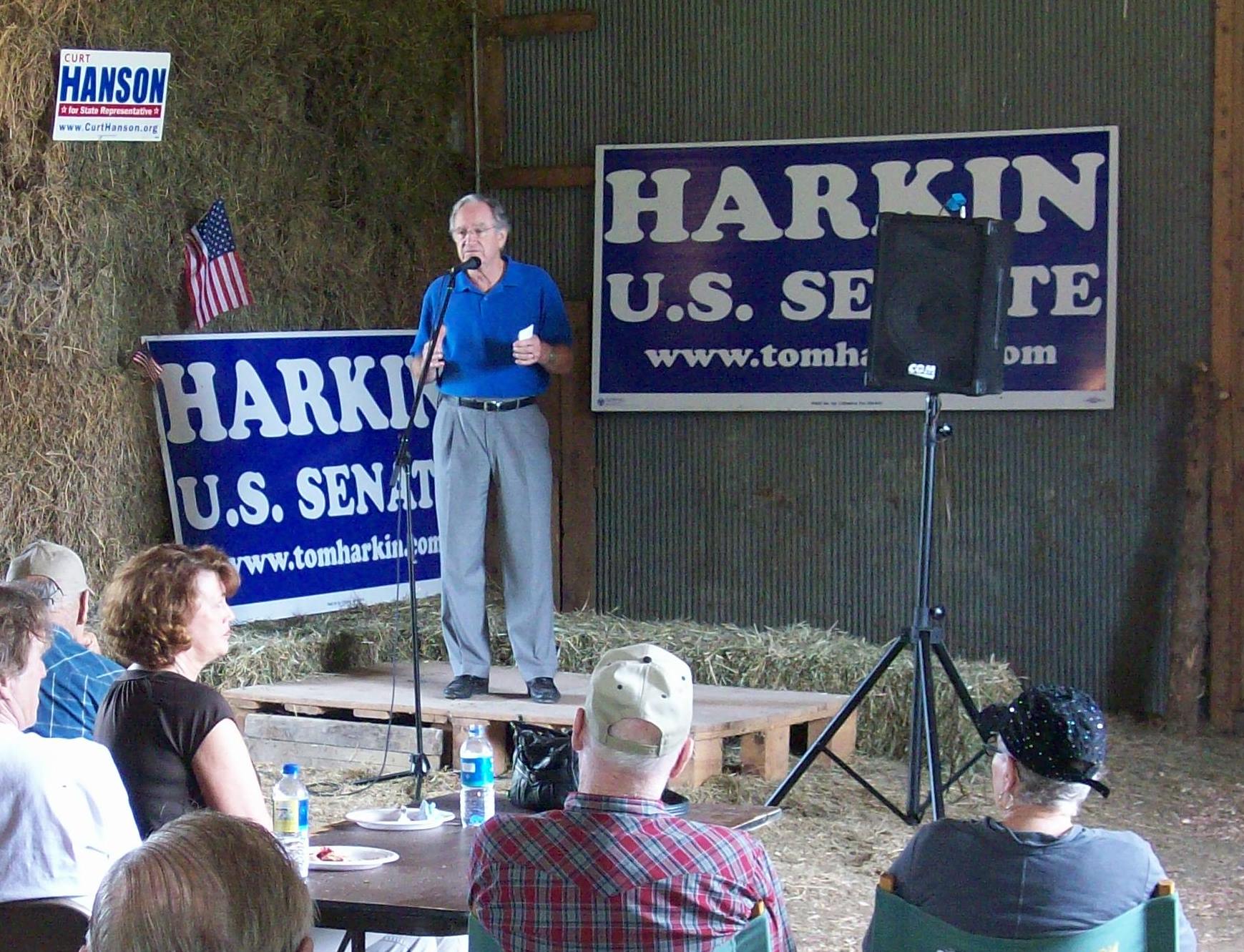
Senator Harkin Speaking at Aug. 2, 2009 Curt Hanson Fundraiser
What seems most important about last night’s Iowa House District 82 special election to replace Curt Hanson is Democrat Phil Miller won in a post-Tom Harkin era.
Iowa no longer has a Democratic U.S. Senator able to travel most counties, recount his local margin of victory to politicians and engage voters. When Harkin visited Dick Schwab’s 2012 house race in Cedar County, his presence didn’t tip the scale in our favor but gave us hope a Democratic candidate could win rural, conservative areas. A case could be made that when Harkin retired so did Democratic hopes for the state. Democrats fell apart, first by losing his U.S. Senate seat, and then by crafting a spotty effort to support Hillary Clinton for president. Given the scale of President Trump’s Iowa win, such hope is needed.
If you want election night analysis, read Bleeding Heartland’s detailed report on the numbers and potential meaning for Democrats by clicking here.
Here’s the crux: “Today’s result is proof that good Democratic candidates can still compete in Iowa’s smaller towns and rural areas where Republicans made huge gains up and down the ticket in 2016,” DesMoinesDem wrote.
It is significant that one of Iowa Republican Party chair Jeff Kaufmann’s stated goals for 2017 is to shore up support among “new Republican voters.” In a July 27 article in the Cedar Rapids Gazette he said of his “new voters,”
I’m worried about them because, in general, what they know is Republicans have control and Republicans aren’t doing what they promised, even though individual congresspeople and senators are doing what they have promised… The people that are less informed about the process, yes, I worry because it contributes to a climate that we’ve given you what you’ve asked for and we haven’t delivered.
I hope the House District 82 election results give Mr. Kaufmann something else closer to home to worry about.
The test for Democrats will be whether they can walk and chew gum at the same time in 2018. It is one thing to concentrate resources on a single race and win, quite another to turn the Iowa house, senate and governor’s office Democratic again. Democrats have done it in Iowa with mixed results. Governor Harold Hughes’ term beginning in 1964 was notable and largely successful. Governor Chet Culver’s 2006 term hangs like an albatross around neck of the Iowa Democratic Party.
Democrats can have a drink to celebrate Miller’s win thanks to Harold Hughes’ revamping Iowa’s alcohol control system and legalization of “liquor-by-the-drink.” This morning after they can hopefully develop momentum toward additional wins in 2018.
Dr. Phil Miller’s win last night provided evidence hope is alive.
There’s a school board election Sept. 12 in the Solon Community School District and I’m pumped! We all should be jazzed if we care about K-12 education.
Like Ahab hunting Leviathan I believe big voter turnout in school board elections is possible. History shows me wrong — in the 2015 school board election only 281 people turned out at the polls. History notwithstanding I encourage people to vote in every election.
Current school board president Dick Schwab was involved with the 2014 general obligation bond voters approved by 71 percent.
“I’m delighted. I couldn’t be happier,” Schwab was quoted in the Iowa City Press Citizen as saying at the time. “We obviously have a lot of work to do; we’re basically on a path to make the district even better and these are resources that will help us do that.”
He was right. We see the physical plant improvements the bond made possible: notably a middle school and the performing arts center. Compare that to this year’s Iowa City Community School District bond proposal and Solon’s bonding process was no drama, no tax increase, results only.
Many of us will miss Dick Schwab when he leaves the school board.
When the filing period for three school board positions closed Aug. 3, Schwab’s name wasn’t among the candidates. The four who did file include current board members Tim Brown and Rick Jedlicka, and Dan Coons and Nichole Pizzini. Presuming the incumbents will be re-elected, Schwab’s open seat is contested.
I believe every voter in the district should learn about Coons and Pizzini, make a reasoned decision, and VOTE. Admittedly not every voter will follow my advice. I also know the Solon community can do better when it comes to voting in school board elections.





 Journey Home
You must be logged in to post a comment.