Haying is a social and economic movement and around here farming takes precedence over schooling.
There’s a school board election Sept. 12 in farm country.
Farmers are buying 9,000-foot spools of Brazilian baler twine, windrow teeth, left and right handed rake wheels, baling wire, reels of bale netting and a lot more.
Tens of thousands of straw and hay bales have been harvested the last couple of weeks. Some went into bunkers and barns, some sit in large round rolls near the field, and some were sold and trucked out.
Because of Thursday’s rain showers more farmers than usual came to town. I got an update on the season from several of them at the home, farm and auto supply store. Not one talked about the school board elections.
Thursday was also the school board election filing deadline in Iowa. I live in the Solon Community School District where activities of the school board continue as background noise to a number of large construction projects. Since 2000, district resources have been invested in a new high school, a ready to open middle school, a new performing arts center, a new football stadium and a new sports complex. Except for the graduates who stayed in town, public works projects are the most visible aspect of recent school board activities.
I tried to get the skinny about who was running for three seats in the Sept. 12 election but no one seemed to know, including current and former board members, the newspaper, and local political activists. I found out from the county auditor after the filing deadline. Four people filed for three open seats.
The terms of Dick Schwab, Rick Jedlicka and Tim Brown are up this year. Jedlicka and Brown filed for re-election and barring controversy should be easily re-elected. Former board member Dan Coons and newcomer Nichole Pizzini also filed. Schwab decided to end his long service on the board, opting to move out of state before the next school board term would have ended. That leaves his seat open for either Coons or Pizzini in this non-partisan election.
A few years back a local group, many of whom were associated with Saint Mary’s Catholic Church, made a successful, concerted effort to take control of the Solon school board. Coons and Brown were candidates the group supported. Both are registered Republicans according to Johnson County Auditor records.
Pizzini’s family has long been interested in politics. Her husband, Shawn Mercer, filed for state representative as a Democrat when Ro Foege retired in 2008. He withdrew once party leaders indicated Nate Willems of Mount Vernon was the insider pick to replace Foege. Mercer is a current member of the Solon City Council. Pizzini is a registered Democrat.
In school board elections personality matters more than politics, so the advantage goes to Coons over Pizzini from the get-go because he organized for previous campaigns and has name recognition as a former board member. There is a stunning lack of controversy about the school board today. Because of the positives of a new middle school and sports complex, the political environment favors incumbency.
In recent years, the highest vote getter in a Solon school board election was Don Otto in 2000 with 1,118 votes, according to the county auditor’s website. Word of mouth is the most effective tool to get information from the candidates to voters. Pizzini is the underdog as a newcomer, however, with smart work she could get the votes needed to win a seat. That makes the Coons – Pizzini match up interesting. The expectation is voter turnout will be low, even with a contest, so either Coons or Pizzini could activate the number of voters required to win.
In Solon there is living memory of attending the one-room school house at the edge of town. For many we are not far removed from that time and its deep roots in farming. Nonetheless, in addition to qualified teachers, adequate, modern facilities are important. Recent school boards in Solon have delivered.
I look forward to learning more about the candidates as the campaigns progress.
The origin of my adult interest in cooking and gardening is time spent in a motel room in Thomasville, Georgia while implementing a logistics project at a large, nearby mining and manufacturing company.
I’d go into the plant early and stay late, returning home to Iowa only every other weekend. When I got back to my room, I turned on the television and fell asleep watching the TV Food Network.
That’s not to say experiences with my mother and grandmother played no role. They did, especially in our kitchen on Marquette Street where Mother prepared meals using familiar ingredients both fresh and prepared, and at Grandmother’s kitchen — first at the Lend-A-Hand and then at the Mississippi Hotel.
Rather than sustenance, food became an escape in my adult years.
In the 1990s I escaped into the T.V. During thirty minute segments I could forget extreme poverty and plain family restaurants that served a meat and three sides in rural Georgia, and engage in personality chefs who enjoyed what they were doing as locals did not. I had no kitchen so the interest was intellectual. I did learn techniques, some of which I would use later in our home kitchen. We don’t get Food Network any longer but it set me on a course for being the kind of home cook I am today.
Yesterday I made breakfast of steamed broccoli, fresh tomatoes and quesadilla — a gardener’s breakfast. In a social climate of political turmoil, disease, famine and extreme weather events food continues to represent escape as well as nourishment. Producing local food and dishes is a way of navigating diverse interests in a society that seems to have gone mad. Not only escape, but protection of who we are from those who would change us.
In western culture we begin each day with choices about food. The lesson I learned in Georgia, on the T.V. and in family kitchens is to choose fresh and local in order to sustain our lives, and there’s more. Make something of our choices. For a brief moment yesterday it was a gardener’s breakfast. Now to turn to today.
Just as the election of Barack Obama encouraged me to leave a 25-year career in transportation and logistics, the presidency of Donald J. Trump is stirring winds of change.
Where they will take our small family is uncertain.
Each year presents its challenges and successes. We’ve been able to hold on financially — by the skin of our teeth. There is more to life than money.
Because of a decades-long plan I rely on Social Security and Medicare, to both of which I began contributing in 1968. Whether they will be there for us long-term is uncertain. We are too deeply invested to back out now. We can’t let an unknown future stymie hope and aspirations.
The cycle of our lives is around work, gardening and health. Take paid work out of the picture and there should be an opening to do something different next year.
In 2009, when I retired from transportation and logistics, I took a path of civic engagement. I joined organizations and spent time working with people in society. The next retirement — beginning in spring — is expected to be one of reading and writing much more than I am able to do in hours stolen from days of hard work. There must be some form of civic engagement, but this time I expect it to be much closer to home.
Regardless of outcome, I’m repairing my mast, mending my sails, and ready to put the winds of the national culture to work at home.
Today begins a long stretch of work shifts on weekdays at the home, farm and auto supply store, and on weekends at the apple orchard — 96 days in a row.
I’m not ready but both jobs help pay bills. Work I have been doing on weekends will get shoved to weeknights and early morning. I’ve been here before. There’s nothing else to do but let go and fall into the rush.
The garden is doing reasonably well and my barter agreement will make work canning tomatoes and freezing bell peppers. Last year it was impossible to keep up with the garden and I lost more tomatoes than we harvested. With sunrise getting later, I’m also losing some of my early morning time outdoors. I’m not complaining. Just figuring out the best way to cope. The expectation is this year will be better than last.
At the end of the rush comes winter and a window for retirement. I reach full retirement age in December and my spouse reaches Medicare age in January. If we successfully negotiate these milestones, signing up for Medicare and Social Security, a financial burden will be lifted and we will be able to breathe easier for a while.
For now, it’s a rush toward familiar butunkown times. Hopefully there will be some fun and accomplishment along the way. Here we go!
Between planning, planting and weeding a garden, and fall’s frosty end, lies a time to harvest, cook and preserve the results. So it is with our lives.
As humans we possess a unique ability to envision a future: one where we need supper and know we will need food later. We produce in abundance, fearing we won’t have enough. With modern food supply chains producing readily available foodstuffs in the United States this isn’t rational. In this sense, a gardener is an archetypal human living a life on urges, needs and wants we don’t fully understand.
Saturday Harvest in High Summer
The culture that produces a kitchen garden is complex, involving not just the gardener and soil, but seed producers, greenhouse operators, equipment manufacturers, chicken manure composters, potential future diners and others. A gardener is deeply engaged in human society. Much of our garden time seems solitary but isn’t. Animals wander nearby and we view the results when they eat garden plants and produce we’d hoped to harvest later. There is a daily drama of birds which are abundant in Big Grove. There is also a vast and little understood society of insects, some of which are annoying, a few deadly, and without others, the garden could not exist. A gardener embraces the complexity of life’s culture.
A gardener is not only a gardener nor does he or she seek to be. Each is just one iteration of humanity engaged in a broad society and we Americans are a peculiar bunch. We work hard, long hours whether it is at home or in a workplace and leave little time for enjoyment of the fruits of labor. Sometimes, like this weekend when I am between work at farms, we get time to ourselves to enjoy life lived how best we know. My story of Saturday is in four parts.
Predawn
My day begins around 4 a.m. and if I’m lucky, I got six or seven hours of sleep. I slept well Friday into Saturday waking only briefly to put in a load of laundry around 2 a.m. The routine was basic. Do stretching exercises, make coffee, say hello to spouse, go downstairs, and turn on the desktop computer to see what’s going on in the world. That’s not to say I didn’t already know. I use my mobile device in bed before turning on the light. Usually something new has happened since retiring the night before.
I wrote a series of tweets to better understand my memory of the Patient Protection and Affordable Care Act as it pertains to the false accusation it is a job killer. I recall local businessmen who said after the law went into effect they were in a position to add jobs but didn’t want to do so because they would have to provide health insurance per the ACA mandate. The assertion is the mandate killed these jobs and that idea got blown up into hyperbole of unprecedented proportions. Re-circulation of this idea is ongoing and rarely fact checked any more.
Businesses of a certain size should provide a health insurance benefit to employees or risk the possibility of being unable to recruit qualified staff. By defining the size at which to mandate health insurance, the law changed the business structure. In highly competitive local markets for landscapers, concrete workers, framers, heavy equipment operators and the like, employers faced a changed landscape. Operating on tight budgets, rather than embrace quality of life for employees they resisted change. The core problem lies in that the K-12 education system does a really poor job of preparing students to enter business. People carve out a niche, generate revenues and go out of business if they don’t properly manage risks or aren’t adequately capitalized. Small-scale operators I know are not educated in things we took for granted when I managed the profit and loss of a $12 million annual revenue transportation and logistics operation as part of a billion dollar corporation. The problem is not the ACA, or teachers. It is our education system doesn’t provide an adequate path for people to be successful owning and operating a business.
Pickle Fermentation
Outside
If there was no rain I water the garden shortly after sunrise. Without thinking it turned into weeding, then harvest and before I knew it the time was 11 a.m. The garden looks more like a weedy mess but inside there is abundance.
Before going outside I started soup to take for lunch at the home, farm and auto supply store, and mixed the brine for a batch of dill pickles.
I picked a box of kale for the library then went plot-to plot to collect what was ready. There were broccoli florets, leeks, onions and fairy tale eggplant in one. Jalapeno peppers, a bell pepper and cucumbers in the next. More broccoli and celery near the locust tree. Four kinds of tomatoes in the tomato patch. Basil is ready but I left it in the garden until I’m ready to make pesto.
Apples are sweet enough to eat out of hand, but not sweet enough to juice and ferment into apple cider vinegar. I picked the ripest for a batch of apple sauce. There are a lot of apples this year because of almost perfect pollination during spring. It should be a long apple season starting now.
I collected the harvest in a crate and placed it on the kitchen floor. There was another two hours of work cleaning the produce but that could wait.
Soup for Next Week’s Work Lunches
Short Trip
I try not to leave our property on weekends unless for work. Ours remains a car culture and we don’t have disposable income for shopping if we thought we had it before. Saturday I went to HyVee to pick up canned goods, pantry staples, organic bananas and Morningstar Farms frozen products we use. Organic celery is permanently on the shopping list although we have a lot of celery ripening in the garden. I picked three heads that morning so bought none at HyVee.
On the eight mile trip to town I noticed two sweet corn stands on Highway One.
One is the farm where we get most of our sweet corn, Rebal’s Sweetcorn. Supply was uncertain from their Saturday post:
It was tough picking this morning; we had to really search for the corn in this patch… we’ve got corn today, but it’s not a full load, so if you want it, try to get out here early. And, because of having to search to find the better ears, we might just let this one go and wait for the next. We’ve got 4 blocks (patches) coming up that look beautiful!!! The question is when they’ll be on… we’re checking them every day, so I’ll keep posting
They had plenty as I passed Southbound.
Lindsey Boerjan runs a seasonal road-side stand further south and was featuring sweetcorn and melons. I wrote an article about women farmers in the Sept. 22, 2015 Iowa City Press Citizen:
Lindsey Boerjan is a fifth-generation farmer living on the family-owned century farm where she grew up. She moved back in 2011 and farms alongside her aunt, uncle, husband and daughter, who run a beef cow and calf operation. To supplement income from beef sales, Boerjan raises chickens and operates a small community-supported agriculture project.
The CSA didn’t make it, although the road-side stand likely does better. I decided to stick with Rebal’s on my return trip.
A musician played for free will donations outside the entrance to HyVee. He seemed too young and inexperienced to be playing Folsom Prison Blues, although he was very musical.
Dinner Salad
Cooking
On arrival home I put away the groceries and started cleaning the morning harvest.
Leek stalks make a great vegetable broth base so I got out the large stainless steel pot. I added the leek leaves, broccoli stalks, a turnip — greens and root, kale and onion tops. I don’t usually salt vegetable broth and this time I didn’t add bay leaves. It cam out dark and flavorful — two and a half gallons.
Part of summer cooking is going through the ice box and making sure old stuff is used first. We have a broccoli abundance and need to do something soon with the gallon bags of florets. The freezer is almost full, so freezing more is not a good option.
I found some lettuce and decided to make a small salad and pizza for dinner. The salad is a work of art with two kinds of lettuce, kohlrabi, two kinds of tomatoes, cucumber, grated daikon radish, bell pepper, pickled jalapeno pepper, sugar snap peas and other items either from the farm or grown in our garden. Ironically I forgot to put some small broccoli florets on the salad.
I also made applesauce, salsa with tomato, garlic, jalapeno peppers and onion, and a cucumber salad of diced cucumbers dressed with home fermented apple cider vinegar, salt and pepper.
Our pizza process is to buy pizza blanks from the warehouse club and add toppings at home. Making our own pizza dough is no real work, but the convenience of a pre-made cheese pizza for $2.50 presents value. I added Kalamata olives and a diced red onion from the farm, then topped with Parmesan cheese. 15 minutes in a 425 degree oven plus a minute under the broiler and done.
This Morning
Everything on my list didn’t get done Saturday. I’m processing the vegetable broth in a water bath this morning and figuring out how to pack a summer’s worth of yard projects into today’s glorious summer weather. That is, I wrote stuff on my white board. Once I move outside into humanity and culture, I will likely forget about the plans and do what comes naturally.
Image of Earth 7-6-15 from DSCOVR (Deep Space Climate Observatory)
A recent article at Nuclear News reminds us the world is on the cusp of an energy revolution.
“The cost of renewables like solar and cell batteries for electric vehicles are making the carbon-based economy obsolete, with the turning point only a few years away,” author Christina MacPherson wrote.
The age of centralized, command-and-control, extraction-resource-based energy sources (oil, gas, coal and nuclear) will not end because we run out of petroleum, natural gas, coal, or uranium,” Stanford University professor Tony Seba recently said. “It will end because these energy sources, the business models they employ, and the products that sustain them will be disrupted by superior technologies, product architectures and business models. Compelling new technologies such as solar, wind, electric vehicles, and autonomous (self-driving) cars will disrupt and sweep away the energy industry as we know it.
When we consider the use of coal in Iowa, there are many of us who remember the coal trucks plying the streets and alleys of our childhood, dropping loads of the black stuff down chutes leading to a basement coal bin and then to our gravity furnaces. Through the winter, people shoveled coal into burning embers to heat their homes. Coal ash was shoveled out and in the spring, it was tilled it into gardens and spread on fields. Coal ash was also sent to dumps. On the farm, coal was purchased with seeds, feed and grain. It was part of a background to life that did not consider the potential harm to human health we now know it represents.
Those born in the 1950s and before have living memory of how natural gas replaced coal for home heating. The conversion was driven by much lower natural gas cost compared to coal. Similarly, lower costs of renewables will drive the move away from fossil fuels. We are almost at that point, as MacPherson indicated, and the business community is recognizing the reality by investing in renewables.
A recent article by Eva Zlotnicka for Morgan Stanley reiterates this point.
Economics and improving technologies, not regulation, are the driving forces behind many of the sustainability trends in global markets today. Our energy commodities team’s fundamental analysis of power-generation economics shows that longer-term coal can’t compete with natural gas or renewables, even on an unsubsidized basis. In a recent report, the team cut its 2017 coal-burn forecast by around 4%, and now sees only a modest year-over-year improvement, with most of those gains lost by 2018, due to ongoing competition from natural gas and renewables.
The 45th president made much of reviving the coal industry during his election campaign. The trouble for him is the market is heading a direction that not even he and his fossil fuel friends can stop. He can roll back all the regulations he likes and the market will continue to drive the switch to renewable energy.
Many of us were disappointed when President Trump announced his decision to exit the Paris Climate Agreement. It was all hat no cattle.
There is almost no disagreement in the scientific community that fossil fuel use contributes significantly to planetary warming and related climate change. However, that’s not the point. What gave rise to the Industrial Revolution continues to work, and as renewable energy costs decline and become cheaper than the cost of fossil fuels and nuclear, bankers, manufacturers, and service industries will convert because it makes business sense to do so.
Add the public health, environmental, business and economic value of renewables together and a scenario where energy companies may start divesting themselves of coal and oil operations emerges.
How will the U.S. exit the Paris agreement? 45 didn’t say. Will his administration follow the four-year exit process outlined in the agreement, or will he remove the United States from the U.N. Framework Convention on Climate Change (UNFCCC), exiting in about a year? If the drivers of transformation in our energy system are economic, what whit of difference does his decision make?
The agreement posed no financial risk to the United States, according to Morgan Stanley. It seems doubtful other nations will follow the United States out of the agreement, although some may. The pursuit of the goals in the Paris Agreement by remaining countries, combined with the efforts of U.S. states and cities acting on their own, offer the best chance to reduce carbon pollution in the atmosphere.
Nonetheless, an energy revolution is going on and at this point little politicians do seems able to stop it.
I can’t believe we have to cover this Iran sh*t again.
Point 1: The 45th president doesn’t like the Iran Deal. While he twice certified Iran’s compliance with the July 14, 2015 agreement between Iran, the P5+1 (the five permanent members of the United Nations Security Council—China, France, Russia, United Kingdom, United States—plus Germany), and the European Union, each time his State Department under Rex Tillerson undercut any positives.
“Today I’d like to address Iran’s alarming and ongoing provocations that export terror and violence, destabilizing more than one country at a time,” Tillerson said in April after the first certification. According to Time Magazine, he proceeded to lay out a long list of bad things Iran is doing, from sponsoring terrorism to oppressing its own people to violating U.N. constraints on its missile program. When it came to the nuclear deal, he said it failed to ensure Iran won’t become a nuclear state in the future and said the administration was conducting a “comprehensive review of our Iran policy.”
The comprehensive review was ongoing when Tillerson made the second certification last week. The 45 administration proceeded to impose more sanctions on Iran.
We get it. 45 called the agreement “bad,” “horrible,” “stupidest deal,” etc.
Point 2: There was no question Iran was pushing the limit of the Nuclear Non-proliferation Treaty (NPT). I posted about this March 5, 2010:
The reason Iran is in the news is reasonably straightforward. As signatory of the NPT, Iran has the right to the peaceful use of nuclear technology. The trouble is that in 2003, the International Atomic Energy Agency (IAEA) determined that Iran had not been forthcoming about its uranium enrichment program, as required by the NPT. The IAEA conducted an investigation and their Board of Governors reported Iran’s noncompliance with the NPT to the United Nations Security Council. The Security Council demanded that Iran suspend its enrichment programs. The Council imposed sanctions after Iran refused to do so. When the uranium enrichment facility in Qom was made public in 2009, this heightened awareness of Iran’s apparent belligerence precipitated the current discussions between the parties about further sanctions and/or diplomacy. The corporate media latched on to an easy news story.
Point 3: President Barack Obama chose diplomacy. He initiated discussions about nuclear non-proliferation with Iran. Crazy, no? To actually talk to Iran and engage the European Union and the P5+1 states in the deal. The deal was consummated and is in effect. It stopped Iran’s nuclear program. As 45’s administration indicated with its certification of Iran’s compliance, the Iran Deal is working.
Point 4: While 45 hasn’t fulfilled a campaign promise to dismantle the Iran nuclear deal, he remains deeply suspicious of it according to a Sunday article in the Los Angeles Times. The war hawks in Washington, led by former U.N. ambassador John Bolton wanted 45 not to certify compliance. On its own terms the agreement has accomplished its purpose of preventing Iran from enriching uranium to develop technology to make a nuclear weapon, things of which they were well capable in 2009.
On any given day one might say, “who knows what the hell Trump will come up with?” In a dangerous world we should be thanking President Obama for avoiding war with Iran and stopping its nuclear program, something that can’t yet be said about his successor in the Oval Office.
It seems too early to be talking about the 2018 Governor’s race. However, people are politically active and there is a gaggle of candidates.
I have no preference today and assume they are all serious about their campaigns. Here’s my first look at the race.
I favor Corbett over Reynolds on the Republican side because I know and worked with him during my transportation career. I heard him speak in 2015 at the Climate Reality Leadership Corps training in Cedar Rapids. He did some good things after the 2008 flood devastated downtown Cedar Rapids. Because he’s still got an R behind his name, that pretty much disqualifies him for me in the general election.
On the Democratic side I’m not sure who’s who. Here’s the ones that are running or considering a run in no particular order.
I know the two women best.
This is Andy McGuire’s second bite at the gubernatorial apple (2006 being the other). Her recent tenure as chair of the Iowa Democratic Party should disqualify her for two reasons: over reliance on national campaigns for funding IDP operations, and for running an imperceptible 2016 campaign in my precinct and the ones around me where Trump won. She seems a bit tone deaf to be running again.
I like Cathy Glasson from past associations, mostly with John Edwards’ 2008 campaign. She is like most SEIU leaders I’ve met in that when she gets behind something she puts her all into it. When she says something, she means it and her policies have a lot to like. Mostly she is about the struggle working people face — with a asterisk next to “working people” indicating “strong union” in the definition. I imagine she was pissed when Governor Chet Culver would not support the union agenda. Women I know tell me they don’t see any Democratic women being able to win as governor. I don’t know, but I like her.
There’s also some men.
John Norris has the resume to be governor, but I’d rather his spouse Jackie were the nominee. I suspect his political chops will play well in the areas Chet Culver won.
Jon Niederbach’s campaign tagline is “Bold New Leadership Not Beholden To Any Special Interest.” He’s been president of the Des Moines School Board, and a former board member of Proteus, an organization that provides medical services to migrant workers. Proteus gave me a lot of insight when I was on the county board of health. I’m not sure people outside Des Moines have heard of him, so he will need to work hard on a steep hill to gain name recognition.
A number of Iowa legislators support State Senator Nate Boulton in the primary. First elected to the legislature in 2016, he’s a political newcomer who gained prominence in the first session of the 87th Iowa General Assembly. He argued diligently for Democratic positions and the governor’s office needs that kind of person. Just because he’s popular among legislators, doesn’t mean he’s ready for prime time.
Todd Prichard is from my home town and is now a state representative from Charles City. He announced for governor May 16, then last week headed for Bulgaria in the National Guard. Other than his military service, I’m not sure what distinguishes him from the pack.
Fred Hubbell is a retired business executive whose family founded Equitable of Iowa. If any among the candidates is a household name, he is. The Hubbell family donated Terrace Hill to be the governor’s mansion, and his family have been significant donors to numerous causes, including the 2008 flood recovery, United Way, Planned Parenthood, and the Iowa Democratic Party among others. He announced last week and hasn’t held political office. Hubbell is expected to have few financial hurdles in the governor’s race. Rep. Mary Mascher’s endorsement of Hubbell means a lot.
Finally, former Iowa City Mayor Ross Wilburn is exploring a run for governor. He lives in Ames and little has been posted in media about the progress of his candidacy. Wilburn’s name recognition is less than Niederbach.
A lot is at stake for Democrats in the 2018 governor’s race. Here’s what Johnson County’s Sue Dvorsky had to say:
“We will be a dangerous group of people with nothing to lose. We will be unleashed,” Dvorsky told the Des Moines Register. “We’re gonna win this time, or we’re going down for 40 years.”
Tres Leches Cake Photo Credit – Stu Spivack, Wikimedia Commons
The Cedar Rapids Gazette was sitting on the break room table last week at the home, farm and auto supply store, open to an article about IPERS, Iowa’s public employee retirement plan.
Written by Matt Sinovic of Progress Iowa, the first sentence asserted more of the usual fare from the progressive group, “Once again, Republicans in the Iowa Legislature are inviting an out-of-state attack on the economic security of Iowa families.”
Thanks, but I’d already had my allowable dose of confirmation bias that morning. I closed the paper and started my shift.
That would have been that, except my state representative, Bobby Kaufmann, raised the article in a July 21 update to his legislative newsletter list.
Finally, I want to address the conversations being had regarding IPERS. I want to ensure (sic) everyone that your retirement is safe and will continue to be. There was an unfortunate editorial in the Gazette. I am being complimentary when I call it misleading and partisan. Every two years a committee meets to ensure our retirement fund is solvent. That is all that is happening. Every two years members of both parties get together and examine our retirement system to make sure our promises can be kept. I have said it before and I will say it again: I am a HELL NO on any bill that would negatively impact the retirement promise that has been made to you.
A long-standing complaint of Blog for Iowa is the legislature does little to address long term plans for IPERS.
“As it stands, there is no long term plan for educational financing, Medicaid, IPERS or property tax reform,” Chad Thompson wrote May 24, 2005. “What we did get was some reshuffling of bank accounts and a further drain on the reserves we do have.”
When Lieutenant Governor Kim Reynolds brought up the idea of a task force to evaluate modification of IPERS last January, my nerves tensed.
Reynolds, who soon will become the state’s governor, said in remarks at a Scott County Republican Party fundraiser Jan. 26 (reported by Ed Tibbetts of the Quad City Times), that commitments already made to IPERS members would be honored. “I feel very strongly about that,” she said. However, she also raised the possibility of moving toward a “hybrid” system that would include the current defined benefit pension arrangement as well as a defined contribution component. The latter is akin to a 401(k) system that is common in the private sector.
While Reynolds’ statement garnered attention, IPERS did not seem like a high priority on its own.
On January 30, 2017, I issued a statement telling IPERS members they should be concerned about the future of their benefits.
Since that time, my concern has continued to grow. After witnessing how quickly the legislature and governor were willing to move without input from the people would privatize the investment of employees’ and retirees’ pensions. Individuals will pay more and private companies will reap the benefit.
We have made adjustments over the years to ensure the success of IPERS. We do not need to tear this plan apart, but rather continue to manage it well.
In the context of Governor Reynolds’ and Treasurer Fitzgerald’s January statements, Kaufmann’s assurances raise a flag.
I read Sinovic’s article and one of his issues is the Reason Foundation will be involved with the biannual review Kaufmann referenced.
What should we care who reviews IPERS?
The Reason Foundation, established in 1978, is part of a dark money network of wealthy libertarians that has been at work in our recent elections, according to Jane Mayer, author of Dark Money: The Hidden History of the Billionaires Behind the Rise of the Radical Right. “Reason Foundation advances a free society by developing, applying, and promoting libertarian principles, including individual liberty, free markets, and the rule of law,” according to their web site. Their tagline is “free minds and free markets.”
Fitzgerald and Sinovic are saying the cake is baked regarding the IPERS solvency review. We don’t know the result, but can get a taste of what to expect by reviewing the law Michigan Governor Rick Snyder signed this month. Here are some key features of the new Michigan public pension plan reported by the Reason Foundation:
New hires will be auto-enrolled in a defined contribution retirement plan (DC Plan) that has a default 10% total contribution rate. DC Plans inherently have no risk of unfunded liabilities, and the maximum employer share for the plan (7%) is less than what employers should be paying for the current plan.
However, if new teachers would prefer a defined benefit pension plan (DB Plan), they will have the choice to voluntarily switch to a new “hybrid” plan that, unlike the current “hybrid” plan offered to teachers, uses very conservative assumptions and short amortization schedules and splits all costs 50-50 between the employee and employer.
Uniquely, the hybrid plan will have a safeguard mechanism that would trigger closure if the funded ratio falls below 85% for two consecutive years.
And to top it off, the reform design improves certain actuarial assumptions and infuses the plan with $250 million in additional contributions to chip away at the pension debt.
Sound okay? Obviously any change will be viewed with suspicion by IPERS participants. I don’t agree with Sinovic that the Reason Foundation’s involvement is an “attack on the economic security of Iowa families.” What will annoy people is if Republicans try to slam through a hybrid plan similar to Michigan’s as Fitzgerald feared they might.
If, as Rep. Kaufmann indicated, the biannual review is simply to produce solvency, then good job for relieving unnecessary worry. As Fitzgerald indicated, “as state treasurer, an IPERS board member, and trustee of the Fund, I can tell you that Iowa has worked hard over the years to ensure IPERS is on solid ground. And we are.”
If, as Fitzgerald and Sinovic believe, the end result will be major changes to IPERS similar in scope to the Michigan law, that’s something else entirely. Time will tell. Current IPERS participants are forewarned to pay attention.
Sinovic is free to publish his opinion about whatever he is paid to advocate. However, when he posts an article like the Gazette piece he does no favors for Democrats hoping to win back seats in the Iowa legislature in 2018. Readers can see straight through the hyperbole and associate his comments with the Democratic Party. Democrats become defenders of the status quo by default, a status quo Blog for Iowa has been complaining about for 12 years.
And seriously Republicans. You have to pick a Koch network think tank for the solvency review? One that while claiming to be non-partisan favors a certain outcome?
What’s needed in public discourse is a statement of what progressives are doing to ensure IPERS is solvent. We also need a chance to win elections, something Sinovic’s article didn’t help.
Sunday my spouse and I took the public library poster she made to the fairgrounds where the county’s seven libraries have a booth for the fair which runs Monday through Thursday this week.
We parked outside Building B, went in, and slid the foamcore board into a slot. It took a couple minutes.
A friend was there setting up an adjacent booth shared by Physicians for Social Responsibility, Veterans for Peace, PEACE Iowa and 100 Grannies for a Livable Future. We chatted for a while, about raccoons, chipmunks, single use water bottles, libraries and why I haven’t attended more events. We then went our separate ways: she and her son to Village Inn, and we to buy the first sweet corn of the season from a local farmer.
I could make similar connections with many fair booth sponsors, almost anyone could.
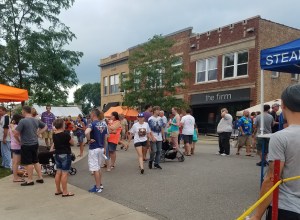
Last night I volunteered selling tickets at Solon Beef Days, which is the annual festival near our home. We sold about 500 tickets during my shift and had a brief conversation with each buyer.
I knew the voter registration of many who bought tickets. I remembered who they supported, which elections in which they voted, when they donated, and who lived in their households. It’s not that I’m snoopy or a gossip. It just comes with the turf of political canvassing near one’s home for two decades.
Some say we should volunteer to make phone calls and door knock on political campaigns to win elections. That may have once been true, however, the electorate is going through a profound change with the rise in importance of personal computers and cellular technology. That change is not finished.
James Carville is hard to stomach these days, but during the Bill Clinton campaign his fax machine and “rapid response” was a competitive advantage no one else had. It was an innovation that contributed to Clinton’s win.
People don’t talk much about Joe Trippi but he was one of the first to understand a virtual community and its implications for political campaigns. In his book, The Revolution Will Not Be Televised: Democracy, The Internet and The Overthrow of Everything he points to the moment he understood it.
“I sat at my PC, crying and watching as people eulogized David (Haines) and mourned him the way you would a good friend.
And that is the precise moment that I got it.
I was attending a funeral on the Internet.
This was not a bunch of individual people sitting in front of a television alone, watching a sad program, reaching on cue for the Kleenex brand tissue. This was a rich, fully realized community, a world of real people interacting with each other, sharing their kids’ first steps and crying on each other’s shoulders when they lost someone they cared about, someone most of us had never met.
Now campaigns have IT staffs but the Howard Dean campaign had Joe Trippi.
Today, people can always be in touch thanks to mobile communications devices and cellular technology. They are also increasingly suspicious of someone or something they don’t know or understand. I suspect that’s natural human behavior writ large as a defense mechanism to easy and increased electronic connectivity.
It’s not that people don’t know or want to know what’s going on in the broader world. World events are filtered by members of much smaller social groups, taking on more specific meaning.
Confirmation bias, the tendency to interpret new evidence as confirmation of one’s existing beliefs or theories, increasingly plays a role in elections by drawing people into smaller, more personal networks of social relationships facilitated by electronic networking. An email, a knock at the door, or a phone call does little to penetrate such relationships in any positive way. Such personal groups may span time and distance but members are hardened into a set of beliefs that becomes resilient. That spells trouble for political campaigns trying to keep up. It deflates the value of phone calls and door knocking in political campaigns.
What to do?
My answer is pretty simple. Make friends with neighbors. Go to the county fair or a church social. Work with seniors in your community. Spend time talking to people at the town festival. Buy sweet corn from a local farmer. While these things don’t seem political, they represent a radical approach to succeeding in politics in response to the Trump phenomenon. Political operatives will adapt to the new model or hate it because small consulting firms that came up since the 2004 election may go out of business using the old one.
The potential exists for a new democratization of political campaigns but no one has cracked the code. That is, no one except Donald Trump, according to cognitive science and linguistics professor George Lakoff.
Maybe once we understand everything we like to hear on the internet is not true there will be a useful democratization of campaigns.
Until then, I’ll look forward to the next trip to the farm to get sweet corn, and my next outing tomorrow to be with people in the physical world. That’s where the action is and where the next winning campaign is being formed. Don’t get left behind.








 Journey Home
You must be logged in to post a comment.