I made corn tortillas for the first time last week. They tasted okay, but weren’t the best. They served.
A tortilla press is forgiving but my dough texture and portioning needs practice. The second batch was better than the first, so there’s hope of better fresh tortillas.
Tortilla-making was not part of our family culture coming up. Mother began making tacos at home when she worked in the grade school cafeteria. She used store-bought tortillas and everyone liked them, including some of my friends who frequently asked, “when is taco night?” Those were the days when neighborhood grocery stores began selling more prepared food and eventually instituted a “Mexican section” in one of the aisles. Occasionally I make taco filling similar to what Mother made. When I do, it’s comfort food, plain and simple.
I’ve been buying raw flour tortillas from the warehouse club and make breakfast tacos once or twice a week. Home made tortillas provide better control of what goes into them.
Tortillas serve as a better delivery system than a slice of bread, or pouring stir fry on rice. Fillings can more interesting than tortillas. In the works is a kale, black bean and Guajillo chili sauce filling. My recent project of buying a press and warmer, Guajillo and New Mexican chilies, Mexican oregano and Mexican cheese is to develop new meal options. If it goes well, I’ll cultivate different chilies in the garden next year, although I’ve already ordered the seeds so there’s little doubt about that.
Tortillas are like the mathematical function that establishes relationship between inputs and outputs. At the beginning is the raw material from the garden. In the end, it can lead to a better life.
“January 20th, 2017 will be remembered as the day the people became the rulers of this nation again.”~ President Donald Trump inaugural address
It would be one thing if we had entered a new era of Jacksonian Democracy where the common man raised into prominence. Plain folk like me would apply common sense to problems with a focus on results.
When elites and moneyed interests control almost everything in our government, the way the aristocracy did in Andrew Jackson’s time, to invoke Jackson now as something positive is a cruel joke. Like Jackson, Trump exaggerated the size of the crowd at his inauguration and motivated mob scenes.
Under Republican hegemony I have less say than ever in government.
That said, there is a lot we can do. The perils of our times are obvious and beg solutions, beginning with electing people who more closely represent our values. During the next 14 days I’ll continue to contribute my part to electing such people. If anything, one effect of the Trump administration and Republican hegemony in Iowa has been to recognize and bolster my Democratic roots.
14 days will come and go quickly. What then? As I suggested in my recent letter to the editor, climate change and proliferation of nuclear weapons pose existential threats to society as we know it. We must embrace change and adapt as we can. We must also work to mitigate these threats for ourselves and future generations. There is a life’s work in that, especially as my personal bandwidth decreases with advancing age. The challenge is to make every effort meaningful, thoughtful and aimed at impactful targets.
I hope to elect more Democrats to the Iowa legislature and the U.S. Congress and in doing so gain a voice where what we’ve been saying has been muted in recent years. Even if we fail in this effort we must re-assert our voices. I’m optimistic things can get done.
Climate change is already negatively impacting agriculture, the mainstay of our state. If we seek to grow nutritious food in the corn belt there needs be a focus on soil health and water management. Today the focus is on yield and market prices and that tail is wagging the dog. Something has to give over the near term. Farmers’ attitudes toward cover crops, buffers, and soil and water management must be encouraged by government to change. Sending our topsoil to Louisiana and the Gulf of Mexico at a rate exceeding the land’s ability to regenerate it is unsustainable and farmers know it. It is made worse by precipitation patterns that combine heavy rainfalls, long periods of drought, and warmer, more humid nights. The impact of climate change on agriculture is significant and can no longer be denied.
A primary role of our federal government is national defense. With or without nuclear weapons, the United States remains the most powerful nation on Earth. It is a simple question begging an answer: why impose the risks of nuclear weapons on society if they are no longer needed for national defense?
The nuclear non-proliferation movement has ebbed and flowed during my lifetime. Whenever there is a broadly organized plan of action to do something about the Trump administration’s change to nuclear proliferation policy, I’m ready to join. Right now, there’s too few of us in Iowa and no fulcrum for action. I continue to follow groups like the Arms Control Association, Council for a Livable World, Friends Committee on National Legislation and Physicians for Social Responsibility in Washington, D.C. to stay informed.
While I am hopeful of positive advances mitigating these two threats, my optimism is tempered with realism gained through a few successes and many failed attempts to move the needle on them since the 1970s. Today is no time to give up.
We have yet to have a hard frost, which is okay by me until I get the kale in for cleaning and freezing. Despite weird weather, this year was the best ever for our home garden. It seems I should say more about it than that.
Truth is I’ve been bedridden the last 48 hours, spewing mucus into tissues without end. I’m over the worst of it, feeling more like working at my desk under lamplight and the glow of my monitor in the wee hours of morning. The last two days seem lost in endless fits of coughing. The two times I went outside to get the mail the weather was perfect for fall.
The ice box was getting overfilled with greens from fall CSA shares. Despite my punk feelings I cleaned eight varieties and made a vegetable broth using them with traditional celery, onion and carrots. This set the stage for other dishes to use the abundance. I made a test batch of fennel potato soup while the broth was bubbling.
Fennel Potato Soup
Melt two tablespoons of butter in a small skillet. Clean and slice a bulb of fennel into spoon-sized pieces and fry it in the melted butter until it begins to soften. Turn off the heat.
In a saucepan cover seven or eight small, peeled and diced potatoes with vegetable broth and bring to a boil. Add the fennel and butter mixture then salt to taste. Add broth to cover again. Return the soup to a boil then reduce to a simmer. Cook until the vegetables are soft and serve with a dollop of sour cream and salt and pepper to taste.
Made three servings.
This weekend was the kick-off of GOTV (Get Out The Vote) for Democrats, and I’m sorry to have missed the action. Between scheduled work and being sick, there was no time to do much but generate sales for tissue manufacturers. I followed along on social media, but that’s not the same as being there.
I don’t have any predictions about the results, and based on the 2016 presidential race, don’t plan to make any. What I do know is more people I know are engaged this year than since 2006. That’s a positive sign for Democrats.
Republicans seem to be using an outdated playbook. A group called the Congressional Leadership Fund spent almost half a million dollars on behalf of Congressman Rod Blum in the First Congressional District to scare us about Abby Finkenauer who is leading in the polls. They warn us she wants to create more “sanctuary cities” and team up with Nancy Pelosi to implement an extreme liberal agenda. Despite the scary music in the internet spots, there are no sanctuary cities in Iowa and it remains unknown if the U.S. House of Representatives will flip to Democratic or whether Pelosi will be elected speaker if it does. Voters who might respond favorably to these ads have been conditioned by the rise of right wing radio and to a lesser extent, FOX News. Accepting these ads may not be reasoned, but it’s in their wheelhouse, and something of a concern.
What I see locally is the same Republican candidate placing the same campaign lawn signs in the same places as he has done since first elected in 2012. It’s clear his segment of the electorate is not growing and that’s good news for the Democratic candidate.
Our gubernatorial candidate Fred Hubbell led in the last polling. Republicans handed Democrats a full quiver to use this cycle. Between their malpractice on privatization of Medicaid, alienating large numbers of voters over abortion rights, and getting teachers and other public employees mad over changes to collective bargaining, there is plenty to shoot down the incumbent. There is so much to talk about Democrats should disband the party if they can’t win the governor’s race this cycle. If we do win, we’ll be able to check the most egregious aspects of the Republican agenda going forward.
I guess I’m getting over my sickness if I can write about two of my favorite things, local food and politics. After I post this I’ll head upstairs, have leftover soup for breakfast and see if I can get feeling well enough to go to the orchard for a my shift. There’s kale to pick before the hard frost leading to winter.
Weekends at the apple orchard are as good as life gets. Families and individuals arrive to walk among colorful deciduous trees, drink a cup of hot, mulled apple cider and bag some apples for traditional uses in apple butter, pies, sauce and crisps.
Like leaves on the trees, cold brings out the best in people. For an hour or two life seems normal as people dream about what to serve with a holiday dinner at extended family gatherings.
I relish my shifts among such society. There are three more of them this season.
Our annual county party political barbecue and fundraiser happened last night while I was working at the orchard. I donated an item for the silent auction — a four-pack of red pepper flakes and ground spice in an African basket — and attempted to provide desserts.
Instead of producing 24 servings of applesauce cake, I caught the oven on fire with an experiment using almond flour instead of wheat. Luckily the fire extinguisher was fully charged. It took a couple of hours to clean up the mess. I re-baked what I salvaged and can report that after baking soda rises once, there is no second rise. I froze cubes of the result for future home desserts. The plan is to microwave them until hot and serve with a scoop of ice cream or flavored Greek yogurt. Ice cream can cure a lot of things.
Speakers at the fundraiser included local candidates and four outsiders: Senator Jeff Merkley (D-OR), Congresswoman Tulsi Gabbard (D-HI), Governor Jay Inslee (D-WA), and entrepreneur Andrew Yang, Democrat from New York City. I’m not aware that any of the speeches are available on line, so the event will pass into the annuals of local scribes without further consideration. I’m curious about what was said, but not that curious. I would like to know if my donation to the silent auction garnered any bids.
2018 has been a punk year in so many ways. October was no different. For every good thing that happened there were two or three to mitigate any joy resulting from it. It feels like a long slog toward winter which unofficially arrives with the end of Daylight Savings Time on Nov. 4, two days before the midterm elections. A darkness is settling in. It is difficult to see where people stand.
I ran into a friend from the board of health at the grocery store after my shift at the orchard. Her husband is a fan of this blog and we talked about my post, Gardening in End Times. Answering the question, what would you do if society were heading for an imminent, irrevocable disaster as in end times, she answered, “I’d work in my garden.” What else is there to do if disaster is coming?
Former U.S. Senate candidate Roxanne Conlin said it better than I could on twitter last night, “I just hope we can check him at the midterms. I’m not sure we will be able to do anything at all in 2020.”
We accept reality as we know it, become better cooks and gardeners, and that’s a life.
Even if we knew our ecosystem was close to the tipping point of global warming and its consequences, it is hard to be ready for the recent Washington Post headline, “The world has just over a decade to get climate change under control, U.N. scientists say.”
The Intergovernmental Panel on Climate Change published its latest report a week ago. 10-14 years remain to address global warming and climate disruption to which it contributes, according to the authors. If our global society doesn’t address it, scientists find we will likely pass a tipping point toward climate breakdown from which there is no return.
Can we take adequate climate action in time?
“Even if it is technically possible, without aligning the technical, political and social aspects of feasibility, it is not going to happen,” said Glen Peters, research director of the Center for International Climate Research in Oslo. “To limit warming below 1.5 C, or 2 C for that matter, requires all countries and all sectors to act.”
I’m not hopeful society will react adequately.
Recycling programs are a case in point about society’s failures.
Driven by a desire to take volume out of waste streams, curbside recycling programs came up after the environmental awareness created by the Apollo moon flights and the widely circulated “Earthrise” and “Blue Marble” photographs. It just made sense to recycle materials like metal cans, cardboard, paper, glass and plastics that could be re-used. Along with that came a push by manufacturers to create containers that were recyclable. By any measure the programs were successful for a long time.
Time intervened and today, more and more communities are either scaling back or dropping their recycling programs. The reason? Contamination of waste, increased collection and processing costs, and lower sales prices for recycled material. Who is getting blamed? China. Here’s an explainer from a Pennsylvania television station:
The recycling markets, whether it’s paper, plastic, glass, or other items, are financially unstable now, local recycling coordinators said.
The cost of recycling, including collection and processing, is increasing, while the prices for recyclables sold is decreasing.
One reason, they said, is China. They control a huge portion of the world’s recycling markets and they now insist on taking recyclables that are not termed “contaminated,” meaning mixed with other materials. In fact, China is no longer accepting any recyclables from the United States.
Recycling is something individuals and families can get their arms around. To hear this story, Americans are no good at it. If we can’t do something as tangible as recycle plastics, cans and glass in a way to enable them to be recycled, how can we be expected to reduce vehicular fossil fuel emissions, use of lawn fertilizers, home heating oil and gas, and a host of other consumer products right in front of us? Take that to the next level and how are we to reduce greenhouse gas emissions in agriculture by changing our food choices to reduce consumption of meat, corn and soy found throughout grocery store aisles? What about the unseen manufacturing plants that use coal, oil and gas to create mundane products like cheap cat litter, toilet paper, hot dogs and home appliances?
What the IPCC is saying is time is short and we have a difficult task in front of us. It involves personal behavior which we have been no good at, and collective behavior that in the current political environment seems impossible.
An obvious precedent to these times is the extinction of Neanderthals after the rise of so-called “modern humans.” How they went extinct is not fully understood, but several theories have been advanced.
“Hypotheses on the fate of the Neanderthals include violence from encroaching anatomically modern humans, parasites and pathogens, competitive replacement, competitive exclusion, extinction by interbreeding with early modern human populations, and failure or inability to adapt to climate change,” according to Wikipedia. “It is unlikely that any one of these hypotheses is sufficient on its own; rather, multiple factors probably contributed to the demise of an already widely-dispersed population.”
Where do we go from here? The IPCC report is no surprise. It is a wake-up call for folks who haven’t engaged in mitigating the effects of global warming and climate disruption. At what point do we get enough people engaged? The day of reckoning has passed, now it’s up to us. We’ll see if we can become better at it.
Image of Earth 7-6-15 from DSCOVR (Deep Space Climate Observatory)
Regardless of winners, there are only two issues that matter on Nov. 6: climate change and nuclear weapons. They represent the only existential threats to society as we know it.
Will Democrats or Republicans do a better job addressing climate change responsibly? I don’t know.
Stakes have gotten higher.
The Intergovernmental Panel on Climate Change issued an Oct. 6 report which said the impacts on humans of letting the planet warm by 1.5 degrees Celsius are bad. If it gets warmer they are worse.
The good news is there is time to address it. It will be hard.
“Limiting warming to 1.5 degrees Celsius is possible within the laws of chemistry and physics but doing so would require unprecedented changes,” said Jim Skea, Co-Chair of IPCC Working Group III.
Humanity does not have a good track record of making sensible change.
The IPCC indicated society has between 10-14 years to address global warming before it reaches a tipping point after which it becomes uncontrollable.
In other words, it will be incumbent upon elected officials to address humanity’s contributions to global warming regardless of party.
Please vote, and consider what candidates might do to address climate change as you do.
The phone rang as I was preparing for a shift at the orchard.
Heavy rains had Rapid Creek flooding its banks and the nearby pumpkin patches. Apple trees on the south side of the creek would be inaccessible until the water receded, maybe Sunday, my supervisor said. We chatted a bit then I let her go to call the rest of the crew. They’d only need a few people for the anticipated number of customers.
Crates of bell peppers and onions were stacked downstairs waiting to be prepped for freezing, so there was plenty to do on an unexpected day off. Like most low-wage workers, when I don’t work, I don’t get paid, so I’m ready to work when the creek surge passes. Working in the kitchen, while important, yields no currency.
Fall Broccoli at Sundog Farm
The cancellation gave me a chance to arrive at the farm’s fall potluck dinner before the food was all eaten. I baked an apple pie from the orchard to share and drove over early for the first time in years. We toured the farm which was vibrant with fall colors. The food and company was excellent. I met new people and farm friends to hear their stories.
At home the ground was squishy with water. That hasn’t happened much since we moved to Big Grove. The garden continues to produce and I picked what is likely to be the last cucumber. I rely on my bartered CSA shares for fall cruciferous vegetables. Based on the visit there will be plenty this year.
Apple Pie for the Potluck from Wilson’s Orchard
Finding enough to eat has not been an Iowa problem. Ever since discovering and nurturing an ecology of food the abundance of nature became obvious and my focus turned local. What can I grow myself? What can I rely upon from my farmer friends? What can I get to improve the quality of our cuisine from the markets? Food ecology forms a framework upon which culinary culture is hung. Once recognized, nourishment flows like the rain that flooded the orchard and our yard.
2018 has been a year of weird weather and it is not finished. The state and municipalities did not adequately consider short, heavy downpours when designing our roads and infrastructure. Gravel roads were washed out after the storm. Flash flooding crossed major thoroughfares in the county seat. Call it what you will but the weird weather is taking a toll on food producers and their customers. We are all connected and the harm by changes in weather is obvious and everywhere.
It’s part of sustaining a life in a turbulent world.
We don’t have mountains in Iowa. There are only so many cliffs. The idea of a landslide conjures something abstract and usage is mostly related to politics and the hope of a big win in the November general election.
Politics is not what I have in mind.
I’m on a bit of hiatus. Not sure when I’ll return but for the time being here’s a video for your entertainment.
We are in peak apple season at the orchard where I’ve been working more hours compared to August. Time at the home farm and auto supply store continues to be predictable work and a regular paycheck. I’m working more volunteer hours in politics as the general election is just six weeks away. The garden is finishing with some plots ready to be cleared.
September was a month of plain living.
People don’t often use the phrase “plain living.” Most don’t want to be plain. I embrace it. I don’t know why I’m walking this blue-green sphere, but I am, and want to get along as I get by. Maybe that’s enough of a goal. It makes a life.
On Wednesday I read Anthony Bourdain’s “Appetites: A Cookbook” from cover to cover. I needed to get away. Many of his anecdotes have been out there, although there is always something new to learn. While meat is not on my bucket list of culinary adventures, there are a dozen Bourdain recipes I’ll try and hopefully adapt to our kitchen.
I’m usually on my own for Thursday dinner and had Bourdain in mind as I prepared a burger. It began after work at the home, farm and auto supply store with a trip to the warehouse club. I selected S. Rosen’s Plain Mary Ann hamburger buns. This bun is not a wonder of nutritional value. Like me, it’s plain. The warehouse club sells them in bags of 16 for a couple of bucks, which means I froze most of them to use later. Bourdain said bun selection is very important. This made in Chicago and trucked to Coralville bun fit the bill.
Our burgers are commercial veggie patties and like the bun, plain and utilitarian. They fill in for “burger” in the iconography of consumer life. I cooked the patty, and prepared the bun with Dijon mustard on the bottom, ketchup on the top, thinly sliced onion from the CSA and a thinly sliced tomato from the garden. As the burger warmed, I put a piece of Swiss cheese on top to melt. The goal in ingredient selection is to make the burger so it can be eaten without a bib. Served with a side of corn chips and salsa and apple cider it made a meal. It reminded me of childhood.
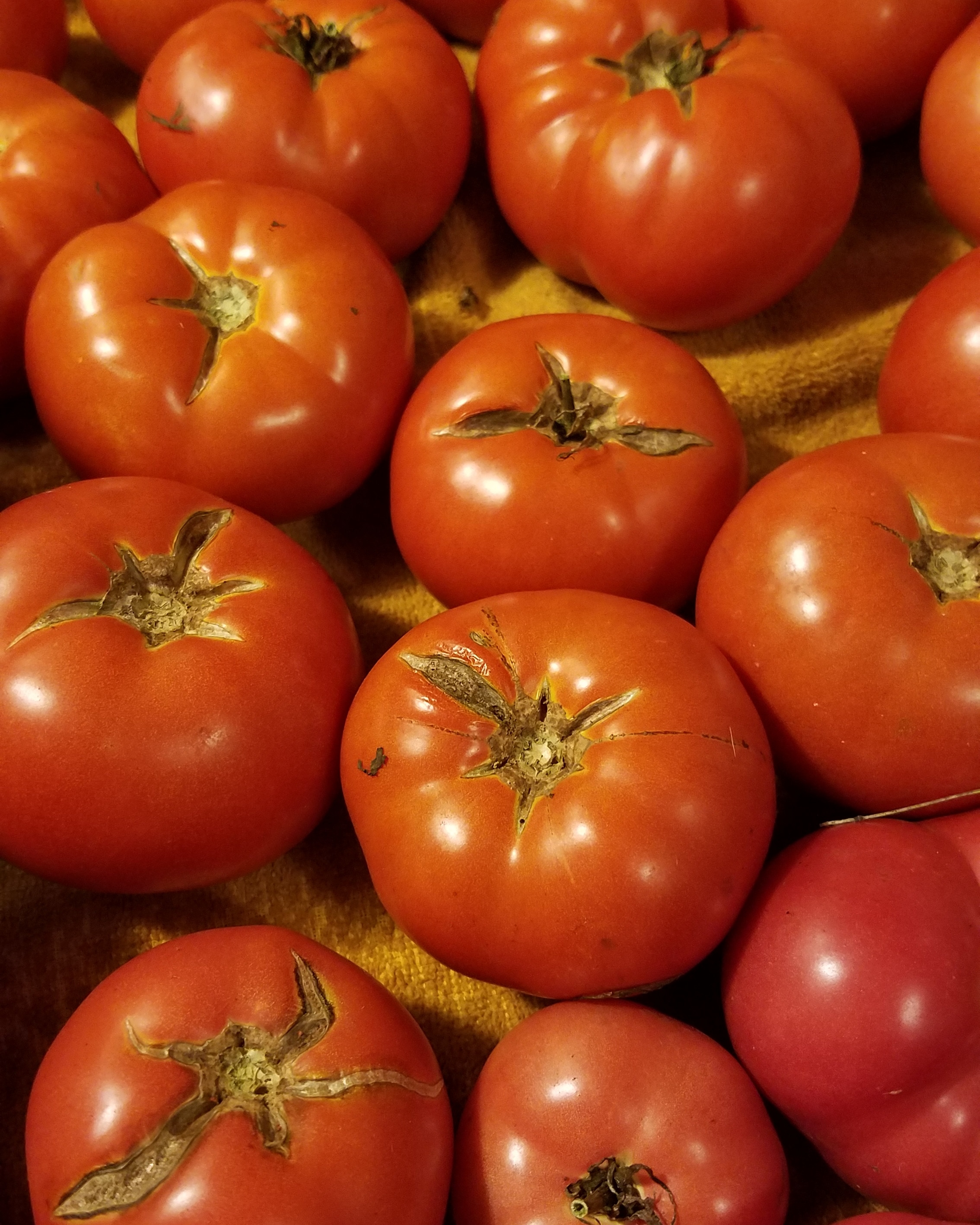
September was also the month I harvested my best crop of tomatoes, ever. There were enough to free me from any single preparation so I have several variations of tomato sauce in the ice box and freezer. Enough to last most of the next year. A few remain on the kitchen counter but they won’t last long. I have salsa with the abundant crop of Jalapeno peppers in mind.
One could do a lot worse than to live a plain life with plain folk. That of itself can be extraordinary. Especially with a burger for dinner.
We were busy at the orchard last weekend with perfect fall weather: sunshine and cooler temperatures. Throngs of people visited picking apples, buying apple products, and having fun with friends and family.
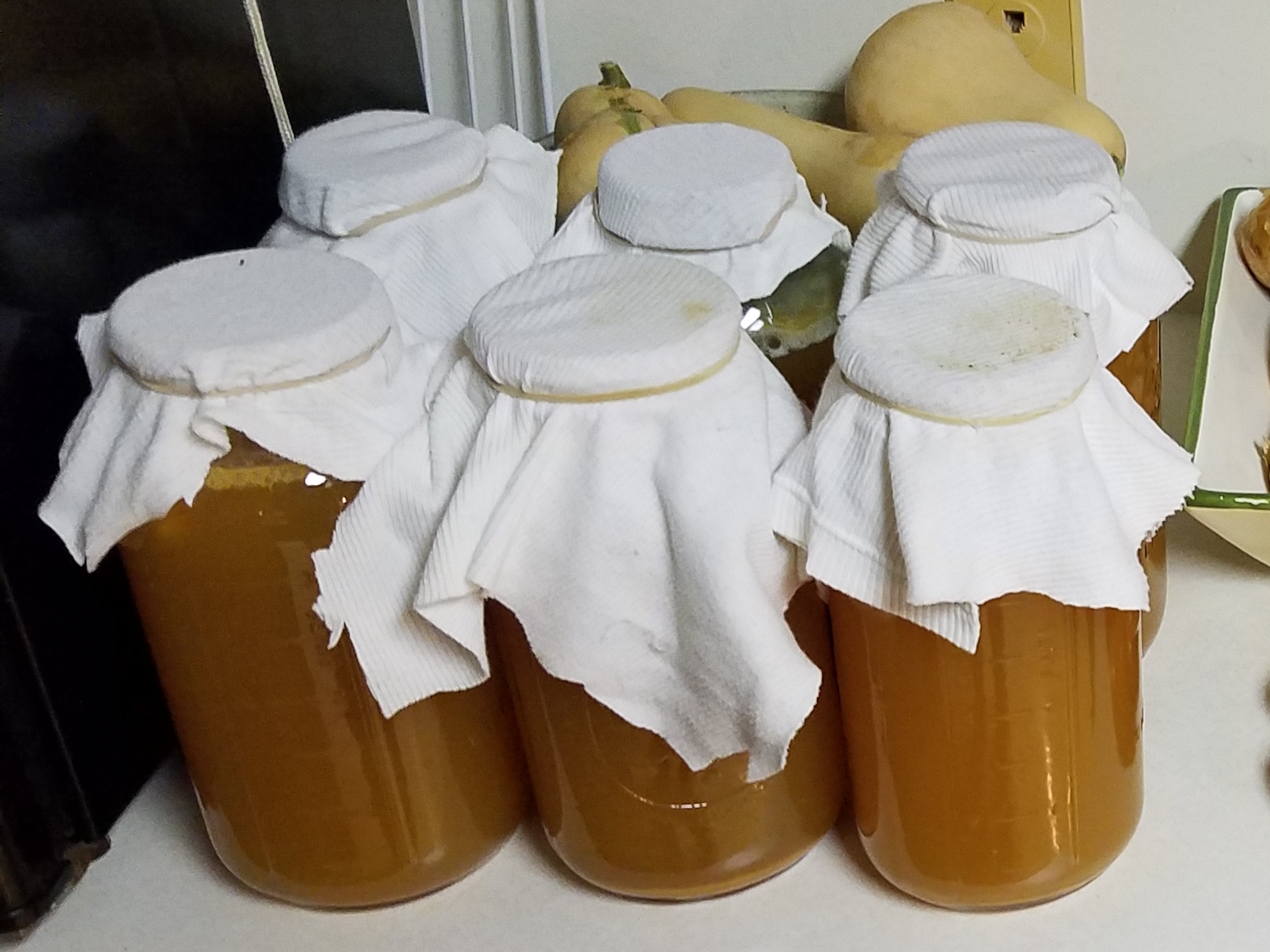
We are at peak apple cider sweetness this week. Gala and Honeycrisp apples make the cider sugar content highest of the year. A great time to make fermented products — cider vinegar for me. Since my apple trees did not produce this year, I bought four gallons and started vinegar on Saturday.
The mother of vinegar I use is traced back to the 19th Century. It’s a proven process and if one cares about flavor in a home kitchen, a necessary ingredient.
I haven’t written for a week, due mostly to my brother-in-law’s passing on Sept. 19. Jim and I started at the University of Iowa the same year, although I didn’t run into him after university until Jacque and I met. He married Jacque’s sister. A Celebration of Life is planned in October.
This year has been a challenge for many people I know. As our eyes turn toward the midterm elections we’re hoping to break the spell of this sour time. At least dilute it enough so it is more tolerable.





 Journey Home
You must be logged in to post a comment.