Categories
Writing

Growing a Story for the Long Haul

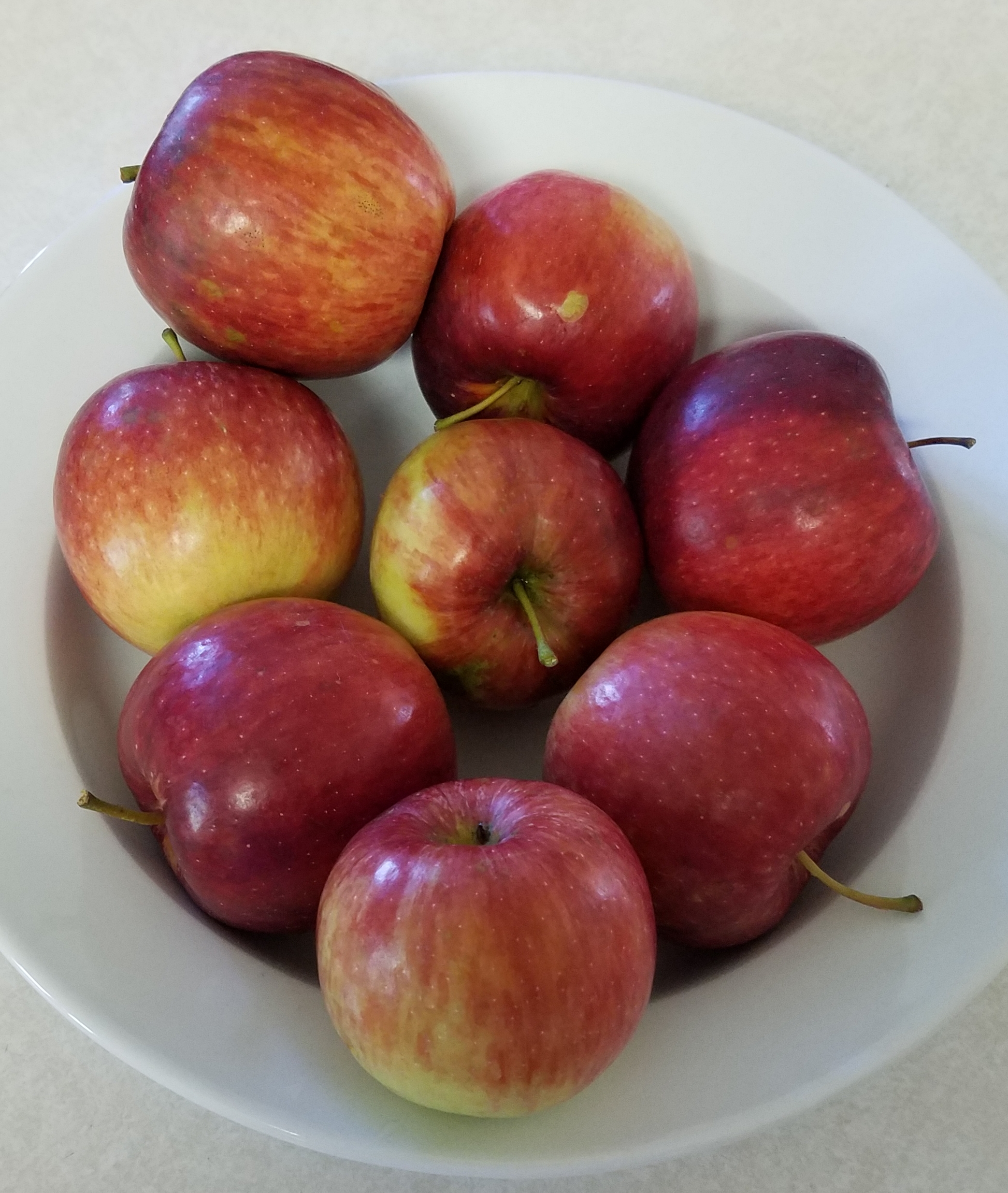
Bowl of Earliblaze Apples

Monday afternoons my spouse and I devote time to organizing the household, reducing clutter, and cleaning.

It’s a long-term project we do together. We schedule it on the calendar. Sometimes it means working together on a household issue. Sometimes it means moving boxes and furniture. It definitely means cleaning. Yesterday I spent an hour shredding personal papers. There’s is a lot to do.

We each have reasons for the project. Mine is to eliminate belongings accumulated in 67 years so when I’m gone those left don’t have to deal with them. In particular, I don’t want our daughter to have to spend weeks doing work I should have done. I also want a more comfortable place to live.

The project conflicts with my desire to produce new work. Yet a few hours a week won’t kill me as I slow down into retirement. As the work gets organized, there is a lot to like about it. Now or never is the time to consider all this stuff.
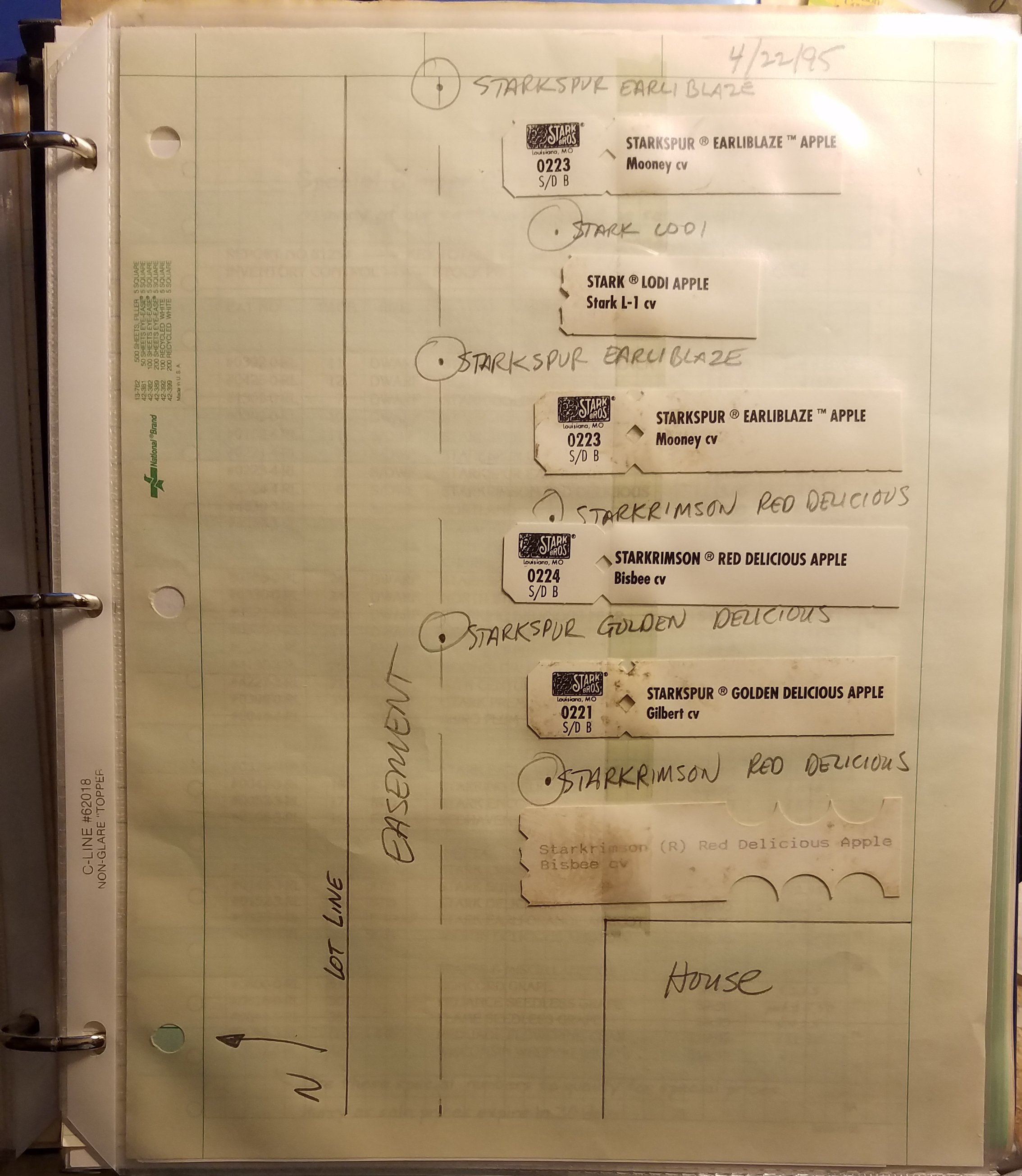
1995 Apple Tree Planting Record

Among recent findings was the planting record for our grove of fruit trees. Planted on April 22, 1995, I began with six varieties of trees, which over the years has been reduced to three: one Red Delicious and two Earliblaze apple trees.

Yesterday I ordered two new apple trees: one Zestar! and one Crimson Crisp. I’ll take out one of the Earliblaze trees and increase the distance between plantings. The idea is to get a succession of ripening fruit — the same thing I originally intended. The new ripening order will be Zestar!, Earliblaze, Crimson Crisp, then Red Delicious. I plan to plant one or two Gold Rush Trees, but the nursery is sold out this year. Gold Rush is a late apple that stores exceptionally well. Planting trees is a longer term commitment than a couple of seasons so I don’t mind waiting until 2021 for those.

I know more about apples today than I did when we moved to Big Grove. That’s mostly due to working at a local orchard during apple season. It changed how we view them dramatically, introducing new flavors and varieties. Whatever apples we have in our home orchard, we’ll supplement them with other local fruit. I probably think about apples more than most people.

If I were to tell my story, the seven seasons of working on farms and at the orchard would be part of it. Not only is the work a source of food, it is about culture and learning. It is about integrating our kitchen with an ecology of food that includes fewer items from the grocery store and more I grow or have a hand in growing.

Producing a crop of apples is a sign of something. To begin with, it is a long-term commitment to growing. The rest is about how the trees are cultivated and apples are used. If all I did was make hard cider with them, that would be something. I want more from life than that. I’m in it for the long haul.
Categories
Writing

Shared Culture by the Lake

Making apple cider vinegar.

When we moved to Big Grove Township we had expectations about building a life here. These expectations spoke to our shared culture.

We built a new home, settled into the public school community and began getting to know people as I worked a career that would eventually take me to a job in Eldridge, Iowa where I managed a dedicated fleet operation for a large steel service company. At the time I thought the 55-minute drive was a reasonable commute.

While there, in a staff meeting, news of the planes hitting the World Trade Center and the Pentagon, and crashing in a field in Somerset County, Pennsylvania began to emerge. I was scheduled to fly to Philadelphia that morning but the flight would be delayed. That day became part of an American cultural heritage.

The events of Sept. 11, 2001 were an opportunity for the country to pull together, to unite in shared values. It was squandered by our national leaders who used the terrorist attacks as sufficient reason to invade Iraq. Our disdain for the national culture has increased since then.

Participating in a national culture is made worse by growing income and wealth inequality. If comparisons of modern capitalism with the Gilded Age and the rise of Rockefeller, Morgan, Vanderbilt, Carnegie and others is apples to oranges, Republican leadership of the U.S. government is systematically undoing every constraint on wealth and business implemented since the 1890 Sherman Antitrust Act. This is intentional, and under a government subject to the unlimited financial contributions of businesses. In part, we can thank the U.S. Supreme Court decision in Citizens United v. FEC for unleashing the power of the wealthy in our governance.

Not only do we view the rise of the wealthy into power over our lives with disdain, we spend more time thinking about it because of new media available to us 24/7. We tend to forget our local culture, the culture we share with family, friends and neighbors — things that are shared, yet personal to us.

Mom’s funeral on Monday started an immersion into cultures I forgot existed. Greeting people from every part of Mom’s life at the visitation taxed my ability to remember. I don’t believe I come up short. At the Knights of Columbus Hall after interment I sat with three of my cousins and talked about things I’d forgotten existed. Aunt Wini’s wringer washing machine, Orsinger’s ice cream, Uncle Vince’s photography culture, Chicago steel mill culture, and more. I was able to keep up even though it has been years since I’d seen any of them. I could keep up because it is our shared culture.

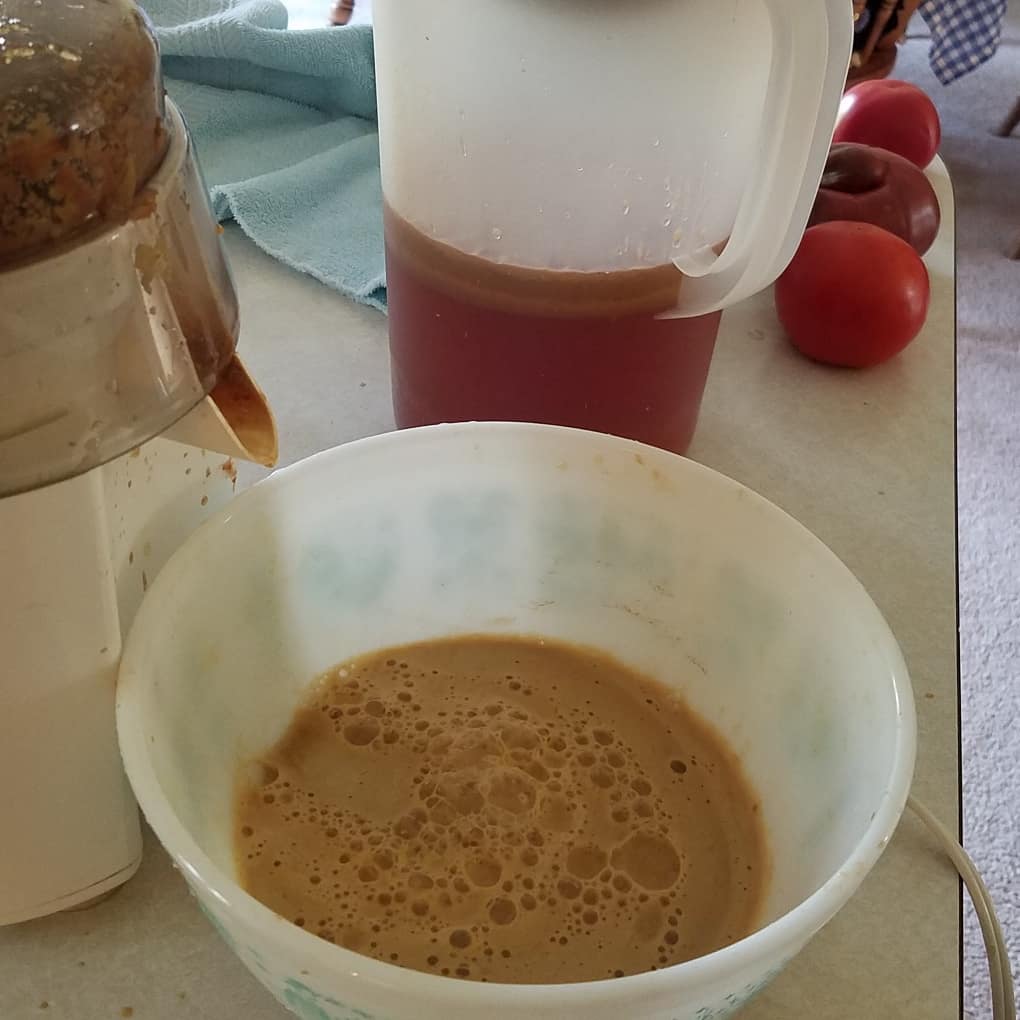
Yesterday I took the crate of apples from the summer trees in our backyard and made a gallon of apple cider vinegar. By this morning the brewers yeast was working. After skimming the scum, I put the two half gallon jars on the pantry shelf to ferment. I got the mother of vinegar from a neighbor. His family had been making vinegar with it since the 19th century. The distribution of our vinegar is in a short radius with most of it used in our kitchen. I’d be willing to bet I’m one of a very small number of people fermenting vinegar in our township.

The point is we have shared cultures and the only way they exist, now and into the future, is by participating in them. The sad occasion of Mom’s passing was made better by the celebration of her life by the living. Our cuisine is made better by making our own vinegar for pickles and salad dressings. Eventually our national culture will regain its value but we are not there yet.

We chose this township based on the logistics of living. To make it meaningful we’ve had to participate in local cultures. As bad as the national culture is now, we can’t stop participating because so much is at stake. What happens near the lake ripples throughout society. If enough people engage, that could be life-changing for us, and for us all.

Categories
Environment Writing

Glorious Summer of 2019

Cherry Tomatoes

If August was a tough month, this summer has been one of the best in recent years.

Moderate local temperatures with reasonable relative humidity, rain enough to help the garden grow, and friends meeting the challenge of growing flowers and vegetables in a changing climate, all helped us feel comfortable.

July was notable for being the hottest month for the planet since record-keeping began, according to the U.S. government. Regional variation made Iowa tolerable, perhaps a harbinger of the impact of humans living on the planet continues its steady deterioration of our biome.

Despite favorable weather it was hard to get off the starting blocks in August on scores of projects needing attention.

It will soon be time to turn the page.

For the time being I’m eating cherry tomatoes and enjoying the last weeks of this glorious summer.

Categories
Writing

Starting Again

Canning Plum Tomatoes

Out of the ashes of lives past we are reborn.

With last Thursday’s death of Mother, as well as that of our friend Lillian Davis, life continues. As we linger around funeral arrangements and schedules, phone calls and meet ups, emails and social media posts, something positive is on the horizon if we can only see it.

Like the single concertina note that begins the David Merrick musical Carnival! it’s familiar and quickly to be accompanied by other instruments. We are uncertain where it will go, but only for a few moments, and then we’ll get swept up in, “Direct from Vienna…”

Warehouse work occupied my last shift at the home, farm and auto supply store on Wednesday. We prepare for the holiday retail season and new merchandise arrives daily. There were trucks to unload, inbound shipments to process, and on line orders to fill. Our store is doing reasonably well compared to our daily goals, although a large-scale competitor is building a new store nearby. Fleet Farm expects to extract $2 million per week in revenue from the area. Our sales and those of others may take a hit. At the end of the year I’ll assess whether to continue there in 2020.

The orchard didn’t need me yesterday because of thunderstorms in the forecast. I used the time to work on funeral arrangements, then we went to the visitation for Lillian. Her children, who were in 4-H with our daughter, are grown and handled themselves well in a tough situation. Lillian would have been proud of them.

Summer plans have been scrambled. To get away from the death reminders I canned the ripe plum tomatoes yesterday. There will be more. I see a physician today and hope to develop next steps to control my glucose levels without medication. Jacque and I have plans to start cleaning the house and downsizing, a process that will go on for a few months. There is more to life than these existential errands.

We do what we can, hoping for the best, and try to make positive contributions in a fractured and turbulent society.

Or as the character Yoda said in the Star Wars movies, “No. Try not. Do… or do not. There is no try.” We can do better.

Categories
Writing

Six Weeks Until Autumn

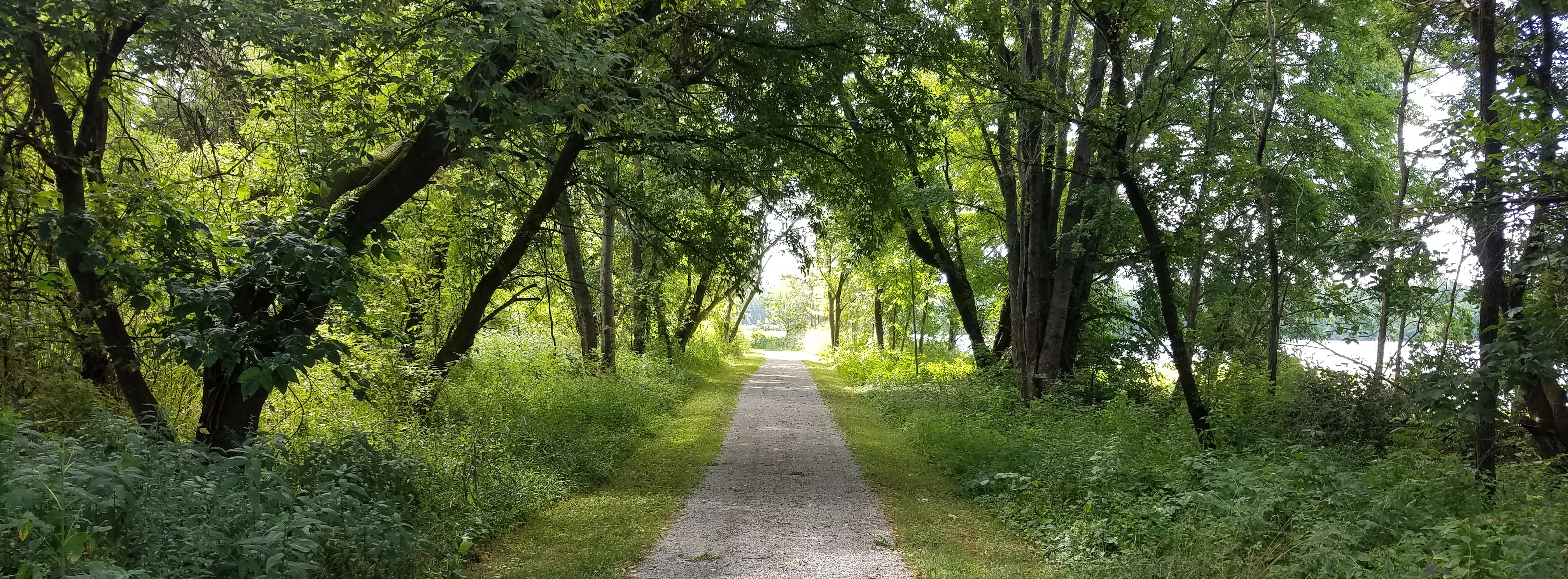
Lake Macbride State Park trail – Summer 2019

It’s time to move on. Yet… I would linger in this spectacularly Iowa summer.

It is a summer like those remembered from childhood. Long, warm days that stretch into a vanishing point. Cool nights to greet an early riser well before dawn. A never ending chance to find opportunity in a world which lies beyond the work-a-day society in which careers were spent.

No one can meaningfully say how many more of these days we’ll have before the atmosphere turns humid, making outdoors living unbearable. Despite the lack of rain, it’s been a good summer. A time to reap what we sowed and arrive into autumn.

A couple of things.

I’m tasting the first apples from two trees daily, evaluating sweetness and crunch, background color and appearance. While Japanese beetles invaded the leaves, there will be fruit for the kitchen. One doesn’t see apples like mine in grocery stores because they are small and imperfect from living in a pesticide-free environment. Commercial growers would have culled most of them for juice yet they are a main crop for the production of seasonal baked goods, cider vinegar, juice and applesauce if I need it. Picking and processing them will be a bigger project than usual.

Cucumbers, zucchini and yellow squash are winding down in the garden. Soon I’ll pull up the plants, till the soil and plant next year’s crop of garlic. I am only just learning how to cultivate garlic and looking forward to this second year of my own plants.

My bedside table got crowded with too many books so I need to set priorities for the rest of summer reading. Processing garden abundance will take time away from reading, so I expect to complete fewer books this month. I just started the novel Milkman by Anna Burns, which won the Man Booker Prize last year.

Tuesday colleagues from California met with U.S. Representative Adam Schiff (D-CA) who agreed to add his name to the list of sponsors of the No First Use Act introduced in January by Senator Elizabeth Warren (D-MA) and Representative Adam Smith (D-WA). The bill would establish by law it is the policy of the United States not to use nuclear weapons first, which is what most Americans believe. It was a positive step.

As it usually does, writing daily for Blog for Iowa while the editor was on summer hiatus inspired new interest in seeing the world through a progressive lens. The last of those posts appeared here this week, clearing the palate for new topics and better writing.

However, there are six more weeks of summer to enjoy.

Categories
Environment Kitchen Garden Writing

Summer Hump, August Heat

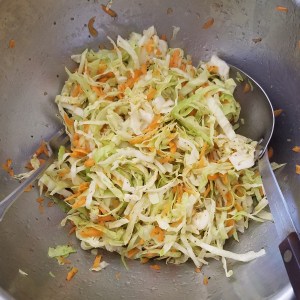
Mixing bowl with summer coleslaw made of local produce and my fermented apple cider vinegar.

Six weeks into summer 2019 we are over a hump, if not the halfway point.

I visited Paris in August 1974. It was hard to find a business open. Eschewing air conditioning we Americans find ubiquitous, Parisians fled the heat of August for the Mediterranean Coast and other breezy spots.

We could learn from that society.

My spouse visited her sister for the month of July. While she was gone I set the thermostat at 84 degrees compared to doing what we wanted in July 2018. The average monthly ambient temperature increased from 75 to 76 degrees Fahrenheit. Between running the air conditioner less and only one person active in the house, our electricity usage dropped by 37 percent in terms of kWh used. I appreciate the savings but I’d like her to return home more.

Summer in Big Grove Township has been reasonably nice with plenty of warm, sunny days, not enough rain, and an abundance from the garden. Friday the ditch had dried out enough I could mow the tall grass and get it looking more normal. The rabbit that lived there this year is likely frowning as rabbits do.

The yard grasses are in transition and need mowing, but not that much. I thought to do it yesterday and rolled up the garden hose near the house after watering in the morning. Not yet. Maybe today after my shift at the orchard. Maybe not as it is a low priority.

We planted our first garden in 1982 and grew or harvested something from our yard in the five places we lived since then. I’m getting better at it.

Cucumbers

We produced more cucumbers this year than we could eat and preserve. I determined a process using four varieties of seeds: two pickling, a Japanese-style cucumber and the utilitarian Marketmore. I made a gallon of fermented dill pickles as dill came in from my barter arrangement with Farmer Kate. The key to good pickles is the cucumber size. Once cucumbers get an inch in diameter they are too large for pickle making. Just don’t do it.

I made dishes of sliced cucumbers for potluck dinners, gave them away, and ate them as much as I could stand sliced raw, in mixed salads, and with lettuce greens when they were in season. There were plenty for sweet pickles but I overdid it last year and have more than a dozen leftover jars. I struck balance between the desire to use every bit of produce in the garden and how we eat them in season.

Tomatoes

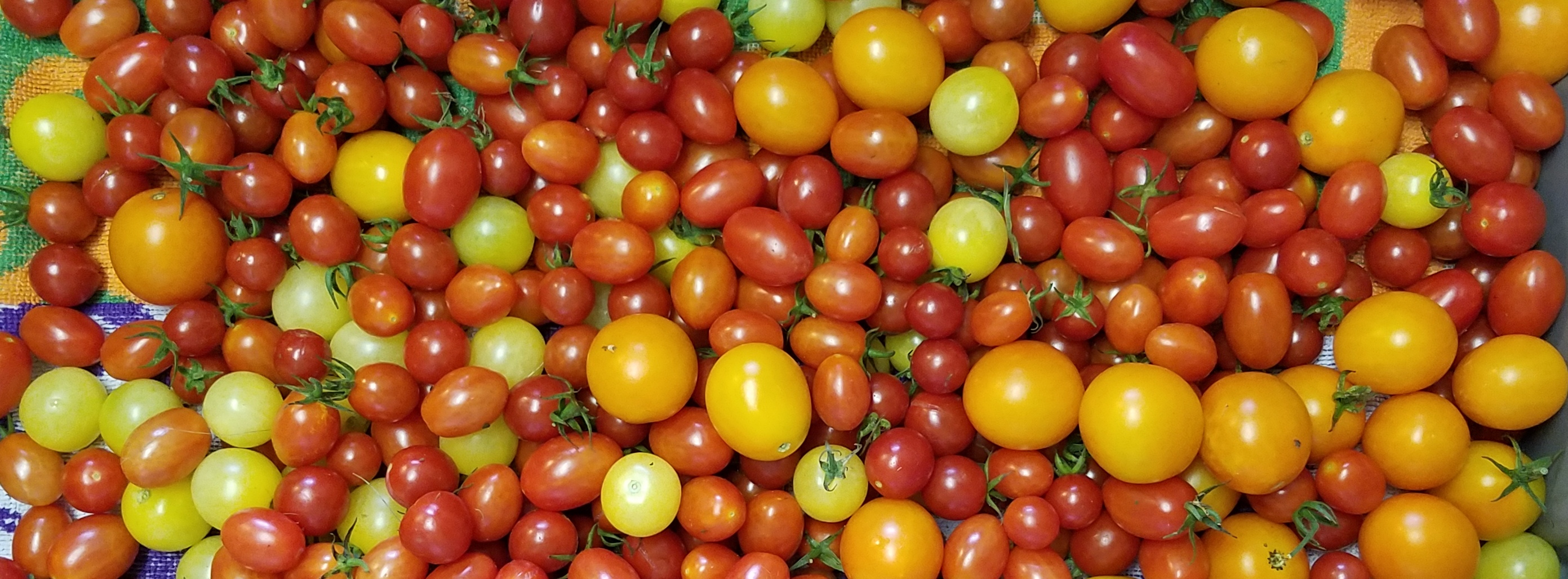
As I posted a couple days ago, we are waiting for tomatoes. The cherries are coming in Jasper, Taxi, Matt’s Wild, Grape, White Cherry and Clementine. The White Cherry, Jasper and Matt’s Wild are surprisingly sweet and delicious. The single Early Girl and Black Krim plants produced fruit. I’ve had a couple Speckled Roma which I found to have tough skin.

This year as last, I planted the rows too close together. I crawled under the seven-foot indeterminate vines and inspected. A lot of good sized fruit waits to ripen under the foliage.

The plants have less blight this year than last. I don’t know why but two things are different. We had extremely cold weather last winter. Perhaps the cold killed some of it off. I also applied diatomaceous earth to the ground after tilling to keep down the crawling bugs that love tomatoes. Perhaps it had an effect on the blight. So far, so good and if all continues to go well, we will have plenty of tomatoes for fresh eating, canning and gifts to friends.

Green Beans

By now we’ve usually had green beans but there are hardly any on the plants. The foliage looks great. There are flowers. No beans. Other area gardeners are experiencing the same thing with a reduction in yield. I picked exactly two beans from a 15-foot row.

Apples

After nearly perfect pollination and fruit setting the invasion of Japanese beetles has the apple trees looking like dirty brown lace. I wait for the fruit’s background color to get right and have been tasting them every other day. The first of two varieties is getting close. Fingers crossed.

A friend sprayed his apple tree with Sevin to kill a Japanese Beetle infestation. The pesticide works although it contains carbaryl, a known carcinogen banned in some European countries. “Aren’t you worried about eating the fruit?” I asked. “Nah!” he said. I continue to refrain from using insecticides, which offer a temporary abatement to the detriment of the environment and apple eaters.

It’s a race to ripeness with popilla japonica. If bugs eat too many tree leaves, inadequate sugar is produced for fruit to ripen. If fruit gets ripe on the tree and they can penetrate the skin, they will mass on it and eat it. There appears to be enough green leaf left to absorb sunlight adequately to ripen the apples. I plan to pick them the minute I find them ripe and ferment the juice to make apple cider vinegar. The second variety, Red Delicious, is for eating out of hand, and everything else apple-related.

The Joni Mitchell song comes to mind, “Give me spots on my apples but leave me the birds and the bees.” In our garden there are plenty of apples and an abundance of birds and bees with whom I enjoy co-existing.

Categories
Living in Society Writing

When to Swallow the Red Pill

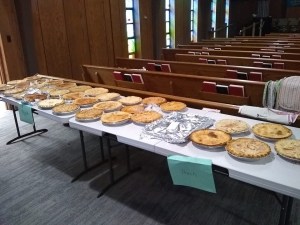
RAGBRAI riders stopped at the Norwalk Christian Church for pie. Photo Credit – Trish Nelson

Trish Nelson will be returning to the editor’s desk next week.

Among things she did while on hiatus was ride a couple days of RAGBRAI, posting this photograph of pies behind empty church pews. The image says something more although I’m at a loss to put words to it. It can speak for itself.

Time for me to go on hiatus for a while as well.

Tomorrow I return to the apple orchard where I work in the sales barn doing whatever is needed for the season. If I’m lucky, I’ll have great conversations with some of the thousands of guests who show up on a weekend. If I’m extra lucky, those conversations will be about apples, gardening and farming.

We political activists need to do our best work to elect a replacement for Dave Loebsack in the Second Congressional District and a U.S. Senator to make Joni Ernst a one-term senator. We also need to retain the hard-won seats of Cindy Axne in the third district and Abby Finkenauer in the first. If we have a candidate in the fourth district, there’s work to be done there as well. Those campaigns will have to wait until after the presidential preference in February, because a person can land only one plane at a time. I favor Rita Hart in the second district and Theresa Greenfield for U.S. Senate. There are no clinkers among those running in the primary.

As far as the Iowa caucus goes, I’m in the same boat as a lot of readers. I want to pick a candidate for president to work with after Labor Day. If I can’t decide which one by then, I may go to caucus uncommitted and join a group that needs one more person to be viable.

I expect to run our precinct caucus (because of a lack of volunteers) and don’t want to get into the unseemly discussions we had during the vote count in 2008. Being uncommitted would be a positive in that regard.

Democrats can’t afford to have winners and losers this cycle, so the pre-caucus dynamic is different from 2008 when there were 8-10 candidates for president and everyone worked hard for their guy or gal to be the one. The only thing that remains the same this cycle is Mike Gravel is running again. (Update: The afternoon of the day this was posted, Gravel suspended his presidential campaign).

Someone asked me who were my top three potential presidential candidates. I had to think, but came up with this answer:

Anyone other than Biden, Sanders, Warren and Harris needs a breakthrough by Labor Day (maybe Thanksgiving) to ouster these four poll leaders. Polls and second choices will drive the presidential preference Feb. 3.

If not this week, then soon, the less than one percenters will hopefully have made their point and gracefully exited the race to work on other Democratic priorities. I’m very sorry Senator Kirsten Gillibrand is in this group. She couldn’t get over the Franken blow back among Democrats I know and lost important donors. She is uncompromising on women’s rights.

Look at it this way. Once I figure out what/who I’m supporting I’ll swallow the red pill and follow the rabbit hole where it leads. With the primary in June, there’s plenty of time to work on Rita Hart and Theresa Greenfield after caucus.

Or look at it another way. If Warren had run in 2016, I would have worked hard to make her the nominee. I’m satisfied she’s not too old today. There’s no one else left in the top 4 besides Kamala Harris. I’m less than confident a woman can get elected in 2020. I don’t like most of the men.

So there’s my indecision. If I can’t decide by Labor Day I may not declare and throw my one preference to which ever group could be viable with it, except maybe Sanders.

The most important endgame is coming together once we have a nominee. Keeping the red pill in a waterproof vial for now.

Hope readers enjoy the rest of summer. Thanks for the clicks during the last five weeks.

~ Written for Blog for Iowa

Categories
Writing

What’s Wrong With Our Food System?

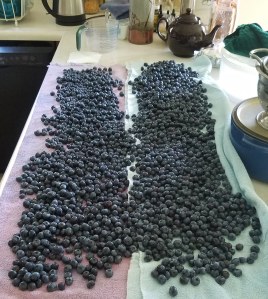
Drying 10 Pounds of Michigan Blueberries for Freezing

There is a strong argument nothing is wrong with our food system.

There is a strong argument everything is wrong with our food system.

To talk about a “food system” at all presumes a lot that may or may not be true.

It’s no secret large corporations increasingly control food production, distribution and marketing. Scalability is a key issue with providing nourishment for billions of people. The hand of large land owners, chemical companies, seed genetics companies, processors, banks, equipment manufacturers and consumer outlets runs throughout each household’s food ecology. Households have a food ecology even if they don’t speak of it using such fancy words. What appears at a meal is influenced at every point in the distribution chain by large corporations.

It’s also no secret farmers, especially small-scale farmers don’t earn a lot of money for their long hours each season. Neither do equipment manufacturing workers, seasonal farm help, truck drivers, grocery store workers, or restaurant workers. Whether one is a contractor for a large international meat-producing corporation or produces heirloom hogs for a meat locker, at the end of the day a diverse and ever changing personal economic structure is needed to ensure viability this year and in the near-term future. People struggle to make a living by farming alone.

At the same time, grocery stores are packed with food and if there remain some food deserts without one, enough food is produced in the United States to feed everyone. I met an executive from a large container manufacturing company when I worked in the Chicago Loop. He said the issue wasn’t having enough food, it was preserving and distributing what we already produce. That remains true, his statement representing another large corporation wanting a piece of the food supply action.

The deck is stacked against young farmers who want to produce food outside the mainstream. I’m thinking of friends that operate Community Supported Agriculture projects or grow specialty crops. Producing meat and vegetables for the local market has been a staple in society at least since medieval times. When there are a lack of well-paying jobs, or capital, if people have access to a piece of land for a season, attractive fruit and vegetables can be produced and sold at a margin that looks better because labor cost is removed from the calculus.

It goes without saying a farmer will work 60 or more hours a week, sometimes turning $100,000 per year in revenue derived from diverse sources (produce, livestock, grazing and retail sales) and living on a fraction of that. Land ownership? Only a small percentage of young farmers can afford to own land.

Consumers can afford a hodge-podgey food system with diverse sourcing, abundant supply, wide variety, and absence of much concern for how food arrived at our table. If corporations own equity in land, equipment and patented seed genetics, it’s hard to see that on our 9-inch dinner plate.

What matters more in this discussion is not whether a food system is good or bad, but whether that is even a thing. If each household develops its own food ecology, including best practices regarding water use, soil conservation, seed genetics and other resource use, that’s not good enough. If a food system exists, what it requires is scalability and that’s where corporations can and likely should play a role. Not evil corporations designed for extraction of resources and cash, but people joined together with common purpose regarding nourishing a growing population.

Asserting there is or isn’t a problem with our food system is itself a problem. It is much more fluid and undefined than that. Like vegetable farmers we need to accept each season for what it teaches us, hoping we can sustain ourselves for another season.

Additional Reading

Last Call for a Food Systems Revolution by Pallab Helder.

To Revive Rural America, We Must Fix Our Broken Food System by Austin Frerick.

World Hunger is on the Rise by Timothy A. Wise.

Twitter thread by Dr. Sarah Taber.

~ Written for Blog for Iowa

Categories
Living in Society Reviews Social Commentary Writing

Parade and Fragments

Sprayer in the Solon Beef Days Parade

A summer parade in Iowa is a chance to showcase lives for the entire community.

Farmers, restaurateurs, insurance agents, bankers, retailers, construction companies, government organizations and more cleanup their equipment and parade it through town handing out treats and small gifts along the route.

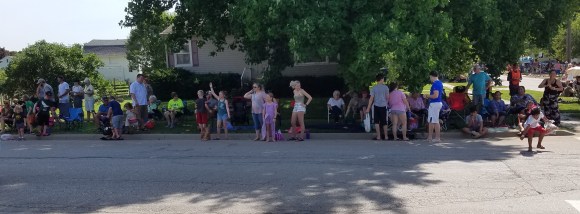
People line the street to watch, sitting on lawn chairs, standing under shade trees and chatting with friends on the sidewalk. It’s mostly for children yet adults get involved as well. Anyone can stand almost anything that marches by in the span of a couple of minutes.

Solon Beef Days Parade Watchers

I.

In 2013 our situation got dire. I had run out of money and held no job that paid enough. Not wanting to return to transportation, I took one low wage job after another to earn enough to get by. Most of the work involved standing on concrete floors, which precipitated a case of plantar fasciitis. Not only did my feet hurt, on a physician’s advice I gave up jogging after 37 years because of it. While the condition is resolved, it persisted until I left full-time work in 2018.

Expenses got delayed during this period, as did preventive health care. It wasn’t clear how tight money had been until I began taking Social Security benefits which brought relief.

II.

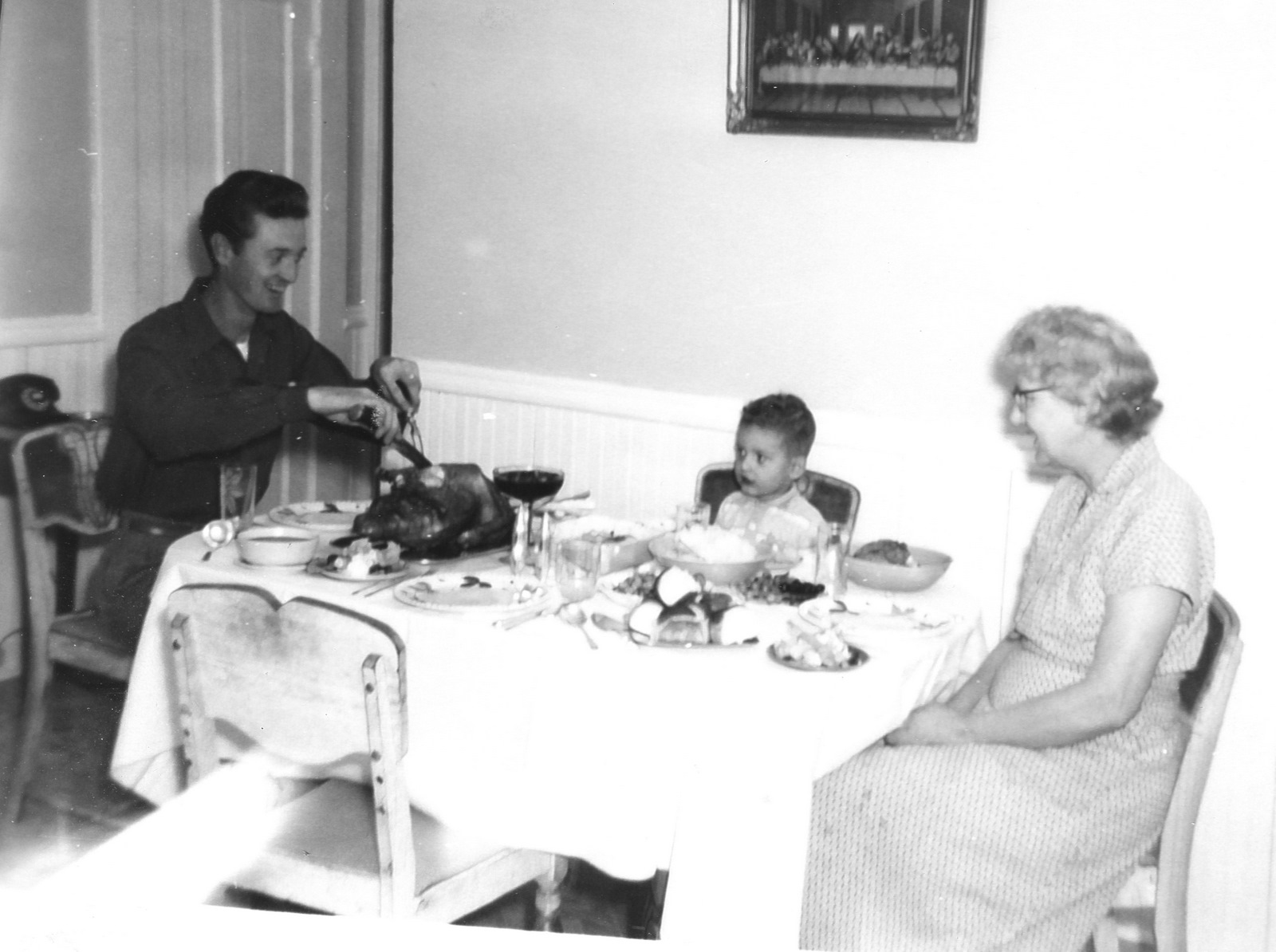
An Early Thanksgiving

The story begins with the proximity of relatives. Our maternal grandmother and grandfather made visits to our home. I never knew my paternal grandparents except in stories and photographs. As much as anything, my grandparent story is about my relationship with Grandmother from my earliest memories until she died Feb. 7, 1991.

We were lucky to have her with us for so long.

Grandmother had five children and 15 grandchildren. She spent more time with our family because of our proximity. She lived with us off and on during my early years, but eventually maintained her own apartment. In later life she lived at the Lend-A-Hand, a residence for women at the time, then moved to the Mississippi Hotel where she lived the last years of her life in an apartment until moving to the Kahl Home for a brief period. Grandmother had many sisters and a brother. We had a lot of relatives, or so it seemed.

III.

I read The Overstory by Richard Powers. It engaged in a way most fiction fails to do. The author must have spent an enormous amount of time researching trees, forests, and the culture around them. He wove them into a spellbinding narrative. I could go on gushing about the book, but just pick it up and read it. If you do, and are interested in the environment, I doubt there will be any regrets.

Categories
Environment Writing

Sunny Day in Iowa

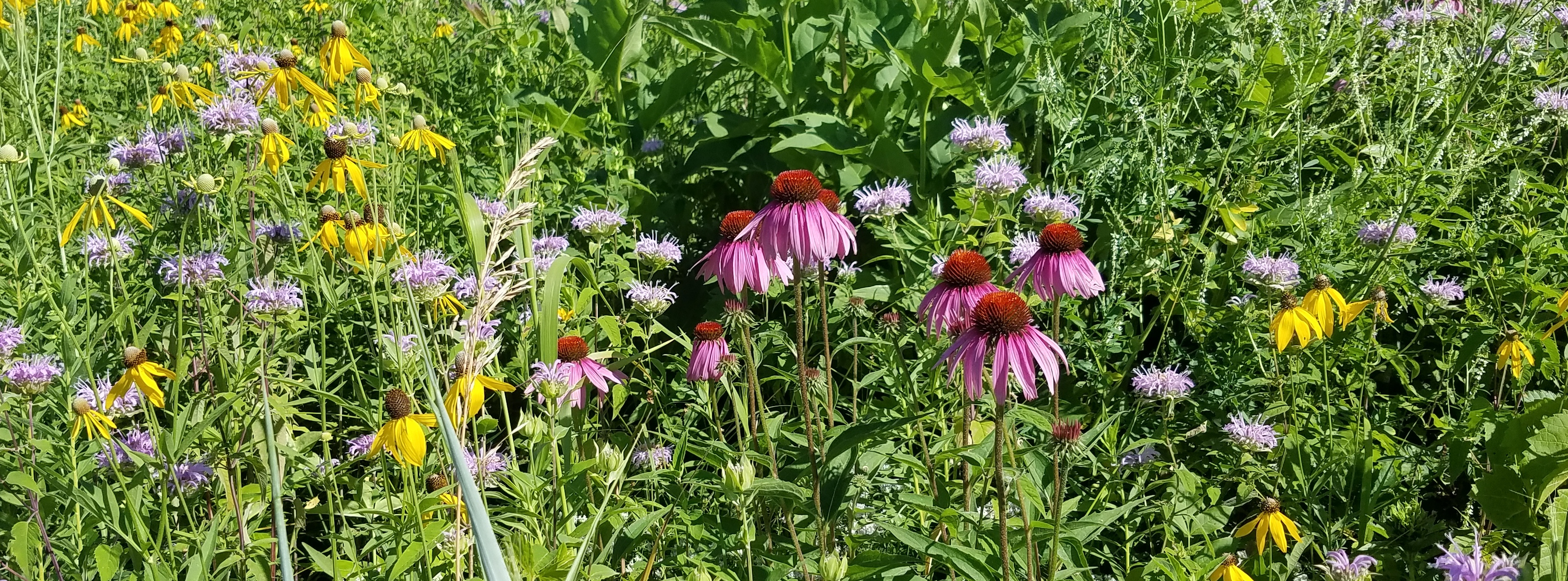
Prairie Restoration Area at Lake Macbride State Park

Each time I walk on the state park trail there are different wildflowers in bloom. Today’s offering was some of my favorites.

After returning from the day’s exercise, I mowed the front yard and couldn’t make out the line where the back yard started. Grass apparently wasn’t tall or thick enough to need cutting so I stopped and put the mower away until there would be enough to use as mulch.

I raked what few grass clippings there were for the garden, checked the moisture in the last few seedlings, and went inside to spend the rest of the day as temperatures climbed toward 90 degrees. We’re to have several days like this without rain.

We enjoy sunny days while we can. The restored prairie shows its pleasure in them with wildflowers in bloom.