Categories
Environment Kitchen Garden

Gardening Before the Rain

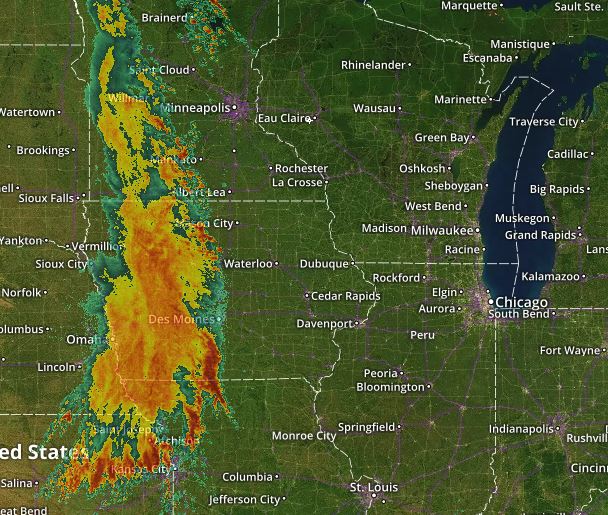
Weather Radar June 2, 4:46 a.m.

In the end it didn’t rain.

The forecast had been rain for a couple of days. The weather radar looked ominous Saturday at 4 a.m. It was heading our way.

At sunrise I went to the garden to beat the rain.

Our garden is big enough to engage a person for hours — weeding, harvesting, planting, mulching, fence mending and the like. It never ends. I think there, mostly about our relationship with the environment and toward a food ecology, the dreams of gardeners.

The work was to mulch tomatoes, weed carrots and beets, clean up kale leaves bitten by intense heat, replant seedlings where they failed and organize for the next planting session. The mulch collected this week is about half used. Before I plant, it must all be relocated to a final destination to clear space for peppers and beans. There is another day’s work waiting today.
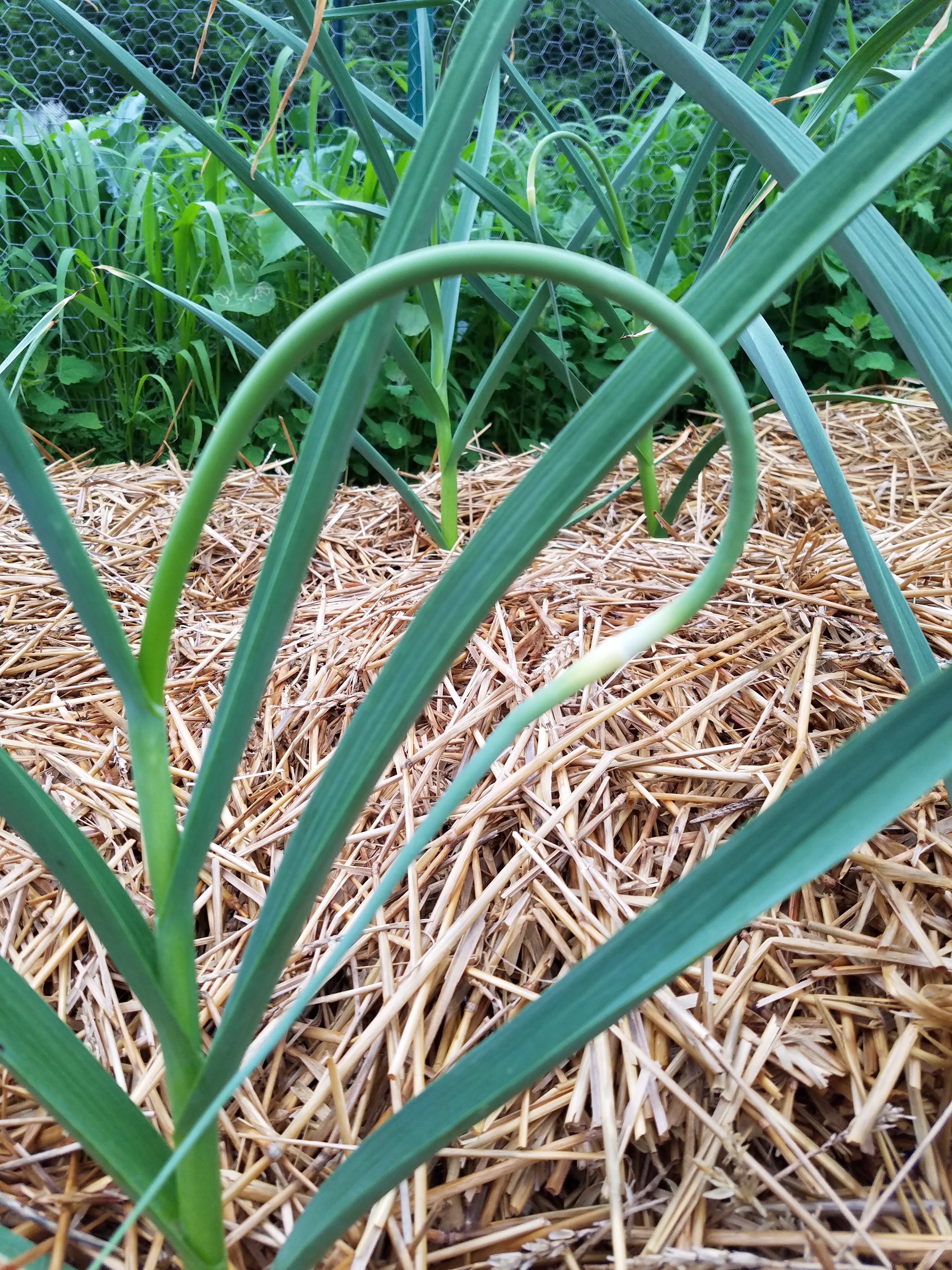
Garlic Scape

The garlic crop has been exciting. Scapes began to appear and as soon as they twist back around on themselves I’ll cut them off, to enable the bulbs to benefit from the plant’s energy, and to use them in the kitchen. The seeds were planted seven months ago so it’s great to see we’re getting closer to harvest.

The cloud formation I saw on radar broke up before it got to us. Where I expected rain, there were blue skies. I got out the hose and watered.

Like it or not, I must deal with my physical capabilities. I’ve been blessed with good health most of my life. When I had to give up running a couple years ago things began going downhill. What I mean is there was a perceptible decrease in flexibility and energy coupled with selected aches and pains in my shoulders, feet and hands. The foot pain is likely related to running although I’ve been spared the joint pain runners experience in their knees and hips. My shoulders? One of the transient doctors at the nearby clinic diagnosed arthritis, but I doubt it. I’ve learned to be careful not to injure myself with lifting. My back is sound. I get along.
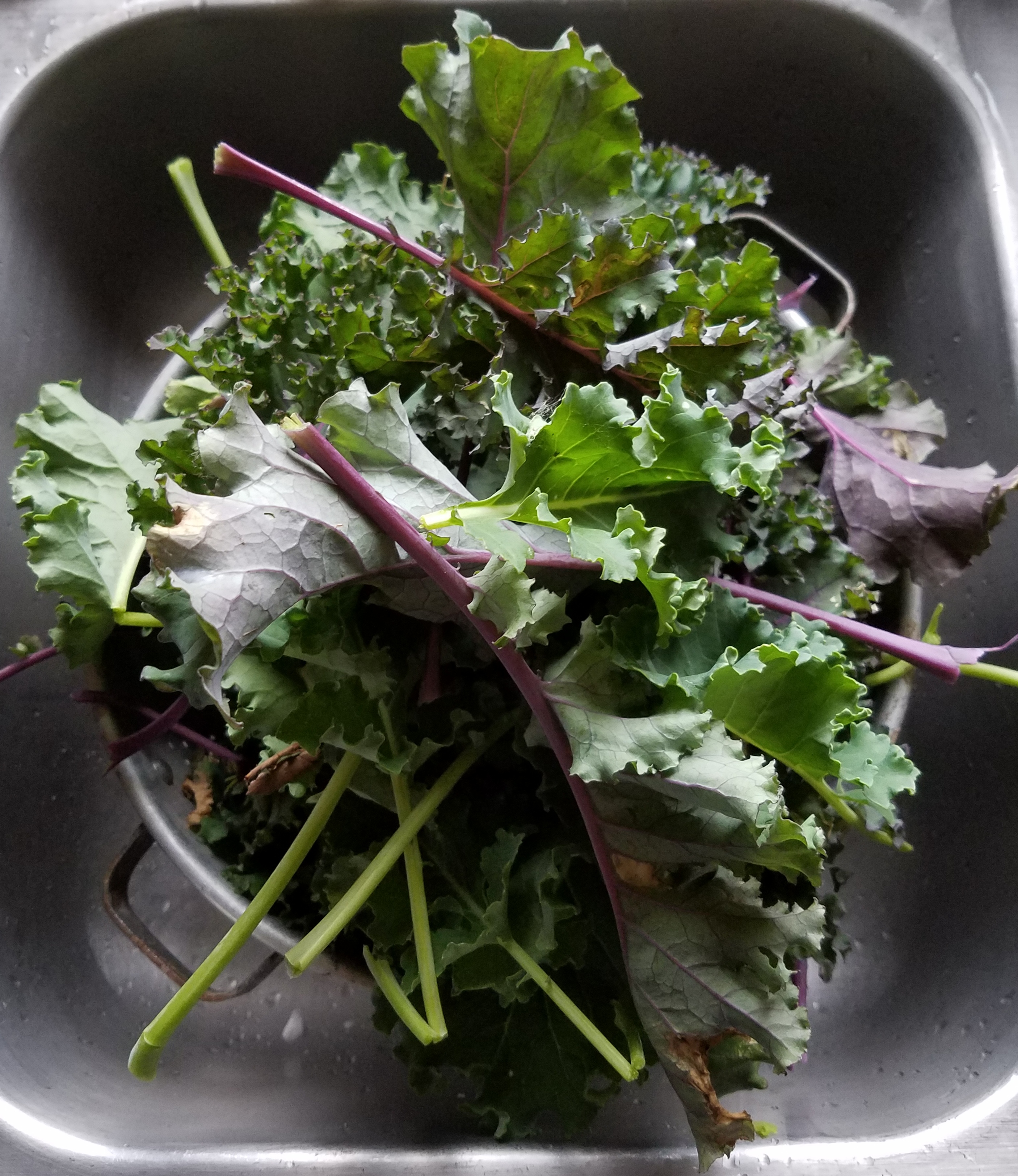
Kale Harvest

The main thing is dealing with energy levels. Instead of staying in the same place to finish a job I’ll take a break and go walking… to the garage, to my desk, to the kitchen. Sometimes I sit in the recliner for a while. I get back up and return to the garden. It’s a hodge-podgey way of doing things, however, I believe variation in work routine staves off further bodily ailments. It’s likely good for my mind as well.

The spring share at the CSA finished on Monday. The ice box is filled with fresh greens and rhubarb. On deck is rhubarb something, a vegetable broth for canning, and spinach daily until the kale avalanche arrives. I did not barter for a summer share at either CSA in order to survive mostly from our garden. Each year I become a better grower. It enables us to sustain ourselves with fresh produce while the season continues.

What more could we want in a turbulent world?

Categories
Environment Kitchen Garden

Bringing Food Home

Farmers Market Food

A relationship with food in American society is complicated.

Some don’t have enough. Others are awash in calories. We each have a human need for nourishment and the ways we go about meeting it are as different as the families which engendered us.

A favorite childhood memory is when Mother went to work in the school cafeteria after the Catholic Church built a new grade school near our home. With other women like her, she took a list of ingredients based partly on government programs (including lots of cheese) and partly on a limited budget, and made meals that included such dishes as porcupine meatballs (hamburger and rice) and grilled cheese sandwiches with tomato soup. Father worked at the meat packing plant which had an employee butcher shop where he could buy beef, pork and meat products at a discount, and did. The idea of stretching hamburger by mixing it with cooked rice was a novelty in our household and eventually we implored Mother to make porcupine meatballs for us at home, just like the ones at school. She did.

This story of external culinary practices coming into our home is essential to understanding the rise of a diverse diet in American society. We see things out there, they look good, and we want them. Most people, including low-wage workers, have or find the means to get them.

Many books, careers and lives have been based on food in society. We are an individualized rather than generalized culture with regard to food acquisition, preparation and consumption. To a large extent, the rise of the modern mega grocery store has shaped our eating habits in ways no one would have expected. Much ink has been spilled about that and I’m less interested in regurgitating my slice of it.

What I do know is local food farmers work hard for the sparse income they garner. All farmers do. The local food movement of which they are a part is based on the hope more people will bring locally produced, raw ingredients produced in a sustainable manner into their kitchens, ice boxes and pantries. Enough people do for a small group of farmers to make a living.

In many ways the increased interest in local food is the same type of behavior that took place in our home in the 1960s. We experience surprise when our CSA share includes Broccoli Raab, Koji or Bok Choy. We learn how to eat and cook them and want more. It’s not that our home nourishment plan is boring. We want and enjoy the experience of creation as it relates to cooking and eating. We want that experience to be personal and shared with family. That is very American.

I concede promotion of local food is a form of consumerism no different from a tomato catsup purveyor who spends dollars on an advertising campaign to enhance sales. The same behavioral forces are at work. I’m okay with that.

Just so you know, I’m not bewitched by the allure of eating a kale salad, at least not yet. Suffice it to say the diversity and behavior regarding food in our household with its kitchen garden, farm sourcing and grocery shopping has some unique qualities that may not be of interest to the authors of the Michelin Guide, but make our lives a little better. That too is very American. That’s part of who I am, who we Americans all are.

Categories
Environment Writing

Earth Day Weekend 2018

Earthrise Dec. 24, 1968

Earth Day is and will always be about this photo taken by the Apollo 8 astronauts on the first manned mission to the moon.

“The vast loneliness is awe-inspiring and it makes you realize just what you have back there on Earth,” command module pilot Jim Lovell said from lunar orbit.

With a perspective six inches from our noses, we often forget who we are and how we fit into the vast reaches of the universe. We are a speck in a place larger than we can imagine.

When I participated in the first Earth Day as a senior in high school, the idea we should work together for peace, reduce pollution, and care for the environment seemed obvious. Even much reviled President Richard Nixon got it — society had to do something to address clean air, clean water and endangered species.

Earth Day is a chance to revisit this iconic photograph. When we consider a broader perspective, as the photograph encourages us to do, little has changed on Earth since it was taken. Our troubles seem petty compared to the overriding fact Earth is our only home. We are all in this together.

As much as societies seek to delineate metes and bounds, there are no borders on the globe. There is only one society of which we are all a part.

This Earth Day I’ll be working at home in my garden. A late spring created pent up demand for outdoors work. For the last four weeks, one excuse after another delayed needed work, yet now I’m ready to release the floodgates.

Not before I consider this photo one more time.

Categories
Environment Living in Society

Letter to the Johnson County Board of Supervisors

Woman Writing Letter

Dear Lisa, Mike, Kurt, Janelle and Rod,

It’s funny how when one gets all the information the picture looks different.

Since I complained about the purchase of Dick Schwab and Katherine Burford’s property using conservation bond money after partial information was leaked via our local newspaper, I wanted to get back to you now that the purchase has been made public.

The fact Burford/Schwab donated the developed portion of the property mitigates my concern about how bond money is being used. In fact, because of that, the plan, as explained in the Press Citizen, complies with what I said in my March 7 email. “I hope and expect you to vote no on the acquisition of this property using conservation bond money.” My concerns are rendered moot because of the donation.

On reflection, this decision was a good one for which the board should be commended. It is also consistent with conversations I have had with Schwab about how he planned to dispose of his property.

While I continue to be dissatisfied by the partial leakage of information, I have no beef with you.

Thanks for your service on the board of supervisors.

Regards, Paul

Categories
Environment Writing

Morning Coffee, Climate Change and the 2018 Midterms

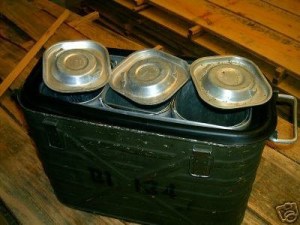
U.S. Army Mermite Can

I first drank coffee in the Army… on top of a hill… during the dead of winter… from a mermite can.

Steam rising from the lid proved irresistible when ambient temperatures were below zero and we had just slept on the ground. What else were we going to do but drink coffee? It was there.

We each have a personal history of drinking coffee. I asked one of the greenhouse seeding crews if they remembered their first cup. Some had specific memories, others did not. For me, it was the windy hill in Germany back in 1976.

Coffee was first discovered in Ethiopia in the 11th Century and spread throughout the temperate zones of the planet. It is currently being grown in more than 60 countries. Brazil, Vietnam, Columbia, Indonesia and Ethiopia are the largest coffee producers by annual export weight. Coffee has become ubiquitous as any foodstuff can be.

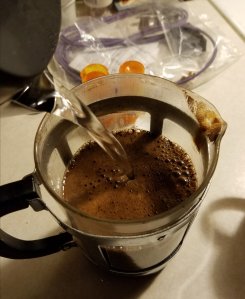
Making Coffee

The sources of our coffee are under pressure because of climate change. Yields are declining in part because a warmer atmosphere holds more water vapor, creating unseasonable and extreme weather events. Likewise, warmer temperatures expanded the range of the coffee berry borer. Coffee rust is a detrimental fungus increasing its range as the planet warms and winters no longer kill it off in mountainous regions where coffee grows. The impact of global warming caused climate change is not trivial.

We would like to drink a cup of Joe without worry. When we go to the warehouse club there is a long, abundant aisle of coffee produced all over the world. A cup of coffee continues to be affordable at restaurants. It hardly seems like a problem. It isn’t… at least not now.

The science of global warming is virtually undisputed. What seems less certain is how it will impact our personal lives going forward. The Earth’s ecosystem is complex and specific regions have had different issues. We’ve had our share of droughts in Iowa, but there has also been enough rainfall to produce crops. Some days it seems the only persistent idea about Iowa’s climate is that rain remains. When it comes to coffee, what happens six inches in front of our noses is not as important as the global environment in which humans live.

There’s the rub.

With the 2016 election of a Republican to the White House, all eyes are diverted from our most pressing problems. Challenges to the study of climate change is one of those pressing problems and not only because I may be deprived of my daily cup of coffee.

The administration walked away from policy decisions we’ve made to reduce greenhouse gas emissions. It is cutting funding for climate research. It is censoring and targeting government scientists. One could reasonably say the government under Republicans has abandoned science as a consideration in policy-making.

As Americans, we know what to do. We must repudiate the direction Republicans are taking our society by voting them out in the 2018 and 2020 elections. I’d rather linger over my morning coffee than get involved in politics again. However, personal political engagement is the price of a livable future.

Categories
Environment Work Life Writing

Green Up is Coming

1970s To-Do List

“Good navigators are always skeptical, not of the presences of things, but of what they see and understand. Good navigators are almost always lost.” ~Robert Finley

Green up has begun and everything seems ready to pop — even if it isn’t.

My usage of “green up” comes from the 1936 film The Trail of the Lonesome Pine,” in which June Tolliver said, “I ain’t marrying till green up,” delaying pending nuptials between her and cousin Dave Tolliver until after hog killing time. Waiting until green up is cause to delay not only weddings, but needed chores, engagement in society, and anything and everything until ambient temperatures warm and spring is in the air. It’s a lame excuse but we keep hoping it will work out after green up.

Demands on my time increased as tenure as a full-time employee at the home, farm and auto supply store draws to a close in seven days. If I’m lucky, and only partly as a result of planning, the most important things will fall into place. There’s also a lot not planned.

I hope to transform how to look at the world. Beginning March 18, my worklife will devote 56 hours each week to writing, food ecology and paid work. It’s a lot but I hope to increase that to 80 hours or more. Will determine if that’s possible in the process.

What I know is there’s much left to accomplish. That said, I don’t keep a bucket list. When young I meticulously kept a to-do list which helped my rise to a middle level of performance and productivity. The to-do list was always there, and rarely did I remove something without addressing it. I use no such device any more. I eschew lists. I abhor them. I can live my life without them and will.

What I hope is to continue to evaluate what and how I see in the world. It’s an imperfect process, one that requires attention and energy. Like green up it’s a path toward life’s potential. As June Tolliver found in the film, the unexpected can come into view. We must break the cycles of tradition and habit in order to see it.

Categories
Environment Living in Society

Letter to the Johnson County Supervisors

Woman Writing Letter

Dear Lisa, Mike, Kurt, Janelle and Rod,

Your vote on the acquisition of Dick Schwab’s property will make it easy for me to determine for whom to vote in this year’s June primary and who to support going forward.

I know the property involved better than most and have worked and spent time with Dick there. In my discussions with him he made it clear he would donate the property to what is now the Bur Oak Trust. I don’t know what changed his mind, but it is human to reap a profit and I’m not surprised he seeks a buyer as he makes his exit from Johnson County.

Maybe I misunderstood his intent. I’m human too.

It is not clear what portions of his property are included in this transaction, as I just found out about it in the newspaper tonight. It isn’t clear what exactly is proposed.

The fact is what I know of this property is well developed and does not seem a good use of the limited conservation bond funds set aside. I hope and expect you to vote no on the acquisition of this property using conservation bond money.

I don’t usually weigh in on your activities, but this one is important enough for me to do so.

Good luck with your decision.

Regards, Paul

Categories
Environment Sustainability

Issues Come Home to Roost

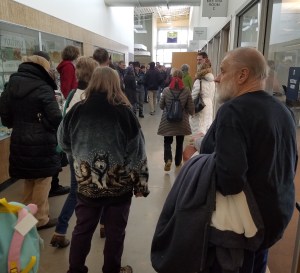
Democratic Committee Volunteers Meeting in North Liberty, Iowa

In September I asserted we should be working to stop nuclear weapons and protect the environment. A year into Trump’s first term it’s clear I understated this need.

The Trump administration rolled out it’s nuclear posture review and oh brother. Obama was bad enough with the $1 trillion modernization plan he negotiated with Arizona Senator Jon Kyl to get the New START Treaty ratified. Our new president is off the charts mad regarding the nuclear complex, or as Rolling Stone‘s Matt Taibbi described him, “insane and ignorant.” There’s a lot to do to resist.

On the environment, it’s as if the Trump administration handed the keys to the front door to the wolves who have been howling and trying to get inside where we live. Ryan Zinke at Interior has reduced the size of some national monuments to make way for exploitation of oil and gas deposits; Scott Pruitt at the Environmental Protection Agency seeks to roll back regulations that protect us to loosen the regulatory chains he claims bind business; Rick Perry at Energy seeks to change the paradigm of growing renewable energy resources to one of increasing stockpiles of coal, oil and uranium. The plan was preconceived and executed with dizzying speed.

What to do to resist?

The focus has to be on electing Democrats in the 2018 midterm elections. Reason doesn’t matter to the Trumpkins. They understand political power. All efforts for the next eight months should be toward re-taking the U.S. Senate and/or House of Representatives, and to make inroads in the state of Iowa by electing a Democratic Governor and re-taking the house or senate or both.

It’s really that focused, that simple. Will a Democratic government get us what we want? The Obama administration nationally and the Culver-Judge administration in Iowa stand as examples it won’t. Regaining political power will re-establish our dominance and hold the wolves at bay, and that may be the best we can hope for this year.

It would be something positive in a government currently overrun with pirates seeking to loot the treasury and pillage the commons. As a society we can do better than this. We must pick our battles carefully and from today’s vantage point there is a lot to bring us together to stem the tide against reason. Nuclear abolition and protecting the environment are both worth our efforts. There are broader currents to bring us together during this election cycle.

Categories
Environment Living in Society Social Commentary

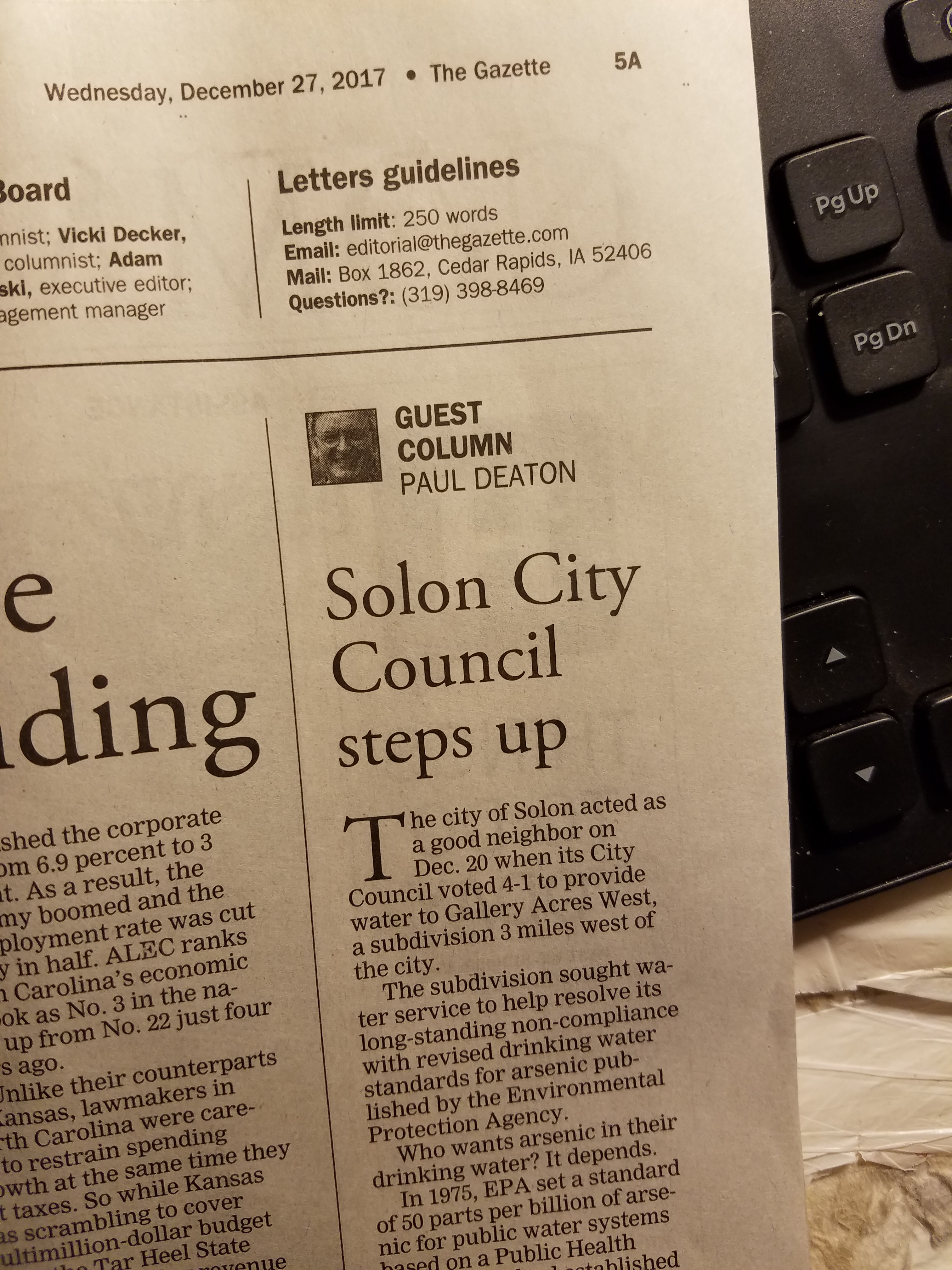
Solon City Council Steps Up

Column in the Cedar Rapids Gazette

The City of Solon acted as a good neighbor on Dec. 20 when its city council voted 4-1 to provide water to Gallery Acres West, a subdivision three miles west of the city.

The subdivision sought water service to help resolve its long-standing non-compliance with revised drinking water standards for arsenic published by the Environmental Protection Agency.

Who wants arsenic in their drinking water? It depends.

In 1975, EPA set a standard of 50 ppb of arsenic for public water systems based on a Public Health Service standard established in 1942. In 1999, the National Academy of Sciences concluded 50 ppb did not achieve EPA’s goal of protecting public health and should be lowered as soon as possible to allay long-term risks of low level exposure to arsenic.

EPA now has a goal of zero arsenic in public water systems however the goal is not technically feasible. The agency acknowledged there is a trade off between the cost of removing arsenic and its public health benefits.

“After careful consideration of the benefits and the costs,” an EPA fact sheet issued in 2001 said, “EPA has decided to set the drinking water standard for arsenic higher than the technically feasible level of 3 parts per billion (ppb) because EPA believes that the costs would not justify the benefits at this level.”

After multiple public hearings, EPA set the rule for arsenic at 10 ppb and public water systems were given five years after the arsenic rule was published to comply.

Some of us who manage public water systems took the new rule seriously and endeavored to comply. Others did not, and that leads us to Gallery Acres West. Their water system had its first violation of the new arsenic standard in 2002, failed to take action to reduce arsenic in their water system, and in 2015 was threatened with legal action by the Iowa Department of Natural Resources to force compliance.

During an Oct. 30 telephone call, I asked Mark Steiger, president of the Gallery Acres West home owners association, why they had not complied with the 2001 arsenic rule. He told me it was the cost of compliance. With only 14 homes in their association compliance would run thousands of dollars per household. I get it. As president of a home owners association that managed the same compliance issue for our public water system with 85 homes, it cost us $2,823.83 plus interest per household to upgrade our treatment facility to remove arsenic. In Gallery Acres West’s trade off between the cost of arsenic removal and public health, cost trumped health and residents continue to use drinking water with high arsenic content and will until they hook up to Solon.

The proliferation of development in unincorporated areas raises an issue of the quality of management in home owners associations. There are perceived freedoms in living in a small, insular community away from city life. There is also a cost. Things that could be taken for granted in a municipality require attention and potential action in rural Iowa.

It’s a good thing Gallery Acres West is close to a municipality willing to do their work for them.

~ First published on Dec. 27, 2017 in the Cedar Rapids Gazette

Categories
Environment Home Life

Watching it Rain

After the Rain

I’m sitting in the back of my pickup truck, the tailgate is down. Gentle summer rain is falling. The tips of my toes are getting wet but I don’t mind. We need the rain.

In Des Moines political parties are holding their conventions. I followed the action on social media, but not closely.

Breeze from the rain is cooling my forehead. It feels quite good. It is much better than working on a computer, or thinking about politics.

This afternoon I tried pulling weeds in the garden. The ground was so dry they broke off at the surface. Now, after this long gentle rain, the roots should loosen and weeding be done more easily.

Wind is blowing from the west and my knees are getting spattered with rain. I still don’t mind.

Dozens of birds are out in yards around the neighborhood. They don’t mind rain either. All of nature seems to welcome the rain.

Lightning and boomers are starting to roll in. The rain continues to fall gently and steadily.

Some nights it is best to just listen to the rain, and so I will tonight.

~ First posted June 16, 2012