Categories
Environment

The Clean Power Plan is not Killing Coal

Coal Mine Demonstrators Going Down – 1950

We’ve known the 45th president seeks to eliminate regulations on the fossil fuel industry so it’s no surprise he announced his intention to modify the Clean Power Plan developed by President Obama’s Environmental Protection Agency.

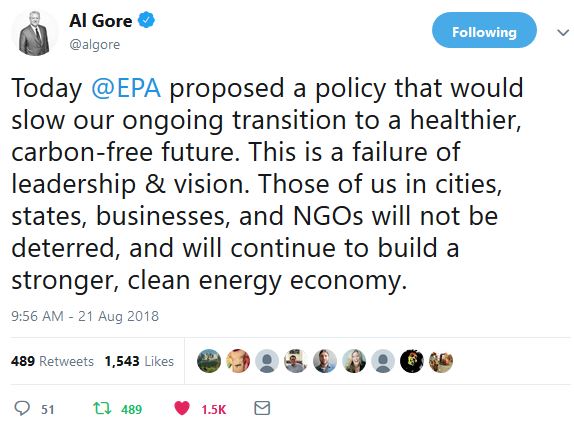
The plan was announced by the president in Charleston, West Virginia at a campaign-style rally on Aug. 21. Here’s what Al Gore, Chairman of the Climate Reality Project had to say.
Whether or not the Clean Power Plan exists makes little difference to the future of coal-fired power plants according to Taylor Kuykendall.
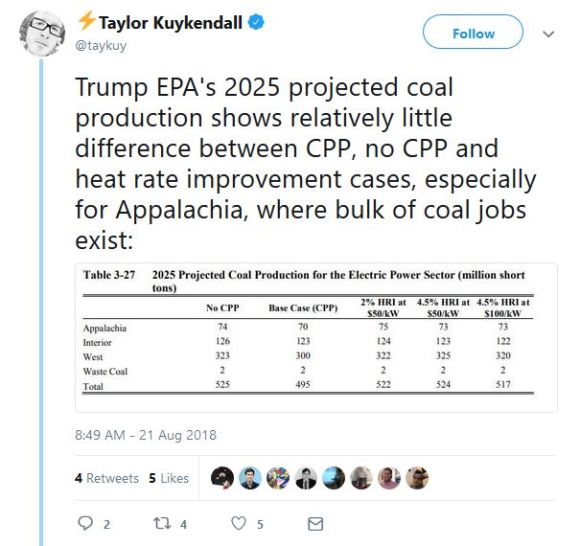
Regardless of executive actions, the days of coal fired power plants are numbered. Electricity produced by wind, solar arrays and natural gas will push coal out of the picture because they are cheaper. This was true when home owners replaced coal furnaces in their homes with natural gas in the 1950s and 1960s. It’s true now. Not only that, there are public health issues with burning coal. It is market conditions that will reduce coal consumption in the United States.

One assignment during my transportation career was to start a school in Boone County, West Virginia to re-train coal miners to become truck drivers. We got a one year grant from the governor’s office to train 250 people. The day we announced it was front page news in the Coal Valley Times. Along side the article about us was one indicating another round of coal miner layoffs.

I recall standing in Democratic Governor Gaston Caperton’s office watching a train laden with coal making its way along the Kanawha River. We knew the coal industry was dying then, it’s dying now, and no amount of special interest pressure on our federal government will bring it back.

Clean coal is a dirty lie and despite efforts to prop the fuel up, government should let go of it and leave it in the ground. As Gore said, “we will not be deterred” from building a stronger, clean energy economy.

~ First posted on Blog for Iowa

Categories
Environment

Irony About Climate Change in New Orleans

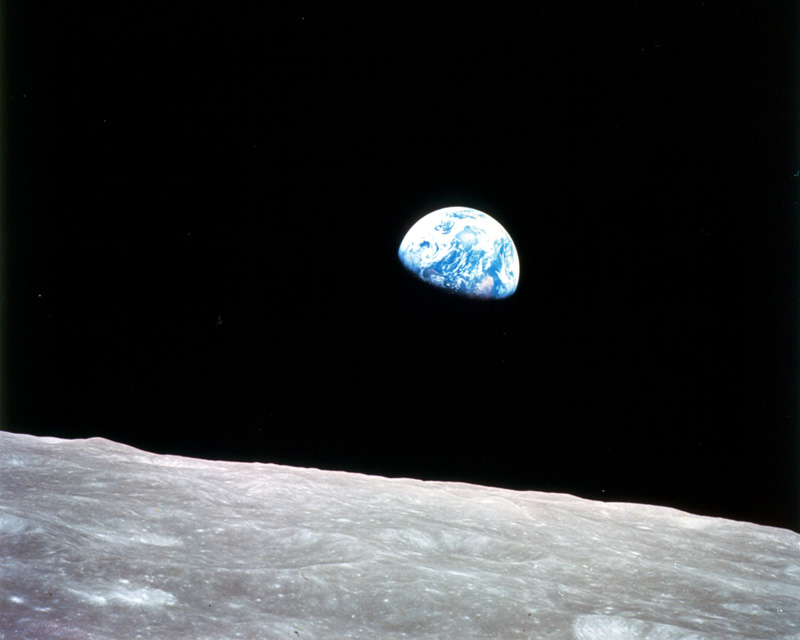
Image of Earth 7-6-15 from DSCOVR (Deep Space Climate Observatory)

It is no surprise the Heartland Institute hosted a conference called “The America First Energy Conference” for climate change deniers on Aug. 7 in New Orleans.

Heartland is the libertarian think tank that teamed up with Philip Morris to deny the health impacts of tobacco use. Climate change denial is high on their priority list.

“The day-long conference reflected the political rise of global warming skeptics in Donald Trump’s America that is occurring despite mounting scientific evidence, including from U.S. government agencies,” Reuters correspondent Collin Eaton wrote, “that burning oil, coal, and natural gas is heating the planet and leading to drought, floods, wildfires, and more frequent powerful storms.”

“The leftist claims about sea level rise are overblown, overstated or frankly just wrong,” Heartland president and CEO Tim Huelskamp said in an interview with Reuters. Regarding the United Nations’ findings on climate change, he said it was “fake science” motivated by a desire for “power and control.”

An irony is the conference is being held in the American city most impacted by extreme weather made worse by climate change. New Orleans has not recovered and may never recover from the August 2005 Hurricane Katrina.

“One of the country’s largest credit rating agencies has put New Orleans and other coastal cities on notice: prepare for the effects of climate change or risk a hit on your credit score,” according to Tristan Baurick at the New Orleans Times-Picayune. When the risk analysis community says it, it must be real.

Climate change is real, it’s happening now, and human activity is a primary contributor to extreme weather events like New Orleans experienced.

The rise of a conference like this is attributable almost entirely to the rise in prominence of libertarian billionaires with a long range plans to re-make American society to their liking. They believe their liberties have been infringed upon by government regulations and the Trump administration has been removing barriers to the practice of unfettered capitalism. That’s not good for you, me, or the people of New Orleans.

It is shocking how much the Trump administration has deregulated government in less than two years. The fact the Environmental Protection Agency is deregulating asbestos, a known carcinogen banned in 55 countries, is a sign of how far they will go. The only check on such behavior is for Democrats to win a majority in at least one chamber of the next Congress during the 2018 midterm elections, or to vote Trump out in the 2020 general election. Much damage has already been done. Some of it can’t be reversed.

I met a nine-year-old from Saudi Arabia recently. He lives with his extended family on the Arabian Peninsula and has come to Iowa the last couple of years to visit his mother before school starts in September. We talked about the weather.

“It sure is hot,” I said.

“Yes, but I don’t believe it is climate change,” he replied.

“No, probably not,” I said. “It’s August in Iowa.”

It is one thing for children to learn the difference between weather and climate change. When adults in the room deny the science of climate change, it’s something else. It’s clear there were few adults at the conference in New Orleans.

~ First posted on Blog for Iowa

Categories
Environment Kitchen Garden

A Difficult And Strange Season Of Weather

Carmen Black at Sundog Farm

By Carmen Black

(Editor’s Note: Iowa Farmers deal with an existential reality that is the weather. Regardless of increasingly polarized discussions about climate change, weather affects real people in tangible ways. Carmen recently wrote this piece to members of her Community Supported Agriculture project Local Harvest.)

The weather has been consistently challenging from the late spring to immediately hot May, from lots of rain to this current dry spell. There hasn’t been a catastrophic weather event, but all these different difficult weather conditions create more work to keep everything growing well.

I’ve been thinking more about it as we’ve been observing its impacts while harvesting more of the summer crops. I’ve talked to many other farmers (including folks that grow other types of crops) about the challenges of this season, and anecdotally it seems like the conditions have been hard on many types of crops and livestock alike. One of things that has struck me about this year is that it hasn’t been just one way like really hot or really wet, but every month has brought a different extreme to contend with. It’s made me wonder if it’s all this erraticness that’s been stressful to the plants and animals rather than just the heat or just the late spring.

I was curious to find out if the weather has just felt difficult to us or if it really has been extreme in the grand scheme of things, so I did a little internet research for weather data. What I found was interesting, and did seem to affirm my feeling that this year really has been weird. This was the coldest April on record (since records began in 1895), and was on average 10 degrees colder than normal. It was also somehow both the 5th snowiest April and the 13th driest April, which seemed a little ironic. 2018 tied for the 6th warmest May with 1887, and the average temperature was about seven degrees warmer than normal. Des Moines had three consecutive daily record highs from May 26-28. I was surprised that in Cedar Rapids the daily record highs for the end of May were all held by 1931 or 1934, and then I realized that was the dust bowl! June was the 10th warmest and 10th wettest June on record. July seems to have been pretty average after all those top 20 finishes for the previous months, as it was the 54th coolest July and the 47th driest July on record. Which I think kind of puts the extremeness of the previous months in perspective. Kind of nice to have an average month finally.

Anyhow, my main takeaway is that this year really does seem to be remarkably erratic when you look at the numbers, and it makes sense that plants and animals would respond unpredictably to all of these changes in the weather. I feel both good that I wasn’t making up that the weather has been extreme in many different ways this season, and kind of bad that it really has been historically weird this year. The fact that it took the dust bowl to beat this year out for daily heat records in May felt kind of grim.

Some crops like onions seem to have really suffered from this weather. You may have noticed that they’ve been smaller than normal this year, and after getting most of onion harvest done last week I’m sorry to report that many of the longer season onions are even smaller. This was especially disappointing to me after such a bountiful onion harvest of really giant ones last summer, but I think makes sense considering what we were up against. We planted more than 3 weeks later than we did last year because it kept snowing, and then had to irrigate the onions (which we hardly ever have to do) because it was so dry. We struggled to keep the weeds under control in the onion field in June when it was so wet, and spent almost a week wallowing in the mud trying to hand weed. All in all I’m glad we have some onions to show for all of it, and have a few ideas of things to try in case this ever happens again.

I also have to say that some crops seem to have really thrived in this weather. We’ve never had such a good cucumber or spring carrot crop before, both of which are crops that we have historically struggled to produce large quantities of for several weeks in a row. The combination of having plenty of carrots and cucumbers has felt like a great accomplishment, and I hope that we’re able to replicate it in a better weather year as well!

~ Carmen Black farms in Cedar Township in Johnson County, Iowa.

Categories
Environment

On the Comeback Trail – Asbestos

Earthrise by Bill Anders, Dec. 24, 1968

The Environmental Protection Agency is not what it once was as the Trump administration finishes year two.

In addition to public renunciation of the words “climate change,” combined with promotion of fossil fuels which contribute to global warming, Trump’s minions are eating away at the foundation of protections the agency created since President Nixon formed it on Dec. 2, 1970. Like a swarm of termites, they follow an agenda crafted by conservative think tanks to deregulate what is perceived as infringement on the liberties of corporations to practice unfettered capitalism.

A national environmental movement influenced Nixon’s decision to create the EPA, and only a similar movement will stop the current administration from dismantling it. Thus far, nothing has proved egregious enough to precipitate a movement like the one that rose in the 1960s. Will the last straw be reintroducing asbestos into our consumer society?

You’ve got to be kidding me. Asbestos?

Asbestos may be coming back to your neighborhood, according to Aileen Kwun who posted an article about it on Fast Company July 31.

“Asbestos, a dangerous carcinogen outlawed in more than 55 countries, could make a comeback in the United States, under Trump’s Environmental Protection Agency,” Kwun wrote. “The EPA has even made it easier for companies to introduce new uses of asbestos-containing products in America — many of which could end up in common products in your home, as well as the materials used to build it.”

“Trump has been outward in his views on the asbestos industry,” she said. “His 1997 book Art of the Comeback explicitly stated that asbestos bans are a conspiracy ‘led by the mob, because it was often mob-related companies that would do the asbestos removal.’”

On June 1, the EPA enacted a Significant New Use Rule (SNUR) allowing the manufacture of new asbestos-containing products to be petitioned and approved by the federal government on a case-by-case basis, according to Kwun.

Ask a public health official and they will say EPA should continue to regulate asbestos as they have.

Asbestos? Making a comeback? Good grief! Read Kwun’s entire article here.

George Carlin famously said, “Environmentalists don’t give a shit about the planet, they don’t care about the planet… You know what they’re interested in? A clean place to live. Their own habitat. They’re worried that some day in the future they might be personally inconvenienced.”

There is little about the modern environmental movement and its reaction to changes at the EPA to prove Carlin wrong. In the meanwhile, termites continue to consume the regulatory foundation for a safe environment built up over decades.

~ First posted on Blog for Iowa

Categories
Sustainability

Helsinki and New START

B-61 Nuclear Bombs

I don’t know one person, acquaintance or public figure who thought the July 16 meeting between Donald Trump and Vladimir Putin in Helsinki went well.

The only people who found a ray of hope in the awkward encounter are those in the arms control community who pointed out some positives, not the least of which is an easing of tensions between the two nuclear powers evidenced in the meeting.

“It looks like Trump and Putin may have agreed in Helsinki to resume strategic stability talks.” Daryl Kimball, director of the Arms Control Association, posted on twitter. “One key issue: New START, which can be extended without complex negotiation, without further approval by Senate or Duma, and without Trump making unwise concessions.”

Such a move makes sense and would be an easy win for Trump. It may not be well received among Trump’s base supporters because, after all, the Obama administration negotiated New START. The 44th president called in his markers to get the U.S. Senate to ratify the treaty. Some of us felt he gave away too much with a complex offering of perquisites to Republican hawks led by Jon Kyl. Not the least of these was an expensive, unneeded modernization of the U.S. nuclear complex. The Trump crowd won’t like it, regardless of the efficacy of an extension, because of the association with President Barack Obama.

Republicans have expressed disappointment with Trump’s foreign policy, such as it exists. They may (publicly or privately) attempt to reign in the president. At some point the U.S. wants to address perceived Russian violations of the INF treaty negotiated between Presidents Ronald Reagan and Mikhail Gorbachev, signed in 1987. Russia has threatened to withdraw from the INF treaty for many years, according to the Bulletin of the Atomic Scientists.

As we look forward with trepidation to the next meeting between the two heads of state, the arms control community will be working to advance the causes of nuclear disarmament and abolition. It is something they do regardless which party has majorities in the Congress or who is president.

~ First posted on Blog for Iowa

Categories
Sustainability

Rise of Nuclear Power was a Bad Idea

In a broader perspective, the rise of nuclear power was a bad idea. It always required substantial government subsidies, and there is no solution for handling spent fuel rods and radioactive equipment. If there is a disaster like Fukushima Daiichi was in 2011, there is no recovery from it years later.

On Friday major news outlets reported Duane Arnold Energy Center near Palo will cease electricity production in late 2020. Duane Arnold, owned by NextEra Energy Resources, is Iowa’s only nuclear power generating station.

Alliant Energy, the utility’s only remaining customer, entered an agreement with NextEra to cease operations five years earlier than planned.

The declining cost of other forms of energy led to the decision, according to NextEra spokesperson Peter Robbins in a Radio Iowa article.

“You are just seeing continued pressure on all sources of energy — from renewables and from natural gas — and we are certainly seeing that in the market place in Iowa,” Robbins said.

NextEra plans to invest in existing and new renewables generation across Iowa before the end of 2020, according to the article. Alliant Energy said it will save customers nearly $300 million in the next 21 years by switching away from the use of the nuclear power.

Duane Arnold’s fate reflects the general decline in nuclear power in the United States. While some, like retired scientist James Hansen and former Energy Secretary Ernest Moniz, point to nuclear power as a potential way to reduce carbon dioxide emissions in electricity generation, it is just too expensive. Georgia Power remains the only company in the United States attempting to build new nuclear reactors. The construction at the Alvin W. Vogtle generating station near Augusta, Georgia has been plagued by delays and cost overruns endemic to the industry. The two plants may never be completed.

On June 1, President Trump directed Energy Secretary Rick Perry to take immediate steps to keep both coal and nuclear power plants running as a matter of national security. If the U.S. exits the nuclear power generation business there could be repercussions in ceding technological advancements to China and Russia. It could weaken existing nonproliferation standards if the U.S. discontinued its work as a supplier in the global nuclear marketplace. The flagship U.S. company for nuclear power technology is Westinghouse which filed for Chapter 11 bankruptcy March 29, 2017. Trump’s initiative isn’t going to help Duane Arnold stay operating as the marketplace is doing its work — there are no customers.

Duane Arnold employs about 540 employees, and because of the nature of nuclear power generation, about 300 will find continued employment during the lengthy decommissioning process. The federal government owns the spent fuel rods and there is no current, viable plan for off-site disposal. Storage time required for spent nuclear fuel rods is measured in multiple millennia. The plant’s license from the Nuclear Regulatory Commission had been extended until 2024.

The only successful application of nuclear has been in nuclear powered submarines and aircraft carriers where the question “what do you do with a nuclear submarine/aircraft carrier once its nuclear plant reaches the end of life?” has no good answers.

Renewable energy is Iowa’s future, it is the world’s future. Friday’s announcement was expected, as cost dictates how consumers source electricity. Nuclear power has never been cost-competitive. There will be disruption in workers’ lives and that’s unfortunate. However, the end had to come, and now that the announcement is made people can begin making plans.

~ First posted at Blog for Iowa

Categories
Environment Living in Society

Logic, Reason, Decency and Asbestos

Woman Writing Letter

Almost no one I know outside of politics is talking about the Nov. 6 election. That seems typical… and okay.

Most of us try to be organized. At least we pretend to be. We seek to live lives of logic, reason and decency. We’ll organize to figure out for whom to vote later, maybe around Thanksgiving.

Not so fast! It will be too late on Thanksgiving.

Here’s a head scratcher for logic fans from the Environmental Protection Agency. In our relentless pursuit to Make America Great Again, the administration wants to bring back asbestos. Yes that asbestos, the known carcinogen banned in 55 countries. It may soon be available again in consumer products near you.

Our president has a theory about asbestos regulation. In his 1997 book, Art of the Comeback, he explicitly said asbestos bans are a conspiracy “led by the mob, because it was often mob-related companies that would do the asbestos removal.” What kind of theory is that? It is a conspiracy theory.

Ask a public health professional or physician what they think about deregulating asbestos. While you’re at it, make your plan to vote on Nov. 6.

The logical choice would be to vote Democratic.

~ Published Aug. 9, 2018 in the Solon Economist

Categories
Environment Home Life Kitchen Garden

Gardening in End Times

Japanese Beetles Enjoying a Pear

I’ve been a gardener since we got married.

We planted a few tomatoes near the duplex we rented in Iowa City the spring after the wedding. As we lived our lives, raised our daughter, and sought economic stability, we either planted a garden or harvested what was there. When we owned a home, first in Merrillville, Indiana, and then in Big Grove, the garden got bigger and I became a better gardener. There is evidence in this year’s abundant harvest.

It didn’t come naturally even though gardening is elemental. The brief narrative of my gardener’s life.

As I step back from the working world to focus on home life what seems clear is society is moving at a startling pace toward disaster. Our industrial society consumes everything useful in nature, leaving us with foul air and water, depleted soil, polluted and acidified oceans devoid of marine life, and a warming world with all the consequences that yields. The earth will survive as it has. We people seem to be on the downside of our prominence. In multiple ways these are end times.

The Slovenian philosopher Slavoj Žižek asserts there is a chance for a new beginning in the terminal crisis in which human society finds ourselves. His arguments are not convincing to us regular humans.

What do we do?

What we have done is argue about approaches. Should we have a carbon tax? Should we ban abortion? Should we ban plastic straws? Is wind, sun, nuclear or natural gas a better source of electricity? Should we cut taxes and reduce government’s role in our lives? Should we become socialists, or even worse, democratic socialists? Should we let go of Hillary’s emails? Should we all just try to get along? Approaches don’t work and we should let go of them all.

The better question to ask is what story do we want to tell? As others have said, notably author Joan Didion, “We tell ourselves stories in order to live.” What narrative will take us out of the current crisis?

For me it’s “I’m becoming a better gardener.”

Regardless of pending social collapse we must go on with our lives. Partly to keep our sanity, and partly — importantly — to take steps toward a more livable world. We will never go back to the Iowa of 1832 before the great division and clear cutting began. What we can do is plant the seeds of a better life where we live. Our forebears left us a disaster. What can we do about it? Make the best of it with forward-looking narratives for the next generations.

I get it that many people don’t have means to do more than survive. When I see the abundance of our garden it’s hard to believe people go without a meal. Yet they do, in large numbers. We can feed a couple of them, but is that enough? It’s something.

The essence of the narrative is the verb to become. “I seem to be a verb,” R. Buckminster Fuller wrote. I seem to be that verb. We are not predestined to anything except our human span of nine decades, and that only if we are lucky. We live in an imperfect society that beckons engagement. I’m not sure working toward perfection is as good as doing something positive is. Knowing what to do requires a better narrative. One that hasn’t been invented for the 21st Century and beyond.

I plan to work on a better narrative, although garden in end times doesn’t seem too bad.

Categories
Environment Living in Society

Reynolds Proclaims Weather Disaster – 11 Times

Front Moving In

Governor Kim Reynolds proclaimed counties in Iowa to be a disaster because of severe weather. It is time to act on climate.

Tornadoes tore through Marshalltown, Pella and Bondurant last Thursday as I got off work at the home, farm and auto supply store. It doesn’t appear anyone was seriously injured or died, although damage to the communities was substantial. Photos and video posted on social media depicted a horrible scene.

Are these storms due to climate change? We know Governor Kim Reynolds issued 11 disaster proclamations since June 11 for severe weather, heavy rains, storms, tornadoes and flooding. Something is different about our weather. Even a casual observer understands our climate changed and contributed to these extreme weather events.

Additionally, the seasons have been out of wack this year. A late spring, early high ambient temperatures, and more frequent storms make our weather exceedingly weird. Iowans have noticed and are talking about it. It’s not a random occurrence.

Ben Santer, an atmospheric scientist at the Lawrence Livermore National Laboratory, led a study of four decades of climate data that concluded human activity is disrupting our seasonal balance. That is, the seasons don’t proceed through time the way they did. Eric Roston at Bloomberg wrote a more accessible article about the study here.

“Poring over four decades of satellite data, climate scientists have concluded for the first time that humans are pushing seasonal temperatures out of balance — shifting what one researcher called the very ‘march of the seasons themselves,’” Roston wrote. “Ever-mindful of calculable uncertainty and climate deniers, the authors give ‘odds of roughly 5 in 1 million’ of these changes occurring naturally, without human influence.”

While an individual study is one thing, the science of climate change is clear. I wrote about it in 2014:

People seeking scientific proof of anthropogenic global climate change are barking up the wrong tree. The goal of science is not to prove, but to explain aspects of the natural world. Following is a brief explanation of climate change.

Around 1850, physicist John Tyndall discovered that carbon dioxide traps heat in our atmosphere, producing the greenhouse effect, which enables all of creation as we know it to live on Earth.

Carbon dioxide increased as a percentage of our atmosphere since Tyndall’s time at the beginning of the Industrial Revolution. As a result, Earth’s average temperature increased by 1.5 degrees Fahrenheit.

The disturbance of the global carbon cycle and related increase in carbon dioxide concentrations in the atmosphere is identifiably anthropogenic because of the isotope signature of atmospheric carbon dioxide.

We can also observe the effects of global warming in worldwide glacier retreat, declining Arctic ice sheets, sea level rise, warming oceans, ocean acidification, and increased intensity of weather events.

It is no wonder the vast majority of climate scientists and all of the national academies of science in the world agree climate change is real, it is happening now, it’s caused by humans, and is cause for immediate action before it is too late.

To learn more about what you can do to help solve the climate crisis, go to The Climate Reality Project.

~ First posted on Blog for Iowa

Categories
Environment

Ed Fallon, Bold Iowa and the Dakota Access Pipeline

Ed Fallon in His Garden

Ed Fallon lives and works in Des Moines and has long been a friend of Blog for Iowa. Here’s an update on Ed’s current activities from an interview conducted last week via email.

We noticed you are affiliated with Bold Iowa. What is Bold Iowa and what attracted you to pitching your tent with them?

I continue to host the Fallon Forum and direct Bold Iowa. Bold Iowa grew out of the Bold Alliance, which was formed after the Keystone XL fight. Just a year after the alliance started, Jane Kleeb, founder of Bold Alliance, abandoned Alliance chapters in Iowa, Louisiana, Oklahoma and Virginia. We now operate as an independent organization.

What are you working on this summer and why?

We’re focused on supporting the landowners who have filed a lawsuit against the abuse of eminent domain to build the Dakota Access pipeline. Sierra Club is part of that suit. One of the ways we are supporting landowners is to raise awareness of the suit through The First Nation — Farmer Climate Unity March. We are also hosting a series of community forums, setting up editorial board meetings, sending out press releases, and encouraging people to write letters to the editor. If landowners and the Sierra Club prevail in the lawsuit, it could stop the oil from flowing through Iowa, North Dakota, South Dakota and Illinois.

Climate change has been in Iowa news this year more than recently. Have you noticed? If you’ve noticed, to what do you attribute the increased mentions in social and conventional media?

I’ve noticed, although the uptick has been small. Mostly, it seems some editorial boards and a few reporters are beginning to understand that climate change is not just another issue, that it’s a crisis that demands immediate attention.

What would you like our readers to do to support your causes during the remainder of 2018?

March with us Sept 1 – 8 from Des Moines to Fort Dodge, following the pipeline route through Story, Boone and Webster Counties. Contact media about the importance of the lawsuit and the urgency of climate action. Most important, vote in November for candidates who take climate change seriously.

Listen to the Fallon Forum live Mondays, 11:00-12:00 noon CT on La Reina KDLF 96.5 FM and 1260 AM (central Iowa). Add your voice to the conversation by calling (515) 528-8122.

~ First posted on Blog for Iowa