I’ve been wanting to try the Impossible™ Burger and will have to wait.
I met a group of friends at a restaurant Friday where Impossible™ was printed on the menu. Since Burger King® decided to offer the plant-based burger nation-wide, smaller restaurants haven’t been able to get it according to our server.
The kitchen did have a Beyond Burger®, which I tried and was satisfied by my pub grub-style meal of a burger, coleslaw and Stella Artois®.
The reason I mention this is the American Farm Bureau Federation was running down products like these burgers for being “ultraprocessed.” In a June 4 blog post, author Teresa Bjork invoked reality to straighten people out,
In reality, meat and milk imitators are ultraprocessed foods. They are made from a long list of ingredients, including sodium and added flavors and colors, to improve their taste and nutrition.
One suspects increased availability of veggie burgers, and the Burger King® marketing decision, is taking a bite out of cattle producer market share. Likewise, the reason ovo-lacto vegetarians like fake meat is not for the salt content, but for how it fits into our lifestyle as comfort food. No matter how bad things may get for us personally, we want the sensation of eating foods that are traditional in our culture. Let’s cut to the chase.
The single biggest way to reduce our impact on Earth is to avoid consuming meat and dairy. Maintaining herds of livestock is a land use policy that encourages the ongoing mass extinction by taking land thus depriving other species of habitat.
“Meat and dairy provide just 18 percent of calories and 37 percent of protein, (using) the vast majority – 83 percent – of farmland and producing 60 percent of agriculture’s greenhouse gas emissions,” according to the Guardian.
We can do better than that.
It’s no secret people should consume less processed food, particularly simple sugars and carbohydrates, for dietary reasons. For the Farm Bureau to favor meat and dairy production of their members is also not surprising. What is fake here is not the burgers, it’s the straw-man argument to protect what Farm Bureau sees as its own interests.
From time to time many Iowans crave a tasty burger. Getting one without politicizing it may be impossible.
The forecast looks perfect for a day in the garden. I intend to get started soon after sun up at 5:31 a.m. and work as long as I’m able or until needed work is done.
Tomatoes and cucumber seedlings are reaching the critical stage where either they get planted or composted and I favor the former. Otherwise, what was the point of all the planning and preparations in the greenhouse? If I establish the tomato patch and plant cucumbers and peppers that will be enough of an accomplishment.
My scale is larger than a typical household garden with 38 plum and slicer tomato plants planned, a scaled down cucumber patch, and a patch of 12 hot peppers alongside one row of guajillo and one row of ancho chilies. If I get that all in, anything else would be a bonus. The goal is to finish by 4 p.m. so I can go out to dinner in the county seat with some of my blogger friends.
Sunday, June 9, is the Iowa Democratic Party Hall of Fame induction in Cedar Rapids. The Hall of Fame is one of the biggest party fundraisers of the year and this year’s inductees are Fred and Charlotte Hubbell who have long been active in Democratic politics. They are also among the most significant financial contributors to the party. Fred Hubbell was our gubernatorial candidate in 2018. Other individuals and groups are also recognized at the event. Here’s a link.
19 candidates for president will take five minutes each to address attendees. Most candidates have events scheduled in and around Cedar Rapids this weekend to expand the reach of their trip to Iowa’s second largest city. The events range from sign waving rallies outside the event location to family-friendly gatherings in a park to food and social time with candidates. The event I plan to attend is a climate conversation with Washington Governor Jay Inslee who made the climate crisis the focus of his campaign for president. Organized by State Senator Rob Hogg, a long-time member of the Climate Reality Project, I’m looking forward to hearing how the conversation goes Saturday, June 8 at 6 p.m. at Ellis Park in Cedar Rapids.
I had a brief chat at the county party central committee meeting with one of the Our Revolution of Johnson County organizers about the Bernie Sanders campaign. The campaign saved voter information from Sanders’ 2016 effort, which resulted in half of caucus-goers supporting Sanders. The salient question is whether 2016 Sanders support can be converted to 2020 support. Our local Sanders organizer is in training this week and they haven’t finished the canvass to know the answer. They have significant endorsers and thousands of volunteers to perform the canvass.
“This incredible group of endorsers are some of the most well-known progressive voices that Iowa has to offer,” Misty Rebik, Sanders’ state director, said in a June 6 statement to Iowa Starting Line. “Together with our 25,000-strong volunteer base in the state, these progressive Iowans will help us build on our grassroots movement and win on caucus night.”
I don’t see any of the other campaigns packing up and going home after this statement. However, if what Rebik told the blogger is true, I’m sure everyone will use their five minute speech at the Hall of Fame to add their Sanders endorsement to the list.
As I reported April 26, Newman Abuissa confirmed he is running for Congress in Iowa’s second district at last night’s county central committee meeting. I’ve known Abuissa for years and he’s a good guy. In addition to being an engineer for the Iowa Department of Transportation, he is a member of the Arab American Institute’s National Policy Council. Active in peace and justice issues within the Iowa Democratic Party his focus has been on foreign policy as it relates to the Middle East. It seems unlikely he will gain traction against announced candidate Rita Hart, but his announcement was clearly heartfelt. He’s right. We could do a lot of good with the money being wasted on our perpetual wars.
I can see the light of a new day dawning through the window on the other end of my writing space. Time to get to work in the garden.
I don’t intend to get alarmist on fair readers with dire predictions of the end of the world as we know it. Even though doomsday stories are quite popular, and climate science is, well science, there is another issue.
In our weird, wet spring weather we believe we have climate change figured out. Instead of planting our potatoes on Good Friday, now we’ll plant them in early June as the ground dries out and all will be hunky-dory. That’s a problem.
Science: Around 1850, physicist John Tyndall discovered that carbon dioxide traps heat in our atmosphere, producing the greenhouse effect, which enables all of creation as we know it to live on Earth.
Also science: As greenhouse gas emissions increased after World War II, our atmosphere warmed significantly. A warmer atmosphere holds more water vapor. As we discovered, water vapor laden atmosphere can unleash torrents of rain on Iowa and elsewhere. There’s photographic evidence!
Suddenly we’ve gotten all climate-changey. Every severe weather event is declared to be made worse because of climate change. Maybe it is although the complexity of our climate doesn’t lend itself to such simple statements.
What makes this problematic is in a culture where we appreciate detective work that goes into finding a villain, assigning blame, and making them pay with social shunning or other consequences, there is no single antagonist with climate change. We are all antagonists which makes a pretty boring story.
Iowans may believe climate change brought us a new normal of wet springs. What the science is telling us about climate change is there is no normal as we define the word. The minute we believe we have climate change figured out a new twist should be expected.
It is time to Act on Climate.
~ Published in the June 13, 2019 edition of the Solon Economist
I ran into a couple of neighbors at the well house while receiving a shipment of chlorine for our water treatment plant. They were checking to see if the dehumidifiers had dried out the well pit after the rain. They had.
We got to talking about the wet spring, polar vortex and the weather generally and predicted we’ll be going into drought next. None of us were kidding.
Other than that I spent the day in our yard and garden. I finished planting the fourth of seven plots and have about a third of number five in. As long as the weather holds I’ll keep after it. The soil is a combo of dry and muddy which is the best we can do this spring.
It’s been five days since I left the property with my car. Spiders made a web in the wheel well.
I planted these seeds in the fourth plot on June 3:
I’ve never grown okra before, so fingers crossed. For the plant to be productive, once it starts fruiting, pods are to be picked once they are three inches long. Gotta get from seed to plant before I worry too much about that. The two rows of beans are a lot. The main purpose is to increase soil nitrogen for next year… and of course we’ll eat or preserve them. It’s the first time planting red beans for drying and storage. I have seedlings of cilantro and parsley, so this patch is for later on, assuming they germinate. There are never enough carrots.
Monday breakfast of scrambled eggs and sauteed bok choy with spring garlic, topped with green onions (scallions).
I picked the first green onions and used them for breakfast. There is a lot going on outside.
I left some of the volunteer garlic in the ground so we can get scapes. If my garlic stock from last year lasts, I’ll plant them as seed later in the summer to supplement the volunteers.
I inspected the apple trees and they fruited nicely. Apples form clusters of five blossoms which get pollinated if we’re lucky. When the fruit forms and starts tipping up, and the calyx closes, you know there will be a fruit. When we get to this point it is the time to cull the extra or non-productive fruits so the ones left will get decently sized. Because this pollination persisted for so long, I believe nature took care of the culling for me and rejected later pollination because the fruits are nicely spaced on the lower branches. That would be your folk-apple theory.
I’ll have to check in with the chief apple officer at the orchard when I next see him. I hope that’s soon.
Ideas about how to cook are ubiquitous. Everyone — family, friends, neighbors, co-workers, chefs, dish washers, dieticians and scientists — has something to say about it. Almost everyone cooks. Talk about cooking can be devilishly engaging. Are there things we can do in our kitchen to mitigate the effects of the climate crisis?
It’s not clear how climate change impacts cooking once we get in the kitchen. We should minimize the use of water, electricity and natural gas while cooking. Many are and everyone should be doing so. Maybe that’s the point. Cooking is so common it’s hard to distinguish one process from another when it come to mitigating the effects of the climate crisis.
We recently lived through a rise in manufacture and consumption of pre-cooked and processed meals and ingredients, increased the amount of food grown closer to home, and changed consumer behavior due to national health scares originating in large farm fields in California, Arizona and Florida. Our collective actions to mitigate the effects of climate change, whether in the kitchen or elsewhere, matter in a time of hegemony of fossil fuels culture. For most, spending time cooking is when we nourish ourselves and practice culture that helps us deal with the complexities of a turbulent world. Cooking helps us focus on what we can control.
Inputs
Inputs set the stage for cooking. The focus is often on where ingredients originate and their environmental cost. That remains important yet I also refer to the framing of our lives in society, including land use, construction practices, kitchen configuration, water sourcing, energy sourcing, and education. All of these are inputs to cooking as they are to how we live our lives.
I’ve written about the importance of sourcing as much food as we can locally. My advice is get to know the face of the farmer where possible, and read the ingredient and nutrition labels on anything else.
If one has space, time and the ability, grow some of your own food. Not only can it taste better, time spent in a garden is enough exercise to avoid a trip to the gym or grocery store. Over our years in Big Grove I’ve developed a kitchen garden where what we eat and cook has become synchronous with seasonally available foods.
A cook includes ingredients grown or made a long distance from home where they offer something unique. Nutmeg and black pepper are examples of spices that serve a vital purpose but are not available locally. When the choice is learn to live without them or accept them for what they are, cooks will choose them as long as they are available. I don’t question that impulse.
Assembling and preparing ingredients on a counter t0 mix, saute, fry, steam, grill or bake them into a meal is fundamental. How much water, electricity and natural gas we use is part of background noise: important but seldom the focus of attention except when we configure our kitchen. Seeking energy efficient appliances and a faucet aerator are basic. Once a kitchen is configured few additional changes seem likely. Many of us don’t have the opportunity to configure a kitchen, especially when living in an apartment.
Simple practices like selection of cookware that retains heat, avoiding long preheating of the oven, keeping the oven door mostly closed while baking, and washing vegetables in a bowl instead of under running water have impacts.
A significant aspect of climate-friendly cooking is buying ingredients in a way that avoids food waste. Have a meal plan and buy only what’s needed for it. Plan to use up what’s in the ice box before it goes rotten when planning meals. These practices should be taught in the K-12 school system.
Our household eschews meat and meat products and has since we married in 1982. I’m an omnivore (just barely) and don’t understand the aversion to going meatless. Production of meat contributes to global warming and even if it is only one “meatless Monday” per week, reduction of meat consumption is basic enough that every household can do something.
Outputs
Cooking in our household is an irregular attempt to make something from ingredients that arrive unevenly over time. Cooking is about output, mostly what we serve for meals from our efforts. It is also about how we use what’s generated from the kitchen, including food waste, food storage and cooking by-products like carrot peels and pasta water.
I am a fan of Tamar Adler’s An Everlasting Meal: Cooking with Economy and Grace. Shortly after I read the book in 2011 I spent time generating the next meal from the previous one as she suggests. Adler presents an example of how cooking can be an efficient process that produces delicious meals. While her book is not about climate change, by being an efficient cook less resources are required and it can be better for the climate as well as our pocketbooks… and taste buds.
Our refuse company picks up weekly but we seldom put both containers at the end of the driveway. We could do better in reducing waste but in the kitchen every scrap leftover from inputs and meal production is put to use. We save leftovers for following meals. When there is excess produce we freeze or can it. Because we have a kitchen garden there is never enough compost so organic material goes into a stainless steel bucket, then out to a household waste composter near the garden. Using the results of kitchen production has become a part of a life that would seem weird if we didn’t do it.
Conclusion
The climate crisis is real, it is happening now, and the potential for global warming to harm us and our society is ever present. Cooking is ubiquitous, and determining ways to cook efficiently and with a smaller carbon footprint is as important as many things we do to mitigate the effects of climate change. It is not everything. It is something.
Experimental row tillage to minimize damage to soil structure.
It was finally a day to spend outside in the yard and garden.
I planted Kentucky Wonder Bush beans (Seed Savers Exchange, 65 days) and transferred beets, arugula, lettuce and parsley into a single row next to the summer squash planted the previous day.
The garden plots have not dried out as well as I’d like. The urgency to get things in the ground had me doing the best I could to dig the semi-muddy soil and move seedlings and plant seeds in garden rows.
I’m using a technique I call “row tillage,” in which I dig more narrow rows to plant. I turn the soil with a spade, break it up with a hoe and then break it down further with a garden rake. Because the soil was still muddy, it didn’t break down as easily as I hoped but it got the job done. Hopefully soil structure is less damaged than if I were to dig up and rototill the entire plot. Because I mulch, there is no concern about weeds by leaving part of the plot untilled. If I had a mechanical tiller, I’d use it in the narrow rows. I may get one as I age or if garden tool-wielding bothers my shoulders or back. The technique worked last year with tomatoes, so I plan to use it more this year.
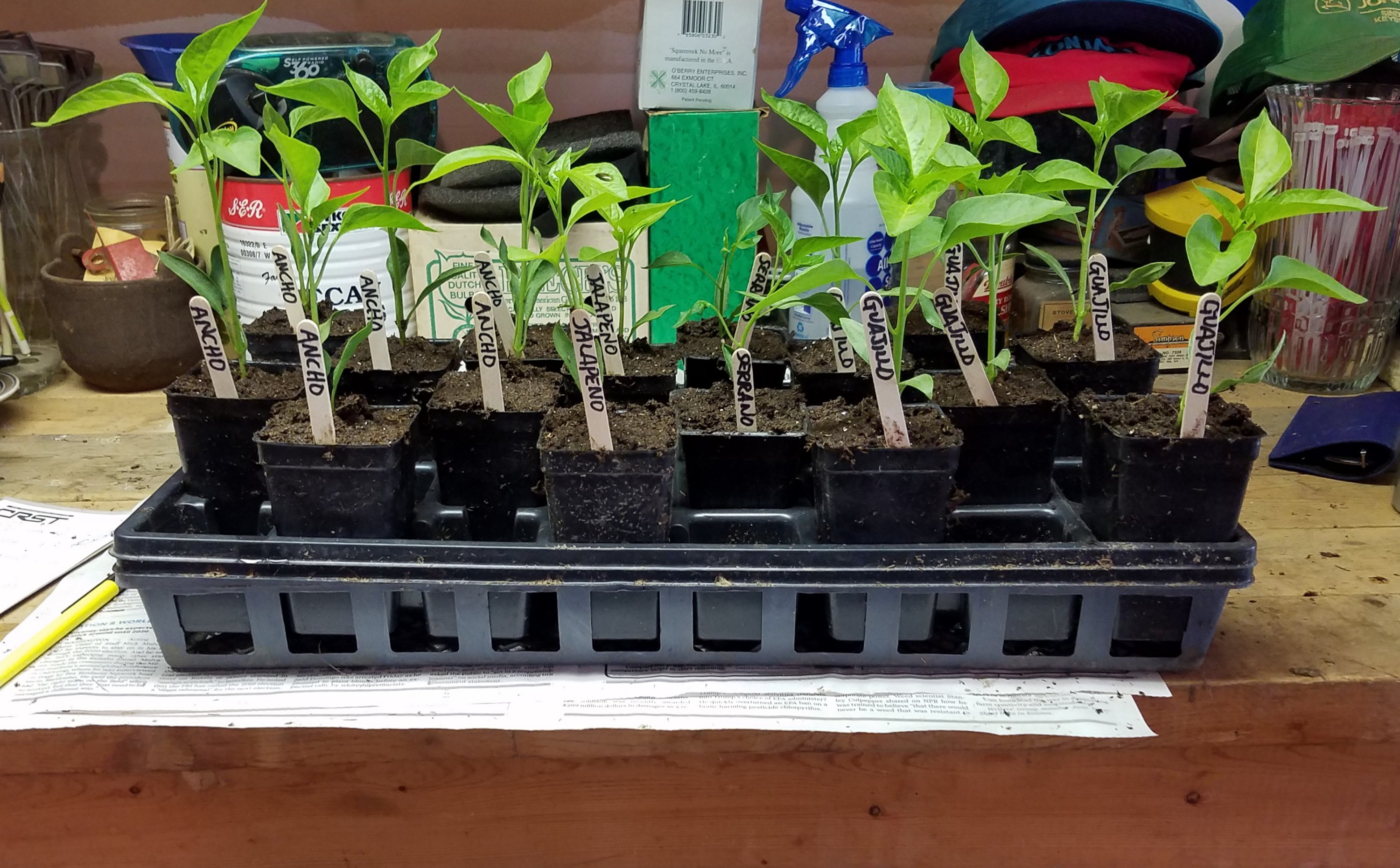
Culled hot pepper seedlings.
Culling hot pepper plants to pick the best starts is important. This year I plan rows with six ancho and six guajillo chili peppers. Seeds from Johnny’s Selected Seeds germinated well so there are extras. The rest — cayenne, jalapeno, Bangkok, Serrano, Red Flame and Red Rocket — will be planted two of each in a big bed. Ancho and guajillo are an experiment in Mexican cuisine. I use jalapeno and Serrano fresh and dry the rest. If the seasons proceeds well there should be plenty of them all.
Harvest was more turnips, parsley, beet leaves, and lettuce. I’m ready to spend another day and the forecast is clear skies. After a bit of desk work, I’m ready to make June 2 a gardening day as well.
The morning was brilliant. Not only the sun, but life all around us as I worked in the garden on what has become a rare sunny morning this season. The sky is now clouding up with scattered thunderstorms forecast this afternoon. We are in between storms.
I direct-planted Early Scarlet Globe Radishes from Ferry-Morse, 25 days. I also planted the last of the onion starts from the farm for scallions.
The ground is saturated. I took down the chicken-wire fence around the early spring plantings and water was evident near the surface — under the grass in the walkway around it. It felt squishy.
Footprint between turnips and carrots.
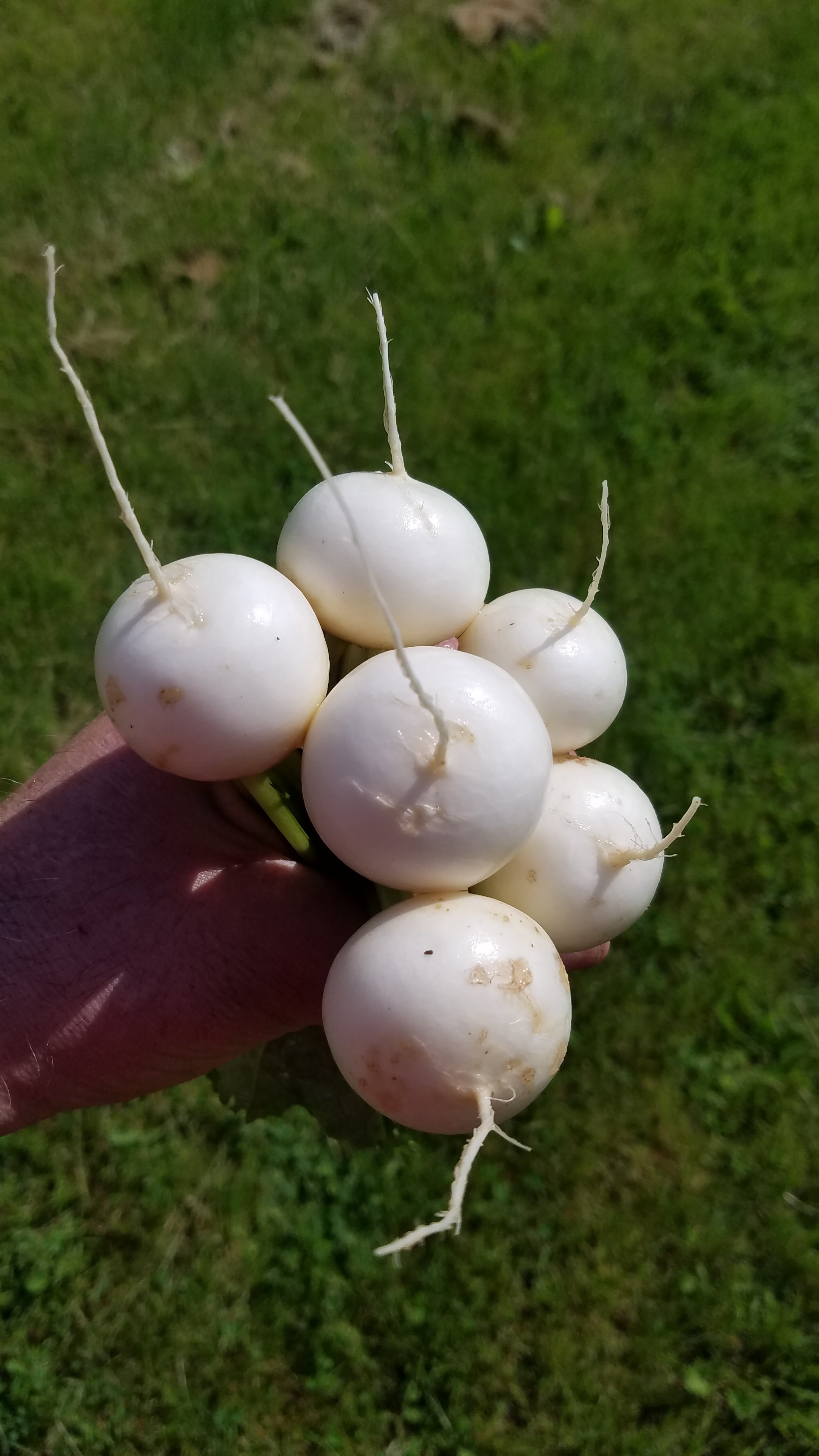
The plot urgently needed weeding. I obliged, filling my bushel basket with weeds several times. I harvested the last of the first radishes, turnips, arugula and four kinds of lettuce. Even with competition the original plantings are looking great: beets, turnips, sugar snap peas, lettuce, arugula and carrots. While ground moisture made it easier to weed, by walking on it I added to compression that already existed. The plants look robust but I’m not sure how the excess ground moisture will impact yield.
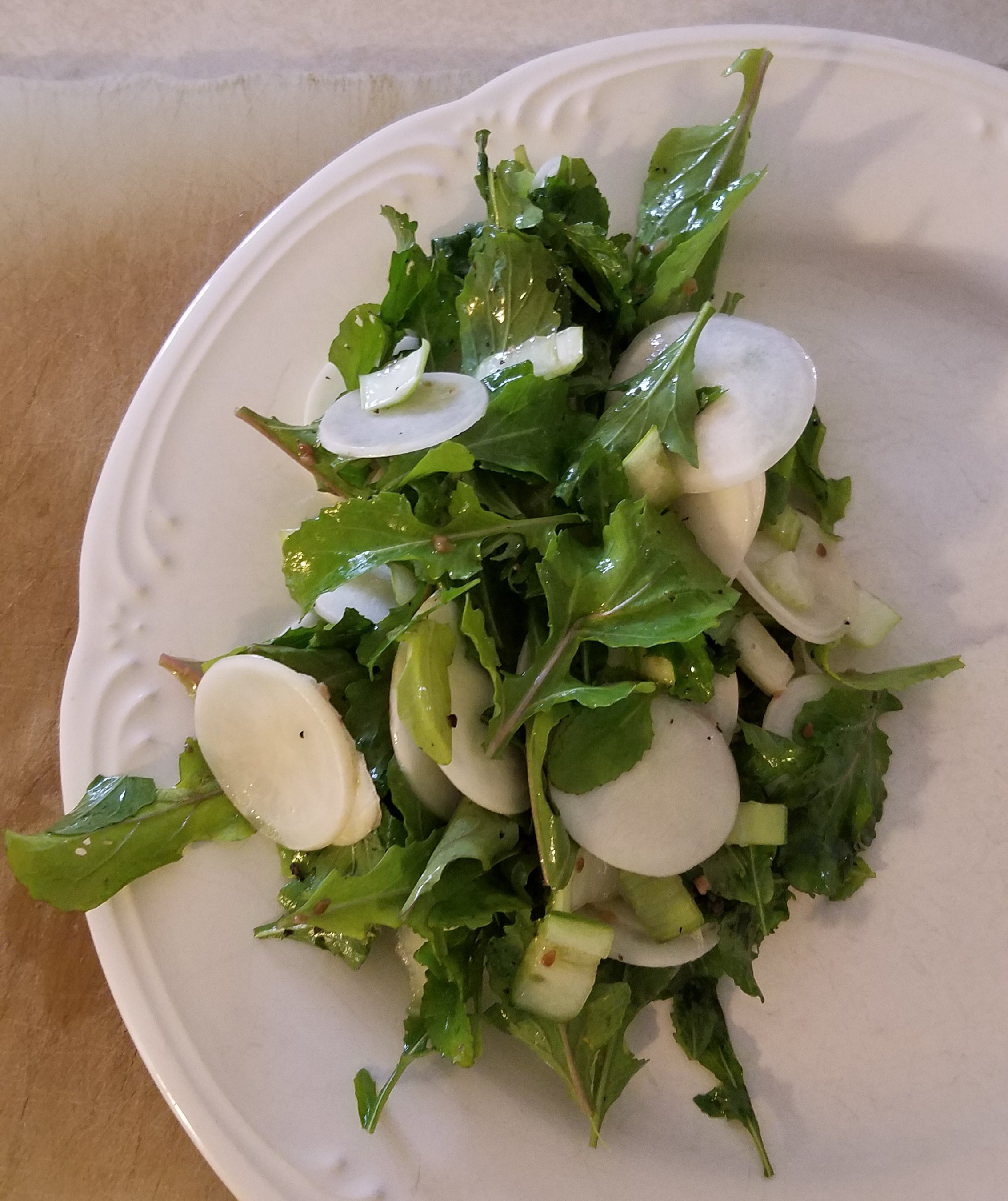
In the kitchen I’m planning some kind of turnip-arugula dish with dinner. A classic is shaved turnips with arugula tossed in a dressing of homemade cider vinegar, olive oil, honey, salt and pepper. I have plenty of turnips, but only two cups of arugula. (I had forgotten I planted arugula). The other option is to braise the turnips in butter then toss them with the arugula and maybe some other kind of cooking greens. Seems the dish would need garlic. Maybe I could make a dressing with the cooking remains, minced garlic and some cider vinegar. Or maybe I could toss the whole works with some of the lettuce harvested today. While there’s no certainty, there are possibilities. This is how a kitchen garden works.
Turnips
I’m not giving up on the garden. I considered mud planting the celery then thought the better of it. The ground is just too wet. So I wait.
It is surprising how just a few hours in the garden finds work for idle hands, clearing the fog of storm-related stress away. I’m not sure when the weather pattern began but is has been weird since the beginning of January. I expect we are only seeing the beginning of the weirdness. That is no reason to stop living.
I planted reserved seedlings of Blue Wind broccoli where others had failed. The plot is under the locust tree and one corner of it may be a problem for anything to grow. We should get some broccoli, and if the slow-starting seedlings mature, it will be in progression. We love fresh broccoli.
I find myself referring to these garden posts frequently to review when something was planted. There is value in trying to remember what I did on Thursday morning. There is hope of a delicious dinner made partly by the work of my hands. That’s why I am a gardener.
Fallen apples after a severe storm Sept. 20, 2013.
A thunderstorm with potential to create a tornado arrived about 8:45 p.m. last night. As the front of the cell moved over our house, we went to the lower level and waited in a safe corner, staying tuned to reports from news outlets. The National Weather Service precisely described our location in one of its tornado warnings.
The early warning system and technology supporting it are pretty amazing.
There was no tornado or straight line winds I could see or hear, although when the sun rises I’ll inspect the property for damage. The forecast is for scattered and isolated thunderstorms beginning around 2 p.m. today. We’ve seen worse storms than last night in recent years.
Wednesday I went to the warehouse club to fill a new eyeglasses prescription. On the way I stopped at a hair salon for a trim. Stylist conversation was about spring planting and how far behind many farmers are. We shared observations that fields have standing water and many farmers haven’t planted. One more manifestation of community talk about excessive rain’s impact our lives.
Farmers are giving up on corn, as it is getting too late to plant. They’ll switch to soybeans if they can get in the fields. From where we are today, they need a solid week of drying before running planters in fields. Estimates are 31 million planned corn acres remain to be planted, a few days work with modern agricultural technology. Because of wet fields with forecasts for more rain, it seems unlikely many will make it before the mid-June planting deadline to get crop insurance. 2019 looks to be a year farmers remain viable through insurance payments, federal subsidies and smart planning. Getting into wet fields not only poses risks of reduced yield for a current crop, resulting soil compaction would affect next year’s planting. So we wait.
I ordered my eyeglasses, fueled my vehicle and picked up groceries. The garden was muddy so I focused on inside work, still waiting for the weather to break. Last night’s thunderstorm indicated Mother Nature is not ready for that.
On Feb. 19 I submitted a vacation request for today and tomorrow at the home, farm and auto supply store so I could finish planting the garden if I hadn’t already.
Paid vacation is one of several perquisites of working for a mid-sized retail company. Such perks are a reason I linger there, even though I’d rather spend more time at home in my garden and kitchen.
As we now know, planting is behind during what may become the wettest Iowa spring in recorded history. People aren’t freaking out yet. Many I know, including all the farmers, are on edge. A lot is at stake when one’s livelihood is built around planting and growing foodstuffs. Non-farming people feel the oppressive weather as well. The continuing rain is not normal for east-central Iowa. I’m not sure my garden will get planted the way I expected in February when I submitted my vacation request.
Yesterday at Kate’s farm a thunderstorm rolled in and we moved the seeding operation into the barn. One doesn’t want to be inside a metal-framed greenhouse during a lightning strike. At home I left my trays of seedlings outside when I went to work and they survived the storm in good shape. I moved them into the garage as rain started again. There have been a lot of thunderstorms locally, which when combined with the recent polar vortex, heavy snowfall, rapid snow melt and wild temperature swings, indicate this isn’t a one-off weather event.
Around 1850, physicist John Tyndall discovered carbon dioxide traps heat in our atmosphere, producing the greenhouse effect, which enables all of creation as we know it to live on Earth. This and other scientific facts about physics, chemistry and biology are the foundation of analytical models that predict future behavior of the climate and its consequences for humans. As Katharine Hayhoe, an atmospheric scientist and professor of political science at Texas Tech University, posted yesterday in social media, “climate models are (not) some type of statistical random number generator.” The science of the climate crisis is the same science that explains why airplanes fly and stoves heat food. It’s science.
Consider the displeasure with which the administration greeted the Fourth U.S. National Climate Assessment which predicted dire consequences for sentient beings in coming years if greenhouse gas emissions continue the way they have been going. The president’s advisors now seek to change how the assessment is done, arbitrarily shortening the window of concern to a near horizon of 20 years. I’ve never seen an ostrich stick its head in the sand, but this is what it would look like. There is no scientific reason to shorten the horizon for considering the effects of the climate crisis in climate models.
I didn’t know what to expect in 2013 when I attended Al Gore’s training to join the Climate Reality Leadership Corps in Chicago. Among the benefits was by understanding the basic science of global warming it became easier to cope with the crisis unfolding in front of us now.
The reality is climate change is real if we have the education and awareness to understand what we are seeing. It is not only about science. As Carlos Castaneda suggested when a reporter questioned him about discrepancies in his personal history, “To ask me to verify my life by giving you my statistics … is like using science to validate sorcery.” So it is with our politics. Scientific facts do not address the politicization of science to serve interests that are indefensible in light of our commonality.
Mother Nature has been the victim of humans living on Earth, of that there is no question. Brutalized and violated, who can mend her broken body? I don’t know if it’s possible, there is no Denis Mukwege for her unless it can be all of us together. Who am I kidding?
The sun is rising after the latest thunderstorm moved on toward the Great Lakes. I’ll put seedlings outside again and hope for a break in the weather long enough to work the soil. While farmers need a good week of dry weather to get crops in the ground, I can make do with less.
I feel good about today but then I am human. Most of us can’t see but six inches beyond our nose, try though we might. To sustain our lives we must do a better job of living now while working toward a better future — despite the setbacks of our politics. What choice do we have?
Whether or not we get a garden in this year the stakes are not high.
Much as I enjoy produce resulting from my labor, I could get along without it a for a year, or two, if I had to. We are part of a strong food ecology and unlikely to go hungry or want for fresh vegetables.
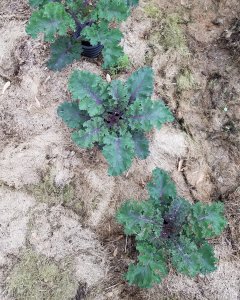
Eventually the ground will dry enough for planting and what has become a dozen trays of waiting seedlings will find a home. There have already been some successes: the kale looks great, radishes have been good, and the sugar snap peas will produce an abundance. I’ll do what I can, when I can, reflecting the position of most gardeners in my area.
The marker for end of spring is moving my vehicle back inside the garage. We are weeks away from that.
On Sunday I planted what will be the last tray of seedlings at the greenhouse. My work there wraps up at the end of June and already I am on every other week duties. Where did the first five months of 2019 go?
The Blue Wind broccoli planted earlier has been a disappointment with less than half of the seedlings planted now growing well. Blue Wind plays a role in larger operations as an early broccoli. We’ll see what it produces, but unless the heads are spectacular, it will be the last of this experiment. Late planting of Imperial will better serve our needs.
In other failures, tomatillos have done little. I may get one plant from the starts. Heirloom tomato starts were iffy, with a couple producing only one or two plants. Rosemary germinated, but growth hasn’t taken off. These failures combined with late, iffy planting take a toll. In the end it’s part of being a gardener.
I pulled apart last year’s tomato patch and mowed it flat. The plan is for cucumbers, peppers, squash, eggplant and sundry crops to go in there. The soil isn’t turned yet and won’t be until I get the previous plot planted.
While I’m struggling to get a garden in, larger scale conventional farmers are having a time of it. Spring rain has gone on so long some are debating whether to put in a crop at all. I posted a link to a story about the issue by Thomas Geyer in the Quad-City Times. My post made over 3,500 impressions on Twitter. Find the article here.
People who rely on their farms for a living have had a struggle of a spring. My friend Carmen at Sundog Farm wrote the following to her CSA members:
As I’m sure you’ve noticed there have not been very many windows of sunshine in between rainstorms over the past month and half, so we’ve been seizing every opportunity when its dry enough to get in the field to plant. Despite the limited opportunities and that planting sometime ends up looking more like wallowing in the mud, we’ve actually been pretty happy with our progress! We’ve also been grateful to have hoop houses where we’ve been producing most of the spring crops, and where we can plant even when it’s wet outside. We are a little behind in getting plants in the ground, but so far we are pretty close to where we want to be and hoping for the best!
Some seasons hoping for the best is what is possible.








 Journey Home
You must be logged in to post a comment.