Categories
Kitchen Garden

Garden Notes — June 20, 2019

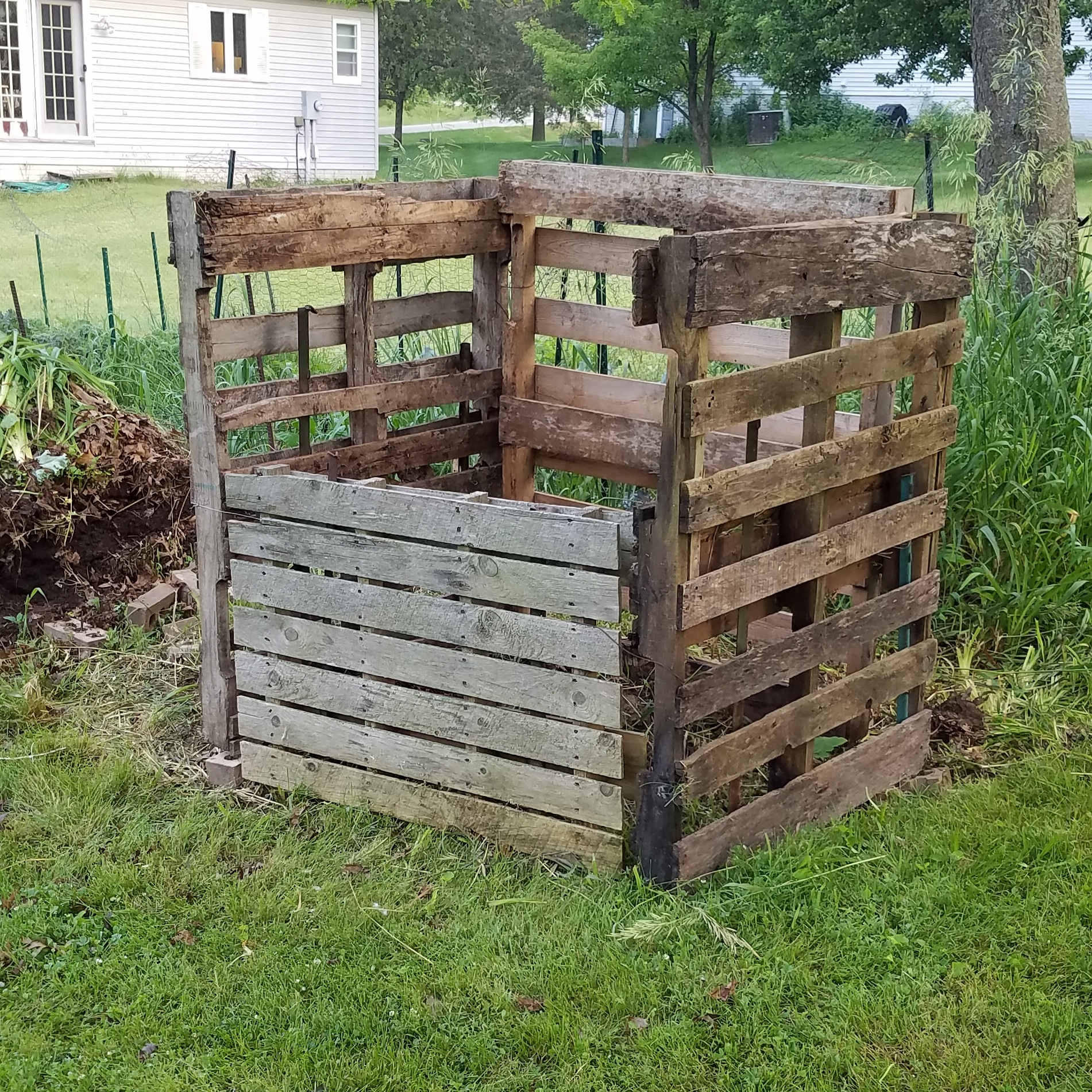
Open air composter

An innovation I discovered at a political event was an open air composter made from shipping pallets.

At Jean and Jix Lloyd-Jones home they had a composter similar to what’s in the image outside their kitchen door leading to the yard.

During the last few years I secured some pallets and made one. It works great for all the greenery I harvest and weed from the yard and garden. It was time to use the compost in the bin so I re-built the device on a different spot, replacing the pallets that were being composted from exposure to the ground. While portable, it’s a permanent fixture in the garden.

This year some garden experiments are worth noting.

For the first time my arugula is producing well. What got me going is starting the tiny seeds in soil blocks then transplanting the seedlings to a garden row. In the past I broadcast them and picked the leaves from a mess of weeds that joined them. The taste of fresh arugula is something distinct and I’m thankful to have figured out how to grow it.

As readers may recall we missed the March 2 planting date for Belgian lettuce and punted. The idea is to make an early patch of lettuce from which leaves could be harvested. I got the seeds as remainders of last season at the home, farm and auto supply store. Because of delayed planting the starts from the greenhouse produced better results while the sown seeds got lumped together rendering the patch difficult to manage. The lettuce process requires further refinement and will begin with more careful selection of varieties from a seed catalogue. I will likely plant Belgian lettuce again since that’s a tradition passed down from Grandmother, but with more reliance on conventional process using the greenhouse.

I added Hakurei turnips to my standard purple top white globes. They produced early, in abundance. They make a great snack or sliced thin and mixed with arugula, a delicious salad. Multiple varieties of turnip proved to be a good thing.

I changed how I used buried containers this year. I planted successions of radishes and used one for daikon radishes which continue to mature. When the radishes were done in one container, I planted basil seedlings. I also planted onions starts in succession for green onions. The production has been better than the potatoes of past years (which were the reason for getting the containers). If I want potatoes I will acquire them from a farmer friend through one of my barter arrangements.

I broadcast okra seeds in a two by three-foot section and they successfully germinated. The first thinning is done and another will be needed once the best plants self-identify. I put them along a fence, but am a little concerned with that decision because deer love okra. We’ll see how it goes. The germination was remarkable.

A main learning is to allow more space between garden rows, but gardeners likely know that. There will be more lessons as the season progresses.
Categories
Environment

Hiking the Deer Path

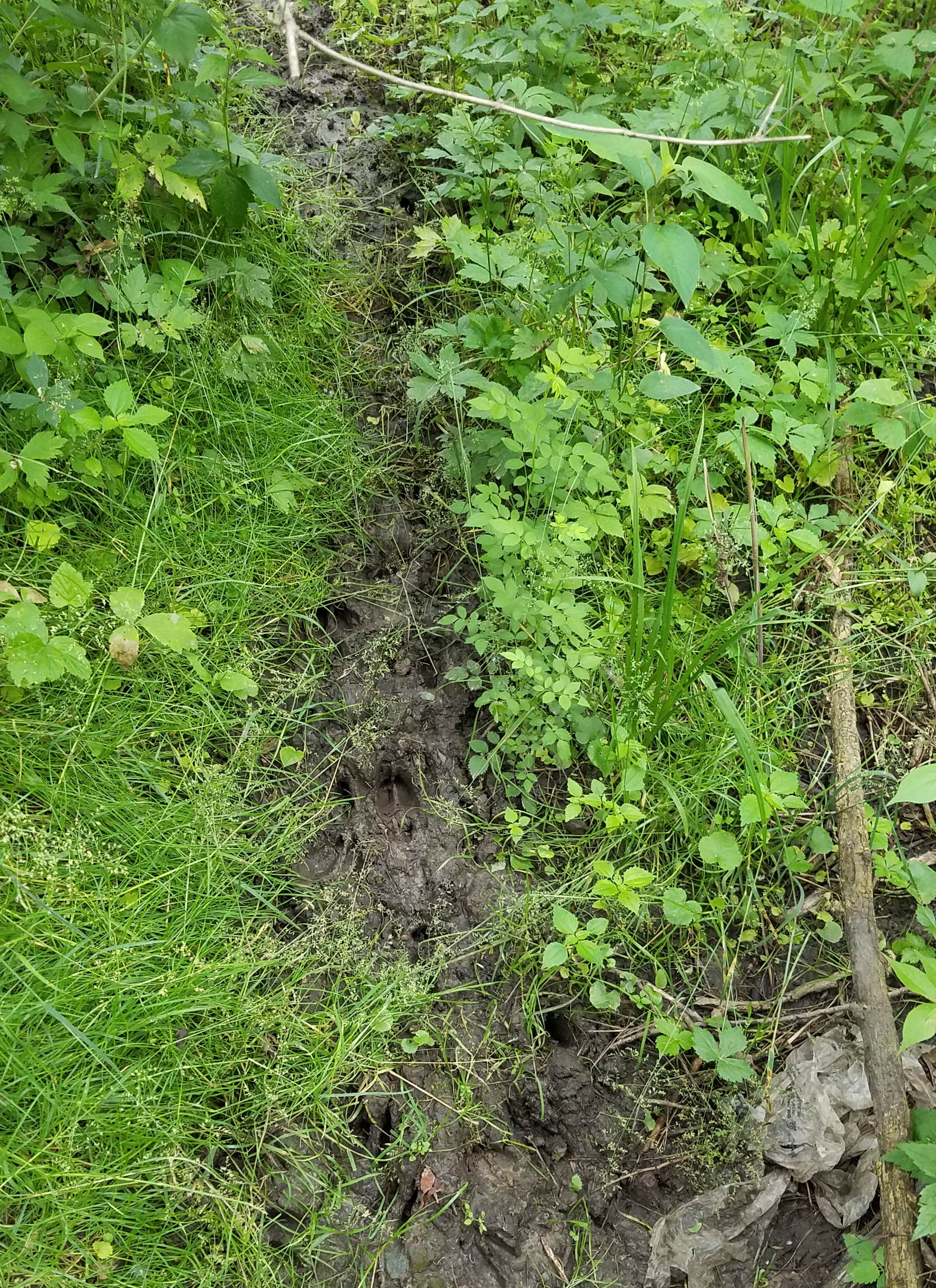
Deer Tracks, June 18, 2019

I walked due east from the garden along the utility easement to access a 25-acre stand of woods at the point where deer enter.

Deer are a constant presence in the neighborhood, especially during apple season, and I try to live in harmony with them by understanding what they will and won’t eat, and by using fences on the garden.

After dining, deer run across the same open space I walked to the wood line.

Based on the condition of the undergrowth, few humans visit the woods except around the edges. The main pathways are those made by deer and the brush is so thick I’m not sure how they get through. In 25 years of living here, there has been little interest in using the woods and I’ve hiked them less than half a dozen times.

Unnamed Creek, June 18, 2019.

I walked a deer path on the west bank of an unnamed creek up hill to the pond created by a now forgotten farmer. It was sweaty work and good exercise. I’ve studied the woods on maps for years and there was never a sense of being lost despite the claustrophobic feeling the thick undergrowth created.

The county planning and zoning commission requires our development to maintain a certain amount of open space so the woods can’t be developed with housing. If our association members had an interest in using the woods more, the deer paths could be upgraded to walking paths and mapped out. There has been little interest so it has become a habitat for wildlife.

If we were to develop the woods as a recreational area, there would be little money for it, so the work would be by volunteers. There would be a lot of work to do. Numerous native species of plants exist there, and identification and preservation seems important. The canopy is relatively thick and consideration should be given to long-term forest health. That might mean thinning some mature trees so younger saplings can grow. There are a lot of fallen branches which could be chipped into mulch to pave pathways. It could turn into a really big project. As busy as everyone is, I’m not sure who would volunteer and I know almost everyone in the association.

Native Fern, June 18, 2019.

Suffice it to spend an hour or so hiking the woods once in a while. It takes effort to forget the manicured lawns and gardens to focus on what is in front of us in the woods. By the time I reached the top of the hill, I had forgotten whatever seemed important when I left the garden to focus on finding my way, and then my way home.

It occurred to me that even though the association owns the woods, that ownership is only loosely so. I mean the woods will continue to develop as it has, enabling brief and specific glimpses into what used to be when Iowa was mostly tallgrass prairie. We are visitors on Earth, and that for a short while. Ownership is a cultural concept unknown to the plants and animals that live in the woods. No one truly owns the woods despite legal documents so indicating.

If I want to understand my relationship with wildlife better, I need to spend more time in those woods. Maybe during another hike in the near future.

Categories
Juke Box

Uncle John’s Band

It’s time for a brief hiatus to focus on 5:30 a.m. sunrises and clear days in the garden.

I’ve been listening to tracks from the Grateful Dead’s 1989 concert at Alpine Valley in East Troy, Wisc. Uncle John’s Band is a favorite performance.

My main experience with the Dead was during my undergraduate years when I ran a carbon arc spotlight at a 1971 Grateful Dead concert at the University of Iowa Field House, and attended another in 1973. I have many of their albums on vinyl, bought in real time as they were released, although sharing bootleg tapes of concerts became a thing before the internet enabled sharing. Hope you enjoy this video.

Hope to be back with new posts soon.

Categories
Home Life

Under a Spell

Not that kind of spell

During the last couple of years I periodically went under a spell.

I don’t mean something another human (or animal) cast on me, but a time of uneasy dizziness and disorientation when I wake.

After a discussion with my physician, he said not to worry. Okay…

It happened again this morning and I did this: Remedy 1: go back to bed. Remedy 2: eat breakfast. Remedy 3: go outside and harvest garlic scapes, radishes and sugar snap peas for dinner. Remedy 4: take a nap. Remedy 5: Read about the impact of infectious disease on pre-Columbian societies. Remedy 6: eat a bowl of soup. Remedy 7: find a recipe for garlic scape pesto.

By 2:30 p.m. I was feeling more normal. Normal enough to turn on my desktop and maintain some files, deposit a check from a writing gig, and open up WordPress. Normal for a sixty-something is different from when I was a thirty-something. Once I’m done I may go outside to breathe fresh air again and feel a breeze. That seems the most impactful and I could use the exercise. The garden was too wet from last night’s rain to accomplish much there, even if I felt up to it.

I’m trying to keep my blood sugar level within a reasonable range to prevent type two diabetes and that may have prompted today’s episode. According to the Mayo Clinic, a healthy range of daily carbohydrate intake should be between 225 and 325 grams. My estimated average has been 202 since I began the project May 25, ten percent lower than the bottom of the range. In addition I’ve lost 17 pounds since then. I feel better, at least when I’m not under a spell.

The biggest change has been my stomach growls when it is ready for a meal. That hasn’t happened for a very long time. When I hear the sound now, I get a snack if it’s not meal time, or fix a meal if it is. Being mostly retired is the only way this kind of tracking and growl response can work as there are too many distractions in a regular life.

There are always free snacks in the break room of the home, farm and auto supply store to tempt one to give up tracking carbs to enjoy some sweet or salty snacks or baked goods. A recent study of 5,222 employees across the U.S. found we consume an average of 1,300 additional calories per week made up of food at the office, according to Shape.com. Working only two days a week makes a difference for me as the will power struggle is absent when I’m not working at the retail outlet.

This carb counting process continues until August when I get a new blood test and see my practitioner again. We’ll see what we see. According to my ophthalmologist the blood vessels in my eyes look fine and diabetes is absent. I suspect the spell was due to not eating enough before bedtime. I experienced glycogen burnout only once in my life, during a century bicycle ride, and this isn’t it.

I don’t like losing the whole morning and part of the afternoon. But as I finish this post, I’m feeling back to normal: sustaining a life in a turbulent world.

Categories
Living in Society

You Say You Want a Revolution

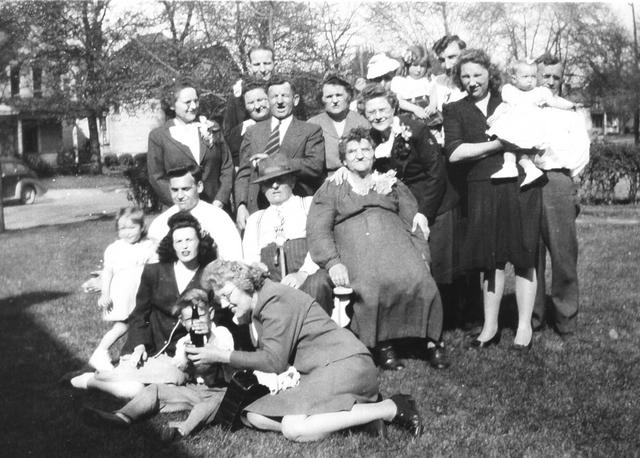
Easter 1946

In Iowa presidential candidates attempt to generate hope. Not just hope of winning in 2020, but to make our country a better place beyond the next election.

So much has changed in our lives and not for the better.

Progress will be difficult for Democrats when the hegemony of wealth and business touches most of us. The hold libertarians and conservatives have on us is based on influence in our jobs, health care, energy companies, transportation, retail stores, and social institutions. Whether we know it or not, we mostly work for them. Something’s got to give in our politics because as the richest get richer, society is not working for the rest of us.

“Establishment politics is just not good enough,” presidential candidate Bernie Sanders said at a CNN Town Hall in 2016. “We need bold changes, we need a political revolution.”

If the shine came off this trademark Sanders claim and the revolution has stalled according to the Washington Post, it may be because a number of candidates, including Elizabeth Warren, Pete Buttigieg, and even long shot Marianne Williamson, are all calling for profound change in American life.

Warren calls for “big, structural change to rebuild the middle class.”

Buttigieg wants a “fresh start for America… It’s about more than winning an election. It’s about winning an era.” He’s thinking of the millennial era.

Williamson wants evolution to a politics of love, saying on her website, “Our task is to generate a massive wave of energy, fueled and navigated by we the people, so powerful as to override all threats to our democracy. Where fear has been harnessed for political purposes, our task is to harness love.”

Presidential candidates need something to elevate their campaigns, which is well and good. I recall a time when I looked for that in a presidential candidate. The nomination of Hubert Humphrey in 1968 cured me. I’m looking for something else and question the idea of remaking everything. We are in pretty deep for that.

A main issue is libertarians and conservatives, the Radical Right as Jane Mayer calls them, would undo everything progressives have accomplished since the Franklin Delano Roosevelt administration. Under President Trump they have a shot at that, maybe the best shot ever. What do they believe? As Mayer pointed out in her 2016 book Dark Money: The Hidden History of the Billionaires Behind the Rise of the Radical Right, “taxes are a form of tyranny; that government oversight of business is an assault on freedom.” Things we take for granted — Social Security, Medicare, the Environmental Protection Agency, OSHA, the National Labor Relations Board — would all be dissolved if the radical right had their way. To the extent a revolution is called because of changes in this status quo, it is too little, too late.

The radical right already owns us. Whether we consume their media, buy their fuel, use their electricity and natural gas, invest in their financial services companies, or shop in their stores, a percentage of each transaction finds it’s way to the wealthiest people in the country. We don’t care if using Wells Fargo, shopping at Amazon or Walmart, using fossil fuels, or working at their jobs is bad for us. We have chosen a way of life and if the radical right is behind it, they have been out of sight, out of mind for a very long time. Not only are we owned, we have been hoodwinked into believing the status quo has been good to us.

During Summer 2019 the Democratic candidates for president will be putting their best foot forward to persuade Iowans to caucus for them. A bright light should shine on the idea of remaking everything in a candidate’s framework. The last time Democrats had a mandate for change was after the re-election of Lyndon Johnson in 1964. Given the structural problems with our government — the electoral college, gerrymandered congressional districts, voter suppression, to name a few — it is unrealistic to expect any political revolution, evolution, big structural change, or winning of an era.

When in 2016 Hillary Clinton said we are stronger together, the phrase was not new. Among the challenges of the 2020 election are for Democrats to maintain control of the House of Representatives and elect a Democratic president. The extended presidential primary season works against us on both of those goals pitting good Democrats against other good Democrats as we promote “my” candidate. Our goal should be to stop the radical right from further bleeding a Democracy on life support by winning the election. It will take all Democrats to get this done. Once we do that we can talk about what’s next.

It is hard to keep hope alive. The problem with our democracy is logic no longer applies when it comes to voting or to almost anything else outside the purview of the richest Americans.

You say you want a revolution. Well, you know, we all want to change the world. Unlike the Fab Four, I’m not sure it’s gonna be alright.

Categories
Home Life

Last Spring Weekend Telephony

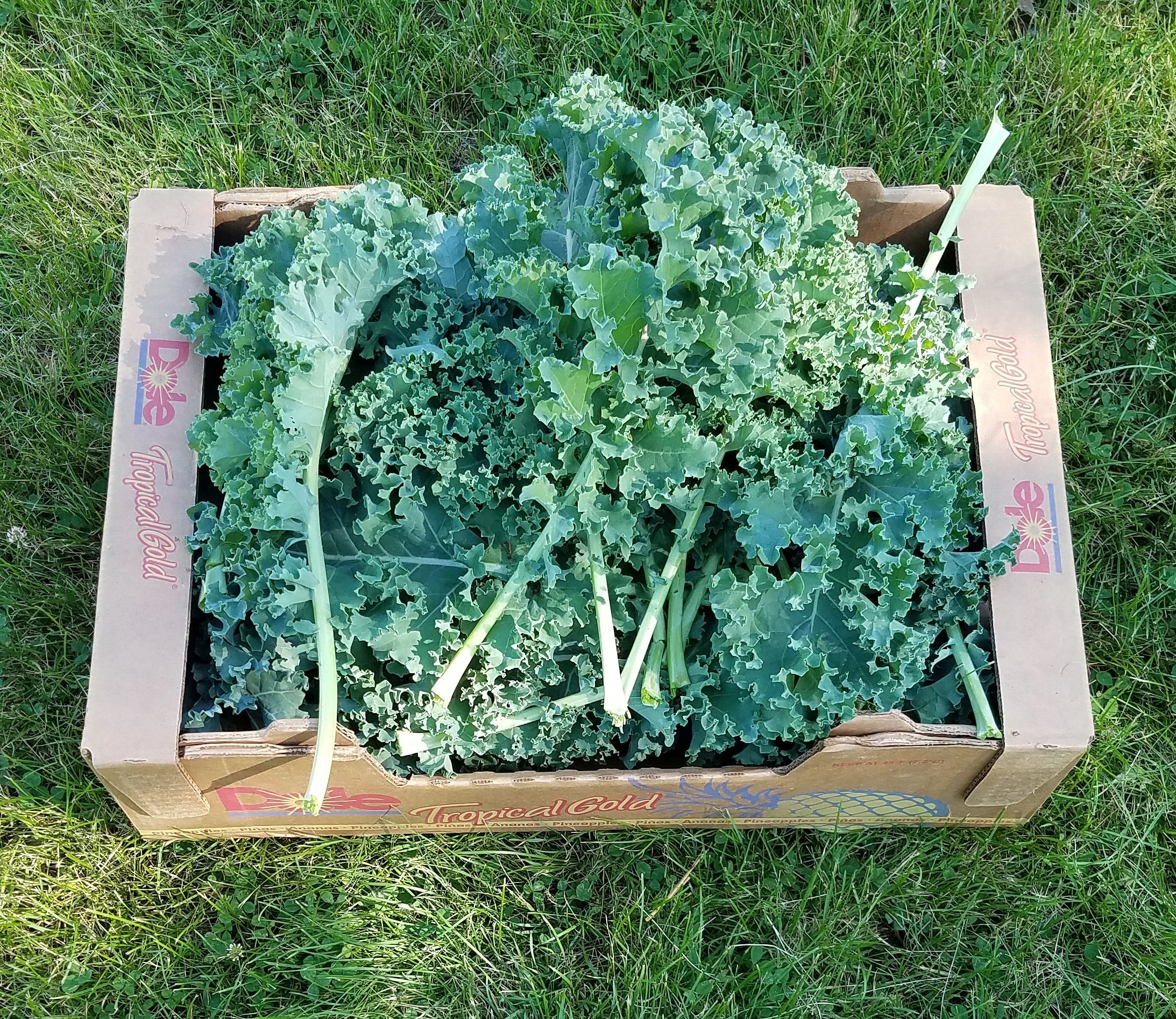
Recent Kale Harvest

I don’t receive a lot of phone calls and am wary when one rings in. The breakout of inbound is something like 60 percent spam and unsolicited telemarketing, 20 percent political calls, and 20 percent humans with whom I need to have a conversation.

The political calls are getting more frequent and I’m picking them up from familiar area codes… for now. I don’t know how they get my number.

The telephone app is one of the least used on my mobile device.

While I lived in Germany, a fellow officer brought his family with him. He couldn’t stand to be away from his spouse who had to stay in touch with close family back in Alabama. The phone bills almost ruined them. I don’t recall how they resolved it, other than she returned to Alabama early, he moved into the BOQ (bachelor officers quarters) and they had to stretch the $11,000 annual officer’s pay a lot further than it was designed to go. I had a telephone from the local German company but rarely used it. It was too expensive  to phone home even though there was a clicker on it that informed me in real time how much I used. The clicker went really fast when I was on line with Mother.

I had two phone calls this week from the Elizabeth Warren and Pete Buttigieg campaigns inviting me to events in the county seat. With the remaining garden and yard work I don’t see that I can afford time to attend either. I do have the Warren office opening on my calendar for Thursday after work at the home, farm and auto supply store. For the summer, I’m sticking to political events closer to home because when I make the half-hour trip to the county seat or to Iowa’s second largest city it takes prime time out of a day I should be spending working at home. I’m usually spent afterward, even if the event itself is short.

Not only do I not like using a telephone, I like driving even less.

I plan to leave my mobile device in the kitchen and work outside until it begins to rain. I have voicemail, which I may access when I come indoors, or may not.

Categories
Kitchen Garden

Spring Cooking Day

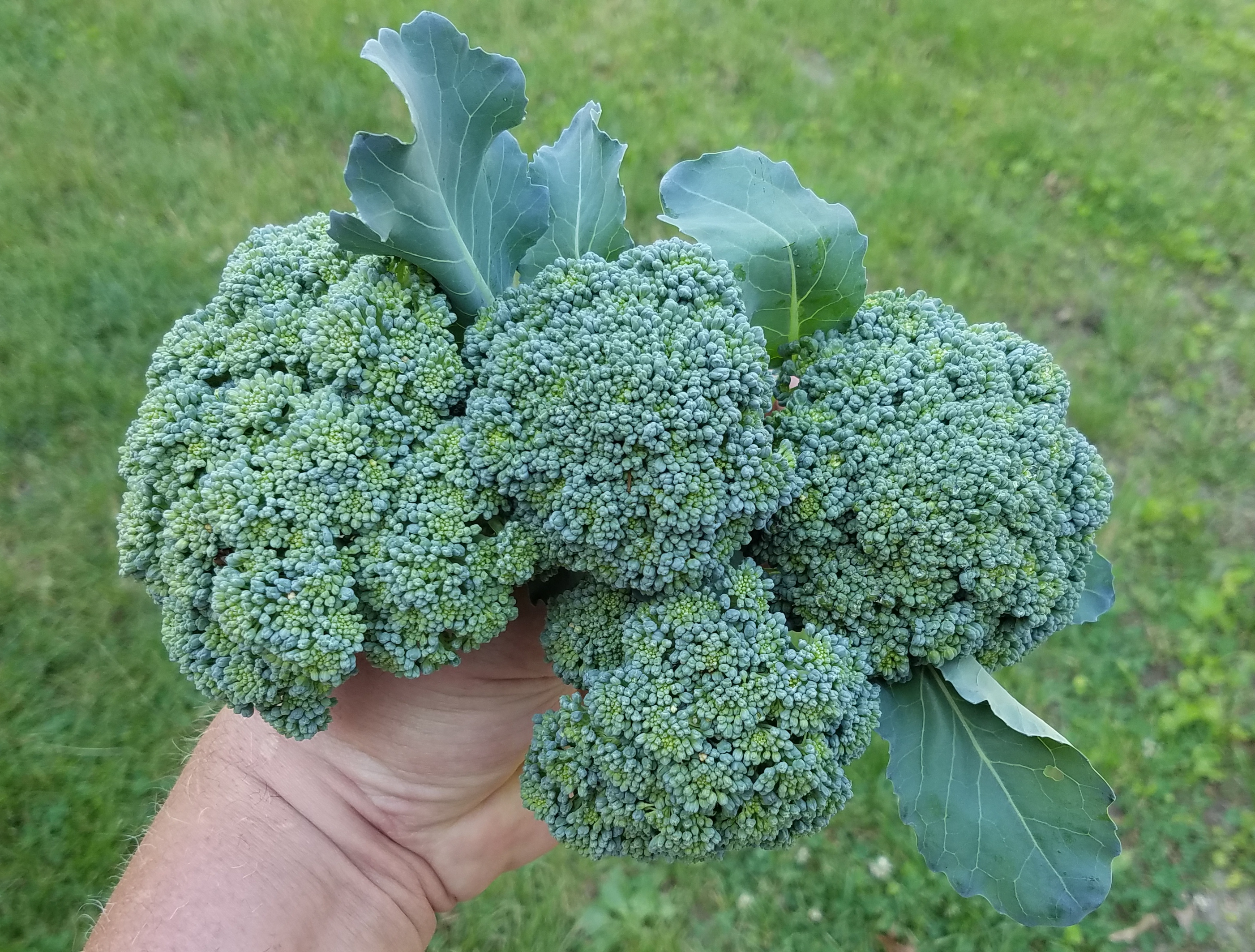
First Harvest of Blue Wind Broccoli

The rush to use ingredients is upon us and the garden isn’t even fully planted.

After watering I made the rounds of six garden plots and harvested radishes, turnips, spring onions, lettuce, broccoli and kale… lots of kale.

I had planned to take a big box of kale to a political event in Cedar Rapids yet forgot it on the folding table in the garage. Upon my return home I bagged it for delivery to library shift workers later today. For now, there is always a home for kale. It looks really good before the bugs and worms start to eat it.

Blue Wind broccoli is an early variety that requires close monitoring to pick it at its peak. Reserving some florets to be added to salads, I steamed it as a side dish for dinner. In fact a lot of kitchen work happened yesterday.

The first thing I did after waking was make pesto with fresh basil. It was the beginning of a day of cookery.

For breakfast I made a casserole using leftover brown rice and fresh spinach. While the casserole was baking I filled the Dutch oven with carrots, celery leaves, onions and turnip greens to make what has become a traditional spring vegetable broth. For dinner I heated a veggie burger and served it with the broccoli and kale.

My go-to kale recipe is simple. I de-stemmed and tore seven or eight kale leaves into 2 x 2 inch pieces in a stainless steel bowl. I heated a wok and added a tablespoon of extra virgin olive oil. I diced half a large onion and sauteed until translucent. I added five cloves of roughly chopped garlic and a quarter cup of pine nuts, cooking until the vegetables were tender and the aroma of garlic rose from the wok. Handful by handful I added the kale while stirring constantly. Once it was all in the wok I added vegetable broth to help cook the kale down. Once the liquid evaporated, I seasoned with salt and pepper to make two servings.

Perhaps the best meal of the day was lunch for which I toasted a slice of bread and spread pesto on it, serving with a cup of cottage cheese — simple pleasures in a time of abundance. We have to pace ourselves to see that as little as possible goes to waste.

Categories
Living in Society

Marianne Williamson Close to Home

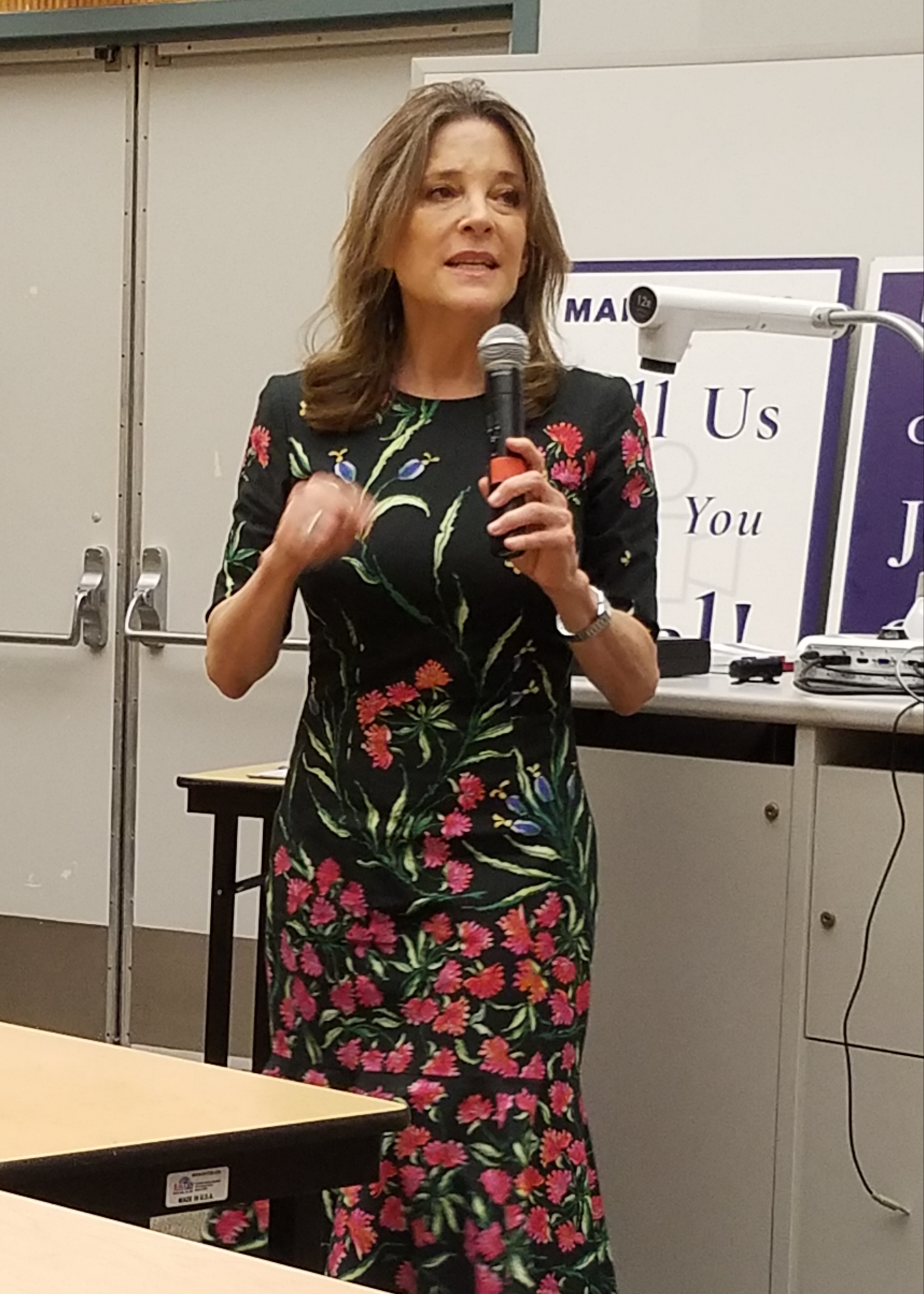
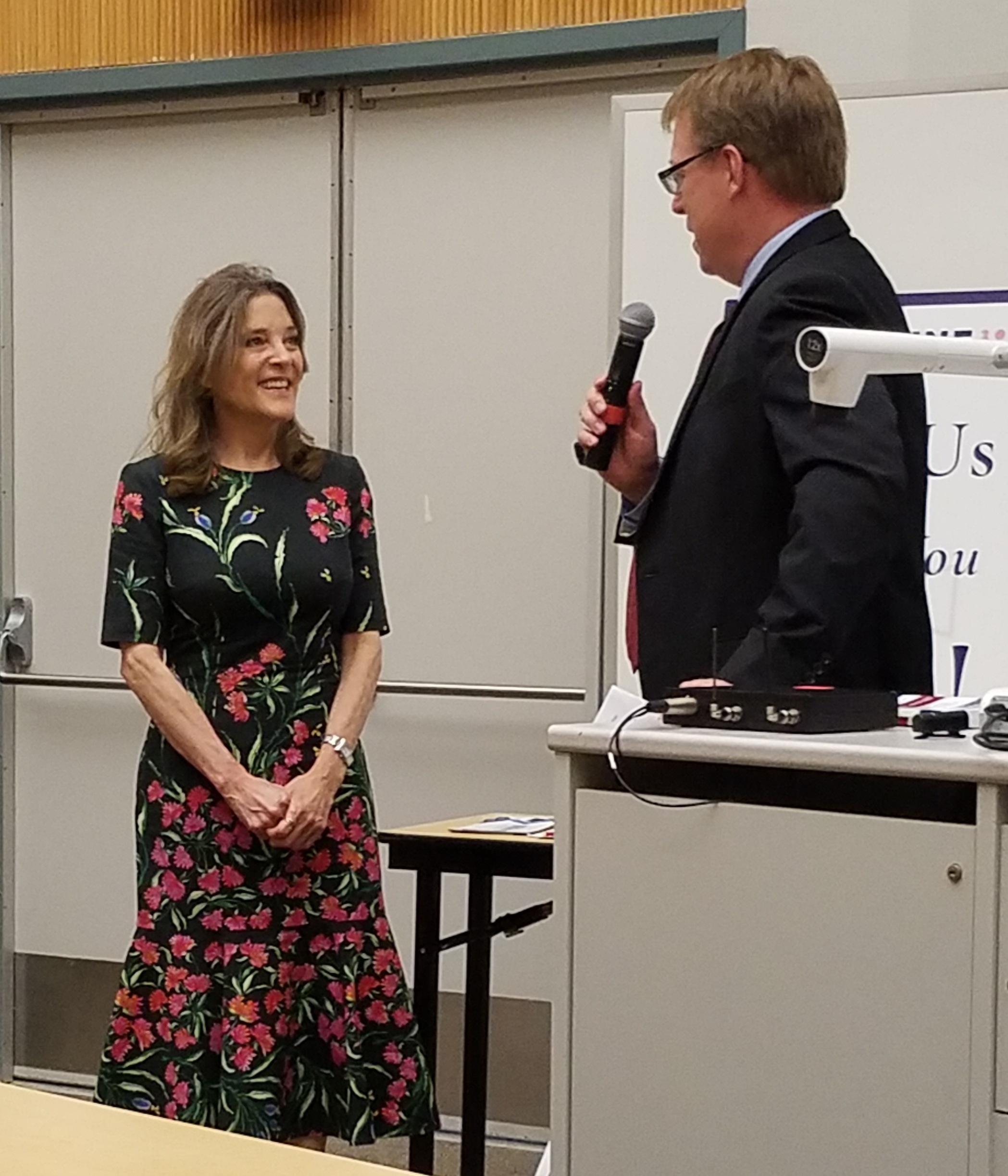
Marianne Williamson addressing a gathering at Kirkwood Community College in Cedar Rapids, Iowa on June 10, 2019.

About 11:15 a.m. I left the garden and drove Ely Blacktop to 76th Street and headed West to Cedar Hall on the main campus of Kirkwood Community College where presidential candidate Marianne Williamson joined State Senator Rob Hogg in a “climate conversation.”

Since I would be returning to the garden after the event, I wore my overalls and mud-caked gardening shoes.

I joined a number of students and staff, along with local members of environmental groups in a large operating theater-style classroom. By the time we got started more than 40 people had joined us.

I attended partly because the venue was close to home, partly to support Senator Hogg’s efforts to engage presidential candidates about climate change, and partly to see if Williamson’s campaign is, as some have called it, a “joke.”

Marianne Williamson taking questions at Kirkwood Community College, June 10, 2019.

Williamson’s campaign is not a joke. Why anyone would criticize a woman who is successful in her own right, by objective standards such as having written four number one New York Times best selling books, had me curious. She made it to the first two Democratic National Committee presidential debates, although just barely achieving one percent support in three separate national polls to qualify. She’s dead serious about her platform and as confident as any of the other 23 presidential candidates. With great optimism she said, “If you’re going to run for president, you might just win.”

The main news out of the event was Williamson did not support a separate DNC debate on the topic of climate change. The reason, she said, was “because there is no competing with Jay Inslee.” Williamson also said the topic cannot be separated from the broader problems in the United States. She made a point. Advocates for addressing the deleterious effects of the climate crisis cannot separate this one issue into a silo separate from other important matters like health care, education and national defense and expect to resolve them.

State Senator Rob Hogg explaining why the Iowa caucuses are first in the nation. “We do it right,” he said.

Williamson made a strong case for slowing our relationship with Saudi Arabia. She said as president she would immediately stop arms sales to the kingdom and end United States support for the war in Yemen, a conflict she said was immoral.

She also weighed in on nuclear disarmament, asking why we need 100 aircraft capable of delivering nuclear bombs when dropping ten of them could end life as we know it? It was refreshing to hear a candidate raise the issue without prompting.

Dave Bradley at Blog for Iowa wrote Williamson was positioned in the third tier of candidates, among those “who truly have little chance and are often running to push some ideas or philosophy.”

Marianne Williamson has been finding her way all her adult life. Win or lose, the time spent with her this afternoon was memorable for her determination to assert her solutions her way. As Hogg referred to her speech in Cedar Rapids yesterday, it is the “politics of love” and quite different from the offerings of other candidates.

Neighborhood Network News recorded this event. The YouTube video can be viewed here.

To learn more about Marianne Williamson follow this link to her website.

Categories
Kitchen Garden

Big Weekend in the Garden

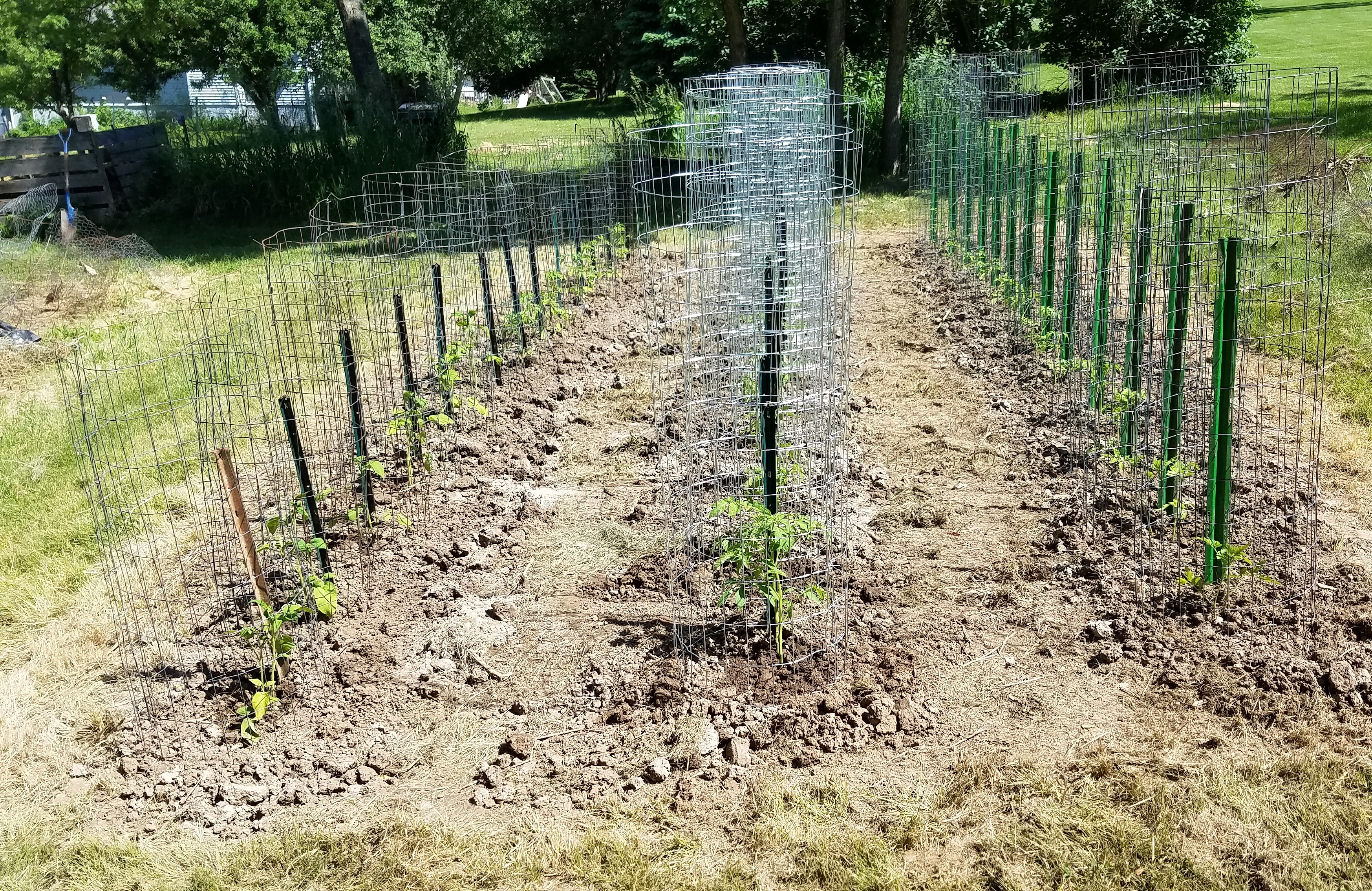
Three rows of tomato plants.

I returned nine empty seedling trays to the farm Sunday morning before my soil blocking shift.

The empty trays reflected clear weather and dry enough soil for planting. I had been worried seedlings would get root bound. I think I made it into the ground in time. I hope so.

The last three days have been devoid of rain with mild temperatures. I worked outside a total of 15 hours, finishing initial planting in six of seven plots. Now I must find spots for garlic planting in late July, Ancho and Guajillo chilies, eggplant and winter squash. I retained several trays of extra seedlings in case there are failures. Starts of basil, parsley, cilantro and broccoli are ready for the second wave of those varieties.

Putting in tomatoes is a big production. I cleared a plot that had been inactive since fall. I dug two-foot wide trenches for the seedlings and prepared the ground with a hoe and rake, putting down fertilizer before raking. A big part of tomato planting is sorting seedlings grown in the greenhouse, seeing how they germinated and counting varieties. In the end I made 47 planting areas with one or two plants per cage in 21 varieties.

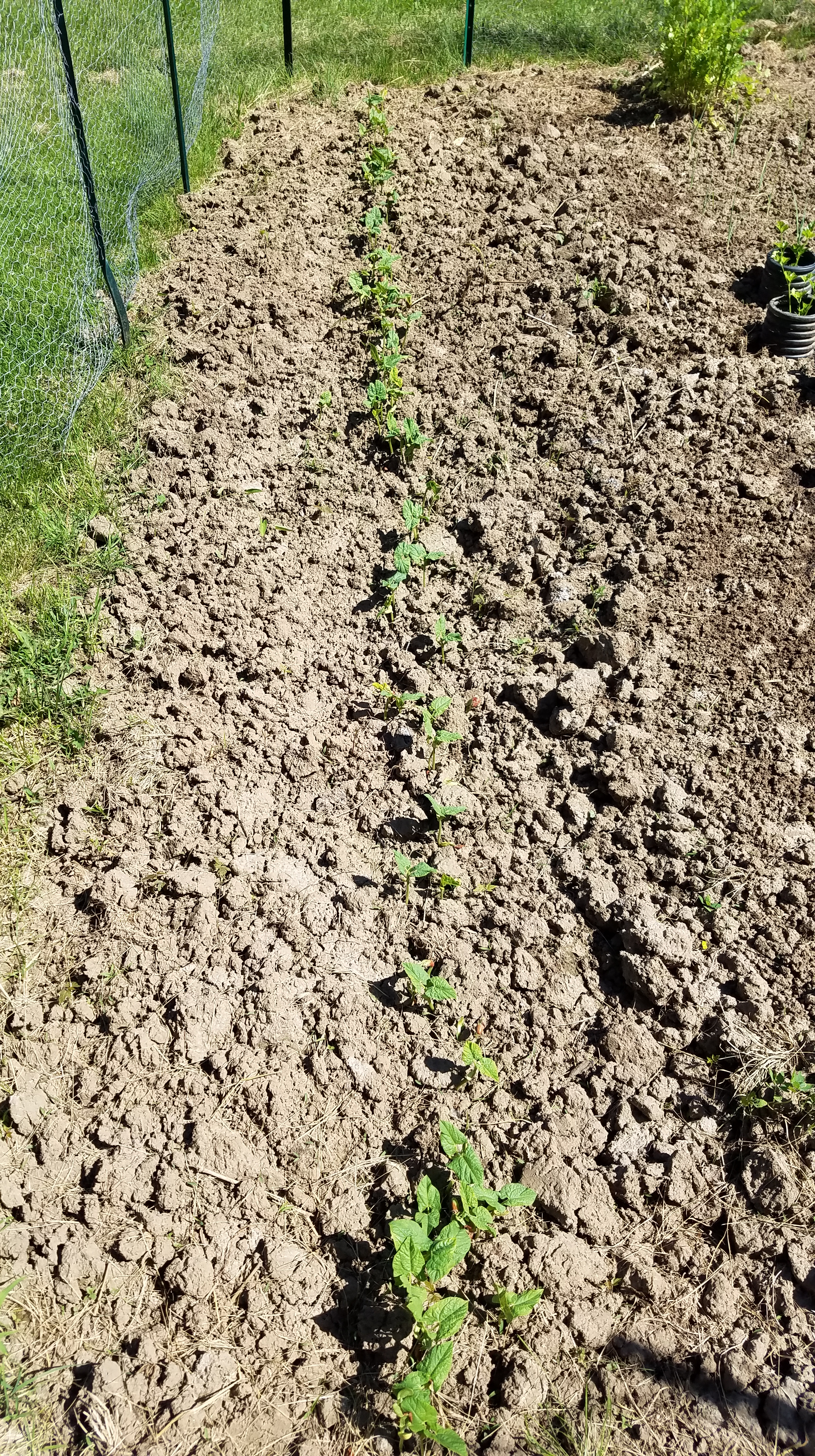
Row of Green Beans

This year I separated the cherry tomatoes into their own spot with more space between plants. The idea is to use that space to gather bowls of multi-colored fruit for the kitchen and for gifts. They are already blossoming.

Main crop slicers will be Brandywine and German Pink, both available from the Seed Savers Exchange. Plum tomatoes included Amish Paste, Roma, Speckled Roma and Granadero. I planted six varieties of cherry tomatoes with orange, red, yellow and white colored fruit. If the plots grow there will be plenty of tomatoes for fresh eating, gifts, freezing and canning.

Another big project was planting cucumbers. Planning included seed selection (Northern Pickling, Little Leaf Pickling, Jade and Marketmore) and downsizing the space from last year. I use 2 x 4 inch welded wire fencing to support plant growth and put seedlings close together. Everything survived the transplant. If plants are successful, there should be plenty of fresh and pickling cucumbers.

The last big planting was hot peppers. I made a patch of 15 plants and everything survived transplant. I have extra seedlings if some should fail. I selected jalapeno and Serrano for fresh eating and Bangkok, Red Rocket, Cayenne and Red Flame for drying. I also have Ancho and Guajillo chilies ready to plant once I figure out where. This will be an experiment in Mexican cooking if successful.

Spending time in the garden enabled me to watch the beans grow. From early Friday morning until late that night plants pushed out of the ground until the row was filled in. The same was true for the red beans, although they were a day later. It is something to watch the garden grow.

By Sunday afternoon I needed a nap. Today I’m rested and ready to get back into the garden for as long as the sun shines. The stress of too much rain is changing to worry about drought. We’re not there yet.

Categories
Environment Living in Society

Jay Inslee at the Cedar River

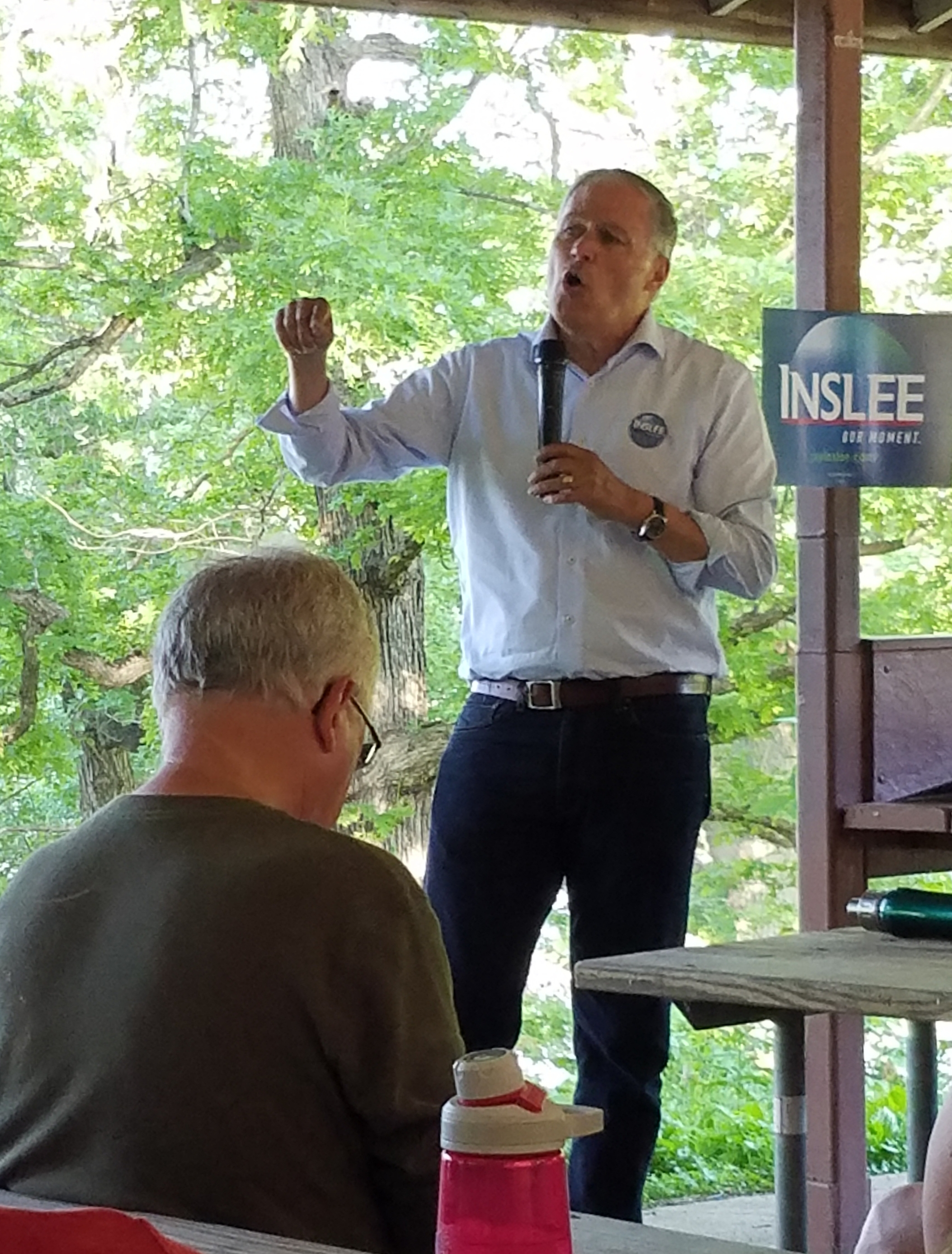
Governor Jay Inslee at Ellis Park in Cedar Rapids, Iowa, June 8, 2019.

CEDAR RAPIDS, Iowa — Saturday afternoon I drove to the Overlook Pavilion in Ellis Park where State Senator Rob Hogg had organized a “climate conversation” with Washington Governor Jay Inslee who is an announced candidate for president.

Hogg reminded us of the 2008 Cedar River flooding. The river was visible behind him.

It is hard to forget the 2008 flood that devastated Iowa’s second largest city. On my way to the event I compared flooding levels of the Atherton Wetland on Ely Blacktop which had been covered with flood water in 2008. From the center of Cedar Rapids I used First Street Southwest, which runs next to the Cedar River, to find the park. On the eastern bank someone had built a flood wall. An earthen berm restricted the view of the river on some parts of First Street. The low-lying area had been inundated in 2008 causing damage to more than 5,000 homes, evacuation of 25,000 people, and roughly $4 billion dollars damage. The flood was made worse by climate change.

In his introductory remarks, Senator Hogg recognized elected officials and organizations present and encouraged the almost 200 attendees to engage in the Iowa caucus process of meeting with presidential candidates. Hogg added later, “with the spirit of citizenship, we can bring Americans together for climate action we so urgently need and the many climate solutions that work.”

Governor Inslee began his remarks with the reason he seeks to defeat climate change, his grandchildren. “We have a moral obligation to the young people of America to defeat climate change,” he said. Noting last week’s atmospheric carbon dioxide concentration was 414.42 ppm (only slightly less than the record (415.70) set May 15), he added, “It is time to act on climate.”

Defeating climate change would be the first priority for an Inslee administration, the governor said. It was a “predicate for success” in all policy areas. If addressing climate change is not job one it won’t get done.

Inslee split from environmental groups like Citizen’s Climate Lobby when he said he did not support a tax on carbon. He favors regulatory reform to reduce carbon emissions. Based on his experience in Washington State, voters are unlikely to accept such a tax, he said.

Inslee asked for help in two areas of his campaign.

While he met the qualifications to participate in the first two debates being hosted by the Democratic National Committee, he has not met the 130,000 donor threshold to participate in the third and fourth. He encouraged those present to donate one dollar or more to his campaign and ask friends and family to do likewise.

Inslee wants the Democratic National Committee to devote one candidate debate to climate change so every participating candidate can lay out their plan to defeat it for voters to see. The request has been rejected, making supporting Inslee the best way to make sure the topic is covered during the debates, he said. Holding a climate change debate outside those sanctioned by DNC is not an option.

“It is the DNC’s job to organize the debate schedule, and the ground rules on unsanctioned debates were made clear with all the candidates, including Governor Inslee, and media partners months ago,” DNC spokesperson Xochitl Hinojosa told Mother Jones. The DNC welcomes candidates to join issue-specific forums instead.

The thrust of the conversation was Inslee has a positive progressive record in Washington State and wants to take that success to Washington, D.C. To learn more about Governor Jay Inslee, visit his website at JayInslee.com.

The Inslee campaign posted video of the event here.

~ Written for Blog for Iowa