Group of captured Allied soldiers on the western front during World War I representing eight nationalities: Anamite (Vietnamese), Tunisian, Senegalese, Sudanese, Russian, American, Portuguese and English. Photo Credit – Library of Congress
Most of Armistice Day was at home.
The forecast had been rain, however, a clear fall day unfolded and I planted garlic. Pushing cloves into the ground with my thumb and index finger, I made two rows and covered them with mulch retrieved from the desiccated tomato patch. It doesn’t seem like much, it’s my first garlic planting ever. If it fails to winter I have plenty of seed to replant in the spring.
Had I been more prescient about the weather I would have spent more time outside: mowing, trimming oak trees and lilacs, clearing more of the garden, and burning the burn pile. Neighbors were mowing. The mother of young children piled up leaves from the deciduous trees at the end of a zip line portending great fun. Instead, I spent the morning cooking soup, soup broth, rice and a simple breakfast.
Leaves of scarlet kale were kissed by frost leaving a bitter and sweet flavor. I harvested the crowns and bagged the leaves to send to town for library workers. Usable kale remains in the garden. It will continue to grow with mild temperatures. Leaves of celery grow where I cut the bunches. There is plenty of celery in the ice box so I didn’t harvest them and won’t until dire cold is in the forecast. An earlier avatar of gardener wouldn’t have done anything in the garden during November.
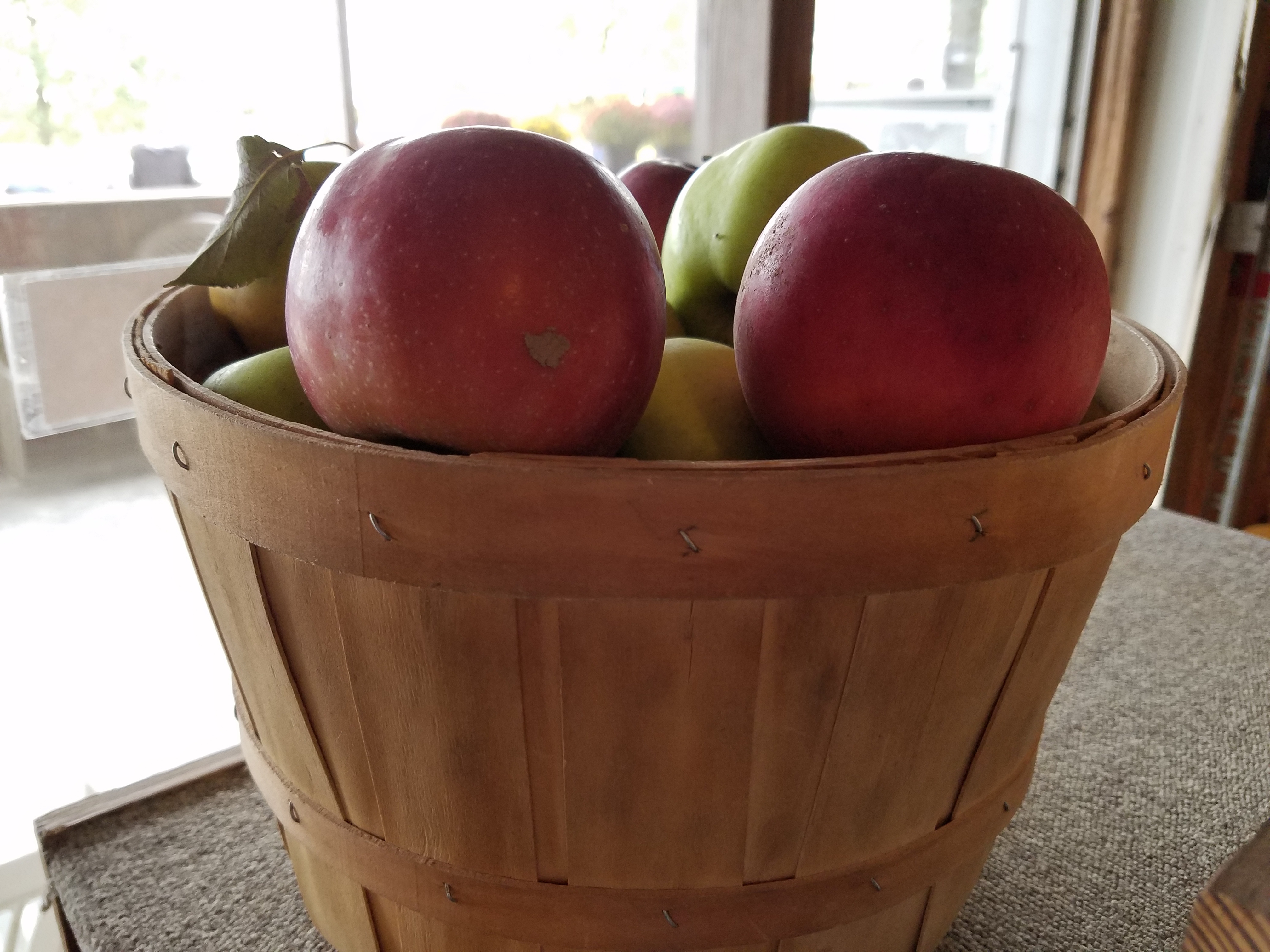
I picked up provisions at the orchard: 15 pounds of Gold Rush apples, two gallons of apple cider, two pounds of frozen Montmorency cherries, packets of mulling spices and 10 note cards. Sara, Barb and I had a post-season conversation about gardening, Medicare and living in 2017.
The morning’s main accomplishment was clearing the ice box of aging greens by producing another couple gallons of vegetable broth. I lost count of how many quart jars of canned broth wait on pantry shelves. For lunch I ate a sliced apple with peanut butter.
We live in a time when favorite foods are under pressure from climate change. Chocolate, coffee and Cavendish bananas each see unique challenges from global warming. In addition, recent studies show the higher concentration of carbon dioxide in the atmosphere is reducing the nutrient value of common foods. Our way of life has changed and will continue to change as a result of what Pope Francis yesterday called shortsighted human activity. He was immediately denounced in social media by climate deniers.
This week, Congressman Ron DeSantis (R-FL) introduced the HERO Act which purports to reform higher education. Specifically, the bill would open up accreditation for Title IV funding to other than four-year colleges and universities. In an effort to break up the “college accreditation cartel” DeSantis would keep current Title IV funding but add eligibility for other post K-12 institutions. States could accredit community colleges and businesses to be recipients of federal loans for apprenticeships and other educational programs.
Telling in all of this is that as soon as he introduced the bill, DeSantis made a beeline for the Heritage Foundation for an interview about it with the Daily Signal. Does higher education funding need reform? Yes. What are Democrats doing to effect change in higher education? That’s unclear. A key problem is progressives don’t have a network of think tanks and lobbying groups funded by dark money to counter the HERO act or the scores of other conservative initiatives gaining traction in the Trump administration.
Even though the 45th president seems an incompetent narcissist, the influence of a conservative dark money network within his administration is clear: in appointments to the Supreme Court and judiciary; in dismantling the Environmental Protection Agency, in undoing progress in national monuments and parks, in weakening the State Department, in potentially politicizing the 2020 U.S. Census, and much more. The reason for his success is his close relationship with wealthy dark money donors and the agenda they sought to implement since World War II.
Today is the 39th anniversary of my return to garrison from French Commando School. I returned with a clear mind, physically fit, and an awareness of my place in the world.
“I am ready to experience the things of life again,” I wrote on Nov. 12, 1978. “The time at CEC4 has cleansed me of all things stagnant. I will pursue life as I see it and make it a place where I pass with love and peace for all.”
We work for peace on the 99th anniversary of the Armistice. If people are not unsettled by evidence of climate change and a Congress that ignores it in favor of pet projects designed to please the wealthiest Americans, we haven’t been paying attention. The need to sustain our lives in a global society has never been clearer.
On Friday I clocked out of work at the home, farm and auto supply store for four days off in a row!
I drove straight home, dumped the coleslaw I made in the morning into a bowl and mixed it up one last time before the potluck. I grabbed a pair of tongs for serving and headed to the orchard for the 6 p.m. event.
The annual crew potluck is our biggest and only non-work event at Wilson’s Orchard.
About 80 people attended at the on-site Rapid Creek Cidery, bringing the best side dishes imaginable to go along with chef Matt Stiegerwald’s braised pork from hogs raised at the orchard’s farm.
We joked we weren’t sure if we were supposed to bring potluck table service. A veteran of many church potlucks brought a basket with plates, silverware, glasses and everything one would need. Most of us used paper plates and flatware. I enjoyed a glass of plain hard cider as aperitif before switching to non-alcoholic.
When serving began, I made a southern-themed plate with pork, my coleslaw, macaroni and cheese, dumplings and raw tiny carrots. One of countless possibilities given the many tables of side and desserts. All that was lacking was corn bread but it was a potluck after all.
My work pals were all there: the octogenarian who makes dinosaurs and showed off the scar from his recent knee surgery to all who were curious; the pilot who recounted his air-search for the other orchard, which he couldn’t find until I gave directions from ground level; the artist who gave a speech about entering the drawing for fabulous prizes mostly from the Orchard’s lost and found (think sunglasses); the data analyst who is sharp as a tack yet made a six-figure error on the cash register; the Ukrainian guest workers; and the crew of bakers with their families — it takes a lot of bakers to make all the turnovers, pies, apple and peach crisps and blueberry buckles we sell. The sales barn manager was there. She works non-stop from before the August opening until the end of the season. Actually just about everyone was there. Needless to say the conversations and meal, with a chance to win prizes, were delicious. That’s no apple joke.
We talked about when we might see each other again and confirmed that God willing and the creek don’t rise we would be back next year. My only regret was it wouldn’t be soon enough. Heaven help us if it’s not until next season.
Our household had no shortage of fresh food this year.
Barter agreements with two farms, my work at the orchard, and a garden that produces more food each year created a kitchen full of ingredients to feed the two of us and others.
I’m thankful to have figured out how to provide local food for our family mostly grown using organic practices.
So it is with this blog. It is a place to capture what’s going on in a turbulent world and make sense of it if I can. I post original content and significant writing from elsewhere. The interplay between this blog, email, Twitter and Facebook is complex and ever changing. Like the fruit and vegetable production, it is a pantry full of ingredients for bigger projects — snippets of this and that drawn from memory and experience.
I’ve written about 2017 as the final lap leading to a finish line. It is also a starting line. In addition to taking care of our aging home, ourselves and our relationships, I plan some writing projects, including an expansion of my post Autobiography in 1,000 Words. I made the plan a year and a half ago and once end of year chores are done I hope to schedule the work. Something else has to give — likely be my work at the home, farm and auto supply store.
At this point, memory is still good and the larder is full of ideas. Now to make something of all these ingredients. What else is there to do?
Our town has a bustling Main Street thanks to smart investments by the city council and willing businessmen and women.
Shops serve basic needs: hair styling, hardware, groceries, fuel and insurance. There are plenty of restaurants. The newspaper is located off Main Street at the only four-way traffic light in town. The library and medical clinic are down the hill. New construction is building capacity for shops and I hope the city welcomes entrepreneurs who give it a go.
Solon’s downtown seems idyllic: a place to forget about the rest of the world for a while. Many of us appreciate that aspect of living here.
At the same time, the Solon area also serves as a bedroom community for lives elsewhere.
During 24 years our family lived here I’ve worked in Cedar Rapids, Coralville, the Quad Cities, Iowa City and North Liberty. I’ve travelled to 40 of the 50 states and to Canada on business and on holiday. We bought our first home computer in 1996 when we connected to the World Wide Web. All of this is to say despite our idyllic setting we live in a much broader world.
There’s the rub. In the generally happy, peaceful and pleasant setting we’ve made for ourselves we bear some responsibility for what goes on elsewhere. We’ve got ours, but what about the rest of society? When we see the tumult and conflict in the United States and around the world it is not enough to say, “I’ve got mine.”
Protecting what we value in society falls on each of us whether it is public safety on our roads or doing something about the genocide in Myanmar. There is something to work on for each of us and Solon makes the perfect base camp for us to make a difference. We should make a difference.
The marketplace of home vegetable gardens, community supported agriculture, farmers markets, road side vegetable stands, restaurants, retail interests and direct farm sales hasn’t coalesced into a sustainable local food system, and may not.
One should never doubt the resilience of farmers. At the same time, due to unwelcome changes in society, our local food system is at risk before it has become sustainable.
A small group of pioneers made progress toward a sustainable, local food system. People like Denise O’Brien, Dick and Sharon Thompson, Fred Kirschenmann, Francis Thicke, Laura Krouse and Susan Jutz took ideas about sustainability and put them into practice. Their work enabled a new generation to enter the local food business — people like Tony Thompson (New Family Farm), Kate Edwards (Wild Woods Farm) and Carmen Black (Sundog Farm).
The idea of a return to diversified farms producing food for local markets begs the question how did we get away from it?
If markets for local food become stale or disappear due to changing tastes or financial stress, increased commodification could erase slim margins and lead to bankruptcy.
A local food system is about cooperation and support: between farmers, and with their customers, suppliers, workers, volunteers and bankers. Without that a family may have their dinner on the table, but the entire system is risked if such individualism is the prevailing attitude.
Change is in the air. Change driven by economic hardship and oppressive policies originating in Des Moines and Washington.
It doesn’t look good for growers, retailers or consumers, not because business models have changed, but because we are entering an era when wealth flows to the top, leaving the rest of us struggling. How will farmers get health insurance if the individual market becomes too expensive? They may take a job in town and let their agricultural aspirations go.
These changes and the challenges they bring will test the sustainability of a fledgling local food system.
Climate change is impacting society negatively as well. What we assume about Iowa’s growing conditions — adequate rainfall and predictable temperatures — is subject to change as the oceans and atmosphere warm, increasing the number and intensity of extreme weather events. Likewise, increased carbon dioxide in the atmosphere may be reducing the nutritional value of food, according to a recent study published in the journal Nature.
I don’t doubt the resilience of farmers I know. If a local food system can be sustained, they will do it. Isn’t it time you got to know your farmer? We could all use a friend during these turbulent times.
~ First published in the Saturday, Sept. 30, 2017 edition of the Cedar Rapids Gazette.
Best news of the week arrived Friday afternoon via email. The Cedar Rapids Gazette decided to publish my opinion piece on the local food system at risk.
A writer lives for exposure to an audience and my readership will get a boost just by being in print media with daily circulation over 30,000.
I will probably run to the convenience store before sunrise to buy a copy as soon as I hit publish. (UPDATE: Here’s the link).
This weekend is mostly about apples. It’s Golden Days at the orchard. We have multiple varieties of Golden Delicious and for the most part, that’s what we’ll be picking. There are a lot of them still on the trees. Last night was family night and I spent most of my shift stocking shelves, coolers and freezers in preparation for what we hope is a good Saturday turnout. I laundered my orchard T-shirts last night and am ready to go. It’s the beginning of the end of the u-pick season.
Fallen Apple Pile
It’s time to pick the Red Delicious apples on our backyard tree. With the record-breaking heat apples are beginning to drop. I’d better not wait any longer. They are sweet enough to eat out of hand and should make great apple sauce. Whatever I’m able to harvest will be a fraction of the potential. We can only eat fresh and process so many.
So that’s the plan. Read and publicize my article in the Gazette and live in Iowa’s apple world. There’s work involved, but it will be a labor of love.
Hurricane Harvey from the International Space Station on Aug. 25, 2017. Photo Credit – NASA European Pressphoto Agency
Rain tapped the bedroom window this morning on the fringe of Hurricane Harvey.
It was a reminder of our connection to the oceans. They are absorbing heat from the atmosphere on a planet experiencing some of its warmest days in living memory. A warmer atmosphere holds more moisture and the result is intense storms like the Category 4 Hurricane Harvey.
In Iowa we adapt easily to hurricanes because of our distance from the coast. Needed rain benefits our gardens and farms. It recharges our surface aquifers. As the weather pattern moved over it seemed normal, not as devastating as it was when Harvey made landfall in Texas Friday afternoon.
Overcast skies and a slight rain depressed attendance at the orchard on Saturday. There were enough visitors to keep busy, especially in the afternoon when the sun came out. Sales seemed steady if light.
One of my favorite August apples is Red Gravenstein, a Danish cultivar. It was introduced to western North America in the early 19th century, according to Wikipedia, perhaps by Russian fur traders, who are said to have planted a tree at Fort Ross in 1811. Red Gravenstein is tart, juicy and crisp — great for eating out of hand.
The cider mill made the first press of apples for the sales barn. The gallon and half gallon jugs sold well. Over the years I’ve come to appreciate the changing flavor of our cider as we move through the apple harvest. I bought a gallon of cider and a dozen Red Gravenstein apples at the end of my shift.
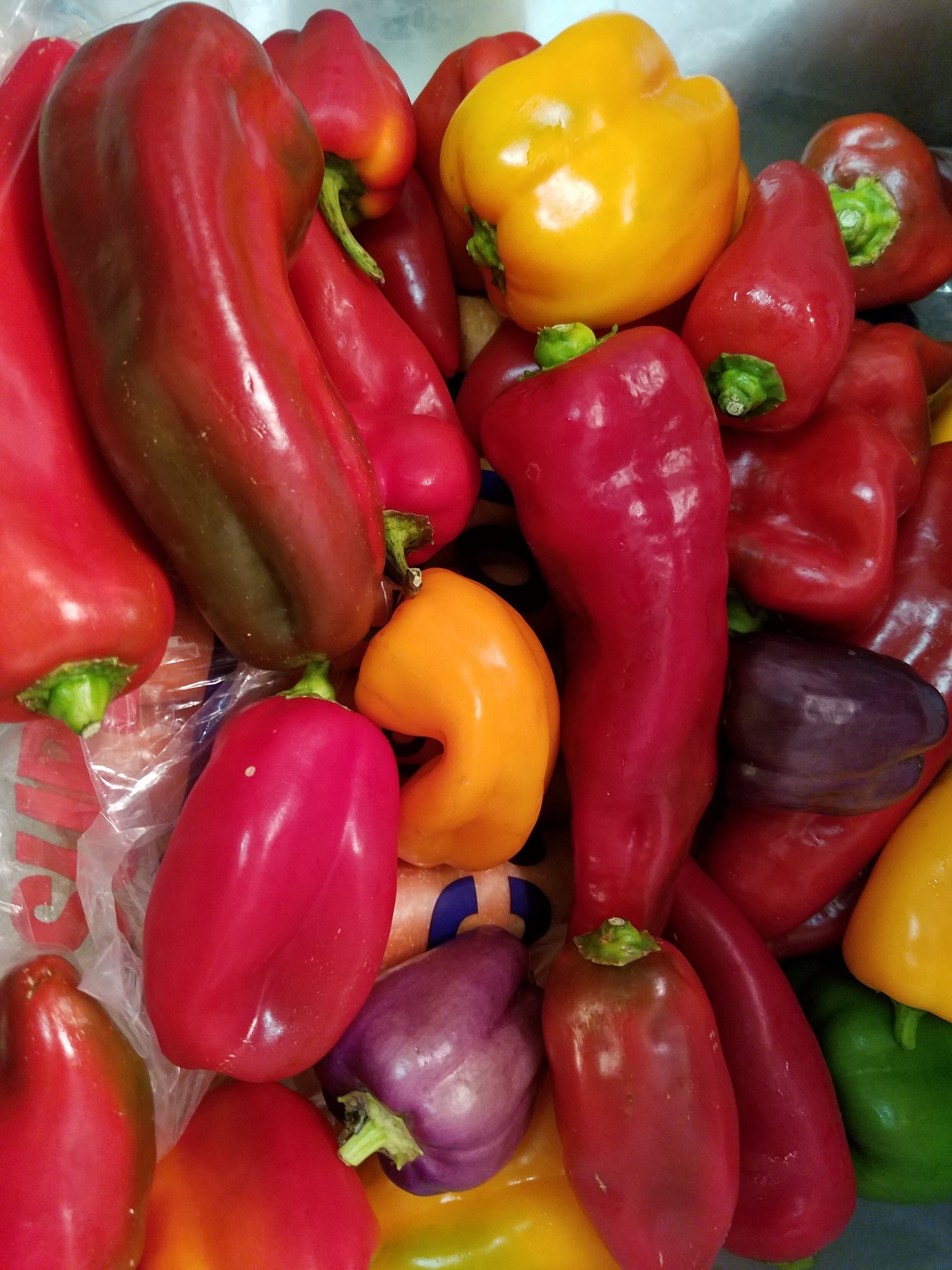
I’ve been reading recipes for tomato catsup in old community cookbooks. After reviewing a dozen or so I went to the kitchen and created this sauce from the abundance of red bell peppers and tomatoes:
Red Pepper Sauce
Ingredients
Half dozen cored and seeded red bell peppers cut in quarters
Equal amount by weight of cored tomatoes one inch dice
One cup of malt vinegar
One teaspoon salt
One tablespoon refined sugar.
Process
Pour the vinegar into a saucepan and bring to a boil.
Add tomatoes and peppers.
Add sugar and salt.
Bring back to a boil and cook for 10-20 minutes until the vegetables are soft.
Strain the mixture. Retain the liquid to use as vinegar in salad dressings.
Run the vegetable mixture through a food mill and either serve immediately or bottle and refrigerate.
Recipe notes
To make a thicker sauce, either reduce it in the saucepan or add tomato paste.
I used malt vinegar because it was on hand. Absent malt vinegar I’d use homemade apple cider vinegar.
Editor’s Note: This series of nine posts was written from Jan. 18, 2009 until March 15, 2009 as I considered my life and what else I might accomplish. They are consolidated below unedited and in the order I wrote them. I left my transportation career shortly after completing this series on July 3, 2009.
I. Each of us has a collection of moments from our lives that define who we are and what we can and will be. Our lives are not predetermined. We can effect change in ourselves and in our relationships in society. Too often, we can get caught up in the trivial and small minded conflicts of daily life. There are plenty of these. We need to be better than this for at stake is everything we hold to be important. Above all, we should strive to be engaged in our daily lives, less creatures of habit and more innovators of the ordinary. Today, in this moment, we have the power and potential to create a life beneficial to ourselves, but more importantly, beneficial to others. Defining moments have informed us in how to behave, and we owe it to ourselves to consider them from time to time.
My earliest defining moment was the day, at age 3-1/2, when a swing-set set up in the basement of our Madison Street home collapsed and injured my head. My parents were horrified. I remember the pool of blood on the basement floor, holding the thumb of the ambulance driver, taking ether dripped into a funnel to anesthetize me for the stitches to mend my gashed head. I am lucky to be alive. What I learned through the injury and recovery in the hospital was that there is an infrastructure of knowledge and caring to support us when things happen. I watched the routines of the hospital staff, the doctor checking up on me, changing room mates and bed linen, daily visits from my parents and the handling of my propensity to get out of bed and walk around. This experience assured me that although we are vulnerable, we are not alone.
Over the years, Doctor Kuhl would examine the scar on my forehead and talk about my recovery when I visited him in his office. Today, I don’t think of the scar, and suspect most people do not even notice it. What I do think about is that while we are not alone, we must be part of a society that helps protect those who are most vulnerable, including the injured and infirm. When I was very young, I made a withdrawal from this bank and now the debt needs repaying.
II. At Northwest Bank and Trust Company, while getting my first checking account, I was deprived of the knowledge that my father would die later that night at the meat packing plant. I had been working at a department store after school and had saved enough to want to spend some of it. The bank was open late on Fridays. I can still remember the light inside the bank and the help from the teller. To do this on my own was a big step and I knew it. As it turned out, it was a step I needed to take.
We were shocked when the knock came on the front door. Two men, Clarence from the union and another I can’t recall, were there to tell our mother what had happened. We kids waited in mom’s bedroom. We were all crying together that night. Life came at us that February morning, ready or not.
Death was somewhat abstract. We watched the fighting in Vietnam in the newspapers and on television. A grandparent had died and was buried at Saint Hyacinth’s in LaSalle. We heard about World War II from neighbors who had served. We knew we would not live forever, but we did not consider death as a present option. This started to change as I heard a newscaster report my father’s accident on television.
During the days leading up to the funeral an endless stream of people came to the house. Relatives, co-workers, friends with covered dishes and desserts, people from bars and restaurants near the plant, fellow students from the chiropractic college, our insurance agent, and many others. My father’s two brothers and sister came in their only joint visit to our house. My mother’s brothers and Aunt Dorothy drove non-stop from California. Even though my father had not finished his conversion to the Catholic faith, a funeral mass was held and the church was packed to capacity. Even the elementary school children filed into the balconies and back of the church. As I sat in the pew, listening to Monsignor Barnes, I realized that Dad’s death and his funeral were community events. I felt that I was part of the community and still do.
Whatever arguments I had with Dad ended that night. I still think of him from time to time and miss him when I do. I was lucky. Lucky that I was about to embark on my studies at the University of Iowa and lucky that mother had the means to support my brother and sister if I left. We talked about me staying to help instead of going to college. She released me from the nest and for that I will always be thankful.
As our lives continue, the lesson I learned that Friday night is that before you know it, life is over. If we want to accomplish something, we need to do it now, as there may not be a later. It is a lesson that I forget, but to which I always return. I had a hard taskmaster in that defining moment in 1969.
III. When news of the Woodstock Music and Art Fair hit the television, there were already tens of thousands of people in attendance. I was working at a department store and when Dennis offered to drive to Woodstock in exchange for gas money, I gave it consideration. I declined the opportunity because I was scheduled to work Saturday. His new GTO with the Hurst transmission would surely make it out to New York, but I had other things on my mind. Today and this weekend has felt like that August afternoon in 1969 with friends hopping planes and driving cars to the Washington DC to participate in Barack Obama’s inaugural events. Today, like then, I have to work. In a sense, not much has changed over the years.
Dennis and I did not go to Woodstock. What I learned was that the actual being there does not inhibit the participation. That decision making, the idea that the road to Woodstock started in a parking lot in Iowa made this remote event tangible and within the scope of our daily lives. I felt connected, even if I did not traverse the country to get there. As it turns out, Woodstock was so well documented that I learned enough about it to understand and participate vicariously. In the case of Woodstock, actually being on Yasgur’s farm did not matter and that is my point.
When we consider information about events arriving in our locale, that information has a basis in reality. As a participant in mass society much of what we learn and understand is molded by an ever changing media in many formats. In a sense, the gap between our inner eye and that of another is the same whether the person is sitting next to us on a couch or is a thousand miles away. When Rene Descartes said “I think, therefore I am,” he was not aware that there would be a Woodstock or an Obama inauguration but in that moment, in the parking lot of the Turn-Style department store, I became aware of the Cartesian outlook in a way that has become part of who I am. Living in society is not about us. It is about communicating through the unseen ether to others in engagement that is as old as civilization. It is something in which it is worth engaging.
IV. Richard Nixon announced his resignation from the presidency on August 8, 1974. I had no idea who Gerald Ford was, or what kind of leader he would be, but the next day, when he said, “My fellow Americans, our long national nightmare is over,” I packed my boy scout backpack and a baby blue bag my grandmother made for me with a couple of changes of clothes, a passport, $2,000 in American Express travelers checks, a sleeping bag and ten rolls of Kodak film and left for Europe.
After college, I shared an apartment with a fellow band member on Walling Court in Davenport, Iowa near the former home of jazz legend Bix Beiderbecke. I felt a strong sense of social responsibility and the moral outrage of youth in what I believed were the deception and lies of a man in whom the country had put its trust. Hearing Nixon’s address that night, in our small apartment was catharsis. I remember this feeling as I type here in Big Grove tonight. I was relieved that Nixon was leaving. More importantly, I felt that the many protests and demonstrations during the Vietnam war had finally borne fruit. Direct action to support a just cause could accomplish things, even force out a sitting president. It was a heady feeling. I wasn’t sure what would be next, but I felt that I could take a couple of months and find out what else was in the world.
That I began with Europe was no surprise: studying English literature in college, neighbors who had served in Europe during World War II and art history classes in high school and in Iowa City. Then, I believed that the United States was a derivative of the European experience. With my mother’s side of the family coming from Poland and my father’s from Virginia, it was not a stretch and my travels confirmed this. I saw Twelfth Night at the Royal Shakespeare Company in Stratford, England. I saw a poster of Bix Beiderbecke when I emerged from the Metro on the left bank in Paris. I ran into a friend from Davenport while taking a bus to the Piazza San Marco in Florence. I discovered a Europe that was familiar and a world small enough for these things to happen. At a youth hostel in Rome, a stranger took me over to the Vatican City and got me tickets for an audience with Pope Paul VI. I learned enough Italian so that when I traveled to Ravenna to see the Byzantine mosaics I could register for my room and order meals in the native language. I bought a cameo on the Ponte Vecchio in Venice, the same place mentioned by Shakespeare in The Merchant of Venice. Jacque wore that cameo at our wedding. I also saw the glockenspiel in Munich along with the place where the Israeli athletes were murdered by terrorists during the 1972 Olympic Games. I was moved by the Dachau concentration camp. I was enamored of the paintings by Vermeer. It was a busy trip, unplanned and random. With Eurail pass in hand, there was always another train to take me someplace new.
Yet it was that moment of seeing Nixon resign on television that opened up the possibilities of the world. I became aware that direct action, in concert with others I did not know, could engender change in society. I also learned that the people, places and things we read about can be grounded in a reality that is not that distant from where we live. We are connected to each other in unlikely ways.
I refused to purchase a copy of Nixon’s memoirs until after his death. I did not want him to benefit from my interest in his presidency. In a way, Richard Nixon, with his deceit, arrogance and imperial presidency, contributed to my awakening to the possibility of social change through direct action. This awakening led me to understand that what I had studied in school was grounded in reality. It was an unlikely connection for which, in retrospect, I am thankful.
V. In January of the bicentennial year I packed again and left for basic training at Fort Jackson, South Carolina. I had been living in a one room apartment near the Mississippi River and the combination of willingness to serve and the end of the Vietnam war led me to seek out the Army recruiter, enlist for Officer Candidate School and put aside concerns about risking my life by saying it was better for peace lovers to join the military and lead, rather than leave it to the likes of Lieutenant William Calley. Calley is the convicted war criminal who was responsible for the 1968 My Lai Massacre, and an example of what was worst about the military during the Vietnam era. We could do better than that.
The impression I made on the three member officer panel when I interviewed at the recruiting office could not have been good. It was probably the shoulder length hair, blue jeans and independent thinking that put them off. Truth is, they had a quota to meet, I met the requirements and had maxed out the proficiency tests. Even if I washed out of OCS, I would continue to have a military commitment as an enlisted service member and they had an enlisted recruitment goal as well. I was in.
Among the large group of us at Fort Jackson, I seemed to be the only one who had brought any money. I had withdrawn $200 from my bank account for expenses until payday came. I found that there was no significant need for money since food, shelter and clothing are complimentary with basic training. In fact, any outside clothes that we had brought had to be put in storage until we were finished with training. During the first week, we were eligible to take an “advance” and most did before we walked down to the post exchange. I bought a t-shirt with something like U S Army printed on it. Many spent every bit of the $25 advance as if it were the first money they had in months. For some, it probably was.
And that night came the shakedown. Two E-5’s who were on snowbird status, soon to leave the military, came into the barracks, turned on the lights and proceeded to inspect every soldier’s belongings, confiscating unauthorized food, adult magazines and other items deemed inappropriate for a soldier going into boot camp. This seemed odd in that these were the same non-commissioned officers who had walked us down to the PX, and they knew what we had bought. When they got to my area, one of them picked up my copy of the works of Geoffrey Chaucer, written in Middle English and thumbed through the hardbound book roughly, asking, “is this pornography?” I had bought the book for Stavros Deligiorgis’ course in Chaucer, and I recalled the professor reprimanding students who wrote notes in the margins. Given the nature of some of the characters and passages, and the frequent appearance of the Canterbury Tales on lists of banned books, I could have easily answer the sergeant’s question yes, but after consideration said “no” and this defined the moment.
The Canterbury Tales is not pornographic, but the actions of these two thugs may have been. I bit my tongue, holding back the moral outrage and blue language to survive the moment. These two piss ant crackers denigrated the best ideals of our armed forces and were emblematic of what was wrong with the post Vietnam military. I had walked among the graves of American soldiers at Arlington and the awe and respect I gained there was vaporized that night.
I took a breathe, and then realized that this was why I had enlisted. If we wanted to heal the wounds in the military, it was going to take a large rasher of tolerance to win the respect needed to effect change. If I was going to get into a position to influence the outcome of any future combat engagement, I had to get through training and not get kicked out for what would have been considered insubordination. Making change in society is partly about patience and perseverence. It is also about picking which fights to fight and that was the lesson I learned in this defining moment.
The early volunteer Army had its problems. When I was stationed in Germany, we found that the majority of our soldiers were tied into the illegal drug culture. It turned out that a group of non-commissioned officers was running a prostitution ring across the street from Lee Barracks. The deputy division commander, a brigadier general, was having an extramarital affair with an enlisted woman who worked for him. Those days were like excerpts from a painting by Hieronymus Bosch.
The coming of soldiers like Paul Gorman, John Galvin, Tom Carney and Norman Schwartzkopf represented a new path and one that ultimately transformed our military into a more effective organization. One that is more worthy of its heroic past. This work was difficult, and I was proud to have been a small part of it.
As we sat around camp fires, in jeeps in small villages and at the officers’ club, we knew that the next mission would be a war in the Middle East over oil. When I left the military, we were already evacuating Iran and getting ready for the conflict. Norman Schwartzkopf was a friend to many of my fellow officers, had received his first star and was heading our way. For me, oil was not worth fighting for. On a rainy October morning in 1979, I left for home, ready for what would be next.
VI. When I landed at McGuire Air Force Base, returning home from three years of living in Germany, my impression was that the United States was a dirty, cluttered place, ill settled and ill managed despite our 200 year history as a country. I compared this to Europe where I had walked along the crest of the Taunus mountains on a ruined wall where the northern border of the Roman Empire had once reached. My friends Larry and Debbie had an apartment in a castle built before the settlement at Jamestown. The United States seemed new, rough hewn and unfinished. I was hoping this applied only to New Jersey.
We arrived just after dawn, following the sunrise across the Atlantic and I immediately checked in at Fort Dix to finish my processing so I could get over to Elizabeth, New Jersey to pick up the yellow pickup truck I had shipped from Bremerhaven weeks earlier. My expectation was that I could get this done and get out of New Jersey that day and I did. I had taken 45 days of leave in conjunction with my separation, so I was still in the Army as I picked up my truck and headed west.
I don’t remember where I stopped, but late in the evening, jet lagged and tired, I got a hotel room for the night. I believe it was in Cambridge, Ohio. Almost thirty years later, it is hard to remember. I recall driving by Three Rivers Stadium where people were gathering for a game. I remember looking down a hill that led west and wanting to go there, despite my tired state.
I stopped in Springfield, Illinois to visit Dennis and Diana. Diana fed us cornbread and beans and Dennis and I saw the film Apocalypse Now in a theater. This film experience, after seeing half a dozen films in theaters in Germany and Patton with George C. Scott about a dozen times while on maneuvers, enthralled me, even if I did not understand Coppola’s work. It whetted my appetite for cinema in a way that few other events have affected me. I had been missing a lot while overseas.
Home again in Davenport, I rented an apartment at Five Points, which was a center for German immigrant culture while I was growing up. I had nothing but a few bags with me when I arrived in the apartment. I bought a desk and book shelves to set up a study. I bought a large round cocktail table like the ones fellow officers had in Mainz. I took delivery of the goods shipped from Germany and the items I had placed in storage before leaving for basic training. There were things from my mother’s house. I sorted through everything. I started attending a local film group’s screenings and tried to get involved in the local culture so as to start a new life. My friends had mostly gotten married while I was in Europe and I bought them all belated wedding gifts and made the rounds to catch up with them and learn about their new lives. I could not settle down.
I scheduled an event at my apartment for November 25, 1979, a wine tasting and dinner party. I was no cook, but planned on lasagna, since I could understand the recipe and had made it once while in Germany. I went to Gendler’s wine cellar and bought bottles of the various types of wine that were grown near my apartment in Germany. I invited people over, and found that I spent most of my time in the kitchen instead of with my guests. The dinner was well received and the drinking after culminated with a vote for the best and my cutting up my military identification card to signify my official exit from the active duty military.
Everyone stayed for a long time, my old friends from before the military, from high school, college and work. The evening was drawing to a close, and the men felt like they had not done enough drinking and asked me what else I had. What it was, inside my freezer, was a bottle of Jägermeister. The men gathered around the kitchen table and toasted the evening, our reunion and the days ahead. It was then that I knew it would be impossible to renew my life in the Quad Cities. It was a defining moment.
The feeling was described by Saul Bellow in his book Henderson the Rain King, “I want.” This desire had taken hold of me and I knew my life was not to be in Davenport. I went to Iowa City, applied to the Graduate College for the January session and was accepted into the American Studies program. I was eligible for the GI bill to help with the cost of the degree. I commuted for a while, then moved to Johnson County and have not looked back. For a moment, I felt my roots in that Five Points apartment, but the world was calling and I had to go and did.
VII. I got my masters degree in American Studies in a fever. I was determined to vindicate my undergraduate effort which was troubled by lack of direction and a desire to get out of school. I had money saved from my time in the Army and with the GI Bill, could afford to attend classes full time. I finished in 17 months with a 4.0 grade point average, without breaking a sweat.
I carried a clipboard I bought in Germany and kept notes on lined paper. I recall some classes favorably, especially Stow Persons’ class on American Intellectual History. But graduate school was about meeting a different group of people rather than the studies. I had a relationship with every person who attended the required American Studies seminar in the fall semester.
One of the many books I read was Berger and Luckmann’s The Social Construction of Reality. Wikipedia explains the book as follows: “The work introduced the term social construction into the social sciences. The central concept of The Social Construction of Reality is that persons and groups interacting together in a social system form, over time, concepts or mental representations of each other’s actions, and that these concepts eventually become habituated into reciprocal roles played by the actors in relation to each other. When these roles are made available to other members of society to enter into and play out, the reciprocal interactions are said to be institutionalized. In the process of this institutionalization, meaning is embedded in society. Knowledge and people’s conception (and belief) of what reality is becomes embedded in the institutional fabric of society. Social reality is therefore said to be socially constructed.”
What defined graduate school for me was gaining the understanding that while many talked about ideas, there was often no basis for their understanding of the subject. They would quote Berger and Luckmann’s work, but when asked, they said they had not actually read it. It turned out that I was one of a very small number who had.
This was the learning I had: that unless we are grounded in reality, the reality of the mundane, our conversation becomes nothing but the exhausted air of hollow lungs. I left graduate school convinced that I needed to get grounded and glad for the redemption of my undergraduate years.
VIII. Our relationship took a big step on our wedding day at the Unitarian Universalist Society of Iowa City on December 18, 1982. If one looks at the photograph of us standing in front of the church door, right after taking our vows, there is what happiness looks like. The day was also an embarkation on a search for truth and meaning in our lives like no other.
So, in the moment of that photograph, on a warm December day, with a small gathering of family and friends and a modest reception and wedding trip planned, we started the journey that together we continue. Words can’t capture how we felt except to say, it was a defining moment full of every potential that life offers.
IX. Through our lives, things happened, some more memorable than others. Who we are was defined when we were very young. In a lifetime, against the outlook of our youth, there are moments worth considering that have further defined our character. For me, after our wedding, it was finding the next job, the birth of our daughter, the decision to move to the Calumet region of Indiana, the decision to take a job at the oil company, spending a day with the president of the logistics company in West Chester, Pennsylvania, closing a $12 million dollar sale at work, our daughter’s high school graduation party, Grandma Perkins funeral and many more. At our core, some part of our childhood wonder persists and we measure ourselves against the hopes we had and the life we have realized. We are not ready to stop living.
Despite setbacks, much has been accomplished, and what is important is our life to come. We want, or need to be a part of society. What hurts most is when we are treated with disrespect in that society. Some disrespect is institutional and some is personal, and neither should prevent us from working in society towards a common good. This is our epiphany and our hope: our reason to continue living.
This month marks 25 years since I was first hired by my current employer. I have gained experience in our business and have been able to get by economically, even if I didn’t get ahead. Over the years, I left the company three times, in 1989, 1998 and 2003. Each time I left, someone asked me to come back and I did. That part of my life is drawing to an end.
Without a pension or substantial retirement savings, there will be no retirement for me as my mother has had, with income, health benefits and a stable economic life. When I consider social security, it has become the ultimate Ponzi scheme, designed with an outlook that has been proven unsustainable by our aging society and unsupportable by the young people who will have to pay into it. What I may have thought would be a “retirement” has become “changing jobs” and it getting to be time to make that change.
Accepting this situation, in late winter, in the morning quiet, getting ready to head into work for a Sunday session of finishing a software design project is a defining moment. What comes next will be up to us.
Haying is a social and economic movement and around here farming takes precedence over schooling.
There’s a school board election Sept. 12 in farm country.
Farmers are buying 9,000-foot spools of Brazilian baler twine, windrow teeth, left and right handed rake wheels, baling wire, reels of bale netting and a lot more.
Tens of thousands of straw and hay bales have been harvested the last couple of weeks. Some went into bunkers and barns, some sit in large round rolls near the field, and some were sold and trucked out.
Because of Thursday’s rain showers more farmers than usual came to town. I got an update on the season from several of them at the home, farm and auto supply store. Not one talked about the school board elections.
Thursday was also the school board election filing deadline in Iowa. I live in the Solon Community School District where activities of the school board continue as background noise to a number of large construction projects. Since 2000, district resources have been invested in a new high school, a ready to open middle school, a new performing arts center, a new football stadium and a new sports complex. Except for the graduates who stayed in town, public works projects are the most visible aspect of recent school board activities.
I tried to get the skinny about who was running for three seats in the Sept. 12 election but no one seemed to know, including current and former board members, the newspaper, and local political activists. I found out from the county auditor after the filing deadline. Four people filed for three open seats.
The terms of Dick Schwab, Rick Jedlicka and Tim Brown are up this year. Jedlicka and Brown filed for re-election and barring controversy should be easily re-elected. Former board member Dan Coons and newcomer Nichole Pizzini also filed. Schwab decided to end his long service on the board, opting to move out of state before the next school board term would have ended. That leaves his seat open for either Coons or Pizzini in this non-partisan election.
A few years back a local group, many of whom were associated with Saint Mary’s Catholic Church, made a successful, concerted effort to take control of the Solon school board. Coons and Brown were candidates the group supported. Both are registered Republicans according to Johnson County Auditor records.
Pizzini’s family has long been interested in politics. Her husband, Shawn Mercer, filed for state representative as a Democrat when Ro Foege retired in 2008. He withdrew once party leaders indicated Nate Willems of Mount Vernon was the insider pick to replace Foege. Mercer is a current member of the Solon City Council. Pizzini is a registered Democrat.
In school board elections personality matters more than politics, so the advantage goes to Coons over Pizzini from the get-go because he organized for previous campaigns and has name recognition as a former board member. There is a stunning lack of controversy about the school board today. Because of the positives of a new middle school and sports complex, the political environment favors incumbency.
In recent years, the highest vote getter in a Solon school board election was Don Otto in 2000 with 1,118 votes, according to the county auditor’s website. Word of mouth is the most effective tool to get information from the candidates to voters. Pizzini is the underdog as a newcomer, however, with smart work she could get the votes needed to win a seat. That makes the Coons – Pizzini match up interesting. The expectation is voter turnout will be low, even with a contest, so either Coons or Pizzini could activate the number of voters required to win.
In Solon there is living memory of attending the one-room school house at the edge of town. For many we are not far removed from that time and its deep roots in farming. Nonetheless, in addition to qualified teachers, adequate, modern facilities are important. Recent school boards in Solon have delivered.
I look forward to learning more about the candidates as the campaigns progress.
Just as the election of Barack Obama encouraged me to leave a 25-year career in transportation and logistics, the presidency of Donald J. Trump is stirring winds of change.
Where they will take our small family is uncertain.
Each year presents its challenges and successes. We’ve been able to hold on financially — by the skin of our teeth. There is more to life than money.
Because of a decades-long plan I rely on Social Security and Medicare, to both of which I began contributing in 1968. Whether they will be there for us long-term is uncertain. We are too deeply invested to back out now. We can’t let an unknown future stymie hope and aspirations.
The cycle of our lives is around work, gardening and health. Take paid work out of the picture and there should be an opening to do something different next year.
In 2009, when I retired from transportation and logistics, I took a path of civic engagement. I joined organizations and spent time working with people in society. The next retirement — beginning in spring — is expected to be one of reading and writing much more than I am able to do in hours stolen from days of hard work. There must be some form of civic engagement, but this time I expect it to be much closer to home.
Regardless of outcome, I’m repairing my mast, mending my sails, and ready to put the winds of the national culture to work at home.








 Journey Home
You must be logged in to post a comment.