This week is the biannual vendor show at the home, farm and auto supply store. We’ll be short staffed today and tomorrow while associates from Iowa and Wisconsin travel to Dubuque to attend seminars and discuss products and process with our vendors.
If it’s like last year, my work queue will build up and I won’t dig out until Thanksgiving. The days will pass quickly and my aura may be colored in shades of grumpiness.
Coffee helps.
This weekend — Labor Day weekend — is the unofficial end of summer and I’m ready to glean most of the garden leaving only kale and peppers until first frost arrives in October. I secured seed garlic from one of the farms and will plant in September. The garden has been successful, the most successful in memory. It has been encouragement to plan for next year.
Saturday and Sunday I made a large pot of vegetable broth with items mostly from the ice box: kale, collards, chard, celery, three kinds of summer squash, carrots and onions. The resulting product was dark and rich.
I made rice with the broth, poured some in canning jars, and made a big batch of lentil-potato-barley soup for work lunches. I used eight or ten leeks in the soup which made it slightly sweet. Growing leeks creates a wonderful availability for the kitchen.
Last night I picked tomatoes, peppers, celery and leeks while the water bath canner came up to temperature on the stove. I ate a Red Delicious apple from the tree. It was slightly sweet and mostly starchy. It is time to begin monitoring the fruit’s progress. The pear tree is close to ripe and will be picked this week.
There is plenty of kitchen work ahead.
So begins another day in the final lap of a working life. I’m heading to the kitchen where I’ll make a second pot of coffee before work. The hot beverage doesn’t resolve our challenges. It makes them more tolerable.
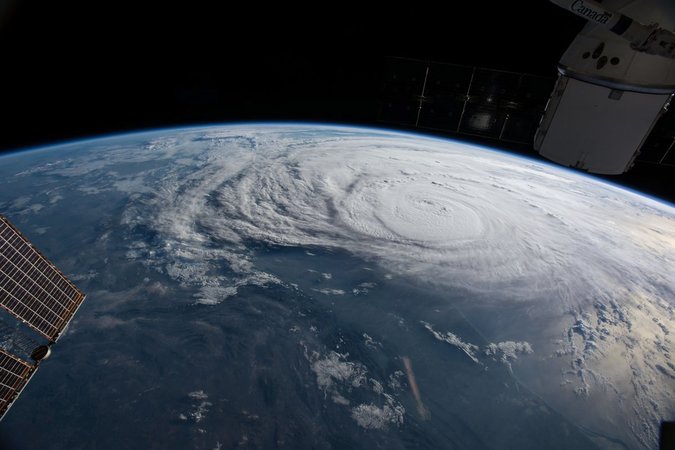
Hurricane Harvey from the International Space Station on Aug. 25, 2017. Photo Credit – NASA European Pressphoto Agency
Rain tapped the bedroom window this morning on the fringe of Hurricane Harvey.
It was a reminder of our connection to the oceans. They are absorbing heat from the atmosphere on a planet experiencing some of its warmest days in living memory. A warmer atmosphere holds more moisture and the result is intense storms like the Category 4 Hurricane Harvey.
In Iowa we adapt easily to hurricanes because of our distance from the coast. Needed rain benefits our gardens and farms. It recharges our surface aquifers. As the weather pattern moved over it seemed normal, not as devastating as it was when Harvey made landfall in Texas Friday afternoon.
Overcast skies and a slight rain depressed attendance at the orchard on Saturday. There were enough visitors to keep busy, especially in the afternoon when the sun came out. Sales seemed steady if light.
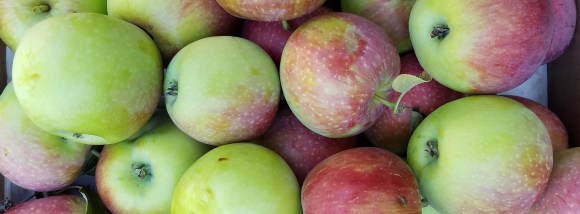
One of my favorite August apples is Red Gravenstein, a Danish cultivar. It was introduced to western North America in the early 19th century, according to Wikipedia, perhaps by Russian fur traders, who are said to have planted a tree at Fort Ross in 1811. Red Gravenstein is tart, juicy and crisp — great for eating out of hand.
The cider mill made the first press of apples for the sales barn. The gallon and half gallon jugs sold well. Over the years I’ve come to appreciate the changing flavor of our cider as we move through the apple harvest. I bought a gallon of cider and a dozen Red Gravenstein apples at the end of my shift.
I’ve been reading recipes for tomato catsup in old community cookbooks. After reviewing a dozen or so I went to the kitchen and created this sauce from the abundance of red bell peppers and tomatoes:
Red Pepper Sauce
Ingredients
Half dozen cored and seeded red bell peppers cut in quarters
Equal amount by weight of cored tomatoes one inch dice
One cup of malt vinegar
One teaspoon salt
One tablespoon refined sugar.
Process
Pour the vinegar into a saucepan and bring to a boil.
Add tomatoes and peppers.
Add sugar and salt.
Bring back to a boil and cook for 10-20 minutes until the vegetables are soft.
Strain the mixture. Retain the liquid to use as vinegar in salad dressings.
Run the vegetable mixture through a food mill and either serve immediately or bottle and refrigerate.
Recipe notes
To make a thicker sauce, either reduce it in the saucepan or add tomato paste.
I used malt vinegar because it was on hand. Absent malt vinegar I’d use homemade apple cider vinegar.
The text message came while I worked at the home, farm and auto supply store. I saw it on my afternoon break.
“If you want to start tomatoes there is a crate on the packing shed floor you could pick up on way home from work,” Farmer Kate texted. “I’m not home but if you need help finding them let me know.”
We barter my labor canning for her tomatoes. Ready or not, the next aspect of the local food season begins with its quick-paced rush to beat spoilage.
When I picked up the tomatoes there was also a crate of bell pepper seconds unclaimed by CSA members. A farm worker offered them and I put the crate in the back of my Subaru.
On the way hope I spotted the librarian leaving the library for her car and swung by to offer some peppers. My sister in law was at our house when I arrived home. I offered her some too. They are so sweet — unlike what’s available at the grocery store. A gift to be shared.
The garden is coming in with more apples than can be picked before they drop. Pears are almost ready, there are tomatoes, celery, hot peppers, basil and more waiting to be harvested and processed. There will be more cucumbers for pickling. Sweet corn will run another week or two at the roadside stand and we want to put some up. Every night after work and most mornings before, I’m in the garden harvesting or in the kitchen making dishes and preserving the harvest. Right now tomatoes, peppers, sweet corn and apples are in the house waiting to be processed. It’s a mad rush.
It’s also a good life. Staying busy with useful work blocks out negativity from other sectors of society. It’s cultured and produces the tangible benefits of relationships, knowledge and good food for our table and those with whom we share.
For the rest of August and September, it’s work, kitchen, garden for me.
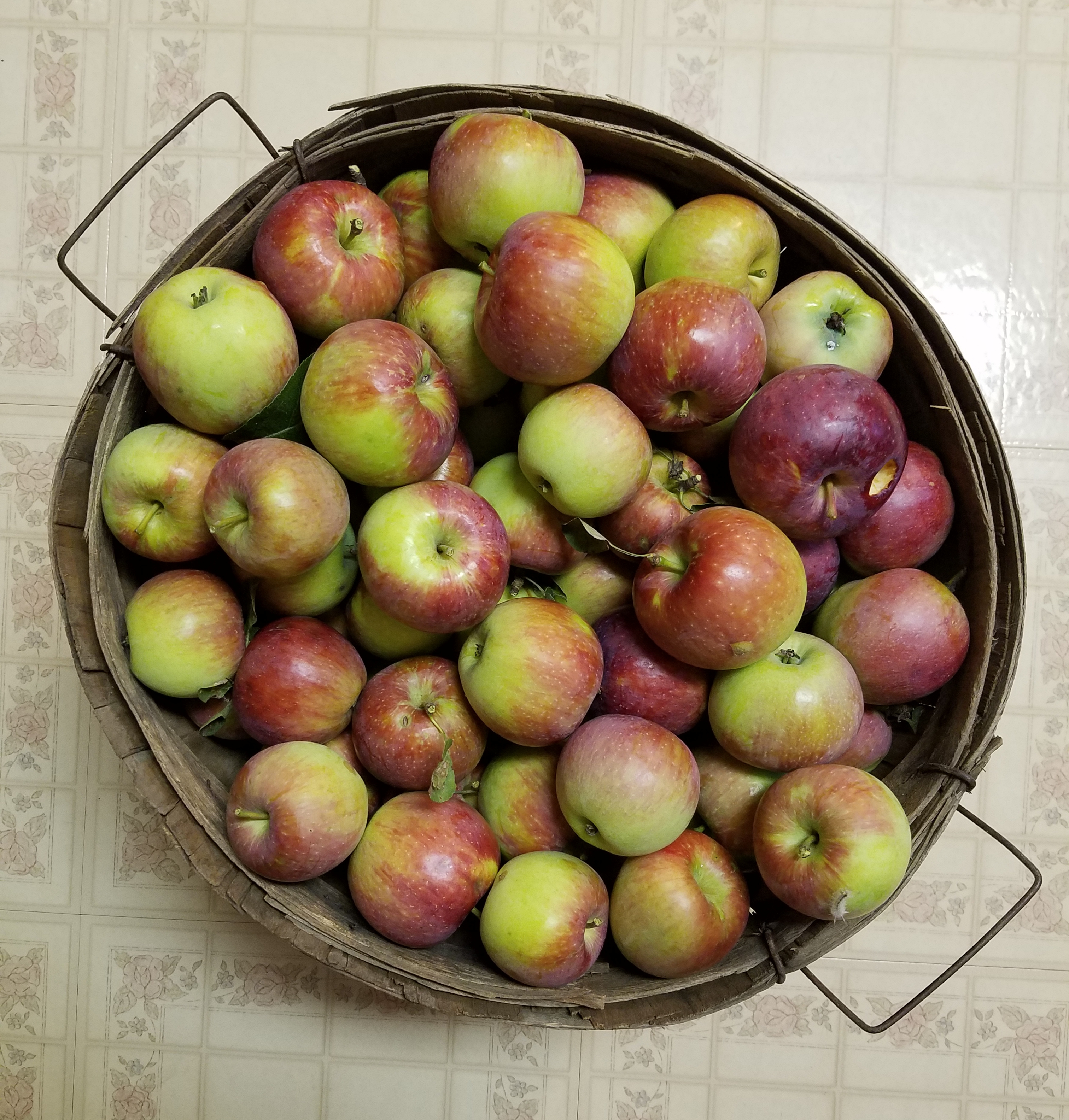
This year’s apple crop has been one of our best. That means an apple activity vortex beginning now until the last red delicious is picked in October.
The two earlier trees are ready to pick and best suited for eating out of hand, apple sauce, apple butter, apple juice for drinking and cider vinegar, and baked goods.
Red delicious apples are good for these products as well and hold up for slicing, freezing and drying. A bit of everything apple is planned this fall.
Working two paid jobs, seven days a week relegates apple chores, and other processing of pears, tomatoes, hot and bell peppers and the like to late at night or early in the morning. These will be busy days, no doubt.
Canning Soup and Jalapeno Peppers
I’m considering getting a second water bath canner to speed up the process. At seven jars per batch I’ve gotten the work done, but at 14 more may be accomplished in the same time. We’ll see how that goes. I’m ready to start canning.
Some lessons learned. In past years I’ve canned garden vegetable soup and have about 24 quarts on hand. That’s enough to last until spring so there’s little reason to can more. The same is true of apple butter. I need to use some of what I have to make room on the shelf so I plan to skip this year. 20 quarts of apple sauce remain in the pantry from previous years. I’ll make enough to get to three dozen. That should take us through to the next large apple crop.
Ending up in an apple vortex during the last lap in a workingman’s race is not bad. I’d say it’s delicious but that would be an apple joke.
The origin of my adult interest in cooking and gardening is time spent in a motel room in Thomasville, Georgia while implementing a logistics project at a large, nearby mining and manufacturing company.
I’d go into the plant early and stay late, returning home to Iowa only every other weekend. When I got back to my room, I turned on the television and fell asleep watching the TV Food Network.
That’s not to say experiences with my mother and grandmother played no role. They did, especially in our kitchen on Marquette Street where Mother prepared meals using familiar ingredients both fresh and prepared, and at Grandmother’s kitchen — first at the Lend-A-Hand and then at the Mississippi Hotel.
Rather than sustenance, food became an escape in my adult years.
In the 1990s I escaped into the T.V. During thirty minute segments I could forget extreme poverty and plain family restaurants that served a meat and three sides in rural Georgia, and engage in personality chefs who enjoyed what they were doing as locals did not. I had no kitchen so the interest was intellectual. I did learn techniques, some of which I would use later in our home kitchen. We don’t get Food Network any longer but it set me on a course for being the kind of home cook I am today.
Yesterday I made breakfast of steamed broccoli, fresh tomatoes and quesadilla — a gardener’s breakfast. In a social climate of political turmoil, disease, famine and extreme weather events food continues to represent escape as well as nourishment. Producing local food and dishes is a way of navigating diverse interests in a society that seems to have gone mad. Not only escape, but protection of who we are from those who would change us.
In western culture we begin each day with choices about food. The lesson I learned in Georgia, on the T.V. and in family kitchens is to choose fresh and local in order to sustain our lives, and there’s more. Make something of our choices. For a brief moment yesterday it was a gardener’s breakfast. Now to turn to today.
Between planning, planting and weeding a garden, and fall’s frosty end, lies a time to harvest, cook and preserve the results. So it is with our lives.
As humans we possess a unique ability to envision a future: one where we need supper and know we will need food later. We produce in abundance, fearing we won’t have enough. With modern food supply chains producing readily available foodstuffs in the United States this isn’t rational. In this sense, a gardener is an archetypal human living a life on urges, needs and wants we don’t fully understand.
Saturday Harvest in High Summer
The culture that produces a kitchen garden is complex, involving not just the gardener and soil, but seed producers, greenhouse operators, equipment manufacturers, chicken manure composters, potential future diners and others. A gardener is deeply engaged in human society. Much of our garden time seems solitary but isn’t. Animals wander nearby and we view the results when they eat garden plants and produce we’d hoped to harvest later. There is a daily drama of birds which are abundant in Big Grove. There is also a vast and little understood society of insects, some of which are annoying, a few deadly, and without others, the garden could not exist. A gardener embraces the complexity of life’s culture.
A gardener is not only a gardener nor does he or she seek to be. Each is just one iteration of humanity engaged in a broad society and we Americans are a peculiar bunch. We work hard, long hours whether it is at home or in a workplace and leave little time for enjoyment of the fruits of labor. Sometimes, like this weekend when I am between work at farms, we get time to ourselves to enjoy life lived how best we know. My story of Saturday is in four parts.
Predawn
My day begins around 4 a.m. and if I’m lucky, I got six or seven hours of sleep. I slept well Friday into Saturday waking only briefly to put in a load of laundry around 2 a.m. The routine was basic. Do stretching exercises, make coffee, say hello to spouse, go downstairs, and turn on the desktop computer to see what’s going on in the world. That’s not to say I didn’t already know. I use my mobile device in bed before turning on the light. Usually something new has happened since retiring the night before.
I wrote a series of tweets to better understand my memory of the Patient Protection and Affordable Care Act as it pertains to the false accusation it is a job killer. I recall local businessmen who said after the law went into effect they were in a position to add jobs but didn’t want to do so because they would have to provide health insurance per the ACA mandate. The assertion is the mandate killed these jobs and that idea got blown up into hyperbole of unprecedented proportions. Re-circulation of this idea is ongoing and rarely fact checked any more.
Businesses of a certain size should provide a health insurance benefit to employees or risk the possibility of being unable to recruit qualified staff. By defining the size at which to mandate health insurance, the law changed the business structure. In highly competitive local markets for landscapers, concrete workers, framers, heavy equipment operators and the like, employers faced a changed landscape. Operating on tight budgets, rather than embrace quality of life for employees they resisted change. The core problem lies in that the K-12 education system does a really poor job of preparing students to enter business. People carve out a niche, generate revenues and go out of business if they don’t properly manage risks or aren’t adequately capitalized. Small-scale operators I know are not educated in things we took for granted when I managed the profit and loss of a $12 million annual revenue transportation and logistics operation as part of a billion dollar corporation. The problem is not the ACA, or teachers. It is our education system doesn’t provide an adequate path for people to be successful owning and operating a business.
Pickle Fermentation
Outside
If there was no rain I water the garden shortly after sunrise. Without thinking it turned into weeding, then harvest and before I knew it the time was 11 a.m. The garden looks more like a weedy mess but inside there is abundance.
Before going outside I started soup to take for lunch at the home, farm and auto supply store, and mixed the brine for a batch of dill pickles.
I picked a box of kale for the library then went plot-to plot to collect what was ready. There were broccoli florets, leeks, onions and fairy tale eggplant in one. Jalapeno peppers, a bell pepper and cucumbers in the next. More broccoli and celery near the locust tree. Four kinds of tomatoes in the tomato patch. Basil is ready but I left it in the garden until I’m ready to make pesto.
Apples are sweet enough to eat out of hand, but not sweet enough to juice and ferment into apple cider vinegar. I picked the ripest for a batch of apple sauce. There are a lot of apples this year because of almost perfect pollination during spring. It should be a long apple season starting now.
I collected the harvest in a crate and placed it on the kitchen floor. There was another two hours of work cleaning the produce but that could wait.
Soup for Next Week’s Work Lunches
Short Trip
I try not to leave our property on weekends unless for work. Ours remains a car culture and we don’t have disposable income for shopping if we thought we had it before. Saturday I went to HyVee to pick up canned goods, pantry staples, organic bananas and Morningstar Farms frozen products we use. Organic celery is permanently on the shopping list although we have a lot of celery ripening in the garden. I picked three heads that morning so bought none at HyVee.
On the eight mile trip to town I noticed two sweet corn stands on Highway One.
One is the farm where we get most of our sweet corn, Rebal’s Sweetcorn. Supply was uncertain from their Saturday post:
It was tough picking this morning; we had to really search for the corn in this patch… we’ve got corn today, but it’s not a full load, so if you want it, try to get out here early. And, because of having to search to find the better ears, we might just let this one go and wait for the next. We’ve got 4 blocks (patches) coming up that look beautiful!!! The question is when they’ll be on… we’re checking them every day, so I’ll keep posting
They had plenty as I passed Southbound.
Lindsey Boerjan runs a seasonal road-side stand further south and was featuring sweetcorn and melons. I wrote an article about women farmers in the Sept. 22, 2015 Iowa City Press Citizen:
Lindsey Boerjan is a fifth-generation farmer living on the family-owned century farm where she grew up. She moved back in 2011 and farms alongside her aunt, uncle, husband and daughter, who run a beef cow and calf operation. To supplement income from beef sales, Boerjan raises chickens and operates a small community-supported agriculture project.
The CSA didn’t make it, although the road-side stand likely does better. I decided to stick with Rebal’s on my return trip.
A musician played for free will donations outside the entrance to HyVee. He seemed too young and inexperienced to be playing Folsom Prison Blues, although he was very musical.
Dinner Salad
Cooking
On arrival home I put away the groceries and started cleaning the morning harvest.
Leek stalks make a great vegetable broth base so I got out the large stainless steel pot. I added the leek leaves, broccoli stalks, a turnip — greens and root, kale and onion tops. I don’t usually salt vegetable broth and this time I didn’t add bay leaves. It cam out dark and flavorful — two and a half gallons.
Part of summer cooking is going through the ice box and making sure old stuff is used first. We have a broccoli abundance and need to do something soon with the gallon bags of florets. The freezer is almost full, so freezing more is not a good option.
I found some lettuce and decided to make a small salad and pizza for dinner. The salad is a work of art with two kinds of lettuce, kohlrabi, two kinds of tomatoes, cucumber, grated daikon radish, bell pepper, pickled jalapeno pepper, sugar snap peas and other items either from the farm or grown in our garden. Ironically I forgot to put some small broccoli florets on the salad.
I also made applesauce, salsa with tomato, garlic, jalapeno peppers and onion, and a cucumber salad of diced cucumbers dressed with home fermented apple cider vinegar, salt and pepper.
Our pizza process is to buy pizza blanks from the warehouse club and add toppings at home. Making our own pizza dough is no real work, but the convenience of a pre-made cheese pizza for $2.50 presents value. I added Kalamata olives and a diced red onion from the farm, then topped with Parmesan cheese. 15 minutes in a 425 degree oven plus a minute under the broiler and done.
This Morning
Everything on my list didn’t get done Saturday. I’m processing the vegetable broth in a water bath this morning and figuring out how to pack a summer’s worth of yard projects into today’s glorious summer weather. That is, I wrote stuff on my white board. Once I move outside into humanity and culture, I will likely forget about the plans and do what comes naturally.
When people think of local food, most have seasonal sweet corn and tomatoes in mind. That hasn’t changed much in years.
The quest for good-tasting food that does no harm has also been around for a long time. Organic food production came up in the early 20th Century as an alternative to the rise in mechanized, industrial farming.
An organic food production system developed, although there is less clarity about it today than there was a few years ago. Organic certification has contributed to confusion.
The Organic Foods Production Act of 1990 and the National Organic Program were game changers that created a new certification process and, importantly, a greater market for organic food. Sales of organic food more than doubled during the period 2006-2015, according to the Organic Trade Association, reaching $43.3 billion in 2015. In its quest to bring standards and a market, the well intentioned government program suffered abuse in the form of government lobbyists from moneyed interests who diluted the meaning of “USDA Organic” many of us found inspiring in the 1990s. Under Sonny Perdue, the 31st U.S. Secretary of Agriculture, further erosion of the law’s original intent and the organic standard is expected.
“It seems that uncertainty and dysfunction have overtaken the National Organic Standards Board and the regulations associated with the National Organic Program,” Senator Pat Roberts (R-Kansas), chairman of the Senate Committee on Agriculture, Nutrition and Forestry, said recently according to the Washington Post. “These problems create an unreliable regulatory environment and prevent farmers that choose organic from utilizing advancements in technology and operating their business in an efficient and effective manner. Simply put, this hurts our producers and economies in rural America.”
Roberts statement is code for getting government regulations out of the way of large scale producers in the organic market. As the 2018 farm bill is crafted by the Congress, any meaningful regulation pertaining to organic standards is expected to be gutted by Trump Republicans.
What you see is not always what you get as organic food producers scale up to meet demand and work the system. Here are two recent examples:
Herbruck’s Poultry Ranch in Saranac, Michigan produces one in 10 organic eggs in the U.S. according to the Chicago Tribune. The linked article describes production processes indistinguishable from those of almost any Iowa confinement egg producer. Those eggs don’t seem organic despite assertions by the ranch. What does “organic” mean in this context. At a minimum, not what we expected.
In May, Peter Whoriskey of the Washington Post reported fraud in imported corn and soybeans. A large shipment of soybeans began as “regular” soybeans in Ukraine and changed to “USDA Organic” by the time it reached a California port, garnering an additional $4 million for the shipment because it was “organic.” Some doctored documents is all it took for a huge, fraudulent payday.
My perspective of organic food is from a backyard garden. Gardening is about changing one’s relationship with food as much as providing food for the table — process more than produce. Using organic practices comes naturally as gardeners are mindful of crop inputs that will land on the dinner plate. A common mistake is neglecting the social context of gardening. In most cases gardening includes family, fellow consumers, merchants, farmers and gardeners. A gardener has only slight intersection with government.
Once government got involved in organic food production a market became viable. That was a good thing for farmers who sought to make a living growing organic food. Organic food systems then merged toward commodification as they scaled to meet demand and that’s the sticky wicket.
An ability to increase organic food production without compromising organic standards has been difficult all along. When news stories raise doubt about the meaning of “organic food,” it’s one more burden for farmers to bear in a business where the challenges of producing organic food at a profit are substantial.
I work on farms that use organic practices and plan to resist compromise on organic standards in the next farm bill. If you care about what’s on your dinner plate, should too.
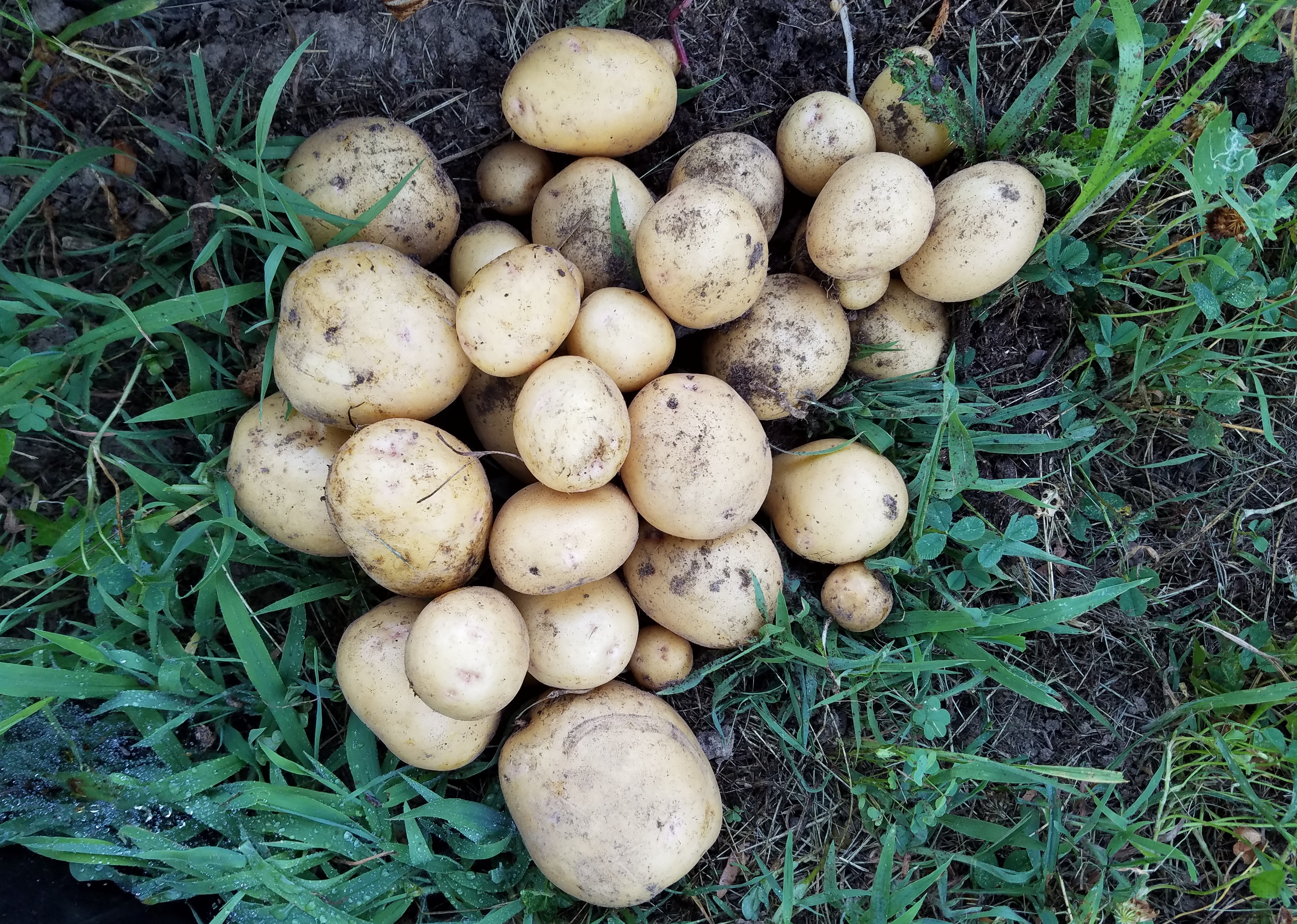
The leaves of potato plants are turning yellow so I dug one of our three tubs to see the progress. They are ready for harvest.
I’ll let others continue to grow until their leaves turn completely yellow. It won’t be long.
There is nothing like the discovery of beautiful spuds in the soil… except maybe eating them.
Deer found the garden and took a fancy to the heirloom squash plants and cucumbers. Enough of the cucumbers are protected inside cages so I’ll yield some. However, with the grocery store of our subdivision’s 25-acre woods I don’t know why deer have to eat our garden. It’s been worse, but I had great hope for the squash plants. They’re not completely gone, but well damaged.
Last night I met up with some blogger friends at a brew-pub in Coralville. The menu offered falafel tacos which seemed right up my alley and priced right at $5 for three. They were served on corn tortillas with a cabbage slaw. I use a recipe for baked falafel and this dish would be easily replicated in our kitchen. I predict it will be… soon.
Michigan cherries are available at the orchard and I’m planning to get some. It will be a good time to confirm my work there beginning when the season kicks off in August. Lodi apples are ready, although with 24 quarts of apple sauce in the pantry there’s no pressing need for this fine cooking apple.
The first broccoli pick is about finished. I’ll open the fence and look through the plants today and pick the main heads of what is left. This year I plan to get the plants out of the garden as soon as they finish producing. That’s a rule of thumb for cruciferous vegetables from my organic farmer friends. I’d like to plant a second broccoli crop. We’ll see how the day goes.
The forecast is expected to be in the mid-80s today so I’d better get back outside and finish the weeding before it gets too hot.
Yesterday I made the last 62 trays of soil blocks at Sundog Farm (Local Harvest CSA) and Wild Woods Farm.
Totaling 946 trays or roughly 110,000 individual seedling soil blocks, I made more than in any previous season. Adding Wild Woods Farm this year is the reason for an increase in this specialized work.
Not only did I produce practical farm products, I learned to be a better vegetable grower by observing farm practices and talking to people about grower issues. Sunday was the last day of the season. God willing and the creek don’t rise I’ll do it again next year.
Next is some summer respite before beginning work at Wilson’s Orchard in August. The garden harvest has begun so there will be plenty of work to keep me busy on weekends.
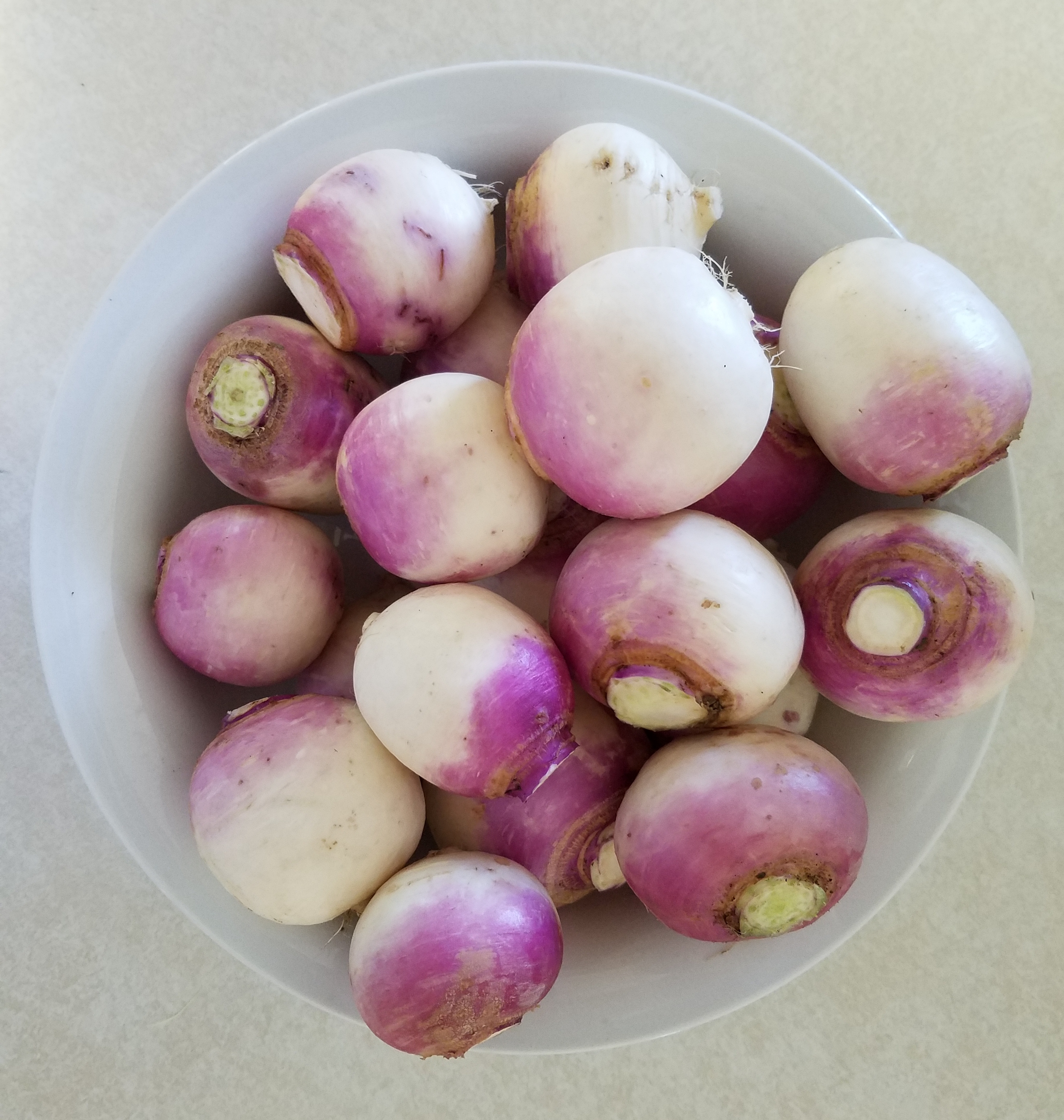
This year was the nicest crop of turnips I’ve grown. Here’s a bowl I prepped for storage in the ice box.
A few years back I started planting turnips for the greens to make canned vegetable broth. With this year’s abundance I’ve already put up about ten gallons of broth using earlier green vegetables.
I use turnips as an ingredient in soups and stir fry, and will occasionally mash one with other root vegetables as a side dish. I’m not yet to the Julia Child level of turnipery but can see it from here.
Saturday was harvest day and this year’s abundance is beginning to cut the grocery bill ($23 this week). I grow other stuff besides turnips. As a friend recently described it we have something of a kalepocalypse going on here. 42 plants was way too many.
There are other lessons from the garden, but no time for them now. I have to water and weed the garden before heading to the farms for the last day of soil blocking. They are starting crops for the fall share today.




 Journey Home
You must be logged in to post a comment.