January and February are usually months to read books. I’m working on my fourth but it seems like I’m running behind.
Political work has taken a bite out of my time.
Ambient temperatures have been warm. Absent a cold spell of temperatures below zero, I’m planning to prune our fruit trees this coming cycle of days off. As I lean into retirement I work two days at the home, farm and auto supply store with five days in a row to do what I please. The days are filled with activity.
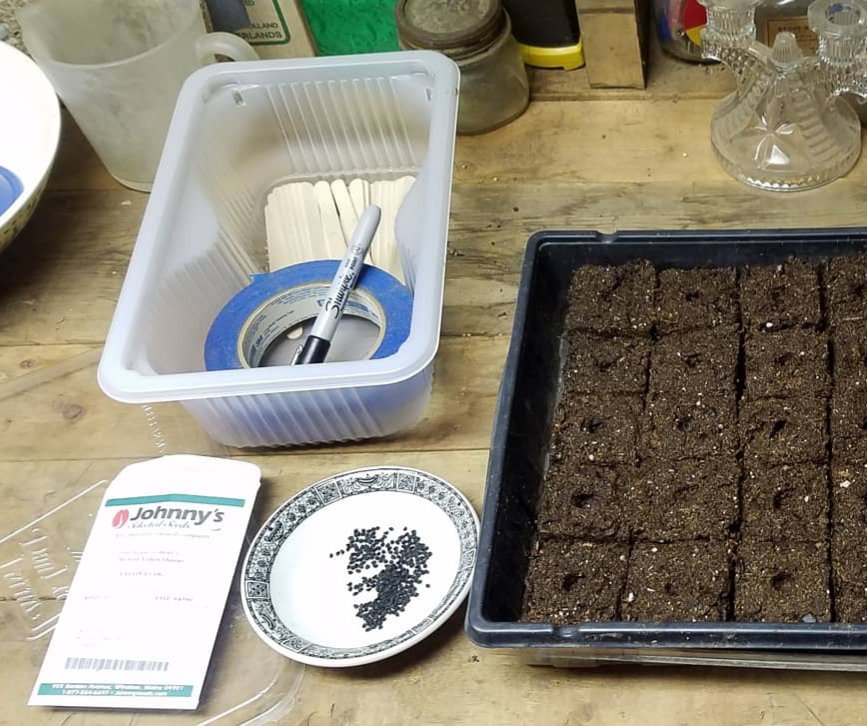
Sunday I’m scheduled to soil block at the farm, the first time this winter. I bought a small soil blocking tool for home use and planted onions and shallots. It’s the first time doing it at home and what the future holds as I wean myself from greenhouse use over the next few seasons.
Our ice box is getting down to carrots, turnips, bread, dairy and pickles. There are mostly jars of things. Light permeates the glass shelving, revealing what’s in the bottom drawer. Growing season is a couple of months away.
Our cooking is from the pantry and freezer. We have storage onions and potatoes and lots of garlic. Apples from our trees and the orchard have been gone a few weeks. There are plenty of canned goods. We have enough to last us until spring arrives, supplemented by weekly trips to the warehouse club and grocery store.
Winter in Iowa has changed. It’s weird. It’s not consistent from year to year. I try to adapt and still find the new experience a bit sucky. Are you winter or not? No response.
As I finish this post, a prelude to getting ready for work, I feel ready: ready for what’s next, ready for something different, ready to move on. In this winter morning I’m ready to emerge from my book-lined writing space and ascend to the kitchen, and all that happens there, midst a winter lament.
I had a chance to introduce myself to a new group of people last night, so I thought I would share it here before the paper goes into the shredder. Here’s what I said to the Johnson County Food Policy Council last night:
I am:
Native Iowan living west of Solon.
Ten years since retiring from a 25-year career in transportation and logistics.
Two terms on the county board of health with four years as chair. Familiar with air and water compliance issues.
Blogger with 234 posts tagged “local food.”
Farm worker. In 2020 on Carmen Black’s farm and at Wilson’s Orchard. Eighth season at each.
Avid gardener with a large kitchen garden integrated with local food producers, grocery stores and other retail outlets.
24 percent of our food dollars are spent on local food, not including my garden.
Mostly ovo-lacto-vegetarian.
These mini-autobiographies are getting easier to write as I age.
I’m experimenting with shallots this year. My friend Simone grew them so I know they can be grown in Iowa. I’m also planting them both at the farm and at home using different techniques.
Eight years ago I attended a local food summit in Iowa City with more than 80 people. It was an event designed to connect local meat and vegetable growers with customers.
Among the speakers was Andy Dunham of Grinnell Heritage Farm. He spoke about the challenges of scaling his carrot production to meet consumer demand at New Pioneer Food Coop in Iowa City. It made no sense at the time they couldn’t produce more, although eventually they did.
Yesterday Dunham revealed New Pioneer and other grocers weren’t buying as much organic produce as they had. Because of decreasing grocery sales and Iowa’s unpredictable weather made worse by climate change, they are exiting their community supported agriculture business and what they characterize as a broken local food system.
It was a surprising decision from a farm many considered to be vibrant and sustainable.
For the full story about changes at Grinnell Heritage Farm read Cindy Hadish’s post on Homegrown Iowan here.
The idea there is a functional “local food system” is a story we tell ourselves to get through the challenges of raising and marketing locally grown meat, vegetables, fruit and flowers. The challenges of sustainability for a community supported agriculture project don’t go away be saying these three magical words. It’s hard work, subject to the vagaries of weather, cultural adaptation, marketing, and endemic farming challenges.
Each farm runs differently with unique revenue streams from CSA shares, meat sales, restaurant and grocery store sales, farmers market sales, government programs, pasture rentals and more. In the world of big agriculture operators carve a niche of customers and product lines to keep themselves financially sound. It doesn’t always work.
Grinnell Heritage Farm is a USDA certified organic fruit and vegetable farm. Most local food producers are not certified organic because of the expense. Many follow organic practices but can’t afford, don’t want, or don’t feel a need to get certified. Most consumers can’t tell the difference in farm products. For Grinnell Heritage Farm to downsize is a bad sign for the future of organic farming in Iowa. If they can’t make it, who will?
Climate change is real, it is happening now, and we haven’t seen the worst of it. The last two years were hell for local food farmers used to predictable growing seasons. Variation from year to year is expected, but not like this. Larger operations like Grinnell Heritage Farm feel the brunt of changing climate.
Consumers are a fickle lot. Yesterday I calculated spending about 24 percent of our 2019 food budget on locally sourced fruit and vegetables. We buy more local produce than most regional consumers. We also have a large garden not included in my calculation. A bag of locally grown carrots is stored in the crisper drawer of our ice box yet I buy USDA certified organic carrots at the wholesale club as well. I haven’t been able to grown enough carrots to meet our needs and the ones from the store are cheap and serve culinary purposes. I know the face of the farmer on the local food I buy but they and I combined can’t supply our household with enough carrots.
The changes at Grinnell Heritage Farm were surprising, but not completely unexpected. With growth in the market share of organic produce, large corporations are getting involved and comparatively smaller operations are being pushed out. Whatever arguments one might have with Dunham’s characterizations of the marketplace or his assessment of the impacts of climate change, he and his family are doing what they believe will save their farm. That’s what all insurgent local food producers do.
As consumers we need to be ready to support local food farmers or decide we don’t care. Either choice has ramifications for our local food environment. I can’t call it a system today because a big part of it will be lost with the exit of Grinnell Heritage Farm from the marketplace.
We had hoped for and worked toward a local food system and could imagine it. The dream hasn’t proven to be sustainable yet.
On Thursday, Jan. 23, the Johnson County Supervisors appointed me to fill a vacancy on the Food Policy Council.
There were eight applications for the position according to county records. Supervisor Janelle Rettig made the motion to approve, with Supervisor Lisa Green-Douglass seconding. All five supervisors voted for my appointment.
I accepted and look forward to my first meeting. Now my part of our work begins.
The Food Policy Council was established in 2012. The county website explains its purpose:
The purpose of the Council is to improve dialogue and discussion and provide necessary advice on food and agriculture issues to the county, municipalities, community boards, local agencies, nongovernmental organizations, businesses, and other interested groups. The Council will address food system issues in the county, including the development of the Council’s Governing Principles and strategic goals, data-gathering, research projects, and policies to address food system issues.
On my Aug. 30, 2019 application I listed my reason for applying, “Have long been interested in this voluntary position and there is an opening. I have time and interest sufficient to serve. I have financial resources to be able to do so.” That seems pretty boring, a comment others have made about some of my posts here.
The contributions I hope to make by serving on the council include, “I am particularly interested in learning about and taking action to meet hunger needs in the county. I am also interested in the relationship between food, Type 2 diabetes and poverty.” We’ll see where the work takes us.
What I’ve learned on the county board of health, as a township trustee, and as an officer of our home owners association is listening is the key skill required to get anything done. I approach this new project with an open mind and a bias toward doing the most good for the largest number of people. As soon as the caucuses are done I plan to dig in.
When I left a 25-year career in transportation and logistics, food occupied part of my attention. Over the years my blood pressure and cholesterol levels had increased, and when I left transportation they quickly returned to normal, mostly by eating more regular food as opposed to restaurant food.
When we moved back to Iowa in 1993, growing a large garden was part of what I wanted to do with the land. We couldn’t afford an acreage, but managed to find 0.62 of an acre not far from the trail around the north shore of Lake Macbride.
I was ready to produce some of our own food, more than we had in Indiana, but not really ready to embrace local food as anything other than a kitchen garden.
The local food movement was a growing group of individual operators struggling to make a living and an impact in a turbulent world. It remains a nascent system directly tied to our consumer culture, dependent upon disposable income and open mindedness in meeting humankind’s most basic need.
I spent seven years working and living in our local food culture and can say food we consume is not all local and needn’t be. At the same time there are benefits of a local food system beyond living within the season, better taste, and knowing the farmer who produced what we eat.
In our home fall canning leads to a pantry full of soup, tomatoes, hot peppers, sauerkraut, vinegar, apple sauce, pickles and sundry items from the garden and farm. The freezer gets filled with bell peppers, kale, sweet corn, apples, broccoli, blueberries and raspberries. It is food – as local as it gets – driven by what is fresh, abundant and on hand.
Along with home processed goods our pantry has bits and pieces from all over the globe, with each serving a purpose in our culinary lives. Combining ingredients and recipes in a personalized cuisine is where the local food movement lives or dies.
More people seek processed or precooked food because of a perception there is too little time for cooking. If adding kale to a smoothie seems easy, making a stir fry using it is less so. Contemporary consumers want a quick and easy path to making meals and snacks, and don’t have the patience it requires to add many new recipes to their repertoire. Cuisine as an expression of local culture has been tossed out the window by many.
Having worked in the food system, whether at home, on a farm, or in a retail store, has been an important part of my life since retiring in 2009. I found it is a way of life to grow food for direct consumption or sales. It also became clear the local food system is a jumble, even if farmers and consumers want it to be more organized.
One operator runs a community supported agriculture project where members pay in the spring, then share in the luck of the farm, good or bad. Another sells chits to be used to buy farm goods at a local outlet framed as a “store.” Another grows specific crops to sell to restaurants, absorbing any financial risk. All of this and more leads us to a point where an onion isn’t only an onion anymore. In the end it’s not about the onion but the culture.
If someone could organize a local food system, they might make a living. That would miss the point. Local food systems are intended to cut out the middlemen in the food supply chain. At the same time, faced with a need for scalability and the tick tock of the growing season, operators might use the help of an intermediary for marketing and sales.
While some of the trail blazers of a sustainable, local food movement are well known – Alice Waters, Joel Salatin, Fred Kirschenmann, and others – a sense of coherence or agreement on basic terms seems missing among local producers. It is as if operators would rather work inside the bubble of what works for them personally as long as the farm to market system seems to work generally. In a way that is not much different from how corn, soybean, egg and livestock producers view their operations.
Where we go from here is uncertain, although I have some ideas about that based on my experience in our food system.
My 2013 decision to develop a barter arrangement with my friend Susan Jutz helped resolve a couple of issues.
I needed the cash income plus a share of the vegetables she grew. More importantly than income, I wanted to become a better gardener and needed a mentor.
By almost any measure our relationship was successful and endured even as Susan sold her farm and moved out of state.
On Feb. 1, 2013 I sent this email proposing an arrangement at her Local Harvest CSA:
Susan:
Hope you are staying warm. I have an interest in developing a deeper relationship with producing local foods. While our kitchen garden is doing well, I want to explore the possibility of doing more with local foods to provide a source of income. This is a long range project, and if you offer it, I would like to exchange my labor for a share of your CSA this season.
I think you would find this a cheap and reliable source of farm labor, and what I would get out of it would be a deeper knowledge of how you do your work.
What do you think?
Regards, Paul
We worked through details that lasted not only that season but established a continuing relationship now entering its eighth year. I expect the conversation about local food to continue this month with Carmen, Susan’s successor. Greenhouse work usually begins in February.
The Community Supported Agriculture model is the workhorse of the local food system. Instead of producing a few fungible commodities, CSA farms produce many types of vegetables in many varieties, providing a weekly share for members who buy in at the beginning of the season. They also leverage other producers to provide eggs, meat, bread, jellies, jams, and other items they don’t produce for their customers. On Carmen’s farm she produces grass-fed lambs and goats. The presence of livestock on a farm is an important part of reducing reliance on chemical fertilizers. Some CSA farms are more diverse than others but the salient feature is that the main consumer model is changed to include a share the farmer provides.
Operating a small farm is challenging. It requires hard work and specific knowledge about a wide variety of issues. It seems like more work than people with a big job at a large-sized employer are used to. There is also more risk during a growing season. Most local food farmers I know do something off the farm to supplement farm income. Every one of them has a positive disposition despite the challenges.
There is an ongoing discussion about alternatives to the CSA model.
Chris Newman of Sylvanaqua Farm in Virginia posted an article on Medium in which he wrote, “The romance of neoliberal peasant farming blinds us to our collective power.” Newman’s assertion is small family farms are not competition for, or a sustainable answer to burgeoning consolidation of agriculture. He touched on a number of obvious points, beginning with farmers markets.
Farmers markets are nice for consumers, but expensive to participate in. If some local food farmers produce for the seasonal markets they compromise their flexibility and scalability, he said. I don’t know about the operational advantages of a local food cooperative because many farmers already coordinate activities with each other. A farmer of meat, vegetables, flowers or the like can do better to avoid such markets. At a minimum one requires additional outlets to extend sales beyond the farmers market season.
Newman lays out the challenges small family farms face regarding workforce in a labor intensive business. Putting together a workforce that accomplishes weeding, cultivation, planting, harvesting, pest control, and everything else isn’t easy when the operating assumption is some percentage of workforce will volunteer or work for very low wages. Newman’s idea of forming a cooperative addresses the wage issue but also seems overly idealistic.
In his book The New Farm: Our Ten Years on the Front of the Good Food Revolution, Ontario farmer Brent Preston tells the story about how he and his spouse found sustainability in the local food movement by transitioning away from farmers markets to wholesale production and sales. This book is a must read for people interested in the local food movement.
Michelle Kenyon, executive director of Field to Family, is establishing a food hub in Johnson County. She’s been featured in the local newspaper. The idea is simple from a farmer’s perspective. Got too much basil? Bundle it to specs and sell to the food hub.
Having an outlet for a farm’s produce is important. Few local farmers follow the traditional CSA model of sharing the farm produce exclusively with members. That would mean all of the extra basil in my example would go to members who would presumably become rich in pesto and pasta sauce. Separating food production from CSA membership provides options for additional revenue streams such as selling to a food hub, to restaurants and to retailers.
A smart farm operator won’t put all their eggs and produce in single basket. They manage a portfolio of revenue streams based on farm production, but include variation in how customers are approached. So often, just having an item when others don’t makes a big difference in exploiting some types of “pop-up” marketing opportunities.
I would like to establish independence from the farms on which I’ve worked since 2013. Controlling everything would free me from outside responsibilities and enable re-designing my garden to expand and produce extra crops that could be sold to others. That has always been a small part of my garden operation but as I progress through my transition to “retirement,” any income generated could help supplement our structure of pension, Social Security and savings. For the time being, I look forward to returning to the farm for another spring of soil blocking. Looking back at this email to Susan, it’s clear I was not wrong to pursue the opportunity.
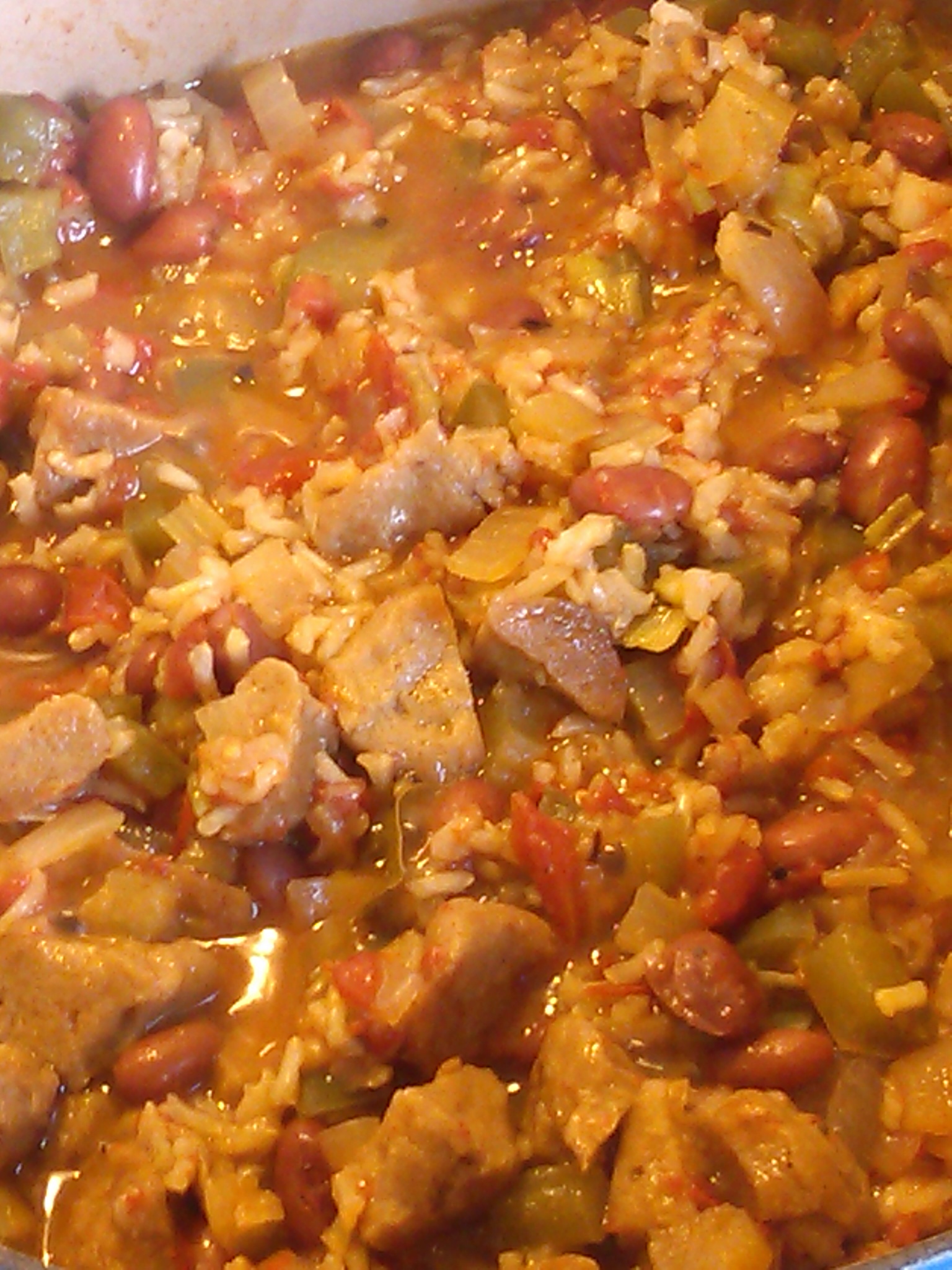
Preparing to cook red beans and rice has been a year-long process because most of the ingredients were produced in my garden or on farms where I work.
The garden produced red beans, okra, tomatoes and celery. Local farms produced onions, garlic and bell peppers. I also grew red pepper flakes and blended the powdered dry spices. Pantry staples of extra virgin olive oil, all purpose flour, and long grain brown rice were USDA organic but not produced in Iowa.
I invested several hours preparing a luncheon meal and time was worth it because of the flavor.
In the morning we discussed my 5-1/2 quart Dutch oven, the enamel of which is wearing off the inside. I’m don’t favor replacing it. Not because of the $350 price tag for a new one from Le Creuset. With a bit of cooking oil on the bottom to prevent rusting it will serve many more years. It is my go-to pan for making red beans and rice. It has been a reliable part of our kitchen.
Cooking is a ritual that evokes memory and skill in bringing a dish together. I soaked a cup of dried red beans in the Dutch oven overnight, then cooked them with half a diced red onion until tender but not mushy. I drained the beans and reserved the cooking liquid, letting them sit on the counter until ready to make the dish.
Around 10 a.m. I started work.
I fried a couple of home made vegetarian burger patties from the freezer and set them aside to drain. (Andouille sausage would be more traditional).
Heating the dutch oven, I added two tablespoons of extra virgin olive oil and cooked a generous tablespoon of red pepper flakes. I diced half a large onion, red bell peppers, and celery stalks and sautéed them in the oil-pepper mixture with a little salt. Once they began to soften I added two cloves of minced garlic and added home made seasoning — think powdered garlic, curry powder, paprika, and powdered hot, red peppers. I added a few dashes of prepared hot sauce from the refrigerator and stirred until everything was incorporated.
Next came additions. I deglazed the pan with a pint of diced tomatoes. Next, a cup each of sliced okra and long grain, brown rice. I stirred in two tablespoons of all purpose flour, then the cooked beans, until everything was incorporated. I tried not to bust up the beans.
What liquid to use was an open question. This time my answer was two cups of the bean cooking liquid (that’s all there was) plus two cups of water. Other options I considered were canned tomato juice and home made vegetable broth. The flavor of the bean cooking liquid made it a good decision.
Stirring everything together, I brought it to a boil then turned the heat down to a simmer, cooking until the rice was done and most of the liquid had been absorbed. Toward the end of cooking I crumbled the burger patties and folded them into the mixture.
It was ready to eat at noon, making four to five portions.
We seek opportunity to follow our creative impulses and cooking is primal. It provides an opportunity to shed anxiety from quotidian affairs, if only for a few hours. A recipe makes the experience replicable but not really. Cooking is a story of how we sustain ourselves in a turbulent world.
Thanksgiving was a quiet day at our house. Neighbors were off with their parents, and the two of us prepared a simple meal of holiday fare.
We made some of our favorite dishes — home made baked beans and wild rice. Both of these have complicated recipes so they are relegated to days that can be devoted to cooking.
I worked the phone in the morning, but after that, could be found in the kitchen. I left the house one time — to empty the compost bucket.
The meal was a success, although the baked bean recipe requires some tweaking. I wrote it in my red book of recurring recipes with a note for next time.
The surprise was that seeing the pie pumpkin on the counter I decided to cook it, even though it wasn’t on the menu. I made a loaf of pumpkin bread and roasted the seeds. I made two cups of cooked pumpkin into one-cup balls and froze them for later. I served sliced pumpkin bread with home made apple butter on top at the meal.
Today I return to the home, farm and auto supply store where it is the eight-hour Black Friday sale. I have to be there when the doors open at 6 a.m. I also work on Saturday and there are plenty of uses for the extra money. For now, it’s my main source of socialization outside of home.
I placed a couple of on line orders this week. One for the bulk of my garden seeds for 2020 and another for a sweatshirt a size smaller than I have been wearing. I’ve maintained the 14 percent weight loss created by my anti-diabetes regimen and the current size is too bulky. We’ll see how that goes.
Our daughter had a twelve hour shift working for the mouse yesterday. At a thousand miles away it’s too far away and too busy there for a visit. Thanksgiving was the two of us sustaining a life in a turbulent world.
I didn’t know where bartering labor for local food would lead. In retrospect, it was not about economics, but learning, access to a greenhouse and participating in farm life.
This Feb. 1, 2013 email to Susan Jutz, one of the first organic farmers and community supported agriculture farm operators in the state got things going.
Susan:
Hope you are staying warm. I have an interest in developing a deeper relationship with producing local foods. While our kitchen garden is doing well, I want to explore the possibility of doing more with local foods to provide a source of income. This is a long range project, and if you offer it, I would like to exchange my labor for a share of your CSA this season.
I think you would find this a cheap and reliable source of farm labor, and what I would get out of it would be a deeper knowledge of how you do your work.
What do you think?
Regards, Paul
She accepted my offer and I’ve been working at Local Harvest ever since. When Carmen Black bought the farm and CSA operation from Susan, I stayed on. I plan to return next year.
In seven seasons I’ve learned a lot about food production. This year’s garden was the best ever, and if I had more time it could be better still. The education I gained has been valuable and I’m ready for next steps.
I engaged with three farms in 2019: Sundog Farm where Carmen lives, Wild Woods Farm where Kate Edwards leases land, and at Wilson’s Orchard owned by Sara Goering and Paul Rasch. Before tax income was $2,423.08 in cash with another $861.75 in bartered goods comprised of vegetables, greenhouse space, and soil mix for home use. I scheduled my work to do soil-blocking at Sundog Farm and Wild Woods Farm beginning in March, finishing in June. That gave me a month off before working at the orchard sales barn where the season runs from Aug. 1 through Oct. 31. I plan leave work at Wild Woods Farm in 2020 which frees up a day a week for gardening.
What else can I learn? Having a place to ask questions about vegetable and fruit growing is important to a gardener. The greenhouse space remains important, although eventually I’ll want to do this at home. Perhaps most valuable is participating in farm life, getting to know young farmers, workers and volunteers and the challenges they face in farming and in life generally.
Our home freezer and pantry are loaded with produce and that’s one measure of success of what began as a barter arrangement. As winter approaches there is a lot to consider for 2020.






 Journey Home
You must be logged in to post a comment.