This week, the Great March for Climate Action headed east through Iowa and Blog for Iowa marched a small part of the route with them. About 150 people gathered in Coralville on Wednesday, Aug. 20, and marched leisurely to the Iowa City pedestrian mall. We marched down the Coralville Strip, past Carver-Hawkeye arena, the University of Iowa Colleges of Medicine and Nursing, the Veterans Administration Hospital, the university’s coal-fired power plant, Old Capitol, and ended in front of the Sheraton Hotel in the pedestrian mall where we were greeted with applause upon arrival. Speeches followed.
It was a chance to meet some of the marchers, and here are some of the people BFIA interviewed and heard:
Ed Fallon, “People need to be thinking of what changes they can make in their own life.”Berenice Tompkins and Andre Nunez. She’s walking barefoot (mostly) and he’s not speaking.Blair Frank “I’m here because of the shift that’s happening around the planet in climate change.Miriam Kashia, Mayor. “Imagine the audacity of a small group of ordinary citizens who believe they have to power to change the course of history.”Ed Fallon, Jeffrey Czerwiec, Miriam Kashia and John Abbe at the marshaling area in CoralvilleRosella Lala Palazzolo selling raffle tickets. Rosella is a veteran of the Great Peace March for Global Nuclear Disarmament in 1986Mike Carberry, “How we deal with climate change is the defining issue of our generation,” with Jimmy BettsJeffrey Czerwiec, “I’m walking every step of the way.”David Osterberg, “We need to make renewable energy 100 percent.”State Senators Rob Hogg and Joe Bolkcom
And finally, here’s the whole gang crossing Burlington Street on Iowa Avenue in Iowa City.
INDEPENDENCE— Friday was a mini-retreat from paid jobs as I drove support for a small team of riders on the Register’s Annual Great Bike Ride Across Iowa (RAGBRAI). The first ride was Aug. 26 through 31, 1973, when people got whatever bike was in the garage tuned up and headed to the Missouri River for what was to become an annual event with thousands of riders on more expensive bicycles.
The day began at 4 a.m., and I arrived to pick up my team in Waterloo around 6:30 a.m. We waited and watched weather radar maps for a couple of hours until the storms passed. Rain held back Friday’s morning start, but in the end, it was a great day for being outside, and in Iowa.
The support driver drops the riders off at the day’s starting point, which was in Waverly. We met in Sumner for lunch, and then I drove to Independence to pick them up. I was also on standby should something happen to one of our riders.
I spent a few hours at the public libraries in Sumner and Independence, and then sat on the front steps of the U.S. Post Office watching riders pass, and waiting for my team to finish for the day. It was time to do something different and get away.
We ended at a church spaghetti supper put on for the riders. It is a big deal for non-profits when RAGBRAI comes to town, and riders seek to carb up for the next day’s ride. After dropping the team at the motel, I headed home, making it back after 9 p.m. It was a long, thoughtful day.
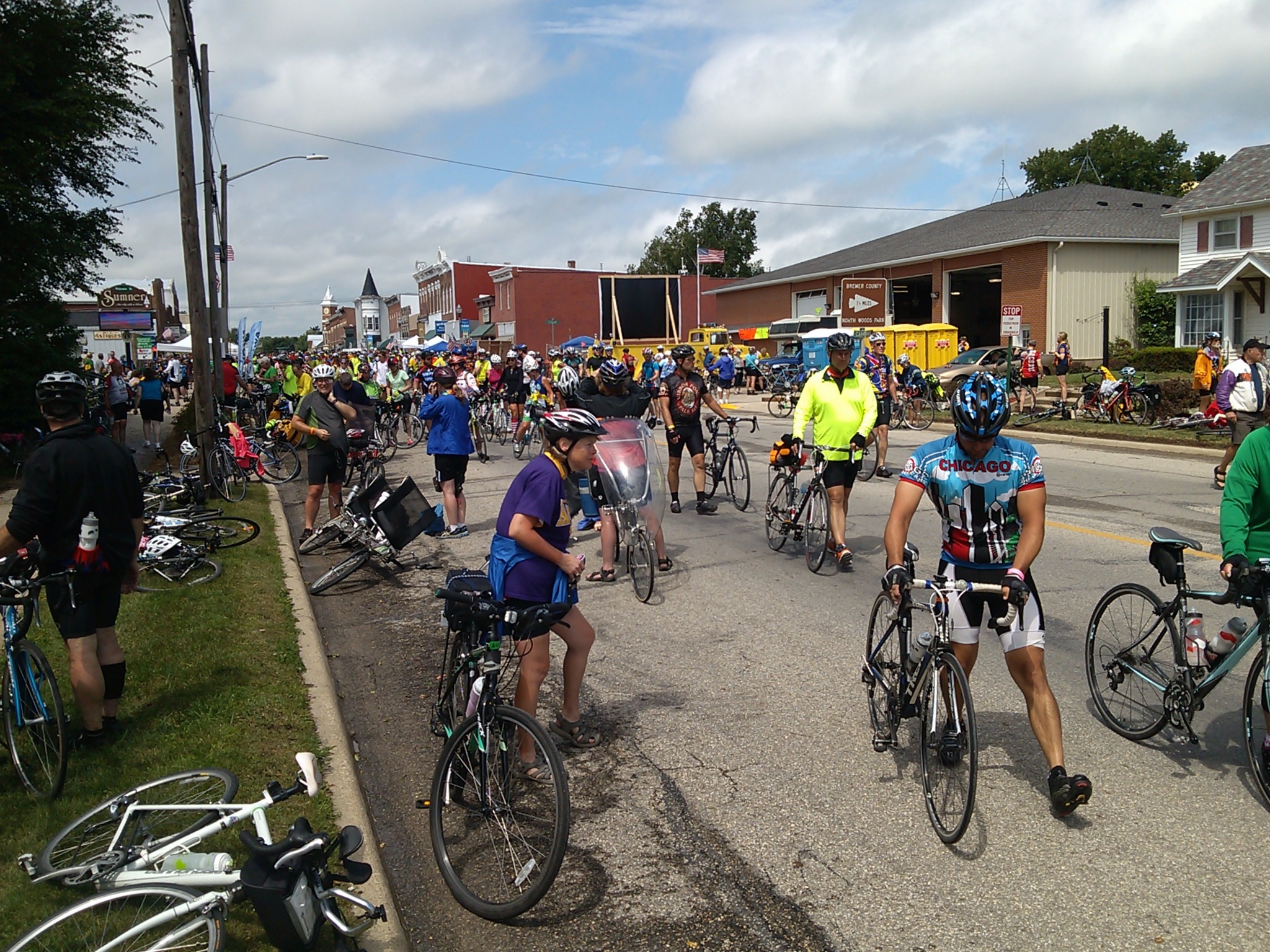
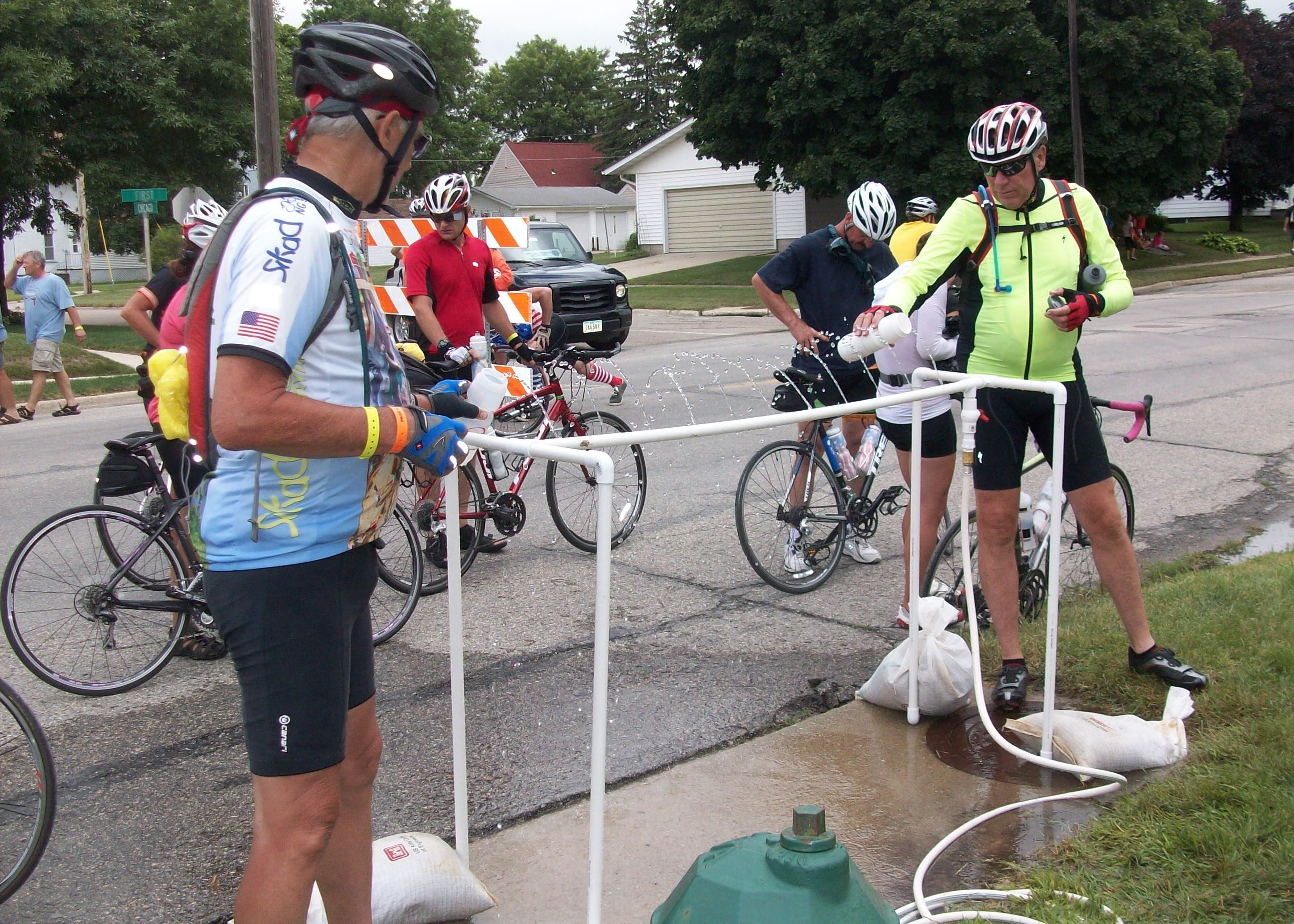
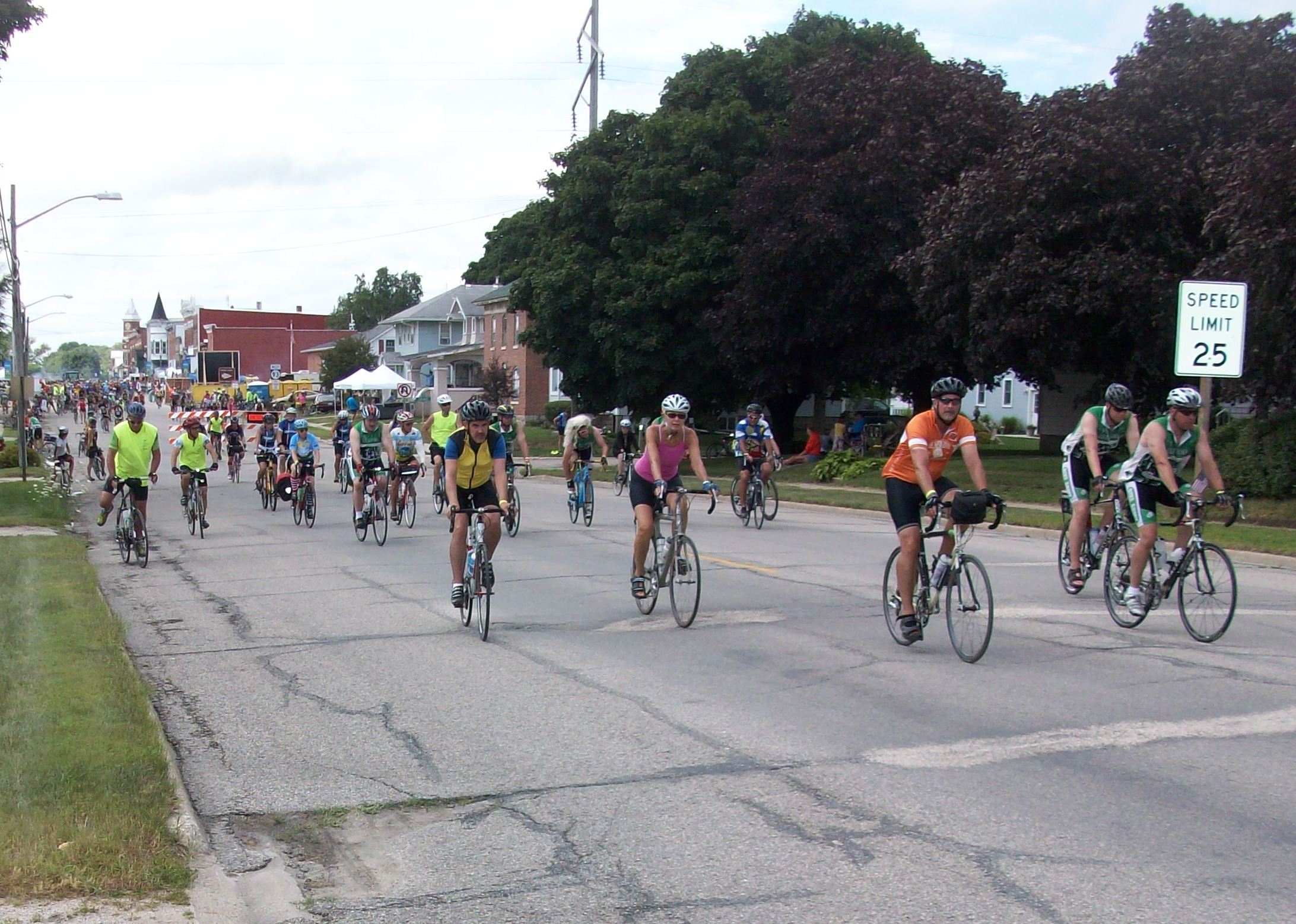
Here are some photos from the rest stop in Sumner, where we had lunch.
Meetup at the Post OfficeStreet Scene at SumnerLetsche’s Bike Shop Airs TiresFilling Water Bottles from a HydrantOn Main StreetStreet Pizza MakersPolitical Pizza ServerVeggie Slice at SumnerLeaving Sumner
SOLON— The hay bale rises above the crowd to clear the bar. Main Street is packed for the hay bay toss— a farm-related activity in a festival put on where traditional farming, matters.
Bingo has begun, a band with a local lead singer is covering The Band Perry, and the beef and pork sandwiches are sold as quickly as the crew can make them.
The restaurants on Main Street offer specials during Beef Days, local beef, food, drinks and music, but the Cattleman’s Association is in the spotlight as the sun sets and we forget about our troubles for a while.
LAKE MACBRIDE— I will be speaking about personal finance, the environment and nuclear abolition four times between April 19 and 24. If you are nearby, please consider attending one of these events:
April 19, 11 a.m.: “Alternative Living: Focus on Finances” with Solon resident and writer Paul Deaton. Paul gave up his 9 to 5 job to focus on his writing. He will describe his creative methods of putting food on the table and how he covers his expenses to survive and thrive. Part of the American Library Association Money Smart Week, Solon Public Library, 320 W. Main St., Solon, Iowa.
April 19, 1 until 3 p.m.: Soap Box Speech on the environment: “Mount Tambora, Mount St. Helens and Nuclear Famine” at the Celebration of Life at Old Brick, 20 East Market St., Iowa City, Iowa.
April 23, 6:30 p.m.: “Earth Week: Climate Reality in Iowa” at 220East, 220 East Fourth St., Waterloo, Iowa.
April 24, 6:30 p.m.: “Earth Week: Climate Reality in Iowa” at the Independence Public Library, 805 1st St. East, Independence, Iowa.
11 a.m.: “Alternative Living: focus on finances” with Solon resident and writer Paul Deaton. Paul gave up his 9-5 job to focus on his writing. He will describe his creative methods of putting food on the table and how he covers his expenses. – See more at: http://www.soloneconomist.com/content/solon-public-library-50#sthash.PGm9t3cj.dpuf
11 a.m.: “Alternative Living: focus on finances” with Solon resident and writer Paul Deaton. Paul gave up his 9-5 job to focus on his writing. He will describe his creative methods of putting food on the table and how he covers his expenses. – See more at: http://www.soloneconomist.com/content/solon-public-library-50#sthash.PGm9t3cj.dpuf
11 a.m.: “Alternative Living: focus on finances” with Solon resident and writer Paul Deaton. Paul gave up his 9-5 job to focus on his writing. He will describe his creative methods of putting food on the table and how he covers his expenses. – See more at: http://www.soloneconomist.com/content/solon-public-library-50#sthash.PGm9t3cj.dpuf
11 a.m.: “Alternative Living: focus on finances” with Solon resident and writer Paul Deaton. Paul gave up his 9-5 job to focus on his writing. He will describe his creative methods of putting food on the table and how he covers his expenses. – See more at: http://www.soloneconomist.com/content/solon-public-library-50#sthash.PGm9t3cj.dpuf
11 a.m.: “Alternative Living: focus on finances” with Solon resident and writer Paul Deaton. Paul gave up his 9-5 job to focus on his writing. He will describe his creative methods of putting food on the table and how he covers his expenses. – See more at: http://www.soloneconomist.com/content/solon-public-library-50#sthash.PGm9t3cj.dpuf
LAKE MACBRIDE— When the drunken arctic air finished its swagger through the upper Midwest, patches of brown grass reappeared in the white landscape. Pools of water formed on the driveway like dammed up dreams, ready to be cut loose when the rest of the snow melts— a false hope of Spring. Feeling restless, I went to town.
Partly, to proofread the newspaper comme d’habitude on Saturday morning. More than that, one of the county supervisors was holding a community discussion at the public library. If life is anything here, it is partly about politics. Several friends were there, and it was good to break winter for a while. It was a campaign stop for the June primary, and also a chance for conversation with friends and acquaintances.
Topics included drug testing, marijuana decriminalization, ever changing synthetic drugs, the overcrowded jail, trails, the para transit service, loss of services in the new mental health regions, and roads— lots of talk about roads. One who lived west of the Ely blacktop mentioned his road specifically. “When will the county address Curtis Bridge Road?” he asked. I listened mostly, and raised an issue or two. It was all good.
Toward the end a woman came in and talked about geoengineering, wanting the county to take action. She had a confusing message. She asked the county to do something about it, but couldn’t say what “it” was. She had a handout with a website which could be the subject of another post… or not. There’s only so much mental capacity and too little time to consider everything.
But allow me to end my drunken swagger. Time has come to be less distracted. Before we accept it and focus, however, the super bowl is coming, marking the last feasible (albeit lame) excuse to delay and celebrate the holidays. What’s the rush? The needs of the growing season will soon be here, catching us unaware. “Just one more thing, that’s all I ask,” he said to himself.
Whatever the human capacity for wonder, the hydrant of behavior must be articulated so we can focus on one thing at a time. Engaging as hanging with friends may be, and good for the soul, if we don’t focus, our lives will be no different than the recent polar vector— chilling us for a few days only to leave without stunting the disruptive vectors approaching our lives.
When I worked for the oil company, we had employees in about 100 countries. On staff was an expert in addictions. He worked not only on drugs, alcohol and tobacco, but on almost everything that could trap people and diminish productivity. When I spent time with him as part of my training, I learned more about distraction and its relationship to addiction than I thought possible. Admitting we have a problem is first step. My addiction is to following life’s many ideas to wherever they lead. I admit it, and don’t really want to do much about it. There it is.
It will freeze again this month, at least I hope it will. There’s pruning to do, a garden to plan, and income to be generated. A season to be made. Things don’t happen without our engagement. All the while, Saturday turned to Sunday. The proof reading is finished, the auto fueled, and the groceries were bought. It’s time to set things aside and focus on one thing at a time, and maybe get some of them done.
LAKE MACBRIDE— The Braley for U.S. Senate campaign came to our political precinct last night, and a small group of friends and neighbors gathered near the lake to hear what the campaign staff had to say. They were looking for help this year to contribute to the effort. No surprise there. The event kicked off the campaign in a way that will begin to get local political activists involved.
What was a surprise is that Braley hired Sarah Benzing. The surprise is that even though the hire is old news and was covered in August, it’s the first many of us that don’t follow politics regularly heard about it. Benzing was Braley’s first chief of staff after winning the 2006 election. More recently, she served as campaign manager in high profile U.S. Senate campaigns for Kirsten Gillibrand of New York, Sherrod Brown of Ohio and Ed Markey of Massachusetts. An old, but more complete biography is here. Braley brought in someone he trusts, but more importantly, he hired a top gun in the political operative world.
Congress is in session, so Representative Braley was in Washington during the event and State Senator Bob Dvorsky spoke briefly on his behalf. The message was that despite a dysfunctional congress, Braley has been able to get some substantial work done to benefit Iowans.
What was missing from the two minute campaign video and the discussion was the Affordable Care Act (ACA). Braley sided with Republicans on the recent house vote to “fix” Obamacare, a bill the White House said would gut the ACA. It will become a political liability if Braley walks back his support for the ACA as a senate candidate. President Obama won re-election in our precinct by four votes, so it seems clear why Braley would try to hedge his bets. But fence straddling on this issue is not becoming of a candidate who asserts he is a progressive politician.
In Big Grove precinct, we gave Senator Tom Harkin 64 percent of the vote during the 2008 election, but also gave Senator Chuck Grassley 62 percent during the 2010 election. It’s no secret that the so-called no-preference voters will decide the 2014 senate race. In this precinct, somewhere between 850 and 1,000 people can be expected to vote in 2014, and that means to win the precinct, if Braley is nominated, he will have a core of 35 percent of the votes, and needs to persuade another 15-16 percent, or roughly 130-150 voters. It can be done, but it will not be a cake walk.
The group gathered last night will support Bruce Braley’s campaign going forward. Whatever he may lack as a candidate is made up by the fact that once the Republican clown car drops off their nominee next year, the race will be depicted as a high-profile duel of the titans. Money is expected to pour into the race, and one can only thank our lucky stars that our household does not turn on the television much any more. Politics is local, so what happens in Big Grove precinct has broader meaning. Maintaining the U.S. Senate majority is high on our list of priorities, and that means working now to elect Bruce Braley.
LAKE MACBRIDE— Having never been a fan of the UNESCO City of Literature designation for Iowa City, I can see why people like it. It gives the social mavens something to preen over. In telling the story of Iowa’s development into a cultural oasis among fields of row crops, mine is somewhat different than what I read and hear about from the source of brightly lit night skies to the south. The main benefit of what the late Darrell Gray described as the U.S.S. Prairie Schooner has been an increased ability to hear writers, authors and lecturers invited by the local literati to speak or read from their work. Last night it was Margaret Atwood.
I don’t know Atwood or her work at all, so it was easy to listen to her talk without prejudice. Somewhere in a box, I have a copy of “The Handmaid’s Tale,” which someone posted on social media is “canonical.” First to admit my deficiencies, I looked up canonical and it means, “included in the list of sacred books officially accepted as genuine.” Genuine is good, and when I find my copy, I’ll give it a try.
What most engaged me was Atwood’s question and answer period. Between you, me and the Internet, I didn’t care much for some of the questions, especially if they revealed too much about the questioner. One teacher went on about a group of women students and their class. She had one of Atwood’s works on the syllabus, but it appeared she wasn’t very knowledgeable about it. An awkward moment that soon passed. While I’m complaining, in the row in front of me was a couple behaving like they were in Juliet’s boudoir, and one or both of them needed a shower to wash away an offensive body odor that reminded me of stints in the oil patch of West Texas. Get a room people and take a shower before coming out in public. My neighbor to the right made a comment about reading the Guardian on my handheld device while waiting for the event to start. Nonetheless, we live life’s diversity, and these things were not a real distraction, even if recalled here.
I perked up at the question about the e-book – paper book divide. Atwood said the market share of e-books had declined from 30 to 20 percent, and that e-readers were better suited for short works. That resonates. She also mentioned her “Three Reasons to Keep Paper Books,” which can be found here, and is worth a read.
Margaret Atwood was smart, witty and attentive to the audience. I was happy to immerse myself in the weird, smelly, nosy and boisterous literary scene in the city just to hear her speak.
Following are prepared remarks for my talk at the Iowa United Nations Association event, “Speaking of… The Environment!” held at Prairie Lights Bookstore in Iowa City, Iowa on Tuesday, Nov. 12.
Thank you Iowa United Nations Association for organizing this event, and to Prairie Lights Bookstore for hosting us tonight.
Climate change is real. It’s happening now. Just ask a farmer. There are few people as close to the intersection between the natural world and human activities as they are. Any conversation I have had with a farmer, included discussion of long term changes in our climate, and how they dealt with them.
Recently, I had a conversation with farmers about this year’s crazy weather: a wet spring that delayed planting, followed by drought conditions in July through September. It was bad, but the worse news was that we can expect more of the same during the next several years.
What does this mean? For one thing, this year’s soybean crop is in and reports from the field are that pods formed on the plants, but didn’t fill out with beans because of the lack of rain. What could have been a great year for soybeans turned into an average one because of drought conditions related to our changing climate.
According to a group of Iowa climate scientists and academicians, the consequences of climate change on farmers are easy to understand. “As Iowa farmers continue to adjust to more intense rain events, they must also manage the negative effects of hot and dry weather. The increase in hot nights that accompanies hot, dry periods reduces dairy and egg production, weight gain of meat animals, and conception rates in breeding stock. Warmer winters and earlier springs allow disease-causing agents and parasites to proliferate, and these then require greater use of agricultural pesticides.” In addition, changes in our hydrological cycle cause increased soil and water runoff, and complications with manure applications. There is also pressure on crop yields.
Everything I mentioned puts pressure on our food system. We can expect more of the same going forward.
There is overwhelming evidence that climate change is anthropogenic, or caused by humans, yet most farmers don’t accept it, even as they deal with its effects.
Scientists don’t know where the tipping point lies, but the effects of climate change on farm operations are clear, and getting worse. Yet, even as we adapt, and farmers do adapt, we can do something about the causes of global warming and climate change without changing our way of life or hurting our economy.
We could start by dealing with the fact that globally, each day we dump 90 million tons of CO2 pollution into the atmosphere as if it were an open sewer. That has to change.
I’m not alone when I say we can do something about the causes of global warming and climate change to protect our food system before it’s too late. We should. Thank you.
IOWA CITY— My World came to Iowa on Tuesday, Nov. 5. It is the United Nations survey to collect grassroots input to the post-2015 Millennium Development Goals (MDG), and one of only 11 U.S. consultations. One of the criticisms of the 2000 MDG process was the lack of grassroots input, and the survey and consultations are intended to address that deficiency post-2015. The goal is to get at least one million U.S. survey responses (if readers would like to participate online, click here).
I was asked to facilitate a small group discussion on access to clean water and sanitation, and was provided a copy of a nine-page handout on the subject. At our table, we had eight people, including some students at the nearby University of Iowa and one person each from China and India, two countries where along with Bangladesh a majority of people in extreme poverty live.
We had an engaging conversation and took notes for submission in the final report to the United Nations. As University of Iowa law professor Jim Leach said, we should support the United Nations, “and take on those that don’t.” We did our part last night.
The publicity, organization and event itself seemed well executed. The attendees I knew had the experiences and credentials to add value to the discussion as the United Nations prepares its next set of millennium development goals. Still, something was lacking. On the drive home, it occurred to me that what was missing was any substantial discussion of business concerns that impact global society so pervasively.
When Shuanghui International, China’s largest pork producer, bought Smithfield Foods, the largest U.S. pork producer, what were they after besides the pork? Because China is so polluted, they were after access to U.S. land and relatively clean water to meet their burgeoning demand for protein. In a free-market way, they would co-opt U.S. land and water rights to benefit China. Americans may not see it this way, but it is the same kind of free-market colonialism the Chinese are engaged with in Africa and South America. The implications for the millennium development goals seem clear.
While a focus on human rights and individual needs may be appropriate for the United Nations, the world has become an open shop where corporations ply their trades freely and collect their tithe, accruing it to the wealthiest people on the planet. The role of corporatism, and keeping it in check as human rights are addressed must be part of the formula for the U.N. I don’t see how that would be possible today.
A very vocal minority, whose members are pro-life, anti-U.N. and anti-taxes will stand as a roadblock to the U.S. governance it takes to keep corporations in check. Until now, the our country has been a beacon of hope for good governance, but the 113th U.S. Congress seems incompetent to pass any bill of significance, let alone one that will reign in corporations as they plunder our world.
As I drove north after the meeting, on a highway not much removed from when Dillon plowed his furrow in the 19th century Iowa wilderness, it seemed clear our civilization has not come as far as we might think. That has to change to make the progress needed to sustain our lives in a turbulent world.
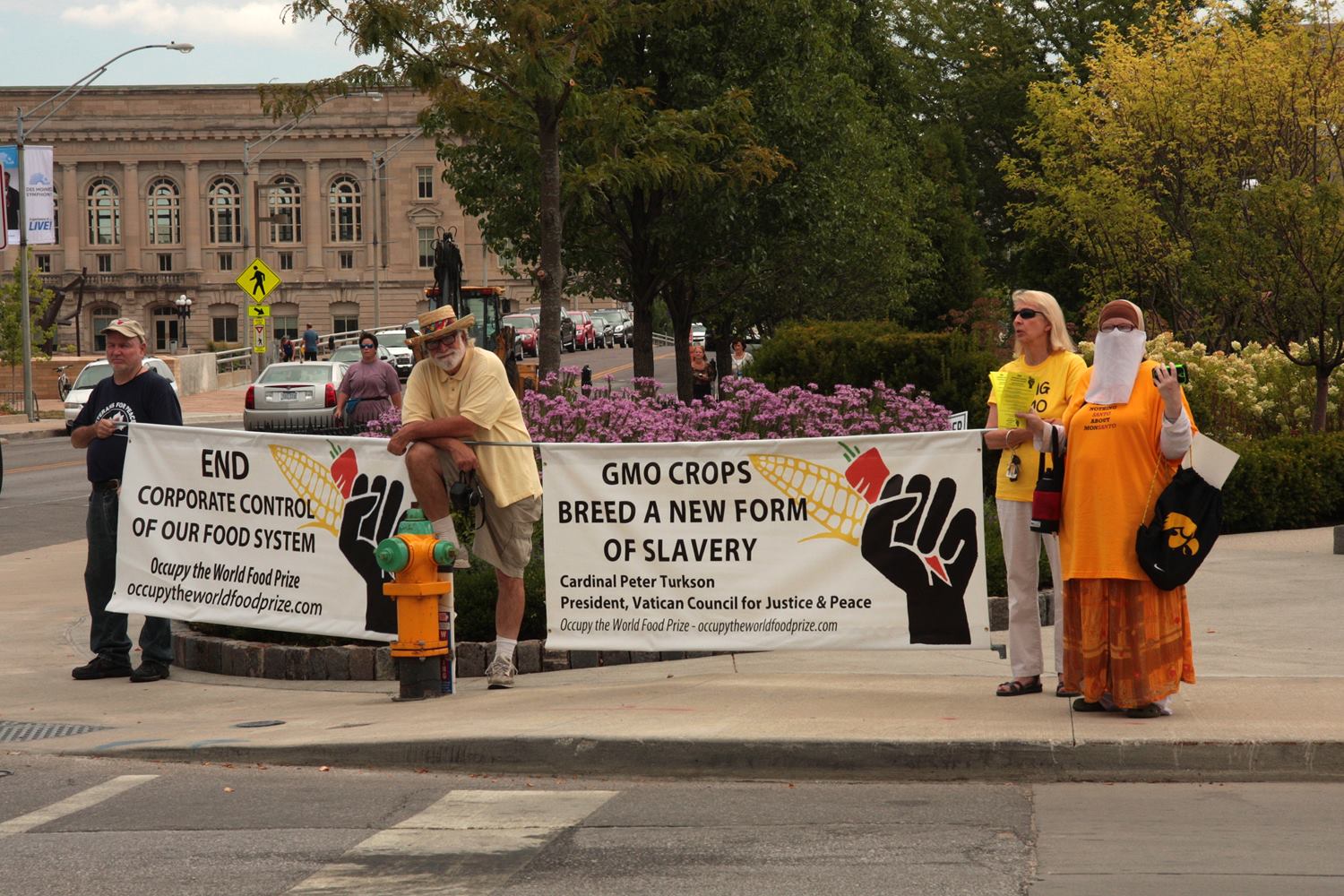
Jim Hightower and his speech, From Factory Farms to GMOs, The Upchuck Rebellion Is Taking Root, has top billing at the Occupy the World Food Prize event on Wednesday, Oct. 16, at 7 p.m. at First United Methodist Church in Des Moines. Maybe that position should have gone to the special guest, Ghanaian Cardinal Peter Turkson.
Leave it to the Roman Catholic Church to point out one of the evils of the agricultural revolution that is genetically modified organisms (GMOs): over-reliance on corporations during third world development. In an article in the National Catholic Reporter, Rich Heffern quoted Cardinal Turkson, “making growers reliant on proprietary, genetically modified seeds smacks of the ‘usual game of economic dependence,’ which in turn, ‘stands out like a new form of slavery.'” Few people I know are talking about GMOs in terms of slavery, but the type of dependency U.S. corporations seek to create in Africa and elsewhere is tangible, and a normal part of development. Cardinal Turkson is at the center of this issue. (For more information, click here).
Cardinal Turkson is president of the pontifical council for justice and peace, a member of the Roman Curia, and potentially the first black Roman Catholic pope. He will be part of the World Food Prize Borlaug Dialogues, and has accepted the invitation to speak at Occupy the World Food Prize. As the National Catholic Reporter pointed out on Oct. 7, he will be talking to both sides in the GMO debate.
During an interview with Des Moines activist Ed Fallon, Occupy the World Food Prize organizer Frank Cordaro said, “our lessons from the occupy movement have taught us that the global financial system controls everything… and lo and behold, we discovered this World Food Prize, and when you look under the covers, it is completely owned and scripted by corporate ag.” “It’s not a world food prize, it’s a corporate world food prize,” Cordaro told National Catholic Reporter in a separate interview.
This year’s World Food Prize laureates are three individuals who have been instrumental in the development of GMOs used by Monsanto and Syngenta Biotechnology, and their companies underwrite a substantial part of the costs of the World Food Prize. Their election to the hall of laureates appears to be self-serving of corporate interests.
Cardinal Peter Turkson is expected to speak against the use of GMOs during the Borlaug Dialogues, which are another attempt by corporations to control the message about their business through so-called opposing views. The dialogues are another in a series of corporate attempts to create a false sense of rational discussion, when, like this year’s laureates, it is self serving at best.
The event flyer for the Occupy the World Food Prize is here. The World Food Prize website is here.










 Journey Home
You must be logged in to post a comment.