Categories
Writing

In An Iowa Kitchen

A Gardener's Breakfast
A Gardener’s Breakfast

The local food movement relies more on kitchens than grocery stores; more on gardens than commercial growers.

While use of locally sourced food by many restaurants has changed to include more of it, a local foods movement cannot be sustained by the hodge-podge of farmers, growers and entrepreneurs who sell locally produced food to restaurants, or for that matter, to grocery stores.

The problems include scalability and sustainability.

We are living in a time where demand for local food exceeds supply. Scaling up to meet demand requires a capital investment most small farmers can’t make. Sustainability relies on creating value along with the food in a way that cooks can afford it and farmers can make a reasonable return on their investment.

Someone recently asked if the area was becoming saturated with Community Supported Agriculture projects and if that’s why some are having trouble growing membership. An answer lies elsewhere. The market for local fresh food has grown so big corporations noticed.

Companies like Hy-Vee, have tapped into the fresh food market by increasing their number of suppliers and offering fresh and local food alongside wares from large commercial growers. They are sucking up market share like a vacuum cleaner as their business model is designed to do – putting pressure on small and mid-sized growers.

Corporate involvement in the local food market is a two edged sword. Growers can sell their best wares to companies like Hy-Vee and get a reasonable return. At the same time reliance on companies rather than CSA members can distract a farmer from his or her core business.

A solution? CSAs should stick to their knitting by getting payment up front and sharing the harvest with members… all of it. It may be tempting to sell some on the side to restaurants and grocery stores, but the further away from the model they get, instead of doing one thing well, everything they do can suffer. In addition, the market share they help corporations grow may be detracting from their core business.

There is nothing wrong with a farmer growing organic greens for restaurant salads and stir fries. In the end, each farmer must make ends meet, and operating a farm —even a small one — is an expensive operation with tight margins. My point is to focus on one thing and do it well.

It is one thing for a farmer to disassemble a barn and use the materials to create raised beds for a ten-person CSA. It is quite another to support a couple hundred families with the variety of produce the market demands. If you ask a hundred CSA members, as I have, why they belong, answers are all over the map. Some want assurance of a grower who uses organic methods to produce food. Some want variety unavailable at Aldi’s or Fareway. Others want to create a cooking experience with young children as part of their education. Most want to feel good about what they are doing with their lives.

One hopes we are beyond the discussion of “food miles” and on to the core value of the nascent local food economy: know the face of the farmer. It’s corollary is know how your food is grown. Try as they might with life-size cutouts of farmers in their stores, corporations have a hard time doing that. Their customers are too diverse, and they have to cater to everyone in the community. If a person combines these two ideas, knowing how our food is produced and creating demand for local, fresh food the local food movement has a chance.

A very few people strive to source every food ingredient locally. It is not with them the future of local food lies. The future of local food is within the potential of every Iowa kitchen.

To sustain the local foods movement requires consideration of what it means to belong to a CSA or buy from a farmers market. Can that fit into culinary habits in a way that is not an encumbrance to what most perceive as very busy lives?

Can kitchen cooks grow some of their own produce? Probably yes, even if it means only a large flower pot with some cherry tomatoes or an herb jar on a window ledge. Even these small things may be a step too far for some.

The trend in food includes extensive prep work done by machines and large companies. Heat and serve has become a by-line for many available grocery items. Along with taking the kitchen work out of meals, risks of contamination have been created and along with it the need for recalls from large processors whose products get contaminated by E. coli and listeria.

In a consumer society it will always be tough for small-scale producers to survive and thrive. That’s why I say the future of the local food movement rests in Iowa kitchens where cooks can use less processed foods and more fresh — secured by buying local and growing their own.

It’s work many can’t do because of choices made about careers and family. What may be the saving grace of the local food movement is the idea of taking control of our kitchens, in part by living and eating local as much as we can.

Categories
Home Life

Sleep Came Easily

Cherry Tomatoes from the Garden

Mounds of grass clippings blocked the John Deere’s steering as I mowed part of the lawn.

The temperature was ideal, the sky clear, and I was alert enough to safely operate the equipment.

To engage the steering I backed off and tried again.

Grass clippings lie in wind rows where I mowed last night. Using a rake and wagon I’ll transfer them to the garden for mulch.

In high summer a gardener/low wage worker/family member finds more to do than there is time. I managed to send a box of kale, fairy-tale eggplant and tomatoes to the library for the workers earlier in the day. They were appreciative.

The garden hose was coiled near the house for mowing. While driving past the garden I noticed the cucumber leaves drooping. I stopped, got the hose back out, and watered. I missed a lot of cucumbers during the morning harvest so I picked them. They filled a crate and created another thing to do.

Dinner was sweet corn on the cob and tomatoes with cheese plate, bread, and blueberry yogurt for dessert. The corn and tomatoes were filling, so I didn’t get to dessert.

After dinner I put cucumbers — newly harvested and those already in the ice box — on the counter after washing them. I sorted and found a place to put them. I hadn’t planned another task, but it needed doing. I’d say I’m in a pickle, and that’s more solution than problem.

As a result of my cucumbering, processing peppers and tomatoes got pushed back.

Sleep came easily after my eighteen hour day.

Categories
Home Life

Couple Hours to Myself

Gardener's Breakfast of tomato, salt, pepper and feta cheese.
Gardener’s Breakfast of tomato, salt, pepper and feta cheese.

Hope regular readers are well tolerating my posts from Blog for Iowa. They are different from what I normally write here, but then none of us is one-dimensional — I hope.

I got off work at the orchard a couple hours early. It’s the beginning of the season and we had plenty of staff to cover customers. The apples coming in are mostly tart and useful for baking, apple sauce and apple butter. We had ten varieties available today.

Had a great conversation with a gent who bought a large bag of Dolgo crabs for crab apple jelly. His recipe was basically this one.

“Don’t squeeze the jelly bag,” he cautioned. “The jelly will go cloudy.”

I wished him good luck as he headed for the sales barn exit.

We get a treat for each shift we work. I ate a Zestar apple. Before leaving I bought a 10-pound box of blue berries and on the way home secured a dozen ears of sweet corn at a roadside stand. Tonight’s dinner will be sweet corn on the cob and fresh tomatoes with blueberry yogurt for dessert.

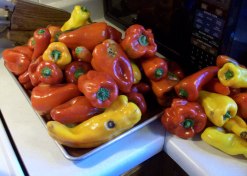
Seconds Bell PeppersPlans for the unexpected mid day gap are to mow the lawn, gather the grass clippings, process bell peppers and Roma tomatoes, fix dinner and freeze some of the blueberries. The freezer is already packed, so I hope the peppers and blue berries will fit. I have no idea if everything will get finished.

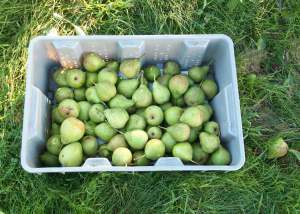
A storm blew down a pear tree branch. After inspecting the damage I picked the unripe fruit then cut the branch cleanly from the trunk. Once they ripen we’ll have more than enough for fresh and maybe some for pureed pear sauce. The tree is still loaded.

Crate of pears.
Crate of pears.

Working three jobs is challenging mentally, physically and every way in between. It’s hard to keep up and a couple of unexpected hours to myself was a welcome surprise.

Categories
Environment Home Life Kitchen Garden

New Saturday Night

Audio Cassettes
Audio Cassettes

Music filled the Saturday afternoon gap left by Garrison Keillor’s retirement.

Not radio, but music recorded on audio cassette tapes.

It is amazing there is even a player in the house. (There are two that work). The sound quality of this outdated technology was surprisingly good.

While processing vegetables into meals and storage items, I listened to Shaka Zulu and Journey of Dreams by Ladysmith Black Mambazo, and Graceland and The Rhythm of the Saints by Paul Simon. I hit the pause button when I left the room so the tape wouldn’t run out without hearing it.

When Jacque returned home from work we had our first sweet corn meal of the season: steamed green beans and corn on the cob. As they ripen, tomatoes will replace green beans. There is nothing like seasonal Iowa sweet corn. I made a cucumber-tomato salad as accompaniment using a recipe found by googling on-hand ingredients.

The Saturday kitchen produced a gallon of vegetable soup, refried bean dip, daikon radish refrigerator pickles and sweet pickles made with turmeric. Outside was hot and humid although nowhere near as oppressive as the summer of 2012 when we had record drought.

On Friday Donnelle Eller posted an article about corn sweat at the Des Moines Register. Corn and soybean plants, which cover Iowa farmland, transpire moisture. During pollination and ear formation as much as 4,000 gallons of water per acre of corn is released into the atmosphere daily, making it feel humid. There were a number of articles about corn sweat in the media last week.

What makes this year different is not corn sweat. The first half of 2016 was Earth’s hottest year on record. This impacts the hydrology cycle, change in which is a primary manifestation of climate change. With global warming the atmosphere can hold more moisture until a precipitating event makes a rainstorm. It is more often a gully-washer.

The high winds and heavy, short-duration rain have become more frequent in recent years. This week a storm caused significant damage to the garden. In addition to losing the Golden Delicious apple tree, the cucumber towers blew over uprooting about half of the pickling cucumber plants. The Serrano pepper plants blew over, breaking the stalk of one near the ground. The high deer fence blew down and deer got into the kale and pepper patch by jumping the low fence. The cherry tomato plants blew over, however I was able to upright and re-stake them without damage.

Climate change is real, it is happening now. It is time to act to mitigate the effects of global warming.

Political Event with Tim Kaine at Bob and Sue Dvorsky's home in Coralville, Iowa on Aug. 17, 2010
Tim Kaine at Bob and Sue Dvorsky’s home in Coralville, Iowa on Aug. 17, 2010

Hillary Clinton announced Senator Tim Kaine would be her running mate this weekend. Friends were posting photos all weekend from the August 2010 event he attended in Coralville. If he wasn’t the center of attention then, as the photo suggests, he will be now.

I’m torn about viewing the Democratic National Convention this week. Hopefully key speeches will be available for viewing afterward and I can avoid social media enough to think clearly about what Hillary Clinton says.

As Sunday begins, I’m not sure listening to recorded music will adequately replace Garrison Keillor’s A Prairie Home Companion. It’s here. It’s what I can do to sustain our lives in a turbulent world.

Categories
Kitchen Garden

Cook or Quit

Harvest for the Weekend Kitchen

I put on my rubber boots and went to the garden in the predawn sunlight. I left a trail where my boots scraped against the dew drops formed on the lawn.

Fresh deer droppings lay moist under the oak trees and two rabbits stopped and watched as I made my way through the clover. I picked cherry tomatoes, jalapeno peppers, daikon radish and everything in this photo.

In the kitchen I made salsa using fresh ingredients, some old relish — everything that made sense. It was tasty and spicy, quite delicious.

The future of any local food movement is in the hands and kitchens of people who do these kinds of things.

If you ask my mother’s generation, “what is local food,” they often mention sweet corn and tomatoes. Hard to argue with the taste and seasonality of those two vegetables, but there is more.

Cooking goes against the grain of a global society increasingly and intentionally seeking to remove creative, engaged prep work from the kitchen and replace it with heat and serve processed food. Here’s an example.

While on break at the home, farm and auto supply store food preparation became a conversation topic as it often does.

A colleague explained how he bought a bag of prepared frozen meatballs from COSTCO and warmed them in his favorite barbecue sauce. He then took a small loaf of white bread, halved and toasted it, and spooned the meatballs on the bottom half making a meatball sandwich. He said it was really good as we listened.

If taste and ease of preparation is all we seek, the industrial food supply chain can meet our needs. In that case, when it comes to local food, what’s here becomes local.

I’ve been spending time in the kitchen this week. At 5 a.m. I stop what I’m doing and make breakfast. Stirfry, roasted vegetables, and because they are in season, fresh steamed green beans with every meal. It feels a little weird, but I felt better all day because I ate mostly what I grew before 7 a.m.

The local food movement is just not going to happen based on a small number of farmers, chefs and advocates and there’s the ceiling. If it becomes a part of our daily lives, which include vegetables from the garden, eggs from chickens we know and preparing food to taste, then the local food movement has a chance.

What it reduces to is either cook or quit.

Categories
Home Life Kitchen Garden

A Brief Storm

Fallen Apple Tree Branch

A brief storm made a decision for me.

The last branches of the Golden Delicious apple tree blew over in a gust of wind during an intense thunderstorm.

I hoped there would be fruit again but not now, not ever from that tree.

I’ll chain-saw the stump for the fall burn pile, finishing the work time brought.

When I planted six trees on the day of my mother-in-law’s funeral I had no idea about apples. The second Red Delicious tree was the first to go, and the Lodi was felled by another storm. Three trees remain and I know a lot more about apples today.

The storm blew over the row of six-foot cherry tomato plants and some of the hot pepper and kale plants. The cucumber cages were also blown around. I straightened everything as best I could. There was some damage, but not ruinous. The wind exposed a generous crop of slicing tomatoes under the leaves. Here’s hoping everything makes it to maturity.

Categories
Home Life Living in Society Social Commentary

Processing Vegetables Before Independence Day

Shocking Green Beans After Parboiling

It takes longer to process vegetables from the garden than it does to harvest them.

That means a lot of summer spent in the kitchen.

I focus on each job — sorting kale leaves, parboiling and freezing green beans, cutting turnips for storage — yet the mind wanders along paths hidden in a day’s activities.

We opened the house and listened to birds at the feeder. From time to time we watched as rabbit, squirrel, chipmunk, and a variety of birds sought seeds. The weather was perfect for anything and my choice was to preserve some of the harvest for later in the year.

Birds scattered when I opened the screen door and cast sunflower seeds in the grass. Eventually they returned to forage for them. It is a predictable behavior that encourages their proximity and my seed-buying. That’s not what was on my mind as I made pesto, bagged kale leaves and prepared luncheon of vegetable soup served on rice.

We live in a violent world and acceptance of such violence is part of who we are.

The list of recent bombings and killings is long, getting longer: Orlando, Florida; Istanbul, Turkey; Quetta, Pakistan; Baghdad, Iraq; Jeddah, Saudi Arabia. These violent and regrettable incidents in the last month may seem bad, and are. What is worse is the long history of genocide embedded in our civilization. The ability to tolerate genocide is a passive crime and a forgotten legacy.

The web site United to End Genocide lists our recent genocides: Armenia (1915), the Holocaust (1933), Cambodia (1975), Rwanda (1990), Bosnia (1995), and Darfur (2003). The passing this weekend of Elie Wiesel reminds us of the need to remember humanity’s crimes and do something to prevent them going forward. For Wiesel, and for many, this process begins by telling the story.

Immaculée Ilibagiza’s memoir, Left to Tell: Discovering God Amidst the Rwandan Holocaust, tells a story of how personal genocide is to those involved. She recounts specific incidents of machete killings too graphic to repeat. Her purpose is similar to that of other holocaust survivors.

“I believe that our lives are interconnected,” Ilibagiza wrote. “that we’re meant to learn from one another’s experiences. I wrote this book hoping that others may benefit from my story.”

The history of genocide against the first people in the Americas is under-recognized and little discussed. The common story is of colonial conflict, disease, specific atrocities and policies of discrimination, according to United to End Genocide. Last week an ailing and imprisoned Leonard Peltier released a letter in which he told a different story.

As the First Peoples of Turtle Island, we live with daily reminders of the centuries of efforts to terminate our nations, eliminate our cultures, and destroy our relatives and families. To this day, everywhere we go there are reminders — souvenirs and monuments of the near extermination of a glorious population of Indigenous Peoples. Native Peoples as mascots, the disproportionately high incarceration of our relatives, the appropriation of our culture, the never-ending efforts to take even more of Native Peoples’ land, and the poisoning of that land all serve as reminders of our history as survivors of a massive genocide. We live with this trauma every day. We breathe, eat and drink it. We pass it on to our children. And we struggle to overcome it.

Today the United States celebrates the signing of a declaration of independence from England with parades, barbecue, family gatherings, food, fireworks, music, travel and intoxication. The opportunity for such revelry came at a high cost.

With each cut of the knife and batch of green beans placed in the freezer I focus on the task at hand. Partly to make something that wasn’t here, and partly to forget the stains on the soul of American society.

I’m processing a lot more than vegetables.

Categories
Home Life Living in Society Social Commentary

Weekend Reckoning

Garage Rags
Garage Rags

Supper was a leftover jar of bean soup, sage and cheddar biscuits, and apple crisp from last year’s crop.

It was delicious… an apple joke.

I set my alarm for 4 p.m. to begin two hours of cooking. I also wanted to hear Garrison Keillor’s radio show from Tanglewood. He’s retiring in July.

Keillor lucked into radio.

“Through a series of coincidences, I lucked onto this show, for which I had no aptitude to speak of, sort of like a kid in Port-au-Prince who’s never seen ice becoming captain of the Haitian Olympic hockey team,” Keillor wrote in an email sent Saturday afternoon. “I was never in theater, never sang in public, but I had grown up at the end of the radio era so I had some ideas about how it might sound. I was a plodder, but persistent.”

So did I luck into a pattern of preparing Saturday dinner with A Prairie Home Companion in the background. All of my other favorite Saturday shows on public radio are gone – likely as a result of budget cuts. Soon Keillor will be gone too. New times require new patterns and I’m okay with that.

Saturday’s harvest included a head of cauliflower, carrots, turnips, an onion, two bunches of celery, and lots of kale for the kitchen and to give to library employees. The herb garden is coming along. I didn’t pick basil but will need to soon.

Planting included an acorn squash seedling and some dill, both given to me by a library worker. The Swiss chard seedlings went into the ground, as did some more jalapeno peppers. I planted lettuce where the carrots grew. The overnight thunderstorm provided needed rain.

Turk's Turban Squash Plant
Turk’s Turban Squash Plant

The harvest was shortly after sunrise. I was out in time to see dew around the edges of the Turk’s Turban heirloom squash plant leaves. It’s as if the leaf was a large moisture collection device, and the drops waiting to get big enough to roll to the ground and provide moisture to the roots. Summer Saturday harvest is becoming one of my favorite times.

After lunch I organized and cleaned the garage, which is to say I put things away, swept the floor and laundered the rags. I decided to leave the bagging attachment on the John Deere for another pass at collecting garden mulch. It’s debatable whether more is needed. It can always be composted if not used.

It’s been a couple of tough weeks in the news, making it difficult to process what’s happened in society. The murders at Pulse Orlando kicked off a series of news cycles that have been enervating at best, at worst a beginning of the end of society as we know it.

There’s a lot to write about. The futile efforts of the U.S. Congress to call attention to gun violence and do something about it, the referendum in Great Britain about whether to leave the European Union, a slate of Supreme Court decision announcements, the peace agreement between the FARC rebels and the Colombian government, and more.

What caught my attention midst the swirl of current events was yesterday’s 140th anniversary of Custer’s last stand during the battle of Little Bighorn in southeastern Montana. During a visit to the battlefield it occurred to me Custer was a fool. The idea the Seventh U.S. Cavalry Regiment could prevail in that open terrain was ridiculous.

Little Big Horn was part of a genocide that began shortly after arrival of Europeans in the west. It found it’s last practical expression 14 years later in 1890 on the Pine Ridge Reservation at Wounded Knee. Leonard Peltier’s case notwithstanding, our war with native populations in the Americas is finished.

The removal of cultures is in many ways the history of the country. We removed native populations, trees and wildlife and called it “settling.” Surveyors laid out a pattern of land use that enabled us to settle the prairie and forget what once was here. Oak-hickory forests, tall grasses and bison as far as human eyes could see have been relegated to special heritage sites. It’s not all been good but it is what we live with.

As rain falls, reminding me to clean the gutters, it’s hard to miss the need to engage in society outside a surveyed lot in Big Grove. To sustain a single life requires engagement in everything around us and many things that no longer are here. At least that’s how I cope with American violence and sustain the will to do something more about it.

Categories
Kitchen Garden

Garden is In

Garden Spinach
Garden Spinach

With planting of Fairy Tale eggplant, Turk’s Turban squash, a sweet potato that sprouted on the counter and 18 bell pepper plants, I declare the initial garden planting finished.

Food is growing in six plots this year and all that remains is the weeding, water management and harvesting.

The days get longer for another week when summer begins.

Yesterday morning was soil blocking at the CSA for the fall crop — blocks for 2,160 seedlings. Afterward I walked the farm to inspect the progress of the crops. I’m not sure how often I will make it back now that my work is done for the season. The crops look fine as the farm transitions from one owner to the next.

What’s next?

With all the produce, cooking will be part of it, but that’s not really what I mean. Politics has devolved to hearing more than a person can stand about the 2016 presidential race. Not that either. My next significant gig is editing Blog for Iowa in August, so there’s time for a break in the action — a focus on maintenance of the house and my small circle of family and friends.

It’s a time to look at the garden I’ve planted and make plans for next year.

Categories
Home Life

Easter Rising

Sunrise Over Lake Macbride

Yesterday was a punk day.

We called the day between Good Friday and Easter Holy Saturday when I was a grader. It was not as important as Easter’s main event in the liturgical year.

On Easter Sunday we dressed in our best clothes to attend Mass with Grandmother. We’d return home for Easter dinner and talk around the table. I remember Grandmother helping wash dishes in the kitchen. It was the most significant holiday of the year, for her, and in our insular Catholic community.

No longer.

It was a punk Saturday because of the stitches in my right hand. Restricted from activity, I stayed indoors, managing to cook dinner, water seedlings, do laundry, make the bed, and read. I would have preferred to get my hands dirty in the soil but it wasn’t meant to be. It was a day of healing if not repentance. Of contemplation, not work.

I rose Easter morning for the first time in a long time without the pain of plantar fasciitis in my feet. Hopefully this condition persists.

Matthew 16:24-25 says, “If any man will come after me, let him deny himself, and take up his cross, and follow me. For whoever wishes to save his life will lose it; but whoever loses his life for My sake will find it.

If I’m not ready to walk those footsteps, today’s healing is a signpost. Healing is possible. Healing can come. Healing can set us free.

The large bandage on my thumb is a reminder healing is not done.

As darkness yields to dawn and sunlight, one can’t help but be comforted by the possibilities each day brings. Days of work lie ahead until that final night and its return to Earth which engendered us.

The journey ahead beckons, on this Easter rising.