We survived U.S. failure to ratify the Kyoto Protocol to limit greenhouse gas emissions and will survive if Republicans drag us out of the Paris Agreement after the 2020 general election, as was announced June 1 in Washington, D.C.
Make no mistake: it is a disappointment that Republicans plan to exit the agreement.
Outside the symbolism for their political party — which I can only characterize as a finger-involved and not-safe-for-work gesture to the rest of the world — the engine driving greenhouse gas reductions is picking up velocity and will not be stopped by any one person or group.
The United States is not the only country on Earth. 194 countries remain in the agreement as the U.S. joins Syria and Nicaragua as the only states outside it. China, India and the European Union have said they will step up to fill the leadership void the U.S. created by its announcement.
Here’s the bottom line: even without the federal government involved, cities, states, businesses, colleges, and citizens across the US are driving a shift to clean energy and bringing down emissions. Just like the Paris Agreement intended.
With Republicans stepping back, it’s up to the rest of us to step up in a big way and keep this momentum going if we want to protect our environment.
Earth is our only home. Consumerism, irresponsible development, environmental degradation and global warming have negatively impacted where we live.
Our work goes on. The Republican decision to exit the Paris Agreement is not the end of the world. Not even close.
~ Published in the June 8, 2017 edition of the Solon Economist
While in Europe, Pope Francis and the G7 leaders bent President Trump’s ears about climate change.
The Pope presented a copy of Laudato Sí: On Care For Our Common Home, his encyclical on consumerism, irresponsible development, environmental degradation and global warming to the U.S. president. He told Pope Francis he would read it.
Reports indicate the six other G7 leaders presented arguments for the United States to stay in the 2015 Paris Agreement on mitigating the effects of climate change. Trump would not commit to doing so by the time he boarded Air Force One for the trip home.
“The entire discussion about climate was very difficult, if not to say very dissatisfying,” German Chancellor Angela Merkel said. “There are no indications whether the United States will stay in the Paris Agreement or not.”
That Trump failed to be part of the G7 consensus on climate may or may not be a sign of his intent. One never can tell with this president.
“I will make my final decision on the Paris Accord next week!” Trump tweeted.
That Trump was willing to listen to his European peers and the Pope indicates he may have an open mind about the accord. However, late yesterday, Jonathan Swan and Amy Harder of Axios reported, “President Trump has privately told multiple people, including EPA Administrator Scott Pruitt, that he plans to leave the Paris agreement on climate change.”
Despite the advocacy workshop for exiting the agreement EPA has become, the result of the president’s decision-making process may be more complicated than making a simple announcement.
Exiting the Paris Agreement would take at least four years. The agreement does not permit states to exit until three years after entry into force (Nov. 4, 2019). It would then take at least a year to finish the process. In that time, Trump could change his mind.
If Trump decides to exit, he would be “willfully, nonchalantly vacating leadership of the world,” former U.S. ambassador to the United Nations Samantha Power said. Another country will step in to fill the leadership vacuum, presumably China with the world’s second largest economy.
A bone of contention with Pruitt and advocates in the hydrocarbon business is the existence of the Clean Power Plan first published by the EPA in the Federal Register Oct. 23, 2015. On March 28, President Trump signed an executive order mandating EPA review the plan. Unraveling the Clean Power Plan is not as simple as signing an executive order. Whether or not the U.S. exits the Paris Agreement, the regulation may stand.
It is significant the first nation Trump visited in his presidency was Saudi Arabia. Saudi Arabia has almost one-fifth of the world’s proven oil reserves and ranks as the largest producer and exporter of oil in the world. Despite concerns about human rights and the treatment of women in the kingdom, Trump seemed elated about the arms deal he made during his visit. His rhetoric isolating Iran may be no more complicated than wanting to take their oil. Iran ranks fourth in proven oil reserves behind Venezuela, Saudi Arabia and Canada.
That 195 states could enter the Paris Agreement was remarkable. Whether it will hold if the U.S. exits is uncertain. Regardless of politics the science on global warming has been identified since the 19th century.
On the morning after the 45th President’s first foreign trip the direction of his administration on climate change is obvious. Government climate change web sites and regulations are officially “under review” in multiple agencies. At the same time the hydrocarbon business is moving to roll back regulations that seek to reduce carbon emissions. The idea of leaving fossil fuels in the ground is not embraced in this White House.
“I think there is a better than 50/50 chance that the Trump administration will stay in the Paris agreement,” Nobel Prize winner Al Gore said. “I think odds are they will stay in.”
It’s been a struggle to get a grip on the presidency of Donald Trump. There’s nothing he’s done to give us hope.
Just give me a handle — anything to grasp onto as normal! Nothing.
Like many who care about the environment, nuclear abolition, and the commons, there seems little hope of advancing a positive agenda during the first term of the 45th president. What some settle on is giving up on 45 doing anything positive, resisting his degradation of our previous work, and working toward the 2020 presidential election and a Democratic president. In other words, create a political climate more receptive to our initiatives.
“I think we have to use the coming four years to create an understanding in the general public and amongst (sic) the security community that we need a fundamental change in nuclear weapons policy,” Ira Helfand, co-president of International Physicians for the Prevention of Nuclear War, wrote yesterday in an email. “Our goal should be that the new administration that takes office in January 2021 is fully committed to this change in policy, and staffed with people who share this vision.”
I respect Helfand’s sense of urgency to use the time we have to accomplish something. At the same time we can’t afford to shelve our priorities until the political climate is more likely to support them. What’s right is right and our work on the environment, nuclear abolition, and the commons must continue even if the odds are against us. There may never be a political climate receptive to the change we seek.
It’s time to turn the page on our reactions to Trump and do what’s right. For me that means joining together with others to work on preserving an environment where humanity can live out its next era in dignity and relative peace. That’s something to grasp onto.
If the evolution of homo sapiens is to eventually become extinct, there is little we can do about that. Whether it is the return of the Imam Mahdi before the end of the world, or the second coming of Christ, we can’t place all our hopes on a life after this one. We live here and now and must act to mitigate the damage we humans have wrought on the planet.
Earth is our only home and we must make the best of what we inherited.
All around us Spring is regenerating the biosphere as it has done for millennia. To be a part of that, especially with others, can only bring us good. Even if the political climate runs against our common sense, hope remains.
This spring we must re-dedicate ourselves to that hope.
Snow fell in darkness leaving a thin blanket of white.
The pin oak tree began shedding last year’s foliage indicating warm weather activated new leaf buds and pushed out the old.
Seems weird to rake leaves in February. More to the point, it’s not normal.
In a couple of hours I return for a fifth season at Local Harvest CSA. The main spring task is soil blocking 72 and 120 cell trays for seed starting in the germination house. Part of my arrangement is keeping some of my own seedlings there. When I’m finished with the farm’s trays, I’ll make one 72 and one 120 tray for myself and seed them with kale, celery and basil. I’m hopeful they will do better than in the south-facing window in our bedroom. Getting my hands dirty with soil is a great way to get ready for spring, three weeks away by the calendar.
Other chores on my white board include doing taxes, computer file backup, cleaning the car, preparing the garden for spring and Belgian lettuce planting this week (traditionally March 2). I made extra servings of spaghetti with tomato sauce for lunches and want to make a batch of taco filling for breakfast on work days at the home, farm and auto supply store. There’s also more writing projects.
During a Climate Reality Project conference call on Thursday, a friend from Waterloo and I decided to work on a project with other friends from Waterloo-Cedar Falls. I’ve done two presentations there and look forward to more meaningful work. We’re planning luncheon, maybe next weekend.
This last lap in the workingman’s race looks to be action packed with local food, environmental and cash producing projects coming into focus.
Night’s snowfall melting in the sun makes way for budding plants in a grey and brown landscape. It is almost time to wipe the whiteboard clean and begin anew.
BIG GROVE TOWNSHIP — Sweeping sand signals the beginning of an outdoors season.
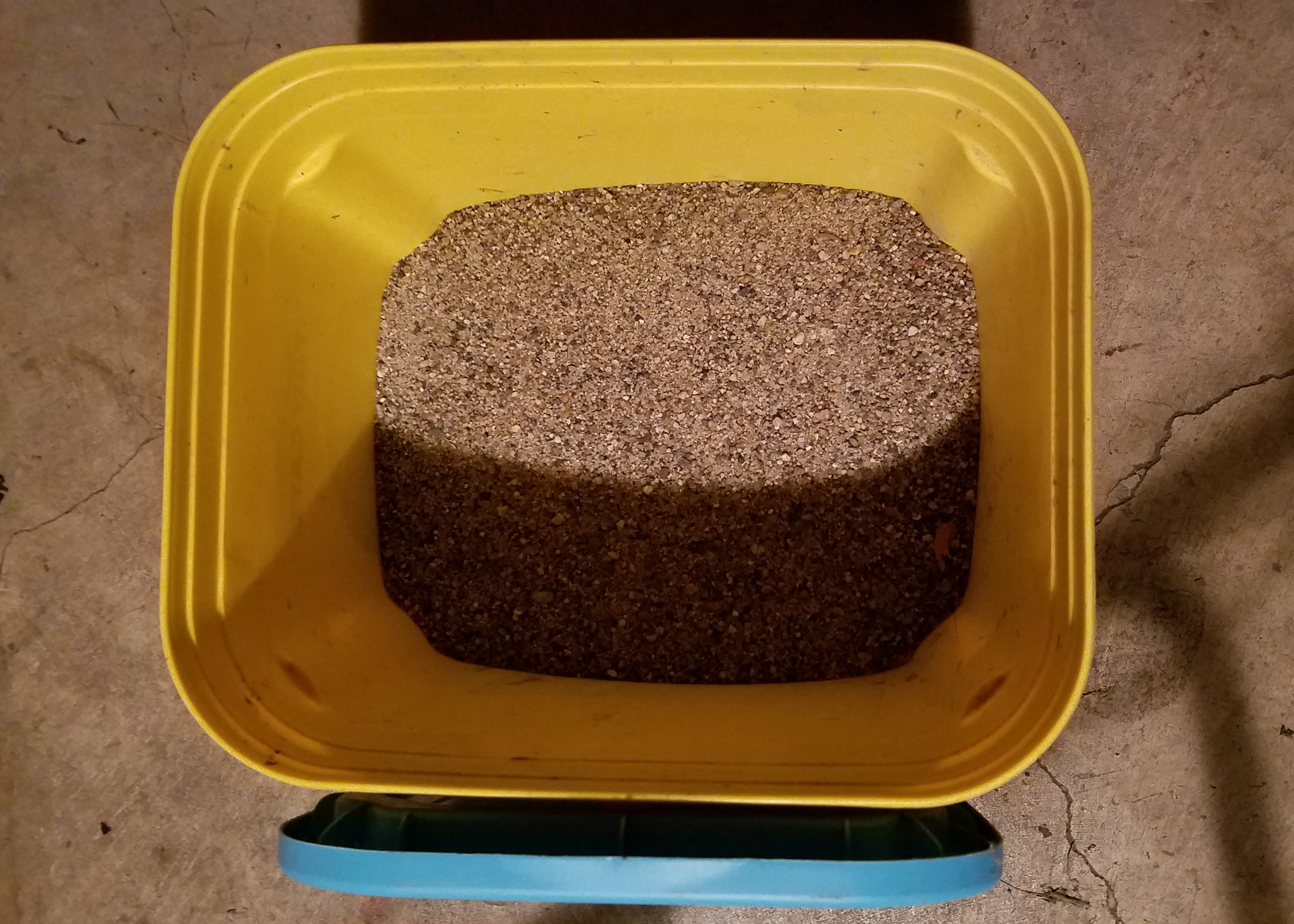
I spent part of Saturday collecting sand from the road in front of the house. I harvested more than we used this winter, so inventory is net positive by 1.5 buckets. It has been so warm we didn’t use sand at all on the driveway or steps.
Trees and lilac bushes are beginning to bud. Troubling but okay as long as a frost doesn’t return between apple blossom time and when they set. I shared my concerns about the early warm weather with a neighbor. We ended up planning a joint project for when frost is out of the ground. “Climate change” and “global warming” didn’t come up but weighed in nonetheless.
I breathed in fresh air and contemplated the beginning of things positive.
Thursday I coughed up a nickel-sized piece of phlegm. By Saturday the cold dominated my attention rendering me lethargic the rest of the day. Besides sand collection, I managed four loads of laundry and a simple dinner of cooked carrots and rice with a vegetarian “chicken cutlet.” Productivity was punk.
Calling off sick from the home, farm and auto supply store is an undesirable option. The reduction in pay for missing work is significant. Although we get 40 hours of sick pay during the year, I don’t want to use it unless I feel sicker than I do. We are incentivized by an end of year payment for unused sick pay. That check for last year came in handy.
Hopefully I can finish several outdoors chores on today’s list.
Rain is the best natural resource left in Iowa, helping us grow crops without irrigation because of its abundance.
If other parts of North America can more deserving be called America’s breadbasket — Central Valley, Imperial Valley and Salinas Valley in California particularly — Iowa is due for resurgence because of abundant precipitation combined with California droughts.
Water shortages in California have reached crisis level and despite government actions may not be resolved. If Iowa farmers were to diversify we could overtake California as America’s breadbasket. Now I’m dreaming.
Rain has been a blessing to Iowa and is expected to be our future.
Beginning in 1832, after the Black Hawk War, the landscape of Iowa was transformed from a natural place to a grid of farm fields, cities and towns. Enhanced by global warming, and changes in the polar vortex and prevailing winds, it rains in Iowa — sometimes too much. Rain is all that’s left of what was once a natural world. I’d go so far as to say there is no nature, only sentient beings struggling to survive in this built environment.
No one begrudges Anthony Sells’ saw mill for processing the trees that gave a name to Big Grove Township where I live. There’s plenty of blame for the built environment to go around. It matters little how we got here. What matters more is answering the question what will we do next?
For me that means collecting rain in our yard and preventing erosion. Some rain will be stored in plant life, some in vegetables and fruit. Some will make it to the ditch and the nearby lake. Take what rain we need and release the rest into the Mississippi basin and beyond. Have faith in rain.
What’s here is rain. Rain remains, it’s covalently bonded electrons exemplary of our being. Let it rain.
~ Published in the Jan. 19, 2017 edition of the Solon Economist/North Liberty Leader.
“We could use some of that global warming,” a truck driver told me.
It was a joke. The ambient temperature was in the low teens and we both work outside as part of our jobs. If the weather were warmer our jobs would be easier. I thought it was funny.
“I don’t really believe in global warming,” he said after a pause.
“It doesn’t really matter if you do,” I replied. “Like it or not our climate is changing because of man-made global warming. It affects us even when it is cold.”
He seemed skeptical. Given a recent study published in the Proceedings of the National Academy of Sciences journal I should have expected his response.
Our perception of climate change and willingness to accept scientific evidence about it is shaped by what we experience, according to Scott Waldman, writing in Scientific American.
That means if one lives where weather is cooler than average, he is more likely to be a climate change skeptic, deferring to personal experience as a guide. If one lives where it is warmer than average, she is more likely to accept the science of climate change, also deferring to personal experience as a guide.
“When personal experience and expert opinion don’t align on a topic that’s not critical to an individual’s well-being, they’re going to go with their gut rather than what the expert tells them,” Robert Kaufmann, the study’s lead author said.
Kaufmann said it’s human nature to trust one’s own experience over scientific evidence or political wisdom.
“Unless it really affects my everyday life, I’m not going to spend time studying this issue, and I’m not necessarily going to believe scientists either, especially now that experts are held in such ill repute, but I’m going to make up my mind based on how I can see and feel climate change,” he said. “For many people, that is record-high and record-low temperatures.”
Such attitudes notwithstanding almost two-thirds of voters across all parties want the Trump administration and the Congress to do more to address global warming, according to Kaufmann.
I appreciate a good climate change joke in the middle of winter because it presents an opportunity to address the fact climate is changing because of human-made global warming, and there is scientific evidence to support it. The conversation is something we should have more often, yet people avoid talking about climate change.
“Most Americans say global warming is personally important to them, but don’t talk or hear about it much,” Edward Maibach and others from the Yale Program on Climate Change Communication wrote.
In “Is there a Climate ‘Spiral of Silence’ in America?” the authors found “more than half of those who are interested in global warming or think the issue is important “rarely” or “never” talk about it with family and friends (57 percent and 54 percent respectively).” Fewer than half of Americans say they hear about global warming in the media monthly or more, and only one in five Americans hear people they know talk about global warming at least once a month according to the article.
It’s pretty quiet out there regarding discussion of global warming and climate change.
“The future of the planetary conditions on which human civilization depends are reliant now more than ever upon scientists and innovators, businesses and civil society, and our collective efforts to accelerate the implementation of the solutions to the climate crisis that are already available and cost-effective,” former Vice President and Nobel Prize winner Al Gore wrote in Scientific American.
If that’s the case, and no one is talking about climate change, how can we create meaningful action to mitigate the effects global warming is having on us?
The good news is technological solutions to the problem are working as the price of renewable energy approaches parity with fossil fuels. In some markets, solar generation of electricity is cheaper than with fossil fuels. If technology will lead the business community to reduce the greenhouse gas emissions contributing to global warming, we are part of the way there. Technology alone won’t drive the change we need. To find political will for action, every voter should engage in the issues. What can we do?
For my part I’m going appreciate the value of a good climate change joke, and use them to break the ice on conversations about the need to act on climate. People may agree or disagree, but talking about global warming and climate change, and the science behind them, is as important as laughter on a chilly day, or a cold drink during a drought.
In this final 2016 post it was easier than last year to outline my writing plans.
The work I do to pay bills and support my writing has been tough mentally and physically. To cope with an aging frame and occasionally distracted mind I have had to focus. That meant planning, and then with discipline, working the plan. 2016 was a mixed bag and I expect to do better in 2017.
I seldom post about my personal life and family — at least directly. That leaves issues I confront every day as grist for the keyboard.
There are four broad, intersecting topics about which I’ll write during the coming year.
Low Wage Work and Working Poor
Not only do I earn low wages in all of my jobs, I meet a lot of people who do too. During the last four years I developed a framework for viewing how people sustain their lives without a big job or high salary. A focus on raising the minimum wage, wage theft or immigration status may be timely but most of what I read misses the mark. Stories fail to recognize the complexity with which low wage workers piece together a life. This subject needs more exposition and readers can expect it here.
Food Cultivation, Processing and Cooking
Living on low wages includes knowledge of how to grow, process and prepare some of our own food. My frequent posts on this topic have been intended to tell a story about how the work gets done. I plan to grow another big garden in 2017 and perform the same seasonal farm work. I sent off a membership form to Practical Farmers of Iowa this morning and expect my experience with that group to contribute to food related writing.
Nuclear Abolition
I renewed my membership in Physicians for Social Responsibility. We have a global footprint and as a member I have access to almost everything going on world-wide to abolish one of the gravest threats to human life. The president elect made some startling statements about nuclear weapons this month. The subject should hold interest and perhaps offer an opportunity to get something done toward abolition. The United Nations voted to work toward a new treaty to abolish nuclear weapons. They did so without the support of the United States or any of the other nuclear armed states. In that tension alone there should be a number of posts.
Global Warming and Climate Change
My framework has been membership in the Climate Reality Leadership Corps. Like with Physicians for Social Responsibility we have a global footprint with thousands of Climate Leaders. We have access to the latest information about climate change and its solutions. The key dynamic, however, is how work toward accepting the reality of climate change occurs on a local level. What researchers are finding is skepticism about the science of climate change originates in the personal experience of people where they live. If the weather is very hot and dry they tend to believe in climate change. If it is cold, they tend not to believe. Thing is, climate change and human contributions to it are not a belief system as much as they are facts. Global warming and climate change already affect us whether we believe or doubt.
So that’s the plan. While you are here, click on the tag cloud to find something else to read. I hope you will return to read more in 2017.
It’s Christmas Eve in Big Grove, the ambient temperature is about freezing, and we’re ready to bunker in, finish decorating our Christmas tree and prepare a traditional supper of chili and cornbread.
My Christmas wish is for peace on earth.
Elusive as that may have been during 2016, we can’t give up hope. Not now. Not like this.
As winter solstice brought longer days — increasing light imperceptible in each day’s cycle — it is time again to fly with eagles, gain a broader perspective, and thank people who are always in these written words if rarely mentioned — my wife Jacque, our daughter, my parents and my maternal grandmother.
Reading
I continue to read more on my phone and computer than I do full-length books. Nonetheless I managed thirteen books in 2016, the most important of which were authored by people I know: Connie Mutel and Ari Berman.
Methland by Nick Reding had the biggest influence, by a distance.
Here’s the list of books, most recent first:
Diet for a Hot Planet: The Climate Crisis at the End of Your Fork and What You Can Do About It by Anna Lappé; My Life on the Road by Gloria Steinem; Sapiens: A Brief History of Humankind by Yuval Noah Haran; Methland: The Death and Life of an American Small Town by Nick Reding; Give Us the Ballot: The Modern Struggle for Voting Rights in America by Ari Berman; A Sugar Creek Chronicle: Observing Climate Change from a Midwestern Woodland by Cornelia F. Mutel; Atlantic: Great Sea Battles, Heroic Discoveries, Titanic Storms, and a Vast Ocean of a Million Stories by Simon Winchester; And Then All Hell Broke Loose: Two Decades in the Middle East by Richard Engel; Slavery in the Upper Mississippi Valley, 1787-1865: A History of Human Bondage in Illinois, Iowa, Minnesota and Wisconsin by Christopher P. Lehman; The Diary of a Napoleonic Foot Soldier by Jakob Walter; Old Man River: The Mississippi River in North American History by Paul Schneider; MiniFARMING: Self-Sufficiency on 1/4 Acre by Brett L. Markham; and Fast Food Nation: The Dark Side of the All-American Meal by Eric Schlosser.
For the fourth year I edited Blog for Iowa while Trish Nelson took a break, writing at least one post each weekday during August. My book review of Give Us the Ballot ran in The Prairie Progressive, a guest column ran in the Cedar Rapids Gazette, and I wrote two letters to the editor of the Solon Economist since the general election. I cross posted Next for Iowa Democrats on Bleeding Heartland, my first post there.
More outside publication is planned for 2017.
Working
Income from five jobs helped financially sustain us in 2016. Work at the home, farm and auto supply store provided health insurance and a regular, predictably low paycheck. In descending order of income were jobs at Wilson’s Orchard, Local Harvest CSA, Blog for Iowa and Wild Woods Farm.
Each of these jobs was good for a reason. Blog for Iowa encouraged me to write every day. Farm work helped me connect with others in the local food movement. The home, farm and auto supply store provided a venue for conversations with low-wage workers. I’ll seek additional income in 2017 and maintain relationships with each of these organizations.
The common denominator among these jobs is interaction with people. As I enter my last year of work before “full retirement,” I seek that as much as income.
Gardening
2016 was another improved year in our home garden. Among many experiments were growing root vegetables in containers (a success with carrots and daikon radishes), growing squash in the unused storage plot, and using sections of 4-inch drainage tile to protect young seedlings. Failures included bell pepper plants which succumbed to weed competition, and loss of tomato yield due to a lack of attention. The best crops included broccoli, celery, eggplant, tomatoes, Bangkok peppers, turnips, basil, sage, oregano and kale.
Ancillary activities included distribution of kale and a few other vegetables to local library workers and friends, and weekly posts about the garden on Facebook.
We raised adequate produce to serve the needs of our kitchen. I also learned a lot through collaboration with friends and neighbors.
Apples
I followed the 2016 apple season at the orchard and continued to develop our home apple culture. Our apple trees did not produce a crop this year.
The last of the 2015 crop is peeled, sliced and frozen, or turned into applesauce and apple butter. We have enough frozen apples left for a Christmas Day dessert. This year’s orchard apples were mostly eaten fresh.
I made more apple cider vinegar. The process was simple: I added Jack’s heritage mother of vinegar to apple cider from the orchard in half-gallon ventilated jars and waited. This year I added an eighth-teaspoon of brewers yeast to each container at the beginning. The benefit was hastened alcohol production and a superior final product. I also learned that a cooler temperature slows alcohol production and this can produce a better result. Today there are two gallons of apple cider vinegar in the pantry and another gallon and a half in production.
Politics
The general election did not produce the result many people, including me, wanted.
At the same time, a lot of acquaintances seek to become active and “do something” during a Trump administration. There is plenty of work to resist the expected rollback of what we value in society. Specifically, work toward protecting the environment, reducing the number of nuclear weapons, and ensuring social justice.
My term as a township trustee ends Dec. 31, so regarding politics, I can be an unencumbered agent of change. The next step is to leverage the opportunity the general election brought with it.
Retirement
The time since my July 2009 retirement from CRST Logistics can be divided into clearly defined phases. First came a period of social activism characterized by work with community organizations. It lasted until the end of 2011. Next was the political year 2012. After that, life found me working low-wage jobs to support my writing. That’s where I am today. In 2016 came a realization that in order to spend more time writing, I have to get past the finish line to “full retirement” as defined by the Social Security Administration. For me that’s in December 2017. I took the first step by signing up for Medicare this month.
2016 was a time to learn, work on writing, and do things that matter. More than anything, I have been writing. Everything else provided a platform or material for it. If 2017 presents significant challenges, there should be plenty to write about.
Some of us aren’t doing any soul searching after the 2016 general election.
Democrats lost, and as a Democrat that means something to me personally. Yet I know what I stand for and so do my friends and family.
Nothing about our beliefs was changed by the election of Donald Trump. If anything, we plan to work harder to advocate for what we believe is just.
Last week the president-elect and his daughter met with former Vice President Al Gore. Gore’s statement after the meeting was important as it pertains to mitigating the negative impact of man-made global warming and climate change on humans. It also applies more generally.
“Despair is just another form of denial. There is no time to despair. We don’t have time to lick our wounds, to hope for a different election outcome,” Gore wrote. “We have to win this struggle and we will win it; the only question is how fast we win.”
I share Gore’s optimism and so should people who care about leaving a better world for our descendants.





 Journey Home
You must be logged in to post a comment.