Categories
Living in Society

Iowa Democratic Veterans Caucus Shunned

The Author with Veterans the Iowa State Fair Veterans Day Parade, Aug. 17, 2009.

The 2018 midterms are going to be a pisser and nothing indicates the bitter intensity of the upcoming electoral contest like publicly shunning the Iowa Democratic Veterans Caucus.

Whether or not there should be a veterans caucus, and a state central committee seat for veterans, is an open question. So few people participate in this caucus — and there are tens of thousands of Democratic veterans — the Iowa Democratic Veterans Caucus is not representative of any but a select few veterans’ views. That’s a problem.

However, thanks to the Reynolds administration, which ejected the group from participation in the State Fair veterans day parade, there may be a renewed interest in the caucus. The Iowa Democratic Party has certainly been more interested, making political hay out of the public shunning. The IDVC itself has been fund raising with twitter posts over the brouhaha.

Any veteran should know what I posted on twitter:

Truth be told EVERY veterans group that was at the parades I participated in had a political axe to grind. The idea veterans parades are apolitical is bunkum.

If we are going to shun veterans groups from the State Fair veterans day parade for political affiliations, let’s start with the American Legion which has a registered lobbyist in Des Moines.

I’ve written many times about being a veteran and this rings true today:

When I left the 2nd Battalion, 87th Infantry, and the Robert E. Lee Barracks in Mainz-Gonsenheim, Germany, I returned my service revolver to the arms room and never looked back. It was with a sense of duty, family tradition and adventure that I had entered the post Vietnam Army. My enlistment was finished, I resigned my commission and like many soldiers turned civilian, my main interest was in getting back to “normal,” whatever that was.

Many veterans are Iowans and it was wrong for the Reynolds administration to begin politicizing the State Fair veterans day parade. She attempted to dodge responsibility, but how is that possible for a sitting governor?

I thought I’d gotten back to normal after my military service. Thanks to this Republican government I need to talk more about my time in the military and the Democratic values so many of my colleagues then held. It’s something I’d much rather let lay, but in an election where everything is politicized, to walk away from it would be neglecting my own responsibilities. That’s something a soldier rarely does.

~ First posted at Blog for Iowa

Categories
Kitchen Garden

Serrano Pepper Salsa

Serrano Pepper Salsa

We don’t need any more salsa in the house yet the abundance of hot peppers this year had me making this recipe… it’s a big batch.

My Serrano pepper crops failed the last couple of years so I’m glad to have more this year.

There weren’t enough of them in the ice box so I went to the garden and picked more. No Roma tomatoes either so I used Clementine, a two-ounce, orange colored tomato of which we have an abundance.

This year I froze the salsa and am not sure how it will turn out when I use it — an ongoing experiment in food preservation. I bagged up two-cup servings. The rest is in the ice box ready for use. The recipe made 17 cups of salsa.

Serrano Pepper Salsa

Ingredients
2 pounds Serrano peppers
3-1/2 pounds Roma tomatoes
1 pound yellow onions
24 ounces tomato sauce
1/4 cup salt
1/4 cup ground black pepper
1 large head of garlic

Technique
Clean and stem the peppers. Clean and prep the garlic, tomatoes and onions, cutting into large chunks. Put the vegetables into a blender in batches. Grind it until medium coarseness. Mix the end result thoroughly in a large bowl. Add the salt, pepper and tomato sauce and mix until ingredients are incorporated.

It is debatable whether to cook the mixture. I like it fresh, although if one wants to can salsa it should be brought to a boil, stirring constantly to keep it from sticking to the pan, and then cooked for ten minutes under medium low heat. After cooking, fill pint Mason jars with the mixture, leaving an inch of head room, and process for 15 minutes.

We’ll be in salsa for months with this recipe. Now what to do with the jalapeno peppers. I’ve already pickled and frozen enough to last until next year.

Categories
Writing

At Summer’s End

KCRG Weather Map 6:36 p.m. Aug. 28, 2018

We turned on the T.V. for the first time in a couple of years to watch the weather report. A large storm moved across Iowa at a high rate of speed and despite home computers, mobile devices, and a community siren wailing in the distance, we felt we needed one more source of information.

The storm amounted to a heavy rain in the micro climate surrounding our neighborhood. It could have been worse.

I finished my summer work at Blog for Iowa. Two months, 52 posts, and a process for gathering information and putting up content our readers might find interesting. I first posted on the blog in February 2009 and made 993 posts since then. It has become part of my writer’s life with a different audience and more exposure. I plan to post more on Blog for Iowa although for now it’s time to turn the page.

I took two days of vacation from the home, farm and auto supply store this week, before the retail dash to the end of year holidays. The time off is compensated by additional work at the orchard. A month into apple season we’re gearing up for a big Labor Day weekend picking Honeycrisp apples — a community favorite. We’ve had a bowl of fresh apples sitting on the counter since I returned to work Aug. 4 for my sixth season.

Yesterday, after my daily trip to the garden, I spent time in the kitchen processing vegetables. The bakery manager at the orchard gave me a bag of small, red hot peppers which are in the dehydrator. I roasted then processed a pan of jalapeno peppers producing eight ounces of hot pepper sauce to use in cooking. While I had the oven on I roasted eggplant and put it in the freezer. Cleaning, sorting, storing cucumbers and tomatoes — trying to stay on top of the harvest. There is a lot more processing to be done before summer ends.

These stories about daily life in Iowa are something. That I write them at all depends upon reasonably good health in a stable society. As much as society and our assumptions about it seem to be unraveling, it’s still here, providing a platform for imaginations. From here I can live a better life, even as I approach the end of my seventh decade. We can’t give in to entropy.

What excites me these days is an understanding that comes with letting go of the old arguments, the old apologies and explanations in life. I accept our human nature. Our intellect can see into the future, however, we can only live now.

I trade in narratives about what happened, about what could be. As I continue to write I seek something, resolution of past grievances perhaps. More importantly I seek a narrative that will carry us into tomorrow. A story about the greater good that remains possible in these turbulent times.

My list of today’s kitchen work has five things: zucchini bread, Serrano pepper salsa, process celery, make refrigerator pickles and Pecos pasta for supper. These will nourish me today and for a while. What I need isn’t food.

Occasionally I get glimpses of life as it could be. Paying attention to those is what makes life worth living. It’s nourishment for the unseen presence in our lives. Whether it’s God, my ancestors, or beams from the great beyond I can’t determine. In that sense, I plan to focus on these glimpses of life while telling my story. Hopefully I can provide something worth while for readers.

Categories
Living in Society

Jeff Sessions is Overworked

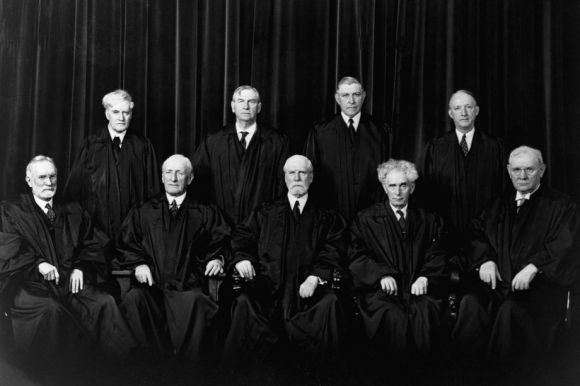
Justices of the U.S. Supreme Court, 1937-38 term. Sitting, from left to right, Justices Sutherland and McReynolds, Chief Justice Hughes, Justices Brandeis and Butler. Standing, left to right, Justices Cardozo, Stone, Roberts, and Black. Photo Credit – Getty Images

Poor Jeff Sessions seemed overworked at an event in Des Moines last week. Sessions is the 84th Attorney General of the United States and apparently a snowflake.

In a room full of judges and lawyers Sessions assailed the judicial branch of government for obstructing the 45th president’s agenda, according to an article in the Aug. 17 Cedar Rapids Gazette. Executive branchers seem to believe their agenda is the only important part of governance and all others should bow down in obeyance.

The flurry of executive orders, proclamations, memoranda, nominations and appointments issued by this president have created a massive workload to hear Sessions tell it. That’s not to mention the lawsuits filed to protect citizens from the troop of marauding grifters the Trump cabinet has proven to be.

Sessions enumerated concerns about his health and some anxiety:

“I may have withdrawal symptoms when this thing is over. The constant criticism kind of wakes you up in the morning. ‘What are they going to say today,’” Sessions was quoted as saying in the Gazette article. “I’ve got lawyers, 100,000 people in the Department of Justice who represent all these federal agencies with all their millions of employees and I’m expected to know everything that’s happening. And when it doesn’t get right, they’re going to put me in jail. That’s kind of sometimes the way I feel about it.”

Poor peanut. Being attorney general is hard.

The 2016 general election was as much about the judiciary as the executive branch. Not only did the Republican Senate obstruct the nomination of Merrick Garland to the U.S. Supreme Court by President Obama, the current president will appoint two and maybe more associate justices cut from a conservative mold. In addition, the administration is populating the federal judiciary with judges vetted for conservative views. Even if the current judiciary favors Democrats, Trump’s minions are working to change that.

There is a long tail on the process — it will be no relief for the attorney general.

Perhaps most telling in the Trumpian storm of executive orders and deregulation is on Aug. 16, a federal judge “issued a nationwide injunction against the EPA’s delay of the 2015 Water of the U.S. rule, which extended federal safeguards to 2 million miles of streams and 20 million acres of wetlands, securing the drinking water of more than 117 million Americans,” according to Huffington Post. WOTUS has been the bane of regulation for U.S. Senator Joni Ernst who has been resisting it since first proposed during the Obama administration. Not so fast General Sessions. more work for you to do. There are laws on the books and the judiciary said in this case you and your boss have to follow them.

I don’t know what people do under pressure in Alabama where Jeff Sessions was born. However, Democratic President Harry Truman has some advice: “If you can’t take the heat, get out of the kitchen.”

Jefferson Beauregard Sessions III should quit whining and get to work. If it’s too much, resign. Some Alabama peckerwood that reveres his namesakes would no doubt welcome him back. Many of us are already working toward a replacement in 2021.

~ First posted at Blog for Iowa
Categories
Living in Society Social Commentary Writing

Newspapers Are Working – So Subscribe

Solon Economist – 2016

Despite significant decreases in staff and other expenses, many newspapers crank out stories relevant to our daily lives.

For example, Jason Clayworth and Brianne Pfannenstiel published a full-page article about Democratic gubernatorial candidate Fred Hubbell’s tenure at Younkers in the Gannett newspapers on Monday. I don’t know how many people will read the article but the fact newspapers crank out copy for Iowans addicted to politics says something positive about the fourth estate, even if having to re-litigate the quotes attributable to the Iowa GOP is somewhat annoying.

Also on Monday, the Cedar Rapids Gazette had front page, above the fold coverage of 2020 Democratic presidential candidate John Delaney’s completion of a 99-county tour of Iowa. Delaney won’t likely be our next president but having the field to himself gives him name recognition he won’t be able to get once more Democrats jump into the presidential race.

I’m told newspapers run non-political stories as well.

Blog for Iowa encourages people who read newspaper coverage on line to subscribe. Without paid readership advertisers won’t buy ads. Without revenue, newspapers will cease to exist. If newspapers cease to exist… well that would be a much different bag of cats. In fact, I predict cats and dogs is all you will read about. While personal, funny, sad, and sometimes delightful, a story about pets is not news.

There may be no saving larger newspapers. As we’ve seen in our county, large news organizations are consolidating, and local coverage has been stripped from daily ink. Instead of getting the Iowa City Press Citizen, most people here read the Cedar Rapids Gazette because of its breadth and depth of coverage. There isn’t even a Sunday edition of the Press Citizen here, and the opinion page runs only a couple of times a week. Team Gannett produces valuable coverage, but it is not local. It is not enough.

Small, local papers with subscriptions of a thousand readers are doing well in Iowa, so if your community has one, spend the nominal annual fee and subscribe. It’s a great place to start and coverage of city council, school board and community activities is second to none. Even though your large local paper may be on the decline, subscribe. I prefer digital so I don’t have to recycle the newsprint. But either way would be better than the alternative.

Thomas Jefferson is reputed to have said, “Were it left to me to decide if we should have a government without newspapers, or newspapers without a government, I should not hesitate a moment to prefer the latter.”

Just imagine what our lives would be like with government but no newspapers. Subscribe.

~ First posted at Blog for Iowa

Categories
Living in Society Social Commentary

Late Summer in Iowa

Summer Vegetables

A pall fell on Iowa as the family prepares for tomorrow’s funeral of Mollie Tibbetts, the 20 year-old college student who was murdered near Brooklyn, Iowa.

Many of us feel a connection to her whether we knew her or not. She went jogging and never came back. We grieve with her family and friends.

Many, including the 45th president, seek to politicize her death. We can’t let that stand. We won’t let it stand. May she rest in peace.

Tragic summers are part of living in Iowa.

While the current midterm election cycle will continue toward its fall conclusion, we live our lives outside of politics. The politics I have come to know recalls a few triumphant moments: Lyndon Johnson’s 1964 re-election; Dave Loebsack’s 2006 election; and maybe Barack Obama’s 2008 election. So few celebrations in the wicked world and none of them perfect. Politics is not why we go on living.

Set aside our work and endeavors to make society better, and what’s left? For some of us it is a deep and abiding love of life — including its comedic and tragic drama. If we tell ourselves stories to live, what story will we tell about this summer so we can go on living?

Division among us makes it harder to craft a narrative for holding back tears — tears of loneliness, of sadness for the loss. Tears unexpectedly salty and wet pulled down by gravity to our tongue. Impartial tears of grief. I am heartened by the idea there is no other side, just one country of which we are all a part.

In the wee hours of morning lightning and thunder preceded rain. I couldn’t sleep. I got up to get a drink of water from the kitchen and felt dizzy walking down the hall. I drank a few ounces and went back to bed, sleeping fitfully.

I’m still tired yet ready to go, ready to take on what’s next. To make the next effort worthy of a life, honorable to our predecessors and invigorating for who’s next. Despite summer’s tragedy we look forward to winter, and ultimately to spring and the chance to renew our lives.

In this moment it’s hard to contemplate the garden’s bounty. Even though it is hard, we will persevere and make something of it. A meal for today and ingredients for the future. What else will we do in the face of tragedy but go on living?

Categories
Writing

Writing in Summer Rain

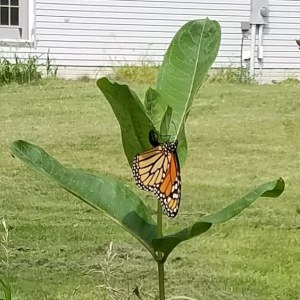
Monarch Butterfly on Milkweed Plant

Thunderstorms have been rolling over all day bringing needed rain and a chance to get caught up indoors.

I’m less freaked out about the amount of food processing ahead. There have been more cucumbers than normal and I canned the last seven quarts of sweet pickles this morning. That will be the last, I promise. I also canned pints of tomatoes, apple sauce and a jar of the same pickles. While the water bath was bubbling I made a pot of chili for supper with fresh tomatoes and Vidalia onions. We’ll cook the remaining sweet corn of the season. My retirement has had that effect — things are less freaky.

Tomatoes are next, although the plan is to eat as many fresh as possible. With only two of us at home, we can’t eat fast enough to keep up with the growing and cooking so some will be canned and turned into tomato juice and sauce. I’m taking it in stride.

Two weekends ago the orchard hosted our back to school weekend. A balloon artist/magician entertained children, and of course there were apples to pick and eat. It was a chance for parents to have one more family fun event before school begins.

Getting ready to attend grade school was one of the great pleasures of life. Each fall began with friends, new clothes, new pencils, and lined, blank sheets of paper. I needed new clothes after growing out of mine. I was first born, so no hand-me-downs. The sensation of hope and opportunity to begin anew is memorable, unlike anything I experience these days. It was something. I hope today’s graders feel the same way.

A Dad walked into the sales barn at the orchard carrying a young child on a backpack and a two-year old on his shoulders. He looked very fit. After they picked apples the toddler helped me transfer apples from our basket to a bag. “Do you want to count them?” I asked. At two, children aren’t really sure what counting is, or how exactly to do it. He just pick up one apple after another and let me do the counting after one and two.

I can see why people return to work after retirement. When we’ve worked our whole lives in stressful situations there’s no slowing down. It will take work to settle in more comfortably after 50 years in the workforce. What I once thought were extra things — cooking, gardening, reading and writing — are now life’s main event. Not sure how I feel about that. I won’t be for a while.

August is the last month to cover editorial duties at Blog for Iowa. I’m not sure what will be next. We’re moving quickly through the procession of apples, Red Gravenstein, Sansa, Akane and Burgundy this week. We have family Friday events through the month of September, so with work at the home, farm and auto supply store time will fly — almost like I’m working again.

Not really. Living one day in society at a time as best I can, hopefully with enough money for seeds in the spring.

Categories
Living in Society

Public Dollars and Private Education

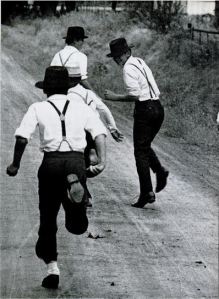
Amish Boys Near Kalona by John Zielinski. Photo Credit – Life Magazine Oct. 24, 1969

The Iowa Republican argument for spending $53 million dollars to support private schools and home schooling programs during the 2017-2018 school year is giving parents options.

“There’s been a trend to slowly put some dollars towards people who are choosing different options,” state Rep. Walt Rogers (R-Cedar Falls) said in a July 18 article in the Iowa City Press Citizen. “I would say that’s a good thing. We want to give as many options for parents and students as we possibly can.”

Rogers is chair of the Iowa House education committee which has overseen spending half a billion state dollars for private schooling since 2008.

This annual expenditure should be on the budgetary chopping block.

It is important that children are not left behind in society. For a long time state government helped private education efforts with tuition and textbook tax credits, busing, teaching assistance, and access to extra-curricular activities for home schooled children. Some of that should continue, although $53 million per year seems like too much given the lean fiscal diet forced on public schools.

When I attended parochial grade and high schools I believed the Catholic parish to which our family belonged made the contributions that paid all school expenses. I came up in the late 1950s and 1960s and contributing to the schools was a regular topic at Sunday Mass. The main way I recall government contributing was in donating surplus food to our school lunch program. There may have been other contributions, but we felt we were on our own. That’s a reality of starting and running a private school.

When I think of home schooling I recall the conflict between Iowa officials and the Amish community near Kalona over children attending public schools. National news outlets covered the story in the 1960s, and eventually the Amish community retained control over the process. Home schooling has changed since then and a lot more people and communities want to home school or encourage it.

This budget debate is not about options. Generating options is not state government’s role. The financial assistance to private and home schools by government has been on autopilot since the 1960s and created a process that obscures the lines between public and private education when it comes to public financial contributions to private schools and home schools. While contributing more state dollars to education than ever, government is under funding public schools, not even keeping up with the cost of inflation. Something’s got to give. It should be private schools rather than forcing public school teacher layoffs and school consolidation.

I don’t presume to have the answer, except to elect a Democratic Iowa House to buffer against the worst parts of the Republican agenda regarding private and home schooling. What we are doing now isn’t working. It is time for change.

~ First posted on Blog for Iowa

Categories
Environment

Irony About Climate Change in New Orleans

Image of Earth 7-6-15 from DSCOVR (Deep Space Climate Observatory)

It is no surprise the Heartland Institute hosted a conference called “The America First Energy Conference” for climate change deniers on Aug. 7 in New Orleans.

Heartland is the libertarian think tank that teamed up with Philip Morris to deny the health impacts of tobacco use. Climate change denial is high on their priority list.

“The day-long conference reflected the political rise of global warming skeptics in Donald Trump’s America that is occurring despite mounting scientific evidence, including from U.S. government agencies,” Reuters correspondent Collin Eaton wrote, “that burning oil, coal, and natural gas is heating the planet and leading to drought, floods, wildfires, and more frequent powerful storms.”

“The leftist claims about sea level rise are overblown, overstated or frankly just wrong,” Heartland president and CEO Tim Huelskamp said in an interview with Reuters. Regarding the United Nations’ findings on climate change, he said it was “fake science” motivated by a desire for “power and control.”

An irony is the conference is being held in the American city most impacted by extreme weather made worse by climate change. New Orleans has not recovered and may never recover from the August 2005 Hurricane Katrina.

“One of the country’s largest credit rating agencies has put New Orleans and other coastal cities on notice: prepare for the effects of climate change or risk a hit on your credit score,” according to Tristan Baurick at the New Orleans Times-Picayune. When the risk analysis community says it, it must be real.

Climate change is real, it’s happening now, and human activity is a primary contributor to extreme weather events like New Orleans experienced.

The rise of a conference like this is attributable almost entirely to the rise in prominence of libertarian billionaires with a long range plans to re-make American society to their liking. They believe their liberties have been infringed upon by government regulations and the Trump administration has been removing barriers to the practice of unfettered capitalism. That’s not good for you, me, or the people of New Orleans.

It is shocking how much the Trump administration has deregulated government in less than two years. The fact the Environmental Protection Agency is deregulating asbestos, a known carcinogen banned in 55 countries, is a sign of how far they will go. The only check on such behavior is for Democrats to win a majority in at least one chamber of the next Congress during the 2018 midterm elections, or to vote Trump out in the 2020 general election. Much damage has already been done. Some of it can’t be reversed.

I met a nine-year-old from Saudi Arabia recently. He lives with his extended family on the Arabian Peninsula and has come to Iowa the last couple of years to visit his mother before school starts in September. We talked about the weather.

“It sure is hot,” I said.

“Yes, but I don’t believe it is climate change,” he replied.

“No, probably not,” I said. “It’s August in Iowa.”

It is one thing for children to learn the difference between weather and climate change. When adults in the room deny the science of climate change, it’s something else. It’s clear there were few adults at the conference in New Orleans.

~ First posted on Blog for Iowa

Categories
Environment Kitchen Garden

A Difficult And Strange Season Of Weather

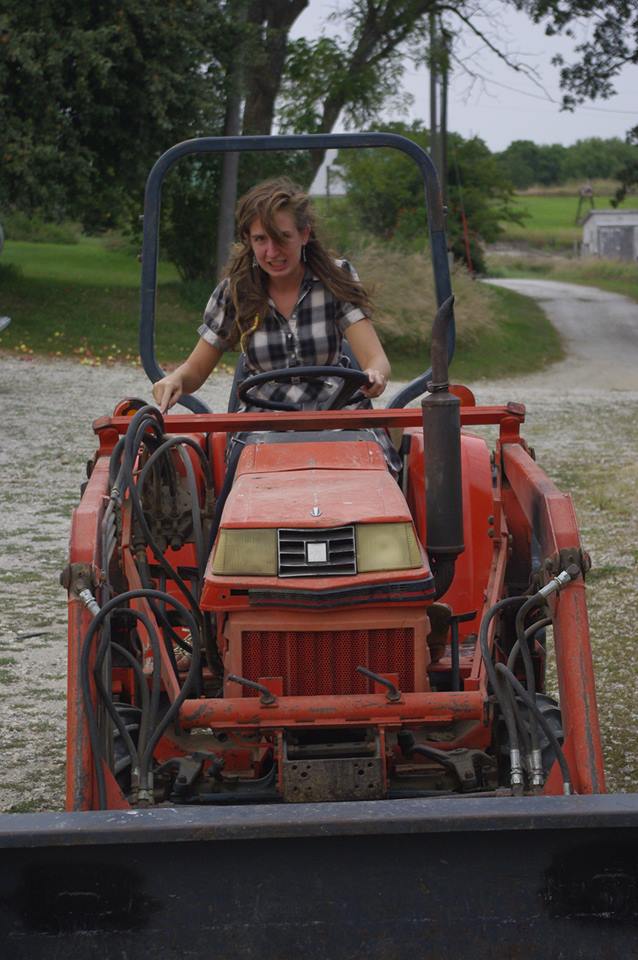
Carmen Black at Sundog Farm

By Carmen Black

(Editor’s Note: Iowa Farmers deal with an existential reality that is the weather. Regardless of increasingly polarized discussions about climate change, weather affects real people in tangible ways. Carmen recently wrote this piece to members of her Community Supported Agriculture project Local Harvest.)

The weather has been consistently challenging from the late spring to immediately hot May, from lots of rain to this current dry spell. There hasn’t been a catastrophic weather event, but all these different difficult weather conditions create more work to keep everything growing well.

I’ve been thinking more about it as we’ve been observing its impacts while harvesting more of the summer crops. I’ve talked to many other farmers (including folks that grow other types of crops) about the challenges of this season, and anecdotally it seems like the conditions have been hard on many types of crops and livestock alike. One of things that has struck me about this year is that it hasn’t been just one way like really hot or really wet, but every month has brought a different extreme to contend with. It’s made me wonder if it’s all this erraticness that’s been stressful to the plants and animals rather than just the heat or just the late spring.

I was curious to find out if the weather has just felt difficult to us or if it really has been extreme in the grand scheme of things, so I did a little internet research for weather data. What I found was interesting, and did seem to affirm my feeling that this year really has been weird. This was the coldest April on record (since records began in 1895), and was on average 10 degrees colder than normal. It was also somehow both the 5th snowiest April and the 13th driest April, which seemed a little ironic. 2018 tied for the 6th warmest May with 1887, and the average temperature was about seven degrees warmer than normal. Des Moines had three consecutive daily record highs from May 26-28. I was surprised that in Cedar Rapids the daily record highs for the end of May were all held by 1931 or 1934, and then I realized that was the dust bowl! June was the 10th warmest and 10th wettest June on record. July seems to have been pretty average after all those top 20 finishes for the previous months, as it was the 54th coolest July and the 47th driest July on record. Which I think kind of puts the extremeness of the previous months in perspective. Kind of nice to have an average month finally.

Anyhow, my main takeaway is that this year really does seem to be remarkably erratic when you look at the numbers, and it makes sense that plants and animals would respond unpredictably to all of these changes in the weather. I feel both good that I wasn’t making up that the weather has been extreme in many different ways this season, and kind of bad that it really has been historically weird this year. The fact that it took the dust bowl to beat this year out for daily heat records in May felt kind of grim.

Some crops like onions seem to have really suffered from this weather. You may have noticed that they’ve been smaller than normal this year, and after getting most of onion harvest done last week I’m sorry to report that many of the longer season onions are even smaller. This was especially disappointing to me after such a bountiful onion harvest of really giant ones last summer, but I think makes sense considering what we were up against. We planted more than 3 weeks later than we did last year because it kept snowing, and then had to irrigate the onions (which we hardly ever have to do) because it was so dry. We struggled to keep the weeds under control in the onion field in June when it was so wet, and spent almost a week wallowing in the mud trying to hand weed. All in all I’m glad we have some onions to show for all of it, and have a few ideas of things to try in case this ever happens again.

I also have to say that some crops seem to have really thrived in this weather. We’ve never had such a good cucumber or spring carrot crop before, both of which are crops that we have historically struggled to produce large quantities of for several weeks in a row. The combination of having plenty of carrots and cucumbers has felt like a great accomplishment, and I hope that we’re able to replicate it in a better weather year as well!

~ Carmen Black farms in Cedar Township in Johnson County, Iowa.