First published on Nov. 7, 2010 on my blog Big Grove Garden.
Pepper Flakes
There is a natural urge to use everything. It gets suppressed by the modern American culture of throwing things away. In our house we often don’t have trash to take to the curb each week, but almost always have recycling to go out. American frugality has been in remission, but expect a comeback.
While working in transportation, I received a gift of some dried peppers in small plastic bags. Two bags have been sitting in the pantry for a while. In addition, I grew a long, thin and red pepper in the garden a few seasons ago. Some of these were dried and stored. In the box store yesterday, in the Mexican food section there were four feet of dried peppers in many different kinds. They were cheap and I bought two bags of the most abundant types. When I got home, I combined all of them and ground about half into pepper flakes. The one jar this produced will last a very long time. When I grind the second batch, it will go into small jars for gifts.
The challenge of American society will be to balance abundance with frugality. Waste not, want not is how it goes. I am afraid that we have not been understanding what we have been wasting, and it’s time we did.
My trips to Texas have been entirely business related. I can’t say how many times I’ve been there but since 1984, when I began my work in transportation, maybe a couple dozen times. I may also have stopped over in Dallas on a flight from time to time. I am familiar with the skyline in the approach to DFW airport.
I wouldn’t want to live in Texas.
It is a land of uneducated people and many are proud of the fact. Texans I’ve known were both religious and hypocritical, always in things for themselves or not at all. Thievery was accepted if a person got something out of it and got away with it. Racism was common among people I met. There was a deep-seated hatred for black people treated equally by the federal government. Treatment by the government was a particular catalyst for conversations about injustice to white people. Hispanics? They were needed for labor whether they were documented or not. Hispanics were a permanent underclass during my travels. When I say “uneducated” I’m referring to white folks.
Don’t get me started on the treatment of women. Texas SB8 bans abortion after about six weeks of pregnancy, before most women know they are pregnant. No exceptions for rape or incest, just bear the child. If you are 11 years old and can’t get a driver’s license, just bear the child. Got a medical problem during pregnancy? Just bear the child. Naturally, the man’s role in a pregnancy is seldom mentioned. The U.S. Supreme Court decided not to stay the law as it is litigated through the court system, effectively ending a woman’s right to choose in the state. The court’s decision was a step too far even for Chief Justice John Roberts who was responsible for gutting Texan Lyndon Johnson’s Voting Rights Act of 1965.
It’s well reported in the national news Texas Senator Ted Cruz placed a hold on President Biden’s state department and foreign service nominees needing confirmation by the U.S. Senate. It has to do with Biden lifting sanctions on the Russian Nord Stream 2 pipeline. Oil and gas has played heavily in Texas politics since before LBJ was elected to the U.S. Senate. How different would our last days in Afghanistan have been if State was fully staffed with permanent people?
I’m not saying Iowa is much better than Texas. It’s not. Since the Republican Party went off the rails after the re-election of Terry Branstad in 2010 it’s gotten worse here with each legislative session. It won’t be long before Iowa clones Texas SB8, although there is a sticky problem with the Iowa Supreme Court decision in 2018 which said Iowa women have a fundamental right to an abortion according to the Iowa constitution. A news person I know said, “It’s pretty clear that anti abortion organizations feel this is their moment, so the pressure will be there (to pass a law similar to SB8).”
We don’t grow cotton in Iowa yet our approach to controlling agricultural pests is similar: spray them with chemicals until they die. About the best thing I can say about Iowa compared to Texas is we don’t have tumbleweeds here. We have a government controlled by Republicans who say they reflect what people want. I haven’t met many of those people in 60 years living here.
I retain some hope for Iowa. We’ll see how the 2022 election goes before going too negative. Suffice it I have no reason to travel to Texas anytime soon. Not even for a visit to the popular festival, the rattlesnake roundup. We have our own snakes in Iowa. They need to be voted out of office.
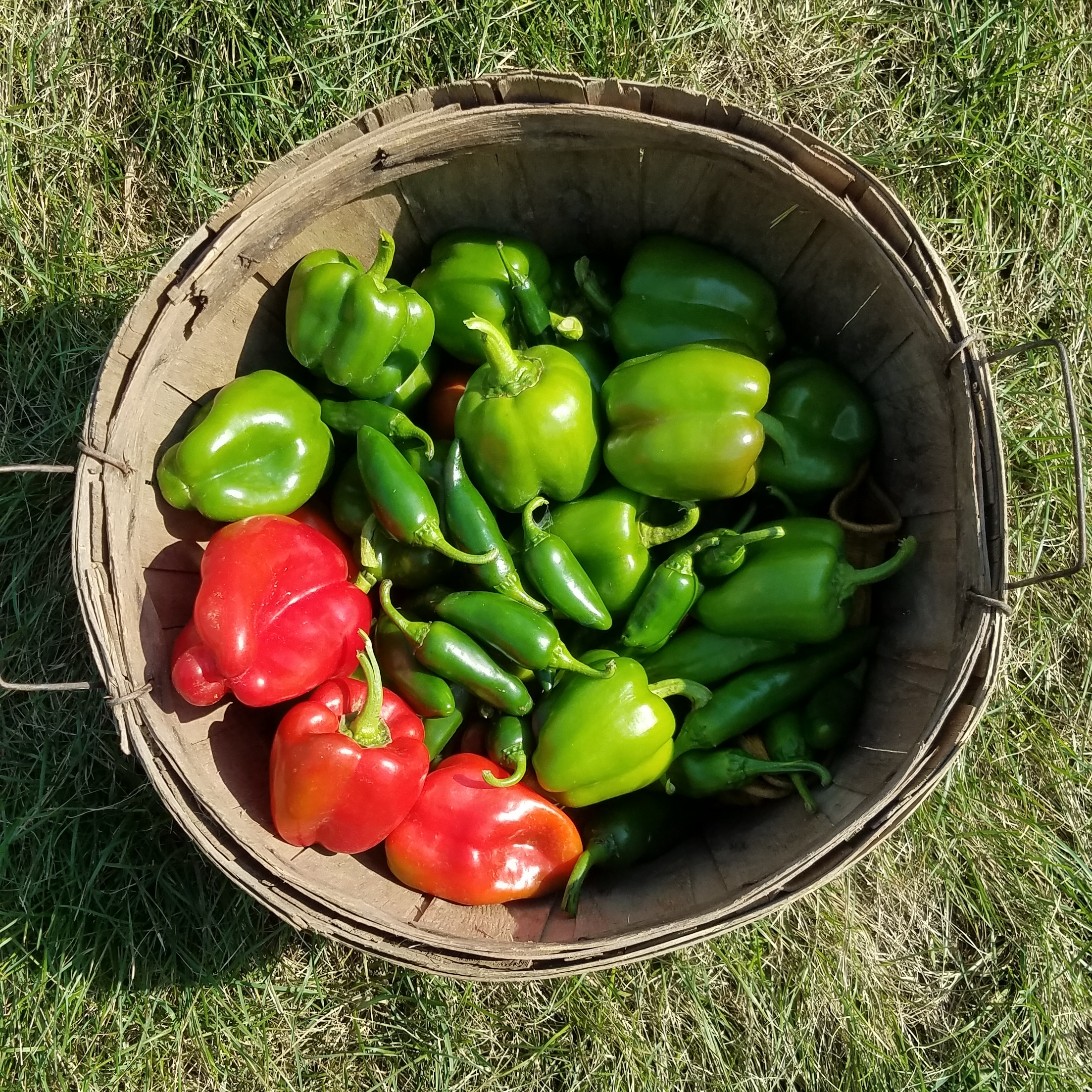
As we turn toward autumn tomatoes are finishing and peppers are coming on strong. I put up a lot of tomato product and am well-prepared to make it until next August. There is always a question of what to do with peppers. This year there are some new ideas.
Pickled jalapenos and hot sauce are traditional. I’ll also grind up what remains of hot peppers and mix it with salt and apple cider vinegar to use in lieu of fresh peppers in cooking. This worked last year so a repeat is in order.
Hot sauce and pickled jalapeno peppers.
I am backlogged with dehydrated hot peppers so no more this year. The main use is to grind for red pepper flakes. I have plenty on hand. I will re-hydrate the old ones next spring and use them to deter pests in the garden.
I grew Guajillo chili plants. The yield wasn’t what I hoped but will roast what there is, skin and coarsely chop them, and mix with apple cider vinegar, salt and garlic to use in Mexican-style cooking. I buy a commercially prepared version of this, so the idea has been in the works for a while.
Bell peppers will be cleaned, sliced in half and frozen in zip top bags. I don’t need many of these as there are some remaining from last year. The main use for bell peppers is for an afternoon snack. At two per day I could make it well into September with fresh ones for out of hand eating and cooking.
Arrival of pepper time also means the end of the garden is near. It’s hard to believe we’re already at that point in the growing cycle.
Each day it becomes clearer electing Mariannette Miller-Meeks to the Congress was a mistake. Instead of supporting the president’s decision to withdraw from Afghanistan, on Aug. 26 she posted this partisan comment to her twitter account, “Joe Biden’s withdrawal of Afghanistan has been a failure and has ended with needless deaths and injuries. Joe Biden should resign as Commander-In-Chief!”
She expanded her view in her weekly newsletter. Thus far, Joe Biden is Teflon to her spam, paying little attention to her or any Republican criticisms. Biden did right by ending the war in Afghanistan.
The problem with Miller-Meeks is not the partisan sniping. She is not voting in the best interests of residents of her district. She voted against almost all of the bills designed to bring the country back from the brink of financial ruin and a catastrophic pandemic. The complete list of her no votes since being sworn in last January is pretty long, but here is a partial one: HR3684 Invest in America; HR1319 COVID Relief Act/American Rescue Plan; HR1280 George Floyd Justice in Policing Act; HR1 For the People Act; and HR5 Equality Act.
Replacing Miller-Meeks with a less partisan member of congress who is willing to work for Iowans will not be a cake walk. Redistricting of the congressional districts lies ahead and while Iowa’s Legislative Services Agency, which draws the initial maps, is non-partisan, there could be changes in the political climate based on how LSA adjusts for population change reported by the last U.S. Census.
If we look at ten years of voting history in the current district, it’s clear a Democrat could win back this seat. Once the new map is created we’ll have to take another look. Luckily the Iowa Secretary of State has good data, down to the precinct level on the five congressional elections since the last redistricting in 2011. Another look based on new district organization is possible.
2nd District
Republican
Democrat
Under vote
Total
2012
Archer
Loebsack
161,977
211,863
16,563
398,167
2014
Miller-Meeks
Loebsack
129,455
143,431
5,079
278,468
2016
Peters
Loebsack
170,933
198,571
18,283
388,501
2018
Peters
Loebsack
133,287
171,446
4,774
318,269
2020
Miller-Meeks
Hart
196,964
196,958
19,189
413,989
Congressional election results in Iowa’s Second Congressional District.
Of the 24 counties in the current Second District, four are solidly Democratic (Clinton, Jefferson, Johnson and Scott). Five flipped from Democratic to Republican in 2020 (Cedar, Des Moines, Lee, Muscatine and Wapello), and the other 15 voted consistently Republican. Republicans were aided by the decision of Iowa Secretary of State Paul Pate to mail every voter an absentee ballot request form because of the coronavirus pandemic. In my view, this was a key factor in the Republican success in 2020.
Looking at the table, what stands out is “midterm drop off.” More people vote when there is a presidential race and the number of voters invariably drops off during the following midterm election. In addition, during the 2012, 2016 and 2020 elections there were significantly more under votes than in midterm elections in 2014 and 2018. That means a significant number of voters cast a ballot for president but didn’t bother to do so in the congressional race. People who are general election voters only are easily identifiable in the voter databases used by both Republicans and Democrats to conduct campaigns.
The key point about midterm drop off is that during the 2018 midterm, Democratic drop off was 14 percent, compared to 32 percent in 2014. I submit the primary cause of better voter turnout among Democrats in 2018 was having Donald Trump in the White House. He was a motivator for Democrats to turn out. That may also be the case for Republicans yet their midterm drop off in 2018 was 22 percent compared to 20 percent in 2014. The meaning is clear.
If Democrats continue to be highly motivated to vote in 2022, reducing midterm drop off, it could give them the votes needed to defeat Miller-Meeks. Without Trump on the ballot, Republicans would be expected to continue to experience midterm drop off similar to 2014 and 2018 or about 21 percent. These numbers should be re-calculated after redistricting but it is hopeful for Democratic prospects in this increasingly Republican district.
The Iowa Democratic Party studied feedback from the failures of 2020 and shared publicly two things that need to be done to win back seats in the Iowa legislature: centralized fundraising for candidates and year around political organizing staff. I have no comment about the former. Hiring permanent staff is a blessing and a curse. If staff can stay focused on 2022 and organize to get out Democratic voters the way we did in 2018, it will be worth it.
If you want to check my numbers, there is more information in the election data which is available at the Iowa Secretary of State website.
Christina Bohannan was endorsed by former Congressman Dave Loebsack on Monday. That means Bohannan is the establishment candidate in a state where establishment candidates usually win if there is a primary. How the congressional campaign organizes is important. What matters more is motivating Democrats to turn up at the polls and vote the whole ballot. Not only will that give us a fighting chance to take back the congressional seat, but will help in races up and down the ballot.
In The Hidden History of American Healthcare: Why Sickness Bankrupts You and Makes Others Insanely Rich, author Thom Hartmann returns to familiar themes of greed, racism and oligarchic corruption. He applies them to a system of healthcare that profits the wealthy and provides marginal healthcare to Americans. A proponent of Medicare for all, Hartmann dives into what’s wrong with American for-profit healthcare and how changing it to a single payer system would be better for citizens.
Describing the overall theme of the series of Hidden History books, Hartmann lays out the challenge:
Americans must now prepare politically for 2024, and that starts by picking candidates and promoting policies that will beat oligarchy at both the presidential and congressional levels.
But most urgently, the entire country must laser-focus on stripping the oligarchic and fascistic elements that have crept into our republic since the Powell Memo, multiple Supreme Court interventions, and the Patriot Act with the war crimes and torture it has already facilitated.
Preface, The Hidden History of American Healthcare by Thom Hartmann
Anyone who bought health insurance through an employer or privately knows the issues with the American system: health insurance premiums are expensive and subject to high annual increases; there are co-pays that vary depending upon what type of coverage is purchased; preexisting conditions affect premium amount and can exclude people from some types of coverage; rather than visit a clinic close to home, an insured must visit medical professionals within the network of the insurance company or face higher costs. This system led to health care costs representing 24 percent of GDP. Countries like Taiwan have a healthcare cost of six percent of GDP, according to Hartmann.
Thom Hartmann
There is a better, less expensive way of providing healthcare. The trouble is, Hartmann said, “(it) would cut off the hundred of millions of dollars that health care industry executives take home every month.”
Hartmann seeks to put healthcare into historical context. He recounts the first single-payer healthcare system in 1884 Germany. He takes us through the creation of Medicare from John F. Kennedy’s initial proposal to passage into law under LBJ, and through the Republican dissent over the program. Hartmann describes Republican efforts to privatize Medicare through what is called Medicare Advantage implemented by President George W. Bush. That section of the book alone makes it worth the reading.
Like previous books in the series, Hartmann’s book is readable and familiar. It is divided into four sections: How bad things are in America regarding healthcare; the origins of America’s sickness-for-profit system; the modern fight for a human right to healthcare; and saving lives with a real healthcare system. The last section proposes solutions to our healthcare system problems.
The Hidden History of Healthcare in America takes us through the history to make the critical point: “It is time for America to join every industrialized country in the world and make health a right, not a privilege.”
Because the subject of the book is so familiar, it renders a complicated process to bare essentials with concrete proposals for action to fix the healthcare system. I highly recommend the book, which is scheduled to be released Sept. 7, 2021.
~ Written for and first published at Blog for Iowa.
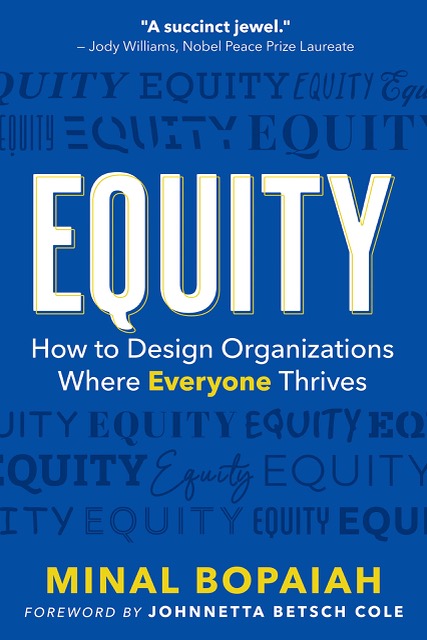
The challenge of creating work places that have inclusion, diversity, equity and accessibility is everywhere. In her new book, Equity: How to Design Organizations Where Everyone Thrives, Minal Bopaiah outlines how to turn lip-service about equity into a real world success story.
“Equality is when everyone has the same thing,” Bopaiah said. “Equity is when everyone has what they need to thrive and participate fully. Equity does not fault people for being different; it makes room for difference and then leverages it.”
The book covers a range of organizations, including for-profit companies and non-profit, non-governmental organizations. She has experience with both and leverages it to strip away buzzwords and conventions often used by management consultants. She reduces the narrative to easily understandable, succinct, and usable language.
Bopaiah introduces us to leaders who have overcome obstacles to equity and led transformative change:
Minal Bopaiah
Managing partners at a consulting firm who learn to retell their story of success by crediting the system that supports them.
News managers at National Public Radio who discover how they can create systemic support for diversifying sources on the air.
A philanthropic foundation that collaborates with grantees to better communicate the importance of equity in healthcare to policy-makers.
And creative professionals who have begun weaving inclusion, diversity, equity, and accessibility into the content they create, thereby transforming how customers and audiences view the world.
As a person who spent a career in business with a company experiencing dramatic growth, I found Bopaiah’s discussion of the myth of “rugged individualism” particularly engaging. She defines rugged individualism as “the belief that individuals are independent and unaffected by the system, time, or context in which they live and that their success is the sole result of their hard work and no other factors.”
One truth about organizations, businesses, and society more generally is the “system” can have a tremendous effect on dividing people and promoting more privileged members among them. As Bopaiah wrote regarding her Indian-American parents, the myth of rugged individualism can cast us “as characters in some kind of Horatio Alger tale in which the world is fair and everyone can succeed if they work hard enough.” Our systems favor the rich and privileged. Bopaiah’s concept of equity provides a way to address what can be a false narrative that suppresses an individual’s ability to participate in an organization equally with others.
Time spent reading Equity: How to Design Organizations Where Everyone Thrives will pay dividends in understanding how organizations in which we participate can be better through inclusion, diversity, equity and accessibility. It is a fast read and moves along quickly to key points of Bopaiah’s narrative. Highly recommended for its brevity and focus.
Don’t have time to read Equity? Here’s a brief video in which Bopaiah explains one of the basic concepts of the book, IDEA: Inclusion, Diversity, Equity and Accessibility.
Minal Bopaiah is the author of Equity: How to Design Organizations Where Everyone Thrives. She is the founder of Brevity & Wit, a strategy + design firm that combines human-centered design, behavior change science and the principles of inclusion, diversity, equity and accessibility to help organizations transform themselves and the world. Bopaiah has written for the Stanford Social Innovation Review and The Hill and has been a featured guest on numerous podcasts and shows. She has also been a keynote speaker for many conferences, inspiring thousands with her credible, authentic, and engaging talks. For more information, please visit https://theequitybook.com
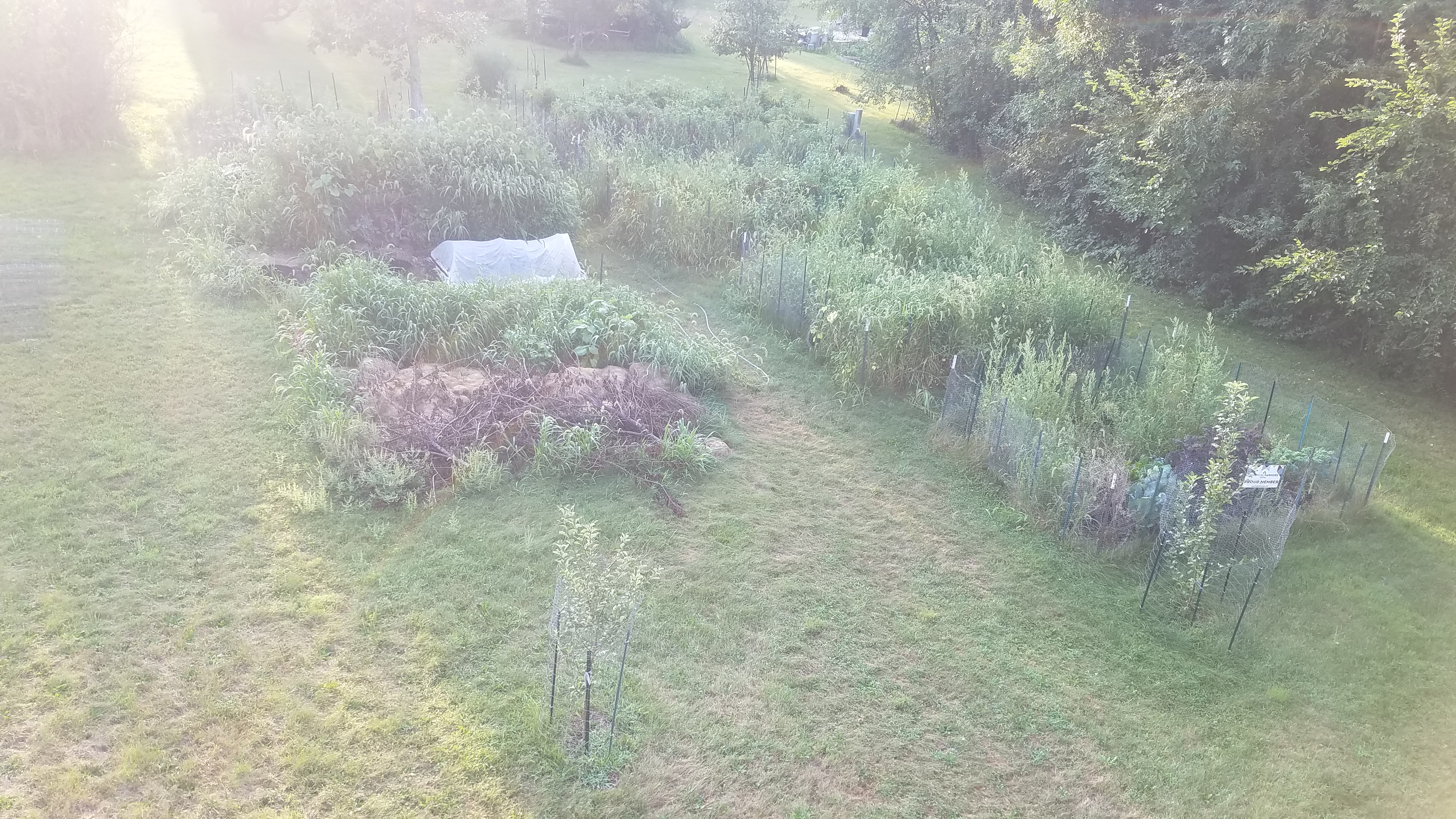
View of the garden from the rooftop, Aug. 28, 2021.
The gutters overflowed with water in a recent rain storm. During the following heat and humidity I climbed the ladder to have a look. Sure enough both sides were plugged with leaves and maple tree seeds. It took less than a minute per side to clean them.
While up there I inspected the roof. The south peak is showing wear, as it is windward. The roof will be good for a while longer. It was the only planned ascension this year.
I go indoors when the heat index is in the 90s. Ten or more years ago it didn’t bother me to work hour after hour in heat and humidity. With a cooler of water bottles on ice, I had everything needed to work straight through. The record drought in 2012 raised my awareness. I began needing a break from the heat about every hour or I would get dizzy. Now I don’t push it. If the forecast is in the high eighties and it’s humid I find indoors work to do.
It’s not like the lawn needs mowing. While the two recent rains greened things a bit, most of the grass remains dormant. I don’t like mowing when it is in this condition. The number of yard and garden tasks is backlogging into a real project. There is no reason it can’t wait until the ambient temperature is cooler.
Perhaps the worst thing about drought-like conditions, combined with a resurgence of the coronavirus, is the isolation. I have intense desire to be with people. Like with the heat and humidity, I’m taking no chances and staying home.
There will be a fall, I’m certain. It will get cooler. I will work in the yard again. In the second year of the pandemic I yearn to do things with people. I’ll be ready when inhospitable conditions abate.
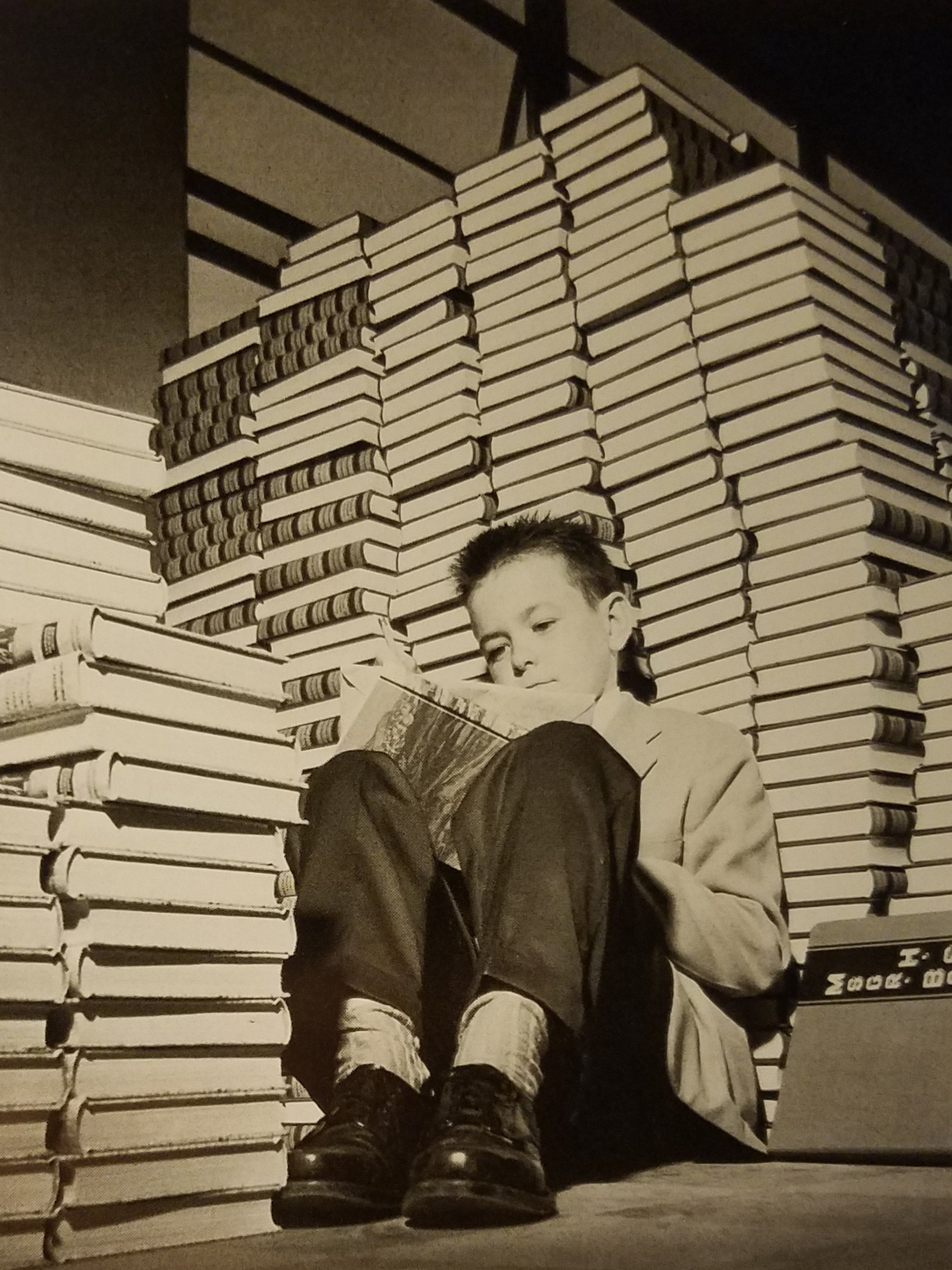
Text on the postcard: “Student, c. 1960. Photographer Unidentified.”
When young our capacity seems limitless. When I got my first library card in 1959 I believed I could read every book on the Bookmobile that stopped each week in our neighborhood. I looked forward to returning books I read and getting new ones. Outside of school, it was a highlight of the week.
Mother got me a subscription to My Weekly Ready, the arrival of which was another highlight. I bought a few children’s books at the local drug store. Keeping up with reading was easy with the energy of youth.
When I lived in Iowa City in my twenties, I started a project to read every book in the public library. It tested my limits. I started at the beginning of the Dewey Decimal system and didn’t make it out of the philosophy section.
I didn’t hear about the Horatio Alger story until I was in college, but that could have been my story, lifting myself up with diligence, honesty and altruism as I read and read and read, waiting for some happy circumstance to present itself and bring me the good things of life. We now know what I was feeling was the privilege of being white and middle class.
I look back to those days, with their libraries full of reading material, and consider my devotion to the act of reading. It was a solitary life and I was mostly okay with that.
What I didn’t realize, that would have helped me if I did, was to get anything significant done in society it takes a context that includes others. I was ready for a life of rugged individualism, in which through my own hard work I could pull myself up by my bootstraps and experience success. I didn’t understand how divisive that could be, pitting my own efforts against others to ensure personal success above all else. Live and learn.
Today I have piles of books I want to read just like the schoolboy on this postcard. However, my intent is different than it was in the 1950s and 1960s. I seek insight to take collective action on things like the climate crisis and more. I provide for my basic existence — food, shelter, clothing, transportation and healthcare — yet that serves only as a platform to do other things with a network of people.
Some days I wish to be that boy sitting next to a stack of books while reading. If I were, there would be things to tell him.
We had good rain a couple of days this week with predictable results: garden tomatoes are swelling and cracking, the lawn is turning green, and there are more mosquitoes buzzing around the garden.
The county public health department identified a pool of mosquitoes that tested positive for West Nile virus. They issued this press release:
Mosquito Surveillance Program Reveals West Nile Virus Risk
The Johnson County Public Health Mosquito Surveillance Program, in collaboration with testing from Iowa State University and the University of Iowa Hygienic Lab, have identified a pool of mosquitoes testing positive for West Nile virus (WNV). Mosquito samples from a trap located in Hickory Hill Park recently tested positive, suggesting mosquitoes with the potential to carry West Nile virus are likely present in the community.
This is the first pool of mosquitoes to test positive for West Nile virus in Johnson County, since the surveillance program was re-instituted in 2017. No human cases have been reported this season. “Historically, we are near the peak season for mosquito activity and potential WNV transmission, “said James Lacina, Environmental Health Manager at Johnson County Public Health. “Avoiding mosquito bites is the best way to limit the risk of transmission, along with reducing habitat, such as areas of standing water where mosquitoes may breed.”
People can take simple precautions to protect themselves against mosquito bites. • Use an effective, EPA-registered insect repellent. • Wear long sleeves, long pants, and socks when outdoors. • Limit time outside from dusk to dawn, when mosquitoes are most active. • Mosquito-proof your home by installing or repairing screens on windows and doors to keep mosquitos outside. • Eliminate mosquito-breeding areas by disposing of standing water from flowerpots, gutters, buckets, pool covers, pet water dishes, discarded tires, and birdbaths.
Email from Johnson County Public Health, Aug. 26, 2021
We don’t live near the park where West Nile virus was found yet I forwarded the notice to some friends who do. It is great to have a functioning public health department.
In other Thursday news, the Washington Post reported on release of the National Oceanic and Atmospheric Administration report “State of the Climate in 2020.” I haven’t read the 481-page document yet the news is not good, it is bad.
Contrary to some news stories about decreased greenhouse gas emissions during the coronavirus pandemic, an associated drop in carbon emissions was all but undetectable to scientists studying our air.
While humanity grappled with the deadliest pandemic in a century many metrics of the planet’s health showed catastrophic decline in 2020. Average global temperatures rivaled the hottest. Mysterious sources of methane sent atmospheric concentrations of the gas spiking to unprecedented highs. Sea levels were the highest on record; fires ravaged the American West; and locusts swarmed across East Africa.
Many measures of Earth’s health are at worst levels on record, NOAA finds by Sarah Kaplan, Washington Post Aug. 26, 2021.
We live in Biblical times with plague, locusts, drought, hurricanes, floods, rising sea levels and wildfires. The planet is literally burning up. While some hope for the rapture to take us from the problems of a deteriorating environment, the rest of us have to cope with the challenges of a planet whose atmosphere traps too much warmth.
Without consistent, concerted efforts to reduce emissions from burning fossil fuels and other human activities, scientists warn, Earth’s condition will continue to deteriorate.
Many measures of Earth’s health are at worst levels on record, NOAA finds by Sarah Kaplan, Washington Post Aug. 26, 2021.
Just read the two-page abstract of the report on page Siii. It is past time to reduce greenhouse gas emissions. No single person can make a difference. It will take all of us working toward the same goal.
It’s no consolation the planet will be fine. The people living on it will not. It’s past time to act on climate.
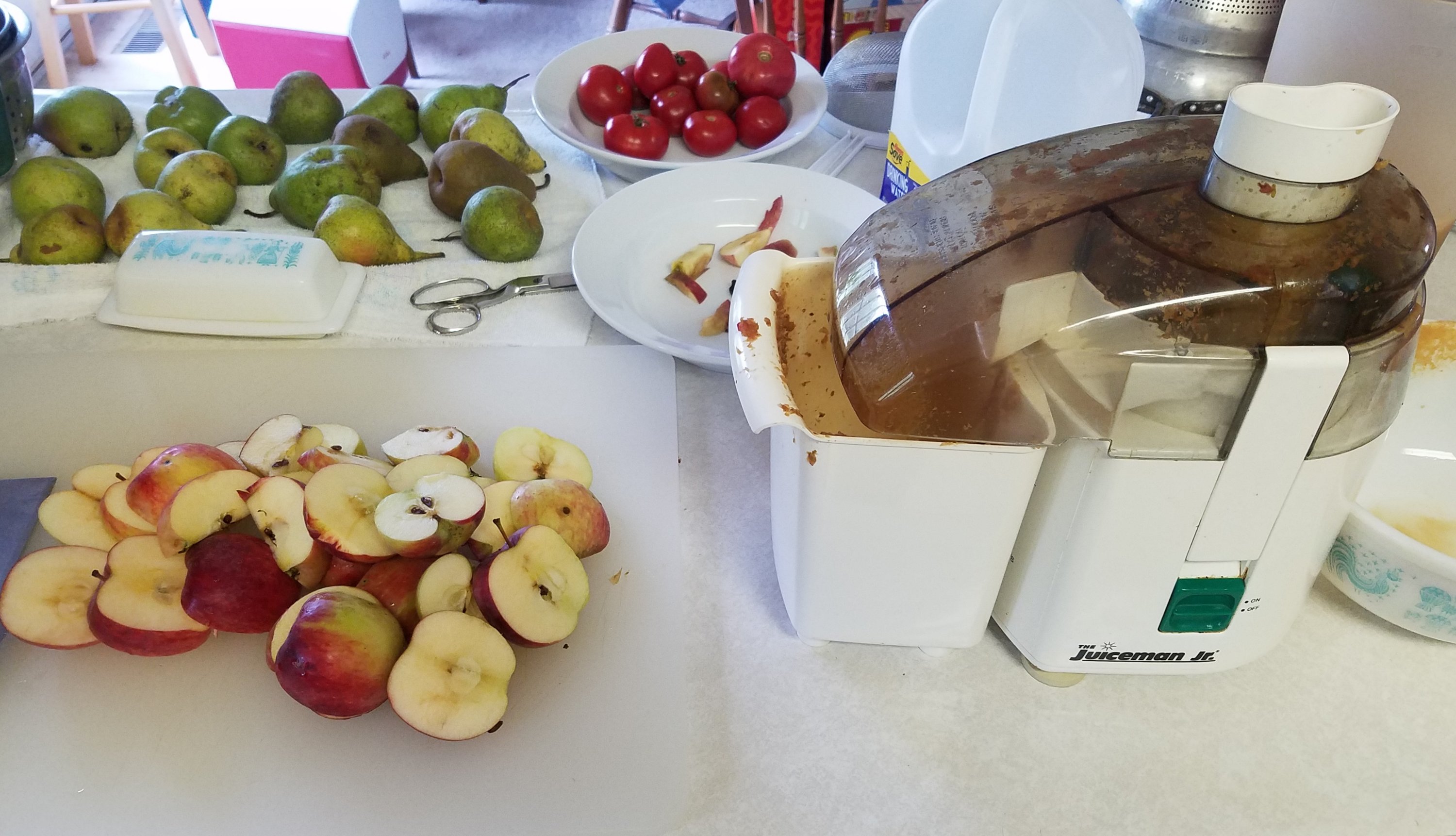
Turning two five-gallon buckets of EarliBlaze apples into juice for apple cider vinegar took about three hours including set up and clean up. Three half gallon mason jars are fermenting in the pantry, and a quart and a half of juice is in the ice box. I drank some of the juice with tacos for supper. It was a good day.
There was already plenty of cider vinegar in the pantry: seven liter bottles, two half gallon mason jars and a couple of smaller bottles in the cupboard near the stove. The goal is to make some vinegar with every apple crop because some years there is no crop. It has not been a problem because vinegar keeps and apples are abundant.
Apple Cider Vinegar
I’ve been making apple cider vinegar since a neighbor gave me some of the mother passed down through his family since at least the 19th Century. I call it “ultra local” because the apples were grown a few steps from the kitchen.
I spent a couple of hours on Wednesday delivering a “Drinking Water Health Advisory” to every home on our public water system. My shirt soaked through with sweat as I walked the two miles of roads. It was good exercise even though I didn’t enjoy some of the steeper hills.
About a dozen people were out in their yards, providing an opportunity to connect. While the news I delivered wasn’t the best, all but one of them had heard of the problem I posted via Facebook and email. Most were in good spirits and appreciated knowing what was going on regarding the water system. I met via conference call with our engineer and water system operator in the morning and laid out a simple plan to address the problem. Here’s hoping for a speedy resolution.
With Tuesday’s announcement that Christina Bohannan is running for congress in Iowa’s second congressional district, I’ve been reflecting on the congressional campaigns in which I’ve been involved. I began to get active when we lived in Indiana, helping Pete Visclosky get re-elected to a third term. He retired in January this year.
Rep. Jim Leach represented the area where I grew up from 1977 to 2003. He moved to Iowa City after redistricting for the 2002 election and was elected there twice. While he was Republican, the district wasn’t as partisan as it is now. When we lived in Indiana I saw Leach hold hearings on Whitewater in the House Banking Committee, which he chaired. After that I realized it was time for him to go. When he became my congressman in 2003, I began working toward that end. In 2006 we elected Dave Loebsack to the Congress where he served until this year.
The 2020 election was a disappointment because the congressional vote was evenly split. Democrat Rita Hart contested the results, but nothing came of it. Mariannette Miller-Meeks was sworn in to the 117th Congress. We are at the beginning of another campaign.
It is time to pass the baton to the next generation in congressional politics. With the isolation caused by the coronavirus pandemic, I did very little volunteer work in politics during the last cycle. Rita Hart made it to our precinct only during the last days before the election, with little enthusiasm for her candidacy. With the resurgence of the pandemic, I see that approach continuing. Besides, it is time to let younger, more engaged people manage campaigns. In the end I’d rather spend time politicking with my neighbors than get involved in the massive energy and expense of a district campaign.
Maybe it was the scent of the apples that evoked this political remembrance. That tasty sweetness which over time will be converted to vinegar. As I age, astringent flavor is more interesting than sweet. I crave it. I make it. I look forward to using the new batch of apple cider vinegar. I both know where it came from and the chef who makes it.
Making apple cider vinegar is part of a life worth living.







 Journey Home
You must be logged in to post a comment.