During one of our vacations in Stratford, Ontario I bought this bound blank book for reasons then unknown. Eventually, beginning in 2000, I wrote down recipes in it and today the pages are more than half filled.
They are the kind of recipes that are more than improvisational knife and spoon work with me standing in the kitchen, checking the refrigerator and pantry, and whipping up a couple of things for supper.
I return to the cookbook regularly.
First pick of the Red Delicious apples, Sept. 12, 2021.
It is apple time in Iowa and someone asked for apple butter. The first pick of Red Delicious apples will go toward that. I have older jars stored on the shelf but when I gift apple butter, I want it to be this year’s batch.
In 2010 I entered my recipe for apple butter in the cookbook. Back then I made something out of every apple harvested. It was a lot of apple butter, apple sauce and dried apples. There are still a couple old jars hanging around. (They need to be pitched).
Today I give away apples I won’t use. One year I gave 350 pounds to a community supported agriculture project for their members. Another I donated to the food bank. I also offer them to neighbors if interested. The idea is to bring enough into the house to make sure the apple products will last for two years until the next big harvest is expected. I’m done with overshooting that goal, except for apple cider vinegar which keeps a long time.
I have hundreds of printed cookbooks and likely a recipe for every growing, crawling, running, flying, slithering, and swimming thing in the ecosphere. I keep my faves nearby: Rick Bayless, Mario Batali, Julia Child, Irma Rombauer and Marion Rombauer Becker. I always return to the red-covered bound book I wrote myself for the good things in our life.
Mariannette Miller-Meeks on the Iowa State Fair Political Soapbox on Aug. 13, 2010. Photo credit: Wikimedia Commons.
During the 2020 primary with the late Bobby Schilling, Mariannette Miller-Meeks was heartless. She took an extremist right turn away from constituents and never came back.
It is telling about a person’s character that despite a call from Schilling’s son for both campaigns to cease false, negative campaigning, Miller-Meeks persisted. While Schilling was recovering from cancer surgery, Miller-Meeks ran a television ad criticizing him for not supporting the former president. Her ad asserted: “I am pro-life, pro-Trump.” She beat Schilling in the primary then went on to win the general election by six votes.
Since her arrival in Washington, Miller-Meeks has taken one extreme position after another. She adds her name to resolutions and legislation that go nowhere but attract additional extremist Republican co-sponsors.
Her most recent caper was signing a letter saying she won’t vote to raise the debt ceiling along with Republican extremists Lauren Boebert, Marjorie Taylor Greene, Madison Cawthorne, and Devin Nunes, among others.
When her vote mattered to Iowans, as in the American Rescue Plan Act, she opposed it, aligning herself with the Republican caucus rather than helping Iowans. Where is her concern for constituents? I see very little of it.
Is embracing twice-impeached Donald Trump endearing Miller-Meeks to voters? What I do know is we can do better than Mariannette Miller-Meeks as our member of congress.
~ Published in the Cedar Rapids Gazette on Sept. 10, 2021.
Mariannette Miller-Meeks on the Iowa State Fair Political Soapbox on Aug. 13, 2010. Photo credit: Wikimedia Commons.
I’m upset about the flag bill, HR 4392, the Flag Standardization Act of 2021.
Why didn’t Rep. Mariannette Miller-Meeks just call it the “I hate the gay and black people flags act” when she introduced it?
It was bad enough when Republicans reacted to the Secretary of State Antony Blinken announcement he would permit the “LGBT flag” (in April) and the “Black Lives Matter” flag (in May) to fly over U.S. embassies.
Right after President Biden signed an executive order recognizing June as Lesbian, Gay, Bisexual, Transgender, and Queer (LGBTQ+) Pride Month, the Republican Freedom Caucus skullduggery crew got to work on their own bill, HR 85, the Old Glory Only Act. Joined by such eminent Republican members as Matt Gaetz, Lauren Boebert, Marjorie Taylor Greene, Louie Gohmert, Madison Cawthorne, and others, the bill had 20 co-sponsors.
It went nowhere.
In the hell’s kitchen of Republican legislation cookery Miller-Meeks’ bill may seem like a compromise. Truth is it is a restoration of the policy of President Donald Trump’s homophobic ban of the LGBT flag on Federal property. We want no part of that.
Don’t Congressional Republicans have better things to do?
United Airlines Flight 175 hits World Trade Center south tower on Sept. 11, 2001. Photo Credit: Wikimedia Commons.
First published at Blog for Iowa on Sept. 11, 2011.
I was scheduled to fly from Moline, Illinois to Philadelphia on Sept. 11, 2001. My flight was cancelled. I returned to the office, and with the other office employees watched the twin towers burning and then collapse on television. I neither understood what happened nor knew what to do. But I turned to a president, one I believed stole the 2000 election, and said that I would support him after this act of terrorism. We all did.
What I remember most from the aftermath of Sept. 11, 2001 was my trip to Philadelphia a few days later. The plane was almost empty. As I approached the Eastern Iowa Airport, the radio announcer said President Bush was also heading to Philadelphia on an unannounced trip. Air Force One was already parked at Philadelphia International Airport when I arrived and I drove past it in my rental car heading to Interstate 95. There were hundreds of law enforcement officials stationed along the presidential route.
As I headed North, I passed the presidential motorcade returning to the airport. It was 10:30 a.m. On the radio I discovered that the President was in town fulfilling a campaign promise to visit a women’s shelter. He couldn’t have been in Philadelphia three hours. I shook my head, disappointed that after all that had happened, we were back to politics.
As the hope of getting something done in Washington D.C. this year wanes, and our attention turns to “jobs,” the “Super Committee” and the 2012 Presidential election, we are approaching the tenth anniversary of the event that brought almost everyone in the country together. I am referring to Osama Bin Laden’s successful hijacking of four aircraft and the deaths, destruction and economic damage it brought. It did bring us together, if only for the briefest of moments. Whatever consensus may have existed then, devolved into political gridlock unlike any in living memory.
We know about the deaths that day, and the illnesses of workers at Ground Zero. What we don’t consider enough is the death, destruction and economic damage caused by the United States reaction to Sept. 11, 2001. Hugh Gusterson reports in The Bulletin of the Atomic Scientists, “the Nobel Prize-winning economist Joseph Stiglitz and his collaborator Linda Bilmes estimate that, in funds already disbursed or committed, the wars in Iraq and Afghanistan have so far cost the American taxpayer… $3.2 trillion.” It is noteworthy that this amount includes $200 billion in interest incurred after the decision to pay for the war with deficit spending. The Congressional Budget Office estimates the United States will incur another $800 billion in interest charges on the war debt by 2020. The wars are costing a lot.
In this month’s issue of The Lancet, Vic Sidel and Barry Levy published an article titled, “Adverse health consequences of U.S. Government responses to the 2001 terrorist attacks.” The article reminds us of the fact that there were more than the dollar costs of these wars. According to the article, as of July 26, 2011 there were 1,568 US Military deaths in Afghanistan and 4,408 in Iraq. There have been tens of thousands of US casualties. Likewise there were many times this number of Afghan and Iraqi deaths. Estimates are that 655,000 Iraqis died in the first 40 months of the Iraq War. Millions of refugees in both countries are on the move as a result of the wars. The health care infrastructure in Iraq was damaged, much of it destroyed. Thousands of villages in Afghanistan and their environs have been destroyed. Of 222,620 US military personnel who returned between May, 2003, and April 2004, 42,506 (19%) reported mental health problems and 68,923 (31%) used mental health services over the first year after they returned home. The article continues, but I have made the point: the cost of our reaction to September 11 was in more than dollars.
As we honor the lives lost and damaged by the terrorist attacks, I hope that for a moment we can include those lost and damaged by our political decision to invade Iraq and to prosecute a war with Afghanistan that no one has been able to win after more than thirty years of fighting.
Once we understand the true cost of war, it seems too high a price.
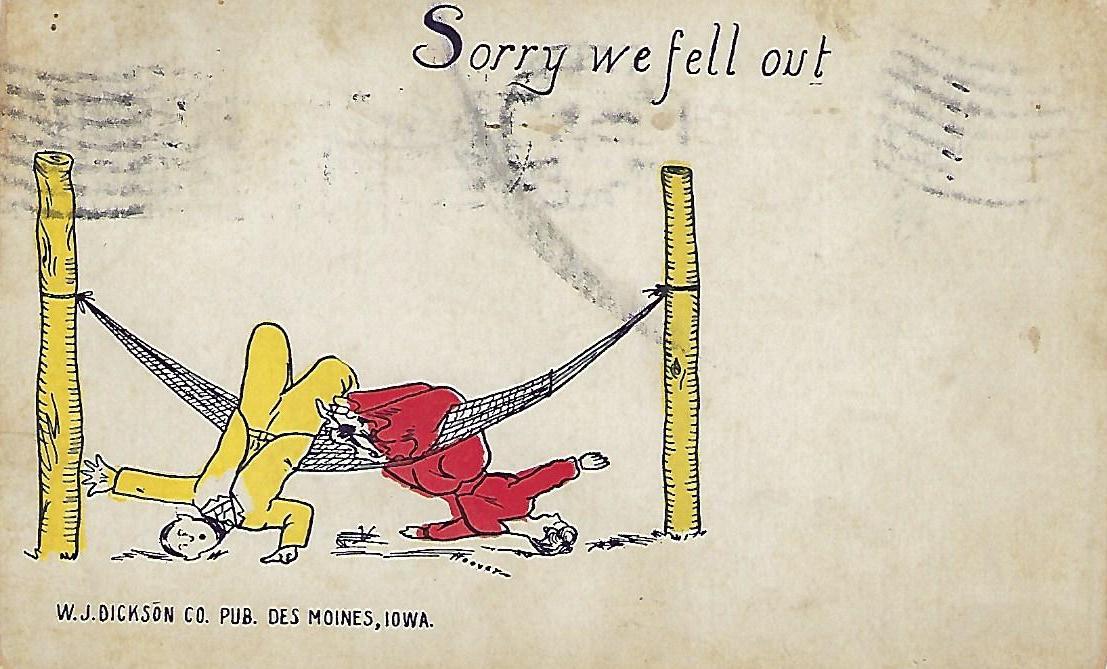
Reverse side: Personal note postmarked Oklahoma City, July, 8, 1908.
Social media hasn’t helped us stay in touch with friends and acquaintances.
In 2010 I searched for members of my high school class and asked them to join a Facebook group started for our fortieth class reunion. Many joined, but the group is now pretty inactive. Mostly we fell out.
It takes work to maintain a relationship and with all the stuff we have to do just to keep up with society it doesn’t happen. We drift except for those closest to us. I’m coming to a place where that seems okay.
What we yearn for is doing new, interesting, or exciting things. It doesn’t matter if it is with people we’ve known for decades or with those we just met. The arc of our lives isn’t a fixed trajectory. Just because we walked to school with the same group of people during the 1960s, that doesn’t mean the bond was permanent. If I encounter such childhood friends — these days mostly at funerals — we reminisce a bit in the moment and that’s that. We’ve built new lives that diverged from our beginnings.
I favor writing letters to friends and family. Not too much, though. There is an unspoken obligation to write one back and I don’t want to hang that on people I care about. Yet I write a letter from time to time.
This postcard reminded me there are a few people with whom I’d like to re-establish contact. Not that many, though. I have to ask why we fell out in the first place. Sometimes we’ll never know.
Yesterday the weather was as good as it gets. Today looks to be more of the same. Wherever you are on this jumping green sphere, have a great day! To get you going, here’s the uniquely talented Jimi Hendrix, who left us too soon.
I spent a fair amount of Tuesday revisiting the outline of my autobiography. It quickly came into perspective. There will be multiple sections with each drawing on different parts of my life story.
After the dedication and introduction I currently see the following parts.
Part I: Background
It will begin with four historical pieces about Lincoln County, Minnesota; the area around LaSalle, Illinois; Wise County, Virginia; and Davenport, Iowa in 1951. I spent the most time last winter drafting these sections. They each need more work.
Part II: Main Narrative
Next will be a high level narrative of my life from birth until the present. In it I’ll cover the main stories on a time line, from my perspective. I’ll leave out personal information of people who are still living.
This part is subdivided into sections: 1. From earliest memories, moving to Madison Street, school, and my eleven-year residence at the American Foursquare in Northwest Davenport. 2. Begins with college, a trip to Europe in 1974, military service, moving to Iowa City, graduate school, and then marriage. 3. I begin what would become a career in transportation and logistics in 1984. I follow my career from the move to Cedar Rapids; to Merrillville, Indiana; and then back to Big Grove Township where we now live. 4. Next comes our daughter finishing grade and high school, going to college, and then moving from Iowa. 5. Finally, there is empty nest life, community engagement, my first retirement from transportation and logistics, continuing work until the coronavirus pandemic, and the post-work life in which I now find myself. The idea of these sections is to lay out the bare bones of how I spent my life. To research and get the story down.
Part III: Collected Writing
The last part of the autobiography will be a collection of my writing from letters to the editor beginning in 1974, and including resumes, poetry, published writing, journal writing, newspaper writing, and blog writing. The focus will be to reduce the quantity of written work to inform the narrative presented in the second section.
The clarity that came from spending time away from writing as I worked on the garden was a welcome surprise. The outline is not finished. A few days work remains and I’m ready to do it. After that it’s back to writing.
Just like that! Temperatures are cooler. It has been in the mid-fifties overnight, with a daily high in the seventies. The shift toward season’s end is happening. Ready or not, here it comes.
This winter I’m again planning to devote significant time to my autobiography. I wrote good pages last winter and would like to move the narrative along. If I learned anything it’s that the task is monumental. Without organization, I’ll never finish.
As I mentioned in yesterday’s post, I’m upgrading my computer CPU to a new one. As I do so, I’ve been going through countless files to see what is relevant to an autobiography. I printed a few things out. The more I look, the more files I find that can be permanently deleted. A person only has so much time to spend with old things that depart from the narrative that is to be preserved. Best to purge it now and get it done.
I resisted going through all the physical objects last winter. The boxes, albums, photographs, files, books, clothing and trunks are everywhere and need to be gleaned for relevant artifacts. Maybe I’ll spend time on that this year. If I do, the idea is to organize things chronologically instead of thematically. That mean busting up boxes and folders I once thought went together. As I extract and refine what I’ll use, there will be no going back. I’m okay with that. As I proceed with computer files I’m finding my organizational process was more a hodge-podge than orderly.
I stopped work on the autobiography mid February as my attention turned to the garden. If I repeat the cycle, I should be able to get a solid five or six months work done. The document on which I’d first like to make progress is called the “book tree.” It’s an outline of how I currently see the narrative progressing. There is a month or more work improving it. In the end it will make writing the narrative easier. Last winter I got addicted to word count. I need to let go of that for the moment and focus on what will be the story. That’s honest, journeyman work to which I look forward.
There are still things to do in the yard and garden. With the hot, humid weather I delayed until there is no more delaying. The grass is turning green and needs mowing. Before I do that I have to clear what became a weed patch upon which to place the clippings. I also have to pick a plot to plant garlic in four or five weeks. By the way, the garlic came in really good this year.
I don’t know how long the autobiography will take. What I expect is it will make life easier for whoever takes charge of my stuff when I’m gone, if for no other reason than that there will be less of it. I cling to the present life yet realize I need to let go. Upgrading my CPU is as good a metaphor as any for that.
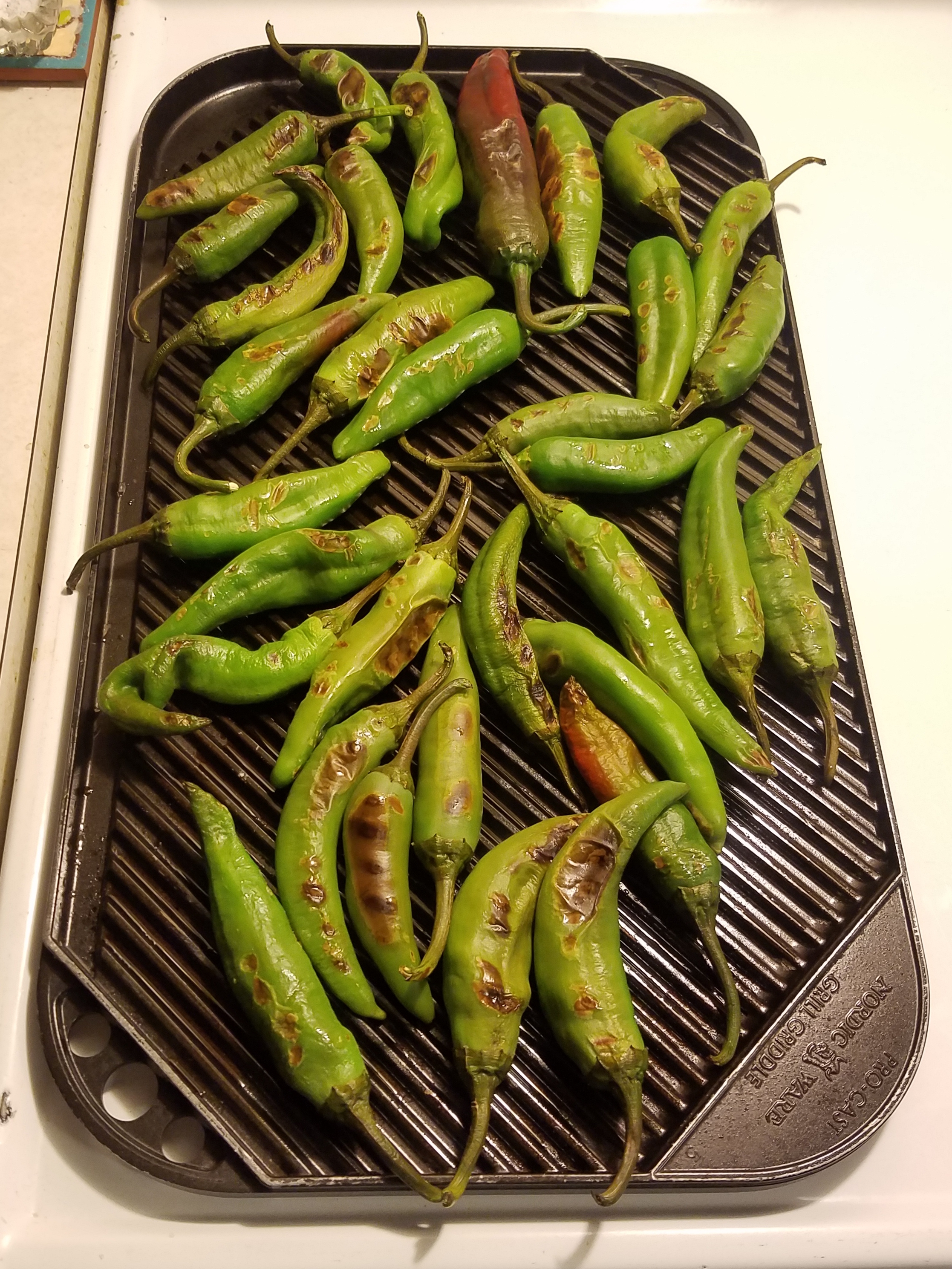
Labor Day weekend work: preserving Guajillo chilies.
For the second year in a row I’m not employed on Labor Day. The kinds of events marking the day are not the same as they were.
An announcement on the Iowa Labor News website read, “Most of the Union sponsored Labor Day events around Iowa have been cancelled, for safety reasons.”
“Safety reasons” refers to the coronavirus pandemic, which is not over, which has no end in sight. “The virus is here to stay,” Governor Kim Reynolds said at a Sept. 2 news conference. “Which means we have to find a way to live with it in a responsible, balanced and sustainable way.” There is no going back to the way things were before the coronavirus came along on Labor Day or on any day.
It’s been 48 years since I carried a union card at a meat packing plant. Since then, private business restructured to minimize its exposure to a unionized workforce. I’m not sure what Labor Day represents any longer. It sure isn’t about unions even if they are the groups most likely to plan events during better times.
Locally grown Honeycrisp apples.
This weekend the orchard began its Honeycrisp apple season, the university had a Saturday home football game, and there is a Labor Day Vendors Market in nearby Mount Vernon. It’s not much considering how many people work for a living. This year’s Labor Day Mayor’s Bike Ride in Cedar Rapids has been cancelled due to the pandemic. Suffice it Monday is a holiday and the weekend can be a time to take it easy.
Labor Day weekend is the “unofficial end of summer.” That’s going to have to do. Since I returned from a trip to Florida at the beginning of July the weather has been exceedingly hot and humid. Sunday morning’s ambient temperature was 59 degrees, reminding us of autumn’s approach. Sumac along the state park trail has begun to change color. There are signs of the end of summer all around.
In February I bought a new CPU to replace the one I’ve been using since 2013. This Labor Day weekend I hope to get it up and running, with files transferred. I face the same issue as in the past: what files do I want to keep? Ready or not, change has come and it’s time to decide. Like with the Labor Day holiday I must act like there is no going back. What is hard is deciding whether that means keeping old behavior or developing new. For now, I plan to work at home on Labor Day.
Text on the postcard: THE GREATEST SHOW ON EARTH is coming your way! To find out when, and much, much more, visit www ringling com MAY ALL YOUR DAYS BE CIRCUS DAYS!
The Ringling Brothers and Barnum and Bailey Circus was a mainstay of my youth. Each year they came to Davenport, usually at the levee of the Mississippi River, to put on the Greatest Show on Earth.
A biography of the Ringling Brothers was one of the first books I checked out from the bookmobile after getting my library card. It was interesting four of the Ringling brothers were born in McGregor, Iowa. They inspired us to put on our own show in the backyard of the American Foursquare my parents bought in 1959.
The circus influenced my decision to be part of the high school stage crew where I could participate in putting on shows.
The days of circuses are ending and Ringling Brothers folded the tents for the last time on May 21, 2017. It was a really big deal when the circus came to town… until they no longer did.






 Journey Home

You must be logged in to post a comment.