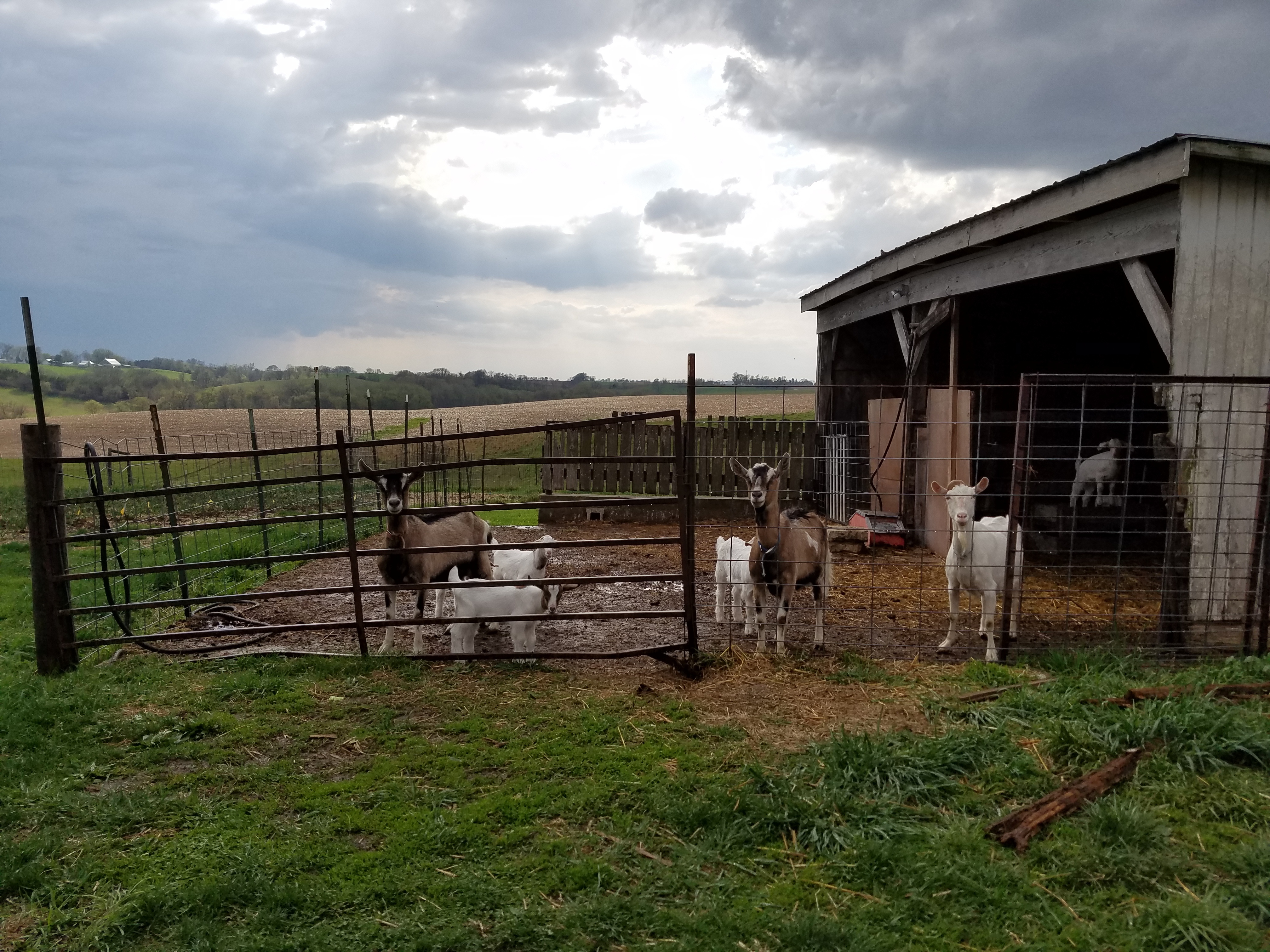
The sound of bleating lambs pierced the air during yesterday’s shift at the farm. It was a sad sound because we know their destiny.
Above is a photo of goats instead.
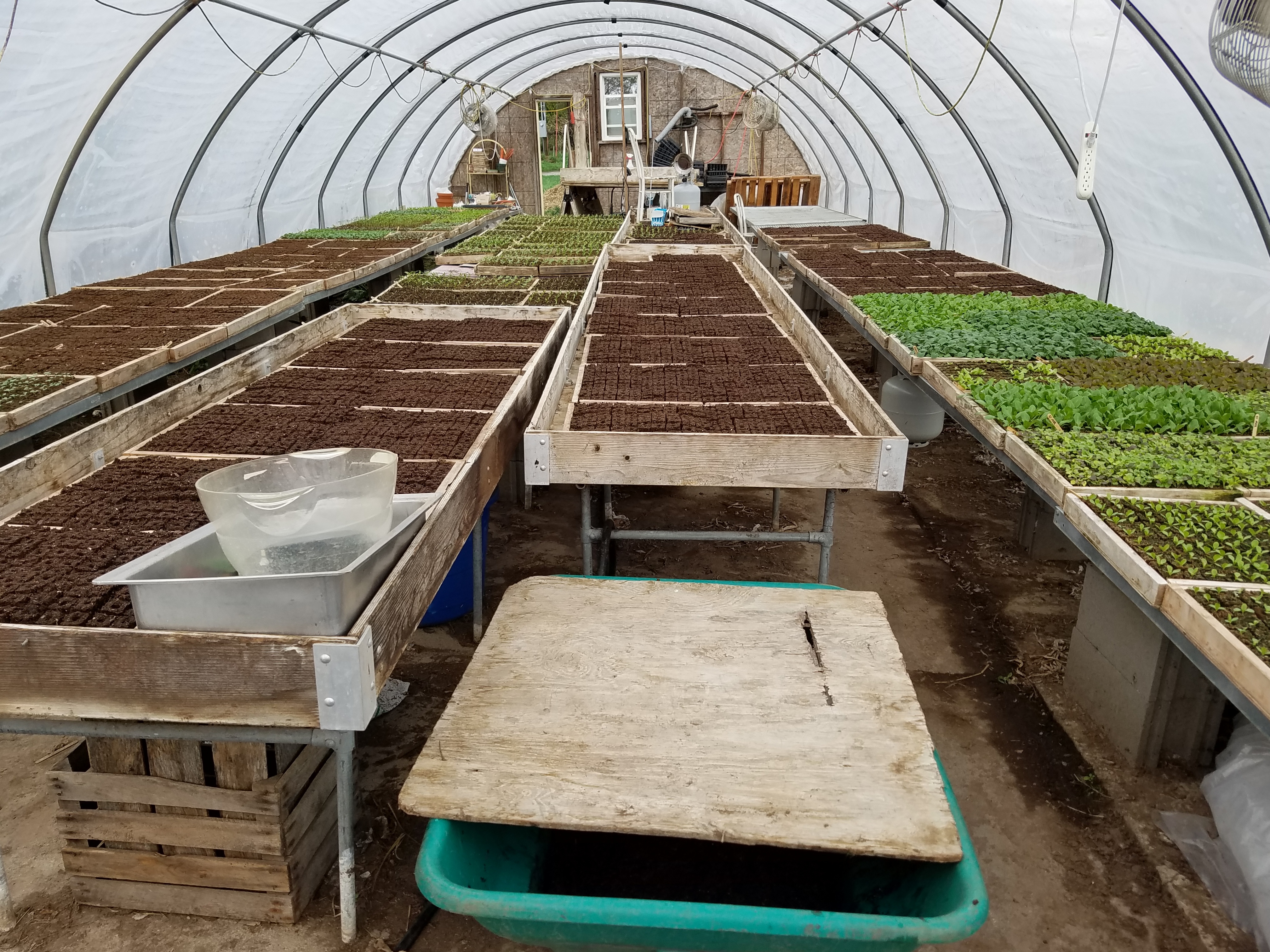
I made 60 trays of soil blocks for the germination shed. It’s time to transplant pepper plants from plastic trays where they germinated to individual soil blocks for finishing before planting. There are a lot of them.
Saturday, April 15 in the Germination Shed
I was to do 78 trays, but a thunderstorm blew over, dropping a brief torrent of rain and hail — enough hail to sting our skin. All of us —four people, two dogs and a cat — made our way into the germination shed to wait out the storm. It didn’t take long. The storm was an emphatic punctuation ending the day’s work.
Between Passover and Easter none of our lambs was sacrificed despite the popularity of leg of lamb as a holiday main course. On a farm we accept the reasons for raising lambs and goats, and the reality of thunderstorms.
I barter my work. Soil blocking yields participation in selected shares, notably the spring share which begins April 24, and fall shares from both farms. It is a way to leverage the high tunnel for early lettuce and greens, and to secure potatoes, sweet potatoes, cabbage, carrots, squash and other storage vegetables so I don’t have to grown them myself. We also exchange work canning tomatoes and freezing bell peppers with each receiving a share of the resulting jars or zip top bags.
I started seven trays of my garden seedlings in the germination shed, also part of the deal. I got bags of last year’s soil mix and onion sets that were part of the farm order. There are other sundry items: pallets saved from the burn pile, leftover partial trays of seedlings, and vegetables when there is over-abundance or if they are too imperfect for members. While no money changes hands, there is mutual benefit from barter deals. My car was loaded as I departed the farm.
The sound of lambs permeates spring days bringing with it both hope and mortality. It’s a hopeful and sad sound. One that leads me to prefer goats.
Rain kept vegetable farmers out of their fields. The rule of thumb is wait four days after a rain for fields to dry. It rained all day yesterday.
Equipment is ready, truckloads of seed potatoes wait in bags, and farmers want them in the ground.
Conditions are ready to plant any cold weather vegetable once soil dries.
Traditional potato planting day is Good Friday, and some gardeners, including me, continue to follow that timetable. I’m growing in containers this year, so feel good about planting a bit early this weekend. I grow them in containers to keep burrowing rodents from getting the first pick and last year the technique worked.
In the break room at the home, farm and auto supply store a case was made not to grow potatoes at all.
They are cheap at the store. There is little difference between a freshly dug potato and a proper storage potato, they said. They take up space that can be planted with more desirable crops like tomatoes, squash and cucumbers. Nutritionally, potatoes are carbohydrates shunned in many modern households.
Leek and Potato Soup
Nonetheless, I persist in producing spuds for fresh eating and cooking. They are a small crop in a diverse home garden.
Growing potatoes — gardening generally — is a statement of resilience. A personal action running counter to a political class with which we increasingly disagree.
Let them ask their questions. What is a leek? Why grow potatoes? While they do, a family can be sustained with leek and potato soup in a way hard to find during a time of pre-cooked meals and convenience store restaurants.
Thinking and talking about potatoes is sublime as gardeners head toward dry ground and the weekend.
After a Saint Patrick’s Day meetup with friends in Iowa City I drove home, parked my car in the garage and haven’t moved it since.
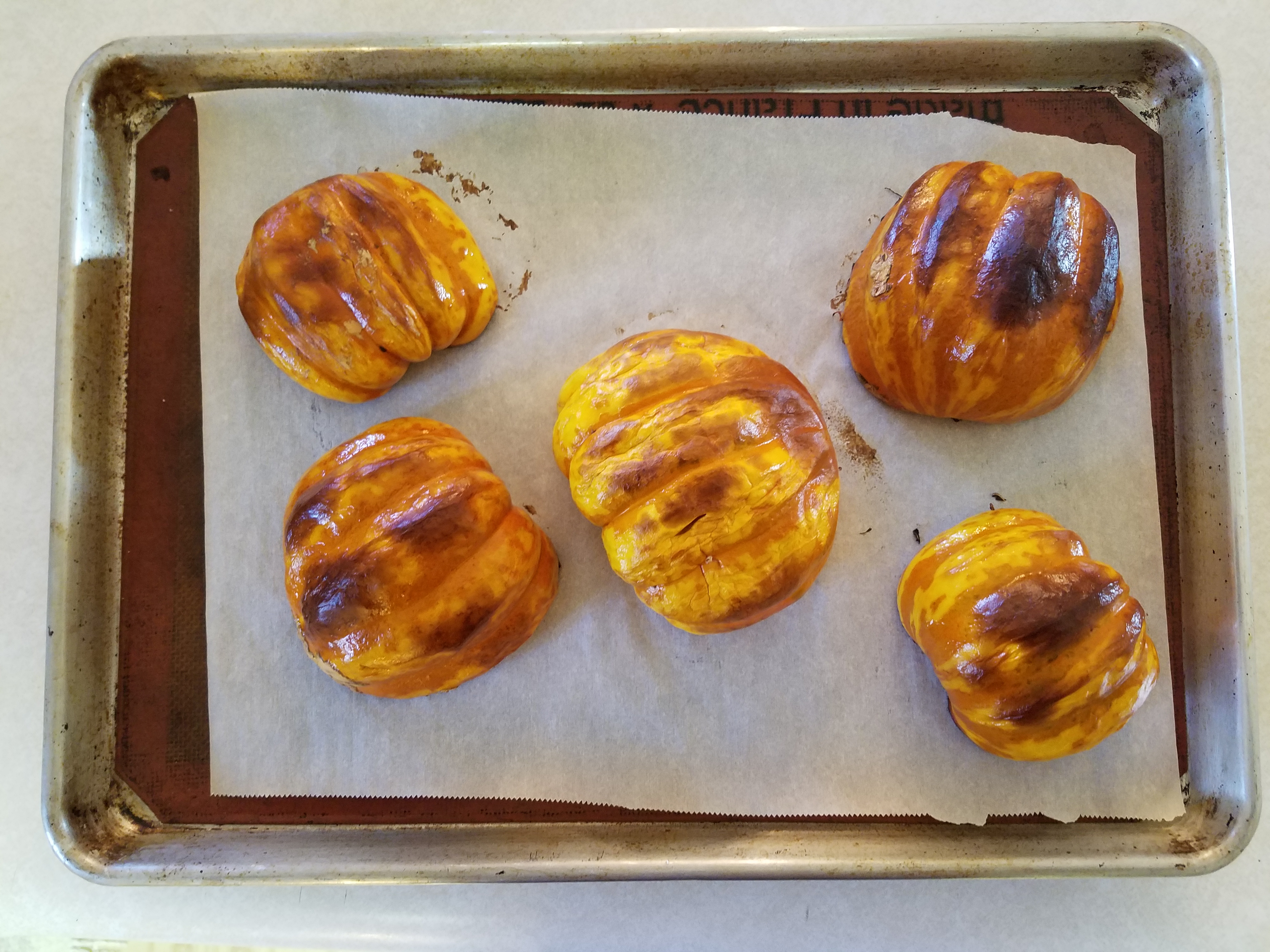
It was too cold for outside work on Saturday so I stayed in, did laundry, cleaned the bird feeder, wrote, read, and cooked dinner of bean soup, Carnival squash and applesauce cake.
The ambient temperature is expected to rise to almost 60 degrees, so I’m planning to work outside after a shift of soil blocking at a community supported agriculture farm.
I read Elizabeth Kolbert’s The Sixth Extinction: An Unnatural History in its entirety this weekend. Her combination of background information with personal stories of field trips is eminently readable. I can’t remember a day so absorbed in a book since leaving transportation. The main takeaway is how uncertain scientists are about changes in earth history over the long term and the consequences of our lifestyle.
Japanese Beetles
The broader meaning of words like “Anthropocene” is not settled, nor agreed. What I know after this immersion, and after reading Sapiens: A Brief History of Humankind by Yuval Noah Haran, I am ready to move forward with something other than narratives of how homo sapiens swarmed over the planet like Japanese beetles.
I buy more bird feed since working at the home, farm and auto supply store. Counting whole kernel corn, I have five different varieties in the garage. Each type attracts a different bird and we enjoy watching them through the French door off the dining area. Some days I feel like picking up a 20-pound bag on sale, and do. I went overboard with 50-pound bags of whole corn and millet, although sparrows seem to really like the millet. There is no science to my purchases.
Bartering is making this year’s garden planning a lot different. Part of the barter system is trading labor for a spring and fall share. Each side of the deal can be defined monetarily. I get a credit of $13 per hour for labor which is applied to retail price of the shares. I use greenhouse space and materials to germinate seeds and care for seedlings until planting in my garden. I will also acquire onion sets and seed garlic through the farms. Where there is a clear financial value, the barter system is simple and easy. This part of the exchange translates into things we can use in our garden or kitchen.
The exchange for specific produce is more complicated.
Canned Tomatoes
Tomatoes are a large part of summer. Last year I planted them in three different garden plots. This year I’ll decrease my plantings to what we’ll use fresh and rely on the farms for canning tomatoes. In 2013 the farmer provided crates of tomatoes which I canned. We split the canned goods 50-50 that year. That was a bit disadvantageous to me considering the amount of work. We haven’t finalized the split, but both farms I work on produce many more tomatoes than needed for their members. One farmer wants lots of canned tomatoes. Something can be worked out.
Bell peppers were a garden failure last year and for many previous years. I’m eliminating them completely. The farms produce bell peppers with a high frequency of imperfect fruit. I plan to trade labor for these seconds and get all of my bell peppers from them. In addition to fresh eating, I seed and freeze them to use throughout the year. We did a 50-50 split on these in 2013, however, this year I’m considering a straight trade of labor hours against a to be determined cost per crate.
There are a number of items we don’t use much in our kitchen but are abundant on the farms. I don’t plan to grow any kohlrabi or cabbage. Should be no problem getting what we need without occupying space in our garden. I’ll barter for some additional broccoli for freezing.
Likewise, I don’t plan to grow lettuce outside my small plot of Belgian lettuce. In between the spring and fall shares that’s coming from bartering.
Summer squash is abundant and available from the farms as are many kinds of greens: collards, chard and “braising greens.” I will grow my own kale and spinach, and everything else will be bartered from the farms.
Eggplant? If Johnny’s Selected Seeds proofs and sends Black Beauty seeds I’ll plant them along with Fairy Tale eggplant. The former can be sliced thick, baked and frozen. The latter are good for the kitchen while in season. There is always an abundance of eggplant at the farms.
Yesterday was the last winter Saturday of staying indoors. Going into the planting season it will also be my day off from the home, farm and auto supply store and the farms. Yesterday was a good day, made better by a feeling of accomplishment. As humans we sometimes need that.
“Lordynges,” quod he, “in chirches whan I preche, I peyne me to han an hauteyn speche, And rynge it out as round as gooth a belle, For I kan al by rote that I telle.
My theme is alwey oon, and evere was
Radix malorum est Cupiditas.
~ Geoffrey Chaucer, The Pardoner’s Prologue
Chaucer’s Pardoner
Outrage at Iowa Republicans serves no useful purpose. Organize your family and friends, or your neighborhood or your social groups.
Resist.
In our house such endeavors begin by getting to work. Making contact with potential fellow travelers is part of it. So is rejuvenating our spirits. Most important before departing on a pilgrimage, we must question assumptions that led us here, those that lead us on. To flesh out faulty timbers of a political view rendered obsolete by the recent election will take effort. The same indulgences, relics and stones will not serve. Soon work will consume us. Before it does, check the compass and kit bag.
Spring will be here soon and winter’s work is not finished. Begin there. Today. Head outside with broom in hand and breathe the crisp air of our future… and organize.
The month since the inauguration of our 45th president was characterized by sleepless nights, stress and constant weariness.
It’s not sustainable.
With that in mind, I’m planning to reduce the political content on this blog and focus on other, equally important issues.
How do we grow food as global temperatures steadily, predictably increase? What kinds of work will sustain us and contribute to a greater good? How can we contribute to peaceful coexistence in an increasingly torn society?
I don’t know the answers, and these topics are each political in a sense. I expect to write about them and more as I make the final workingman’s lap while eyeing hope beyond the finish line.
I’ll continue to write pieces for publication in friendly blogs and local newspapers and re-post them here… and letters, like this one to state representative Bobby Kaufmann prior to the Iowa legislature’s voting to reform Iowa’s collective bargaining laws this week. Friends said I was too polite, but unlike this bill, soon to be law, that’s no crime.
Bobby,
Every teacher I know is upset about this bill and the uncertainty of it. That includes a teacher in HD73 who doesn’t belong to the union and who voted for Trump because of his position on abortion. As I said Saturday in Lowden, I don’t understand the rush to passage and the lack of explanations to teachers and the general public. The bill dropped a week ago and a final vote is expected this week. That’s not reasonable.
On the other hand, I do understand. Republicans won a majority in the legislature and Governor Branstad has wanted a bill like this, probably since Chapter 20 was adopted. The Republican party has the political power to push the bill through and I expect they will.
Here are my issues:
I appreciate that in this letter you attempt to gain feedback from constituents. There is little evidence your colleagues have done likewise. Some say Speaker Upmeyer hasn’t held a forum like you do yet this session.
Your “listen to both sides” comment fails to take into consideration that the proponents of this bill are way out in left field. There is nothing moderate about the bill. There is not even a pretense of meeting “the other side” between the 40 yard lines to work out a reasonable compromise as was done when Governor Ray signed Chapter 20.
You can’t legitimately tell me this bill doesn’t come directly from the playbook of the American Legislative Exchange Council. We both know Speaker Upmeyer is a board member of ALEC and the governor has been involved with them as well. The fact that there has been virtually no Democratic input, combined with a tacit unwillingness to consider opposing points of view, makes this action a tops down, like it or leave it proposition. That’s not good for our house district or for Iowa.
Iowans don’t like what happened in Wisconsin during the recall election of Governor Walker. You tapped into it in your letter below by invoking “DC union lobbyists.” The photos of the capitol during the public comment time last night resembled those from Wisconsin a lot. If the political class, including union lobbyists, have faulty rhetoric, what’s worse is attention paid to them is a distraction from the employees who will be impacted by the legislation.
Finally, I think you are smarter than to draw false equivalencies about “both sides.” As you may recall from the Lowden forum, people with differing views can respectfully discuss issues that are important in our society. By my count, there were five Democrats, one Republican, one Independent and three people who didn’t indicate their party. Truth is it didn’t matter what political party people belonged to because most of the issues we discussed involve all of us. I believe that is the future of Iowa politics, unlike the zero sum game Republicans put forth in this bill.
Government support for citizens from the state has been significantly diminished since Governor Branstad was re-elected. The mental health consolidation has gone badly and the Medicaid privatization has been disastrous. Tax credits to business are out of control and negatively impact state revenue, requiring budget cuts.
I hope you will work within your caucus to enable stakeholders to have a say in revising Chapter 20. A lot more than union members will be watching to see how you and your Republican colleagues treat our public employees.
Thanks again for your work in the legislature. Thanks for asking for my opinion.
In several ways, 2017 will be my final season as a working person.
That’s not to say I won’t continue to work hard in life. According to the Social Security Administration I have a lot of life to live —19.2 years on average. Longevity’s secret is no secret: as long as life holds, engage in it and don’t stop until the final curtain.
By year’s end, my spouse and I will be in a position to slow down and work on projects better aligned with our interests. We won’t be rich, but that was never a goal.
A constant theme is embedded in the thousands of posts I’ve made over the last ten years: Radix malorum est Cupiditas, money (or greed) is the root of all evil. We managed cash flow well during our lives together with almost never a bounced check. Yet currency has been little more than sunlight, reasonably available if one is willing to join in society. Its value is as part of photosynthesis in the botany of our lives.
On the final workingman’s lap some things are clear.
My work at the home, farm and auto supply store is needed to provide health insurance until we both are on Medicare. Health insurance has been the biggest and most unpredictable expense since leaving my transportation career in 2009. I compare my experience to co-workers from Mexico. When they need significant healthcare, they travel home to take advantage of Mexico’s free clinics. In the United States health insurance is pay to play. Premiums contribute to many jobs: physicians, nurses and lab technicians, of course. But also to corporate entities with their executives, sales representatives, manufacturing staff, actuarial workers and legal counsel. By my calculation, monthly premiums for an individual health insurance policy are roughly ten percent higher than Medicare’s cost of service. My lowly paid work will continue at least one more year.
I hope this year’s growing season will produce in abundance. If last year created one of the best gardens ever, I plan to make this one even better. What I don’t or can’t grow will be acquired from two barter arrangements with Community Supported Agriculture projects. If my execution of garden work isn’t flawless, decades of experience should serve us well. Knowing what to do and when makes a big difference.
Our logistics system needs attention. Downsizing possessions, maintaining the house and its mechanical systems, and ensuring cost-effective transportation enter into this year’s plans. Because of the low cost of storage (i.e. loss of usable space), and the value of having built a new house needing few repairs, these tasks have been delayed.
Writing will continue to be important next year, both here and on social media. Writing has been a way to work through problems and relieve stress. When I write a fixed piece — a guest column for a newspaper — I write with confidence. When I start with a blank Microsoft Word document, ideas rise from a deep well of experience. As I mature as a short-form writer, increasing readership will be important.
I feel a sense of limited opportunity as the final months before great change come into focus. There are only so many days to get things done. The feeling is encouragement to make the most of my time. A sense of hope pervades everything and for that I am thankful.
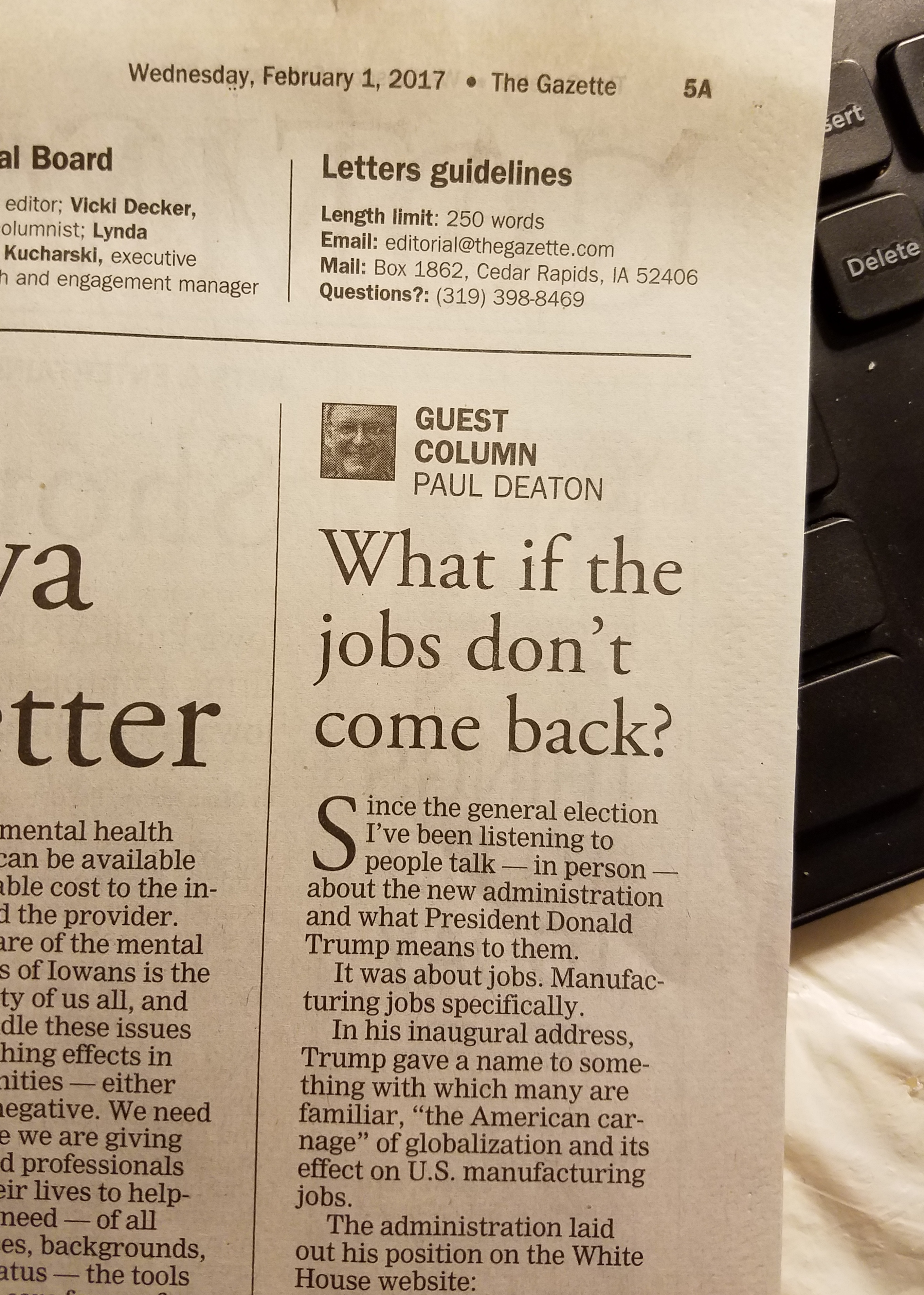
Since the general election I’ve been laying low, listening to people talk — in person — about the new administration and what President Donald J. Trump means to them.
It was about jobs.
Most supporters found a lot of what the president said and stands for to be objectionable, yet voted for him because of the hope for jobs — a central campaign theme. Manufacturing jobs specifically.
In his inaugural address, Trump gave a name to something with which many are familiar, “the American carnage” of globalization and its impact on U.S. manufacturing jobs.
An issue page of the White House web site the administration laid out his position:
Since the recession of 2008, American workers and businesses have suffered through the slowest economic recovery since World War II. The U.S. lost nearly 300,000 manufacturing jobs during this period, while the share of Americans in the work force plummeted to lows not seen since the 1970s, the national debt doubled, and middle class got smaller. To get the economy back on track, President Trump has outlined a bold plan to create 25 million new American jobs in the next decade and return to 4 percent annual economic growth.
As a deal-maker, the president asserts he knows how to do it. His plan is not yet public so it’s difficult to evaluate.
I’ve worked manufacturing jobs during my life and as a director of a logistics company that evaluated countless others. While living in Indiana I interviewed thousands of people impacted by the exodus of jobs in the rust belt as part of a global restructuring of workforce and business operations. In this sense Trump is right about the carnage: real people were negatively impacted by loss of U.S. jobs. I met many of them.
At the same time, finding cheap labor and developing new technologies enabled companies to be competitive in a global marketplace. However, Trump’s “carnage” launched with intensity because of Ronald Reagan’s policies, not Obama’s. I believe Trump’s assertion about jobs is a bait and switch.
On Friday, Jan. 27, the White House announced a “Manufacturing Jobs Initiative.” Andrew Liveris of Dow Chemical Company is convening a panel of business leaders to advise the president. For the most part, it is a who’s who of companies that benefited from globalization. I am doubtful this group can do much besides inform the president what regulations and tax codes need revision to encourage large companies to locate manufacturing plants on U.S. soil. The two token AFL-CIO members represent labor interests on the panel, but even they are part of a gigantic dog and pony show expected to accomplish little in terms of direct results impacting real people.
The metrics to evaluate Trump’s job creation performance already exist in the Labor Department jobs report which shows the millions of jobs created during the Obama administration. Assume the methodology remains constant, fill out the chart as time passes and new results are in, and there is an objective basis on which to evaluate performance. A similar metric holds true for economic growth. We should have a solid couple years in before the 2020 campaign begins. Thumbs up or thumbs down. It should be that simple.
Trump’s discussion of bringing manufacturing jobs “back” is a bait and switch. Globalization of the manufacturing processes and automation that includes robots doing repetitive tasks has eliminated many manufacturing jobs permanently. It will eliminate more.
Like it or not, with Wall Street alumni occupying four key positions in the administration, whatever jobs are created are likely to be similar to those created under Obama.
I am not hopeful for resurgence in manufacturing jobs, nor was this my issue during the 2016 campaign. However, Trump’s assertions about job creation came from the lips of every Trump voter with whom I spoke, no exceptions.
If Democrats hope to win the next presidential election we need to understand why friends, neighbors and work colleagues voted for Trump. In part, it was about jobs that won’t be back the way we knew them, regardless of campaign promises.
~ An edited version of this post first ran in the Cedar Rapids Gazette Feb. 1, 2017
From: Paul Deaton
Sent: Sunday, Dec. 2, 2012 10:14 AM
To: Farmer Kate
Subject: Processing and other ideas
Kate:
Thanks for the kale and spinach. We had both for dinner last night, and now I have a whole refrigerator drawer full of kale, ready to make something. Very yummy, with the prospect of more yummy-ness.
It was curious that you brought up the food processing idea yesterday, as I had recently been thinking of something along those lines. I think a question you should ask is whether you want to become a food processor or stick to being a grower. The trouble most growers I know seem to have is scaling their operation to meet demand. If you focus on secondary things, like processing, it may dilute your efforts as a grower, and hold you back from getting to the peak earnings potential of your farm operation.
That is not to say you should not have an outlet for farm seconds, or do other things but run the farm, you should. But a different approach might work better for you and your limited staff.
Waste not, want not is John Wesley’s old adage. If you are not getting full yield out of the results your work, look for ways to off load part of it.
First, sell the second harvest (seconds and excess) outright, not worrying about what happens to it. Before we talked, I had been thinking about working out a deal with you and others to buy excess and seconds of produce wholesale. Partly I would stock my own pantry, but if there were a commercialization opportunity, the risk and time of developing it wouldn’t land on your shoulders. The problem of what to do with excess and seconds of tomatoes, peppers and onions, etc. by processing them has been solved repeatedly by others and there is significant commercial competition. As a grower, your income may be affected by that market, but how much direct exposure do you want before the idea is tested? My thought is to find wholesale buyers of your seconds and excess.
Second, find people to collaborate with you on things. The example you gave of someone canning tomatoes and paying you in kind was one idea you brought up. I like the idea, but don’t see how that could be scalable. If anyone ever calculates the work involved in home processing, particularly cost of labor, commercialization of this process seems unlikely, especially in light of commercial organic processors. At the same time, what is the value of this work to people who take part in the cooperative? My recommendation would be to pick a few collaborative projects to try each growing season. For example, if you find a great sauerkraut recipe, you might try commercializing that. Team up with someone who is willing to share the risk, plant some extra cabbage, and do it for one season. See how it goes. Have three or four of these projects during the 2013 growing season.
Third, people like the farm atmosphere. Look at Wilson’s Orchard and their apple turnovers. When people come out for the harvest, develop a “harvest season” event or series of events, and center it around a specific culinary or harvest theme. This may be complicated because of your proximity to Celebration Barn, with its limited number of annual events permitted there, but it is worth pursuing. Again, if you would do something like this, collaborate with someone else who can do the bulk of the work related to such an event. If you did it once and generated several thousand in revenue, would that be worth it?
Anyway, you didn’t ask for any of this, but I hope you find the ideas useful. I am going to do something to earn a living wage in 2013, so if you see opportunities for us to work together, please keep me in mind.
In this final 2016 post it was easier than last year to outline my writing plans.
The work I do to pay bills and support my writing has been tough mentally and physically. To cope with an aging frame and occasionally distracted mind I have had to focus. That meant planning, and then with discipline, working the plan. 2016 was a mixed bag and I expect to do better in 2017.
I seldom post about my personal life and family — at least directly. That leaves issues I confront every day as grist for the keyboard.
There are four broad, intersecting topics about which I’ll write during the coming year.
Low Wage Work and Working Poor
Not only do I earn low wages in all of my jobs, I meet a lot of people who do too. During the last four years I developed a framework for viewing how people sustain their lives without a big job or high salary. A focus on raising the minimum wage, wage theft or immigration status may be timely but most of what I read misses the mark. Stories fail to recognize the complexity with which low wage workers piece together a life. This subject needs more exposition and readers can expect it here.
Food Cultivation, Processing and Cooking
Living on low wages includes knowledge of how to grow, process and prepare some of our own food. My frequent posts on this topic have been intended to tell a story about how the work gets done. I plan to grow another big garden in 2017 and perform the same seasonal farm work. I sent off a membership form to Practical Farmers of Iowa this morning and expect my experience with that group to contribute to food related writing.
Nuclear Abolition
I renewed my membership in Physicians for Social Responsibility. We have a global footprint and as a member I have access to almost everything going on world-wide to abolish one of the gravest threats to human life. The president elect made some startling statements about nuclear weapons this month. The subject should hold interest and perhaps offer an opportunity to get something done toward abolition. The United Nations voted to work toward a new treaty to abolish nuclear weapons. They did so without the support of the United States or any of the other nuclear armed states. In that tension alone there should be a number of posts.
Global Warming and Climate Change
My framework has been membership in the Climate Reality Leadership Corps. Like with Physicians for Social Responsibility we have a global footprint with thousands of Climate Leaders. We have access to the latest information about climate change and its solutions. The key dynamic, however, is how work toward accepting the reality of climate change occurs on a local level. What researchers are finding is skepticism about the science of climate change originates in the personal experience of people where they live. If the weather is very hot and dry they tend to believe in climate change. If it is cold, they tend not to believe. Thing is, climate change and human contributions to it are not a belief system as much as they are facts. Global warming and climate change already affect us whether we believe or doubt.
So that’s the plan. While you are here, click on the tag cloud to find something else to read. I hope you will return to read more in 2017.
My birthday trip to the county seat included these real-world variations from yesterday’s plan:
Ordered a voter list for my precinct from the county auditor to start organizing for the 2018 election and beyond.
Noticed the new Zombie Burger and Shake Lab opened next to The Mill. It seemed wrong.
Renewed my library card. Rural residents can take advantage of the Iowa City Public Library. I check out eBooks from home using my card.
Walked past children playing on the pedmall. They were laughing.
Walked past Schaeffer Hall where I spent much time attending classes 45 years ago.
Viewed the Hawkeyes in Space exhibit at the Old Capitol Museum. It is a history of the University of Iowa Physics and Astronomy Department and their contributions to the national space effort beginning in 1951 with the arrival of James A. Van Allen.
Went to Prairie Lights Book Store and bought copies of The Last Love Song: A Biography of Joan Didion by Tracy Daugherty and Born to Run by Bruce Springsteen. I also read some remembrances of Burns Weston and called out a friend on her use of what I felt were excessive exclamation points.
Stopped at the HyVee grocery store on North Dodge Street to buy a few items for my birthday dinner. I also returned cans for deposit.
I arrived home in time to read and fixed a dinner which included a test run of a noodle kugel recipe I got from a Des Moines blogger’s web site. The recipe came out well and there are enough leftovers to last a week. Intended to be a side dish, noodle kugel includes a lot of protein which is needed in our vegetarian household.
The president-elect was busy on twitter again yesterday. Here’s my nascent idea on how to handle him from a Facebook post I made.
Donald J. Trump throws tweets out to media the same way chaff was used to foil radar in WWII. We are seeing what he wants us to see about his incoming administration. All the noise is obscuring the signal, which many of us are not going to like once it comes into focus.
The positive side here is no pretense of being a “compassionate conservative” like Bush II pretended he was. I expect Trump to throttle down immediately to rollback progressive reforms dating back to FDR. I’m keeping my powder dry until we know more specifics of his agenda
I’m taking my advocacy lead from Friends Committee on National Legislation. Diane Randall laid out an agenda which seems practical and makes sense. Her outline of how to deal with appointees who require U.S. Senate confirmation is spot on:
In these confirmation hearings, senators ask the nominees questions that establish a public record. One of the most effective ways FCNL can influence the public record is to encourage senators to ask particular questions. FCNL, along with many of our organizational partners, is preparing questions for senators to ask the nominees. These questions are specific to each nominee, concerning their positions on enforcing current laws and their positions with regard to the safety and well-being of specific populations, or on past statements they have made about the role of the agency they will be heading.
Based on the past public statements, or votes for the nominees who have served in Congress, we are particularly concerned about nominees who have stated their opposition to environmental regulations, full access to health care and protection of voting rights and religious freedom.
Following FCNL’s lead isn’t mutually exclusive, but would be a bit of sanity in what appears to the egregiously brazen impetus of the president-elect’s nominees who have track records running against the grain of progressive values.
It’s two days at the home, farm and auto supply store for me, followed by a three-day weekend. Stay tuned.










 Journey Home
You must be logged in to post a comment.