I’ve not been a fan of the Independence Day holiday since military service. It’s not that I paid much attention to it previously. As a military officer I had time to reflect on the meaning of independence while stationed far from home among strangers.
People celebrate the Declaration of Independence and its grievances against the King of England. I don’t mind. While I’m as glad as anyone Elizabeth is not our queen, and Prince Charles will never be our king, Columbus’ “discovery” of the Americas was an affront to human society. 284 years later the damage had been done and the founders were formalizing a relationship with the King as the hegemony of natives had been diminished by disease and warfare.
Few things point out the advancement of pre-Columbian society, and what was lost, as much as the recent book, 1491: New Revelations of the Americas Before Columbus by Charles C. Mann.
The premise of Mann’s book is there were societies in the Americas that were as sophisticated as any on the globe. They endured for multiple millennia, coming and going over time before Columbus arrived, cultures unknown to Europeans. The Declaration of Independence was an insider deal among participants who had no standing to occupy and exploit the Americas. Yet they did.
It was not unusual for Americans to side with natives at the time of independence, especially when compared to living under English rule. I side with Frederick Douglass who said,
Your celebration is a sham; your boasted liberty, an unholy license; your national greatness, swelling vanity; your sounds of rejoicing are empty and heartless; your denunciation of tyrants, brass-fronted impudence; your shouts of liberty and equality, hollow mockery; your prayers and hymns, your sermons and thanksgivings, with all your religious parade and solemnity, mere bombast, fraud, deception, impiety, and hypocrisy-a thin veil to cover up crimes which would disgrace a nation of savages.
If I celebrate anything this day it is the renewed opportunity to get along with neighbors and friends, something I believe is critical to healing our broken Democracy. While we may not agree about the meaning of Independence Day, it is better to find common ground every way we can. We’ll need that in the Anthropocene Age.
Wednesday I worked outside for five hours at the home, farm and auto supply store.
As temperatures reached toward 85 degrees, a colleague and I consolidated the remaining plants and supplies and opened up traffic flow where the garden center had been. I used a lift truck although there was plenty of physical labor. Our permit with the city expires soon and it’s time to make the parking lot a parking lot again.
Lifting numerous bags of mulch, soil and garden products took a toll. I was tired when I clocked out at 4:30 p.m.
Stopping to pick up provisions at the warehouse club, the trip home took an hour and 40 minutes. I followed a large sprayer from North Liberty to Solon and it drove really slowly. There was no way I could make the trip to the county seat for a meeting where a group is coordinating a presidential candidate debate on our issues: nuclear abolition and climate change.
Aware of the televised and webcast first presidential candidate debate, I skipped it for complicated reasons, but mostly because I couldn’t stay awake until it ended at 10 p.m. With a large glass of milk and an appetizer plate for dinner, I retired early and slept through the night.
I woke around 2:45 a.m. and picked up my mobile device without turning on the lights. A friend from one of the farms where I work participated in a CNN discussion panel after the debate and sent me video. She represented our community well in the brief amount of air time.
My main conventional news sources, Associated Press and the Washington Post each had their spin about what was most significant. AP framed health care and immigration as the top issues debated. The Washington Post headlined economic policy, although they presented multiple articles on several topics.
My social media scroll showed partisans supporting their candidate and little else new. What stood out was broad support for Elizabeth Warren’s performance and a breakout for Julián Castro. In the honorable mention category, de Blasio was not as bad as expected and U.S. Senators Cory Booker and Amy Klobuchar came across as knowledgeable and presidential. Of the ten in the first debate, it is time for Bill de Blasio, Tim Ryan, Beto O’Rourke, Tulsi Gabbard, Jay Inslee and John Delaney to make their way to the exits and find other Democratic work needing to be done. If we have too many presidential candidates, there is no shortage of work to regain a Democratic majority in the legislature.
No regrets about missing the debate as I feel rested and ready to start another day. When you get to be a certain age, physical limits are familiar. One hopes to keep our powder dry and live to fight when it really matters. I can’t honestly say sifting through dozens of announced presidential candidates matters that much.
Editor’s Note about June 27 debate: Survivors of the second debate, according to accounts I read similar to those mentioned, and not from watching the debates, are Joe Biden and Bernie Sanders (only for their high ranking in the polls), Kamala Harris (for her discussion of the importance of race relations in 2019), and Pete Buttigieg for his millennial status and as a reminder of the promise of youth. As U.S. Senators Michael Bennet and Kirsten Gillibrand get honorable mention, they should make their exits from the presidential race to work on electing additional Democratic U.S. Senators to secure a majority. Eric Swalwell, Marianne Williamson, Andrew Yang and John Hickenlooper should recognize the exit music and gracefully seek other important work in the Democratic Party to improve our chances of securing majorities in both federal legislative chambers.
Based on this analysis, there are few choices for me: We need to turn the page on Joe Biden and Bernie Sanders even though their current standing in polls is evidence many like them both. That leaves Elizabeth Warren, Kamala Harris, Cory Booker, Pete Buttigieg, Amy Klobuchar and Julián Castro. I’d like to hear more from each of these candidates in the next debate. The field needs to reduce by half again after that process is completed. Of everyone that is running, on June 28 I’m more likely to support Elizabeth Warren than I was. My willingness to listen will decrease as summer continues. Making a decision of who to support should be doable by Labor Day.
I don’t intend to get alarmist on fair readers with dire predictions of the end of the world as we know it. Even though doomsday stories are quite popular, and climate science is, well science, there is another issue.
In our weird, wet spring weather we believe we have climate change figured out. Instead of planting our potatoes on Good Friday, now we’ll plant them in early June as the ground dries out and all will be hunky-dory. That’s a problem.
Science: Around 1850, physicist John Tyndall discovered that carbon dioxide traps heat in our atmosphere, producing the greenhouse effect, which enables all of creation as we know it to live on Earth.
Also science: As greenhouse gas emissions increased after World War II, our atmosphere warmed significantly. A warmer atmosphere holds more water vapor. As we discovered, water vapor laden atmosphere can unleash torrents of rain on Iowa and elsewhere. There’s photographic evidence!
Suddenly we’ve gotten all climate-changey. Every severe weather event is declared to be made worse because of climate change. Maybe it is although the complexity of our climate doesn’t lend itself to such simple statements.
What makes this problematic is in a culture where we appreciate detective work that goes into finding a villain, assigning blame, and making them pay with social shunning or other consequences, there is no single antagonist with climate change. We are all antagonists which makes a pretty boring story.
Iowans may believe climate change brought us a new normal of wet springs. What the science is telling us about climate change is there is no normal as we define the word. The minute we believe we have climate change figured out a new twist should be expected.
It is time to Act on Climate.
~ Published in the June 13, 2019 edition of the Solon Economist
A brilliant, partly-cloudy sky hung over the landscape as I made my way east on Interstate 80.
Rain broke long enough to allow a trip to Davenport to visit Mom and a friend I met in grade school.
Mother insisted on making coffee and it was the best I’ve had in a while. It took her longer than it would have me, but I stood with her and helped as best I could. At age 89 she wanted to do it so who was I to object?
She’s joined the cohort of octogenarians who dread the thought of going into a nursing home when staying at home no longer works. This dread is almost universal among Americans and with good reason. Almost everyone I know who had experiences with a relative checking into a nursing home has a horror story or two about neglect and mistreatment.
I believe the problem with nursing homes is, like with other modern social phenomena, mostly because of the decline in K-12 education, the rise in private and home schooling, and the dominance of FOX News and right-wing radio among people who continue to be radio listeners or view television broadcasts and cable. People have been dumbed down and will swallow almost anything they hear repeated often enough.
Nursing homes don’t have to be as bad as they are, but education and social learning haven’t prepared us as well as they could for getting help with aging relatives. Most people can’t afford an in-home nurse when someone requires 24/7 attention. A nursing home has become the best opportunity to enable a loved one to live their final time on Earth with dignity. Indignities regularly imposed on residents become exceptionally objectionable because of this.
I met my friend for lunch at an Italian-style restaurant. Italian restaurants usually have fresh salad offerings and this one was no exception. They offered some “Chicago-style” dishes which apparently are gaining popularity in my home town. Like with Mother, my friend and I had an engaging visit.
I got sleepy and stopped at the rest area halfway home to walk around. A great thing about Iowa rest areas is they have clean rest rooms and drinking fountains with free, chilled, filtered water. Refreshed, I made it home okay, passing presidential candidate Tulsi Gabbard’s advertising billboard outside Iowa City. One may try to get away from it, but politics never takes a holiday.
At home, I mowed the lawn as best I could, breaking a sweat. The ambient temperature was moderate and the sky remained bright. As I mowed around the garden, the grove of fruit trees, and lilacs, I was reminded of how much yard work remains to be done to get the property in suitable shape. My solace can be found in the Meriam Bellina song,
One day at a time sweet Jesus
That’s all I’m asking from you
Just give me the strength
To do everyday what I have to do.
Yesterday’s gone sweet Jesus
And tomorrow may never be mine
Lord help me today, show me the way
One day at a time.
I need to make another pass to pick up the grass clippings for the garden.
The garden patch has standing water in divots dug last week. When I mowed near the ditch the sound of running water informed me it hadn’t dried out and might not this year. Gardeners on social media are getting their vegetables planted, and this is the latest start they can remember. The wet spring has been problematic, although all is not lost… yet.
Soon corn farmers will have to turn to beans if the ground doesn’t dry out enough for planting. With China no longer wanting corn and soybeans because of U.S. tariffs, the prospect of plummeting soybean prices is real, and farmers will take it on the chin… again.
All in all Saturday was a positive day in a turbulent world. Hopefully I’ll get some garden time in when I return from the farm this afternoon.
The myth of relaxing on a towel at a beach, sunglasses and sunscreen on, reading a book may not exist for most of us in Iowa. The beach nearest us has been closed in recent seasons because of the risk of exposure to microcystin and E. coli bacteria, both harmful to human health.
Nevertheless, reading is an important part of summer activities, and essential for people engaged in society. Our home owners association has a monthly meeting at the public library where staff politely boots us out in June and July because it falls on the same night as the summer reading program. Summer reading is one of the most important programs at a public library.
When I write “reading,” I mean books. A lot of our time is spent reading news articles which, while important, does not involve the kind of commitment as reading a book cover-to-cover. I started the Goodreads Reading Challenge last year and it helped me stay focused on reading. I’ve read 16 books this year and you can see which ones on my Reading List page.
Here, in no particular order, is a list of ten books on my bedside table for reading this summer:
Where the Light Enters: Building a Family, Discovering Myself by Jill Biden.
The Tallgrass Prairie: An Introduction by Cindy Crosby.
The Radium Girls: The Dark Story of America’s Shining Women by Kate Moore.
The Overstory by Richard Powers.
Pacific by Simon Winchester.
Milkman by Anna Burns.
The Wizard and the Prophet: Two Remarkable Scientists and Their Dueling Visions to Shape Tomorrow’s World by Charles C. Mann.
The Uninhabitable Earth: Life after Warming by David Wallace-Wells.
Janesville: An American Story by Amy Goldstein.
Energy: A Human Story by Richard Rhodes.
While beaches may be closed due to environmental pollution, I plan to find a shady spot on our property or a comfortable chair inside to crack open a book from time to time this summer. Please do leave a comment with what you are reading this summer below.
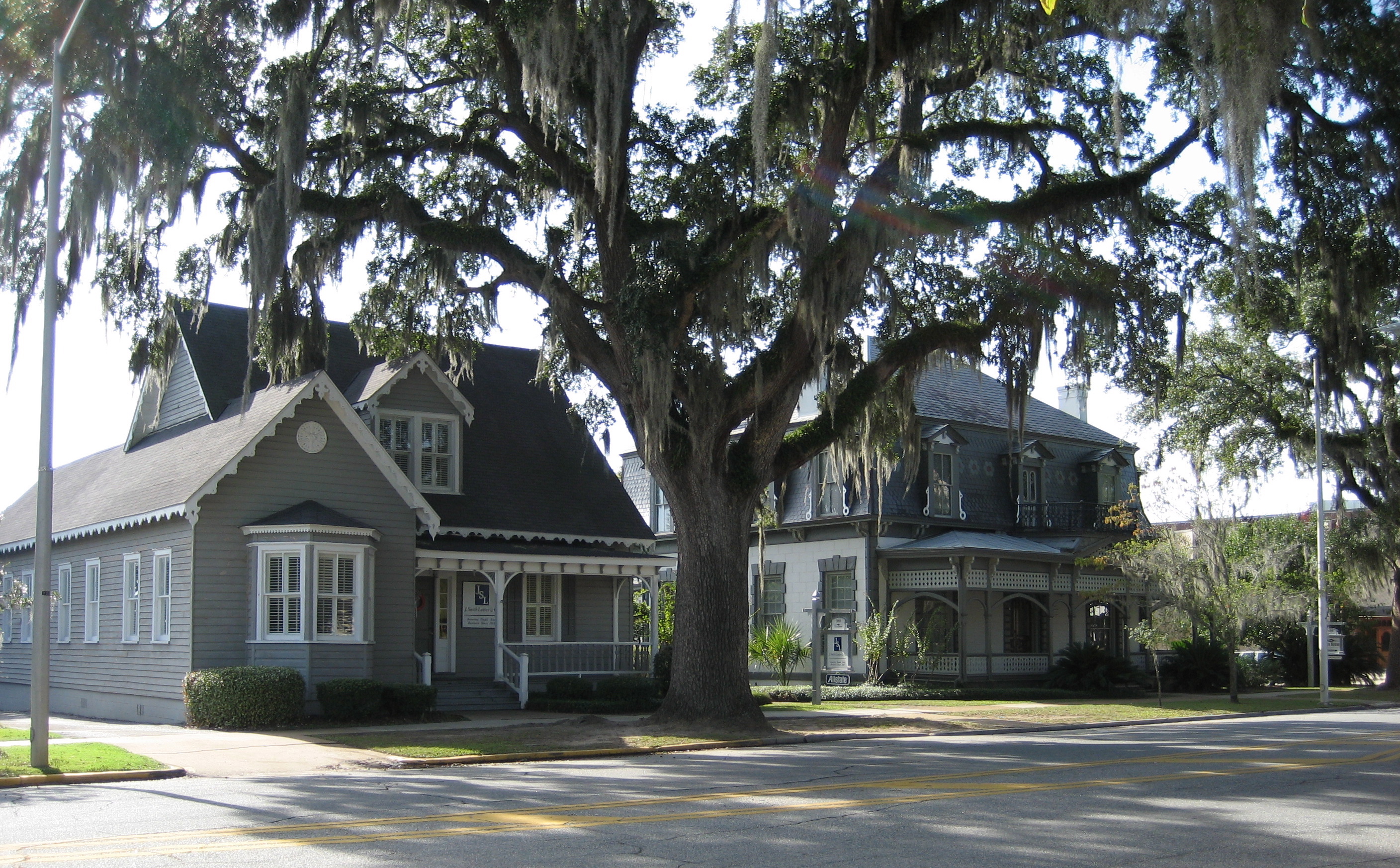
Spanish Moss on a Tree in Thomasville, Georgia Photo Credit – Wikimedia Commons
My memory of South Georgia is specific. I don’t know if it’s real.
As a child, our family drove from Iowa to visit Tallahassee, Florida, the place Father lived after re-uniting with his father after Grandfather’s release from prison. For the record, Grandfather’s conviction for draft evasion was a misunderstanding. He hadn’t meant to be a draft dodger during World War II, according to his late, youngest son Eugene. Dad graduated from Leon High School, then enlisted with his brother Don in the U.S. Army.
That trip was to visit relatives in Wise County, Virginia, according to a recent conversation with Mother. The Tallahassee stop was a side trip. I don’t recall whether the memory occurred southbound or northbound, maybe both.
The memory is of riding in the back seat of the family automobile as Father drove on two-lane Highway 319 where Spanish Moss hung from oak trees with branches extending over the road. Mother was in the passenger seat, I was in back with my brother and sister. Except for Dad, we had never seen Spanish moss before. We did not have that in Iowa. We visited the plantation where Father stayed, Leon High School, and maybe stayed over in a motel, I can’t remember. These events and the long trip at slow speed through the Spanish moss-hung oak trees rolled into one over time, It was almost 60 years ago.
In 1997 I had a three-month work assignment near Ochlocknee, Georgia. My project was located at the largest employer in the county, which was and is involved in mining and processing minerals for a variety of consumer applications. No local ever complained to me about the mines. The rest of the economy was agricultural: peanuts, cotton and pecans.
Because Tallahassee was the closest airport, I flew home from there every other week, driving the same road I had as a child, replete with oak trees hung with Spanish moss. I lived there long enough to recognize other flora and fauna. In particular, pine forests and pecan plantations. The road seemed the same as my childhood memory. I made this regular trip between Ochlocknee and Tallahassee for most of my stay.
The memory sparked an interest in Janisse Ray’s memoir, Ecology of a Cracker Childhood. I wrote the following brief review in the Spring edition of the Prairie Progressive:
Other than authors of country music, few write about the pine forests of South Georgia. Janisse Ray’s memoir, Ecology of a Cracker Childhood, is important for the sense of place it creates. She grew up in a junkyard with ever-present extreme poverty, mental illness, and fundamentalist Christianity. Her story is one of growing self-awareness and hope in a land where both were in short supply.
While Ray is ten years younger, we share cultural references. Perhaps the most significant is the sense of loss she describes for Long Leaf Pine forests and their ecology. I feel much the same living in a state where what was here — tallgrass prairie — has been replaced by fenced parcels where farmers grow crops and raise livestock. Her experience in Georgia informs my life in Big Grove.
Ray mentions Thomasville, Georgia a couple of times in the book. I stayed in Thomasville while working at the mine. There was little daylight between work and rest so my life then was very specific.
The biggest excitement during my stay was when an inspector found a boll weevil in a trap during the season. Boll weevil traps were part of an early warning system to prevent damage to the important cotton crop. One of the plant workers at the mine had a government contract to inspect boll weevil traps. When he found one it made news all round the county.
The first boll weevil appeared in Thomasville in 1915. The insect did its part to bring down the antebellum economy where cotton was a global mainstay. Boll weevils had supposedly been eradicated by chemicals by 1990, but weren’t.
Ochlocknee, Georgia was a poor place where cattle casually roamed Main Street and a Model T Ford sat up on blocks in someone’s yard. I went to the auction house one night, but had no way to transport anything home. I listened to the bidding and tried to keep my hands down. Lunch at the Depot Restaurant was a meat and two sides with iced tea. A diner could pay extra and get a third side. The restaurant has since closed. When I encountered locals outside the job site, the conversation was a mix of complaining, gossiping and harshness. The place and its people defined hard-scrabble.
I had few friends in south Georgia. After working a 13-hour day at the plant, I made dinner at a hotel and watched cable television including a fledgling channel called Food TV. The name later changed to Food Network. I attribute my interest in food and cooking to those nights alone in Thomasville. My involvement in the local food movement has its origins in the contrast between that uninviting place in South Georgia and my nightly food escape. We didn’t have Food TV in Iowa at the time. Like Spanish moss, it seemed exotic.
The main memory, of driving through Spanish moss hanging from branches over the highway, is essential. It is an unchanging remembrance of something seen as a child in a way that shaped me. It has no time or place and some days I don’t know if it’s real. It is the human condition to believe it is real, and eternal. So I do.
Monday didn’t happen as expected. There were three things involving arborists, health care and farming.
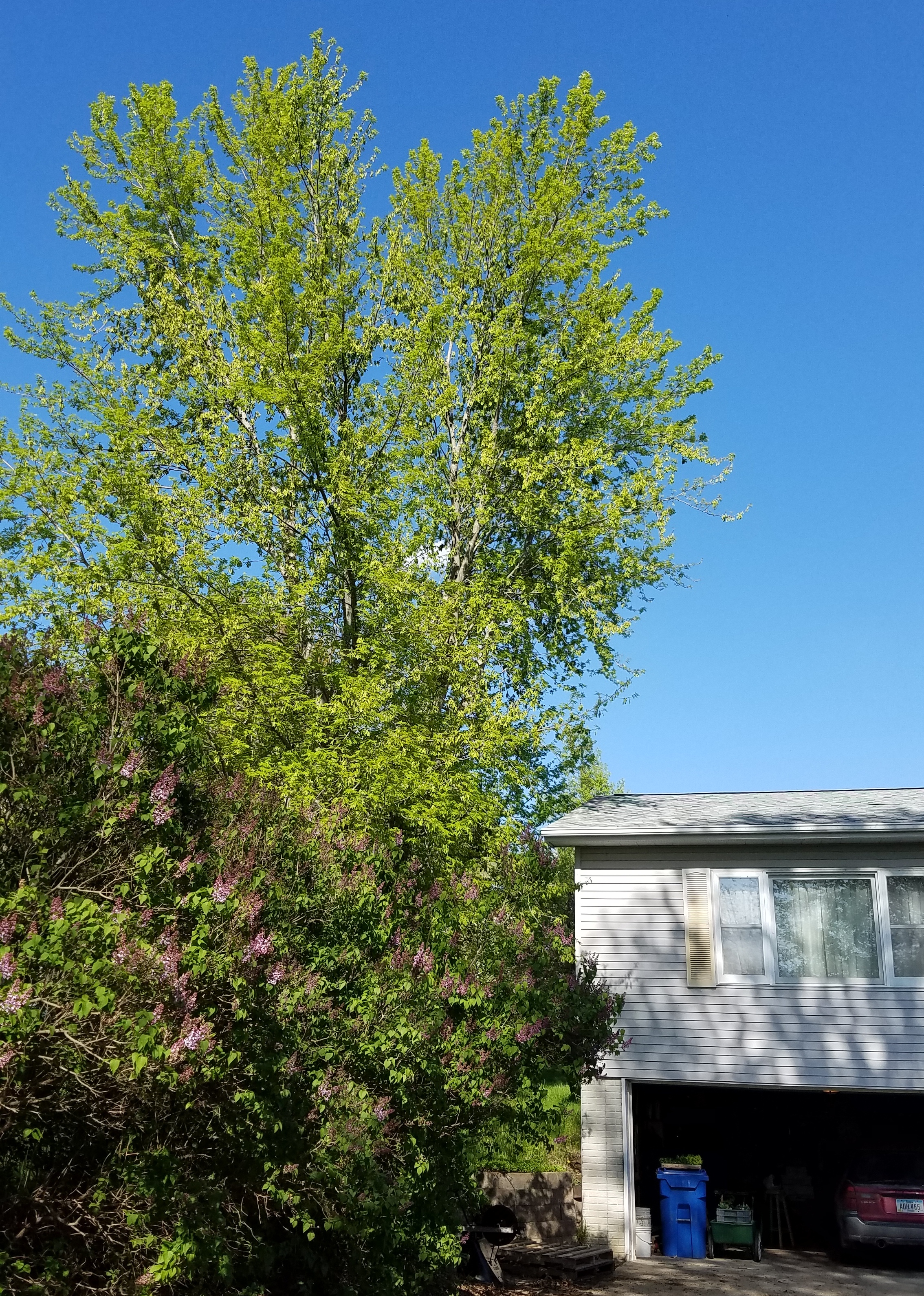
Without announcement, the arborist arrived to take down a maple tree I planted on the northwest corner of the house. Turns out I didn’t know what I was doing when planting the 12-inch, stick-sized sapling so close to the house in 1994.
Now fully grown, unusually strong winds already took out one of the main branches. We determined it would be less expensive to remove the tree than pay for a roof repair when limbs inevitably blew down on it.
It was a small way of mitigating the damage of the climate crisis.
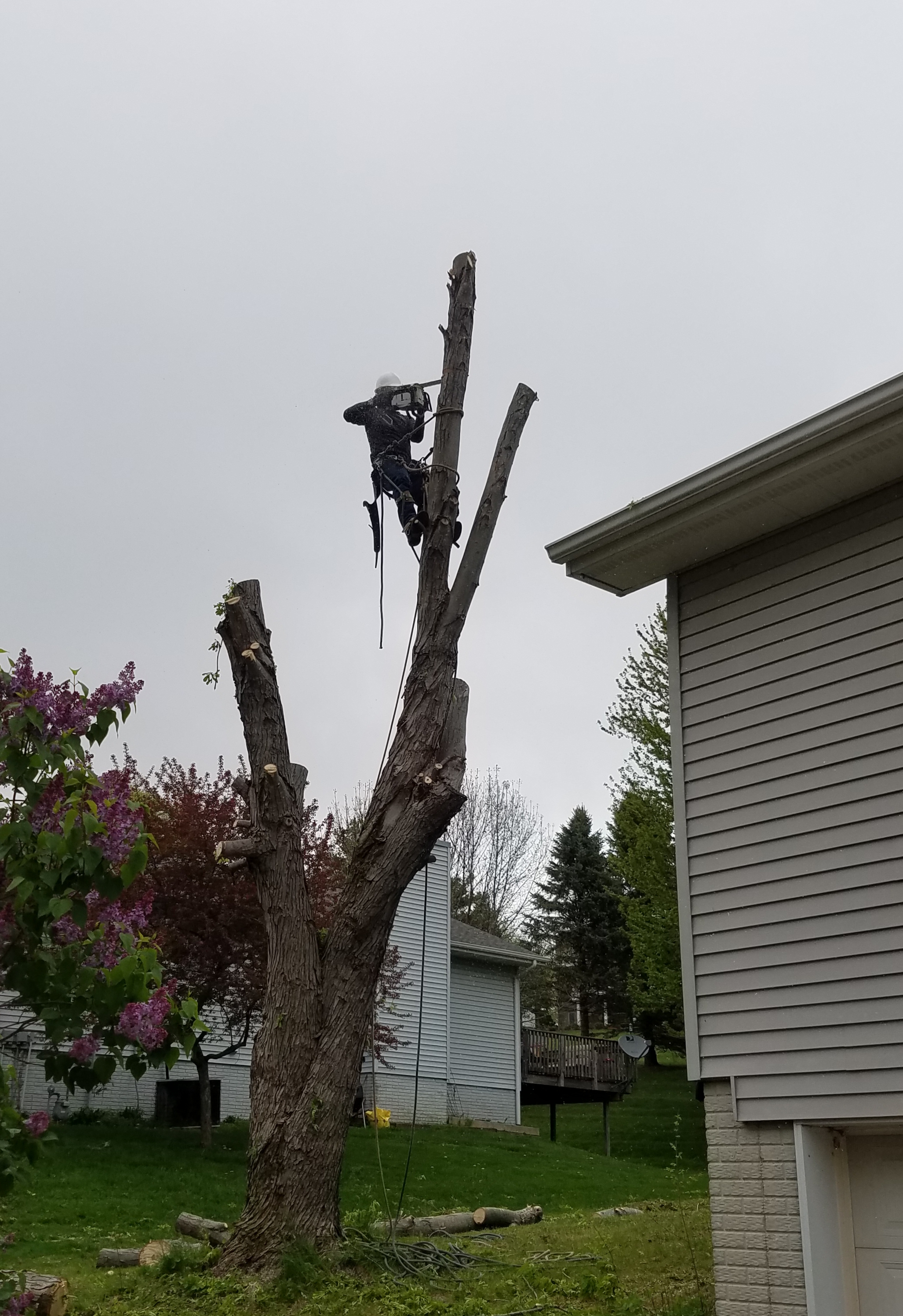
The crew was four men with two pickup trucks to haul away brush and wood. The benefit of using an arborist instead of a tree service is the equipment is pickup trucks, ladders, and an array of Stihl brand chainsaws and old fashioned loppers. There is minimal soil compaction around the work site without heavy equipment and that’s important to a home owner.
Arborists at Work
The arborists took out the maple and trimmed the pin oak, finishing well before noon. Our next door neighbor engaged them for tree trimming and by the end of the day our corner of the neighborhood was looking good.
Monday’s main event was a trip to the local clinic to get checked out.
Last Friday someone called, saying I was overdue for a physical exam. They had an appointment the following business day, which in a small city is disconcerting. The hospital managing the clinic is already having financial difficulties. The fear is the clinic will close, making it neccessary to drive to the county seat for health care. I took the appointment.
We no longer have two physicians at our clinic as one was replaced with an ARNP or Advanced Registered Nurse Practitioner. I get that the United States is facing a physician shortage, and our ARNP fills a coverage gap. It makes sense to differentiate the skills being performed in a local clinic and find practitioners that closely match them.
I miss what I had for a very long time, a doctor with whom I established a relationship and could get to know in our community. I’m not saying it was great, or that we should go back. I miss it but am ready to move on, seeking an answer to the question how do people get treatment in a scenario in which part of every office visit is talking about how to pay for services?
Arborist at Work
I liked my ARNP. He explained something I hadn’t considered. He said I was scheduled for a physical exam and there would be a significant cost. I explained that’s what the Friday caller said I needed so I went with it. He changed the billing code and said, once a person reaches a certain age, the better course of action when seeking treatment is to come into the clinic for specific maladies, without getting a traditional physical exam. I have a history already, which when combined with age and lifestyle risks, along with my complaints, can determine a course of care without physical examinations as I’ve had previously. What their team did today was little different from what the last physician did, with the exception the prostate examination was delayed until the results of a panel of lab tests he ordered were known.
At 3:40 p.m. I drove to the farm to pick up our vegetable share of Bok Choy and Koji, Leaf Broccoli, Mixed Greens, Lettuce, Spring Garlic, and Garlic Chives. Each year I secure onion starts for our garden leftover once the farm has planted theirs. It was time. Usually I get a bundle or two of starts produced in Texas, but Monday was different. The farmers gave me two trays of locally grown starts still in soil blocks. It seemed a generous gift considering the work that produced them. I was thankful to have them.
A day that started with a headache from a 12-hour fast before my clinic appointment turned out for the better. I had a cup of coffee after the clinic and the day got progressively better. It was one more day of sustaining a life in a turbulent world.
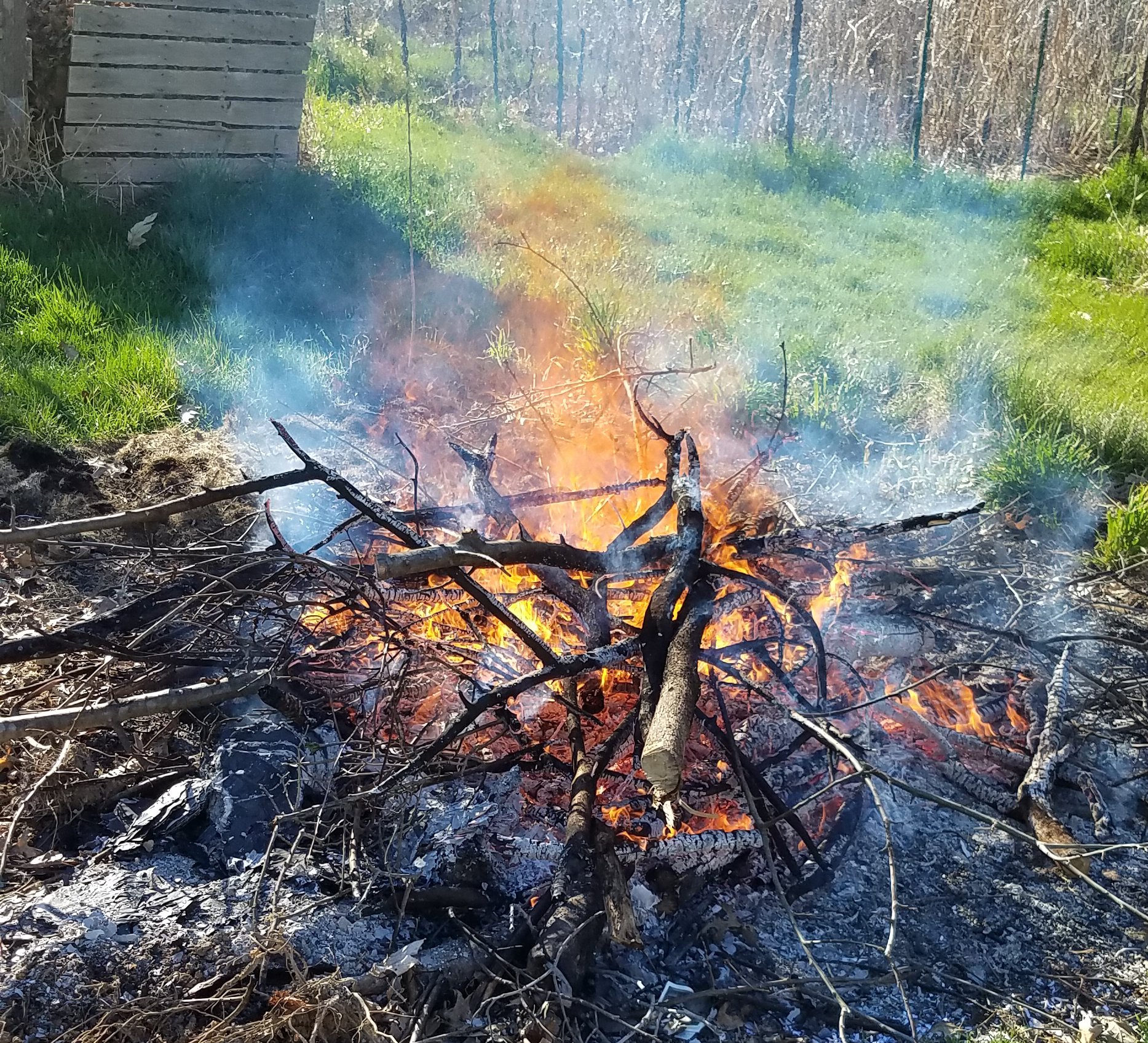
As a gardener I burn brush on a garden plot a couple times a year, rotating the burns on each of seven plots over time. The idea is the mass of the brush is reduced, carbon dioxide is released, and minerals return to the soil. It’s a common practice.
The alternative is purchasing a wood chipper to turn brush into garden mulch — expensive for the amount of brush accumulated in a single gardening season. For the time being, I plan to continue to burn brush because of the carbon cycle.
In 2015 I discussed carbon release from burning wood and other biomass in fires like mine, for home heating, and in the University of Iowa power plant where they burned a mix of fossil fuels and biomass.
What scientists told me was it was better to burn biomass than fossil fuels, partly because the amount of carbon dioxide released into the atmosphere was less than burning coal in experiments they performed.
Ben Anderson, who operated the University of Iowa power plant said, “It’s still combustion but the carbon cycle is what is important there.”
Biomass takes carbon from the atmosphere and stores it until it is released back into the environment in a cycle as old as time. Mining and burning fossil fuels also releases stored carbon which has been stored for millennia. Given our present ecosystem, it is better to leave fossilized carbon where it is, according to the analysis, because releasing it contributes to global warming.
I wrote about this for the local newspaper. The article below was published on Oct. 7, 2015 in the Iowa City Press Citizen with my by line. Many thanks to my editor Josh O’Leary for improving my initial submission.
Biofuel use is a well-known contributor to meeting sustainability goals at the University of Iowa. Since 2003, UI has used oat hulls sourced from Quaker Oats in Cedar Rapids to generate electricity, heating and cooling on campus.
Several chemistry department faculty and students recently completed a study of gas and particle emissions from co-firing coal and two types of biomass versus straight coal at UI’s main power plant.
Researchers also found that using oat hulls with coal reduced carbon-dioxide emissions by 40 percent and significantly reduced the release of particulate matter, hazardous substances and heavy metals.
“The UI is working toward meeting a goal of using 40 percent renewable energy by 2020,” said Betsy Stone, an assistant professor in UI’s chemistry department. “Part of their plan to achieving that goal is the use of biofuel, which is a renewable source of energy, instead of fossil fuel, in this case coal.”
The group was interested in understanding how using biomass instead of coal changed emissions released into the atmosphere, Stone said.
“When burning 50 percent oat hulls and 50 percent coal, we saw a big reduction in criteria pollutants compared to burning 100 percent coal,” she said. “When I say ‘criteria pollutants,’ I’m talking about things like fossil carbon dioxide, sulfur dioxide and particulate matter.”
Use of the 50/50 mixture reduced the mass of particulate matter by 90 percent, Stone said.
While overall CO2 emissions were constant among the three fuels used in the study — straight coal, 50/50 oat hulls/coal, and 3.8 percent wood chips/96.2 percent coal — the use of plant material makes the process more sustainable, Stone said. Biomass takes CO2 out of the atmosphere and incorporates it into the plant. When it’s burned, CO2 is released.
“It’s considered to be a renewable fuel because we have that carbon cycle going on,” Stone said. “With fossil fuels, we’re releasing fossilized carbon. It goes into the atmosphere and takes millions of years to get back to fossilized form again.”
The major take-home message is there is a significant reduction in fossilized CO2, sulfur dioxide and particulate matter, which is beneficial to people living near the power plant, Stone said.
“I thought the study was definitely encouraging and in line with our thoughts that biomass is good for the environment,” said Ben Anderson, UI power plant manager. “Overall, the results are encouraging and provided assurance we are going the right way with the biomass project.”
The biomass project brings the renewable component to the plant, but is also a component of fuel diversity, he said.
“That’s really important for reliable operations,” Anderson said. “Natural gas markets have been known to spike from a cost perspective. If there is a problem with pipeline transport, we can use the biomass and still keep this plant online.”
Maureen McCue, coordinator for Iowa Physicians for Social Responsibility, noted important considerations of this study, including locally sourced fuel options and the avoided cost of buying and shipping coal. McCue called UI’s biofuel efforts “a good use of a resource that might otherwise go to waste.”
“The mixture avoids some of the known adverse health effects associated with burning more coal,” McCue said in an email. “There is no health benefit to anyone unless you assume burning coal is obligatory/unavoidable and thus count as benefited the person(s) who would have been impacted by more coal.
“It’s like saying not hitting your head with a hammer is a health benefit,” she added. “No one wants to risk their health breathing coal emissions or headaches by hammer if there are alternatives.”
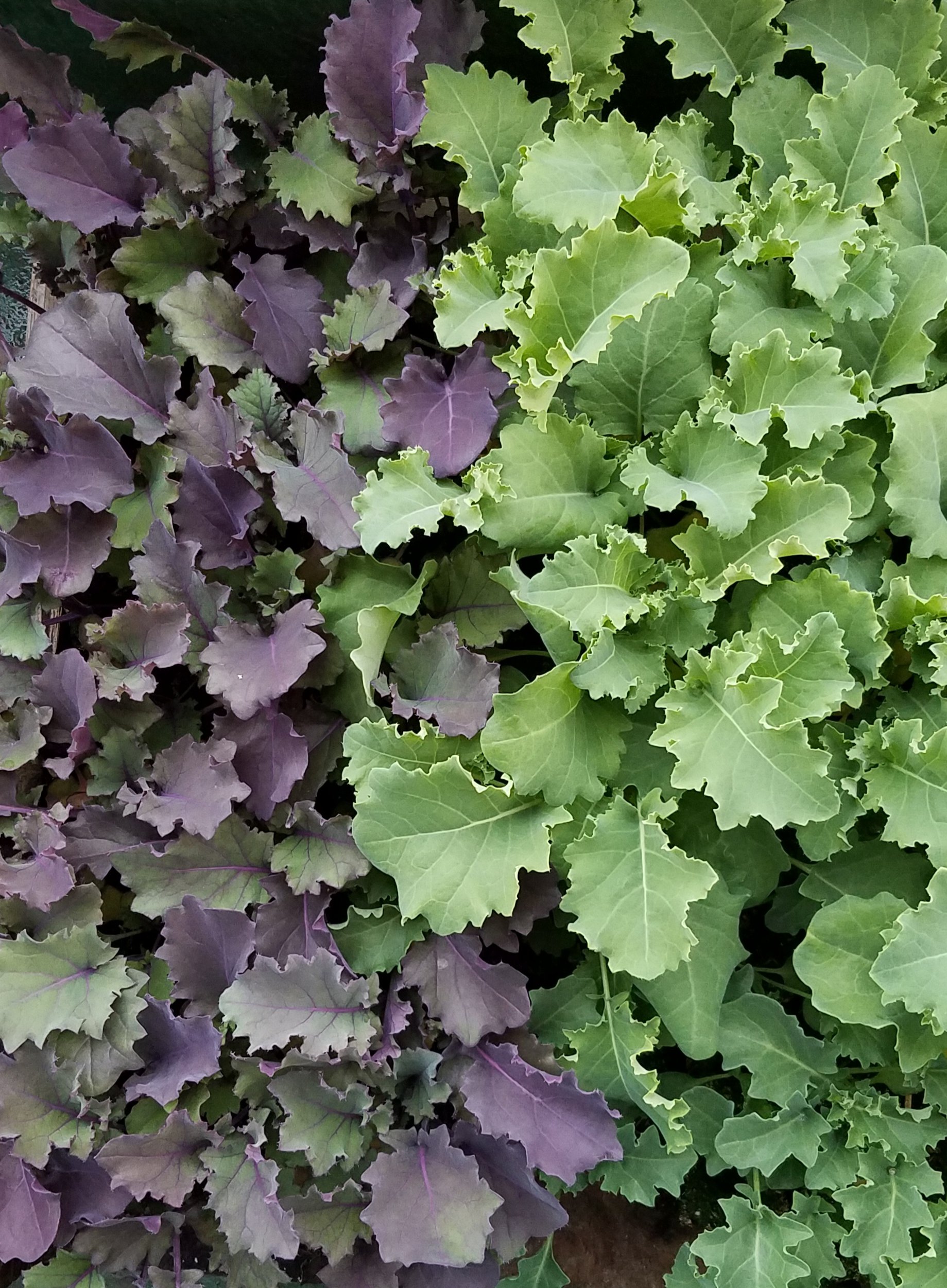
Kale Seedlings from the Greenhouse, Ready to Plant
I’m going home.
Yesterday’s fire at Notre Dame Cathedral, on Île de la Cité in Paris, brought that feeling from the darkness.
It is no longer my world.
When I visited Notre Dame I didn’t take photos. I brought a dozen rolls of Kodak film with me on a 12-week trip to Europe. They had been stolen in Calais. I reluctantly bought two to replace them and used them sparingly. Having studied Gothic architecture in art history class, I figured there were enough extant photographs to call up memories without any light I personally exposed to film. It turns out those memories, in light of the fire, remain prominent without external stimulation.
I remember standing below the large stained glass window, made in the 13th century, in awe of the accomplishment. In 1974 the cathedral wanted repairs and there was ongoing work being done. The flying buttresses looked fragile, the stone facings of the church well worn by pollution from acid rain and vehicle exhausts. I marveled that the stained glass survived two world wars and read the story of how they did. A religious service started and I left the cathedral.
News reports this morning say the stained glass window that made an impression on me 45 years ago was saved from the fire. The collapse of the roof and gutting by fire of the interior means any repairs will be costly. With the centuries-old struggle to keep the building up, it’s hard to see how a complete restoration would even be possible. In any case, the 13,000 trees cut to make the roof —an entire forest — can not be replaced after so many centuries.
We are used to landmarks being changed or disappearing. The World Trade Center in New York City and the Bamyan Buddhas in Afghanistan are two different types of examples in my lifetime. How uncaring people can be about preserving history. How fragile is what has been entrusted to us by the past.
When the world you’ve come to know changes, it is time to go home.
According to the Social Security Administration’s life expectancy calculator I can expect to live 17.4 more years. I’ll do my best to live a good life, however, the journey home has already begun.
Saturday was the first spring day with temperatures in the low 70s.
I spent a few hours raking and using the chainsaw, beginning yard clean up. More clean up remains but I’ve learned to take it easy until returning to better physical shape through the work.
I relished being outside at work so much. Excited to deploy the chainsaw, I forgot hearing protection until I was almost finished.
Neighbors hailed me from their yards and in passing by. The whole neighborhood seemed outside and alive. There was ice below matted leaves yet everything else indicated spring had definitely arrived.
Saturday had begun Friday by covering mixed beans with tap water to soak overnight.
Before sunrise I cooked the beans in homemade vegetable broth, then added carrots, celery, onion and bay leaves. The broth reduced so I added more — four quarts in all. It simmered all day yielding a deep brown color by supper time. A cup of soup with toasted bread, a small plate of cheese and pickles, and a glass of milk made the meal.
A week into April and nothing is planted in the ground. I surveyed the garden plots for a spot to plant peas and carrots and have ideas but no plan. I’m getting better with garden layout each year because of a shift from whimsically filling space to consideration of which plants go where and why. After yesterday there’s a lot of wood to cut for a burn pile, such cutting making space to think about sunlight, shade, soil health, animal traffic and mulch.




 Journey Home
You must be logged in to post a comment.