Categories
Social Commentary

Pent Up Demand

FencelineLAKE MACBRIDE— While the dental hygienist was scaling, I noticed an odd shape on the upside down computer screen above my head. Leviathan? No. Ink blot? No. It was an image of a jaw bone and the hygienist was recording gingival margins as she poked and scraped with the tool. The screen is used to record information, view X-ray panels, and who knows what else. What I know is getting regular dental checks is one of the few remaining luxuries in life, and when at the dentist’s office, I pay attention to everything that’s going on.

Within earshot, another patient was defending Obamacare, saying the popular conception, that the law was a bad deal, was wrong. All of his children were now covered with health insurance thanks to the law, including one with preexisting conditions. He was grateful and appreciative, and spreading the good news.

For small talk, I chose my warehouse work where I was scheduled for a shift that afternoon. I had my work uniform on so discussion came naturally with the same hygienist I’ve had for a number of years. While we don’t know each other, we chat. She lives in the same town as the warehouse, so we had that in common.

When I changed health and dental insurance policies after implementation of the Affordable Care Act, I cancelled our dental policy because dollars covered were less than the cost of premiums. We have been paying directly for dental care since, and while there is a cost, it’s not that expensive with a successful dental practice.

When people don’t have enough money, dental care is one of the first things to go, especially if there are no symptoms. Right behind that is preventive maintenance on automobiles. That’s where my day of relieving pent up demand to take care of things began.

Motor oil has a useful life beyond the 3,000 miles shops write on the windshield sticker for the next change. My last oil change was in March, so even with my extended interval, service was past due. Partly, the challenge was making time, but partly, I knew from the last inspection some work would be needed, and was avoiding it. I inspect my own tires from time to time, and without a gauge, I could tell the tread depth was well below 4/32nds of an inch, and winter is coming.

The dealer had noted an axle going bad in March, and the local technician confirmed it and gave me a $700 estimate for four tires, a replacement axle and some other necessary repairs. The local labor rate is far below the $100+ per hour charged at the dealership, so it is good business to buy locally.

I declined the offer on the tires knowing my next stop was Cedar Rapids for the dental appointment. I had some time to kill. We have used the same tire dealer for most of the 20 years since we moved back to Iowa. I arrived and he had many options, including one priced much lower than our local repair shop. I bought four tires which were changed in about 20 minutes.

One thing led to another on a day designed to meet existential needs. I stopped at the hardware store and bought a couple of wooden toilet seats. I stopped to eat at a sandwich shop in North Liberty, spending the six dollars in my wallet on an Italian-style sub. I accessed the app for my hair salon and saw there was no waiting. I checked in and drove there to cut the shaggy ponytail beginning to grow in an effort to look my best at the presentation scheduled in ten days. There is a different stylist each time, so no relationship. We talked about my warehouse work.

From there I drove to the warehouse where I spent the shift chatting with scores of people. Afterward, I bought two loaves of bread, a gallon of milk and a bag of tortilla chips, all for $10.51, and headed home.

In the darkness of the drive home through the lakes, I thought about the mash-up that was the fourteen-hour day and about how, except for the Obamacare comments, there was no political talk whatsoever. That is bad news for the candidates in the 2014 midterms. Lack of buzz means lower voter turnout.

Delayed existential errands were checked off a mental list, however, the pent up demand was not for that. What we crave is human contact. In sustaining a life, we need it that way, and appreciate each day of living. Sometimes pent up demand takes care of itself.
Categories
Social Commentary

Turning on the Television


LAKE MACBRIDE— It took a bit to remember how to operate the remote controls for our old-school tube television last night. I was loathe to hear President Obama’s plan “to degrade and ultimately destroy the terrorist group known as ISIL.” Information about the speech had been leaked during the day, and there was plenty of commentary in social media about what Obama would say. It is always best to hear bad news directly from the president.

There is little to say, except view or read the speech for yourself. Although the following comment is more significant than its introductory nature indicates:

As Commander-in-Chief, my highest priority is the security of the American people. Over the last several years, we have consistently taken the fight to terrorists who threaten our country. We took out Osama bin Laden and much of al Qaeda’s leadership in Afghanistan and Pakistan. We’ve targeted al Qaeda’s affiliate in Yemen, and recently eliminated the top commander of its affiliate in Somalia. We’ve done so while bringing more than 140,000 American troops home from Iraq, and drawing down our forces in Afghanistan, where our combat mission will end later this year. Thanks to our military and counterterrorism professionals, America is safer.

Because of the work of government officials, there is an unprecedented level of security in the U.S. People feel secure from external terrorists, if not from the occasional gun-toting sociopath who opens fire in public places. There is a price for this security, and it is not only monetary.

The U.S. is becoming increasingly isolated from the rest of the world despite our substantial footprint in almost every country in the form of diplomatic workers, non-governmental organizations, businesses and tourists. It is as if by creating the homeland defense security bubble we have built the equivalent of the Great Wall of China. It serves to protect, but also to isolate us. The latter is an unintended consequence.

American tolerance for an intrusive government is high. While the Central Intelligence Agency, the National Security Agency, the Internal Revenue Service, and the Federal Bureau of Investigation keep an eye on us, that doesn’t seem to bother most people. It is accepted as a price of freedom and we are free to do what we will in society, more than in most other countries.

There is another price. The isolation created by a strong homeland security gives us a false sense of comfort— that we can avoid political discussions and participate in a consumer culture without regard for externalized costs like CO2 emissions and exploited workers. In an increasingly connected world, where we can receive reports about what is going on all across the globe without leaving home, this is ironic.

Maybe people just don’t want to think about the rest of the world. There are plenty of personal struggles that can eclipse external affairs, but consider this: if we don’t engage in a global society it will leave important matters to politicians, our government and the military. We all know the regard in which we hold those institutions presently.

I’m glad to have a television, and a connection to some channels. I’m also glad most of my time is spent in the real world, talking to and working with people, trying to make a difference in something bigger than myself. It’s also why I don’t turn on the television very often.

Categories
Social Commentary

News from the Lake

East Wall of George's Buffet
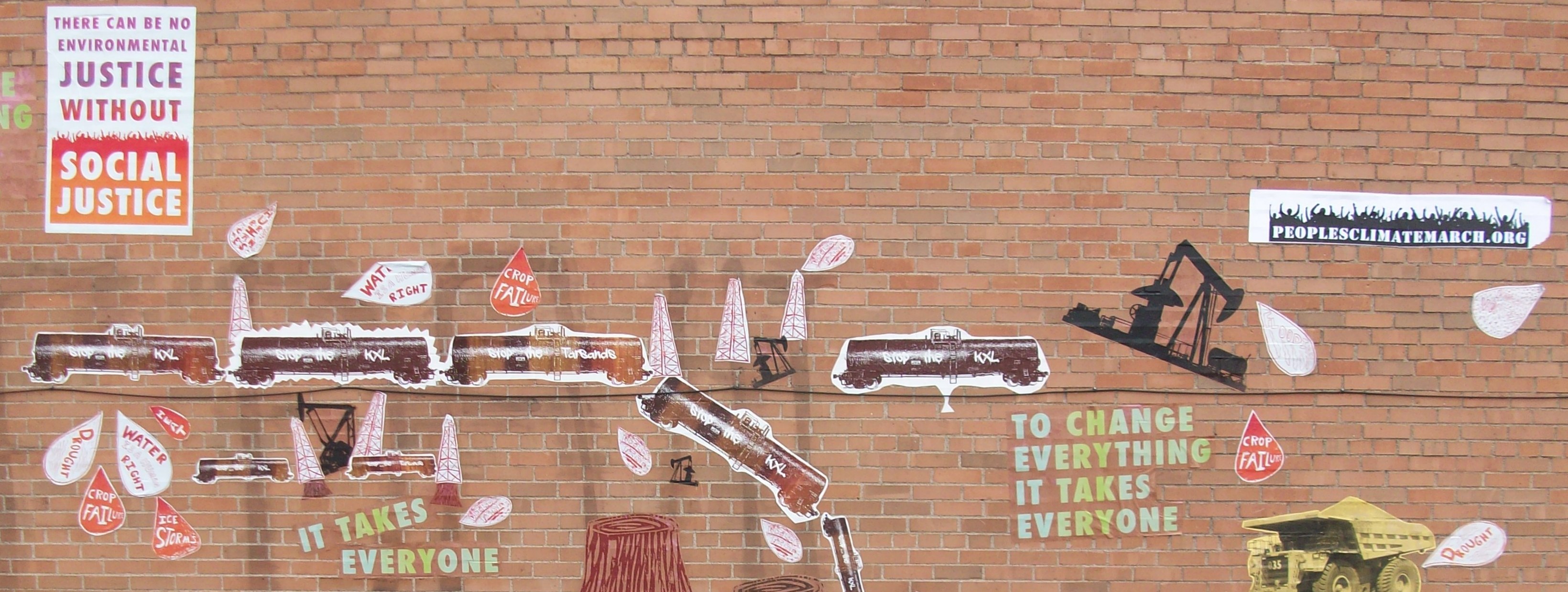
East Wall of George’s Buffet – People’s Climate March Advertisements

LAKE MACBRIDE— A steady rain fell and continued through the night, providing respite for the weary and sound sleep. Having thought I would retreat from society on a day mostly off work, it proved to be impossible, beginning with the trip into town to vote.

Two measures were on the ballot yesterday. Voters approved a $25.5 million bond issue to build a new middle school, a performing arts center to replace the one at the current middle school, and a special education classroom in a 698-294 vote. Voters also approved renewal of the Physical Plant and Equipment Levy of $1.34 per $1,000 in assessed value when the current levy expires on June 30, 2017.

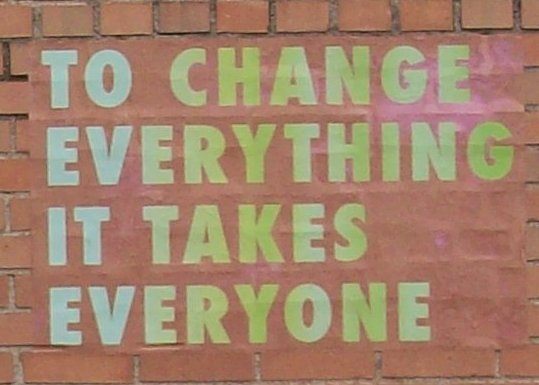
To Change EverythingThe City of Solon was platted in 1840 and named for the Athenian statesman and poet. Ironically, the school district mascot is the Spartans, and the rivalry between Athenians and the Spartans has played out in the community ever since we moved here. Relevant to yesterday’s vote, debate has been about improvement of the auditorium facilities for use between the performing arts departments, and sports enthusiasts. Sports boosters defeated performing arts in the first battles and now we have a ginormous sporting complex in the city. Engaged residents of the district have decided it is time to invest in the performing arts. A ground breaking is expected in 2015.

In addition to passing through the city, I visited the county seat to pay property taxes. I also spent some time in the auditor’s office to see where my tax dollars go. My sense was that county government workers aren’t used to a lot of questions, but I received the answers I wanted.

Poster on the Unitarian Church
Poster on the Unitarian Universalist Society Building

Advertisements for the People’s Climate March on Sept. 21 in New York City have appeared in a couple of locations in downtown Iowa City. I have been engaged to speak for five minutes about the humanitarian campaign against nuclear weapons at a supporting rally in the Iowa City pedestrian mall. That is, assuming I can get off early enough from work at the warehouse.

September and the start of school is always prime time for social movement initiatives, and a lot is at stake with regard to mitigating the causes of global warming. As the saying goes, “to change everything, it takes everyone,” and we are a very long way from engaging everyone in addressing the climate crisis.

The other piece of September news is that every freaking politician I know is doing some kind of event. Between the frequent text messages, email invitations, snail mail and telephone calls, it is impossible to miss the fact that an election is coming, and a lot is at stake. My ability to contribute in kind and financially is limited this cycle, but it is good to know politicians are working. That in itself is a form of news.

Categories
Social Commentary

Friday at the Town Festival

Hay Bale Toss
Hay Bale Toss

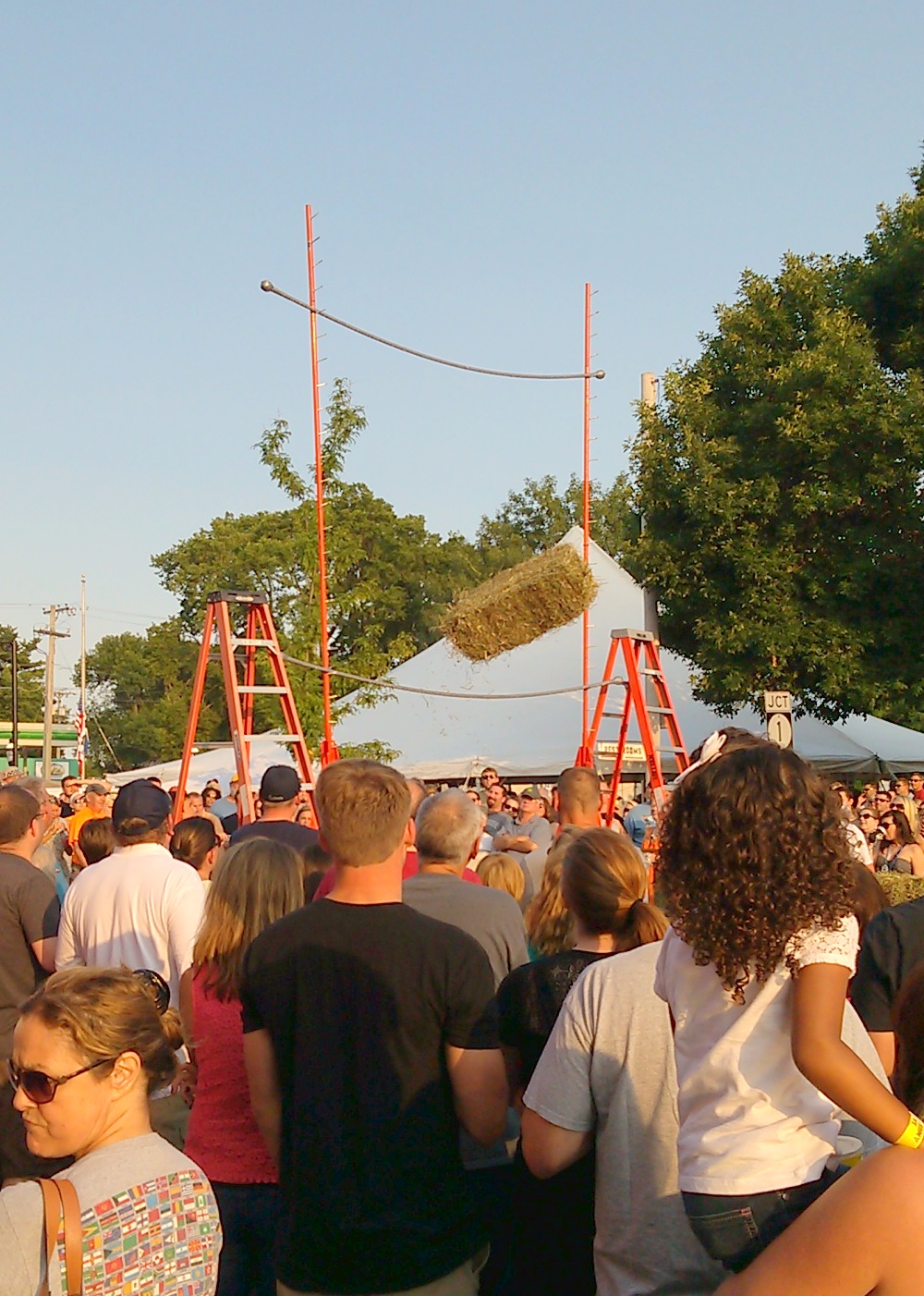
SOLON— The hay bale rises above the crowd to clear the bar. Main Street is packed for the hay bay toss— a farm-related activity in a festival put on where traditional farming, matters.

Bingo has begun, a band with a local lead singer is covering The Band Perry, and the beef and pork sandwiches are sold as quickly as the crew can make them.

The restaurants on Main Street offer specials during Beef Days, local beef, food, drinks and music, but the Cattleman’s Association is in the spotlight as the sun sets and we forget about our troubles for a while.

Categories
Social Commentary

On Spain

Spanish King Coat of Arms

LAKE MACBRIDE— King Juan Carlos I of Spain announced this morning he would abdicate the throne in favor of his son, Crown Prince Felipe. Having visited the country during the dictatorship of Generalissimo Francisco Franco, Juan Carlos made a favorable impression on me from the first days of his reign. Until recently, he held the favor of a large majority of Spaniards. There are not many countries where this type of transition of power holds a place in personal memory.

What makes Spain stand out is my encounters with the Guardia Civil, Spain’s national police force. Under Franco, they had a reputation for brutality among the populace. As a foreign visitor, I was aware of this and came under their scrutiny several times. That the Guardia operated in mostly rural and isolated parts of the country increased the risk of police violations of individual civil rights through lack of supervision and accountability. I did whatever I was asked by them without commentary.

My most significant encounter with Franco’s regime was on a train trip leaving Madrid for France. Basque separatists had set off a bomb in what I now know was the Cafetería Rolando bombing on Sept. 13, 1974. I arrived in Madrid shortly after the blast and was staying at an inexpensive hotel with a number of other international travelers. I had come all that way to see the Prado and was determined to continue my  itinerary. I didn’t understand what the attack meant, and after a couple of days, decided to cut short my stay.

The Guardia Civil inspected my rail car. Every passenger was closely scrutinized and questioned. It seemed they spent a long time with me, a long haired, supposed student with a U.S. passport and a Eurail pass. It was probably no more time than with anyone else. It was a visceral experience of a police state, something we talk about but rarely experience. It seems like yesterday.

Whatever troubles King Juan Carlos may have today, I wish him well and the same for his son. An unusual wish coming from the Iowa cornbelt this rainy spring day.

Categories
Social Commentary Writing

First Share and Living in Society

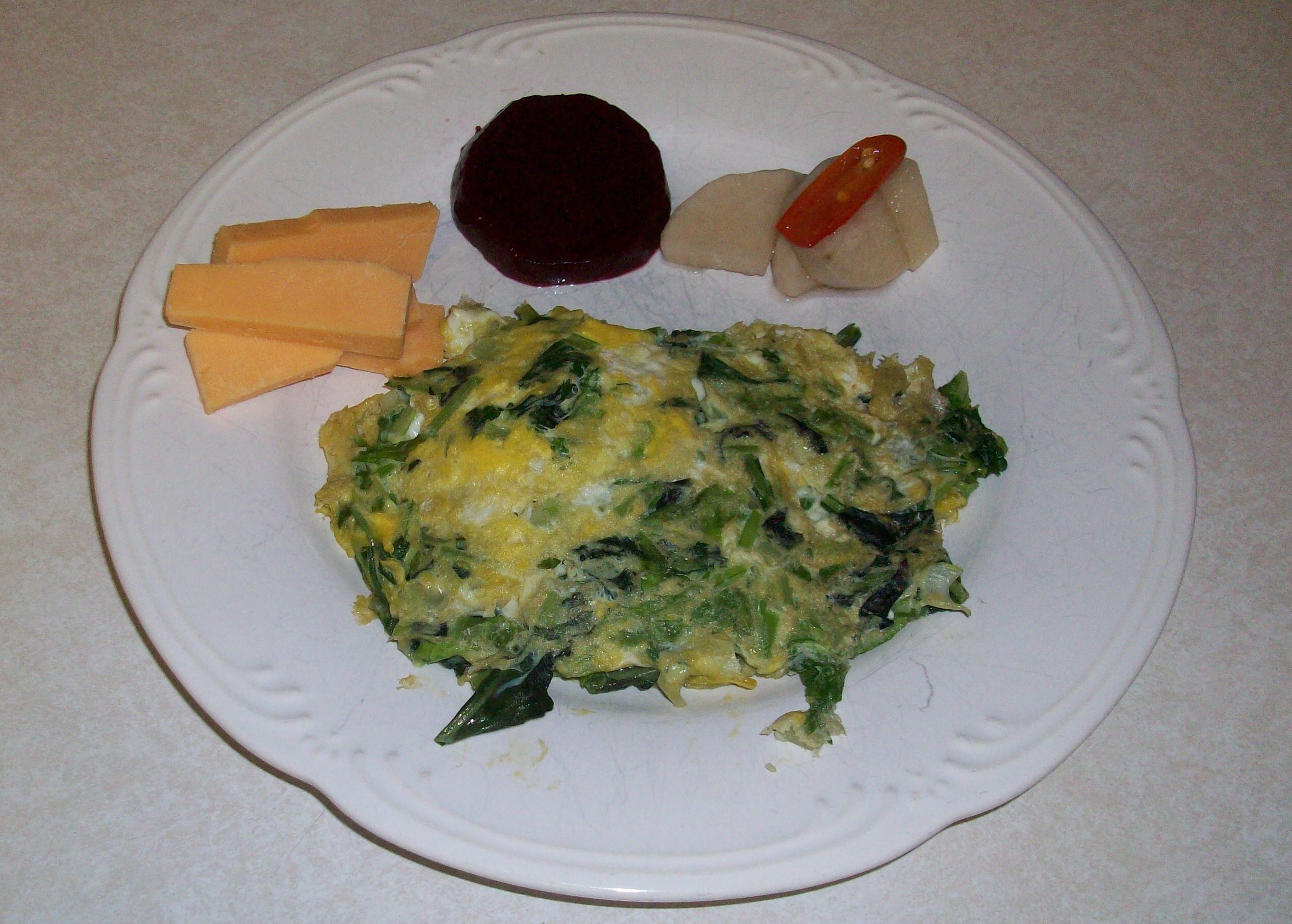
Asian Greens in Scrambled Eggs with Vermont Cheese and Pickled Bits and Pieces

LAKE MACBRIDE— The first share from the Community Supported Agriculture (CSA) farm was ready yesterday— asparagus, lettuce, baby bok choy and Asian greens. Anticipation over spring and summer cooking is building, even if living on bits and pieces from the pantry will continue until the full flow of local produce is unleashed. Picking up the share at the farm was a fine beginning.

We had more than two inches of rain since Earth Day, so outdoor plants are growing. The garden is too wet to work, although as soon as the soil dries, seedlings are ready to go into the ground. Meanwhile I will go on living in society, and that is today’s topic.

The phrase “in society” has a particular usage here. It is part of a spectrum of relationships with people that contrasts with “chez nous,” the French term that refers to “at home” or “with us.” Maybe there is something else on this jumping green sphere (thanks Lord Buckley for this phrase), “outside society” or “foreign,” but most of our lives are spent chez nous or in society. My tag “homelife” could be changed to “chez nous” and sustain the meaning.

Living in society is that set of relationships which sustains a life on the plains. It includes friends, family, neighbors, workplaces, institutions, retail establishments, and organizations with which we associate or interact. The relationships are interpersonal, that is, specific people are associated with each part of society— it is not an abstraction.

When young, we don’t see our life in society this way. We had an ability to live in the moment without a history of interpersonal relationships, anchoring us into something else. As we age, we are more like a character in a William Faulkner novel that must work to suppress the endless flow of memory.

If experience connects us, the way we live in society is based on thousands of previous interactions. For example, someone ran for the U.S. Senate after a long, productive life. If I saw him today in any of a number of settings— at a retail store, at the retirement village, at a literature reading, at a veterans meeting, at a public demonstration— I would think of the courage he displayed by taking on personal debt to challenge an entrenched incumbent politician who would otherwise have run unopposed. I would also think of our many conversations over a period of years. Our relationship is driven by my respect for his courage, and I picture him when I think about the associations we share. When I use the phrase “in society,” it might be referring to an interaction we had, or one like it with someone else.

My usage of the phrase “in society” may have been explained by others who are smarter, but because it is organic there is a peculiar sense to it on this blog. It is personal, but not really, because is it also public.

I am entering one of the richest periods of personal interaction in life. Old enough to have had experience, and young enough to gain new ones. Each day’s potential is vast midst the galaxy of people with whom I interact. Favoring the phrase “in society” enables me to talk about them without revealing where the specific interaction may have occurred. This protects people from unwanted intrusion into their lives, and enables the writing I do for a couple of hours each day.

Chez nous, we would have had breakfast of Asian greens mixed with scrambled eggs, Vermont cheddar cheese and pickled veggies from last season. In society I am part of the local food movement and post photos of my breakfast. Maybe I am drawing a fine line, but it is an important one for a writer.

Categories
Social Commentary

Teeming with Life

Main Street
Main Street

SOLON— While waiting for the transcription from paper to digital, the newspaper office door was open on a cool spring evening. From that frame, I looked across the highway to the city park. There was a lot of traffic, and downtown, nary a parking spot to be found.

Commuters on their way home, a scrapper with corrugated metal stacked on a trailer, boaters and fishers and scores of unrecognized people bustling at the city’s main intersection. Life in motion.

Our publisher entered to download a few hundred photographs from the soccer game, then returned to see its conclusion— making sure some of the photos were good enough for the next edition. When the typist finished, I loaded the weekend’s work on my flash drive and headed home for dinner chez nous.

Main Street has become a place to be of an evening. The new brewery attracts people, and their appearance must be good for the pizzeria, the grocery store and other restaurants and bar. The town comes alive, and we couldn’t say that when we moved here more than 20 years ago.

Main Street is teeming with life, and most of it good.

Categories
Social Commentary Writing

Diving In

Garden
Summer Garden

LAKE MACBRIDE— The ambient outdoor temperature was 50 degrees at 3 a.m., creating a yearning to work in the yard and garden. Other work, however, kept me busy this weekend. So much so, that when each day was done, bedtime couldn’t come soon enough— outdoors had to wait.

I’m okay with that, but I’m not.

When first feeling the urge to be a writer, many years ago, I had no idea what that meant. Now there is a full slate of writing jobs, some paid and some not, and meeting deadlines has become more of an issue. Writing and proof reading our weekly newspaper can’t be described as a stressful job, but beginning on Fridays, it’s crunch time.

The supervisory work at the warehouse also occurs on weekends, so there is little time for extras in the arc from Friday through Monday. The result has been to hang with a new, and very different group of people from the academicians, political activists, public figures, and peace and justice crowd that had become staples of my social life.

American lives move from a fixed point in time toward insularity. Frederick Jackson Turner wrote in 1893,

As each generation of pioneers moved 50 to 100 miles west, they abandoned useless European practices, institutions and ideas, and instead found new solutions to new problems created by their new environment. Over multiple generations, the frontier produced characteristics of informality, violence, crudeness, democracy and initiative that the world recognized as “American.”

The degree to which one takes issue with the frontier thesis asserted by Turner in The Significance of the Frontier in American History, there is no denying the bent toward utopianism that exists in daily life. People don’t care about money as much as they want to be able to pay their bills and live their lives. In doing so, they create an island of utopianism carved out of a complicated society. Perhaps I am corrupting what it means to be utopian, but that too is an American idea.

I heard a woman say she wanted the man to make the decisions for her last week. I was stunned. Only an insular life can espouse such a world view. One that lacks a basic connection to a greater society, and exists in the rarefied air of a peculiar social network.

Ugggghhhhh. That’s depressing,” said one friend.

“Thank goodness she’s in the minority,” said another.

“A sample of one does not a movement make,” said an activist I know.

Whatever repulsion there is to a woman who wants her man to do the thinking, it is part of the diversity of life which has become a context for my writing.

A writer must necessarily become isolated while working. At the same time, there is a constant want and need for contact with humanity in all of its diversity. Writers must break from the swaddling of the familiar and dive in— it’s as close to utopia as American living gets.

Categories
Environment Social Commentary Sustainability

Enjoying Life More

Snowstorm
Snowstorm

LAKE MACBRIDE— An article about James Lovelock was recently updated and is in the news again. “Enjoy life while you can,” said Lovelock in 2008. “Because if you’re lucky, it’s going to be 20 years before it hits the fan.” Whether enough people are listening to his admonition about the inevitability of catastrophic climate change is doubtful. Whether we should is another question.

While the U.S. has its share of doomsday preppers, by and large the potential for social unrest, like in Ukraine, Egypt, Syria and Venezuela, is discounted by most people I meet. If some are stocking up at COSTCO, it is the result of a mathematical calculation of price per serving, and how long that over-sized box of crackers will last. Preparing for Armageddon is the last thing on shopper minds. As Americans, we have a high level of tolerance for injustice… as long as we perceive that as individuals, we are being treated fairly.

Our public awareness is influenced by a media bought and sold by a few wealthy people. Corporations influence our lawmakers, agriculture, retail stores, our utilities, and anything we do that requires our participation. Seldom has there been a large scale outbreak of social unrest, nor is one likely without a wholesale breakdown of consumer society. The wealthy are smart enough to prevent that from happening unless it serves their purposes.

Perhaps the most recent American social movement was the political tide that swept Republicans out of power and inaugurated President Barack Obama. Discontent with our government increased once the abuses of presidential power became more widely known after Sept. 11, 2001. It was a peaceful movement, even if we had yet to end two wars, and continued our questionable use of drones to target people in countries with which we are not at war.

It would take a lot for wide-spread, violent protest to topple the U.S. government. For that matter, protests against drones, economic issues, taxation, the Keystone XL pipeline, nuclear weapons installations, mountaintop removal coal mining and other issues pass largely unnoticed by society. In the middle east, it took a widespread drought, a shortage of export crops from Russia and Ukraine and high food prices to activate citizens for social change. Of course now we are getting back to climate disruption caused by global warming.

Helping mitigate the causes of global warming is at the top of my to-do list. I wrote about it at this link, “climate change is real, it is happening now, it’s caused by humans, and is cause for immediate action before it is too late.” Of course, according to Lovelock, it is already too late. Climate change is not the only worry we have about survival of life on the planet.

The other threat is the lingering possibility of a nuclear weapons exchange. In our post-Cold War era, this borders on the absurd. The two countries with the largest number of nuclear weapons are the United States and Russia. The war is over, so disarm. We can’t afford the hundreds of billions of dollar we spend on the nuclear complex, so disarm.

The humanitarian consequences of a small-scale, regional nuclear war, like between nuclear states India and Pakistan, are unthinkable. Conservative organizations like the Red Cross/Red Crescent Society and Rotary International are signing on to abolish nuclear weapons for that reason. They are most active outside U.S. borders.

Americans are already looking to enjoy life more, oblivious to the tangible threats we face. It is possible to mitigate the causes of climate change, work toward nuclear abolition, and enjoy life more. Once one has read Sartre not much seems futile, and engaging in life becomes its own reason to live. Whether we can make a difference is a question the naysayers would answer for us, something we can’t let them do.

Categories
Social Commentary

Snow Fell in Town

Newspaper Office
Newspaper Office

SOLON— An inch of snow had accumulated while I was inside working on next week’s newspaper. When one is the proof reader for a small weekly paper, he gets a preview of what’s happening. There is some action, but not much.

The second session of the 85th Iowa General Assembly began last week, as evidenced by the multitude of newsletters from our state representatives and senators. Our circulation spans two senate districts, so there were a total of four in my folder. As a recovering political junkie, I had already read the four at home, and then some. There was little news, except to say it’s open season in the Iowa legislature. My state representative was holding two listening posts today in Bennett and Lowden. Had the weather been better, I would have driven over.

What was in the news was that J.C. Penney is closing 33 stores and laying off 2,000 employees. On Thursday I accepted a part time job requiring white shirts, and I didn’t have any decent ones. I went to Penney’s yesterday morning to buy them. (Note to self: throw the rags in the closet away, as they are not shirts any more).

Upon arrival, I was one of a small number of customers in the store. A gent greeted me close to the door, offering his assistance. My shirt is an oxford-style, buttoned down collar with long sleeves. The gent attempted to compliment me by suggesting a size smaller than I required, but the photo of the tag from my old shirt clarified the matter. He helped me find what was wanted in short order.

I am baffled by the pricing scheme at large box stores. The tag on the shirt said $30. There was no other price posted. The gent told the cashier to make sure I received the 25 percent unadvertised discount. When she rang it up, the computer/cash register gave me a 50 percent discount. While discussing payment terms, she asked if I had a J.C. Penney credit card. I explained that I do, but prefer to keep all my charges on a single card, so I would use my MasterCard. Another discount. My final cost was $12.75 plus tax per shirt or 42.5 percent of the listed price.

Keep in mind there was no visible price advertising in the store and when I mentioned the discrepancy to the cashier she said the amount was correct. Price was dependent upon the cashier’s entries, the bar code and the computer database. The personal shopping experience was compelling because the price seemed to get lower every step taken toward payment. How do they make money that way? They’ve taken logic out of the process, and one supposes they have their reasons.

I pointed out to the cashier that our store wasn’t on the list to close. She said they were rated number one in the U.S. for sales by size. She asked if I had ever been to the Muscatine store scheduled to close. She had been, and wasn’t surprised because they had so little merchandise in it. We had a nice conversation.

The whole shopping experience was engaging on many levels, but I don’t see how this store could be making any money with so few customers and the vagaries of pricing. If they stay open, I’ll be back if I need additional shirts.

When I got home from the mall, I ordered garden seeds— 26 varieties costing $122.75 including shipping. That plus herb seedlings to be bought at one of the farms and I should be ready for planting. As soon as the snow lets up, I’ll be ready to get outside and prepare the soil.

For now there is snow, and I’m okay with that.