Sunday will mark completion of the seventh year since I retired from transportation. It was a risky decision.
Nonetheless, my blood pressure immediately dropped into the normal range, and I began engaging differently in society with results that mattered more than pursuit of monetary compensation from a private company. Outcomes weren’t always positive, but are they ever?
This Independence Day weekend affirms that decision was the right one. It is a time to enact the future and it begins close to home.
A benefit of an American lifestyle is having the occasional weekend off.
Yet the weekend is more French than American — le weekend!
In June 1977, over two weekends, I was in France with a French infantry marine unit. Those days imprinted the meaning of “weekend” on me even if I don’t get to weekend very often.
My guide for the exchange officer experience was an infantry marine platoon leader stationed on the Atlantic coast in Vannes. The unit was on alert to deploy to Djibouti, which had recently declared its independence from France. If there was trouble in the transition, the unit would head there.
Upon arrival at the train station I was driven straight to the officer’s club. I drank too many pastis before attending a reception in my honor — no one told me about the reception until several pastis had passed my lips. The non-commissioned officers lined up one aperitif after another in front of me with glee. Too drunk to be embarrassed, when someone mentioned the reception, I decided to leave the remaining drinks on the table, sober up, and listen and learn about the culture.
At the reception I practiced my French and mustered a dim comment about the Concorde, which was still new. The alcohol drove out my vocabulary so it was the best I could do.
In homes and apartments I briefly lived as French do. There was a continuous series of meals and events tied together with a notion of forgetting about work for a while. Weekends continue to be French in Big Grove, although with much less alcohol and no drunkenness. God’s in his heaven, all’s right with the world.
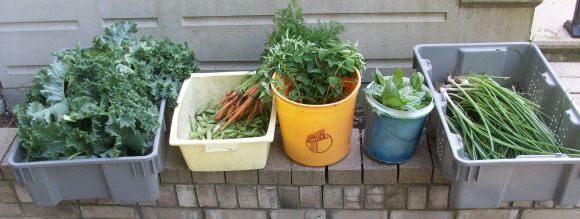
Last Saturday of Spring Harvest – kale, peas, carrots, celery, oregano, basil and spring onions.
The garden is in, harvest begun and work remains to be done this Father’s Day weekend.
Weekends at home are a way to avoid expenses as I navigate from semi-retirement to full retirement in a few years. There is no extra money to drive into the county seat for “shopping,” nor is there adequate clothing in the closet to attend any galas to which I may be invited. Working at home avoids expense.
Saturday was the first of many harvests from the vegetable garden. Untold hours were devoted to planting, cultivation and now harvest of kale, celery, carrots, peas, spring onions, basil and oregano. It was exciting.
Garden Shares for Library Workers
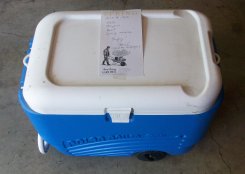
One of my outlets for excess produce has been workers at the public library. I prepared shares of onions, kale, oregano and basil in a cooler and drove them into town. One of the library workers gave me an acorn squash seedling for which I will find room.
Next I went to the grocery store where a neighbor and I talked for ten minutes about beer selections. He didn’t carry the union-made Pabst Blue Ribbon that would have been my first choice, nor did he have made in Canada Labatt’s Blue which would have been my second. Partly as political commentary I settled for a six-pack of a Mexican mass produced brand. Upon return home I iced three of them and two cans of Royal Crown Cola in the cooler.
Broccoli in Cages
The garden entered the summer phase and it’s time to break loose the broccoli.
Last year the broccoli crop was a failure. I decided to protect the seedlings with chicken wire a
nd they survived initial growth. It’s time to take the chicken wire off the individual plants and create a close fence that will keep deer from jumping in and allow the plants to spread their leaves. I scoped it out on Saturday and hope to free the broccoli later this morning.
Peas and Carrots
Harvest is unfinished until the produce is washed, distributed and processed. In a kitchen garden like ours that means cleaning, storage and cooking which takes more time than one might expect.
For dinner I made peas and carrots, and kale-black bean-vegetable soup poured over brown rice made with a jar of home made tomato juice. By the end of Saturday I was very tired.
I took a course in African American Studies while in graduate school.
Kale – Black Bean Soup on Brown Rice
The late Jonathan Walton made the case that slaves were likely too tired to do much organizing after working a shift on Southern plantations. I learned a lot about the literature of slavery and its narratives because of Walton. I wasn’t sure what to make of his assertion, other than that slaves were people just as we are.
I yawned during class from time to time and Walton called me on it, inquiring about my condition… was the subject matter too tedious? Had I been up late the previous night? I tried to stay awake. It was a dry topic.
Peas and Carrots
Everyone has an opinion about slavery. For the most part, people don’t directly favor it. It is a stain on our public consciousness that has not been removed, nor likely will be in my lifetime. I’m not sure what exactly that means in 21st Century America.
The term “wage-slave” is popular today, especially among people ascendant from low-paying work. Forced labor continues to exist unawares, notably through labor trafficking. Neither is the same thing the peculiar institution was.
Modern life has us removed from the actuality of things like neighboring, sharing and slavery and we are the less for it. This Father’s Day Weekend I plan to commune with what is actual — what is real. By doing so sustain our lives in a turbulent world.
The Bernie Sanders campaign is laying off hundreds of staff members, indicating either he is planning to throw in the towel after California, or that he won’t be placing people currently on his staff in local political organizations for the fall campaign. Maybe both.
The presidential nominating party may not be over, but most of the guests have left and the hosts have begun cleaning up the mess, getting ready for a return to normalcy, which in Iowa means organizing for the June 7 primary elections where there are contested races, and the fall campaign beginning after the Labor Day weekend.
Political campaigns will work through the summer, and there is a filing period in August, but each year, regular people engage in the election cycle later and closer to the election. For folks like me, politics takes a holiday after the primary elections until the fall campaign. We have lives to live.
I’ve written about the county supervisors race which has been reduced to a series of special interest forums in Iowa City and Coralville, along with fund raisers and whatever else each campaign sees fit to do.
I missed the first forum last night. Bottom line was I couldn’t afford the $5 in gasoline and an hour of driving on a work night. Stephen Gruber-Miller covered the forum for the Iowa City Press Citizen and here’s a link to his article. They say people in the county seat can access video of the event on their local cable television channel, but the service does not include Big Grove Township.
My trouble with picking three candidates for supervisor is besides the incumbents, I don’t share a view of the county with any of them. My relationship with the county seat is tenuous at best, although I likely benefit from the economic engine that is the University of Iowa. I’ll pick one of the two business people for my third vote and see what decision the urban centers make for me. No need to decide until late in the race, early June most likely.
The other primary election that matters is for U.S. Senate and I support State Senator Rob Hogg over three other candidates.
Politicization of our lives has become a detriment to living, so the compulsion I felt toward campaigns during the George W. Bush years is in remission. I work on issues, but like with the climate crisis, they represent human values and shame on those who politicize them or frame them in the false paradigm that is conservative vs. progressive. People like billionaire Tom Steyer is who I have in mind, but it applies equally to all of the billionaire class members.
My summer will be eking out a living on the margins of society, hopefully making enough money to live on, reducing debt, and finding joy in simple pleasures. We don’t need politics for that.
Our daughter visited for four days — just over 96 hours. Once she was safely returned home, I was incapacitated with a headache, fever and dizziness for a full 48 hours.
Of course I went to work sick. That’s what low income people do.
I broke fast with some cornbread and milk for breakfast yesterday.
I also had the last follow up for my injured hand.
“Let me see you hand,” Doc said as he entered the examination room, barely closing the door.
After a quick look he said it was good and released me. Hand shake, fist bump and done in less than 60 seconds.
I like the efficiency and my employer likely does too.
I’m ready for work around the house and garden… work delayed by the last week’s events. I feel the pressure of being way behind, but still hope to get early planting done by Derby Day.
The forecast is great weather for working outside after my shift at the home, farm and auto supply store.
People who harp about hourly wages are tedious and mostly fooling themselves. The economic instinct in society should be and is making a decent life from what we have and are given. Wages are a part of that, but there is a lot more.
A person can’t make a decent life based solely on wages.
I’ve read my friends at the Iowa Policy Project on Iowa’s cost of living, wage theft, and minimum wage. I don’t disagree with their analysis of the data sets they chose. My issue is work like theirs serves the political class more than it does regular workers. Useful for policy makers, but not for those working poor.
The Johnson County Board of Supervisors recently implemented a policy to raise minimum wage in the county — with caveats — to $10.10 per hour by Jan. 1, 2017 and then index it to the Consumer Price Index for the Midwest Region. I attended a public hearing on the ordinance in Solon, read online comments and news articles on the ordinance and its impact, and importantly, talked with scores of people impacted by the law. The ordinance is a lifeline to some, but has little impact on most working poor because it does not adequately address their central concern — finding a job that pays a living wage.
As a low wage worker, I tell a small part of my story in the following paragraphs. It includes a brief history lesson, corporate interests in consumer pricing of gasoline, work injuries, and the role of total compensation packages.
History Lesson
In 1975, minimum wage was $2.10 per hour. With the proceeds of a full-time, no benefits job at a convenience store, I rented an apartment, bought food, had a telephone, owned a car and lived a reasonable life in my home town. A person could get along on $2.10 per hour, barring personal cataclysm, if just barely.
According to the CPI inflation calculator, the $2.10 I earned in 1975 equates $9.26 in today’s dollars. The exact same job I held in 1975 — convenience store cashier — now pays a going rate of $10 per hour. Minimum wage hasn’t kept up but the market has.
How can a person can build a decent life on low wages? It’s not easy. However, addressing minimum wage is a form of tinkering around the edges. So many analyses of minimum wage fail to consider the corporate system we have in every aspect of our lives. Yes, people have to contend with complex issues involving corporate life. They include health care, insurance, banking, debt, fuel, communications, food security and electricity. People complain about these aspects of life rather than leverage them to their advantage. The one I know most about is fuel pricing.
Gasoline Pricing
Gasoline prices were $2.099 per gallon at local outlets this week. Gasoline is the dominant passenger vehicle fuel and buying it has become an accepted part of life that includes transportation as a basic expense.
One of my roles during a transportation and logistics career was to purchase about 25 million gallons of diesel fuel per year for a large trucking firm. I visited refineries, pipeline companies and retailers and came to know how every penny of the price we paid came about. While I bought diesel, the same lessons apply to gasoline — something almost everyone who lives outside public transportation routes has to buy.
When I drove my first car, a Volkswagen Beetle in high school, a couple of bucks would fill it up. During gas wars, the price went as low at $0.27 per gallon. Today, state and federal tax alone is $0.579 per gallon in Iowa. An escalating tax became part of the expense background.
Perhaps the biggest change in gasoline pricing over time has been the move from vertical integration of energy companies to the culture of outsourcing and partnering among varied aspects of the fuel supply chain. This is sometimes called horizontal integration.
When I worked for Amoco Oil Company in Chicago in 1990, the corporation was paid $600 million for its oil fields in Iran. Partly because of political instability — their oil fields were seized during the 1979 Islamic Revolution — partly to divest assets and buy crude oil on the open market. Little did we know at the time, Amoco, a company viewed as a stalwart of great places to work and the ninth largest global corporation, was in the process of disappearing. At one point they did everything from exploration, production, refining, research and retailing. They merged into a foreign corporation.
When we pull up to a gasoline pump at a convenience store, the details of the hydrocarbon supply chain seem very remote. Oil and other hydrocarbons have become fungible commodities, and as such, we tend to deal with the price at the pump. Crude oil and crude oil futures trade on financial markets which provides some price visibility. Invisible are the many people from exploration and drilling, to production and refining, to transportation and delivery, to sales and marketing who get some part of the transaction of filling a passenger car gasoline tank.
Working for low wages reinforces the focus on per gallon price. When gasoline prices go up it’s bad. When they go down, we like it. Set aside the government subsidies, the unrecognized cost of using the atmosphere as an open sewer for emissions and everyone taking a fraction of our $2.099 per gallon. Energy company executives and politicians alike realize price is king and expend resources to keep it so. All a minimum wage earner knows is when price at the pump goes down, there are a few more dollars to spend this month. What people in the oil and gas business know is each entity along the supply chain is taking a margin above their costs out of the pockets of gasoline buyers. The impact on working poor is disproportionate. Raising the minimum wage won’t fix corporate extraction of money from gasoline consumers or almost anything else.
Work Injuries
I cut my right hand at work this week and had to get stitches — six of them at the base of my thumb.
It doesn’t hurt much, and my motor skills haven’t been impaired, however, the doctor said I’m supposed to minimize use of my hand until a worker’s comp doctor reviews my healing progress on Monday. There’s plenty of work that can be accommodated at the home, farm and auto store where I work so lost wages there shouldn’t be a problem. I went back to work after returning from the clinic — there was no lost time.
What matters more is the loss of productivity in everything else I do during spring to get by.
I contacted the farm and asked for relief from soil blocking for a week. I’ll lose that wage earning opportunity. The work restriction will also be a setback for weekend work in the garden. I had hoped to plant radishes, peas and turnips in newly turned ground, some of which I will sell at the farmers market. Income is delayed. There’s no short term disability insurance, so If I don’t work, productivity and income will be lost.
People who craft models about minimum wage often include the idea of short term disability as a footnote. Focused on hourly wage, they say if everything goes according to plan a person can make it on $15 per hour or whatever. Everything doesn’t always go according to plan, especially if one is working poor. Consequences of the minor lacerations on my right hand serve as testament.
That’s where economic models created to advocate for raising the minimum wage are inadequate. Life is much more complex. There are unwelcome limits an injury imposes on life at the economic edge. Accommodating and adjusting in response is a more resilient skill that matters more than raising the wage.
I’ll adjust because I have to to preserve the tenuous thread from which our economic life hangs.
Total Compensation Package
Anyone who has studied employee turnover knows the key reason people leave jobs is not wages. It’s how they were treated by their manager. None of the analyses about minimum wage I’ve read included this key aspect of work life. It makes a difference how well trained a manager is in a lowly paid job. The tendency is to rigidly design a work process and try to get workers to fit in like they were a precision machined part of the operation. Low tolerances for performance are often baked into the job, but regardless of performance if one’s supervisor is a prick, that employment will end eventually, usually by choice of the employee.
Under the Patient Protection and Affordable Care Act, companies that employ workers 30 or more hours per week must provide health insurance. To the employer this is one of many costs that yield a total cost of the employee. There is a tendency to push as much of the cost for health insurance on the employee in the form of premium co-pays, deductibles and co-pays. In my current job employees get health insurance benefits with reasonable premium co-pays and a high deductible/co-pay structure. Family coverage is more expensive, and the cost of covering a spouse is roughly equal to the cost of the least expensive policy on the government health insurance marketplace for a single individual.
Since the insurance is offered by the employer, there is no government premium subsidy, which with premium co-pays creates a disincentive for working poor to seek full time work with benefits. It is easier, and better economically, to work multiple part time jobs without benefits and sign up for health insurance through the marketplace to get the subsidy.
Wages in larger businesses are a function of total pay package. Smart companies look at the competitive marketplace for employees and determine the range of how much a position should be paid. Often a human resources consulting firm is engaged to benchmark compensation per position. Once the range is determined, the company decides what part of pay is through benefits and what part through wages. Wages, paid time off, workers compensation, disability, health and dental insurance, employee discounts, clothing allowances and the like are all part of the cost of an employee and their total compensation package. Companies will always strive to keep the overall cost of employees low.
If government raises the minimum wage, a company will seek to keep employee compensation costs the same or lower. That means some aspect of pay and benefits will take a hit, shifting the same dollars to wages from benefits. Another alternative is to turn employee hiring and management over to a temp agency which bills employee costs at a fixed rate. In some cases, like that of the Whirlpool Corporation’s recent operation in North Liberty, there are multiple layers of this type of outsourcing. The employee may earn slightly above minimum wage, but the rest of the benefits package is taken by the temp agency or subcontractor. Raising minimum wage may only shift where the money is coming from. It all comes from the total compensation package.
Conclusion
The starting point for a new conversation about wages is to consider our history, the impact of corporations on almost every aspect of our lives, the risks of injury in low wage jobs and how the total compensation package and erosion of benefits in favor of wages makes a difference when one is working poor. Hopefully this post will serve to begin some new, more meaningful discussions.
I cut my right hand at work yesterday and had to get stitches — six of them at the base of my thumb.
It doesn’t hurt much, and my motor skills haven’t been impaired, however, the doctor said I’m supposed to minimize the use of my hand until a worker’s comp doctor reviews my healing progress on Friday. There’s plenty of work that can be accommodated at the home, farm and auto store so lost wages there shouldn’t be a problem. I went back to work after returning from the clinic — there was no lost time, an important metric for people like our store manager.
What matters more is the loss of productivity in everything else I do during spring to get by.
I contacted the farm and asked for relief from soil blocking for a week. The work restriction will also be a setback for weekend work in the garden. I had hoped to plant radishes, peas and turnips in newly turned ground. I’ll experiment with turning the soil without my right hand, but the prospects seem dim for getting much done.
There’s no short term disability insurance, so If I don’t work, productivity and income will be lost.
People who craft models about minimum wage often include the idea of short term disability as a footnote. Focused on hourly wage, they say if everything goes according to plan a person can make it on $15 per hour or whatever. Everything doesn’t always go according to plan, especially if one is working poor. Consequences of the minor lacerations on my right hand serve as testament.
That’s where economic models created to advocate for raising the minimum wage are inadequate. Life is much more complex. There are unwelcome limits an injury imposes on life at the economic edge. Accommodating and adjusting in response is a more resilient skill that matters more than raising the wage.
It has been so long since I was injured at work — more than 40 years ago at the meat packing plant — I can’t remember what to do.
I’ll adjust because I have to to preserve the tenuous thread from which our economic life hangs. It’s all part of sustaining a life in a turbulent world.
The family-owned home, farm and auto supply store put me on a Monday through Friday schedule this year. It created something rare — a regular weekend off.
As winter ends, work at home and at the farm returns to center stage. It was possible to feel I got something done this weekend.
I did — indoors and out.
Le weekend began Friday with a time clock punch. After work, I bought provisions at the warehouse club on the way home. After putting food and sundries away, I repaired one of our two cars in the garage. I drove the repaired vehicle to pick up Jacque after work, reading a book checked out from the library on my phone’s Kindle app while waiting in the parking lot.
That evening at home I made a to-do list on the white board and continued reading. I hope to finish Slavery in the Upper Mississippi Valley 1787 – 1865: A History of Human Bondage in Illinois, Iowa, Minnesota and Wisconsin by Christopher P. Lehman before returning to work on Monday. It’s due back to the digital library in seven days.
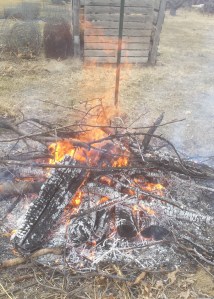
At home I watered the trays in the south-facing window. The basil, lettuce and celery seedlings are coming along. I burned the brush pile and prepared containers for raised beds of root vegetables planned for early planting. Making sure I had five buckets of sand for next winter, I swept the remainder into the ditch from the road in front of our house. Each task accomplished added to a positive, hopeful attitude.
Embers of the Burn Pile
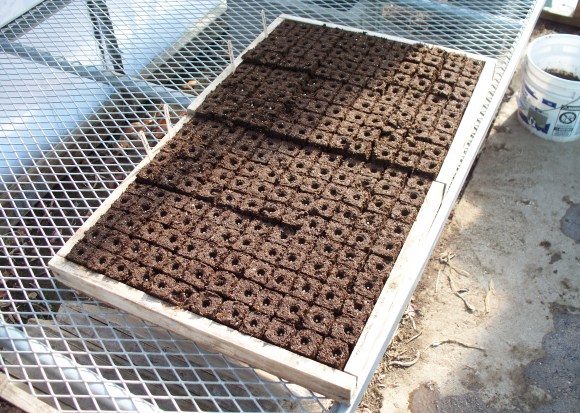
Sunday I’ll soil block at the farm. We’ve been having a problem with invasive species in the seedling trays. That needs discussion and resolution before we get too far along. The schedule is 28 trays of 120 blocks, or 3,360 seedlings, so addressing the problem quickly matters.
Set this aside. Saturday made the weekend.
Saturday cooking included a bowl of steel cut oats for breakfast, chick pea curry to use up the last of the big batch of them, and chili with cornbread for dinner. Since Jacque works on Saturday afternoon, and seldom knows how long the work will take, I always prepare something that can be re-heated easily while listening to A Prairie Home Companion on the radio.
Earlier Saturday I made a trip to the grocery store to buy some organic celery, raisins and onions, then returned to the kitchen and made three jars of lemon flavored iced tea for the week. The food was all good although I forgot the garlic in the curry.
These things seem simple, but framed by a regularly scheduled weekend off, they have the potential to become a way of life. What ever happened to that in our 24-hour, non-stop social media, highly complex, yet unfulfilled lives?
While we won’t get rich living like this, it is rewarding in so many other ways. It’s past time to re-invent Le Weekend.
Driving out of Flint, Mich. on Bristol Road wasn’t in the plans.
I interviewed some 30 people, all but one male, for truck driving jobs at the Days Inn across from the GM plant. Tired and ready for sleep, I went to the van to get my overnight bag and found all four tires had been slashed.
In the parking lot with a driver I later hired, the tire service came and replaced them. Around 10:30 p.m. I decided to drive the four hours back home to Indiana. The drive seemed much longer as I fought sleep and considered the day’s events.
In his film Roger & Me, Flint native Michael Moore identified Nov. 6, 1986 as the date of the announcement that General Motors would start laying off thousands of workers to move jobs to Mexico. Eventually, Mexican labor would prove too expensive and GM moved some of those jobs to Southeast Asia and elsewhere where people would work on the cheap building cars and auto parts.
I made about a dozen recruiting trips to Flint in 1988. There was a lot of interest in our non-union jobs, a lot of anger, and few hires. As a trucking terminal manager in Northwest Indiana I interviewed countless people seeking work in Wisconsin, Illinois, Indiana, Ohio, Michigan, Pennsylvania, New York, Kentucky and many other states. I took a pencil to it, and found I had interviewed well over 10,000 people from 1987 until 1993. My life was forever changed by that experience as one applicant after another told me their stories of adjusting to devastation in the rust belt as the policies of President Ronald Reagan and his cronies eviscerated the middle class. We are still in the wake of his administration.
It was the end of an era as large-scale work sites like Buick City laid people off and eventually shuttered their plants. Flint is just one example of the hellhole the steel, auto, and other manufacturing towns became. Flint went from being an award-winning auto maker to being an EPA cleanup site. People still live there, but what was no longer exists.
Today we hear of the water crisis in Flint.
Nearly two years ago, the state decided to save money by switching Flint’s water supply from Lake Huron to the Flint River, a tributary that runs through town and is known to locals for its filth, according to CNN. Because of the corrosive nature of water in the river, iron oxidized discoloring tap water, and more importantly, lead began leaching from the pipes in the water system.
“Everything will be fine,” former Flint Mayor Dayne Walling said as he downed a glass of water.
It’s not fine. It won’t ever be fine.
Flint went to hell, literally, after GM began shedding jobs to cheap foreign labor. Violent crime rates rose, people left the city, and today 40 percent of the population lives below the poverty line. Employees dependent on union jobs had trouble coping when the jobs were gone, resulting in complex social and psychological problems. I experienced some of their anger that day in Flint and I won’t forget because it permanently changed me.
I get why Reagan is lionized for what he did to Flint and dozens of other manufacturing cities. The anger is still here. We are still in Reagan’s wake.
“Publishers are not accountable to the laws of heaven and earth in any country and regardless of my opinion, editors and publishers will print what they will.”
I wrote this in a letter to the editor of the Quad City Times in 1980 reacting to a popular feature section called Soundoff.
“(It is) little more than a vanity press for many of the writers,” I wrote. “It gets pictures, letters and opinions into print as a final goal; shouldn’t there be more to public voicing of opinion than that?”
This is more applicable today than it was three and a half decades ago.
What I learned in graduate school is the same statement can be applied to almost everything written in public. Reflecting on the Times experiment to make their pages more open to comments and retain readership, chaos reigned. What has changed since then is the emphasis on viewpoint in media — corporate, social or self published — which has been formalized. It’s not all good.
As I turn to the hard yet fun work of writing this year, I plan to journal my experiences in the food system here. Four years from full retirement, there are bills to pay and a life to live. I may pick other topics from time to time. I need to make the best use of every moment.
I’m writing off line as much as I can. While I don’t like to work for free as long as there is less cash than budget, I may occasionally post about those creative endeavors.
Thanks for reading this blog. Check out the tag cloud for your interests. I hope readers will be back often.











 Journey Home
You must be logged in to post a comment.