I stood outside in early morning darkness where there was a refreshing yet decidedly warm breeze.
The overnight low was 80 degrees Fahrenheit. I’m not sure if that’s warm enough to hinder apple production but scientists believe at some point failure to cool adequately at night does impact taste and texture.
They don’t fully understand the impact of climate change on apple production. For the home fruit grower it’s one more thing for concern.
The breeze dissipated with arriving sun. The forecast is clear and hot with ambient temperatures rising to the mid-nineties. We’re getting used to the heat, especially after the 2012 drought.
After sunup I went to an apple tree, picked one and ate it. The sugars are beginning to form but it is still a “green” apple.
Tonight begins the two-day festival in the small city near which we live. The ambient temperature is expected to peak around 6 p.m. when things are just getting going. Tomorrow is the parade through town when it’s pushing 90 degrees. I’m not sure it is a good idea to attend this year so am skipping the famous hay bale toss tonight and will re-evaluate the parade in the morning. A friend from across the lakes in Big Grove Township is running for sheriff so I want to be there to support him.
It’s blazing hot! We have an air conditioner and refrigerator with an ice maker that both work. There are also three bushels of vegetables that need processing. There will be plenty of inside work to keep me busy now that the heat is here.
The challenge for a gardener is to use or preserve the abundance in a way that makes sense.
At the beginning of a gardener’s life-long journey, what that means is not clear. Clarity approaches as our interaction with a kitchen garden matures, planting to meet the anticipated demands of modern living — season by season, meal by meal.
Gardening is as much about cooking and eating as it is about genetics, crop inputs, pest control and horticulture.
Saturday morning I made more basil pesto to freeze and started the first batch of dill pickles. Friday I pickled beets and dried parsley for the cupboard.
The photo represents dinner last night. The veggie burger and ketchup are processed foods and the vegetables are locally sourced. I grew the squash and peas, a farmer friend grew the onion and carrots. It was a satisfying, seasonal meal. Cooking techniques developed through years of practice and study made it possible to reduce the amount of time needed to prepare these dishes. At the end of the day, this meal was nothing, a throw-off addressing our need to eat. This meal was also everything.
People frequently post photos of their meals and we enjoy viewing them on social media. It is a natural impulse that say what I’ve done has meaning beyond a single meal or dish. In a search for truth and meaning in life eating is important, or as my colleague at the orchard Matt Steigerwald said, “food is important.”
Like so many things in life it reduces down to the question what will I do with my life today? Living with a kitchen garden and enjoying its production is one important thing among others.
Sunday afternoon I was getting cabin fever so I drove to Ely, bought gasoline, played Powerball, and bought a pint of mint chocolate chip ice cream.
It is six miles to Dan and Debbie’s Creamery where I shop a couple of times a year. I’d go more often but I keep forgetting they are closed Monday until arriving when the building is locked up. I’m also avoiding sugar and carbohydrates for health reasons or I’d work harder at more frequent visits.
The ice cream was delicious. I debated whether to get a half gallon for $9 or a pint for $5. Economy would have me buying the larger size, but chances are I would have eaten the whole thing in one or two sittings. I managed to split the pint into two dessert-sized servings and fit it into my daily carb budget. I have a carb budget.
Wildflower
Sometimes one has to get out of the house.
My imagination let loose as I drove on Ely blacktop through the Atherton Wetland. So much so I didn’t notice whether flooding has receded, or whether people were using the ATV park.
When I reduced my schedule at the home, farm and auto supply store to leverage Social Security and phase into a slowdown, I had no idea how it would impact me. Mostly, I’m becoming more aware of who I am. It has taken time and I am not sure I fully realize what it means. One thing is certain, I’m not who I was.
This July hiatus is a chance to figure part of that out.
Not certain when it happened, my driving social-style is in remission. It may be gone completely. I no longer need to be in charge. I’m happy to follow the lead of others if they are competent. I take time for things I would not have had the patience. I did not see that coming.
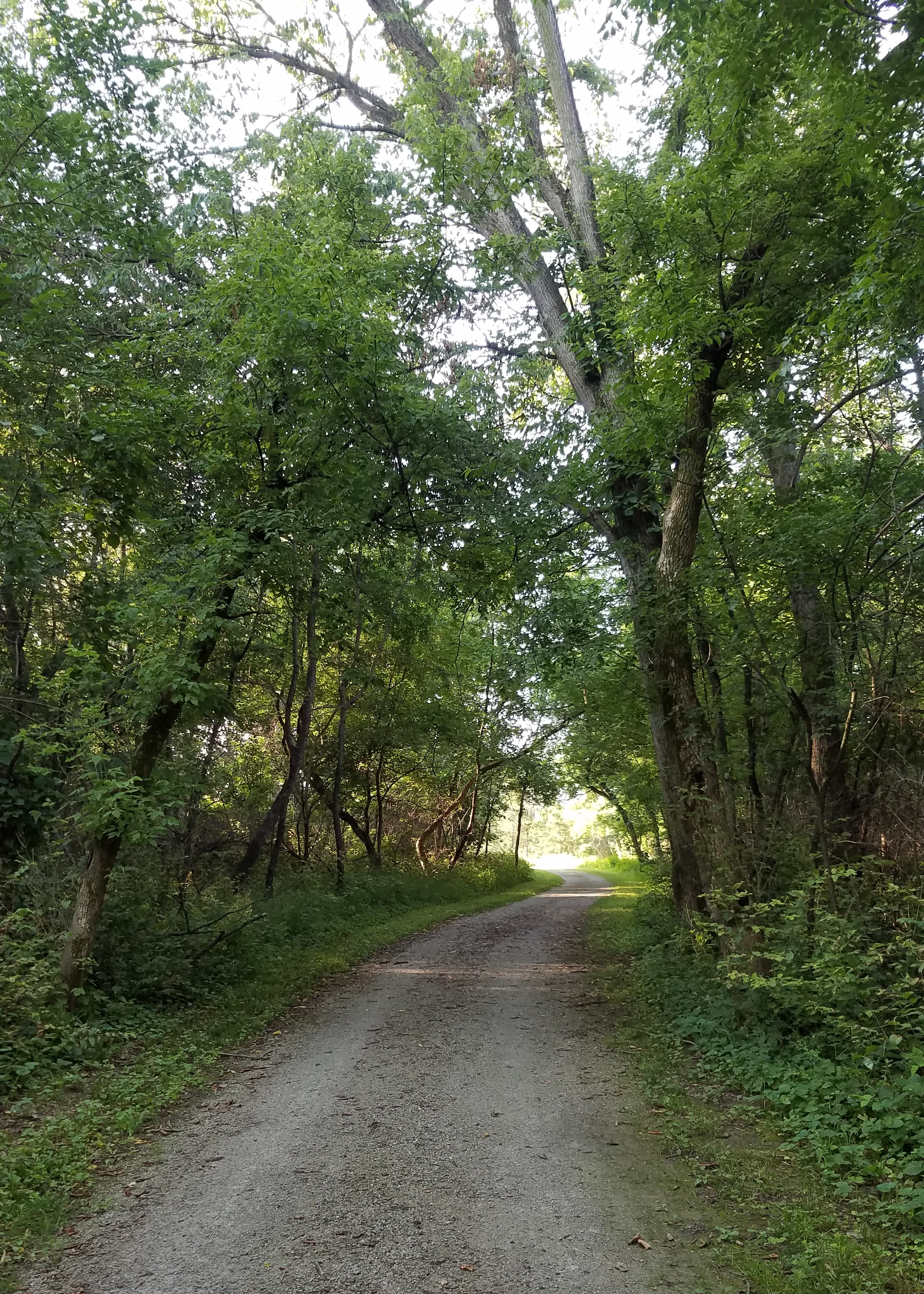
Lake Macbride State Park Trail, July 8, 2019.
With a form of financial security through a pension, the press of bills due without funds to pay them is also in remission (Thanks FDR for Social Security). Our consumer debt is going down: we gained almost $12,500 in net worth since my pension payments began and debt servicing picked up. Once the pressure of nose to the grindstone was relieved new possibilities opened up and there is more than financial improvement.
The biggest change is feeling comfortable staying home and working. I let one of my farmer friends know I would not likely be returning next year. At some point I’ll leave the home, farm and auto supply store to spend even more time at home. There is work here in the form of household repairs, reading, writing, gardening, cooking and such, to fill more time than I have left on this blue-green sphere.
In addition to the work, there’s the occasional chance to buy ice cream and become lost in the wetlands on my way home. I’m learning to see where I live again.
Blaming the woes of society on our K-12 education system is a habit I need to break.
In the post below the target was a failure to teach children about their responsibilities when signing student loan papers. A high school graduate is an adult at age 18 in our culture, so when taking on debt that has the potential to cripple them for decades, they should be equipped to know what they are doing.
Parents also play a key role in educating youth, however my grievance with the way the Iowa legislature funds public schools is they are not spending enough money where it is most needed, and the results show in the form of an ill-educated electorate that makes what I believe are bad decisions.
It is unfair for me to pin this on public schools as State Senator Claire Celsi immediately pointed out:
In the July issue of The Atlantic, author Nick Hanauer addresses the tendency to blame public schools in an article titled, “Better Public Schools Won’t Fix America:”
Long ago, I was captivated by a seductively intuitive idea, one many of my wealthy friends still subscribe to: that both poverty and rising inequality are largely consequences of America’s failing education system. Fix that, I believed, and we could cure much of what ails America.
This belief system, which I have come to think of as “educationism,” is grounded in a familiar story about cause and effect: Once upon a time, America created a public-education system that was the envy of the modern world. No nation produced more or better-educated high-school and college graduates, and thus the great American middle class was built. But then, sometime around the 1970s, America lost its way. We allowed our schools to crumble, and our test scores and graduation rates to fall. School systems that once churned out well-paid factory workers failed to keep pace with the rising educational demands of the new knowledge economy. As America’s public-school systems foundered, so did the earning power of the American middle class. And as inequality increased, so did political polarization, cynicism, and anger, threatening to undermine American democracy itself.
Hanauer assigns blame to our economic system: income inequality and the fact workers are underpaid.
“Allow economic inequality to grow, and educational inequality will inevitably grow with it,” he wrote. “By distracting us from these truths, educationism is part of the problem.”
While sad that my participation on Twitter is sometimes a distraction, eventually I can get around to a more reasonable position thanks to the commentariat. One commentator accused me of adopting the policies of U.S. Senators Chuck Grassley and Joni Ernst. That’s not the case, but at least we didn’t have to invoke Godwin’s Law to resolve the issue. Despite any issues with an ill-educated electorate, hope for a better world remains.
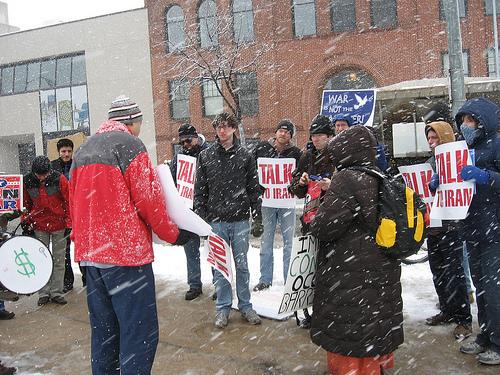
Except for the president and members of his administration, the world supports the Iran Deal negotiated by the Obama administration with key allies and Iran.
On June 28, Austria, Belgium, Finland, the Netherlands, Slovenia, Spain and Sweden, which are not party to the agreement, issued a statement supporting the Iran Deal:
“(We) attach the utmost importance to the preservation of the Joint Comprehensive Plan of Action (JCPOA), signed by Iran and unanimously endorsed by the UN Security Council, as a key instrument for the non-proliferation regime and a major contribution to stability in the region.”
The purpose of the agreement was to restrict Iran’s ability to produce a nuclear weapon. The United States, under President Donald Trump, chose to violate the JCPOA because the chief executive thought it was a “bad deal.”
Last week the president authorized new sanctions against Iran, but they already felt economic pain from previous ones. What this round of sanctions tells Iran and the rest of the world is the U.S. is running out of options, according to Jarrett Blanc at Politico,
With Iranian oil sales down to 300,000 barrels per day (from 2.5 million before sanctions were reapplied) and Iran’s economy suffering, the United States has effectively cut Iran out of international commerce already. The real signal Iran will take from the new sanctions is that the Trump administration either does not understand this reality or cannot come up with a more effective option to improve upon it.
Iran recently announced it would exceed the 300-kilogram limit on low-enriched uranium required by the Iran Deal. They did exceed it, which was widely reported on Monday. Daryl Kimball, executive director of the Arms Control Association made this June 27 press release with Kelsey Davenport, ACA director for nonproliferation policy, which summarizes where we stand regarding the Iran Deal (emphasis mine):
(Washington, DC)—Iran’s announcement that it may soon breach the 300-kilogram limit on low-enriched uranium set by the 2015 nuclear deal is an expected but troubling response to the Trump administration’s reckless and ill-conceived pressure campaign to kill the 2015 nuclear agreement, known as the Joint Comprehensive Plan of Action (JCPOA).
It is critical that President Donald Trump does not overreact to this breach and further escalate tensions.
Any violation of the deal is a serious concern but, in and of itself, an increase in Iran’s low-enriched uranium stockpile above the 300-kilogram limit of 3.67 percent enriched uranium does not pose a near-term proliferation risk.
Iran would need to produce roughly 1,050 kilograms of uranium enriched at that level, further enrich it to weapons grade (greater than 90 percent uranium-235), and then weaponize it. Intrusive International Atomic Energy Agency (IAEA) inspections would provide early warning of any further moves by Iran to violate the deal.
Tehran is not racing toward the bomb but rather, Iran’s leaders are seeking leverage to counter the U.S. pressure campaign, which has systematically denied Iran any benefits of complying with the deal. Despite Iran’s understandable frustration with the U.S. re-imposition of sanctions, it remains in Tehran’s interest to fully comply with the agreement’s limits and refrain from further actions that violate the accord.
If Iran follows through on its threat to resume higher levels of enrichment July 7, that would pose a more serious proliferation risk. Stockpiling uranium enriched to a higher level would shorten the time it would take Iran to produce enough nuclear material for a bomb–a timeline that currently stands at 12 months as a result of the nuclear deal’s restrictions.
The Trump administration’s failed Iran policy is on the brink of manufacturing a new nuclear crisis, but there is still a window to salvage the deal and deescalate tensions.
The Joint Commission, which is comprised of the parties to the deal (China, France, Germany, Russia, the United Kingdom, the European Union, and Iran) and oversees implementation of JCPOA, will meet June 28. The meeting is a critical opportunity for the state parties to press Iran to fully comply with the nuclear deal and commit to redouble efforts to deliver on sanctions-relief obligations.
For its part, the White House needs to avoid steps that further escalate tensions with Iran. Trump must cease making vague military threats and refrain from taking actions such as revoking waivers for key nuclear cooperation projects that actually benefit U.S. nonproliferation priorities.
If Trump does not change course, he risks collapsing the nuclear deal and igniting a conflict in the region.
If interested in following the progress of the Iran Deal, discussions with North Korea, and potential extension of the New START Treaty between Russia and the United States, follow Daryl Kimball on twitter @DarylGKimball.
~ Written for Blog for Iowa. Paul Deaton is, among other things, a member of the Arms Control Association.
The combination of advancing age and a world heated by human-made global warming has me looking for ways to cope.
When temperatures are forecast above 90 degrees Fahrenheit with high humidity I get my outside work done early then head into the house. I keep the thermostat at 83 degrees so as not to use too much electricity, but to take the edge off the hot, humid days. I manage to sustain my sanity.
I used to work outside in blistering weather until beginning to black out. It is a concession to age that I refrain from scheduling work to spite such conditions. Mother Nature always wins.
If the political failure to address global warming takes us all out, I can live with that. The extinction of humans would be fair if everyone goes together. Such fatalism serves no useful purpose if there is still a chance to slow greenhouse gas emissions and eliminate the use of fossil fuels that power our economy. What choice do we really have but to go on living? Part of that has to be political advocacy.
If we are individuals in the Anthropocene, we are doomed already. One has to wonder what Ayn Rand would have to say about the prospect of an end to humanity. One supposes as long as government doesn’t tax individuals and corporations she’d be okay with it. Although, she too signed up for Medicare and Social Security.
2019 has been a time of personal rebuilding. I made it across a career finish line and it took time for life to settle. I signed up for Medicare, then Social Security, and have begun to take better care of myself and effect repairs around the house. I spend a significant amount of time at home where reading, writing, gardening, yard work and cooking take a majority of my time. Something will be next.
I know what part of it is. The 2020 general election looms large in our efforts to engage the government in addressing the climate crisis. How to impact the election is complicated. In part I plan to band together with like-minded citizens and work for candidates, Democratic candidates for the most part. Everything from president down to township trustee requires positive change. There is more than politics.
It starts with taking care of ourselves but cannot end with the individual. That’s the outlook that brought us to today. What we know is government’s reduction of taxes and deregulation of business have played out in front of us. They fail to address the core issue: our survival in a turbulent world. What seems important is answering the question what role should government play in our lives? Finding a new answer is essential while living in the Anthropocene.
For the next five weeks I’ll be covering weekdays for our editor Trish Nelson who is on summer break. This is my seventh year to provide summer posts, and more than ten years since I began posting at Blog for Iowa.
Regular readers know my topics: politics, foreign affairs, the climate crisis, the Iowa legislature and nuclear abolition. I’ll contribute those types of posts and more as I compete to gain your interest in a busy media landscape.
While Iowa lakes struggle to maintain safe water quality for summer activities like boating, low impact water sports, and swimming, Lake Macbride experienced its first-ever public health warnings about microcystins produced by blue-green algae. Department of Natural Resources staff recommended people not swim in the lake because of high levels of toxins in the water. While the swimming ban was lifted, there is another traditional summer activity for those skeptical about the water’s suitability: reading a book. Following is a list of books readers might consider for summer reading.
I know the 720-page Mueller Report published by The Washington Post sounds like a lot and maybe a straight through reading isn’t for everyone. However, read ten pages per day and it can be finished in 2.4 months.
Willard “Sandy” Boyd, the fifteenth president of the University of Iowa, published a memoir this year, A Life on the Middle West’s Never-ending Frontier. He was university president when I was an undergraduate and graduate student. Boyd remains active as Rawlings/Miller professor of Law at the university and is president emeritus. The memoir offers his views of the role of a public university and how it evolved since he first worked at the University of Iowa in 1954. I picked it for my personal connection to Boyd, but there is a lot more to the memoir, especially if your interest is in higher education.
If folks haven’t read a history of the great migration of black citizens fleeing the south in the 20th Century in search of a better life, The Warmth of Other Suns: The Epic Story of America’s Great Migration by Isabel Wilkerson offers an option. After fifteen years of research and writing, Wilkerson published the book in 2010. It “examines the three geographic routes that were commonly used by African Americans leaving the southern states between 1915 and the 1970s, illustrated through the personal stories of people who took those routes,” according to her Wikipedia page. Knowing the history of the Great migration is essential to maintaining progressive values.
What is a single book to better understand the climate crisis? I found an answer in The Uninhabitable Earth: Life After Warming by David Wallace-Wells. Fair warning: there is not much good news within these 310 pages. What the book does do is present a broad array of the effects of the climate crisis and how they impact us now and near term. Wallace-Wells seeks to address denial that climate change poses immediate consequences that are both ever-changing and happening in front of us. Required reading for anyone advocating a sustainable life on Earth. That should include almost everyone.
Democrats expecting a fair fight in the 2020 election aren’t playing by the same rules as Republicans. When we consider how progressive values might again gain dominance in American culture it is important to learn how we arrived at this Trump moment. Two books highlight how we got here and are worth reading: Dark Money: The Hidden History of the Billionaires Behind the Rise of the Radical Right (2016) by Jane Mayer, and Democracy in Chains: The Deep History of the Radical Right’s Stealth Plan for America (2017) by Nancy MacLean. When people talk about getting money out of politics they are just flapping their gums if they don’t understand how it got in. These two books provide that insight and are essential progressive reading.
It seems like yesterday I was having a cup of coffee with Kurt Michael Friese in Iowa City. It’s hard to believe he’s gone. In A Cook’s Journey: Slow Food in the Heartland Friese offers a guided tour of the slow food movement in the Midwest around 2008. While a little dated, the book is worth reading for the landscape of Midwestern local food it presents and people in the local food movement. It’s also a way to remember his work as a chef.
That’s what’s on my summer reading list. Feel free to share what’s on yours in the comments.
June’s last day marks the beginning of my hiatus from farm work.
The orchard’s chief apple officer confirmed they need me in the sales barn this year. My manager emailed me back to set a starting date. Apple season is set and I can focus on other things in July.
For the first time this year I made a “project run” to the commercial center in Coralville. I picked up a replacement faucet handle, a new light/vent fan part for a bathroom, some topsoil and grass seed to fill in the depression over the septic tank, a new bird feeder and a shepherd’s hook, and eight more 6-foot stakes to protect tomatoes from deer. I hope there will be more trips like that.
Weeding the garden is a never-ending task. I focused on the plot with beans and a variety of crops. Even the parsley seeds sprouted and I removed competition so they will grow to maturity. I saw several Japanese beetles in the basil so I harvested the big leaves. I also harvested kale, broccoli, green onions, radishes, parsley, beets and sugar snap peas. The ice box is crammed with containers of fresh greens and other vegetables. With my spouse visiting her sister for a few days I will be eating a lot of greens for a while.
I planted Table Queen Acorn squash (Ferry – Morse, 75 days) and Honey Bear Acorn squash (Johnny’s Selected Seeds, 85 days) in newly claimed space. Acorn is our favorite winter squash so here’s hoping they succeed.
The lawn was a field of clover which I harvested with my John Deere mower and grass catcher. Rabbits will find something else to eat, hopefully not my garden. I piled the clippings in the transition space near three oak trees I planted from acorns and will decide which vegetables get protection next. When weather turns hot, the lawn doesn’t produce as much, so it will be a couple of mowings before the garden is fully mulched.
My clothing was drenched with sweat by the time I finished the lawn. I hung my t-shirt and jeans to dry, took a shower, and focused on kitchen work the rest of the day. Processing today’s harvest took the most time.
I like this in between time for a lot of reasons. It’s a chance to let the dust of the first half year settle and figure out what is most important to sustaining a life in a turbulent world. Just like weeding, the non-productive energy-suckers need to be removed to free up what’s most valuable.
With recent moves to reduce the number of government advisory panels, overturn the Obama administration’s clean power plan, and increase the speed with which logging permits are approved in national forests, the Trump administration plows the field of deregulation in a way libertarians and conservatives could previously only dream about.
They have gone too far.
Even with regard to mitigating the impact of the climate crisis, the fossil fuel industry indicated the world is proceeding on an unsustainable path. According to the BP Statistical Review of World Energy 2019.
There is a growing mismatch between societal demands for action on climate change and the actual pace of progress, with energy demand and carbon emissions growing at their fastest rate for years. The world is on an unsustainable path.
In a special message to the Congress on Feb. 8, 1965, President Lyndon Johnson said,
Air pollution is no longer confined to isolated places. This generation has altered the composition of the atmosphere on a global scale through radioactive materials and a steady increase in carbon dioxide from the burning of fossil fuels.
A group of scientists explained to Johnson that burning fossil fuels could cause climate change, according to Naomi Oreskes and Erik Conway in their 2010 book Merchants of Doubt. “Most thought that changes were far off in the future,” they wrote.
In 2019 we see the effects of climate change in real time. We are living them.
Johnson signed hundreds of conservation and environmental measures during his tenure, developing the strongest record for the environment of any president. In so doing, he laid the legal foundations for how we protect the nation’s land, water and air.
Given time I believe Republicans will destroy the Johnson era legal foundation while their leader is lying to the American people about the quality of our air and water in a way that conflicts with our personal experience.
“We have among the cleanest and sharpest — crystal clean, you’ve heard me say, I want crystal clean — air and water anywhere on Earth,” President Trump said at a June 18 campaign rally in Florida. “Our air and water are the cleanest they’ve ever been by far.”
The science of climate change — that carbon dioxide and other gaseous emissions warm the atmosphere creating the greenhouse effect that enables life on Earth — has never been in doubt. It’s science and as Neil deGrasse Tyson recently said, “When you have an established scientific emergent truth it is true whether or not you believe in it.”
When Trump lies and repeats his lies over and over again, believers and followers will set aside what is in their best interests, what is plainly visible in objective reality, and parrot his words. It creates turbulence in society, an argument about things which there is no arguing, and delays political action that should have been taken years ago. It creates doubt.
Now we have a climate crisis.
Environmental advocates don’t agree on the path to resolving the climate crisis, in fact there are broad divisions. Some favor a carbon fee and dividend as a means of reducing carbon dioxide emissions. Others want geoengineering, a deliberate large-scale intervention in the Earth’s natural systems, to counteract climate change. Others want to keep fossil fuels in the ground and convert our electrical grid to sustainable, renewable electricity generation. Others favor implementing nuclear power as a way to get to zero emissions with electricity generation. There is no agreement about specific strategies and tactics to use.
What remains from the divisions is an elemental truth, we have to do something to mitigate the effects of climate change. While assertions like those of our president and his administration create doubt about the use of political action regarding climate change, doubt no more. We have to do something and soon.
If you’d like to learn more about the climate crisis I recommend David Wallace-Wells recent book The Uninhabitable Earth: Life After Warming. It is a comprehensive look at the diversity of the climate crisis. My advice is read his book then get involved with climate action.
The garden was muddy making it difficult to plant… so I waited.
For exercise I took a walk on the state park trail, 20 minutes out and 20 minutes back… with stops for photos.
Wildflower
Although the pace was slow, I could feel the benefit of the walk. It energized me to install the deer fence around the tomatoes and perform a few garden chores before an afternoon thunder storm.
I picked turnips and sugar snap peas from the garden. The first Japanese beetles have arrived. The six-foot stakes worked well to protect the tomato plot from deer who eat the top shoots if they can get to them. It makes a significant difference in yield. Almost everything looks good.
With season’s end of soil blocking tomorrow comes blank space to fill… or not. I’ll do something but let go of filling every moment with intentional action a while back.
One of the most profound things I studied in art history was horror vacui, or fear of the empty. We looked at photos of Greek vases where every space of the surface had images on it. The human tendency is to fill everything the way a person gets a tattoo or two and ends up with a full sleeve. Fear of the empty. It is more creative and more difficult to leave spaces blank. Letting go the obsession to engage every chance to express ourselves frees us to produce better work.
A gardener gets time to think about things like this… and watch the arrival of Japanese beetles, and vegetables planted with one’s own hands grow in sunlight, and devise unique solutions like my deer fence.
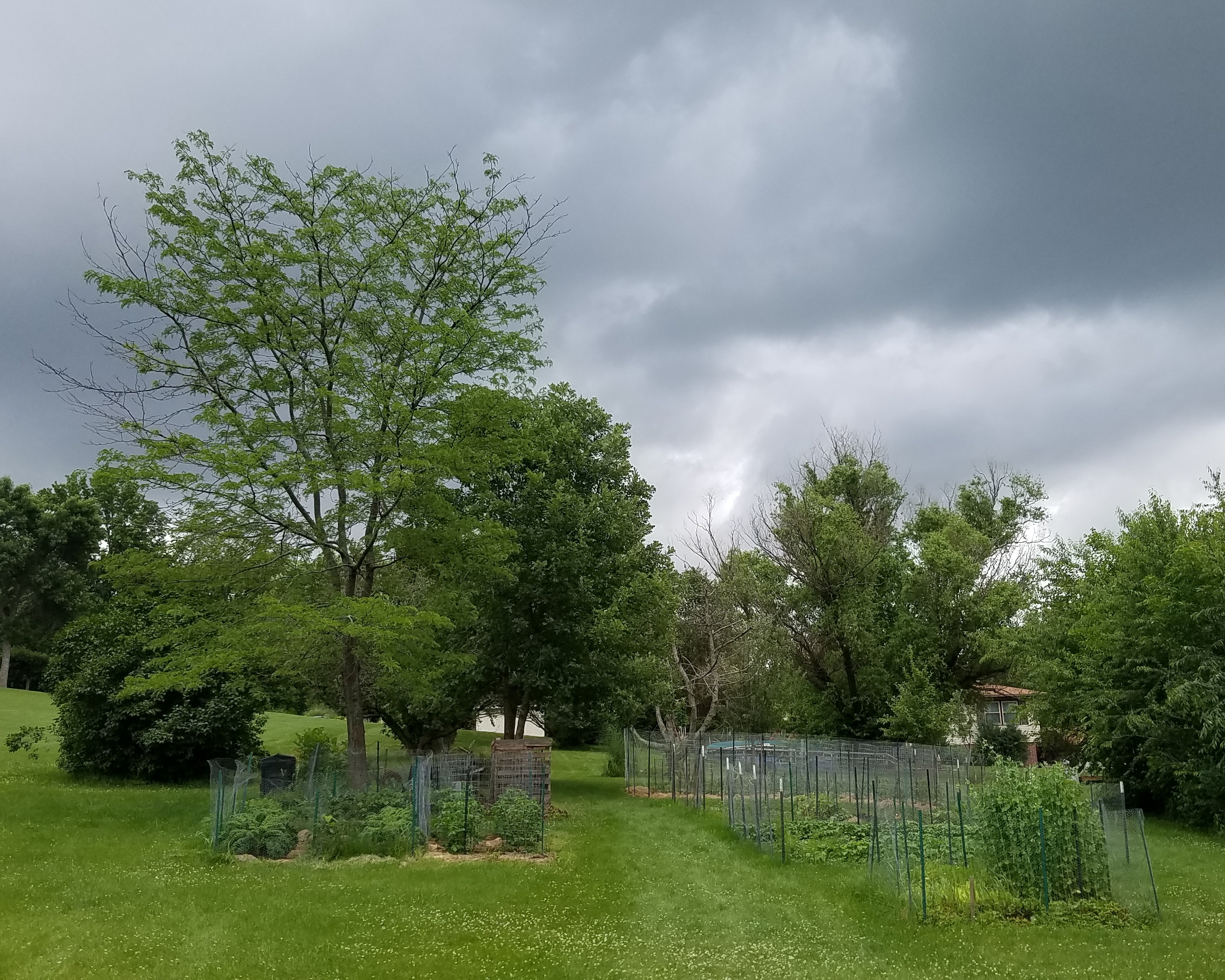
Some days we have to stand back and look at what we’ve built:








 Journey Home
You must be logged in to post a comment.