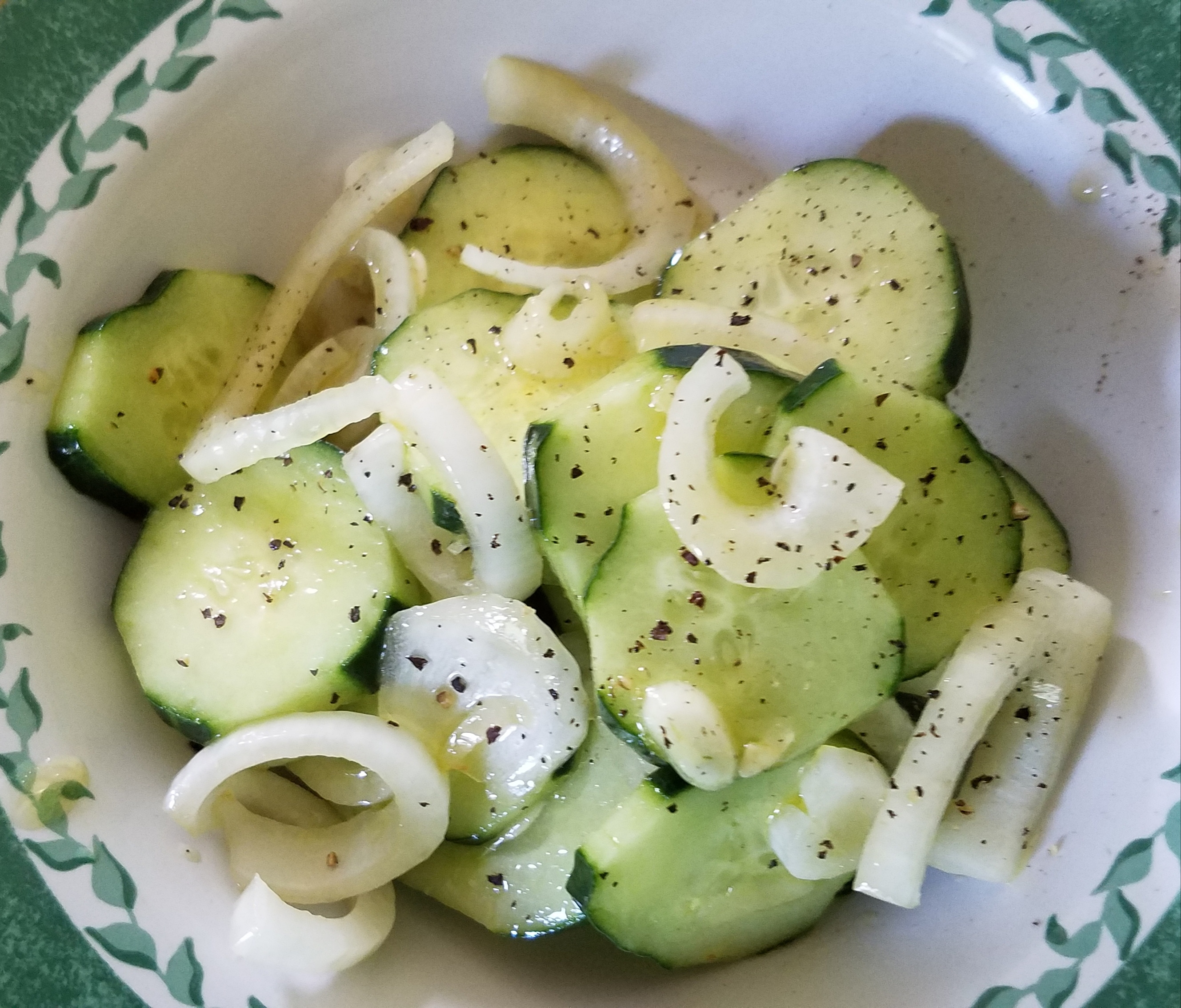
Peel them, slice and put them in a bowl. Add thinly sliced onions, extra virgin olive oil and your favorite vinegar, then salt and pepper to taste.
Mix gently then serve. It’s summer in a bowl.
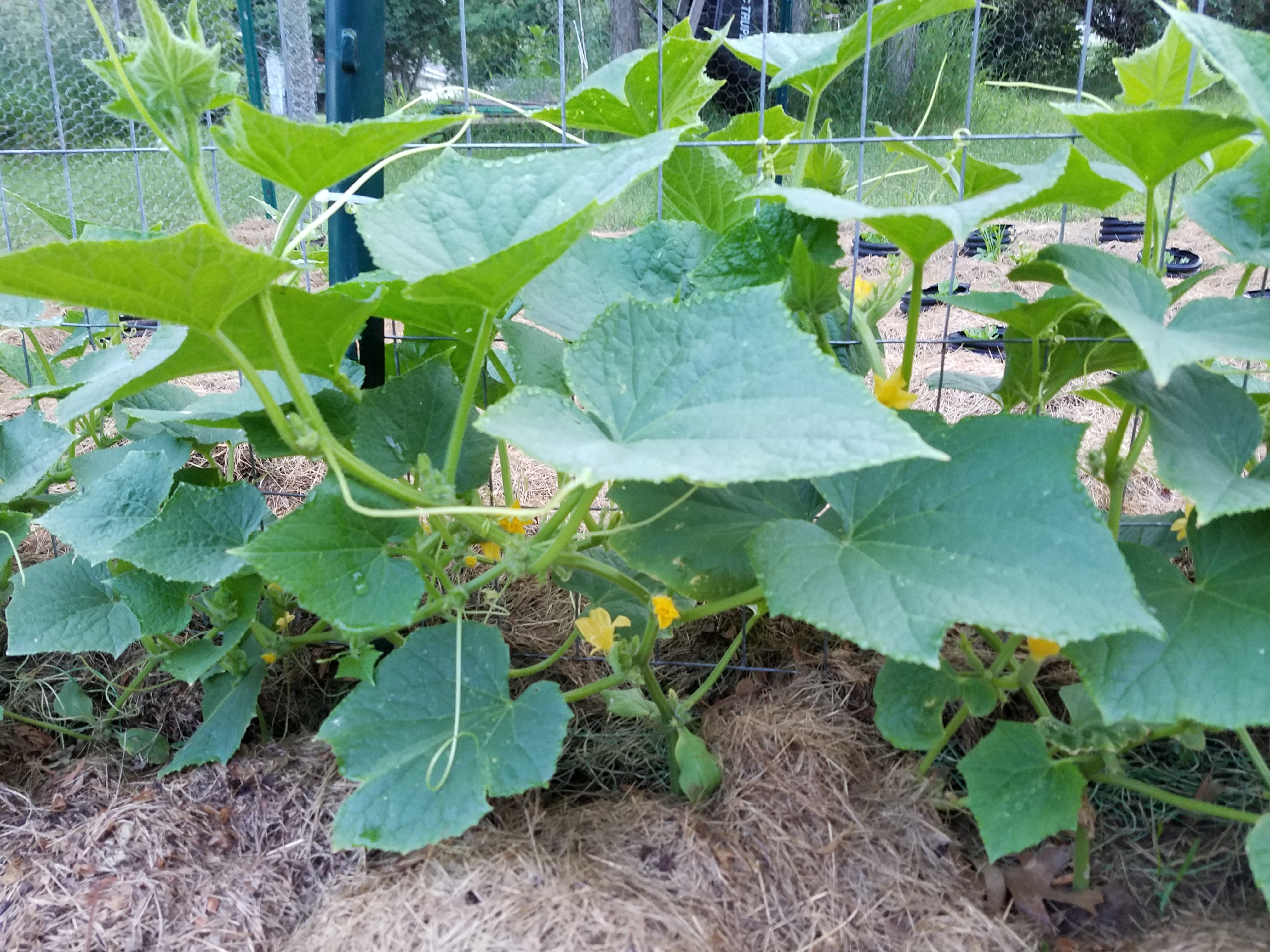
When the garden produces them, we eat a lot of cucumber salads. This year I mastered the art of cucumber growing with a couple of simple things. First, I mulched as soon as I planted the seedlings. Then, I made sure deer had no access to the plants. I also put up cages and a fence for the vines to grow upward. The result has been abundant.
Other than in pickles, cucumbers don’t preserve well. They must be enjoyed in the moment, and sometimes that’s as good as it gets.
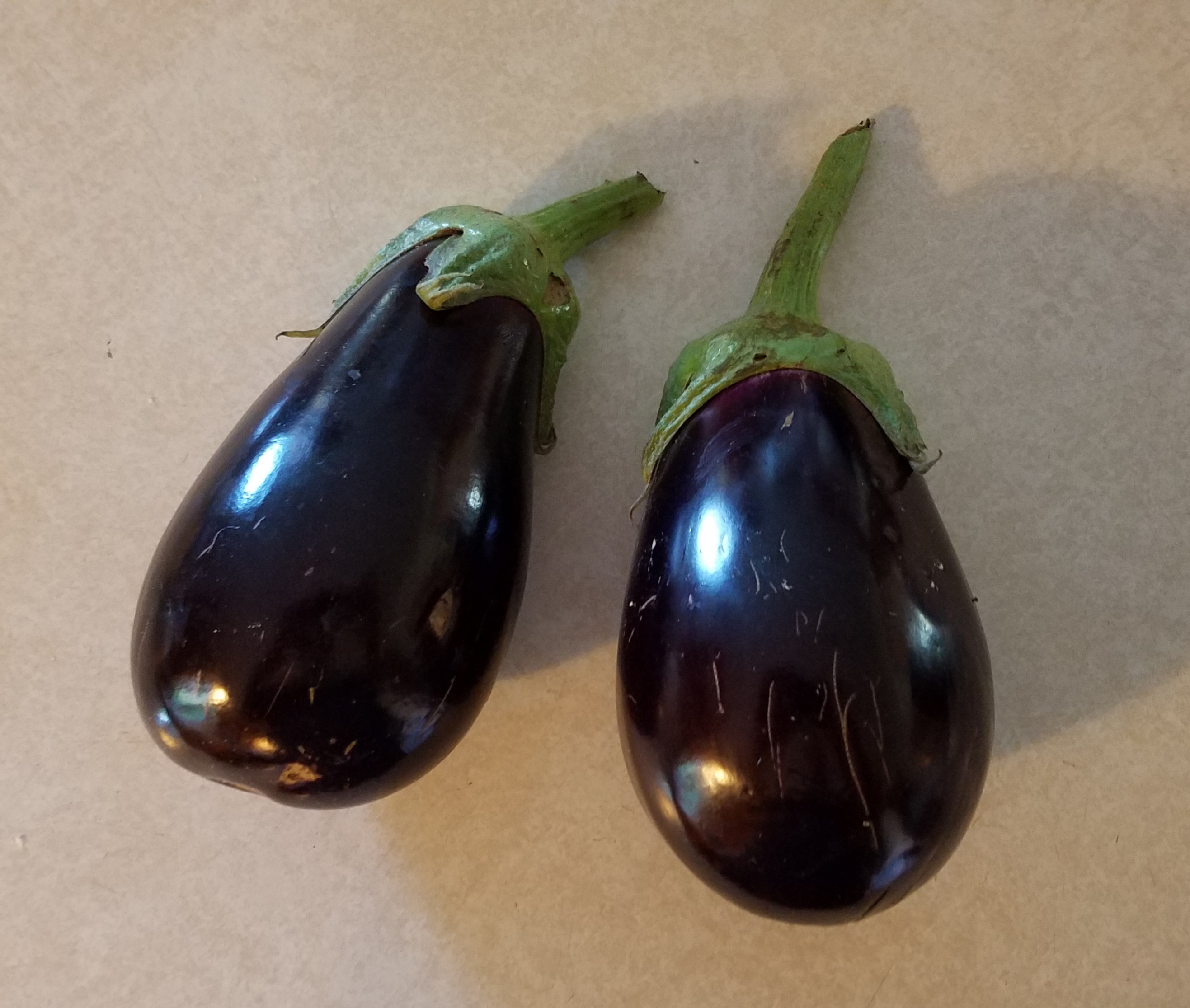
By the time eggplant season is finished. everyone in the family is tired of it.
Here’s a simple, tasty recipe that’s not as much a recipe as techniques to use garden abundance in mid summer. The savory flavor will have diners coming back for more.
The first part is preparing eggplant slabs for the dish and for freezing.
Cut two half-inch slabs lengthwise from the middle of each eggplant and reserve the smaller portions from the sides. Skin on or off, your choice.
Lightly salt the slab of eggplant and drizzle extra virgin olive oil on it until both sides are coated. Place it on a baking sheet lined with parchment paper or a silicone mat. Cut slabs from all the large eggplants you have and line them up.
Place the pan in a 450 degree preheated oven and bake for 8 minutes. Take the pan out and flip each slab using tongs and put them back in the oven for another seven to eight minutes. Take them out and set the pan on a cooling rack.
Once cooled, what is not needed for the dish can be frozen, then bagged up in zip top bags for later in the year. Great to use these in Eggplant Parmesan.
Eggplant Dinner
The dish has three components: the eggplant slab, quarter inch slices of fresh mozzarella cheese, and a vegetable ragout.
The ragout is a way of using what’s available. Put a frying pan on the burner with a tablespoon of high smoke point cooking oil. I diced an onion, diced the reserved small slices of eggplant, finely sliced garlic scapes, fresh celery, and two hot peppers (jalapeno or Serrano). Any combination of what needs to be used up should serve. Sautee until the onions begin to soften.
While the vegetables are sauteing, grate half a large zucchini on a piece of parchment paper and set it aside. Halve eight to ten cherry or grape tomatoes and put them with the zucchini. Check the vegetables and once soft add the zucchini and tomatoes and stir constantly until the zucchini begins to cook. Don’t overcook the zucchini.
In individual baking dishes, or in a glass baking pan if you don’t have individual, line up one or two eggplant slabs per serving, depending on size. Next place a slice of fresh mozzarella on each large slab of eggplant. Top with the ragout and put another slice of mozzarella in the middle on top. Put the dish in to the oven and warm it for 10 minutes or until the cheese melts.
Take it out, transfer it to a plate, salt and pepper to taste, and the entree is finished. If you like, top it off with a poached egg.
Note: I did not use any seasoning other than salt and pepper and the dish was quite savory. If you have herbs and spices on hand, feel free to add your favorites.
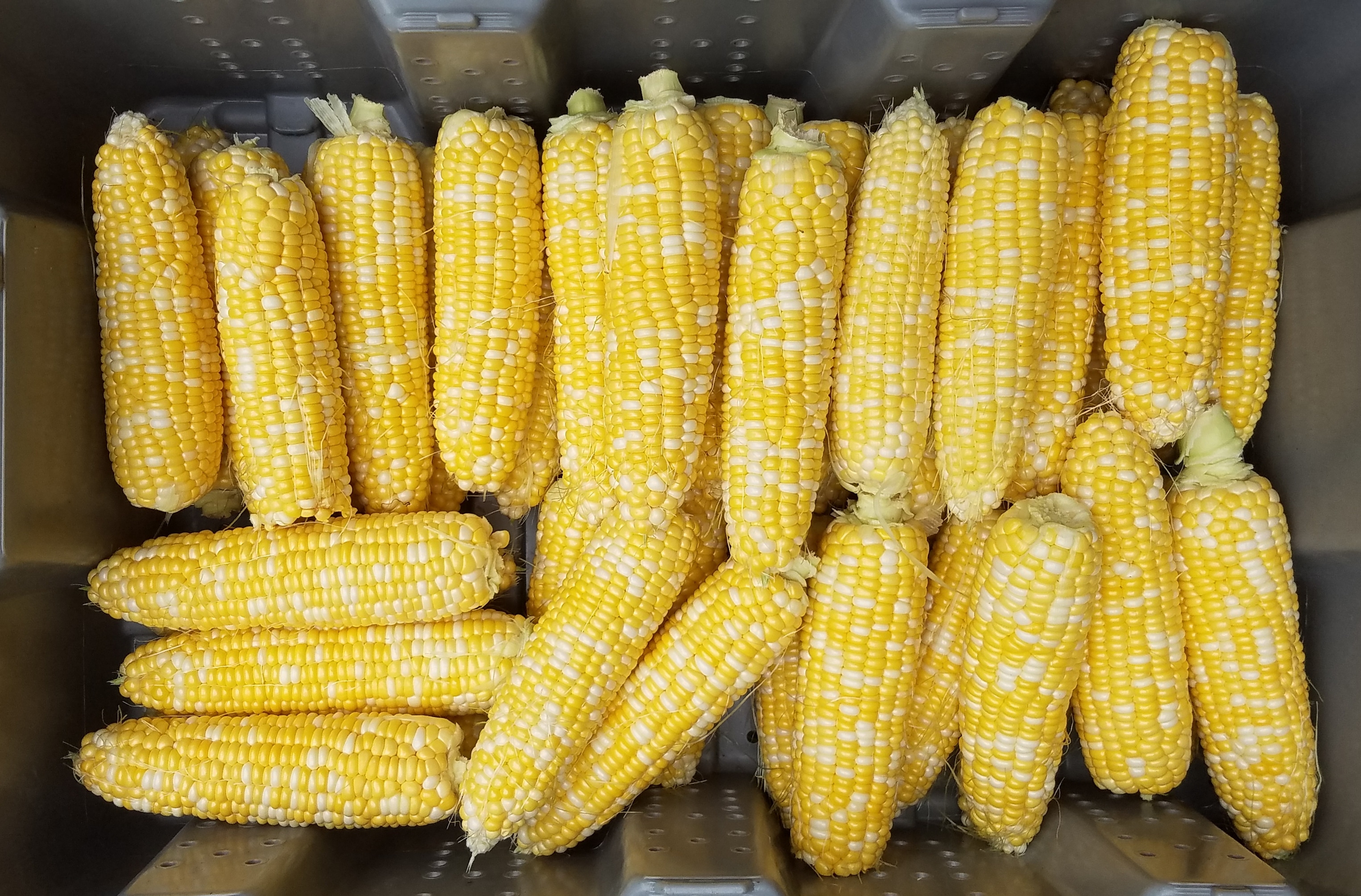
I bought sweet corn from a roadside stand and we had it for dinner with tomatoes and cucumbers from the garden, and thin slices of cheddar cheese from Vermont.
At some point after our return to Iowa in 1993, I decided to outsource corn growing. It takes up too much space and what space could be devoted to it produced a small crop. It was a good decision.
I cooked and froze the remainder of three dozen ears in two-cup portions in zip top bags.
We revisited stories of our lives during and after dinner.
How our cat would lick the cobs cleaned of corn kernels.
How putting up corn had been a long tradition — a family project.
How simple and good this year’s corn tasted compared to the past.
The trick to eating sweet corn is knowing how much to eat without getting a belly ache. The first ear was buttered, then sprinkled with lemon pepper seasoning and a little salt. Three ears is a usual portion. I ate four and went light on the salt. There were no ill effects.
Tomatoes
The arrival of sweet corn and tomatoes is the arrival of high summer. A short window — a couple of weeks max — when summer is good and we get a chance to be human again.
That’s something we need in this turbulent world.
In Iowa we also have the Register’s Annual Great Bike Ride Across Iowa, more commonly known as RAGBRAI, which began yesterday. Donald Kaul and John Karras were two Des Moines Register reporters behind the annual event. It was expected this year, and Kaul died of prostate cancer Sunday morning.
“On January 11, 2018, Kaul, an agnostic, revealed that the cancer in his prostrate has spread to his skeleton and that he will no longer take treatments,” wrote Des Moines Register columnist Kyle Munson. “He was in the end stages of his battle with cancer and didn’t expect to live beyond the year.”
The end came at 11:50 a.m., according to a local radio station.
The narrative of this year’s RAGBRAI seems already written, and it doesn’t include Kaul. There is time for some show of recognition on the seven-day tour. We’ll see what happens.
For me RAGBRAI was about the summer of 1973 when it started. An artist I met in Davenport invited me to her family’s home near the Catholic orphanage to meet her parents. Her brother was out in the garage when I met him too. He was talking about riding his bicycle across the state with the Des Moines Register. Over the Coffee, Kaul’s column, was popular in this household.
Today people prepare for months for the long endurance test the annual ride has become. Specialized, lightweight bicycles, meal plans, and training. Not in 1973 when the sequence of events was 1. figure out how to get to the Missouri River with the bike; 2. tighten up the hub axle nuts; and 3. air up the tires. I can’t recall, but I don’t believe he even had a derailleur gear on his bike. It was pretty simple then and proved to be enduring.
Kaul’s death on the beginning day of the 46th RAGBRAI is likely coincidence. In any case, he is memorable for his writing more than his promotion of bicycle riding.
In high summer, after our dinner of sweet corn and tomatoes, my wife and I discussed our interactions with Donald Kaul. She got his autograph in a bookstore in Iowa City, and I corresponded with him when he was a Washington, D.C. correspondent for the Register. He was a constant part of our Iowa lives. That will still be true now he succumbed to cancer.
The change in our local food ecosystem from last summer to this is hard to fathom.
We let go of the summer share from the Community Supported Agriculture projects to rely on our garden.
It was a big step and I feel much less stress from over abundance. Some days I’d like more lettuce, and some of the specialty crops, but there is plenty from our garden to fill the gap. Now that tomatoes, cucumbers, eggplant and peppers are beginning to come in, I don’t forecast any gaps.
What is hard to fathom is why the transition has been so easy. Maybe I’m getting to be a better gardener. Maybe I was due to go on my own.
Tornadoes tore through Marshalltown, Pella and Bondurant yesterday as I got off work at the home, farm and auto supply store. It doesn’t appear anyone was seriously injured or died, although damage to the communities was substantial. Photos and video posted on social media depicted a horrible scene. The Marshalltown Times-Republican newspaper got an issue out the next day despite the storm — practicing journalists they are.
Are these storms due to climate change? I don’t know. What I do know is the seasons are out of wack. A late spring, early high ambient temperatures, and more frequent storms make our climate exceedingly weird. We adjust, accommodate, but something’s different.
Ben Santer, an atmospheric scientist at the Lawrence Livermore National Laboratory, led a study of four decades of climate data that concluded human activity is disrupting our seasonal balance. That is, the seasons don’t proceed through time the way they did. It may be confirmation bias, but I doubt it. Eric Roston at Bloomberg wrote a more accessible article about the study here.
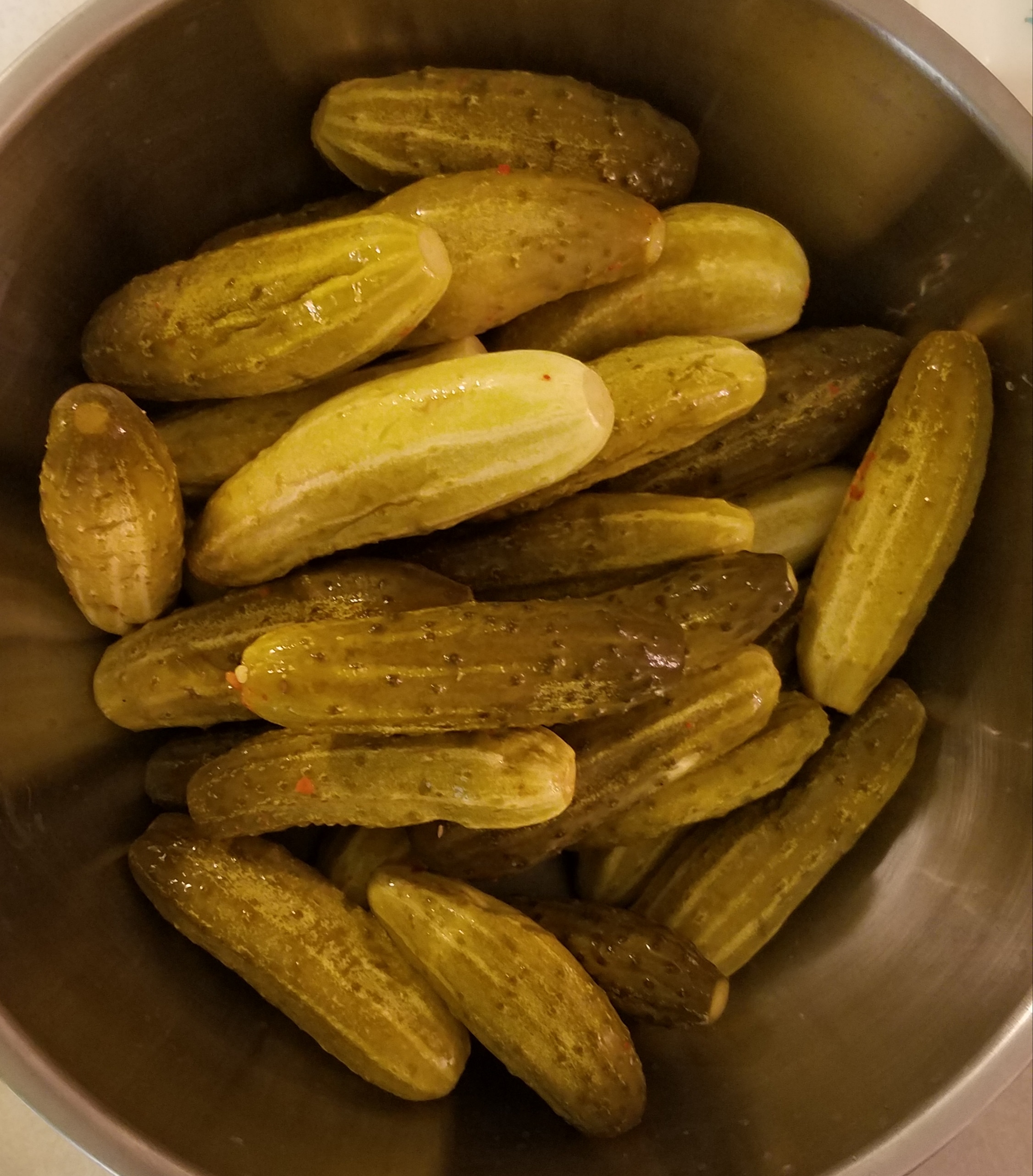
In the kitchen it’s cucumber day! A batch is sweating over a bowl and the crock is full of sweet pickles to be water bath processed tomorrow. The dill pickles in the photo took 13 days to ferment. It was worth every minute.
Here’s a second recipe for kale and garlic scape pesto. The first uses walnuts and Parmesan cheese and can be found here.
Get out the food processor and place it on the counter.
Measure the following and place in the bowl of the food processor in the same order:
Two thirds cup raw pine nuts
One third cup thinly sliced garlic scapes
One and one half cups roughly chopped kale, packed
One third cup whole basil leaves, packed
One teaspoon sea salt
One half teaspoon freshly ground black pepper
Two tablespoons lemon juice. If fresh lemon, peel first and add the yellow rind
Two thirds cup extra virgin olive oil (reserved)
Turn on the processor and grind the mixture until it starts to break down.
Drizzle the olive oil into the mixture as the machine runs.
Scrape the bowl into a quart canning jar with a spatula.
Spread some immediately on a slice of sourdough bread toast for the cook and any kitchen visitors. Screw on the lid and refrigerate until ready to use.
Fresh pesto keeps only briefly without oxidation in the ice box. If you want to use it way later, put the jar in the freezer.
There is little point in growing a garden if one doesn’t use the produce.
Yesterday I made the first pick of arugula and sugar snap peas for a classic dish with farfalle.
Preparation is done while the pasta is cooking and the result makes the effort worth it.
Put six ounces of dry farfalle pasta on the boil for 12 minutes or until al dente.
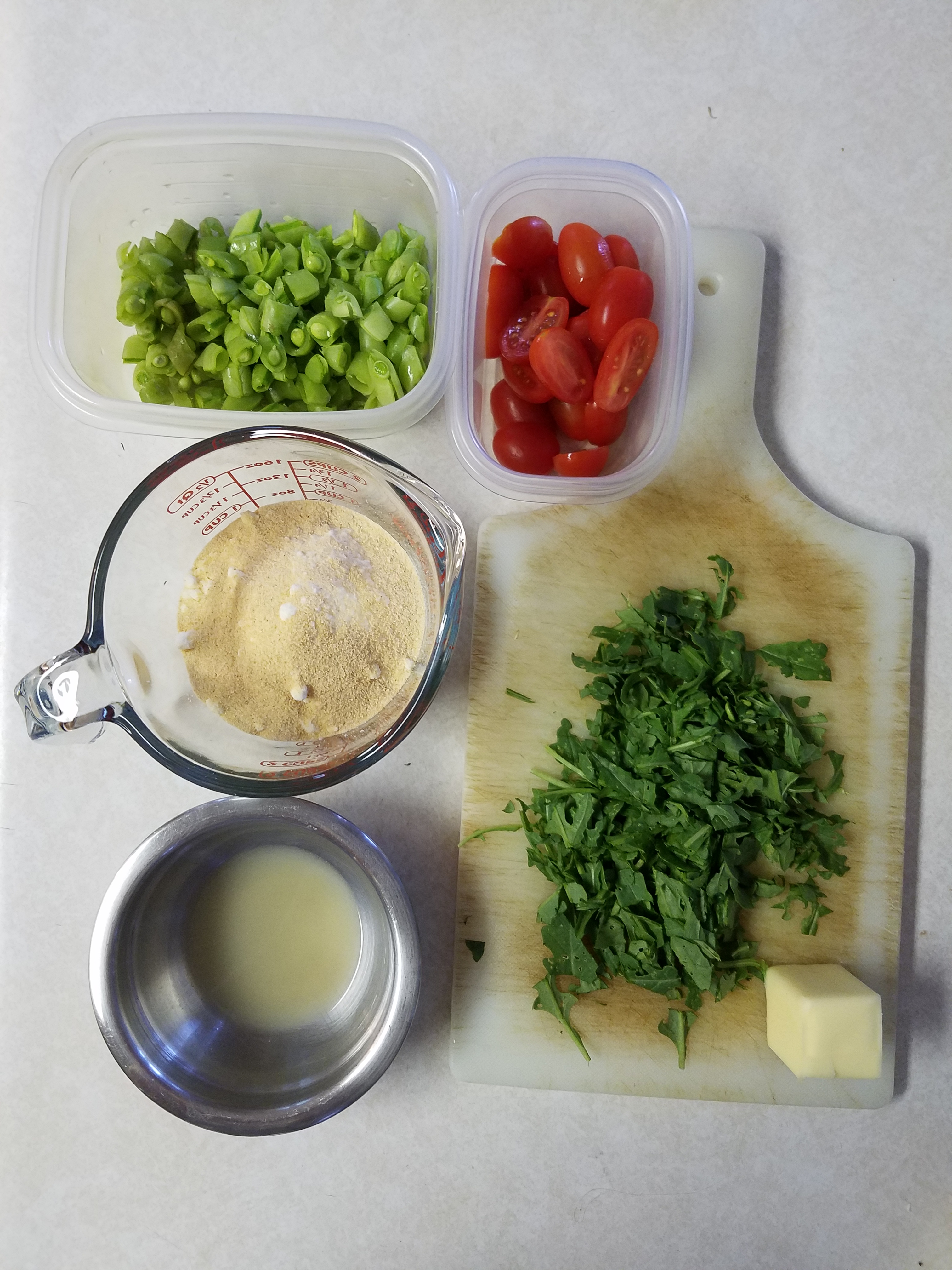
While the pasta is cooking clean the sugar snap peas, removing the vein, and slice thinly. Next, roughly chop the arugula. Set both aside.
Cut ten grape tomatoes in half and set them aside. We get grape tomatoes from the warehouse club, although the first flowers are appearing on the tomato plants in the garden. It won’t be long before we have home grown cherry and grape tomatoes.
Remaining ingredients include a scant quarter cup of lemon juice, one cup Parmesan cheese, a generous tablespoon of granulated garlic, and 2 knobs of butter.
Cut the butter into small bits and place in a large bowl. Dump in the drained pasta and gently mix to melt the butter. Next add the lemon juice, peas and arugula and mix until incorporated. Finally, add the tomatoes, cheese and garlic mixture and mix together until the cheese coats all of the pasta. Salt and pepper to taste and serve. Makes 2-3 servings.
Seasonal side dishes include a lettuce salad with kohlrabi, spinach and kale or steamed asparagus.
I must be the worst food writer in the world as I neglected to take a photo of the finished dish. Suffice it to say it tasted like spring.
The garden and yard were excessively dry Saturday morning so I watered the vegetables. Couple of hours later it rained, then cleared up in time for a wedding at Wapsipinicon State Park.
It was a lovely day for a wedding, and for living in Iowa.
We could use more lovely days… and more rain.
I had a couple of food inspirations this week.
On Thursday I had meetings after my shift at the home, farm and auto supply store so I stopped at Estela’s Fresh Mex Mexican Restaurant on Burlington Street in the county seat. I ordered veggie tacos with the traditional mix. The line cook measured a portion of vegetables (corn, onion, peppers and other undetermined items) on the griddle and sauteed them. Next the mixture was distributed among three flour tortillas in a specialized stand and served with choice of toppings and sauce. The inspiration was more process than composition. Because I make breakfast tacos at home at least once a week, I found inspiration.
I use fresh uncooked flour tortillas from the warehouse club in our home kitchen. The typical filling is onion, bell or hot peppers according to what is available, fresh garlic, and recipe crumbles seasoned with home-blended spices. This mixture reminds me of tacos Mother used to make so I anticipate keeping it. What Estela’s traditional mix inspired is a second type of filling, a combination of sweet corn, black beans, onions, peppers and garlic that could be made fresh in a big batch and stored in the ice box. When I want tacos, I could portion out what’s needed and keep the rest — handy for breakfasts when time is short. I plan to work through some variations on this idea during coming weeks.
A second food inspiration was to begin making smoothies.
A smoothie is a use it up recipe based on what’s available. I start making them in spring as spinach and kale come in. It’s a good way to use some of the bounty. The base is home made almond milk.
The preparation for almond milk is to soak raw almonds for three days, changing the water at least once daily, and grinding them in a blender. I use two cups filtered water with one cup raw almonds. It makes enough for three or four servings. I use the entire blended mixture but if one wanted almond milk like what comes from the grocer, it could be strained with a cheesecloth. For breakfast smoothies I use everything… why not?
When I worked at the warehouse club they sent us to Chicago to be trained as demonstrators by Blendtec staff. The basic technique is to load the blender jar with liquids and soft ingredients on the bottom, then top with frozen and hard ingredients. Leafy greens can go before or after the hard ingredients. Using this technique eliminates any need to poke ingredients into a moving blade with a spatula.
A typical smoothie includes a cup of almond milk, a Cavendish banana, other fruit in the ice box, a quarter cup of Greek yogurt and a generous handful of greens. I’m also using up a home-mixed protein powder, but when that’s gone I won’t replace it. Protein comes from the yogurt and almonds.
I also made a spread from goat cheese and other ingredients in the ice box. This too is a use it up recipe, although I bought the goat cheese at the warehouse club intending to make a spread.
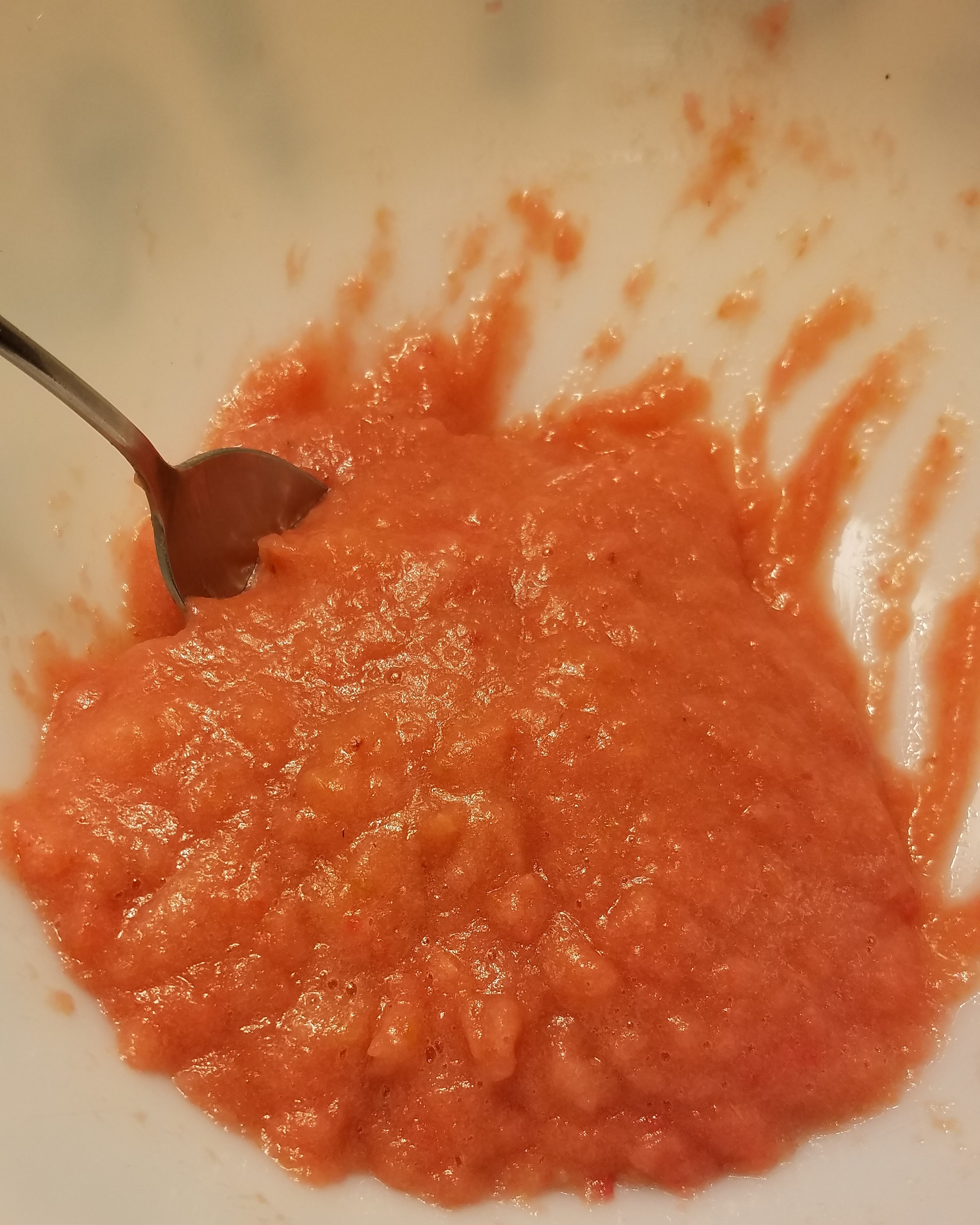
I put a log of goat cheese in the bowl of the food processor with two cloves of peeled garlic. Next, a generous cup of purchased New Mexico Hatch Chile mix. I’d use home-canned hot peppers if I hadn’t purchased the blend which included salt, garlic and lime juice. I added half a small jar of sun dried tomatoes from the ice box and processed everything until smooth. I added no seasoning, and after refrigeration a day or two garlic began to overpower the pepper flavor. If I did it again, I’d use only one clove of garlic and try other on-hand ingredients. The spread goes well on crackers and on toast.
Try any of these three ideas and I bet you will be on your way to a lovely day.
No food is more local than a kitchen garden. I’ve got to get moving on mine after a late spring.
Everyone was in a good mood at the farms when I soil blocked Friday and Sunday. My farmer friends caught up last week by finishing onion and potato planting. Trays of seedlings are moving to wagons and then into the ground, thus clearing the greenhouse for what will be June and July crops. I started zucchini and cucumbers Sunday in the greenhouse.
The first spring share is today and in honor of it I’m composting my over-wintered lettuce.
A neighbor and I had a conversation about spinach and how it grows. She is changing her garden around as last year the zucchini they love developed powdery mildew. Her tactic is to plant the whole garden in corn to give the soil a break and let the fungus dissipate. Here’s hoping that works.
As for me, Monday is mine to do what I want. This week that will include getting our septic tank pumped, writing off line, gardening and yard care. It’s time to put winter behind us.
At retirement plus 19 days I thought I’d be more productive.
Yesterday, after a shift at my desk and an hour-long visit with a neighbor and a team of surveyors, I took a nap… with long, deep sleep. Groggy when I woke, the better part of the day had escaped me.
It’s not like the main spring work of gardening was doable. Rain and ambient temperatures in the twenties and lower thirties gave me a chill most of the day. My farmer friends take advantage of every micro dry spell to plant a row of seeds or plow a field. A home gardener needs an ample period of dry ground and time to get in seed potatoes, early lettuce, radishes, turnips, peas and the like. Thus far the burn pile remains and the ground is unbroken, indicating there was a garden but little else. On the other hand, when the weather breaks, I’m ready.
Boxes of canning jars pile up as we draw down the pantry.
Last night Jacque and I went separate ways for dinner. She prepared a pasta dish with pasta made from lentil flour accompanied with a side salad. I prefer pasta made with semolina flour. These days a salad is organic greens from a specialty grocer, carrots, celery and home made dressing. When she finished in the kitchen I made a dish I had been thinking about for a week.
Mother made a simple gravy with bacon grease, flour and milk. My supper was a variation of that.
The gravy recipe is easy: three tablespoons fat, three tablespoons flour to make a roux then two cups milk simmered on low heat until thickened. We cook vegetarian at home so I substituted salted butter for the bacon grease. Mother added cooked hamburger to the gravy but I wanted more.
Dinner preparation began with diced storage onions, bell pepper from the freezer and a four ounce can of sliced mushrooms from the Netherlands sauteed in extra virgin olive oil, seasoned with salt and pepper. When the onions began to soften I added two finely diced cloves of garlic from Kate’s farm and incorporated them into the vegetables.
Next was two cups of Morningstar Farms recipe crumbles stirred in until thoroughly thawed and mixed. When the ingredients reached the proper stage I made a well in the center of the frying pan and added three tablespoons of salted butter to melt. I added an equal amount of flour to make a roux. When the roux had cooked for a couple minutes I added two cups skim milk and stirred the mixture until everything was incorporated. I brought it to a boil and turned down the heat to a simmer for about ten minutes until the liquid thickened.
I toasted a slice of sourdough bread, diced it, and spooned the mixture on top in a big bowl. That and a couple of raw carrots was dinner… with leftovers. Comfort food from memories of Mother.
In the annals of human history yesterday wasn’t much. Two people getting along in a place where we’ve lived for 25 years.
“I feel as if I’m fixin’ come out of hibernation and need to work with friends on something meaningful,” I emailed a friend. “What that is will eventually manifest itself… I hope we can recognize it when it does.”
For now I wait for the weather to break, rest and heal.





 Journey Home
You must be logged in to post a comment.