Categories
Environment Living in Society

Algae and the Politics of Denial

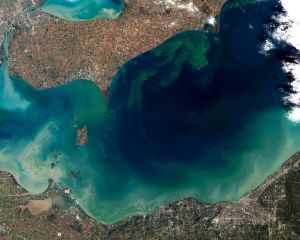
Algae Bloom in Lake Erie, Oct. 5, 2011. Photo Credit – NASA Earth Observatory

During his July 8 speech on the environment, the president mentioned his administration’s fight with “toxic algae” in Florida 50 miles from his Mar-a-Lago resort.

Bruce Hrobak, a bait and tackle shop owner in Port St. Lucie, Fla. gave a testimonial at the event about the great job he thought the federal government did to help his business which was “devastated by toxic algae from Lake Okeechobee.” His praise was about more than the government.

“You jumping into this environment brings my heart to warmth, knowing that what you’re doing is going — is the truth,” Hrobak said. “It’s going wonderfully. My business in 2018 was so horrible, we — I own two stores — we closed several days a week because of, you know, the algae and people being frightened, if they were afraid to touch the water and everything. I have a marine mechanic — I just wanted to say really quickly — has a bad infection in his arm from the marine algae and stuff.”

Mr. Hrobak gushed about the attention his problem had received and mentioned his wife was yelling at him less because business was better this year. People laughed and applauded. Rhetorically anyway, Trump halted advance of the red tide.

Iowans are familiar with the problems of algal blooms. The nutrient-rich soup that comprises our lakes and streams has been a hindrance to public recreation. We’ve restricted access to public beaches and educated kayakers, swimmers and boaters about the dangers of exposure to blue-green algae and the microcystins they produce. Iowa’s response to the problem amounts to shrugging our shoulders.

The Iowa Department of Natural Resources doesn’t plan to follow new federal recommendations for beach water quality that could lead to more public warnings about toxins in the water, according to a June 20 Cedar Rapids Gazette article by Erin Jordan.

Instead of adopting federal standards for algal contamination, an Iowa Department of Natural Resources spokesperson told the Gazette, “The group does not agree with the formula and science used to develop the eight micrograms per liter for cyanotoxins microcystins standard.”

Arguing with science is the new normal for government doing what it wants. The other new normal is the president asserting he has addressed a problem when in fact he is ignoring it.

Mother Jones reported July 12 on a toxic algae problem not being adequately addressed by the administration:

In June, the National Oceanic and Atmospheric Administration projected a Massachusetts-sized dead zone would alight upon the Gulf of Mexico, driven by a vast algae bloom fed by fertilizer runoff from the upper Midwest. As the bloom decays, it sucks oxygen out of the water. As a result, as NOAA puts it, “habitats that would normally be teeming with life become, essentially, biological deserts.”

And on Thursday, NOAA predicted that Lake Erie, which provides drinking water to 11 million people, will also experience a massive harmful algae bloom, starting in late July. The bloom is fed largely by phosphorus runoff in the Maumee River basin in Ohio, where the land is dominated by corn and soybean farms as well as massive indoor hog farms. Phosphorus is a key nutrient for plant growth, and farmers apply it to fields in the form of fertilizer (which comes mainly from phosphate mines in Florida) and hog manure.

People argue in social media that algae blooms are a naturally occurring phenomenon, that they are nothing to worry about. While that is partly true, they do occur naturally, they are fed to grow very large by agricultural runoff. For political reasons, government won’t connect the dots and take action on the much larger issue of nutrient runoff.

“Science is a fundamental part of the country that we are,” Neil deGrasse Tyson said. “But in this the 21st century, when it comes time to make decisions about science, it seems to me people have lost the ability to judge what is true and what is not… When you have people who don’t know much about science standing in denial of it and rising to power, that is a recipe for the complete dismantling of our informed democracy.”

The president is addressing red algae in his back yard. What has he done about blue-green algae for the rest of us? He denied us a solution and distracted us from the problem. This while his minions in the audience for the speech stood and applauded.

We’ve go to do something better.

~ Written for Blog for Iowa

Categories
Environment Kitchen Garden

Heat is Here

July 18, 2019

I stood outside in early morning darkness where there was a refreshing yet decidedly warm breeze.

The overnight low was 80 degrees Fahrenheit. I’m not sure if that’s warm enough to hinder apple production but scientists believe at some point failure to cool adequately at night does impact taste and texture.

They don’t fully understand the impact of climate change on apple production. For the home fruit grower it’s one more thing for concern.

The breeze dissipated with arriving sun. The forecast is clear and hot with ambient temperatures rising to the mid-nineties. We’re getting used to the heat, especially after the 2012 drought.

After sunup I went to an apple tree, picked one and ate it. The sugars are beginning to form but it is still a “green” apple.

Tonight begins the two-day festival in the small city near which we live. The ambient temperature is expected to peak around 6 p.m. when things are just getting going. Tomorrow is the parade through town when it’s pushing 90 degrees. I’m not sure it is a good idea to attend this year so am skipping the famous hay bale toss tonight and will re-evaluate the parade in the morning. A friend from across the lakes in Big Grove Township is running for sheriff so I want to be there to support him.

It’s blazing hot! We have an air conditioner and refrigerator with an ice maker that both work. There are also three bushels of vegetables that need processing. There will be plenty of inside work to keep me busy now that the heat is here.

Categories
Environment

Living in the Anthropocene

Lake Macbride State Park Trail, July 1, 2019

The combination of advancing age and a world heated by human-made global warming has me looking for ways to cope.

When temperatures are forecast above 90 degrees Fahrenheit with high humidity I get my outside work done early then head into the house. I keep the thermostat at 83 degrees so as not to use too much electricity, but to take the edge off the hot, humid days. I manage to sustain my sanity.

I used to work outside in blistering weather until beginning to black out. It is a concession to age that I refrain from scheduling work to spite such conditions. Mother Nature always wins.

If the political failure to address global warming takes us all out, I can live with that. The extinction of humans would be fair if everyone goes together. Such fatalism serves no useful purpose if there is still a chance to slow greenhouse gas emissions and eliminate the use of fossil fuels that power our economy. What choice do we really have but to go on living? Part of that has to be political advocacy.

If we are individuals in the Anthropocene, we are doomed already. One has to wonder what Ayn Rand would have to say about the prospect of an end to humanity. One supposes as long as government doesn’t tax individuals and corporations she’d be okay with it. Although, she too signed up for Medicare and Social Security.

2019 has been a time of personal rebuilding. I made it across a career finish line and it took time for life to settle. I signed up for Medicare, then Social Security, and have begun to take better care of myself and effect repairs around the house. I spend a significant amount of time at home where reading, writing, gardening, yard work and cooking take a majority of my time. Something will be next.

I know what part of it is. The 2020 general election looms large in our efforts to engage the government in addressing the climate crisis. How to impact the election is complicated. In part I plan to band together with like-minded citizens and work for candidates, Democratic candidates for the most part. Everything from president down to township trustee requires positive change. There is more than politics.

It starts with taking care of ourselves but cannot end with the individual. That’s the outlook that brought us to today. What we know is government’s reduction of taxes and deregulation of business have played out in front of us. They fail to address the core issue: our survival in a turbulent world. What seems important is answering the question what role should government play in our lives? Finding a new answer is essential while living in the Anthropocene.

Categories
Environment

Doubt No More

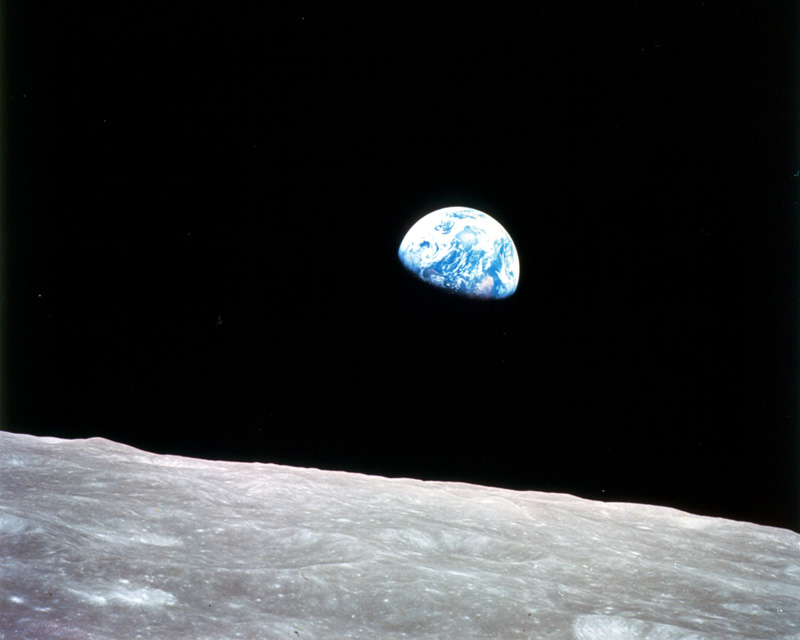
Earthrise by Bill Anders, Dec. 24, 1968

With recent moves to reduce the number of government advisory panels, overturn the Obama administration’s clean power plan, and increase the speed with which logging permits are approved in national forests, the Trump administration plows the field of deregulation in a way libertarians and conservatives could previously only dream about.

They have gone too far.

Even with regard to mitigating the impact of the climate crisis, the fossil fuel industry indicated the world is proceeding on an unsustainable path. According to the BP Statistical Review of World Energy 2019.

There is a growing mismatch between societal demands for action on climate change and the actual pace of progress, with energy demand and carbon emissions growing at their fastest rate for years. The world is on an unsustainable path.

In a special message to the Congress on Feb. 8, 1965, President Lyndon Johnson said,

Air pollution is no longer confined to isolated places. This generation has altered the composition of the atmosphere on a global scale through radioactive materials and a steady increase in carbon dioxide from the burning of fossil fuels.

A group of scientists explained to Johnson that burning fossil fuels could cause climate change, according to Naomi Oreskes and Erik Conway in their 2010 book Merchants of Doubt. “Most thought that changes were far off in the future,” they wrote.

In 2019 we see the effects of climate change in real time. We are living them.

Johnson signed hundreds of conservation and environmental measures during his tenure, developing the strongest record for the environment of any president. In so doing, he laid the legal foundations for how we protect the nation’s land, water and air.

Given time I believe Republicans will destroy the Johnson era legal foundation while their leader is lying to the American people about the quality of our air and water in a way that conflicts with our personal experience.

“We have among the cleanest and sharpest — crystal clean, you’ve heard me say, I want crystal clean — air and water anywhere on Earth,” President Trump said at a June 18 campaign rally in Florida. “Our air and water are the cleanest they’ve ever been by far.”

The science of climate change — that carbon dioxide and other gaseous emissions warm the atmosphere creating the greenhouse effect that enables life on Earth — has never been in doubt. It’s science and as Neil deGrasse Tyson recently said, “When you have an established scientific emergent truth it is true whether or not you believe in it.”

When Trump lies and repeats his lies over and over again, believers and followers will set aside what is in their best interests, what is plainly visible in objective reality, and parrot his words. It creates turbulence in society, an argument about things which there is no arguing, and delays political action that should have been taken years ago. It creates doubt.

Now we have a climate crisis.

Environmental advocates don’t agree on the path to resolving the climate crisis, in fact there are broad divisions. Some favor a carbon fee and dividend as a means of reducing carbon dioxide emissions. Others want geoengineering, a deliberate large-scale intervention in the Earth’s natural systems, to counteract climate change. Others want to keep fossil fuels in the ground and convert our electrical grid to sustainable, renewable electricity generation. Others favor implementing nuclear power as a way to get to zero emissions with electricity generation. There is no agreement about specific strategies and tactics to use.

What remains from the divisions is an elemental truth, we have to do something to mitigate the effects of climate change. While assertions like those of our president and his administration create doubt about the use of political action regarding climate change, doubt no more. We have to do something and soon.

If you’d like to learn more about the climate crisis I recommend David Wallace-Wells recent book The Uninhabitable Earth: Life After Warming. It is a comprehensive look at the diversity of the climate crisis. My advice is read his book then get involved with climate action.

Categories
Living in Society

Marianne Williamson Close to Home

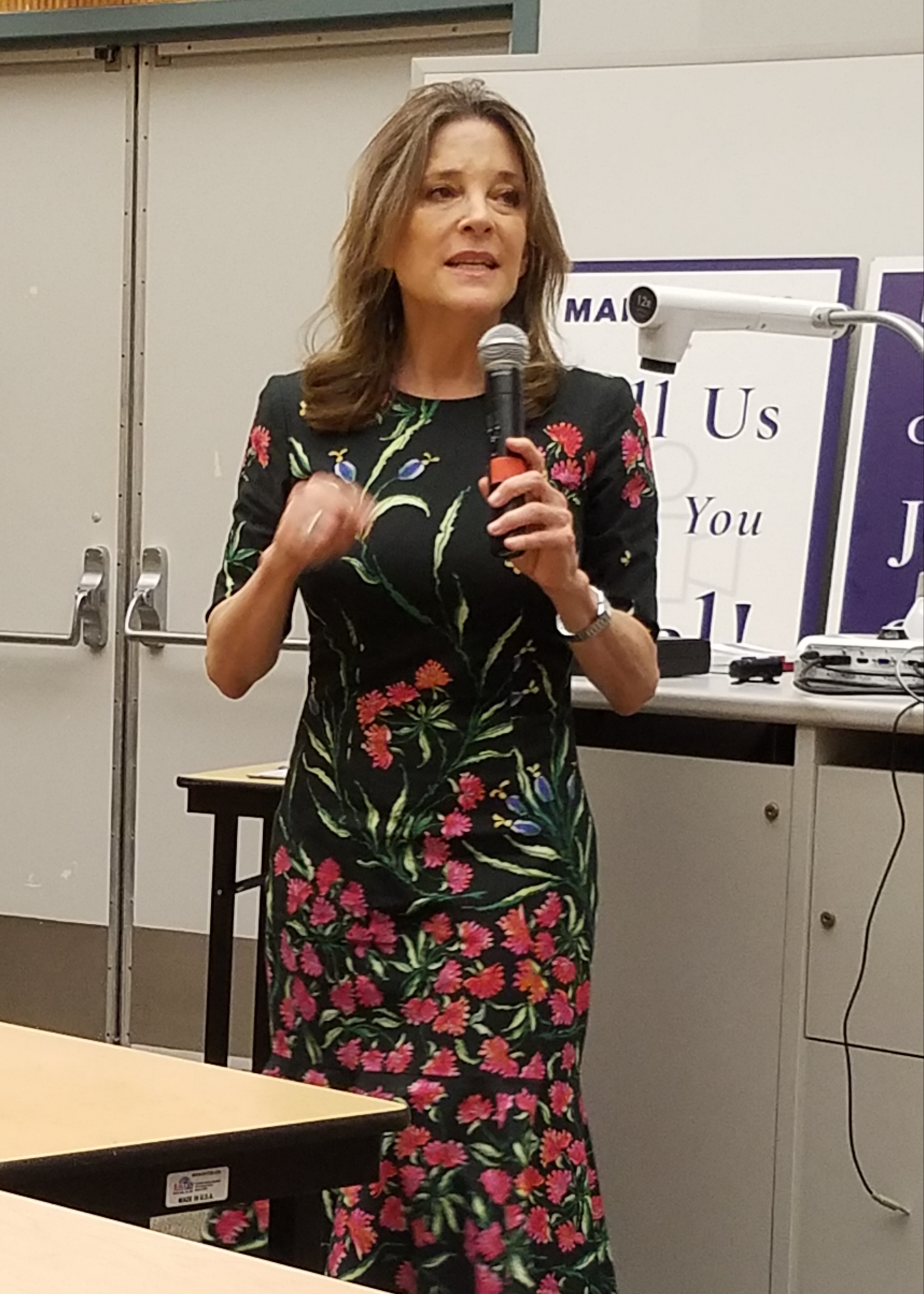
Marianne Williamson addressing a gathering at Kirkwood Community College in Cedar Rapids, Iowa on June 10, 2019.

About 11:15 a.m. I left the garden and drove Ely Blacktop to 76th Street and headed West to Cedar Hall on the main campus of Kirkwood Community College where presidential candidate Marianne Williamson joined State Senator Rob Hogg in a “climate conversation.”

Since I would be returning to the garden after the event, I wore my overalls and mud-caked gardening shoes.

I joined a number of students and staff, along with local members of environmental groups in a large operating theater-style classroom. By the time we got started more than 40 people had joined us.

I attended partly because the venue was close to home, partly to support Senator Hogg’s efforts to engage presidential candidates about climate change, and partly to see if Williamson’s campaign is, as some have called it, a “joke.”

Marianne Williamson taking questions at Kirkwood Community College, June 10, 2019.

Williamson’s campaign is not a joke. Why anyone would criticize a woman who is successful in her own right, by objective standards such as having written four number one New York Times best selling books, had me curious. She made it to the first two Democratic National Committee presidential debates, although just barely achieving one percent support in three separate national polls to qualify. She’s dead serious about her platform and as confident as any of the other 23 presidential candidates. With great optimism she said, “If you’re going to run for president, you might just win.”

The main news out of the event was Williamson did not support a separate DNC debate on the topic of climate change. The reason, she said, was “because there is no competing with Jay Inslee.” Williamson also said the topic cannot be separated from the broader problems in the United States. She made a point. Advocates for addressing the deleterious effects of the climate crisis cannot separate this one issue into a silo separate from other important matters like health care, education and national defense and expect to resolve them.

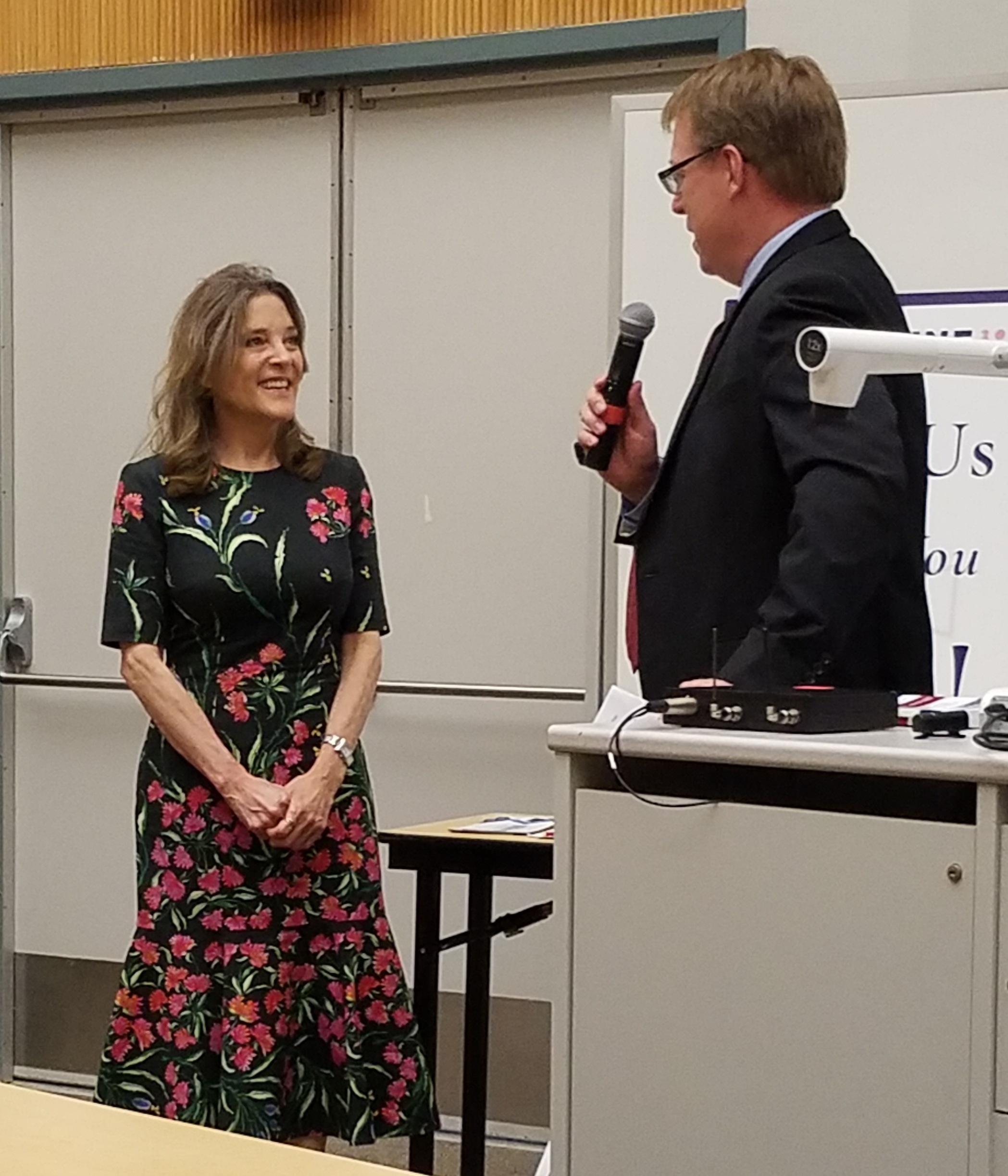
State Senator Rob Hogg explaining why the Iowa caucuses are first in the nation. “We do it right,” he said.

Williamson made a strong case for slowing our relationship with Saudi Arabia. She said as president she would immediately stop arms sales to the kingdom and end United States support for the war in Yemen, a conflict she said was immoral.

She also weighed in on nuclear disarmament, asking why we need 100 aircraft capable of delivering nuclear bombs when dropping ten of them could end life as we know it? It was refreshing to hear a candidate raise the issue without prompting.

Dave Bradley at Blog for Iowa wrote Williamson was positioned in the third tier of candidates, among those “who truly have little chance and are often running to push some ideas or philosophy.”

Marianne Williamson has been finding her way all her adult life. Win or lose, the time spent with her this afternoon was memorable for her determination to assert her solutions her way. As Hogg referred to her speech in Cedar Rapids yesterday, it is the “politics of love” and quite different from the offerings of other candidates.

Neighborhood Network News recorded this event. The YouTube video can be viewed here.

To learn more about Marianne Williamson follow this link to her website.

Categories
Environment Living in Society

Jay Inslee at the Cedar River

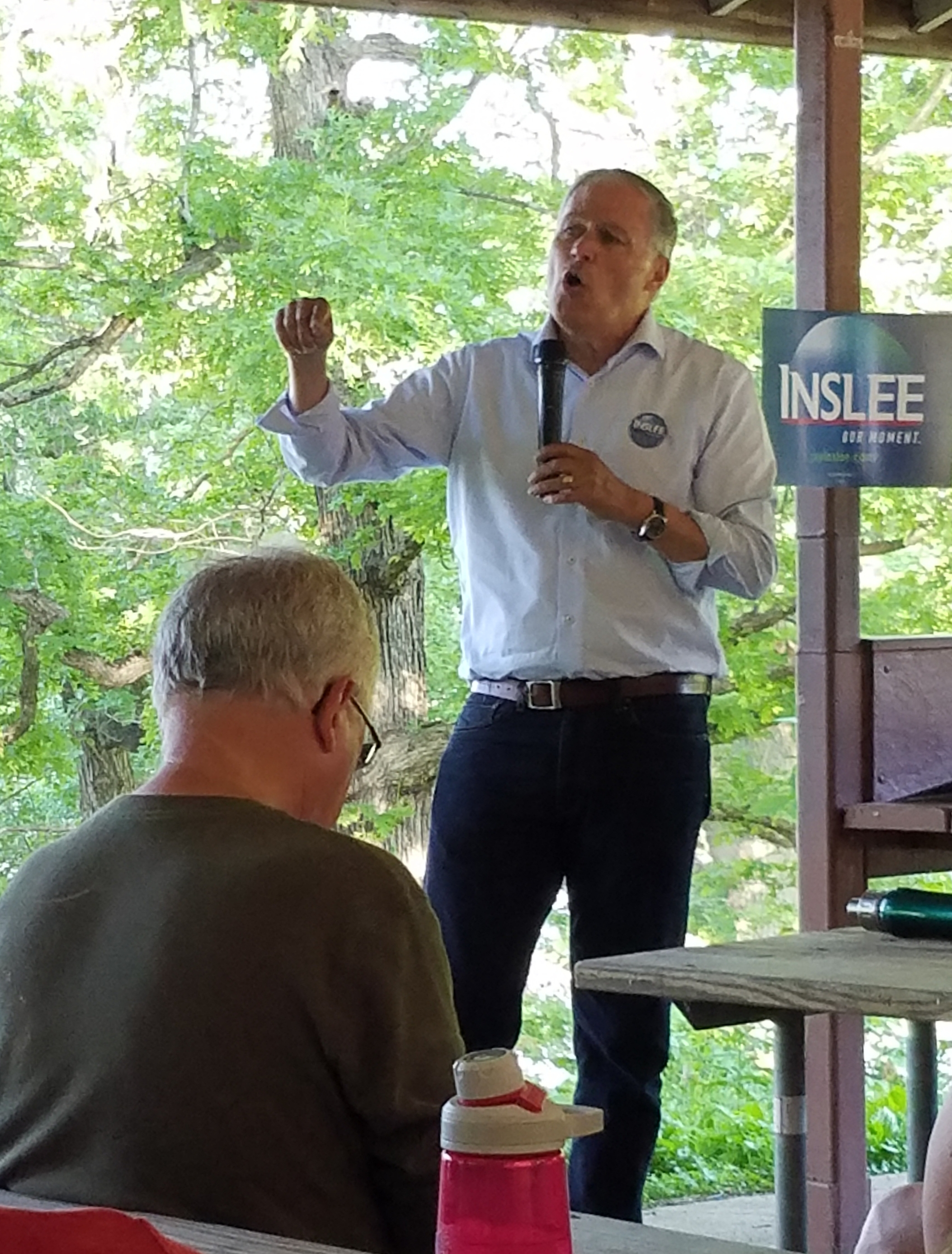
Governor Jay Inslee at Ellis Park in Cedar Rapids, Iowa, June 8, 2019.

CEDAR RAPIDS, Iowa — Saturday afternoon I drove to the Overlook Pavilion in Ellis Park where State Senator Rob Hogg had organized a “climate conversation” with Washington Governor Jay Inslee who is an announced candidate for president.

Hogg reminded us of the 2008 Cedar River flooding. The river was visible behind him.

It is hard to forget the 2008 flood that devastated Iowa’s second largest city. On my way to the event I compared flooding levels of the Atherton Wetland on Ely Blacktop which had been covered with flood water in 2008. From the center of Cedar Rapids I used First Street Southwest, which runs next to the Cedar River, to find the park. On the eastern bank someone had built a flood wall. An earthen berm restricted the view of the river on some parts of First Street. The low-lying area had been inundated in 2008 causing damage to more than 5,000 homes, evacuation of 25,000 people, and roughly $4 billion dollars damage. The flood was made worse by climate change.

In his introductory remarks, Senator Hogg recognized elected officials and organizations present and encouraged the almost 200 attendees to engage in the Iowa caucus process of meeting with presidential candidates. Hogg added later, “with the spirit of citizenship, we can bring Americans together for climate action we so urgently need and the many climate solutions that work.”

Governor Inslee began his remarks with the reason he seeks to defeat climate change, his grandchildren. “We have a moral obligation to the young people of America to defeat climate change,” he said. Noting last week’s atmospheric carbon dioxide concentration was 414.42 ppm (only slightly less than the record (415.70) set May 15), he added, “It is time to act on climate.”

Defeating climate change would be the first priority for an Inslee administration, the governor said. It was a “predicate for success” in all policy areas. If addressing climate change is not job one it won’t get done.

Inslee split from environmental groups like Citizen’s Climate Lobby when he said he did not support a tax on carbon. He favors regulatory reform to reduce carbon emissions. Based on his experience in Washington State, voters are unlikely to accept such a tax, he said.

Inslee asked for help in two areas of his campaign.

While he met the qualifications to participate in the first two debates being hosted by the Democratic National Committee, he has not met the 130,000 donor threshold to participate in the third and fourth. He encouraged those present to donate one dollar or more to his campaign and ask friends and family to do likewise.

Inslee wants the Democratic National Committee to devote one candidate debate to climate change so every participating candidate can lay out their plan to defeat it for voters to see. The request has been rejected, making supporting Inslee the best way to make sure the topic is covered during the debates, he said. Holding a climate change debate outside those sanctioned by DNC is not an option.

“It is the DNC’s job to organize the debate schedule, and the ground rules on unsanctioned debates were made clear with all the candidates, including Governor Inslee, and media partners months ago,” DNC spokesperson Xochitl Hinojosa told Mother Jones. The DNC welcomes candidates to join issue-specific forums instead.

The thrust of the conversation was Inslee has a positive progressive record in Washington State and wants to take that success to Washington, D.C. To learn more about Governor Jay Inslee, visit his website at JayInslee.com.

The Inslee campaign posted video of the event here.

~ Written for Blog for Iowa

Categories
Environment Writing

We’ve Gotten All Climate-Changey

Raindrops on the Driveway

We have a problem with climate change.

I don’t intend to get alarmist on fair readers with dire predictions of the end of the world as we know it. Even though doomsday stories are quite popular, and climate science is, well science, there is another issue.

In our weird, wet spring weather we believe we have climate change figured out. Instead of planting our potatoes on Good Friday, now we’ll plant them in early June as the ground dries out and all will be hunky-dory. That’s a problem.

Science: Around 1850, physicist John Tyndall discovered that carbon dioxide traps heat in our atmosphere, producing the greenhouse effect, which enables all of creation as we know it to live on Earth.

Also science: As greenhouse gas emissions increased after World War II, our atmosphere warmed significantly. A warmer atmosphere holds more water vapor. As we discovered, water vapor laden atmosphere can unleash torrents of rain on Iowa and elsewhere. There’s photographic evidence!

Suddenly we’ve gotten all climate-changey. Every severe weather event is declared to be made worse because of climate change. Maybe it is although the complexity of our climate doesn’t lend itself to such simple statements.

What makes this problematic is in a culture where we appreciate detective work that goes into finding a villain, assigning blame, and making them pay with social shunning or other consequences, there is no single antagonist with climate change. We are all antagonists which makes a pretty boring story.

Iowans may believe climate change brought us a new normal of wet springs. What the science is telling us about climate change is there is no normal as we define the word. The minute we believe we have climate change figured out a new twist should be expected.

It is time to Act on Climate.

~ Published in the June 13, 2019 edition of the Solon Economist

Categories
Environment Kitchen Garden

Garden is Growing

Cherry tomato planting area: Clementine, Taxi, Jasper, White cherry, grape, Matt’s wild cherry

I ran into a couple of neighbors at the well house while receiving a shipment of chlorine for our water treatment plant. They were checking to see if the dehumidifiers had dried out the well pit after the rain. They had.

We got to talking about the wet spring, polar vortex and the weather generally and predicted we’ll be going into drought next. None of us were kidding.

Other than that I spent the day in our yard and garden. I finished planting the fourth of seven plots and have about a third of number five in. As long as the weather holds I’ll keep after it. The soil is a combo of dry and muddy which is the best we can do this spring.

It’s been five days since I left the property with my car. Spiders made a web in the wheel well.

I planted these seeds in the fourth plot on June 3:

Hidatsa Red Beans, Seed Savers Exchange, 80-100 days.
Emerald Okra, Ferry — Morse, 58 days.
Clemson Spineless Okra, Ferry — Morse, 58 days.
Cilantro, Ferry — Morse, 45 days.
Extra Triple Curled Parsley, Ferry — Morse, 70-80 days.
Hercules Main Crop Carrots, Johnny’s Selected Seeds, 65 days.

I’ve never grown okra before, so fingers crossed. For the plant to be productive, once it starts fruiting, pods are to be picked once they are three inches long. Gotta get from seed to plant before I worry too much about that. The two rows of beans are a lot. The main purpose is to increase soil nitrogen for next year… and of course we’ll eat or preserve them. It’s the first time planting red beans for drying and storage. I have seedlings of cilantro and parsley, so this patch is for later on, assuming they germinate. There are never enough carrots.

Monday breakfast of scrambled eggs and sauteed bok choy with spring garlic, topped with green onions (scallions).

I picked the first green onions and used them for breakfast. There is a lot going on outside.

I left some of the volunteer garlic in the ground so we can get scapes. If my garlic stock from last year lasts, I’ll plant them as seed later in the summer to supplement the volunteers.

I inspected the apple trees and they fruited nicely. Apples form clusters of five blossoms which get pollinated if we’re lucky. When the fruit forms and starts tipping up, and the calyx closes, you know there will be a fruit. When we get to this point it is the time to cull the extra or non-productive fruits so the ones left will get decently sized. Because this pollination persisted for so long, I believe nature took care of the culling for me and rejected later pollination because the fruits are nicely spaced on the lower branches. That would be your folk-apple theory.

I’ll have to check in with the chief apple officer at the orchard when I next see him. I hope that’s soon.

Categories
Environment Kitchen Garden

Cooking in the Climate Crisis

Shaved turnip, arugula and bok choy salad.

Ideas about how to cook are ubiquitous. Everyone — family, friends, neighbors, co-workers, chefs, dish washers, dieticians and scientists — has something to say about it. Almost everyone cooks. Talk about cooking can be devilishly engaging. Are there things we can do in our kitchen to mitigate the effects of the climate crisis?

It’s not clear how climate change impacts cooking once we get in the kitchen. We should minimize the use of water, electricity and natural gas while cooking. Many are and everyone should be doing so. Maybe that’s the point. Cooking is so common it’s hard to distinguish one process from another when it come to mitigating the effects of the climate crisis.

We recently lived through a rise in manufacture and consumption of pre-cooked and processed meals and ingredients, increased the amount of food grown closer to home, and changed consumer behavior due to national health scares originating in large farm fields in California, Arizona and Florida. Our collective actions to mitigate the effects of climate change, whether in the kitchen or elsewhere, matter in a time of hegemony of fossil fuels culture. For most, spending time cooking is when we nourish ourselves and practice culture that helps us deal with the complexities of a turbulent world. Cooking helps us focus on what we can control.

Inputs

Inputs set the stage for cooking. The focus is often on where ingredients originate and their environmental cost. That remains important yet I also refer to the framing of our lives in society, including land use, construction practices, kitchen configuration, water sourcing, energy sourcing, and education. All of these are inputs to cooking as they are to how we live our lives.

I’ve written about the importance of sourcing as much food as we can locally. My advice is get to know the face of the farmer where possible, and read the ingredient and nutrition labels on anything else.

If one has space, time and the ability, grow some of your own food. Not only can it taste better, time spent in a garden is enough exercise to avoid a trip to the gym or grocery store. Over our years in Big Grove I’ve developed a kitchen garden where what we eat and cook has become synchronous with seasonally available foods.

A cook includes ingredients grown or made a long distance from home where they offer something unique. Nutmeg and black pepper are examples of spices that serve a vital purpose but are not available locally. When the choice is learn to live without them or accept them for what they are, cooks will choose them as long as they are available. I don’t question that impulse.

Assembling and preparing ingredients on a counter t0 mix, saute, fry, steam, grill or bake them into a meal is fundamental. How much water, electricity and natural gas we use is part of background noise: important but seldom the focus of attention except when we configure our kitchen. Seeking energy efficient appliances and a faucet aerator are basic. Once a kitchen is configured few additional changes seem likely. Many of us don’t have the opportunity to configure a kitchen, especially when living in an apartment.

Simple practices like selection of cookware that retains heat, avoiding long preheating of the oven, keeping the oven door mostly closed while baking, and washing vegetables in a bowl instead of under running water have impacts.

A significant aspect of climate-friendly cooking is buying ingredients in a way that avoids food waste. Have a meal plan and buy only what’s needed for it. Plan to use up what’s in the ice box before it goes rotten when planning meals. These practices should be taught in the K-12 school system.

Our household eschews meat and meat products and has since we married in 1982. I’m an omnivore (just barely) and don’t understand the aversion to going meatless. Production of meat contributes to global warming and even if it is only one “meatless Monday” per week, reduction of meat consumption is basic enough that every household can do something.

Outputs

Cooking in our household is an irregular attempt to make something from ingredients that arrive unevenly over time. Cooking is about output, mostly what we serve for meals from our efforts. It is also about how we use what’s generated from the kitchen, including food waste, food storage and cooking by-products like carrot peels and pasta water.

I am a fan of Tamar Adler’s An Everlasting Meal: Cooking with Economy and Grace. Shortly after I read the book in 2011 I spent time generating the next meal from the previous one as she suggests. Adler presents an example of how cooking can be an efficient process that produces delicious meals. While her book is not about climate change, by being an efficient cook less resources are required and it can be better for the climate as well as our pocketbooks… and taste buds.

Our refuse company picks up weekly but we seldom put both containers at the end of the driveway. We could do better in reducing waste but in the kitchen every scrap leftover from inputs and meal production is put to use. We save leftovers for following meals. When there is excess produce we freeze or can it. Because we have a kitchen garden there is never enough compost so organic material goes into a stainless steel bucket, then out to a household waste composter near the garden. Using the results of kitchen production has become a part of a life that would seem weird if we didn’t do it.

Conclusion

The climate crisis is real, it is happening now, and the potential for global warming to harm us and our society is ever present. Cooking is ubiquitous, and determining ways to cook efficiently and with a smaller carbon footprint is as important as many things we do to mitigate the effects of climate change. It is not everything. It is something.

Categories
Environment

Climate Reality: It’s a Crisis

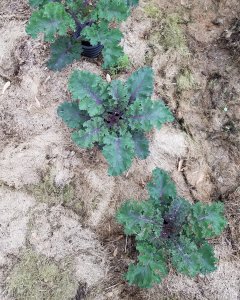
Scarlet Kale in My Garden

On Feb. 19 I submitted a vacation request for today and tomorrow at the home, farm and auto supply store so I could finish planting the garden if I hadn’t already.

Paid vacation is one of several perquisites of working for a mid-sized retail company. Such perks are a reason I linger there, even though I’d rather spend more time at home in my garden and kitchen.

As we now know, planting is behind during what may become the wettest Iowa spring in recorded history. People aren’t freaking out yet. Many I know, including all the farmers, are on edge. A lot is at stake when one’s livelihood is built around planting and growing foodstuffs. Non-farming people feel the oppressive weather as well. The continuing rain is not normal for east-central Iowa. I’m not sure my garden will get planted the way I expected in February when I submitted my vacation request.

Yesterday at Kate’s farm a thunderstorm rolled in and we moved the seeding operation into the barn. One doesn’t want to be inside a metal-framed greenhouse during a lightning strike. At home I left my trays of seedlings outside when I went to work and they survived the storm in good shape. I moved them into the garage as rain started again. There have been a lot of thunderstorms locally, which when combined with the recent polar vortex, heavy snowfall, rapid snow melt and wild temperature swings, indicate this isn’t a one-off weather event.

Around 1850, physicist John Tyndall discovered carbon dioxide traps heat in our atmosphere, producing the greenhouse effect, which enables all of creation as we know it to live on Earth. This and other scientific facts about physics, chemistry and biology are the foundation of analytical models that predict future behavior of the climate and its consequences for humans. As Katharine Hayhoe, an atmospheric scientist and professor of political science at Texas Tech University, posted yesterday in social media, “climate models are (not) some type of statistical random number generator.” The science of the climate crisis is the same science that explains why airplanes fly and stoves heat food. It’s science.

Consider the displeasure with which the administration greeted the Fourth U.S. National Climate Assessment which predicted dire consequences for sentient beings in coming years if greenhouse gas emissions continue the way they have been going. The president’s advisors now seek to change how the assessment is done, arbitrarily shortening the window of concern to a near horizon of 20 years. I’ve never seen an ostrich stick its head in the sand, but this is what it would look like. There is no scientific reason to shorten the horizon for considering the effects of the climate crisis in climate models.

I didn’t know what to expect in 2013 when I attended Al Gore’s training to join the Climate Reality Leadership Corps in Chicago. Among the benefits was by understanding the basic science of global warming it became easier to cope with the crisis unfolding in front of us now.

The reality is climate change is real if we have the education and awareness to understand what we are seeing. It is not only about science. As Carlos Castaneda suggested when a reporter questioned him about discrepancies in his personal history, “To ask me to verify my life by giving you my statistics … is like using science to validate sorcery.” So it is with our politics. Scientific facts do not address the politicization of science to serve interests that are indefensible in light of our commonality.

Mother Nature has been the victim of humans living on Earth, of that there is no question. Brutalized and violated, who can mend her broken body? I don’t know if it’s possible, there is no Denis Mukwege for her unless it can be all of us together. Who am I kidding?

The sun is rising after the latest thunderstorm moved on toward the Great Lakes. I’ll put seedlings outside again and hope for a break in the weather long enough to work the soil. While farmers need a good week of dry weather to get crops in the ground, I can make do with less.

I feel good about today but then I am human. Most of us can’t see but six inches beyond our nose, try though we might. To sustain our lives we must do a better job of living now while working toward a better future — despite the setbacks of our politics. What choice do we have?