Daylight remained as I drove into the driveway after a shift at the orchard.
If the garden appeared scorched by the previous night’s first frost, some tomato plants survived and the kale looked resilient.
The weather forecast is a couple of days without rain. I scheduled garlic planting for Tuesday when the ground should be dry enough. Fingers crossed I get a crop in this year.
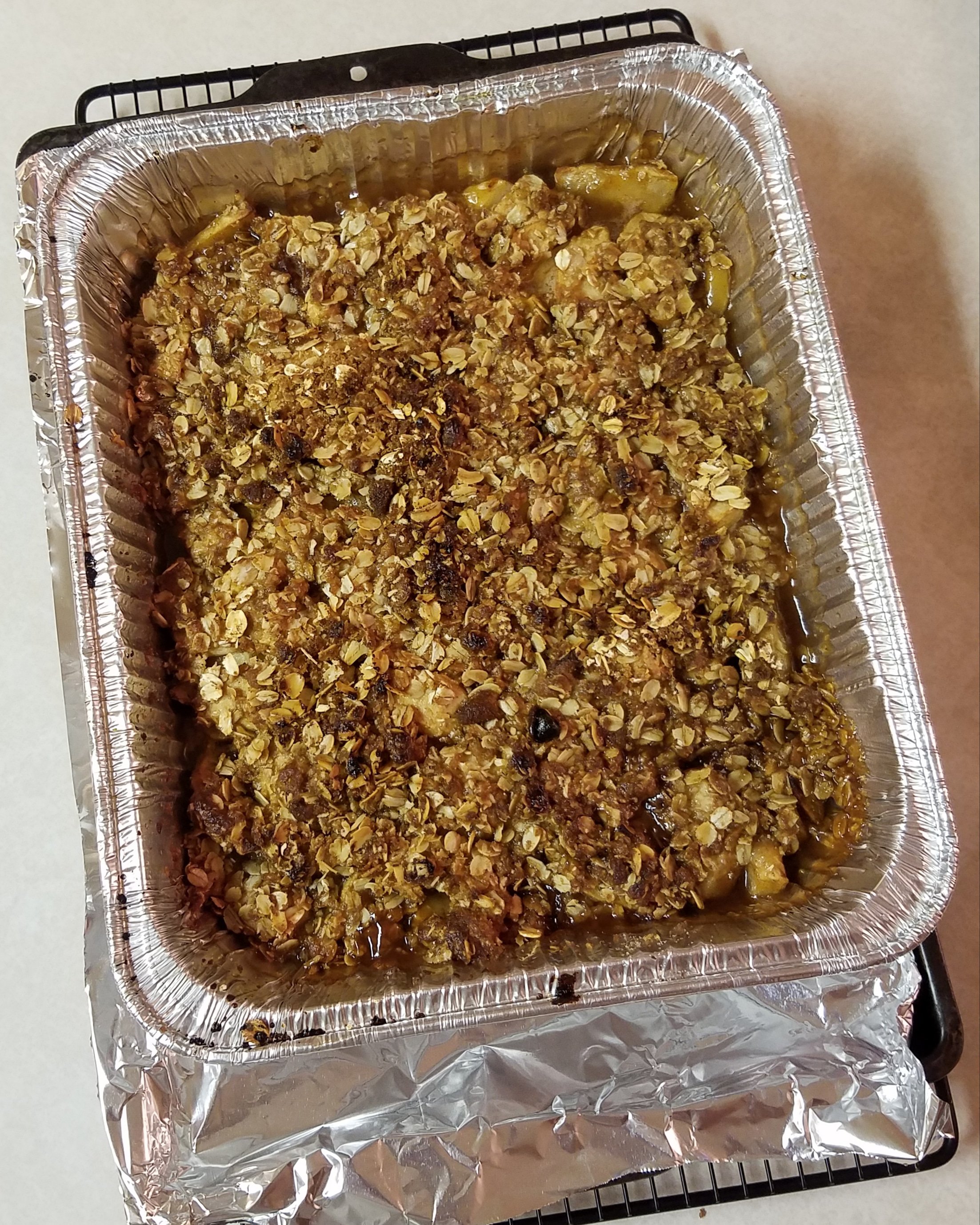
I picked another bushel of fully ripened Red Delicious apples yesterday morning. This morning I used apples knocked down and damaged during the picking process to make an apple crisp for the county party’s fall fundraiser. In September I bought 30 aluminum food service trays for potlucks. This was the fifth one used.
We were busy at the orchard Saturday. Because of rainy weekends there is a pent up demand for the u-pick apple experience. I was tired at the end of my shift. I fixed eggplant Parmesan for dinner and could go no further. I was so tired I left the dishes to clean this morning. If there was any doubt, autumn has definitely arrived.
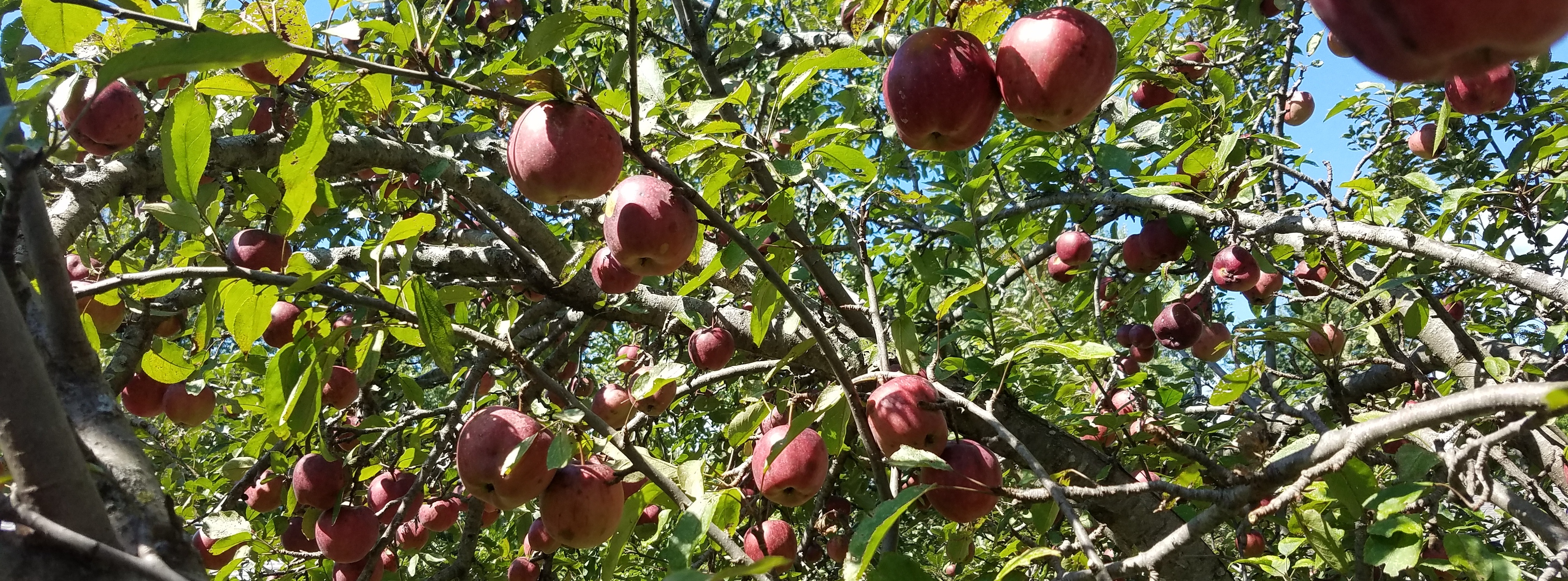
I picked low-hanging fruit from the Red Delicious apple tree last week. All that’s left is dangling red orbs high above the reach of my 20-foot ladder plus 10-foot picker.
Most of those apples will fall to the ground for deer and wildlife food.
I blame the nursery person who grafted this supposed “semi-dwarf” cultivar on the root stock. Either something was wrong from the git-go or the cultivar grew around the root stock and made it’s own roots in its 24 years since planting. The tree has produced in abundance — an investment that repaid itself many times over. I’m happy with the hundreds of pounds of apples I was able to harvest this year, even if I couldn’t reach every one of them.
It rained all day Saturday so I stayed home from the orchard. When touching base with my supervisor mid-morning, more staff than customers were in the sales barn. I used the day for house work, cleaning the kitchen, doing laundry, organizing recycling, processing the last batch of tomato sauce, cooking reading and writing. I also took a nap.
The rain is suppressing my orchard paycheck with take home pay down 30 percent compared to last year. Nonetheless, with good health, Social Security, and my spouse’s small pension we are doing alright financially. I can spend some of the apple money on books and political work.
Friday a copy of What I Stand On: The Collected Essays of Wendell Berry 1969-2017 arrived via letter carrier. It will make excellent winter reading.
This week I purchased some items for our political organizing office in the county seat: paper towels, trash bags, paper cups and the like. I baked a large apple crisp which was used at yesterday’s volunteer training. I also contributed to Brad Kunkel’s campaign. He’s running for Johnson County Sheriff in a contested primary next June and is purchasing his “cowboy cards” this week. These are reasons we work an extra job even if the weather keeps the amount down.
A neighbor is hosting 2020 presidential candidate Rep. Tulsi Gabbard next week, so I offered baked goods with apples for the event. I noticed one of the school board candidates will be in attendance. I support Elizabeth Warren, but I’m going because that’s what neighboring means.
With cooler overnight temperatures, the season is turning to fall in earnest. Soon I’ll glean the garden and prepare a bed for garlic planting. If it ever dries out I’ll collect grass clippings for mulch next year. I see a brush fire in the works to return the dead fuel of plants and trees to minerals for next year’s garden.
October is looking to be busy so I have to be organized, which is no hill for a climber. If only I could climb up and get those last dangling apples. The third month of apple season is another part of sustaining a life in a turbulent world.
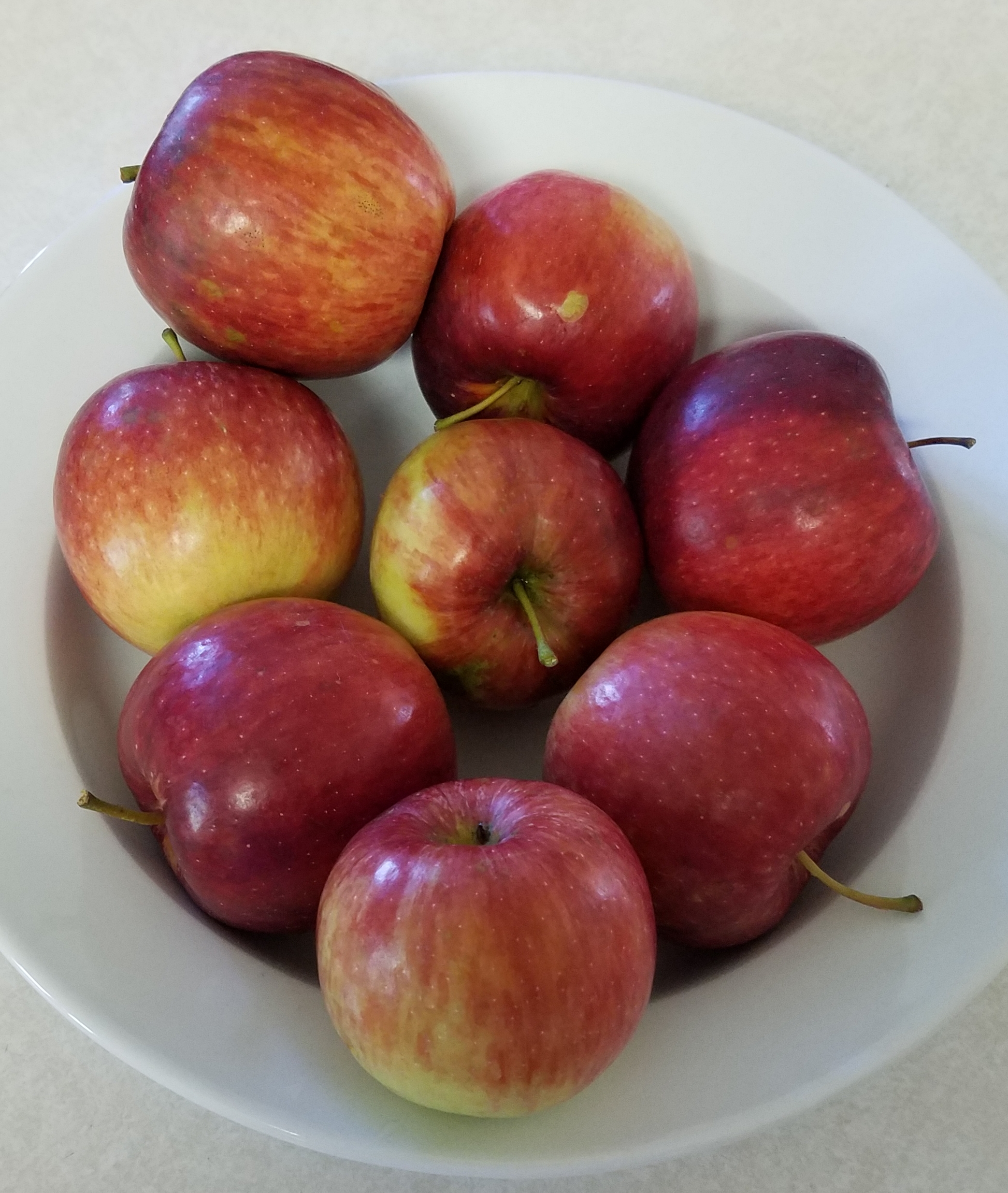
Cart of Red Delicious apples harvested Sept. 30, 2019.
(Editor’s Note: This year I donated 350 pounds of Red Delicious apples to Local Harvest CSA for distribution in member shares. Here’s the note I wrote for weekly newsletter).
The apples in your share are Red Delicious variety grown from a tree planted on Earth Day 1995 by Paul Deaton in Big Grove Township.
Back yard apples are maligned for a couple of unjust reasons.
First, the State of Washington about ruined the Red Delicious, which was first discovered in Iowa, where it was called the Hawkeye by some. Growers in Washington decided this apple was the way to go because of its marketability. They went all in and devised techniques that took the flavor right out of the fruit, including picking before they were ripe, then “ripening” them in a chamber of ethylene gas before shipping. Applying science to the Red Delicious about ruined it and gave it a bad name.
Second, backyard apples have developed a number of “reasons” why people don’t want to cultivate them. If someone has an apple tree they inherited, they may make up a hundred excuses not to prune and take care of it. While these apples aren’t perfect, get a knife out, cut off the bad spots, and they make good eating if fully ripe. They make other fall apple things like crisps, cobblers, sauce, butter and dried apples.
Let’s face it, when Johnny Appleseed, born in 1774, came across the country he had one thing in mind as he planted apples by seed: enabling future settlers to make hard cider. Although the technique is making a comeback, many city-dwellers have forgotten that piece of apple lore. As long as the apple isn’t rotten, it can go into cider (press or many use a juicer for small batches) from which one can make vinegar, sweet cider or hard cider. If one is concerned about bacteria, get your cooking thermometer out and heat the cider thoroughly to about 165 degrees for ten seconds. It will kill the bad bugs and leave most of the flavor.
Monday I began harvesting Red Delicious apples from a tree planted on Earth Day 1995. This tree outlasted three others planted the same day.
Tuesday I completed a 350 pound donation to Local Harvest CSA, which has been my go-to outlet when there is an apple abundance. I kept three crates for the kitchen and many apples remain on the tree. Naturally, the best apples are furthest up and hardest to get. They don’t seem to be dropping like Earliblaze did so there is a chance to pick more… a lot more.
The question is always the same: what to do with the abundance? In the past I felt it important to use every apple possible. As a result of such compulsive cookery the pantry is well stocked with canned apple sauce and apple butter. I may can a batch of seven quarts of applesauce this year to refresh the stock rotation, but don’t really need it. With my current concerns about blood glucose levels, applesauce isn’t a go-to option for dessert even if I enjoy it.
Baked goods is an option. 2019 is busier than most years in politics so there are plenty of outlets for apple crisp, applesauce cakes and apple pies, including the county party’s annual fall fundraising barbecue. I can’t make it to the barbecue because of my work schedule but I’ll send in desserts for 24 or 36 people. I’ll also send an apple crisp to the Elizabeth Warren office in the county seat. We don’t eat much in this category, but at least one apple crisp will be for us as well as a celebratory applesauce cake.
This year I plan to dry more apples than usual. As a snack, dried apples are very sweet and something different. I have an old Ronco dehydrator purchased for a buck at a yard sale. It can dry a batch in a day or two.
I offered free apples to neighbors on our private Facebook page. I’ll fill any orders that come in on Friday. I’ll share with folks in town if they ask.
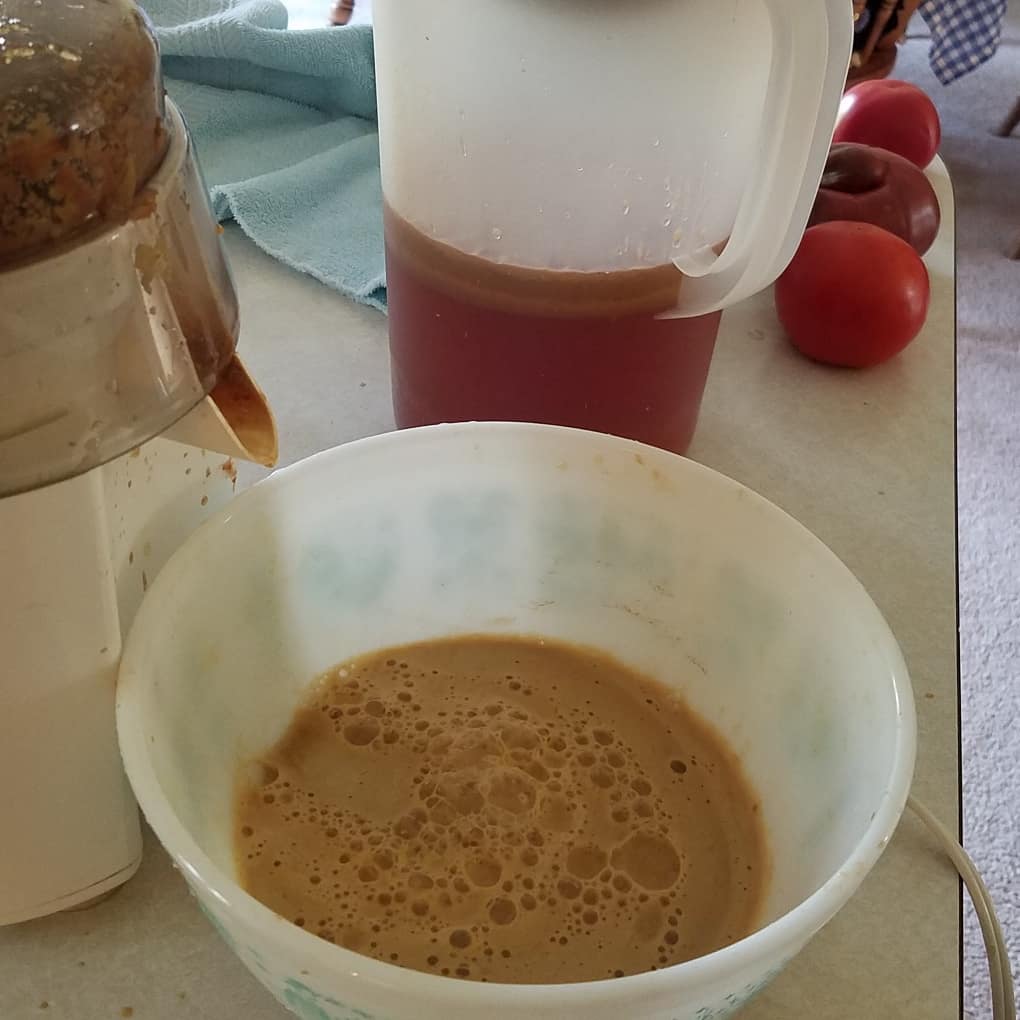
The bumper crop makes me wish we had a cider press. I’ll produce about two gallons of apple juice for additional apple cider vinegar making, but that work with a household juicer is too labor intensive to process all the apples. Maybe I can process a batch of seven quarts of sweet cider for special occasions.
When Johnny Appleseed planted his orchards, he did it for hard cider for settlers. My fermentation is to the vinegar stage, and for now I stay away from the hard stuff. That is, unless a gallon jug sits in the ice box too long and begins conversion of sugar to alcohol on its own. I’ll drink that. I’ve gotten to a place where I prepare our salad dressings using vinegar made in our pantry.
Living an apple life is pretty good. Maybe as good as it gets. It is work — the joyful kind. Thus far I’m nimble enough to scale the ladder and take in in the view for a moment before picking fruit. Apples are a way of dealing with life’s problems and an opportunity for self-improvement. I believe I’ll plant more trees next spring.
My Saturday and Sunday shifts at the orchard were cancelled because of almost continuous thunderstorms during the weekend.
I’ll miss the income, although will get by.
Saturday I canned the next batch of tomatoes. With the pantry containing 24 quarts of whole and diced, 24 quarts of tomato water and 48 pints of whole and diced, there should be enough to last all of 2020 and then some. I didn’t mention the quart bags of tomato sauce in the freezer… or the four dozen fresh on the counter… or the next wave ready for harvest. We’re good on tomatoes.
Sunday was a punk day. To get out of the house and take my daily exercise I returned to the orchard and picked the apples in the photo… in the rain… wearing the wax jacket I bought in Stratford, Ontario during one of our summer trips when our daughter was in high school. The wax jacket worked as far as keeping the rain off goes. The plastic lining made it too hot for humans by the time I returned to the sales barn to pay for my apples. I lost count of how many varieties of apples I tried thus far this season, maybe two dozen. The Robinette and Alvin Gilliam’s Seedling were astoundingly flavorful. It would be tough for me to return to supermarket apples.
Every once in a while we are reminded of how little we actually know about our daily lives. While it rained I made it halfway through Michael W. Twitty’s book The Cooking Gene: A Journey Through African American Culinary History in the Old South. It is one of few books I know like it. Twitty presents expository words about his genetic history and how that influenced the culture of slavery from a culinary perspective. He brings together something worth studying if interested at all in the local food movement.
There is a lot in the book. Although I don’t consume much meat and no fish or seafood, I’ve been thinking about my approach to growing and cooking since I started the book. Twitty provides new insight into the idea of a kitchen garden and using food that’s found or produced locally. There is a lot of discussion of greens, the liquid they are cooked in, and staples like corn, rice and root vegetables. I consider my own culinary practices and it’s a hodge-podge of dishes, techniques and ingredients rather than something coherent as Twitty recounts.
Culinary times have changed since the 17th and 18th century through increased urbanization. If everyone that lives in the nearby cities of Cedar Rapids and Iowa City trekked out to the country to forage nuts, wild plants, fish and game on a subsistence basis, the land would soon be stripped clean. That’s not to mention land in private ownership with prime foraging areas and posted no trespassing signs. In that sense, only a small percentage of the population can return to that lifestyle. When the oceans are over-fished, and marine ecosystems are collapsing there is no reason to consume more fish and seafood. When poring over a menu that contains sushi, I shake my head and end up explaining to diners at my table why it shouldn’t be consumed. It doesn’t always go over well.
At the same time there is an ecology of food. If the cultural elements have changed, the instinctual behavior hasn’t. There’s a lot to learn and think about in The Cooking Gene. That’s part of why we read books.
Next I need another walk near the lake or through the orchard to let the ideas ferment. Only then will I see whether it is fleeting enthusiasm or something from which to make structural changes in my kitchen garden.
Left to right: Kidd’s Orange Red, Frostbite, Arlet, Robinette apples
We’re in the main season at the apple orchard.
We survived the madness of Honeycrisp weekend and can settle into some really great fruit like the four varieties of apples in the photo.
The Robinette was complexly flavored and super-delicious. That’s no apple joke.
The last two days of summer bring a lot of work. There are tomatoes to process, apples to pick, and a garden plot to prepare for garlic planting in a couple of weeks. The lawn is ready for grass collection once it dries out from the rain. Today thunderstorms are forecast so my shift at the orchard is doubtful. Outside work at home is also a bit dicey. Once the orchard shift is decided, I’ll plan the rest of the day.
Yesterday I took a quart or so of the small potatoes, cleaned and trimmed them, and put them into the slow cooker. I added carrots, onions, celery, some vegetable broth and a generous quart of tomato water to cover. By the time I returned from my shift at the orchard, it was ready to eat and so good. There are leftovers, including plenty of broth with which to start another batch of something.
I’ve been taste-testing Red Delicious apples for almost a month. The starchiness has passed and they are turning sweet. Not ready, yet close enough to start talking about containers in which to put the 350 pounds to be donated to a CSA. After that I have plenty of takers for what I don’t use in our kitchen. I plan two gallons of apple cider vinegar, a couple of gallon bags of dried apples for snacks, and a dessert for the county political party barbecue coming up next month. Will store as many as will fit in the ice box for later fresh eating. This variety is staying on the tree well, so there should be plenty.
Politics is taking more of my time. Yesterday I did a walk-through with the Solon School District to see if a facility would work for the February precinct caucus. It will. On Thursday I attended a town hall meeting with Elizabeth Warren in the county seat. The report was she stayed until 11 p.m. to meet everyone who wanted to meet her individually. Yesterday I introduced our newest Warren organizer to our local coffee shop and provided a couple of upcoming events to get on her radar. While I work on weekends until the end of apple season, the 2020 election is already ramping up.
We make a choice in life: engage in what’s good in society and work to make it better, or withdraw into our own family and lock the door against intrusions. When we enter the main season, it’s less of a choice. If we don’t work to make our lives better, there’s no one else who will.
Monday afternoons my spouse and I devote time to organizing the household, reducing clutter, and cleaning.
It’s a long-term project we do together. We schedule it on the calendar. Sometimes it means working together on a household issue. Sometimes it means moving boxes and furniture. It definitely means cleaning. Yesterday I spent an hour shredding personal papers. There’s is a lot to do.
We each have reasons for the project. Mine is to eliminate belongings accumulated in 67 years so when I’m gone those left don’t have to deal with them. In particular, I don’t want our daughter to have to spend weeks doing work I should have done. I also want a more comfortable place to live.
The project conflicts with my desire to produce new work. Yet a few hours a week won’t kill me as I slow down into retirement. As the work gets organized, there is a lot to like about it. Now or never is the time to consider all this stuff.
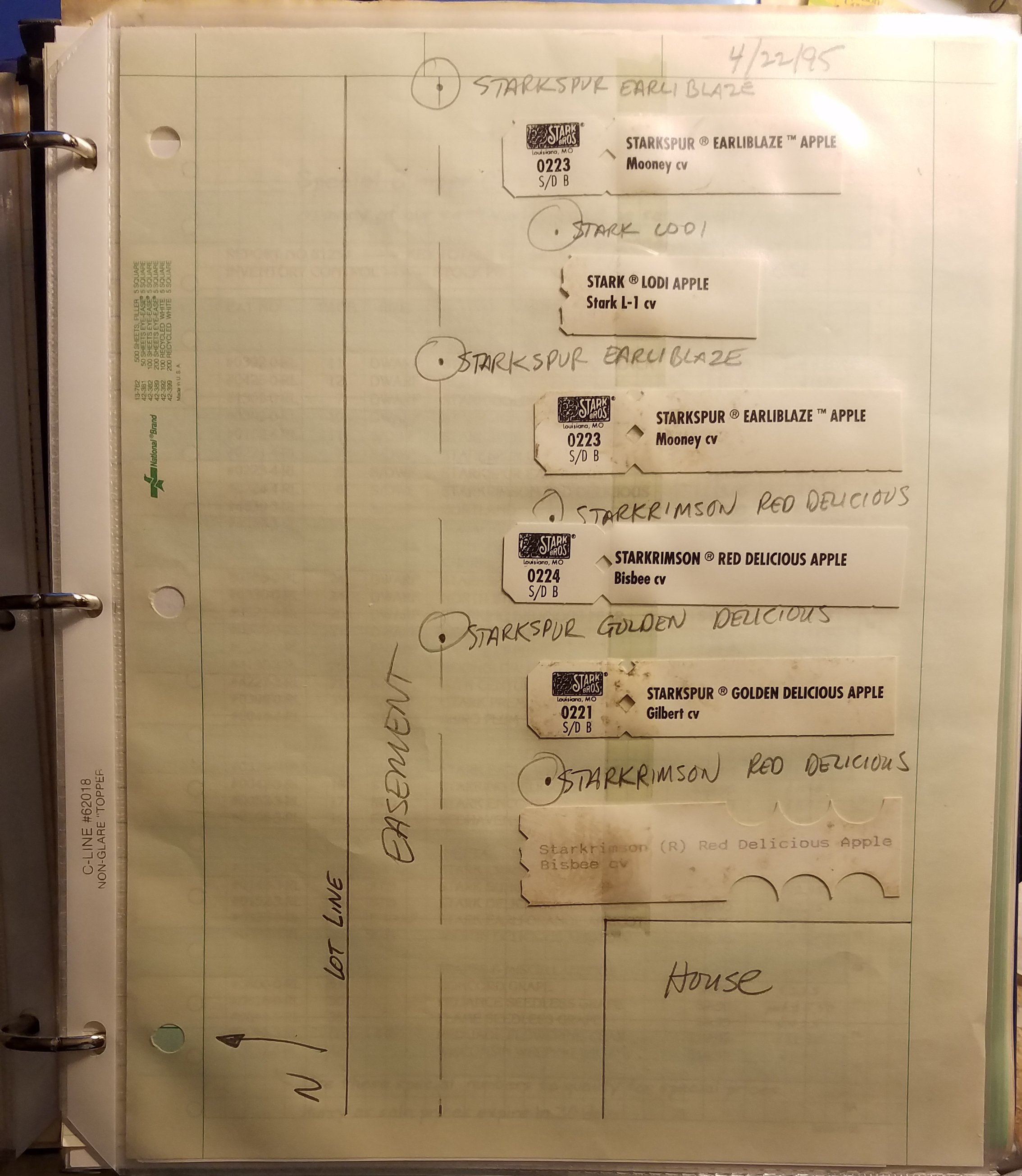
1995 Apple Tree Planting Record
Among recent findings was the planting record for our grove of fruit trees. Planted on April 22, 1995, I began with six varieties of trees, which over the years has been reduced to three: one Red Delicious and two Earliblaze apple trees.
Yesterday I ordered two new apple trees: one Zestar! and one Crimson Crisp. I’ll take out one of the Earliblaze trees and increase the distance between plantings. The idea is to get a succession of ripening fruit — the same thing I originally intended. The new ripening order will be Zestar!, Earliblaze, Crimson Crisp, then Red Delicious. I plan to plant one or two Gold Rush Trees, but the nursery is sold out this year. Gold Rush is a late apple that stores exceptionally well. Planting trees is a longer term commitment than a couple of seasons so I don’t mind waiting until 2021 for those.
I know more about apples today than I did when we moved to Big Grove. That’s mostly due to working at a local orchard during apple season. It changed how we view them dramatically, introducing new flavors and varieties. Whatever apples we have in our home orchard, we’ll supplement them with other local fruit. I probably think about apples more than most people.
If I were to tell my story, the seven seasons of working on farms and at the orchard would be part of it. Not only is the work a source of food, it is about culture and learning. It is about integrating our kitchen with an ecology of food that includes fewer items from the grocery store and more I grow or have a hand in growing.
Producing a crop of apples is a sign of something. To begin with, it is a long-term commitment to growing. The rest is about how the trees are cultivated and apples are used. If all I did was make hard cider with them, that would be something. I want more from life than that. I’m in it for the long haul.
I want to write a nice summary of this year’s garden including successes, failures and lessons learned.
Instead of crafting something usable, I visited two of the farms where I work.
Knowledge lives within us more than in written words. Life doesn’t always proceed in a linear manner despite predictable changes in season.
Yesterday was about dealing with the abundance of Red Delicious apples ripening on the tree. I plan to give excess — about 350 pounds — to my friend Carmen for the winter share in her CSA.
At the orchard we did a taste test: the apples were too starchy. Then to Sundog Farm where we discussed how much for each share and a process for delivery once they ripen. I think we are set.
Over the years I’ve been able to develop a network of master gardeners, farmers and growers to provide feedback on what happens in our garden. I am a better gardener because of this work. I’ve come a long way since getting started with the process in 2013.
Two things added a unique layer to summer gardening: my spouse’s five-week trip to her sister’s home in July, and the 26-day interim between Mother’s death Aug. 15 and her funeral Monday. Both were unexpected and made a unique mental frame for what was already a weird gardening season.
While Carmen and I walked about her farm she showed off her lettuce patch in a high tunnel, and the abundance of tomatoes a crew was harvesting. We had a conversation about diversification. This year was a big tomato year for both of us, although that’s not been the case for everyone. We planted many varieties of tomatoes and while she has members to take the excess, my canning, freezing and eating has physical limits which will soon be reached.
I moved the cherry tomatoes to their own patch this year and it’s a better idea. They are all good, but my favorites were Jasper, Matt’s Wild Cherry and white cherry. I planted two rows of four plants and next year I will only plant one row to make it easier to harvest.
Among my trials this year were okra (easy to grow and a little goes a long way in our kitchen), Guajillo chilies (if they ripen well I’ll get a crop for making pepper sauce for tacos), Poblano chilies (did not produce much), red beans (I mistook pole beans for bush beans so they had trouble), and planting beets in flats before transplanting them to the ground (produced much better beets than sown seeds). I planted two types of broccoli in succession, but the second variety (Imperial) didn’t produce.
We had basil, parsley and cilantro in abundance. Basil goes into tomato dishes and parsley and cilantro are for eating fresh. Fresh cilantro is an important addition to tacos. I made a good amount of basil pesto and froze it. Even with lots of uses for basil, I let the second raft of plants go to seed because there was too much.
If there was a single most important lesson in gardening this year, it was to better tune what I grow to our cuisine. I’m not exactly sure what that means but Carmen and I discussed and agreed that is important for a gardener. As our family cuisine makes a transition, this will gain relevance when planning next year’s garden.
So that’s the story of the 2019 garden, which isn’t done.
When we moved to Big Grove Township we had expectations about building a life here. These expectations spoke to our shared culture.
We built a new home, settled into the public school community and began getting to know people as I worked a career that would eventually take me to a job in Eldridge, Iowa where I managed a dedicated fleet operation for a large steel service company. At the time I thought the 55-minute drive was a reasonable commute.
While there, in a staff meeting, news of the planes hitting the World Trade Center and the Pentagon, and crashing in a field in Somerset County, Pennsylvania began to emerge. I was scheduled to fly to Philadelphia that morning but the flight would be delayed. That day became part of an American cultural heritage.
The events of Sept. 11, 2001 were an opportunity for the country to pull together, to unite in shared values. It was squandered by our national leaders who used the terrorist attacks as sufficient reason to invade Iraq. Our disdain for the national culture has increased since then.
Participating in a national culture is made worse by growing income and wealth inequality. If comparisons of modern capitalism with the Gilded Age and the rise of Rockefeller, Morgan, Vanderbilt, Carnegie and others is apples to oranges, Republican leadership of the U.S. government is systematically undoing every constraint on wealth and business implemented since the 1890 Sherman Antitrust Act. This is intentional, and under a government subject to the unlimited financial contributions of businesses. In part, we can thank the U.S. Supreme Court decision in Citizens United v. FEC for unleashing the power of the wealthy in our governance.
Not only do we view the rise of the wealthy into power over our lives with disdain, we spend more time thinking about it because of new media available to us 24/7. We tend to forget our local culture, the culture we share with family, friends and neighbors — things that are shared, yet personal to us.
Mom’s funeral on Monday started an immersion into cultures I forgot existed. Greeting people from every part of Mom’s life at the visitation taxed my ability to remember. I don’t believe I come up short. At the Knights of Columbus Hall after interment I sat with three of my cousins and talked about things I’d forgotten existed. Aunt Wini’s wringer washing machine, Orsinger’s ice cream, Uncle Vince’s photography culture, Chicago steel mill culture, and more. I was able to keep up even though it has been years since I’d seen any of them. I could keep up because it is our shared culture.
Yesterday I took the crate of apples from the summer trees in our backyard and made a gallon of apple cider vinegar. By this morning the brewers yeast was working. After skimming the scum, I put the two half gallon jars on the pantry shelf to ferment. I got the mother of vinegar from a neighbor. His family had been making vinegar with it since the 19th century. The distribution of our vinegar is in a short radius with most of it used in our kitchen. I’d be willing to bet I’m one of a very small number of people fermenting vinegar in our township.
The point is we have shared cultures and the only way they exist, now and into the future, is by participating in them. The sad occasion of Mom’s passing was made better by the celebration of her life by the living. Our cuisine is made better by making our own vinegar for pickles and salad dressings. Eventually our national culture will regain its value but we are not there yet.
We chose this township based on the logistics of living. To make it meaningful we’ve had to participate in local cultures. As bad as the national culture is now, we can’t stop participating because so much is at stake. What happens near the lake ripples throughout society. If enough people engage, that could be life-changing for us, and for us all.
A main feature of the vacant lot we bought in 1993 was its proximity to Lake Macbride State Park.
When we need exercise, or just want to get away from the house, it’s a short walk to the trail that runs five miles from our nearby city to the main park entrance. In August the park is filled with wildflowers, insects and other flora and fauna of living in Iowa. There is as much to observe as there is to escape in quotidian life.
A trail walk can reset our lives each time we venture out.
Two weekends into my seventh season at an apple orchard I continue to enjoy the work and its customer engagement.
A family drove over from Chicago, one stopped on their way back to Rochester, Minn., and regulars return with the micro-seasons within a procession of a hundred apple varieties. Every chance we have to converse is a window into lives where with at least one common interest. It is the beginning of something positive.
A trail walk can get us centered and ready for such engagement.






 Journey Home
You must be logged in to post a comment.