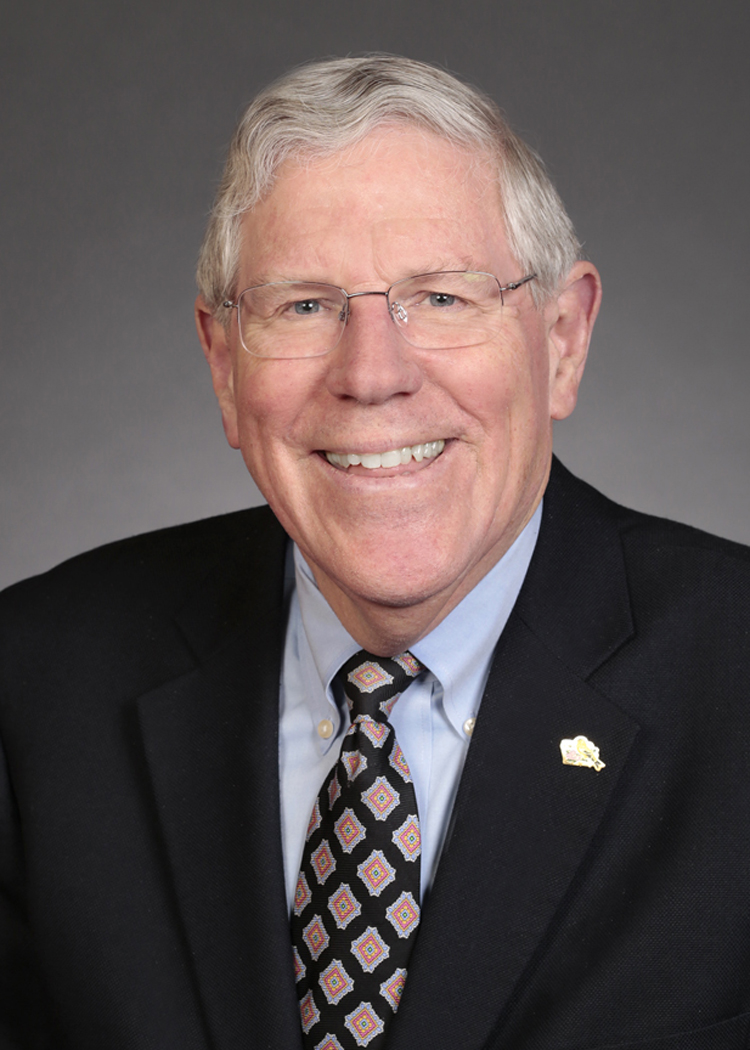
State Senator Robert Dvorsky Photo Credit – Iowa Legislature
State Senator Bob Dvorsky’s decision to retire at the end of his current term hits close to home for a lot of reasons.
He represented our family since we returned to Iowa in 1993. During the time since then he became a key player in Democratic politics and in the Iowa Legislature.
He did a lot for Iowans when Democrats held the majority in the Iowa Senate. He also worked to get things done regardless of which political party was in control.
With Bob Dvorsky in office, politics became personal in a way it hadn’t been before.
I began corresponding with him on issues shortly after he was elected to the Iowa Senate. My last letter from him, a response about the no wake issue on Lake Macbride, was dated April 25, 1996. A few years later I became politically active again and saw him everywhere, eliminating the need to write.
During the decades I’ve known him, I can’t recall a single time Bob didn’t seek me out for a brief conversation, whether at the capitol, at a political event, or at my workplace. He knew the owners of the company where I spent most of my transportation career, and after my retirement we encountered each other at the warehouse club where I worked part time. He was always positive and encouraging.
When people say all politics is local, I think of Bob Dvorsky. He’s been a friend and mentor who represented my interests in the legislature. I wish him well in the second half of the 87th Iowa General Assembly and ever after.
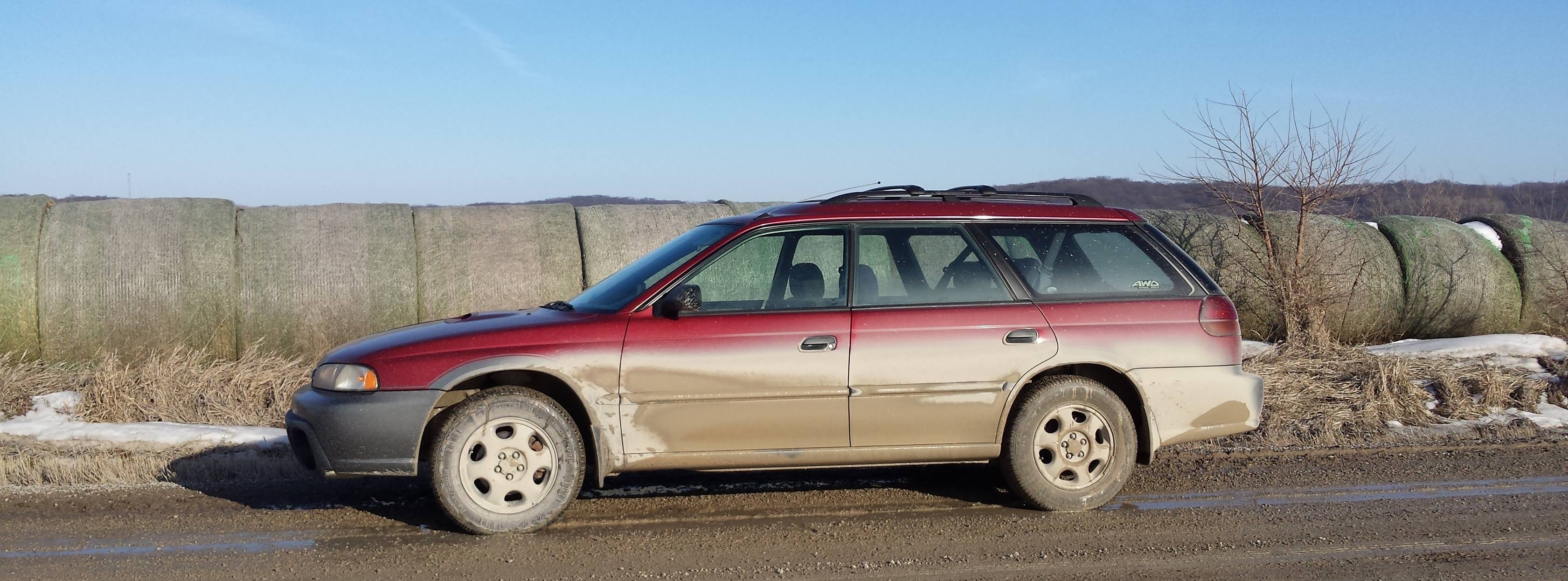
One of my work buddies is a mechanic and Vietnam veteran. He was a mechanic during the war although it’s his brother who now operates an auto shop in the county seat. He is active in the American Legion and has a reputation as a curmudgeon. I find myself pointing out I’m older than he is, although I defer to him because of his veteran status. He drives a vehicle similar to my 1997 Subaru.
Transportation is important when working for low wages. The idea of buying a new car — straight from the dealer — is a fantasy reserved for immediately after buying a winning lottery ticket or hitting it big on Bitcoin futures speculation. The chances of doing any of them are minuscule. When someone gets a new car it means nicer and newer than the previous one. My colleagues at the home, farm and auto supply store favor used cars that work and one or another of our collective vehicles is always acting up. We help each other with rides, loaner cars and jump starts without questioning it.
Essential to life with an old car is knowing a good mechanic, “good” being the hard part. Finding one means slogging through abundant folklore, experiences and stories of wrench turners to identify someone gifted at diagnosis with an approach that produces excellent results inexpensively. Being a good mechanic includes willingness to work on an old car, knowledge about the model, and doing what’s needed to keep it running and nothing more.
Acknowledging the importance of diagnosing automotive problems, three groups of mechanics took medical-sounding names for their automotive businesses in the small city near where I live. There’s an auto clinic, auto medics, and an ag clinic. Proper diagnoses are important and good mechanics are possessed of the knowledge, resources and skills to make them. I don’t normally use my curmudgeonly Vietnam veteran friend as my mechanic, even though he would likely work on my car for free.
A while back my Subaru began intermittently overheating. I took it to my mechanic and after several diagnostic attempts we figured a leaking head gasket caused the problem. We weren’t sure, but were sure enough to give it a try. If a dealer were to replace a head gasket in my car, the book calls for pulling the engine because of the configuration of the engine compartment. My mechanic saved me 10 hours labor by replacing the head gasket with the engine in the chassis. He understood ten hours labor made a big difference in our budget.
Recently the electrical system went on the fritz and I suspected the battery was going bad.
Troubleshooting began by asking people I know. My Vietnam veteran friend checked the battery and results of the computerized test he ran showed it to be okay. It wasn’t, but I took his word it was and tried charging the car each night in the garage. The issue did not resolve and repeated charging may have made the battery worse.
I called my regular mechanic, whose schedule was packed, and got an appointment for the following week. When my spouse was not working I used her car to get to work. When I used mine, it continued to lose a charge after four hours in the parking lot until it would not re-start immediately after parking it for the day. It was frustrating.
My colleagues at the home, farm and auto supply store stepped up with five jump starts during the period. On my second break I’d pore over the schedule to see whose shift ended the same time as mine and ask a co-worker for a jump. The first person I asked always jumped me: we all understand cars that have been in service for a while have issues. I was cautious about asking the same person more than once for fear of wearing out the welcome.
Car problems are an existential annoyance. They are also less important than maintaining relationships, including with family, co-workers and neighbors. We are stronger together and will need strength for the coming years. That and a good mechanic.
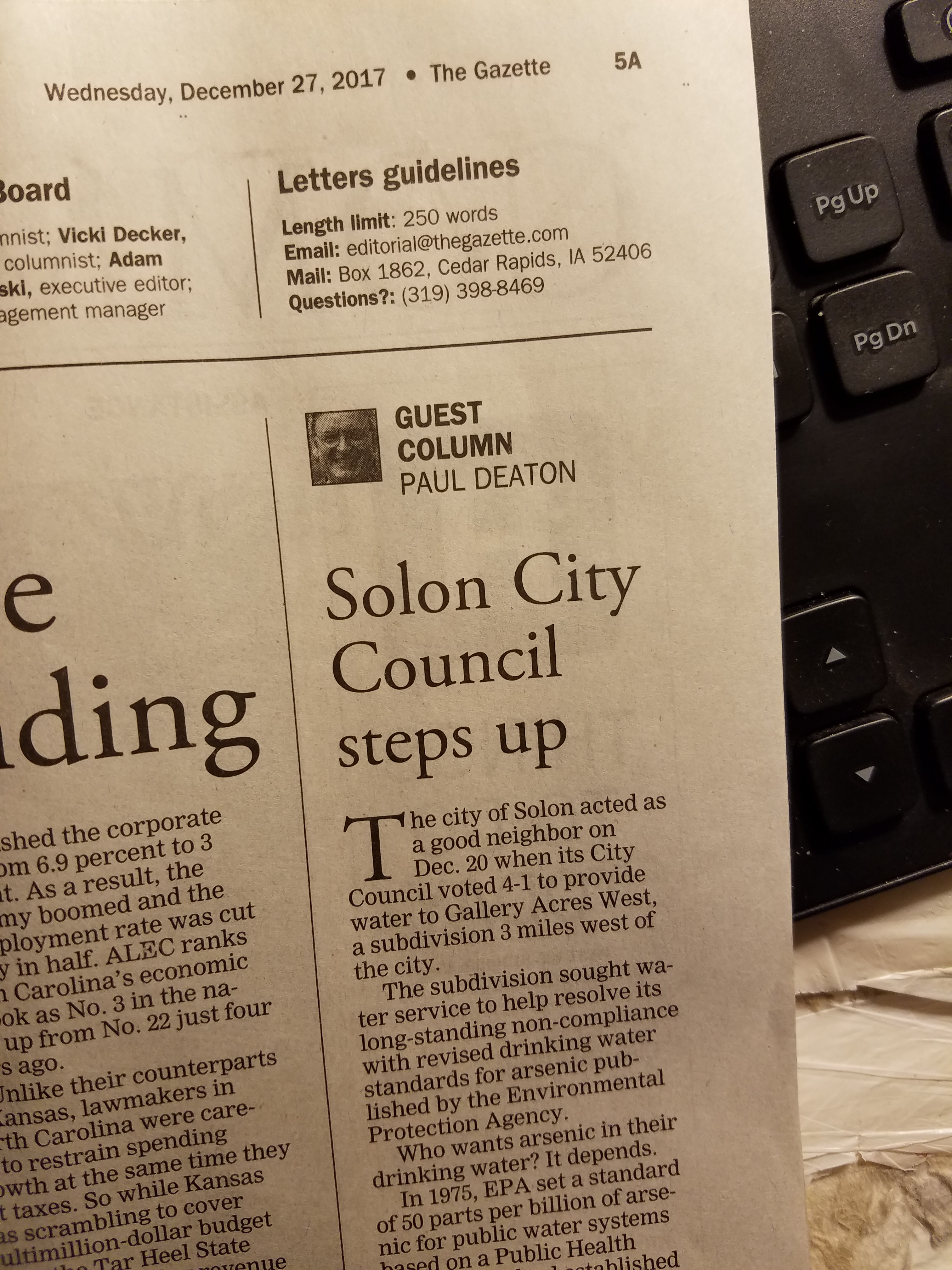
The City of Solon acted as a good neighbor on Dec. 20 when its city council voted 4-1 to provide water to Gallery Acres West, a subdivision three miles west of the city.
The subdivision sought water service to help resolve its long-standing non-compliance with revised drinking water standards for arsenic published by the Environmental Protection Agency.
Who wants arsenic in their drinking water? It depends.
In 1975, EPA set a standard of 50 ppb of arsenic for public water systems based on a Public Health Service standard established in 1942. In 1999, the National Academy of Sciences concluded 50 ppb did not achieve EPA’s goal of protecting public health and should be lowered as soon as possible to allay long-term risks of low level exposure to arsenic.
EPA now has a goal of zero arsenic in public water systems however the goal is not technically feasible. The agency acknowledged there is a trade off between the cost of removing arsenic and its public health benefits.
“After careful consideration of the benefits and the costs,” an EPA fact sheet issued in 2001 said, “EPA has decided to set the drinking water standard for arsenic higher than the technically feasible level of 3 parts per billion (ppb) because EPA believes that the costs would not justify the benefits at this level.”
After multiple public hearings, EPA set the rule for arsenic at 10 ppb and public water systems were given five years after the arsenic rule was published to comply.
Some of us who manage public water systems took the new rule seriously and endeavored to comply. Others did not, and that leads us to Gallery Acres West. Their water system had its first violation of the new arsenic standard in 2002, failed to take action to reduce arsenic in their water system, and in 2015 was threatened with legal action by the Iowa Department of Natural Resources to force compliance.
During an Oct. 30 telephone call, I asked Mark Steiger, president of the Gallery Acres West home owners association, why they had not complied with the 2001 arsenic rule. He told me it was the cost of compliance. With only 14 homes in their association compliance would run thousands of dollars per household. I get it. As president of a home owners association that managed the same compliance issue for our public water system with 85 homes, it cost us $2,823.83 plus interest per household to upgrade our treatment facility to remove arsenic. In Gallery Acres West’s trade off between the cost of arsenic removal and public health, cost trumped health and residents continue to use drinking water with high arsenic content and will until they hook up to Solon.
The proliferation of development in unincorporated areas raises an issue of the quality of management in home owners associations. There are perceived freedoms in living in a small, insular community away from city life. There is also a cost. Things that could be taken for granted in a municipality require attention and potential action in rural Iowa.
It’s a good thing Gallery Acres West is close to a municipality willing to do their work for them.
~ First published on Dec. 27, 2017 in the Cedar Rapids Gazette
Three-day weekends are rare at the home, farm and auto supply store. However, this year the retail store was closed Monday for the Christmas holiday.
I managed to get some things done. Mostly I slept, not understanding beforehand how much sleep I needed.
Three days was not enough time to catch up on sleep.
As I consider “full retirement” this spring, out of the box I’ll need two weeks to do nothing but catch up on sleep. Being bone weary makes it difficult to get things done and there is plenty I want to do after leaving full-time, lowly paid work. Getting rested equals getting started on a new life.
That’s not to say the weekend wasn’t festive. I made Christmas Eve dinner, baked shortbread cookies, and we spent time together and talked. We phoned and texted friends and family. We talked a lot.
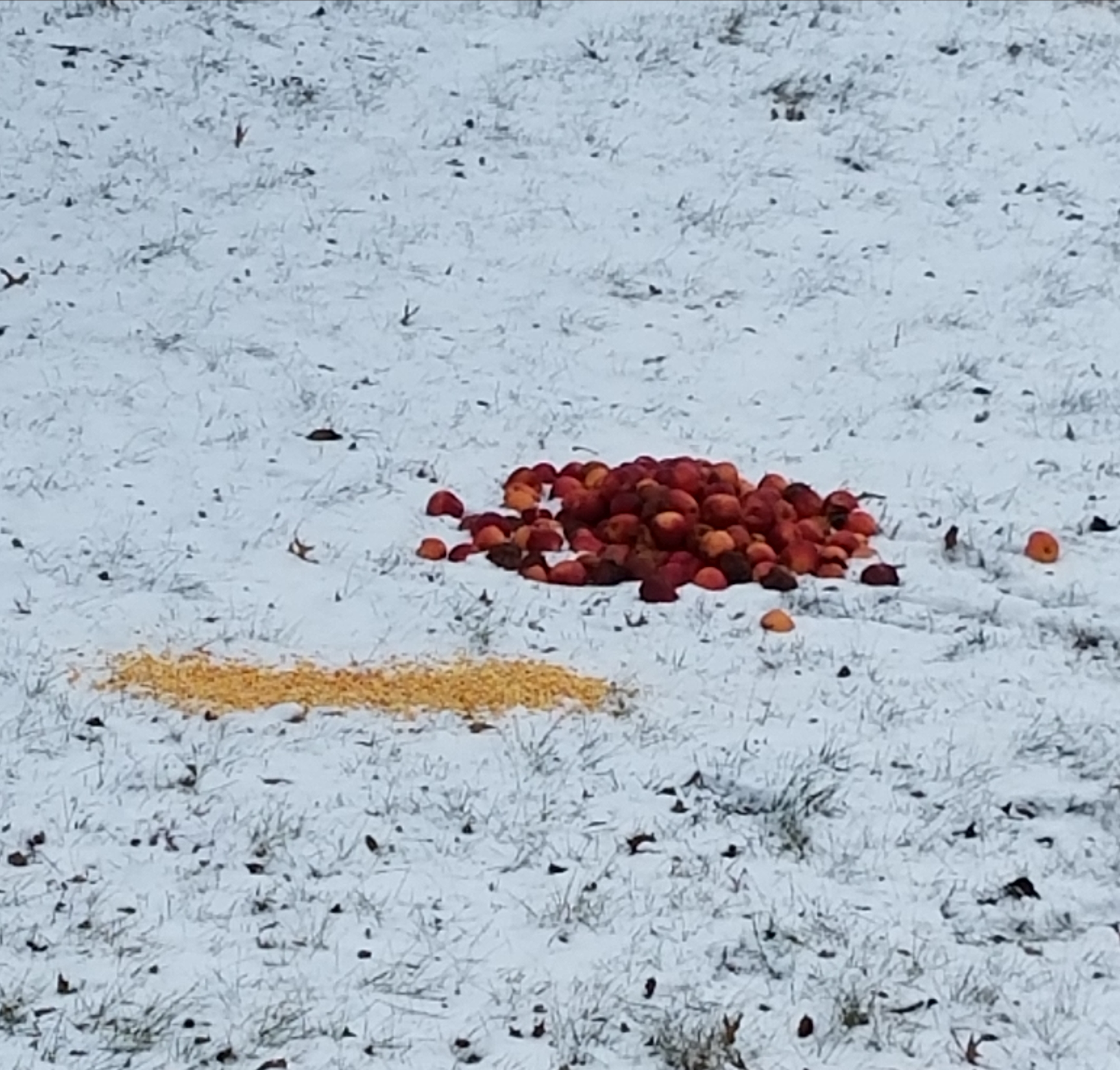
Corn and Apples for Wildlife
Birds were not coming to the feeder so I changed bird seed. I dumped piles of apples and whole corn for wildlife and watched as crows came first to feast. I spent no money and didn’t leave the property a single time after arriving home on Friday.
I long to take retirement. We can’t afford to stop working. How to sustain our lives needs to be worked out by spring. Treading water, I wrote our budget with enough income to cover expenses for 12 months. I’ll use that time to determine how to make things work. If it’s possible, we’ll figure it out.
I’m enrolled in the federal retirement program and Jacque signed up for federal health benefits. We each carry a deck of insurance cards — Medicare, Medicare supplement and Medicare Part D. We hope not to need any of them. Without the federal retirement program we’d both have to work until we die.
I’m counting on being able to write during retirement. I spent Christmas morning writing an article for the Cedar Rapids Gazette. One never knows if writing will be accepted, but it’s free to the newspaper and I have a unique perspective. I like publishing in the Gazette because of it’s comparatively large circulation. Fingers crossed. I’ll write more going forward.
I’ve had my car on the trickle charger for 12 hours so it should start this morning. Thursday is my appointment at the auto clinic to have the charging system diagnosed. Hopefully it can be diagnosed and fixed — the same hope for every 20-year old vehicle. The alternative is the scrap heap. I won’t need transportation as much after retirement. I budgeted half the gasoline next year compared to this, hoping to use even less.
The time between Christmas and New Years is weird. Because of the paid birthday off work I’m at the home, farm and auto supply store only three days this week. What’s nice about this time is the ability to withdraw from society enough to get our bearings.
BIG GROVE TOWNSHIP — I found a quart jar of whole bean coffee in the pantry, ground a quarter cup, and made a pot with my French press — a bitter yet delicious treat while reflecting on the past year.
I will need a second pot.
2017 was a year of treading water in a sea of challenges.
National political culture mattered this year. The inauguration of Donald J. Trump as president set a sour tone as his conservative and sometimes unqualified picks filled out the judiciary. His cabinet ate away at the foundation of our Democracy the way termites invade the weakest point of a structure to consume and thereby weaken it. If Barack Obama’s 2008 election freed me from the constraints of a transportation career, the 45th president fouled the air of creativity with his every move — spoken and unspoken. It was a time when capital was valued more than labor, with no better expression of it than the tax bill signed into law on Friday. Repression of Democratic ideals could be found everywhere we live.
My response to the toxic environment was to engage. I re-joined the county party central committee, our home owners association, and the Macbride Sanitary Sewer District. I also wrote: seven letters to the Solon Economist, two columns published in the Cedar Rapids Gazette, 24 posts on Blog for Iowa, two on Bleeding Heartland and 159 posts here. I finished reading ten books this year, most of those in the first few months of the year. I followed the circus that has been Republican control of the federal and state government, and developed some new friends. Moral: when the nation goes sour, get involved locally.
My work at the home, farm and auto supply store has been a physical drain. I applied for and was approved to start Social Security benefits with the first check arriving in late January 2018. I’ll be transitioning out of low-wage work before Memorial Day.
Wild Woods Farm and Sundog Farm kept me busy spring weekends, and I worked the fall apple season at Wilson’s Orchard. There were bits and pieces of other income. By the end of the apple season, I was ready to rest from farm work. Our balance sheet was unchanged year over year.
My health has been okay. I got a crown and transitioned to a new dentist as Dr. Erusha retired. I avoided seeing a physician and am past due for a checkup. The physical work at the home, farm and auto supply store, and on the farms, has been tolerable. My plantar fasciitis remains present, but subdued going into 2018. I’m in reasonably good health for a soon to be 66 year old male.
On a positive note, Jacque and I marked the 35th anniversary of our wedding this month.
“That which does not kill us, makes us stronger,” German philosopher Friedrich Nietzsche said. I’m still here. We’re still here. We managed to sustain our lives in a turbulent year. That alone is hope for a better future.
On several occasions, friends and family politely informed me I must downsize my book collection.
I resisted.
The specific enjoyment of working at a desk, surrounded by books, may not be everyone’s idea of idyllic, however, for me it is close to sublime. It’s who I am.
While pondering a work backlog in said enjoyably sublime, idyllic location, my mind began to wander. It arrived, somewhat predictably, on the question which book to read next? One thing led to another and finally to the context of the current series of posts about going home, my remaining time, and this analysis.
How many books can I read during the coming years?
Set aside what we all know about life — we could die tonight — and answering this question is useful to a bibliophile. Here goes:
I can read 50 pages a day if I keep at it. I don’t read books every day but expect to come close as I transition to full retirement next year. It’s an inexpensive way for a person with limited resources to stay engaged in society. Assume I read 50 pages, six days per week.
According to the Social Security Administration life expectancy table I can expect to live another 18.5 years. Assume I do. That would be 288,600 pages read. Sounds like a lot, yet it is a finite number.
How long is a book? Obviously they vary in length and some are more interesting than others and read faster. For purposes of analysis, I used the Harry Potter series (UK edition) as my guide to book length. The seven books in the series total 3,407 pages, averaging 486.7 per book. This is somewhat arbitrary but sounds about right. My reading potential is 592.97 books during the coming years. If I can do it, that would more than double the number of books I now read per year to 32.
There are issues with this hopeful analysis.
What if my eyesight fails? That’s possible and somewhat likely given the results of my infrequent visits to the optometrist. We’ve discussed macular degeneration, cataracts, optic nerve disorders like glaucoma, and the condition of my retinas. While my eye health is reasonably good, that could change. If it does, it could impact my ability to read. It could also restrict books read to large print editions or those available electronically where the font size can be enlarged. I don’t like thinking about it, but there it is: a bibliophile’s nightmare.
There is also a question of cognitive engagement. Will I be able to understand what I read for my life span? Will reading help resist neurodegenerative disorders like Alzheimer’s disease, Parkinson’s disease and Huntington’s disease? Will the head trauma I experienced at age 3 manifest itself in my remaining years in the form of a neurocognitive disorder? Will I experience a stroke or head trauma that will impact cognitive function? While less worrisome than loss of eyesight, if I lose the ability to comprehend what I read I’ll just have to deal with it.
An air traffic controller can land only one plane at a time and so it is with reading books. The most important question was my first one: which book will I read next? Carefully considered answers are important at full retirement age.
My friends and family are right, I should downsize my collection of books. Partly because given the remaining time I can’t read but a small percentage of them. I must focus on those relevant to my current life. Downsizing is also important because I don’t want my paternal legacy to be passing on an unorganized mountain of stuff for our daughter to spend her time going through. That would be rude and not what I want to be as a father.
I’m going home next year and hope to continue reading books. There’s a lot to learn and experience inside their covers. Reading helps sustain our lives in a turbulent world.
I’m going home now that my applications to the U.S. federal retirement program are approved.
My first payment from Social Security is scheduled around Jan. 24, 2018. We both have health coverage through Medicare, a Medicare supplement policy, and a prescription drug plan effective Jan. 1. We’ll need the money and hope we don’t need the health insurance.
It’s not clear what “going home” means today, but for sure, I’ll be leaving employment at the home, farm and auto supply store in the first half of 2018 — likely late winter or spring.
I don’t write in public about family, but plan to nurture those relationships.
Compensated work is on the 2018 agenda, specifically farm work for the sixth season at Community Supported Agriculture projects and at the orchard. I’d work for wages after my retail experience but need to transition out of driving a lift truck and lifting 50-pound bags of feed in long shifts. If I took a new job for wages, the commute would have to be less, the pay more, and personal fulfillment high. I hope to get better as a gardener, transitioning to a more productive vegetable patch and more fruit trees.
Uncompensated work is on the agenda as well. Scores of household projects wait for time and resources. I expect to have the time and some of the resources in 2018. We built new in 1993 and that reduced our home maintenance expenses in the early years. Things now need attention and preparation for the next phase of our lives in Big Grove. I expect to reduce the number of things we possess, converting current warehouse space to better livability.
I’ll continue to be active in our local community, but less outside Big Grove and surrounding townships. The home owners association, sewer district and membership on the political party central committee will serve as primary volunteer activities. I’ll also seek volunteer opportunities in nearby Solon. For a broader perspective I belong to the Arms Control Association, Physicians for Social Responsibility, Practical Farmers of Iowa and the Climate Reality Project.
Importantly, writing is on the 2018 agenda. I’ve been planning an expanded autobiography and that will be the first major project. With it I hope to develop a process to research, write and re-write a 20,000-word piece for distribution, if not publication. If my health holds and the wolves of an increasingly coarse society are held in abeyance, there will be additional projects. My first six decades have been in preparation for this. I believe positive outcomes will result.
I’m going to home to the life we built for ourselves. We’re not from here, yet after 24 years we have deep roots in this imperfect soil. I’m ready to settle in and grow.
Special elections are interesting because they occur off-cycle by definition and are all about building a unique electorate from scratch. There were two notable special elections yesterday, in Iowa’s third Senate District to fill the vacancy created by the resignation of two-term senator Bill Anderson, and in Alabama to fill the vacancy created by appointment of four-term U.S. Senator Jeff Sessions as U.S. Attorney General.
Turnout is almost always lower in special elections and that creates unique opportunities for different results. A local example was the March 2013 special election to fill Sally Stutsman’s seat on the Johnson County Board of Supervisors after she was elected to the Iowa House of Representatives. Republican John Etheredge won against Johnson County Democratic Party Chair Terry Dahms in a surprise victory that made him the first Republican elected to the board since 1958. If you didn’t know, Johnson County is the most Democratic county in Iowa.
In the third Iowa Senate District, Democrat Todd Wendt faced off against Republican State Representative Jim Carlin. Unofficial results are Carlin won the election 54 percent to 46 percent for Wendt — a solid win. There are plenty of summaries of the race and I like the coverage by the Sioux City Journal’s reporters Brent Hayworth and Mason Dockter here.
The vote numbers tell the story of this deeply Republican senate district. During the 2014 general election 22,262 votes were cast in Senate District 3. Anderson ran unopposed and won with 17,176 votes. According to unofficial results, Carlin totaled 3,591 votes last night, and Wendt 2,988, for a total of 6,579 or 30 percent of the votes cast the last time the district was on the ballot. What that means is Wendt made a respectable showing in a district President Donald Trump won by 41 percentage points, defeating Hillary Clinton 68 percent to 27 percent in the 2016 general election. I hesitate to draw many conclusions from this or any special election. Wendt received a lot of help that would not have been possible in a general election, but in the end he didn’t prevail. Had the Democrat won last night, I believe he would have been sanded off in the woodshed of the 2018 general election the way John Etheredge was in Johnson County.
My experience with Alabama is limited.
In a carload of GIs let loose for the first time in weeks from Officer Candidate School at Fort Benning, Georgia, we headed to Phenix City, Alabama to get tattooed. I’d be sporting ink if the town hadn’t closed down early on a Saturday night for “moral reasons.” When I traveled to Fort Rucker to visit a friend from Germany I noted anti-pope scrawling on roadside telephone booths. I drove past the Auburn and Tuskegee campuses noting the contrasts between them. At Tuskegee students wore uniform-appearing white shirts, looking professional, whereas Auburn students made no impression but seemed to be vague, indistinguishable white protoplasm. I have relatives in Alabama who left the Catholic Faith to join an evangelical sect near Huntsville. We don’t talk any more.
Last night’s special election in Alabama had a lot of moving parts and that’s what made it interesting. Democrat Doug Jones won the election with 49.9 percent (671,151) of 1,344,406 votes cast compared to 48.4 percent (650,436) for Republican Roy Moore and 1.7 percent (22,819) for write-in candidates, according to the New York Times. If there were a one-half percent difference between Jones and Moore, Alabama law would trigger an automatic recount. There is a sea of internet ink about the race. I prefer the Washington Post piece by Sean Sullivan, David Weigel and Michael Scherer here.
My filter for Fox News is author Stephen King, who tweeted last night, “FOX news is sayi g ‘Doug Jones is already a lame duck.’” FOX News is wrong in the assertion Jones will be ineffective. With the U.S. Senate currently standing at 52-48 Republican to Democratic, Jones will make a difference beginning whenever Majority Leader McConnell decides to seat him. One suspects Jones will take his seat after the vote on the conference bill on tax reform.
There are some reasons to believe Jones could be sanded off in the woodshed of the 2020 general election when his term expires. Here are mine:
Higher turnout in a general election will favor the Republican.
Don’t expect Alabama Republicans to pick another flawed candidate like Moore in 2020. They may be backward compared to other states, but they are not stupid.
Jones was able to hire seasoned political consultant Joe Trippi for the special election because of nationwide focus on the race and the campaign donations it generated. Democrats will invest a lot of money and effort in 2020, but it will be spread across the nation.
Higher than expected turnout among black voters contributed to Jones’ win. There is backlash among black voters who found their best candidate in Jones but have adopted a wait and see attitude to determine whether or not he addresses key issues they face. Especially important is the Alabama black voter suppression effort on full display during this election.
Jones’ victory is a significant step toward Democratic control of the U.S. Senate after the 2018 election. It also had an electorate set in time, only partly related to general election electorates that consistently produced Republican Alabama senators. Democrats should be heartened by the results of Jones’ win, stay focused on the prize, and study his and Wendt’s electorates to learn how they produced the results they did.
This year a group of Ukrainians with temporary work visas joined us at the orchard.
They were hard-working and fun to be around.
Their contracted wage far exceeds the $185 per month they can earn in Ukraine from their trained profession as English teachers. The visa sets a specific hourly rate of pay and the host is required to provide round trip transportation to Iowa plus housing. They can stay for up to eight months at a time. The Ukrainians went home to their families after the season, although each of them plans to return in a couple of months to help prune apple trees.
Saturday I drove to the orchard to pick up apple cider and frozen cherries. While there, the octogenarian friend who referred me showed up. We talked with the owners long enough for my spouse to wonder where I was. We ran through the usual topics —the hickory nut harvest, Gold Rush apples, cooking projects, which books we were reading, activities of mutual friends — and told jokes, usually one at the expense of another. It was a great conversation among friends.
We live in the same political precinct and have common political interests. We discussed the surprising plan to move the U.S. Embassy from Tel Aviv to Jerusalem within a few years, and scuttlebutt about Democratic candidates considering a run to replace our state senator Bob Dvorsky when he retires at the end of 2018.
Multiple sources told me local internet personality Zach Wahls and former diplomat Janice Weiner are both kicking tires on a state senate run. I’ve not met either of them and it was news to my co-workers. While politically engaged, each of us has bigger fish to fry than politics.
The orchard sales barn will be open next weekend and that’s it for the year. I’ll need more cider… and conversation by then.
Everyone wants work that’s fairly paid. Once one accepts a work contract — agreeing to work for a wage — that usually ends discussion about compensation. We turn to our co-workers and the life we share in a place and time. If the job is any good we don’t talk about compensation, work hours, or much of anything but the idea of what we do and how to do it better. This has been the case most of my life in every job I’ve held.
At the home, farm and auto supply store we recognize it as lowly paid work, not just for hourly employees but for management. Yet we engage in work as a team and do our best to meet our goals. Employee turnover is high in retail and based on my experience compensation is not the driver. What matters more is it’s relatively easy to get retail work and if one keeps their nose clean and shows up, the employment and paycheck are predictable. A job easily secured is one easily left and that drives turnover. Our workplace is a stopping point for many people enroute to something else.
One of my colleagues was recruited from the sales floor to help check in freight during our busy season. We talk while working. Cognizant of his low wages, he said, “you get what you pay for,” indicating he would work harder if paid more. I’m not sure about that but didn’t tell him so. He is already a hard worker compared to others, and his income contributes to a household with his wife and two children. The job means something to him, but he’d leave it on short notice if a better one came along. We don’t talk much politics at work but he wears a stocking cap and coat with the word “Trump” screen-printed on them.
As my worklife winds down before taking “full retirement” next year, I value the people with whom I spend time. They are a diverse group and I hope to add something to our relationship before I go — remembering the past and living each moment to the fullest extent. These are stopping places, part of a long, personal journey that’s not over. As Robert Frost wrote in 1923, “I have miles to go before I sleep.”
I’m sitting in the back of my pickup truck, the tailgate is down. Gentle summer rain is falling. The tips of my toes are getting wet but I don’t mind. We need the rain.
In Des Moines political parties are holding their conventions. I followed the action on social media, but not closely.
Breeze from the rain is cooling my forehead. It feels quite good. It is much better than working on a computer, or thinking about politics.
This afternoon I tried pulling weeds in the garden. The ground was so dry they broke off at the surface. Now, after this long gentle rain, the roots should loosen and weeding be done more easily.
Wind is blowing from the west and my knees are getting spattered with rain. I still don’t mind.
Dozens of birds are out in yards around the neighborhood. They don’t mind rain either. All of nature seems to welcome the rain.
Lightning and boomers are starting to roll in. The rain continues to fall gently and steadily.
Some nights it is best to just listen to the rain, and so I will tonight.





 Journey Home
You must be logged in to post a comment.