Categories
Living in Society

Surviving a News Avalanche

Colorado, November 2010

It’s as if everything in the national and state government is approaching a breaking point. What might be broken? Any remaining faith we have that the United States is different from other nations in a positive way.

I can’t count how many significant news stories there were in the week leading up to this holiday weekend, at least a couple dozen. How to deal with them? Military training instructs us: bunker in and wait for the shells to fall before commencing an initiative.

I’m trying not to think about it going into end of year holidays. Yet, how could I not?

As I approach my 67th birthday, age may be a driver. I’m old enough to remember our country made contributions to peace and prosperity in the world. We did good things. I also see we are responsible for covert wars, military actions and civilian deaths in combat operations. We’ve not been a player only for good in a while.

During the run up to the 2016 election, anyone with knowledge of history, or even those just paying attention to the campaign, knew Donald Trump would be bad at the job of president. No one knew he would be this bad. What kind of man retreats from working on our many current issues to watch television and listen to the radio? That a president would do this, as media reports he is, is not good for our mutual, future prospects as a nation.

Groups formed to resist Republican governance after Trump’s victory. I’m skeptical of the efficacy of putting my elected officials on speed dial for daily or even weekly calls. Better than resisting, we should be voting them out, only we haven’t been able. Despite a “resistance,” Iowa Republicans maintained the trifecta control of the governorship, house and senate. We need to work smarter.

First we wait until the news avalanche finishes. Until we know the bottom — until the dust settles, giving us clear sight — it is difficult to make any meaningful effort. So for a few more weeks we hunker down and figure out where to go from here.

With all the news it has been difficult to know where “here” is. We will eventually recognize this place. Soon, I hope.

Categories
Writing

Holiday Writing

Writing About Apples

In May 1972, in the English Philosophy Building of the University of Iowa, professor David Morrell held up a copy of the book he published the previous year and asserted it represented the future of modern American fiction.

My high school friend Dennis was also in the class and we were skeptical. Morrell wasn’t wrong.

The book was titled First Blood and has been in continuous publication ever since. In 1982 it was made into a movie starring Sylvester Stallone. There were sequels. A student of Hemingway and John Barth, Morrell wrote First Blood while at Iowa where he taught English until 1986 when he gave up tenure to write full time. Last count he had written 32 books.

Morrell is the only undergraduate professor I continue to follow. That’s because when social media rose in the culture he adapted to it and is a constant presence on Twitter and Facebook. He’s easy to follow. Yesterday he posted a link to a video about writing which arrived as I’m figuring out what to write next year.

“The point is to have the passion and the drive to see in a book that it can make you a better person,” he said. “So that even if the book is not published you haven’t wasted your time because you wrote something that is truly important to you.”

That’s good advice. Write to make yourself a better person.

If I took any lesson from Morrell it was his practice of taking a deep dive into techniques he would depict in his fiction. Over the years he learned mountain survival skills, firearms handling, how to drive in emergency situations, and how to fly an aircraft. All of this training served his thriller writing. The take away for me was that writing must be grounded in experience. Not only so it reads well, but so we understand and can communicate life experiences faithfully.

During end of year holidays Big Grove and the lake district gets quiet as people settle into home, family and community. It is respite from the increasing turbulence we see in our politics and in society. I use this time to gain perspective on what I’ve done and written. Today the days start getting longer — an embarkation point for what’s next. Not sure what I want except forgiveness and redemption.

Midst gardening, farming and living there will be writing. I hope to improve my skills and stay grounded in reality… and to become a better person.

Categories
Kitchen Garden

Very Late Fall Cookery

Garden and Farm Vegetables

With winter solstice tomorrow afternoon, it’s getting late to be calling this autumn.

There are still fresh vegetables in the ice box and plenty of ideas for what to do with them. On Monday and Tuesday I binged on YouTube videos about street food in Pakistan and India, which led me to make a batch of egg fried rice.

To begin, I am shocked by how much oil or butter is used by these street vendors. It is well known that restaurateurs use a lot of butter in cooking. Eating in diners accepts a high level of saturated fats in food. But these videos? Oh My God! A quart of vegetable oil? Two or three cups of butter? It’s enough to give a person a heart attack… literally.

In an American home we don’t use so much cooking oil yet there are lessons to be learned here. I got out the wok and spent about half an hour prepping vegetables.

I found parsley, carrots, onion, celery, turnips, kale, collards, garlic, fennel and leeks and diced them up for stir fry. There was about four cups of leftover, cooked rice, enough to use four eggs.

If I keep making this dish I need to work on seasonings. I was tempted to add red pepper flakes to the oil in the beginning but resisted the heat to see what the other flavors would lend to the experience. I kept it simple with salt, ground black pepper, ground cumin and smoked paprika. It was good without hot peppers. 

Egg Fried Rice with Local Vegetables

The rest is pretty easy. Place about four tablespoons vegetable oil in the wok and heat to temperature. Add vegetables one dish at a time in cook’s order (those needing most cooking first) reserving the parsley for finishing. Sauté and stir constantly until the vegetables begin to soften and add the eggs. Street vendors crack eggs directly into the wok, but I beat lightly in a dish and added them all at once. Stir constantly until the eggs begin to cook. Add the cumin and paprika at this point and incorporate. Add the rice and stir until the eggs are cooked and everything is incorporated and heated evenly. Add parsley and serve. Made four generous portions.

The kitchen was filled with the aroma of chopped fennel all day. In the finished dish it added a brightness that’s hard to describe. Stirring constantly helped prevent the eggs from creating a crust on the bottom of the wok and made cleanup easier. If I were to serve this as a side dish I’d reduce the number of vegetables to basic aromatics and some greens, maybe add some pine nuts. Stir fry is a flexible dish that can use up what’s on hand.

As fall turns to winter egg fried rice helped transition from ice box to pantry for food sourcing. I felt I learned from the experience of making it. In our kitchen, that’s what cooking is all about.

Categories
Living in Society

Royceann Porter Won Special Election

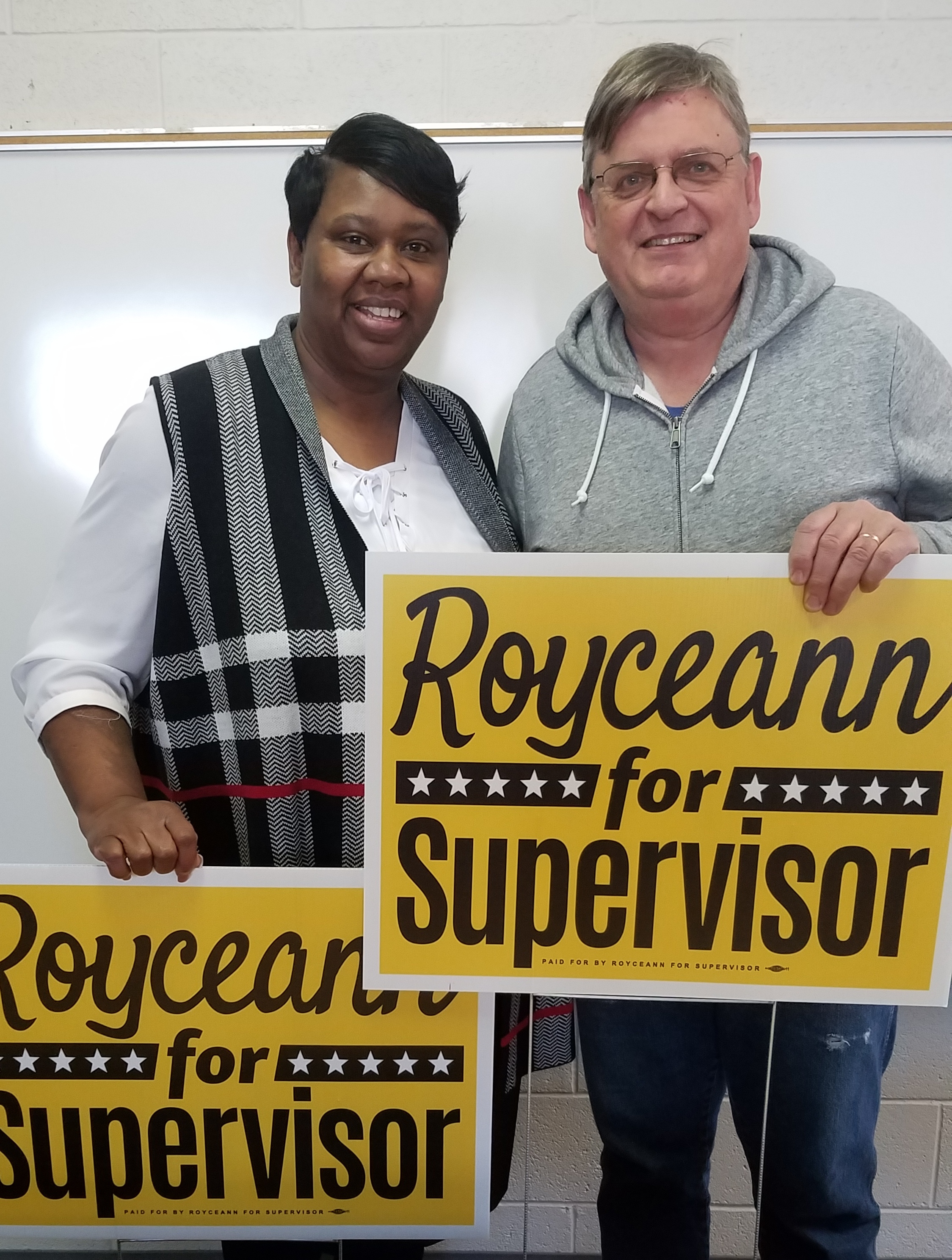
With Royceann Porter in Solon, Dec. 8, 2018

I hadn’t heard of Royceann Porter until she was considered to be the Democratic nominee to fill the seat on the Johnson County Board of supervisors left by the death of Kurt Friese.

Through hard work and effective organizing she won yesterday’s special election by an honest margin of 56 percent of 9,658 votes cast, beating another Iowa City resident, Phil Hemingway, decidedly.

In case you missed it, I included a photo. Royceann Porter is black, and a woman, the first black woman to be elected to the Johnson County board of supervisors.

During the campaign I found racism was still alive in the county. Those of us who talk to voters and have over the last couple of decades are well aware of Johnson County’s endemic racism. Porter herself has been working for racial justice in the county. Voters I meet don’t look at themselves as racist, although Royceann’s candidacy scratched it like a rash. It showed itself in characteristic fashion in unexpected, unwelcome places among people in my circle of acquaintances. The euphemisms were several: “Hemingway is better qualified.” “Did you see her at the forum?” “We need rural representation.” These were Democratic voters I spoke to and the attempts to distract from their racism wore thin and saddened me.

I contributed to Royceann Porter’s campaign. As a Democrat, what else was I going to do? With other area friends we organized a meet and greet in our nearby city and advertised it in the local newspaper. I contacted everyone I know and urged them to vote for Porter in the special election. I posted this photo on social media with an endorsement. I don’t know what impact these things had, but Johnson County Democrats may have learned the lesson of the 2013 special election when their chosen candidate, Terry Dahms, lost to Republican John Etheredge with 6,113 total votes cast in that election. Yesterday turnout across the county improved over 2013 by 58 percent.

Was this election about race? Only partly. With a focus on running a viable campaign in a short period of time, Porter overcame every obstacle she faced and won. Racism is still there in Johnson County, the same racism I recognized when our family moved to Big Grove in 1993.

This election and Royceann Porter’s win provides another opportunity to address problems in the county. Racism is only one of a long list of things the board of supervisors must tackle. There’s plenty to do and the board voters chose is reflective of who I am and the direction I’d like to see county government go. That’s what elections are supposed to be about, isn’t it?

Good luck to Royceann Porter on the board. She has the potential to accomplish a lot in 2019 and beyond. Many of us will be pulling for her.

Categories
Environment Writing

Ice on the Lakes

Ice Skates on a Shelf

On early morning walkabout the moon and stars were out, casting silvery light on me and everything.

Yesterday a thin layer of ice rested on the lakes, its mirrored surface perfect for skating if it thickens. Based on the forecast, we’ll see more open water soon.

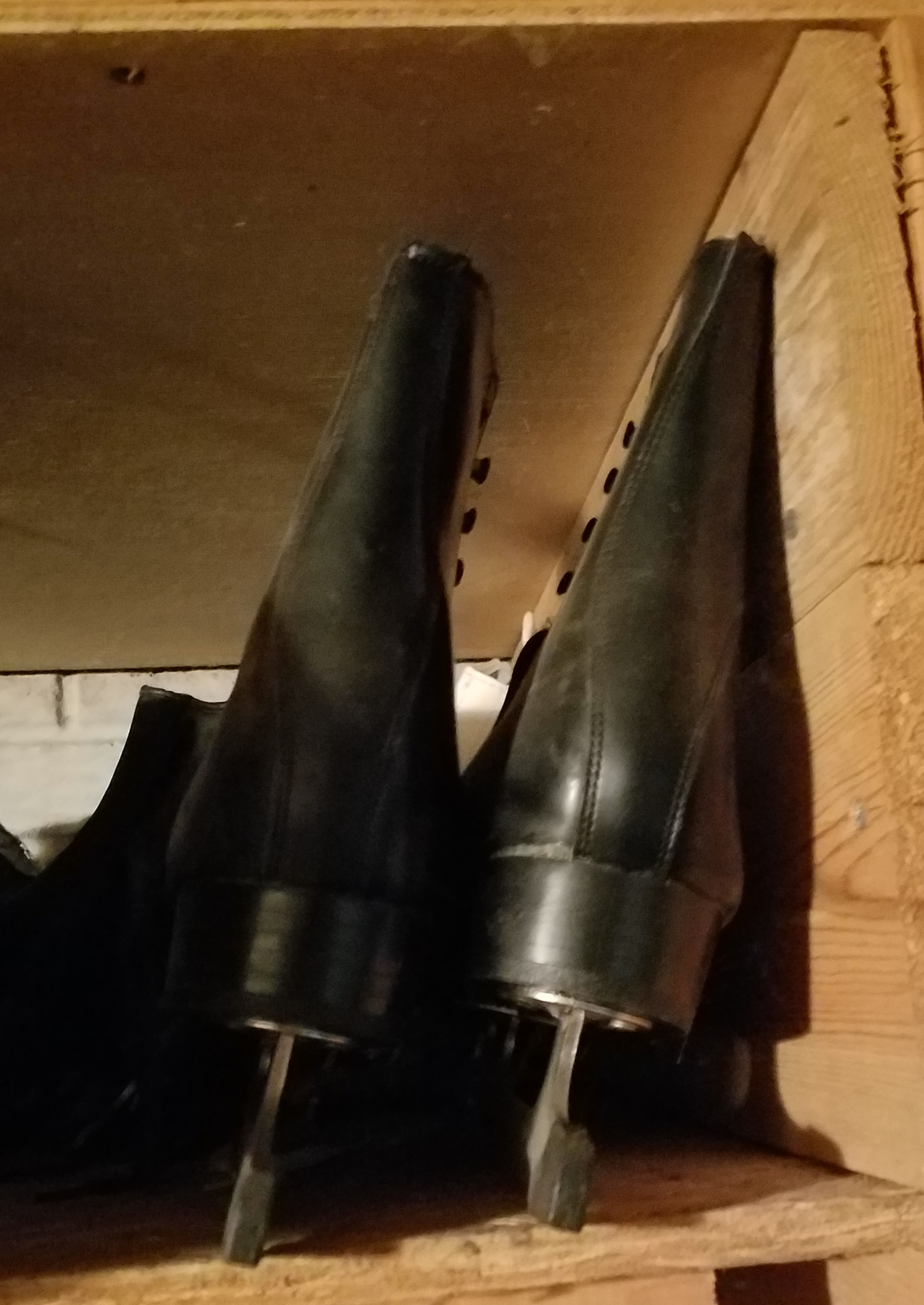
When our daughter was a grader and the lake froze we’d don ice skates and cut a path all the way to the other shore. When snowmobiles plowed by we could feel the ice moving up and down taking us with it. We keep the skates on a shelf in our garage.

We live in a cold middle place where it’s not quite winter and not warm enough to work long outside. Our attention turns inward and to the possibilities of next year.

The best part of the coming holidays is people engage in things. A calm quiet falls over the Johnson County Lake District. If it were snowing one could hear flakes fall.

It’s a time for planning and writing here in Big Grove. What few fresh vegetables are left in the ice box will soon be eaten up… well, except maybe the turnips. I’ve been watching videos of Indian street vendors making gigantic woks of chicken fried rice. There’s a tub of leftover rice and plenty of eggs so I’ll try that for lunch or supper. I forget eggs are chickens.

And so it goes. Vonnegut taught us death can be absurd, tragic and predictable. It seems mostly random and will eventually take us all. I’d like to get back out on the ice and cut its clear, smooth surface in long figure eights. I’d watch fish swim through the ice and hope the crazing wouldn’t result in my going to live with them. Not yet anyway.

The hope of this holiday season is we can do positive things next year. Isn’t that always the case? So it goes, and here we go. Gliding along the surface until we take a plunge, hoping for a resurgence of living each moment as best we can.

That’s optimistic. Increasingly, that’s who I want to be, who I am.

Categories
Living in Society Social Commentary Writing

This is not France

Protesters on the Champs-Elysees. Photo Credit – NBC News

We see a lot of customers wearing yellow safety jackets at the home, farm and auto supply store. Mostly they seek something to complete a project.

Road crews, construction workers, and tradesmen of every kind stop in wearing the bright, reflective safety gear. It is mostly men. Usually, they are in a hurry to get back to work.

The similarities between these Iowans and the French citizens protesting an increased fuel tax seem mostly external. The French are required to carry yellow jackets in their vehicles in case of a mechanical breakdown on public streets and roads. Before I began working at the home, farm and auto supply store I thought only fire fighters wore such reflective clothing.

What makes our yellow jacketed citizens different is the Trump administration is creating massive changes in financial matters that impact them and who cares? Where are the protests? For the most part Americans play the hand dealt in subservience.

Take interest rates. On our last statement before the president was inaugurated, our annual variable interest rate was 3.00 percent on our home equity loan, indexed to the Wall Street Journal published rate. Our current rate is 4.75 percent, an increase of 58.33 percent. Where is the outrage?

Take gasoline and diesel prices. On Dec. 10, the average U.S. price of gasoline for all grades was $2.511 per gallon with diesel at $3.161. During the same week in 2016, gasoline was $2.347 and diesel $2.493. The price of gasoline increased 6.99 percent and diesel 26.80 percent under this administration. With U.S. oil production hitting record high levels last month, why aren’t gasoline and diesel prices coming down?

I don’t really expect answers because I know them. Interest rates and oil prices are just not on the financial radar for most people. They are an assumed background noise. Something that has to be dealt with, but not very often. Importantly, American businesses have learned how to change things in their favor without precipitating the kinds of protests we see in France. It is a basic part of corporate pricing policies.

The protest in France is about fuel prices. During the first Gulf War I worked for Amoco Oil Company, where we were acutely aware of the global political situation as it related to discovery, development, refining and selling our products. I managed a small trucking fleet and fuel price volatility during the war led us to implement a fuel surcharge in our contracts with customers. We weren’t the first to implement a fuel surcharge but today they are a hidden part of almost every type of delivery service. Depending on a customer’s savvy, fuel surcharges can be negotiated to produce an additional margin for operations through various pricing schemes. As suggested, it’s just not on the radar for American yellow jackets. Interest rates? You gotta be kidding me.

It’s been a long time since I was in France.  I’ve never understood their politics the way I do ours. Is Macron good or bad, or just another president in a series of controversial figures? What I do know is Americans rarely make the news for our protests. That is more newsworthy than what the yellow jackets are doing in France.

Categories
Environment Writing

No Going Back to Coal

Coal Mine Demonstrators Going Down – 1950

On Aug. 10, 2016, Donald Trump appeared at a campaign event about 50 miles from my father’s home place in southwestern Virginia. He asserted coal miners would have one “last shot” in the election, cautioning that the coal industry would be nonexistent if Hillary Clinton won the election.

“Their jobs have been taken away, and we’re going to bring them back, folks. If I get in, this is what it is,” Trump said.

How do you tell if the president is lying? Check to see if his lips are moving.

There was no last shot. The coal industry is dying and the president’s efforts haven’t and won’t change that.

It is easy to dismiss his comments as campaign bluster. However, real lives are at stake and young couples are leaving Appalachia to find work in other professions and make a life. We are all driven by the need to make a living. Despite strong personal history and traditions in a place, the economics of living there may cause us to leave as it is doing in coal country where mining jobs continue to be in decline.

U.S. coal consumption is projected to decline by nearly four percent in 2018 to the lowest level since 1979, the U.S. Energy Information Administration said on Tuesday. At year-end, appetite for coal will be a staggering 44 percent below 2007 levels according to NBC News.

The cost per kilowatt hour of electricity generated by new solar arrays is less than those generated in existing coal-fired power plants. Cheap natural gas extracted by hydraulic fracturing has taken new coal-fired power plants off the drawing board. Right or wrong, the power industry is switching to gas. India, one of the top ten global carbon dioxide emitters, has cancelled plans to build nearly 14 gigawatts of coal-fired power plants with the price for solar electricity “free falling” to levels once considered impossible, according to Ian Johnston at the Independent.

There are no easy answers for people impacted by our changing energy economy. Families that relied on coal extraction to make a life will have to revisit their choices regardless of what the president does or says.

When I was coming up the home where I spent ten formative years had recently been heated by coal. When my parents bought it the large gravity furnace in the basement had been converted to natural gas. It was an inefficient way to heat our home, but it was very reliable, and natural gas was less expensive and more convenient than coal trucks plying the alley behind our house to deliver. There is no going back to coal in home heating, or anywhere else.

The sooner we generate our electricity from renewable sources, the better we reduce greenhouse gas pollution in the atmosphere. No amount of presidential bluster can save the old energy economy, nor would we want to. Our politics isn’t there yet, but we will act on climate change. There is an existential urgency that we do.


Categories
Writing

Friday Community Work Day

Autumn at Lake Macbride

Our electric clothes dryer was on the fritz.

A technician arrived Friday morning and replaced the idler pulley that had been making noise. Although long ago replaced, a washer and dryer was one of the first gifts my in-laws gave us after our wedding. A working home washer and dryer is neccessary in an American household. 

I’m glad the local company from which we bought the dryer provides service. The repair was completed well before 9 a.m., leaving the rest of the day free to occupy as I would… sort of.

After the repairman left, a neighbor who is on our well committee called to ask me to help a local well service price an upgrade to the mechanicals in our well house. He was in a nearby town and wanted to stop by enroute home to the county south of us. I said yes.

Our public water system has been using more water than anticipated when we upgraded the well about 12 years ago. Time and usage are taking a toll on the mechanicals — the pump will eventually need replacing. He secured the information needed for a proposal on a replacement pump. It was an unexpected but useful and informative interruption of the day.

Discussion of water systems with a well-known operator is a way of tracking what’s going on in the county. I enjoy this part of the work. He said he was picking up business as well service operators like the one who renovated our well exit the business.

As I showed him around the well house, we discussed the new line a subdivision west of us is running from the city to resolve the high level of arsenic in their drinking water. A couple of other subdivisions requested stubs on the line, but no one else requested service. From Thursday’s newspaper article, it’s unclear whether the city would be willing to provide water to customers beyond the initial scope of their agreement.

We also discussed the new well at the orchard where I work. The tricky part was figuring out how to drill the new well around a seven-day-a-week operation that includes a retail barn and a restaurant. They figured it out and the new well is in service.

When I returned home I sent out the notice of our regular association meeting next week along with a call for agenda items. There were other association matters to tend to which occupied my attention most of the rest of the day. The slate wasn’t really clear when I went to the kitchen to make dinner.

Working two days a week at the home, farm and auto supply store leaves me time to work in our small community. I’ve been on the association board three different times since 1995 and will finish out my term and maybe go for one more. I find the work interesting and there is plenty of it. At some point I’ll step back and let someone else lead the effort. A lot depends on how successful we are in transitioning from work to retirement during the next couple of years.

Even without a part time job there is plenty to occupy a pensioner. Staying engaged in the community is not only important to longevity, someone has to do the work. For now, I’ll be on the board to help sustain our progress and plan for the future. However, it would be great if I could leave those chores to someone else and focus solely on writing. For now, I’ll make do with early morning sessions and posting the results on this blog. However, there is a bigger project in the background, one which will occupy my time with intensity once begun. I’m looking forward to it once I finish all these existential errands.

Categories
Environment

Environmental Issues 2018-style

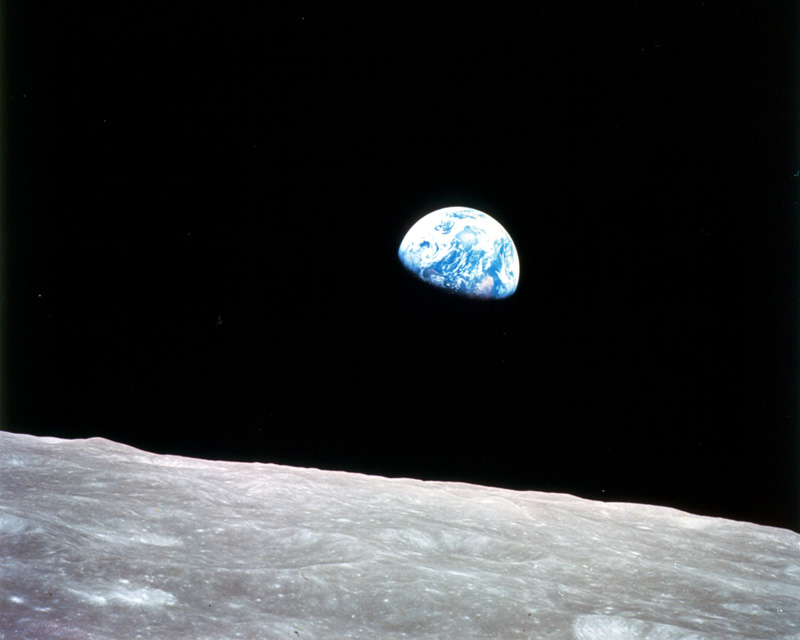
Earthrise by Bill Anders, Dec. 24, 1968

There was never any doubt that when Republicans won the 2016 election setbacks were in store for parts of the environmental movement that rely on government regulations.

Conservative think tanks like the Heritage Foundation were ready with swat teams to investigate every part of the executive branch and reverse anything and everything that could be to favor business interests during the president’s first term.

The funders of these operations have plenty to celebrate going into the new year. The rest of us took a step backward.

What I’ve learned in almost 50 years of being in the environmental movement is there is no parsing the actuality of environmental degradation. A person can summarize the greenhouse effect in as few as 200 words. The impacts of global warming are available to anyone who would recognize them. There is an inevitability of climate action with the main concern being we wait until it is too late to save ourselves.

The battle over the coal industry is being fought less by environmental advocates and more by market dynamics. So many electric utilities converted to natural gas because of its current low cost and availability. Why wouldn’t a utility want a thermal energy source delivered right to their door over a mineral that had to be delivered and handled by the rail car load at greater expense? Based on the home heating conversion of coal to natural gas, ongoing when I was a child, there is no going back to coal.

Natural gas is also a problem because of greenhouse gas emissions. While solar energy installations have stalled as a result of the president’s tariff policy, the market will figure it out to use the sun and wind directly. Renewable energy will prevail in the marketplace over extraction-based energy sources. Based on the science of climate change, they have to prevail if we hope to adapt to the deteriorating environment we created.

Symbolic gestures like the Green New Deal the House of Representatives is proposing are something. However, the problem of environmental degradation won’t be solved by governments alone. We need a resurgence of green habits. It is still too easy and inexpensive for someone to hop in the car and drive 20 miles to pick up groceries to expect them to change their behavior.

Progress made on environmental issues and policy during the Obama administration was no progress at all if it could be so easily reversed by the next administration. The idea a potential Democratic president in 2021 could reverse the damage done by Republicans is a shallow hope. We have to do better than this.

As 2018 draws to a close there is much to be done to reverse the deleterious effects of a changing climate. Some of it can’t be reversed yet we can’t lose hope. Despair is a form of climate denial.

“We do not have time for despair,” Al Gore said recently. “We can’t afford the luxury of feeling discouraged. Too much is at stake.”

Inside politics and out, now is the time for climate action.

Categories
Living in Society Social Commentary

Christmas is Coming

Christmas Lights

It’s been seven weeks since the end of apple season, now two weeks until Christmas. The glow has come off holiday seasons.

It’s not that I’ve become all grinchy, hidden away in a darkened lair while neighbors illuminate their homes in festive lights. I don’t know what it is but last year we didn’t even open the holiday decoration boxes and this year likely won’t either. It makes the clean up easier and there are no young children and few family members with whom to share our traditions. People turn inward this time of year and so shall we.

We make home made chili on Christmas eve and serve it with cornbread. There are special recipes and sparkling apple cider. Christmas day we’ll fix a dinner with elements of what we had for Thanksgiving — sweet potatoes, wild rice, farm vegetables, a relish plate, and a source of protein. There will be leftovers. It will be tasty and traditional.

I know what to do to make it through the holidays — contact friends and relatives and plan for next year. Write a budget, get organized for tax season, plan the garden. The world starts shutting down Christmas eve and there will be time for a long winter’s nap… or two. Time to spend writing along with restlessness and resting for what’s next in 2019… a long walk on the lake trail.

My disconnect from Christmas began with military service. The first year in Germany, no one even knew I was there except for the battalion commander’s secretary and my family. Without a telephone, before the time of personal computers, I spent the holiday alone and that broke me from family traditions. By the time New Year’s came, other officers realized I was there and tried to include me. It felt ersatz and futile.

There was a resurgence of Christmas spirit with some joyful times when we married. Even in our decoration-less home with just the two of us the day is special. That will be enough. We’ll miss having our daughter with us and will think of her as Christmas day turns to night. One year she worked the park’s fireworks display as families gathered on streets of make-believe. Someone has to make holiday memories for night visitors.

Today I return for a shift at the home, farm and auto supply store. With five days off work I’m getting cabin fever and that will dissipate as morning turns to afternoon. Socialization at work is a main reason to stay in the work force while I can. Soon the Christmas merchandise will go on clearance with bargains to be had. I might bring something home. Who knows whether our holiday lights will even work after so long in storage. I might even use them again this year because hope remains. It’s the season of hope.