Congratulations on your reelection last month and thanks for the conversation after the Second District convention.
My wish list is brief, here it is.
Create a process to audit where defense dollars go. We are spending a lot on defense, more than I believe is needed. We ought to be able to determine where this money goes. I believe we can save money. I’d bet there is enough money to pay for the president’s wall, not that we should. Please work on such accountability for the Pentagon.
Protect Social Security and Medicare. I first paid into Social Security the summer of 1968 and 50 years later depend on my Social Security pension to help pay monthly bills. Most of my friends on Medicare believe it doesn’t cover enough. However, what we have adds value to our lives. Keep these both solvent and determine a better, more cost effective way to manage them.
No doubt you are aware of the dire reports on the potential consequences of climate change on society. The New Green Deal for which Nancy Pelosi has indicated support could be part of a government effort to mitigate the consequences of global warming and climate change. It is not enough. Scientists have indicated in the recent Intergovernmental Panel on Climate Change report that the horizon for catastrophic consequences is much closer than expected. It is time to act on climate change, and I hope you will do your part every day.
Thanks again for your representation. Best wishes for end of year holidays and an optimistic new year.
There are things I like and dislike about nearby Iowa City which is the seat of Johnson County government. Here’s a post about what I like in no particular order.
Parking at the Administration Building The primary reason I travel to the county seat is to take care of county business. When the board of supervisors built the administration center they created ample, well-maintained parking that is always convenient once one figures out the traffic pattern of the streets surrounding it. Getting in and out to take care of business or attend a meeting has always been easy and welcoming.
Downtown Parking My reasons for visiting the downtown vector are to attend a meeting or special event, or to get service from one of the specialty shops that can only be found there. The small city near where I live can’t support a jeweler, a printer, or clothier, so the county seat is the next best bet. I opposed building the parking ramps back in the day, but today they are a stress reliever. If my wallet is emptied of bills, they will take plastic for settlement.
HyVee In our ecology of food we need a large conventional grocery store where I can find specialty items and a few staples. Located near the edge of the city, the North Dodge Street HyVee is convenient when I am in the county seat for other reasons, and not too far when I’m not. Inevitably I run into people I know there, most times multiple people in a single visit. It is not only about getting a few grocery items but about socializing. I also use the store as a place to meet people who live in the county seat.
Bookstores Because the University of Iowa is its own large population center the city is able to maintain a large independent bookstore and an equally large used bookstore. On rare occasions when I feel like shopping, Prairie Lights Bookstore and the Haunted Bookshop are usual destinations. It is hard to go inside one or the other and leave without buying a book.
Memory Repository Since 1970 I’ve spent significant time in the county seat, attending university, and afterward, living a life. We married there. Our daughter was born there. I protested the Vietnam War there. My earliest creative efforts took place there. One of my favorite places to be is having a coffee near the intersection of Market and Linn Streets. Today I make fewer new memories there. When I think of who I became after leaving home, a lot of it happened in the Johnson County seat. From time to time I need to remember that.
This list is a description of who I am in the context of geography. I understand people don’t get that excited about parking capacity. We live far enough away from the county seat for it not to be a nuisance, and close enough to get in and out quickly while conducting the business of a life. Wherever we lived there would be a county seat. I like ours just fine.
Image of Earth 7-6-15 from DSCOVR (Deep Space Climate Observatory)
Like others, I was skeptical the broad coalition to act on climate formed during and after the 21st Conference of the Parties to the United Nations Framework Convention on Climate Change in Paris would last. This week at COP24 in Poland, three top oil producing states, the United States, Russia and Saudi Arabia, along with number nine, Kuwait, blocked acceptance of the Intergovernmental Panel on Climate Change report the conference commissioned.
The four oil producers objected to “welcoming” the report and preferred the vague language of “noting” the report. Because the conference proceeds only after reaching consensus, and they couldn’t, the report was not adopted.
“Opposition to climate action is one of the issues motivating Trump’s cozy relationship with the corrupt leaders in Russia and Saudi Arabia,” State Senator Rob Hogg tweeted Dec. 9. “This is not who we are as Americans, and we need to put a stop to it.”
“Under Trump, instead of leading the world to act on climate change, the United States joined with Russia and Saudi Arabia to stop the recognition of a scientific report about the increasingly urgent need for climate action,” he tweeted.
Absent U.S. leadership on climate I expect further dissent within the coalition that reached consensus Dec. 12, 2015 with the Paris Agreement. Our politics, led by moneyed interests, hinders efforts to do what makes sense regarding climate change. We can’t even agree on the facts about climate change. Accepting the IPCC report, or “welcoming” it to use the vernacular of the conference, should be a non-issue.
Although President Trump announced his intent to withdraw from the Paris Agreement, the U.S. continues to be party to it. We live in a time when the truth has become unhinged from reality and it’s hard to see what path our country will take regarding our need to act on climate going forward.
What we see in Iowa is changing weather patterns enhanced and made worse by climate change. The 2012 drought was unimaginably oppressive and reduced corn and soybean yields. After local storms on Sept. 19, 2013 knocked trees down and damaged our home I wrote, “Everywhere in the farming community, people are concerned about extreme weather. Weather is always a concern for farmers, but this is different.” New research shows change in the atmosphere is reducing the nutritional content of foods we take for granted. None of this was expected. All of it hits home.
Whether people use the words climate change is less the issue. What matters more is our lives are changing, with tangible costs, and people are worried about it. Not only for the monetary damages of a storm, or for reduced crop yields, but for what it means for the future.
The aspiration of the Paris Agreement was noble, but likely unfeasible without leadership from the United States. Regretfully President Obama did not get buy-in from Republicans in government before he signed the Paris Agreement. Once he was gone, politics took over and his efforts to mitigate the effects of climate change are rapidly being rendered null.
There’s no easy solution to climate change. Was there ever? The truth before us is we must act on climate before it’s too late. Whether society is capable of doing so remains an open question. COP24 provided another setback to action.
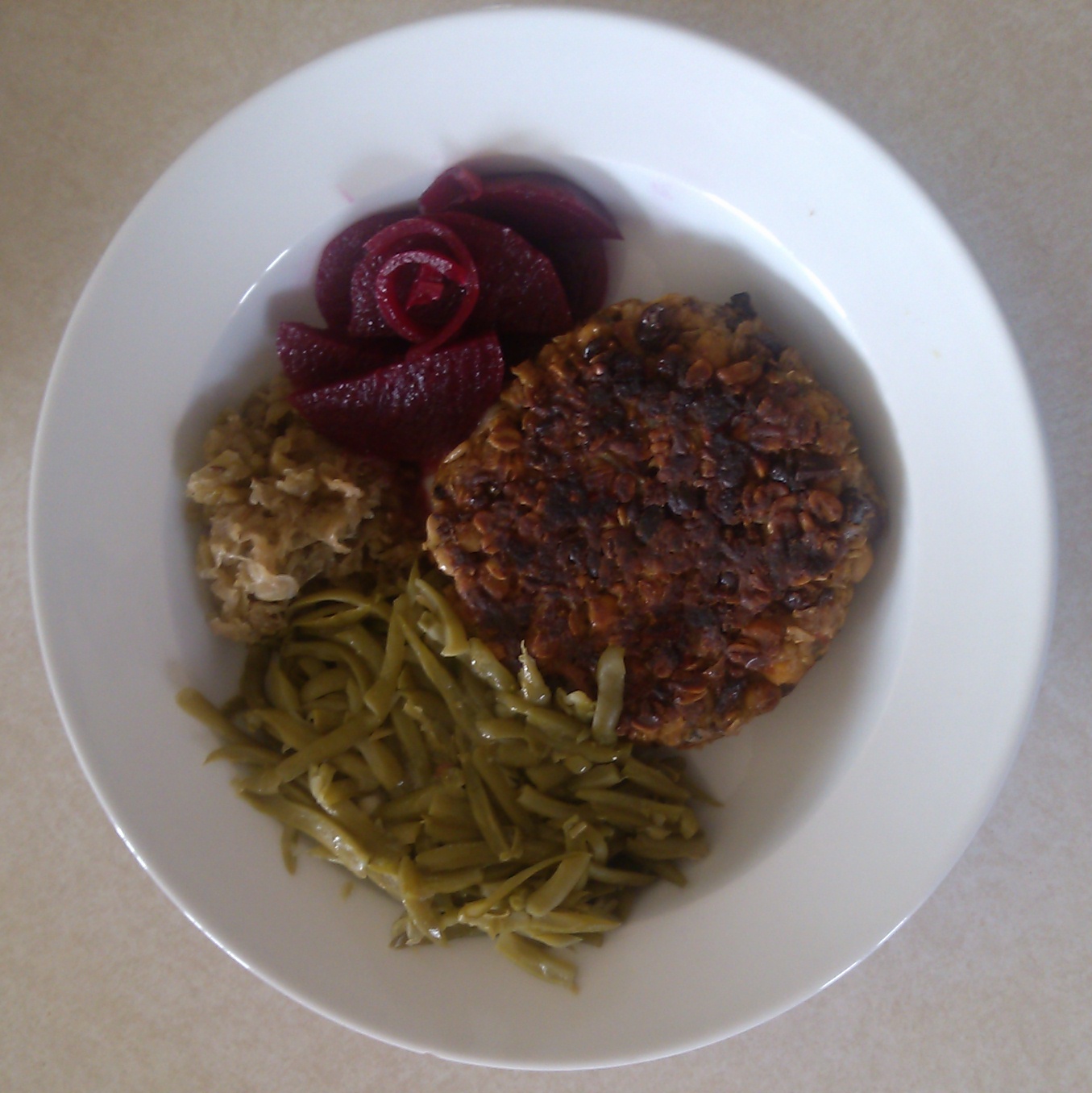
We are an ovo-lacto vegetarian household, although Morningstar Farms makes me a lazy vegetarian at home.
In our ecology of food we still purchase mass-produced, vegetarian burgers, recipe crumbles and chik patties. It’s an easy dinner to warm one up, prepare a couple of side dishes, and call it done.
I came up in a household where variations of hamburger played a number of roles. Mother made burgers, chili, taco meat, meat loaf, meatballs, and many other dishes using various cuts of ground beef. To a large extent, our current use of meat substitutes is to evoke memories of that long ago childhood.
A couple of homemade vegetarian burger patties wait in the freezer, and I look forward to finding or inventing a recipe that hits all the notes of satisfaction. Maybe then we can quit using outside products. In the interim, manufactured meat substitutes create a predictable, inexpensive, convenient source of food comfort.
I recently read Anthony Bourdain’s book, Appetites, in which he wrote about hamburgers. I don’t know if he approved of manufactured burgers, but using inexpensive buns from the wholesale club, I took his written explanation and videos and made a hamburger sandwich that proved to be quite delicious. A burger and fries (made from local potatoes parboiled and frozen after harvest), with home made dill pickles, is my go to dinner when my spouse is working. The manufactured burger patties fit the recipe just right.
I mentioned the Bourdain story to a friend. His response? “You do know he committed suicide?” Guess I’m not too worried about that possibility. For now, meat substitutes remain in our food ecology.
Tradition and memory play a role in our food culture. It wouldn’t be that difficult to figure out the nutritional content of food products and construct a generic meal designed to meet nutritional needs. The dialectic between nutritional science and memory waxes and wanes, and a desire to serve memory seems unlikely to be suppressed. As Chef Matt Steigerwald said, “Food is important.” I submit a corollary, “Food we grew up with is also important.”
I’m not really a vegetarian, except at home where I am a lazy one. From time to time, at social events, or when I’m in a hurry, I’ll eat something containing meat. Suffice it that the industrial meat complex is not sustained by my meager consumption of its products.
When I worked a summer job at a meat packing plant, one of the measures of our work among summer help was whether or not we’d eat what we made. That depends, I said. We made things like fertilizer, rendered lard, chitterlings, organ meat and other exotica which haven’t had a place on my plate ever. Back in the day, when I was single, I occasionally bought white bread, packaged bologna, and yellow mustard to make sandwiches, although those seem like ancient times. There were enough FDA inspectors around the plant to engender a feeling that the food products were safe to eat. I’m not sure that remains the case and my exposure to it is minimal.
It doesn’t seem human to be regimented or formulaic in the kitchen. If it were, why wouldn’t we have a home robot prepare all our meals? I’m no robot and flourish in an environment where each kitchen session is a blank slate. There are also times when a burger, fries and a dill pickle make me feel like home. That has little to do with nutrition.
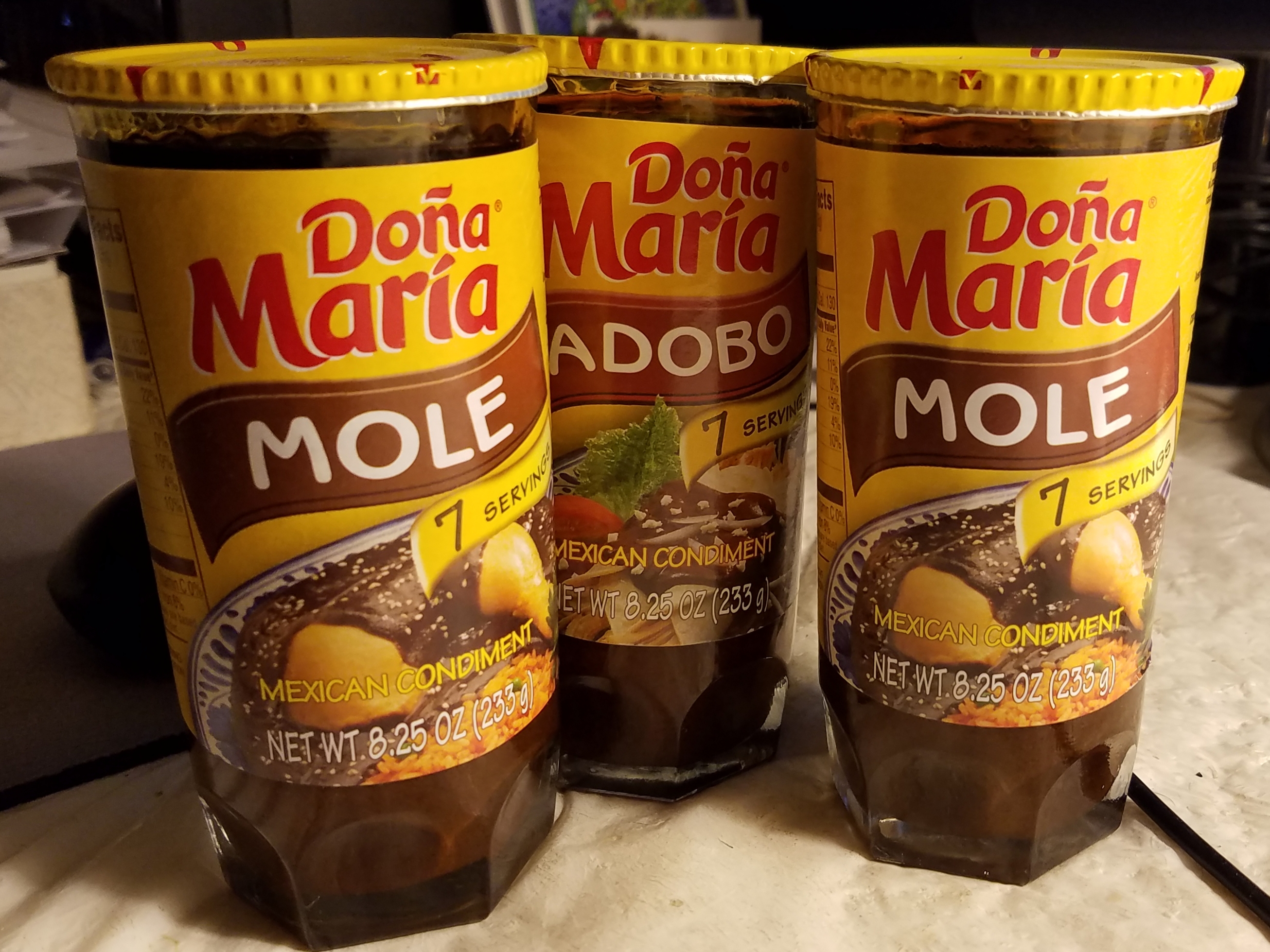
I found jars of mole and adobo paste in the pantry. They expired a long time ago but that didn’t stop me from re-hydrating a jar with home made vegetable broth and making a dish with tofu.
Using prepared mole paste makes the process easy. Layer drained and washed black beans, cut corn and cubes of firm tofu in a casserole. Next, pour mole sauce all over and bake in a 375º oven until thoroughly heated and bubbling, about 35 minutes. Top the casserole with sliced green onions and fresh cilantro if available. Spoon the mixture on brown rice to make a satisfying meal.
This is not a recipe as there is no intent for readers to prepare the dish. I’m capturing a moment in time. I’m not even sure I will make Tofu Mole again once the jars of paste are used up.
It’s another idea on the current excursion into Mexican flavors. It is all uncharted territory and that makes the journey engaging.
Turn-Style Department Store, Davenport, Iowa. Photo Credit – Davenport Iowa History Facebook Page
In high school I worked part time at a discount department store called Turn-Style. Located on Brady Street near what was then the edge of town, the meager income enabled me to purchase a used Volkswagen Beetle and save money for college. I made my first contribution to Social Security while there and learned work habits that continue to serve.
Over the years, Jewel Food Stores sold Turn-Style to May Department Stores which converted it to a Venture Store. It was purchased by K-Mart. Today the building is a Theisens Home, Farm and Auto Supply store, owned by the same family that owns the store where I currently work two days a week.
In high school I worked in the drug department which sold consumable products that included over the counter medicine and hygienic products, candy, tobacco, nuts, greeting cards, gift ware, sugary drinks, and recorded music.
Most shifts I would spend part of my time stocking vinyl records, making sure any new arrivals made it to the sales floor, and the bins of albums were properly sorted and arranged. I picked records to play as background music before the days of Musak. There were no rules in the late 1960s and my supervisor seldom censored my choices. It gave me a chance to listen to music that wasn’t available on AM radio. I started buying vinyl and played it on my parents’ record player.
As my collection of records grew an issue arose: the distinction between being a music player and a music listener. It caused me some teenage consternation.
One of my neighborhood friends’ older brother was the drummer for a popular band called The Night People. They played at the Draught House next to the Mississippi River and the cool kids in my class went to hear them. I did not. I guess that made me a listener rather than a player, and I was okay with it. They would make fun of my friends and I when we talked about news from bands they had performed with.
I got my musical start right after the Beatles came to America in 1964. I persisted in playing, despite derision in our neighborhood. My song list included mostly folk songs I played by myself. On occasion I played with a small group or with someone else who was learning to play the guitar. It seemed like there were a lot of us learning to play then. There was always a divide between what music I played and that to which I listened.
In the end, a musician had to make a song their own. Bands like The Night People sounded just like The Beatles or Rolling Stones or whoever they mimicked. What art is there in that? Live bands like this were co-opted by disk jockeys who played original, prerecorded versions. If I was a music listener more than a player, it was to understand and adapt songs that might be a good fit for me. By all accounts The Night People were successful, and who ever heard of me?
During those years in high school I made a decision in the Turn-Style parking lot. A friend wanted to go to Woodstock. We’d heard about it the week before and he offered to drive if I’d come along and pay part of the gasoline expense. We talked about it for a while and in the end I said, “I have to work Saturday.” That was a decision easily made. In it I chose to be less a music listener and more a player. It made all the difference.
My story includes music, especially as I left home in 1970 to begin university. College began a period of adventure and learning that extended through my return to Iowa City in 1980 and subsequent marriage in 1982.
In following years I pivoted to providing for our family, which eventually included a daughter who had a musical training as part of her curriculum through high school. Somewhere between then and moving back to Iowa in 1993, the chords got lost and dissonant.
I had a nascent hope I could make a living playing music with no idea how that would work. The closest I came to it was when I flew to London in autumn 1974.
What would follow getting my English degree at the University of Iowa? To postpone answering that question I made a grand tour like people did in the 18th Century. With two thousand dollars in American Express traveler’s checks, a backpack full of clothes, and a satchel Grandmother made for me, I booked a flight from Montreal to London with a open return date. The trip was poorly planned and I had no clue where or what I would do once I arrived. I picked London only because English was spoken.
When I arrived at a youth hostel I met two musicians who had just arrived from New York. They had plans to find an agent and book some shows. They suggested I get a guitar and join them. I had no resume to present, just an assertion I had been playing since grade school. In any case, I bought a cheap guitar and made the rounds with them one day without rehearsals or a song list. I quickly grew skeptical, took their names, and decided to leave. It was probably best and the closest I’ll get to being a professional musician. That is, not close.
I carried my newly acquired guitar wrapped in the jean jacket I wore on the plane and headed out of London for a loop around Southern England. It included Oxford, Stratford upon Avon, Bath, Stonehenge, Salisbury, Portsmouth, Brighton and Dover. I played when I stayed at youth hostels and in parks along the way. I had no trouble meeting other travelers my age and made connections that would serve me while touring the continent. I practiced a lot to conserve funds and divert from the immediate need to find a place to stay each night.
Traveling alone, having my backpack stolen in Calais, going through Paris, then to Spain, Italy, Austria, Germany and Holland in rapid succession over 13 weeks made music a central aspect of my life. I got better at playing and playing with others. I used no sheet music, but listened to songs and figured out the chords in a style that suited me. I watched other musicians and learned from them. Music was not the whole experience as I took in architecture, paintings and sculpture as well. Music was something.
Music still is something. What exactly that is will result from this series of posts… I hope.
What surprised me was the clarity with which Obama depicted a life on the South Side of Chicago and how it influenced her both while coming up and once she had means to be on her own. The first two sections of the book are by far the strongest. That’s partly because as First Lady events in the third part had plenty of previous play in the media creating a background noise that interfered somewhat with her meticulous and thoughtful narrative.
She crafted a story almost anyone could relate to. Highly recommend you check this book out from the library and give it a read. Better yet, have your children read it, or read it with a group of friends.
After writing yesterday’s post I located the Yamaha guitar I bought for $300 in 1970. It was under the bed, covered in dust, with two broken strings sticking out of the case. I opened it, saw the guitar was virtually unchanged, then closed the lid and slid it back under the bed.
Not yet.
Last night a friend posted Instagram video of Greg Brown, Iris Dement, Dave Moore, Larry Mossman and Ben Schmidt playing music around a dinner table in someone’s home. Instagram is not the best medium for music. Nonetheless, it captured the moment well enough to believe it happened. Maybe that’s the point more than the tunes they played.
The last time I played with someone was during a trip to Montana in July 2010. We overnighted at a friend’s remote cabin. We had played together in a band while I was at university. He had an extra guitar and I struggled to keep up with the simplest chord progressions. By the end of the session I felt my skills could come back. That’s as far as it went.
A high school classmate’s family owned an old farmstead near Bellevue. When we first went there, there was no furnace and many rooms were empty. Over years the family fixed up the place, furnishing it with second hand beds and furniture. I remember the children made quilts for the beds. I attended a wedding reception there. It made a cozy family gathering place. My friend invited me to a meet up with a group of his college classmates. He took my guitar to a remote corner of the house to play by himself. We all want to get better at what we do, as did he. They sold the place years ago.
Being a musician, even a bad one, requires practice. More practice than seems reasonable. What I found was there were not enough venues in which to perform. I’ve played at coffee houses, on stage, for small gatherings, and at least one wedding, but most of the time I played alone, or when I was in one, with the band. There is a certain self analysis in music making. Did I hit the right notes? Did I miss anything? How could I phrase that better? Practicing music is like writing in that there is always a next draft, that is, until one performs. The performance stands alone in stark existential reality.
I’ve seen countless musicians perform in person. Among the most memorable was Andrés Segovia who played in Iowa City during the height of influenza season. The audience was coughing and hacking throughout his performance until Segovia stopped playing, took a handkerchief from his pocket, and coughed back. There was scattered laughter.
Perhaps the most famous person I’ve heard perform was Sir Elton John at the Cow Palace in San Francisco. Oracle hired him for the annual Open World conference attended by tens of thousands of people, including me. I was invited because our logistics company was installing a version of Oracle’s transportation management software.
During my time in politics music began to be associated with political events. When I managed a state house campaign we sometimes hired a musician to perform at fund raising events. Over time, I heard Carole King and Bruce Springsteen perform at big events for presidential candidates. I remember former U.S. Senator Tom Harkin singing “every day is a winding road” with Sheryl Crow at his annual steak fry. Can’t say I attended any of those events because of who was performing.
For now the guitar rests under our bed. It’s a question, I guess. Will I take it up to play again? It moves me toward practice and maybe performance, and that’s a form of progress even though I don’t yet know the answer. Before proceeding down the music trail I need to visualize it. With all the practice required, I don’t want to wander without a vision.
Showing off calluses on my fingertips Photo Credit – Mike Carron
During the last couple of decades the role of music in my life diminished. There was no plan, it happened on its own, without a recognizable nudge.
My guitars and banjo are tucked in safe places around the house, protected from the elements, largely unused. I sold my Telecaster to long-time friend Dennis. It has been a long time since anyone used the piano in the living room. My shelves of vinyl, cassettes and compact disks gather dust. Since the budget cuts on public radio, I can’t find a station that plays music in a range of eras and styles. In the car, my presets are country and classic rock. For the 25-minute commute to the home, farm and auto supply store I can stand them, mostly. The last musical concert I attended was a Celtic guitarist at the local library. I follow him on YouTube and that’s where I do most of my home music listening today.
It wasn’t always so. In first grade I served as emcee for a variety show at Sacred Heart Catholic School. I wore a bow tie and rehearsed my lines carefully. There were words I never heard before in the script. I introduced performances by my classmates, then wanted to perform.
When we moved across town in 1959 I took piano lessons at the grade school. I practiced in the upstairs gymnasium which also served as an auditorium, my rendition of Brahms bounced off the walls of a large, empty room at the end of the school day. My neighbor, a couple grades ahead of me, was a guitarist and played a concert for us graders before he left for high school. I thought he was cool, and he’s now one of the few people I know who make a living as a singer songwriter.
By eighth grade I was playing guitar. On a snowy day the year the Beatles came to America Mother took me to the King Korn stamp store where she traded books of stamps for a Kay guitar. I played my first concert of folk songs in eighth grade along with some neighborhood friends.
In high school, I took guitar lessons from the late Joe Crossen who played in a rock and roll band. After that, I tried to learn classical guitar at university but my fingernails weren’t good enough to make it work. After leaving Davenport in 1970 I felt music would be part of me. For many years it was. I don’t know what happened. This is not a lament or dirge. I accept life as I find it while imagining the future as it should be.
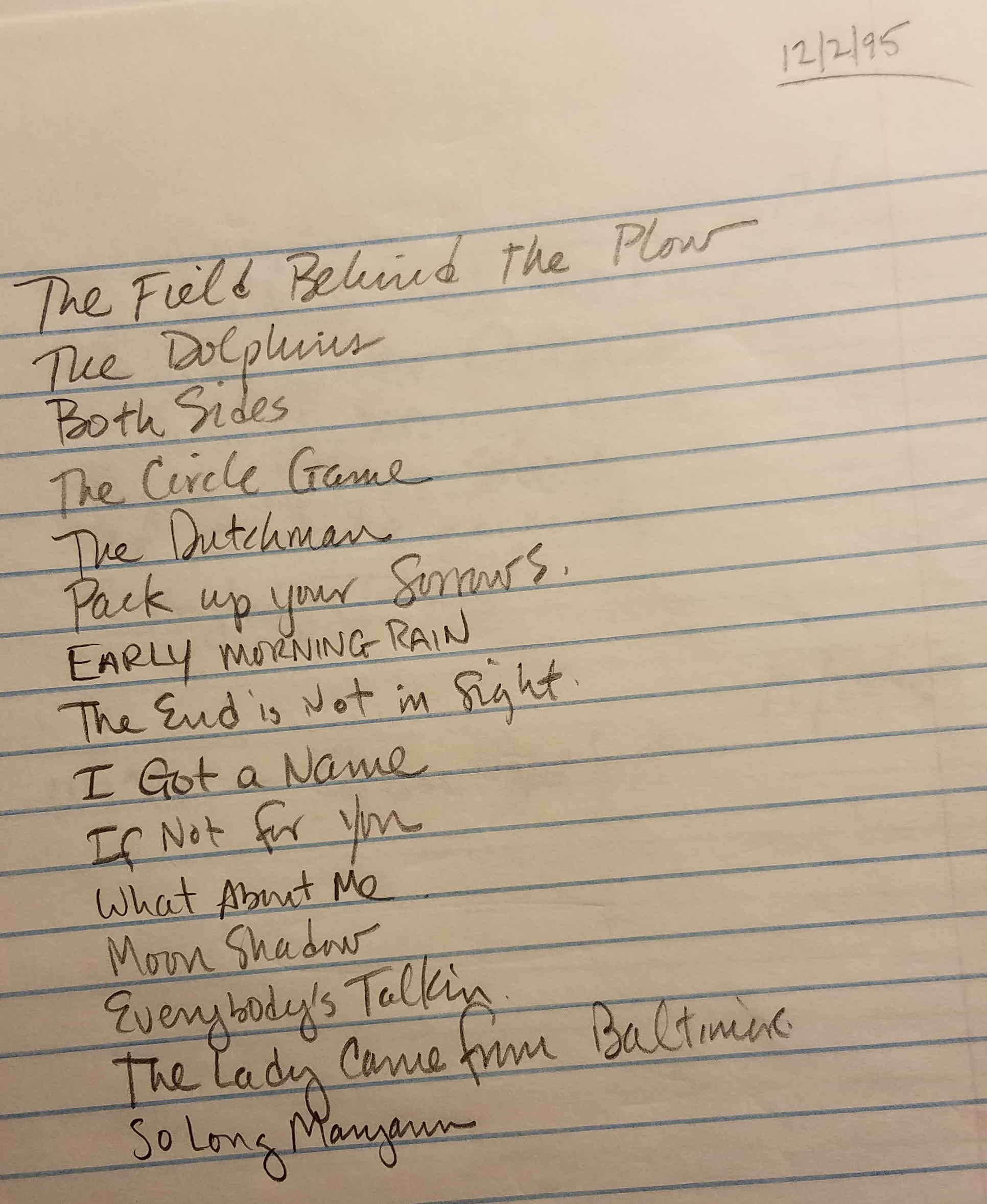
The other day Jacque and I were listening to different versions of The Dutchman, a ballad by Michael Peter Smith. We listened to his, Steve Goodman’s and Liam Clancy’s versions and it became clear Smith’s phrasing and tempo made the better experience, evoking an emotional response. We talked about the song which has been a favorite since early in our relationship. It was surprising how good Smith’s version was, when we’d only paid attention to Goodman all these years.
I’m awake early this morning, tapping on the keyboard. My sister in law stayed over last night after a brunch with friends in the Quad Cities. I don’t want to wake the house and keep the music turned off. Neither do I use headphones because I live in the moment at my desk. If there are noises in the house — the water softener cycling, someone walking to the bathroom, the washing machine running — I want to hear it. No muffled reality for me.
I don’t know about music any more. Every so often I find a song I like and listen to it repeatedly for a while. Then I get over the infatuation. What I mostly want is a feeling I should play music again. It’s not there yet. It may never be. I have a hard time visualizing it.
I remember traveling the Mediterranean coast with a young student from Germany in the 1970s. We had Eurail passes and rode trains from Barcelona, Spain to Genoa, Italy, playing guitars in our youth hostels until the host reluctantly said it was getting part curfew. I played lead to his rhythm and vocals, it was life as good as it gets, fleeting, transitory, in the moment. That can’t be captured again in the same way. Despite years and neglect, music can live within us. At least that’s my hope in late autumn.





 Journey Home
You must be logged in to post a comment.