Monday I made a big pot of vegetable soup using what has become a standard process.
Mirepoix of onion, celery, carrot and salt sautéed in a couple tablespoons of vegetable broth.
Potatoes peeled and cut in large chunks, a 15 ounce can of rinsed, prepared beans, a pint of diced tomatoes, a quarter cup of barley, a half cup of dried lentils, a few bay leaves, two cups frozen sweet corn, a quart of home made tomato juice and vegetable broth to cover. I added lots of potatoes and carrots for texture and flavor. Toward the end of cooking I added a cup of frozen peas.
The soup cooks up thick and hearty, just the thing for subzero temperatures the polar vortex is bringing our way tonight and tomorrow.
Other soups I make are similar, adding every kind of vegetable we have on hand — after harvest or after cleaning the refrigerator. The limited number of ingredients in this recipe standardizes the outcome into something recognizable and delicious. Importantly, it is repeatable.
Over the weekend I sorted recipes, an act of curation. I found I’m much less attached to dessert recipes. Over the course of a year I make a few batches of cookies, an apple crisp or two, maybe a spiced raisin or applesauce cake. Those recipes are well used and written in my red book. I love dessert, but not that much.
The dessert recipes I kept included blueberry buckle, a seasonal item we serve at the orchard after the first blueberries come in from Michigan. The recipe our bakers use is called “Betty’s Blueberry Buckle,” but the one I have will serve.
While in graduate school I conducted a series of interviews with a subject for a class on aging. She had a letter from William F. Cody inquiring about his legacy in Davenport. I kept her recipe for custard for the memory, although I’m not sure if and when I might use it.
I find it hard to dispose of artifacts of consumption, although about half of the unsorted pile of recipes went into the paper recycling bin. That I got rid of anything is a sign of progress. So many things compete for attention that piles of artifacts, like these recipes, sit around indefinitely.
Winter is a great time to enjoy a bowl of soup and sort through the detritus of a life on the prairie. I look forward to spring.
Since retiring in 2009 my morning routine includes making a French press of coffee shortly after waking, wandering downstairs with sleep sand in my eyes, reading at a computer for the first cup, then writing.
When I’m writing everything fades into background as I consider words on a screen. It is bliss.
This blog hit a record number of views in January with four more days to go. I’ve posted almost every day since apple season ended. If I consistently apply my skills as a proof reader and editor I can produce a post that engages readers without calling attention to the prose. I live for return readers and discussions in society about what I’ve written. That too is addictive.
I’ve become some kind of writer animal. The work is not really process, more like a habit that roots out meaning in a common life. Some days are better than others, but an intellectual or human side appears only irregularly.
The addiction worries me.
Cognizant of increasing age I’m reluctant to spend too much time writing. When I begin, minutes and hours go by in a mysterious vortex that sucks away time leaving a few hundred words. That’s not all bad, just worrisome.
With the economic security of income from diverse sources, I’m free to do what I want. From time to time I think about building a wooden bench to place under one of the trees I planted. In good weather I’d read poetry and consume Galoises and Pernod Ricard while immersed in sunlight and pondering the muse. I’ve been drunk in France after too many anise aperitifs and don’t smoke. As good as it sounds, I doubt that’s my future.
Process isn’t everything but it helps. If I were to improve my writing — take out some of the animal-like habits — that’s where I’d focus. Seeking raw material in memory and artifact, discovery of meaning in society, followed by writing, re-writing and more re-writing. Something positive seems likely to result.
As I finish my second French press of coffee I’m wide awake.
I’m drawn to this comforting place, surrounded by books, with a small space heater keeping away the subzero temperatures outside. I’ll ponder my craft a while longer before turning everything off until tomorrow. Such pondering making us human as much as writing ever might.
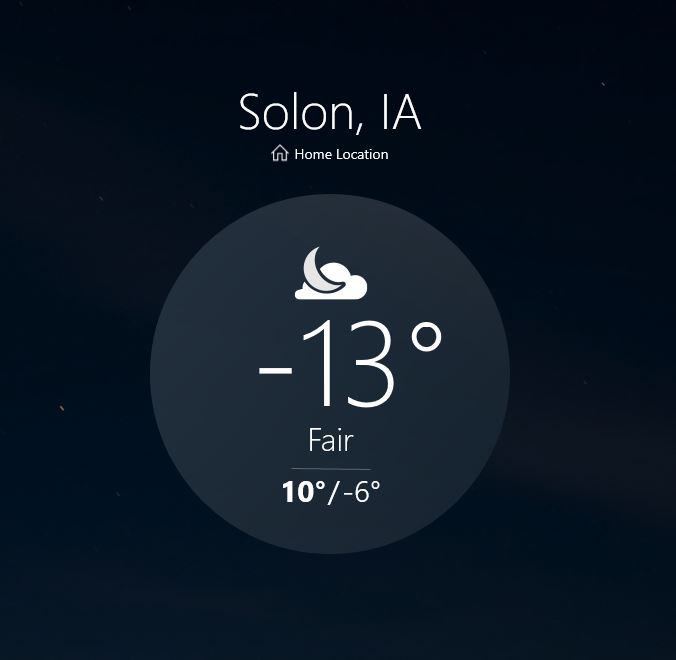
Outdoor ambient temperature Jan. 26, 2019, at 6 a.m.
Images depicting ambient temperature reports have been ubiquitous on social media the last few days.
According to the Weather Channel, temperatures plummet to 25 degrees below zero by Tuesday thanks to a polar vortex.
It’s what I’ve been waiting for to prune apple and pear trees as sap flow is halted by the temperature. Considering the forecast, the best day to prune will be Friday, Feb. 1.
Not everyone likes the cold but I don’t mind. I’ve never had frostbite or chilblains, even while living outdoors in subzero temperatures for a week at a time during military service in Germany. If one takes precautions, risks are minimal.
Once trees are pruned, I’ll be ready for it to warm up.
The cold spell began just as my shifts at the home, farm and auto supply store ended. We are bunkered in with plenty of food, a working furnace and water supply, and an internet connection. As president of our home owners’ association I worry that cold weather will cause a water line break, so fingers crossed. Later today I’ll drive my spouse to work in town so the car doesn’t sit in the snowy cold while she’s there.
Today’s cold weather is like what I recall from childhood. If there is no wind, it is tolerable and welcome. Like every year, winter will turn to spring and everything that means.
Every Wednesday evidence newspapers are dying is delivered to the end of our driveway.
I’ve asked the Iowa City Press Citizen to stop this delivery as we get a digital subscription. They can’t. They deliver the paper free on ad days to boost circulation numbers upon which advertising revenue depends.
The whole newspaper business seems to be on life support: advertising revenue diverted on line, subscriptions down, profitability gone. If governments could forego publication of notices, minutes and official announcements, they would. It would sink many low circulation weeklies in small cities. There are no easy answers and in many homes it is not a question: how can newspapers survive?
It is a big commitment to read a daily newspaper. I know because only in semi-retirement could I read two dailies — The Iowa City Press Citizen and the Cedar Rapids Gazette. With life being a time crunch to address other priorities, it is easier and more relevant to read from a score of internet news sites on the go than be restricted to a single newspaper. That’s part of the problem.
It goes deeper than that. Steve Cavendish of the Washington Post wrote today,
Print revenue is down, digital and mobile revenue aren’t nearly enough, and now a hedge fund promising even deeper cuts wants to acquire the company (Gannett). If the future of corporate news operations looks bleak, that’s because it is.
Newspapers have been under pressure since a heyday that ended in the late 1980s. Hedge funds owning newspapers is the final butcher block upon which the pieces get cut up and sold to the highest bidder. People continue to want news, so what is the next evolution?
There is talk about blogs being a potential supplement or replacement for formal news organizations. I doubt it for a couple of reasons.
Part of what makes good reporting possible is the financial backing of a large organization. Even though news organizations are diminished in that regard, a blogger is either self-financed or just barely capitalized. Pat Rynard of Iowa Starting Line took “this month off from writing to handle our financial and administrative side of things.” Rynard is proving the model of blogging as a political news source, however, he is one guy. Whether his operation is scalable to the level of a news organization is an open question. He reported today he should be solvent through the February 2020 Iowa caucuses, which is a positive. As much as I’d like to see him succeed with sustainable funding and revenue, he faces a lonely and uphill struggle compared to a stressed but viable news organization with adequate financing.
Laura Belin, publisher of Bleeding Heartland, is self financed so her struggle is not financing but access. Associated Press reported today she is trying to get a press pass in the Iowa House of Representatives. AP’s Ryan Foley wrote,
Belin applied for formal credentials for the first time to cover this session, which would grant her work space and easier access to briefings with key lawmakers, among other things.
She was denied but is persisting with her request. Judging from the quality of Belin’s previous coverage a press pass would make logistics easier, although her coverage already sets a high journalistic standard. She breaks news and covers topics newspapers don’t. This leads to another issue, readership.
Foley reported Bleeding Heartland gets 1,500 or more unique daily views while in session. That is great exposure for a blog, however, not nearly what a newspaper, with a print circulation of thousands would get between print and on line. Once I got more than 3,500 unique website views when I freelanced for the Iowa City Press Citizen. My average was much lower than that, but print edition plus on line clicks was always more than 10,000: hard to beat for a blogger. While I stop in at Bleeding Heartland and Iowa Starting Line frequently, they do not yet have the general audience penetration to compete with formal news organizations. As political blogs with a devoted following, maybe they don’t need it.
The first job I held was as a paper boy delivering the Des Moines Register. There weren’t many sales and it was a long walk between deliveries. When I ran into customers while making collections I got feedback on what they liked and didn’t like about the newspaper. (Mostly they didn’t like Donald Kaul’s Over the Coffee). Those days are mostly gone.
I hope the Iowa City Press Citizen survives the next acquisition. They already got rid of their big facility off North Dodge Street and are tucked away in rental space above a couple of restaurants. The idea of delivering free papers to boost circulation sounds like it came from an accounting meeting. I’m reminded every Wednesday the newspaper business as I knew it has dim prospects for the future.
Crews were removing about 10 inches of snow from the parking lot at the home, farm and auto supply store when I arrived for my shift.
Part of my work was hand shoveling the areas around the dock so trucks could get in to deliver. There was a lot of snow.
Around 1 p.m., a trailer load of “contractor trailers” arrived from the western part of the state. My job was to unload the five-high stacks from the flatbed truck. It is always tricky business and the snow packed pavement made it more so.
This job is a three person team. The truck driver climbs the stacks of trailers loosening tie down straps and securing the ones I’m lifting with a chain to the forklift mast while a trusted associate ground guides. It took three and a half hours to unload trailers into drifted snow around the edges of the parking lot.
It’s all in a day’s work, the most challenging thing I do.
At the end of the process I felt something had been accomplished.
This is part of a series about political issues that garner interest, but maybe too much or for the wrong reasons.
Main events occurred today at the Iowa State Capitol in the second week of the first session of the 88th General Assembly. Among them was a meeting of the State Government Committee about IPERS.
In a 5:22 a.m. email to my state representative and committee chair Bobby Kaufmann I wrote,
Good luck with the IPERS hearing today. I believe Iowa Policy Project and Progress Iowa are foolish to continue to hammer away at Republicans about IPERS. I agree it was problematic a couple of years ago to bring in the Reason Foundation to “evaluate IPERS,” however, the governor and Republican leadership got the message from Iowans not to mess with it. Time to move on.
A few hours later, I continue to believe that is true.
At the meeting Kaufmann reiterated his Dec. 6, 2018 assertion that under Republican leadership, and as long as he chaired the State Government committee, no changes would be made to IPERS. I’m sure today was meant to be the final word since everyone, including the governor, house speaker and senate majority leader said the same thing.
During the committee meeting, State Representative Mary Mascher, one of my favorite politicians and human beings ever, was mentioned by reporter Caroline Cummings in this tweet:
Cut to chase. Messaging the senate is not going to happen. Kaufmann would not have said what he did without Republican leadership support. After the 87th Iowa General Assembly, in which Republicans were noted for last minute bills Democrats barely had time to read before voting, any trust between Democratic and Republican members broke down. As Bobby Kaufmann’s father Jeff told me at the Solon Public Library on Jan. 21 2012, “There is no longer a Daniel Webster moment where people’s minds are changed in floor debates.” The “trust issue” to which Mascher referred is real and not going away.
At 1:01 p.m., shortly after the meeting, I received an email from Progress Iowa about it, confirming what was said, with a surprising addition, “We won’t be bullied by Bobby Kaufmann.”
IPERS is an important retirement program for many Iowans. It is right to stand up for it as was done the summer of 2017. However, it seems unlikely to be changed this session and maybe next because of the negative impact change would have on Republican chances in the 2020 general election. At what point do we move on to issues that matter as much or more?
When there is no imminent threat to IPERS the posturing, misrepresentation and hyperbole of groups like Progress Iowa seems misdirected. The cliche in politics is follow the money. Who is financially backing them? Why IPERS? The organization’s financial reports would likely provide answers.
It is important to watch the progress of IPERS in the legislature. It is simmering on a back burner and the governor said in 2017 she would like to evaluate changing the program to a hybrid with a defined contribution instead of a defined benefit for new members. She said she would protect the defined benefit workers were promised. Wealthy libertarians behind Dark Money in politics are playing a long game. Waiting a couple of years so house members can get re-elected is not an issue. Vigilance is required to make sure the IPERS pot doesn’t boil over unexpectedly. For now, the committee chair who would have to pass a bill has declared, “Not on my watch.” Democrats will be keeping watch.
It is time to set this one aside and focus on other, better, equally important things this session.
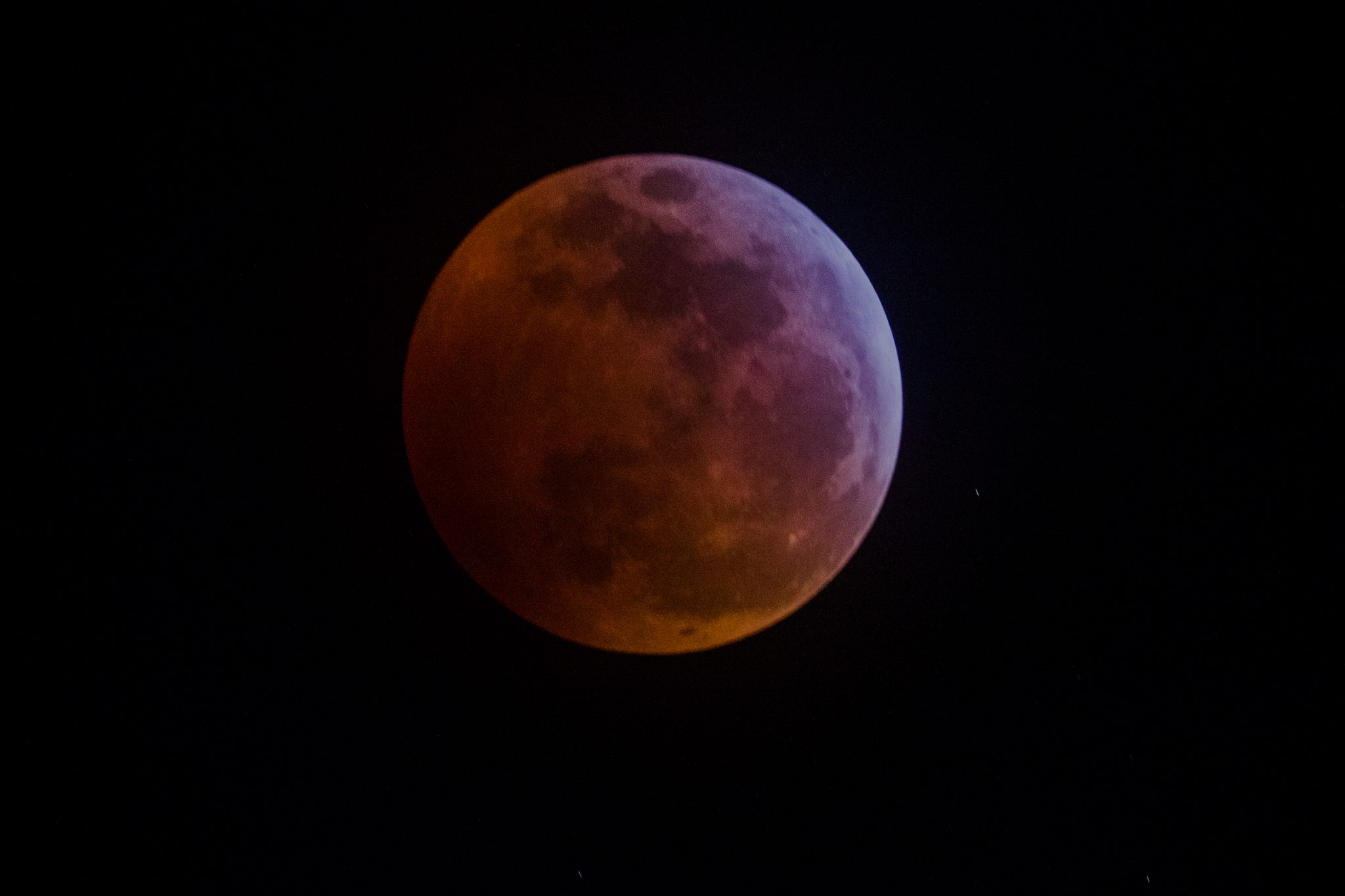
Lunar Eclipse on Jan. 20, 2019. Photo Credit – Van Allen Observatories, Iowa City, Iowa.
Refracted light creating a reddish-orange hue on the moon’s surface looked pretty cool last night.
It was an event to remember, one that transcended daily life. It drew many of us together with a shared experience.
In the eclipse it was easy to imagine and literally see the vast emptiness of the universe. It reminded us of how reliant we are on our only home with its thin layer of atmosphere. No human hand played a role in the astronomical phenomenon except to warn us, as astronomers have since ancient times, it was coming.
Lunar Eclipse Taken with Mobile Device
The event had a long name: super blood wolf lunar eclipse. I don’t need or want a name, just memory of the image enlarged on my retina with a pair of unsteady binoculars.
After sunset the sky was as clear as it gets. The full moon illuminated everything in bright, silvery light. A few years ago I would jog on the lake trail in such light. As the eclipse progressed, the landscape darkened. The moon moved above the house so I went out to the driveway to see it. It was below freezing and I returned inside several times to warm up.
Witnessing the lunar eclipse lacked profundity, it being a function of celestial mechanics. If I was inclined to howl, that’s on me and my humanity. The experience asks the question why can’t we get along when we have so much in common? No answer was forthcoming.
I thought of Juliet’s speech to Romeo:
Although I joy in thee, I have no joy of this contract tonight. It is too rash, too unadvised, too sudden, Too like the lightning, which doth cease to be Ere one can say “It lightens.”
I cling to the shared experience even if my view is blurred by an intervening atmosphere, inadequate lenses, and less than perfect eyesight. If the shared experience serves a human purpose, I’ll assimilate it, becoming the eclipse. Maybe it could transcend physics to help sustain our lives in a turbulent world.
Editor’s note: An original version of this post appeared on Nov. 13, 2010. It has been edited because my writing wasn’t as good as I thought back in the day.
Clarity surfaced during a talk by Ana Avendaño, assistant to President Obama and Director of Immigration and Community Action for the AFL-CIO.
She was in Iowa City, talking about the meat packing industry. Her narrative struck me:
Back in the 1970s, meat packing workers were among the highest paid in the country, more highly paid than some auto workers. Multinational corporations, with a strategy of busting unions, began consolidating meat packers, creating a perfect storm for labor and a perfect outcome for themselves. Union workers were replaced with a continuous stream of lowly paid immigrant workers.
“The narrative of the meat packing industry is important to remember,” she said. An emblematic consequence of consolidation has been the immigration raids in Marshalltown and Postville.
Corporate advocacy to break labor unions is a global phenomenon, Avendaño said. “What corporations can’t do in a free market, they are doing through governance,” putting pressure on law makers to make labor law more favorable to their interests. She spoke of the International Monetary Fund and the World Bank as co-conspirators. They hold out loans to countries and “specifically require them to change labor laws in a way that hurts workers,” Avendaño said. “It is the hypocrisy of what we are living through today.”
I worked in a meat packing plant two summers while an undergraduate. It was easy to get a job there. I belonged to a union, the Amalgamated Meat Packers and Butcher Workmen of North America, and at $4.04 per hour, made enough money to get through the next school year. As Avendaño’s narrative suggested, wages were good.
The plant conditions were dangerous and work was physically challenging. My maternal grandmother and father had both worked in the plant and my father died in a plant accident. I never felt in danger, working as a millwright’s assistant in 1971 and on third shift cleanup crew in 1973. I got to see most of what went on throughout the plant and warehouses. It was not pretty.
Avendaño missed something. It’s true low cost operators like Iowa Beef Processors could perform the work cheaper and re-invent how meat processing was done. It’s true unions gave concessions until many of the jobs, especially slaughterhouse jobs, were consolidated in a much smaller number of places. It is also true that at a lower rate of pay, many Iowans no longer wanted to do this work. Enter immigrants.
As Avendaño spoke, adjusting her glasses, and pointing at the PowerPoint on the screen, it hit me. After my father’s death, while rummaging around in his basement workshop, I found a pay stub from his work at Oscar Mayer. He made less than $90 per week.
It was a different world then. How we acquired and made our food was different. Dad shopped at the company butcher because meat was fresher and less expensive. The rise of highly processed foods, farm subsidies that keep prices low, and the invention of a consumer society where we spend more than we earn using credit, had not begun. We made more food from scratch because many of the food items in today’s grocery store aisles did not exist. We lived close to the means of production and $90 per week was a living wage. We were working poor, but didn’t call it that. We had a decent life.
That is where the narrative unravels. Life was not about pay and benefits. It was about what else we did with our time. Even at those wages we couldn’t wait to get out of the plant. We knew we could do better with our lives than work on a production line. Avendaño was advocating improvements in a status quo that while needed for the betterment of workers were no solution to larger problems of corporate hegemony in our lives. It is as if we have stopped trying to improve society, so we can cling to the remaining dregs in a barrel of prosperity long drained by the wealthy class.
That morning, in the darkened room, it seemed a fool’s errand and that was my epiphany.
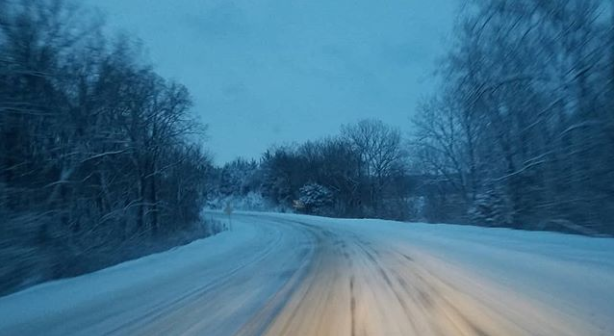
Between three and four inches of snow fell overnight. It’s still coming down. I have 80 feet of driveway and a shovel to deal with when the sun comes up. The first buckets of salt and sand were emptied yesterday — there is plenty in reserve.
It’s not our first winter in Big Grove.
I filled the bird feeder for the first time this year and expect birds to find it this morning. Deer, used to the cultural resonance of last year’s seeds, have been stopping by to check the feeder since hunting season began.
Despite the unbroken crystalline sheet of snow it’s not a blanket, that clichéd word. We need a new vocabulary. Neighborhood sounds are muffled in pre-dawn hours yet we know global tensions have increased rendering nothing comforting about newly fallen snow this January.
President Trump’s “America first” slogan and the actions behind it are unraveling what global order existed before his rise to power. We all know it and the dissonant, unwelcome noise of his administration conditions us with its absurdity. Columnist George Will characterized the effect in the Washington Post,
Half or a quarter of the way through this interesting experiment with an incessantly splenetic presidency, much of the nation has become accustomed to daily mortifications. Or has lost its capacity for embarrassment, which is even worse.
I’m interested in U.S. foreign affairs. The last two years have been exhausting.
Step-by-step, we withdrew our leadership from the Trans-Pacific Partnership, the Paris Agreement under the United Nations Framework Convention on Climate Change, and the Joint Comprehensive Plan of Action regarding Iran’s nuclear program.
There’s talk about withdrawal from the INF treaty, the New START treaty, and even from the North Atlantic Treaty Organization which our country helped found.
Trump’s meeting with North Korean dictator Kim Jong-Un was a head scratcher. After decades of unsuccessful negotiations regarding North Korea’s nuclear weapons ambition, the president held a brief meeting in Singapore then declared in social media, “There is no longer a nuclear threat from North Korea.”
It is hard to describe the instability we created in the Middle East where we’ve engaged third string envoys like Mike Pompeo and John Bolton to do our work, in Pomeo’s case, only until the Rapture.
Last week the president introduced his Missile Defense Review which is certain to destabilize relationships with China and Russia, potentially fueling a new nuclear arms race.
By these actions and more, the United States under Trump created a vacuum of leadership which China in particular, but Russia as well, are ready to fill. What is lost in “America first” is the American people benefit from international stability. This president and Republicans who back him apparently could care less.
We understand there will be a 46th president. The U.S. House of Representatives is poised to check this one. The only question is when he will exit the office. In the meanwhile, it is time to clear snow from the driveway and get out in society, to sustain our lives while the absurdity continues.
I don’t like the national disgrace under which we currently live and the instability this president created. Few I know do. Time and good work will cure some of it. At least that’s what I hope now that we’re getting into winter.
Author at Kraft Foods Oscar Mayer plant on Second Street in Davenport, Iowa Nov. 25, 2011
Feb. 1 will mark 50 years since Father was killed in an accident at the meat packing plant. Memories of Dad have hardened into meaningful stories. I was thinking of him when I woke this morning.
What I remember most is his trying to get out of life as a factory worker. He never made it.
He didn’t like it that he got his hands so dirty, that work in the plant was degrading. His father felt the same way about mining coal. Father and son, they both tried to escape their work culture and couldn’t. Dad encouraged me to find a different path and I tried. After two summers working at the plant during college, doing some of the hardest work in my life, I declined their job offer to become a plant foreman after graduation. It was the only offer I had.
The most important decision I made after Dad died was whether to leave Davenport and attend the University of Iowa as he and I discussed. Mother encouraged me to go and I did. For years I didn’t understand that the August 1970 trip to Iowa City was it. My relationship with family changed in a way that was unexpected and forever. I didn’t realize it at the time but I mourned Dad’s death long afterward. I don’t know exactly when — probably during military service — I was able to live with the loss.
After a shift Dad would head over to the Knotty Pine or Pete’s Midwest Tavern where he would cash his paycheck and socialize. It was what people did, the culture of meat packing. That night he cashed his check at Pete’s Midwest over his lunch break. I kept the coins from his pocket after he died, Mom used the bills the way she would had he gone on living.
Losing a parent before life begins can be tough. It was life-altering for me. Fifty years later I don’t think of the loss. It is a part of me about which there is no thinking, only doing. What else is there to do except go on living?







 Journey Home
You must be logged in to post a comment.