A colleague at the home, farm and auto supply store is itching to get on the road.
Last year he drove for a local asphalt company making pretty good dough. When the seasonal job wound down he returned to retail.
“I can’t do this for ten years,” he said, referring to both his age and the retail work he had undertaken.
He asked my advice about working for a large truckload common carrier driving over the road. I told him it’s a hard life.
Because of his type of driving experience, the firm to which he had applied required he attend a company-approved truck driving school for two weeks. It’s been 20 years since I recruited men and women for that type of school to work program but I provided advice nonetheless.
There will be an agreement. Make sure to read it before signing, I said. During my tenure in driver recruiting, attending a company driving school before employment was not free. Typically the written contract is for a period of employment, up to a year, after which liability to repay the schooling was forgiven. If one quits, for any reason before the term is up, the former employee would be responsible to repay the entire amount. Back in my day it was $5,000 although that likely changed since then. Creditors will dog debtors relentlessly, so the agreement is not to be taken lightly.
Second, do you really want to be gone from home for three weeks at a time? Driving is tedious, sedentary work for van drivers with hours to think about things. There is more physicality in being a flatbed driver, with tarping, chaining and strapping loads, but at a certain age who wants that? Time off changes forever for over the road truck drivers. That’s its nature and it is uncompromising. Most good drivers have a compliant social style, so being assertive doesn’t come naturally, especially with their dispatcher. They sometimes fail to realize that in addition to doing a good job as a driver, one has to be assertive to get time off. I don’t know what my work buddy will decide but I wish him well.
During winter we’re all itching to do something. A few weeks of isolation during bitter cold spells is welcome. There comes a point when we’re ready to do something else, something less confining. It’s cold for now but the economy of spring has already begun to ramp up with garden seeds and fertilizer finding their way to retail outlets. There is a yearning to break loose the limits of four walls and reach for our potential. It begins mid-winter and makes us restless. Making good decisions rolls up into the wintry mix of unrealized ambitions and present challenges. Friends make it easier to sustain our lives in this turbulent weather.
After four hours digging snow in the driveway wind came up and I shut down the operation.
Mid-dig I made a cup of hot cocoa and took a break.
I made it to the road, gaining access for when I leave for a shift at the home, farm and auto supply store in a couple of hours.
The retail store is doing inventory. I expect a day of counting and recounting items with discrepancies between what was found by the scanners and what our computer system shows on hand. The recounting work will take several days.
I texted the farm where I’m scheduled to soil block on Sunday, saying the weather forecast looked dire and asking whether work would continue. The hydrant in the germination shed is usually frozen at this point so we would move soil blocking to the sheep barn where there is running water. It was uncertain she could keep the temperature in the germination shed warm enough to prevent the blocks from freezing at night. She’s researching cold and germination and will make a decision about pushing the schedule back a week by Saturday. The farm published the spring share schedule so the clock is ticking on these starts. The other farm where I work is scheduled to start soil blocking on Feb. 26.
We are having a real winter this year. A winter featuring wild variations in temperature. Variations that make weird noises in the house.
For now, with snow covering the garden, there is little else to do besides work indoors. We draw from the pantry, freezer and ice box for meal ingredients to use food as it nears the end of its storage life. We have a couple pounds of potatoes, a couple of apples, and vast amounts of onions, noodles, canned tomatoes, apple sauce, apple butter, pickles, sauerkraut, and dry goods. We aren’t wealthy but we won’t starve for a couple of months.
This year will be one of transitioning to full retirement. We have our financial structure in place and are gliding into the end of a worklife in society. In many ways, this is what I’d hoped for back in the day of the Whole Earth Catalogue and arguing with conventional farmers in undergraduate school about the efficacy of organic growing. While not in a hurry to complete the transition, we make changes with purpose. Each day taking us closer to what’s next with hope for a brighter future.
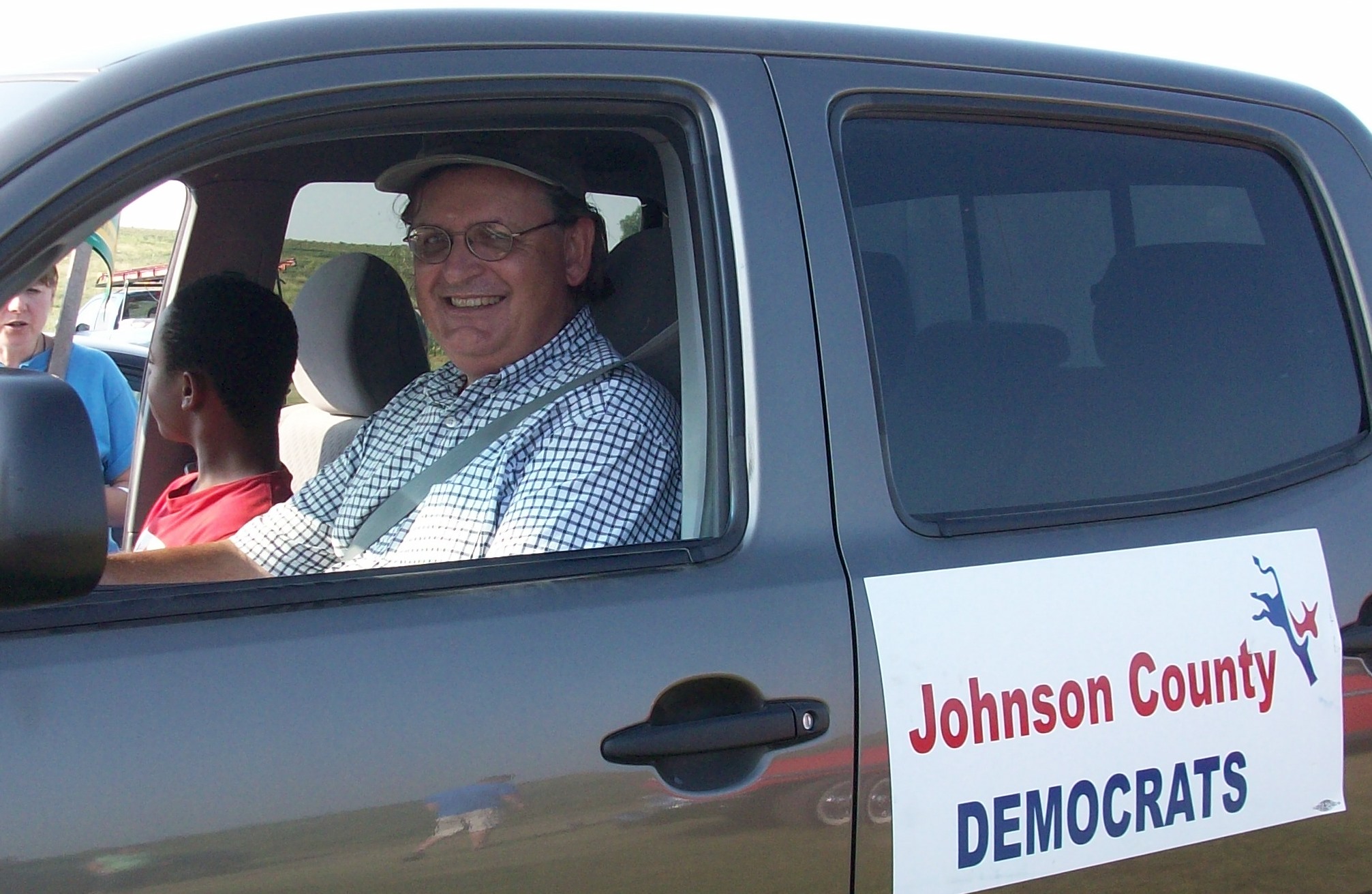
The author driving a parade vehicle in Morse, Iowa.
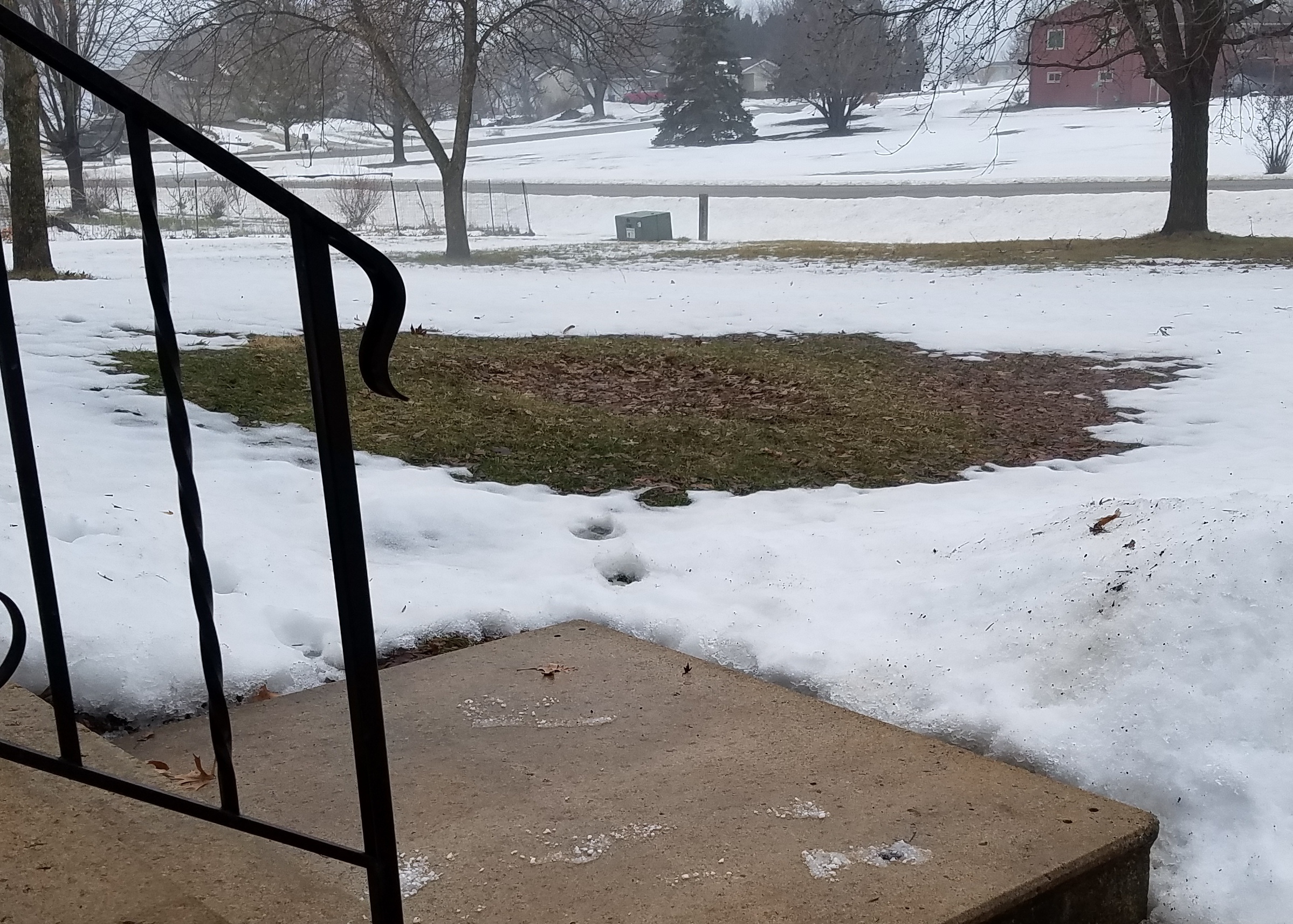
Four and a half inches of snow rests on the driveway waiting to be removed.
I like snow and don’t mind shoveling. I’ve gotten better at it since beginning work at the home, farm and auto supply store — a moderately physical job.
While fluffy snowflakes fell yesterday afternoon I made a batch of hot chocolate mix using ingredients from the pantry, enough to last until spring. I had to grind the granules of powdered milk in the blender because they would not dissolve as they were.
The warm, steamy drink is comforting and the best option after fresh apple cider from the orchard was used up.
Local political news was dominated by the Iowa Democratic Party’s release of proposed changes to the 2020 Iowa precinct caucuses.
“The Iowa Democratic Party has always sought ways to improve our caucus process, and today, we are setting the stage for the 2020 Iowa caucuses to be the most accessible, transparent, and successful caucuses in our party’s history,” Iowa Democratic Party Chair Troy Price said in a press release. “Starting almost immediately after the 2016 cycle, this party took a holistic look at how we can make the Iowa caucuses more accessible and transparent. These proposals are the result of thousands of hours of conversation and years of hard work.”
I read the 65-page proposal, which is open to public comments for the next 30 days, and believe it is what Price said, a move to make participation more accessible and transparent. I also believe the Democratic National Committee forced Iowa to take these kinds of steps to remain first in the nation. Let’s face it, getting any group together for a meeting at a specific time in February is a challenge. By adding what are called “virtual caucuses,” the proposal provides a method for people to participate if they are unavailable to venture into a cold February night to hang with other residents of a precinct for an hour or so. I’m all for it.
The Iowa national delegate selection process seems arcane to those in the media who follow the presidential horse race and report on it. They build up to the caucus and need to report a “winner.” When viewed in terms of winners and losers it is hard to say what winning delegates in Iowa means to a Democratic presidential candidate. The first month of the primary and caucus calendar has the early states, Iowa, New Hampshire, Nevada and South Carolina, about a week apart. They will be followed by Super Tuesday during which nine states hold presidential votes, including Texas and California. What traction candidates may get out of Iowa is dampened by the close proximity of these other contests. To make sense of the horse race, all 13 early states should be viewed through the same frame.
It is hard to say if the caucuses are important. Political scientist David Redlawsk asserts the Iowa caucuses remain important and wrote a book about why. Last night on Twitter Redlawsk posted, “Caucuses are about party building & organization as well as voting.” For those of us who have been trampled by a mass caucus exodus immediately following precinct delegate selection, the merits of Redlawsk’s assertion about “party building” are dubious at best and border the ridiculous.
In our precinct we’ve mostly struggled to fill our committee assignments to the county party convention with caucus-goers who will show up. We have even nominated people not present to fill the two county party central committee seats rather than let one go empty. This is the main organizing that goes on at the Iowa caucuses. With the notable exception of 2008, participation is mostly by people who have been very active in party politics.
The pre-caucus publicity and outreach of campaigns helps activate voters. In an electorate where more voters register no preference instead of for one of two major parties, it serves the general election more than any political party. I’m sure discussions about what happened at caucus circulate among dinner tables and community social events where the mix of party affiliations is diverse. That’s something. It is hardly being organized.
We’ll see how the 30-day comment period on the new process goes. I’m guessing there will be tweaks rather than major changes by the time it is finished.
My beef about politics is everyone wants to be a strategist and few will be tacticians. For most of my adult life I’ve been more interested in tactics than strategy, so I find the attitude annoying. A first distinction among strategists usually has to do with sorting. Is one a party insider or a rank and file Democrat? Are you a hardcore activist or one of the normal people? I don’t accept such sorting and believe we Democrats are all rank and file. Or, as Walt Whitman wrote in Song of Myself, “For every atom belonging to me as good belongs to you.”
Now that Iowa Democrats developed a reasonable plan to make the Iowa caucuses more inclusive and transparent, the next step is working to flip my precinct and our state from Trump to Democratic in the general election. I don’t subscribe to a paternalistic notion that our Democratic presidential selection process beginning with the caucuses is rigged by the party. Just read the plan and explain how it favors someone. It doesn’t. Let Democrats nominate who they will and chips fall where they may. We should all be working for the eventual nominee whoever it is, beginning now.
SOLON, Iowa — Snow began to fall about 10 a.m., an hour before the scheduled legislative listening post with our State Senator Zach Wahls. By the time I got to the community center, about three inches of fluff was on the ground. We live in Iowa. We began on time.
It was a small gathering, affording everyone who wanted to ask questions or discuss issues adequate time. On points where there was disagreement — resolving opioid addiction and boat motor size on Lake Macbride — the topics advanced in a civil and straightforward manner. Credit to the senator for the way he moderated those conversations.
The mix of party affiliation of locals appeared to be half Republican and half Democratic. Of the people I knew, there was a retired firefighter, a chiropractor and the school board president. As is usually the case, several people from outside the district attended with their own agenda. By now, we’re used to that. The Center for Rural Affairs was a co-host of the event and had a display with literature available.
My question was about discussion of female genital mutilation in the legislature and news media. Senator Wahls said he hadn’t read a bill on the subject, and that no one he knew was in favor of the procedure. After the listening post I found both the Senate and House have versions of a bill making it a felony to perform genital mutilation or transport a minor out of state for the procedure. (Bill numbers are HF63, HF299, HSB115 and SF212).
Cedar Rapids Gazette columnist Lynda Waddington, who won an award on Friday for her editorial writing, laid out expectations for the legislature in a recent column:
Send a strong message that female genital mutilation will not be tolerated.
Give prosecutors the tools and resources to bring perpetrators to justice.
Signal to state prosecutors that this practice is a crime that must be prosecuted.
Provide education and outreach to at-risk communities and professionals likely to encounter girls at risk.
Include measures to specifically prevent girls being trafficked across state lines for such procedures.
“A federal judge said it is up to the states whether or not girls undergo female genital mutilation,” Waddington wrote. “Iowa lawmakers must make a statewide ban on this unnecessary and heinous practice their first priority.”
That’s why I felt it necessary to raise it with Wahls. The issue was known last session but a bill did not advance out of committee. Read Lynda’s article at the link for more background about why Iowa is even talking about female genital mutilation.
We covered a lot of topics in an hour. It was time well spent.
Tim Brown, president of the Solon School board, attended. Brown is an engaging conversationalist with a wealth of knowledge about what’s going on in the community. He was interested in the legislature’s plans regarding school funding. Wahls recapped the bills on which he expects to vote, maybe as soon as next week. There is plenty of ink out there with details, including James Q. Lynch’s Cedar Rapids Gazette story from this morning’s newspaper.
After the formal part of the meeting, a group of us discussed a variety of topics, including the fact that the school board election will be combined with other elections in November. Two seats are up. Since our school district straddles counties, there will be an additional election cost to the board for about 20 homes in the Solon Community School District located in Linn County. Johnson County Auditor Travis Weipert has not released detailed election plans according to Brown.
Even though the turnout was light, it was good to circle up with Senator Wahls on a snowy day in Solon before the first funnel.
I live in the country, in case this is the first time you are reading this blog. In economic tough times, we have to multitask any resource use, so when I drive to the county seat, I try to combine tasks. I book events and meetings then schedule others around them. This is what I did yesterday when I spent the better part of five hours near the intersection of Market and Linn Streets in Iowa City.
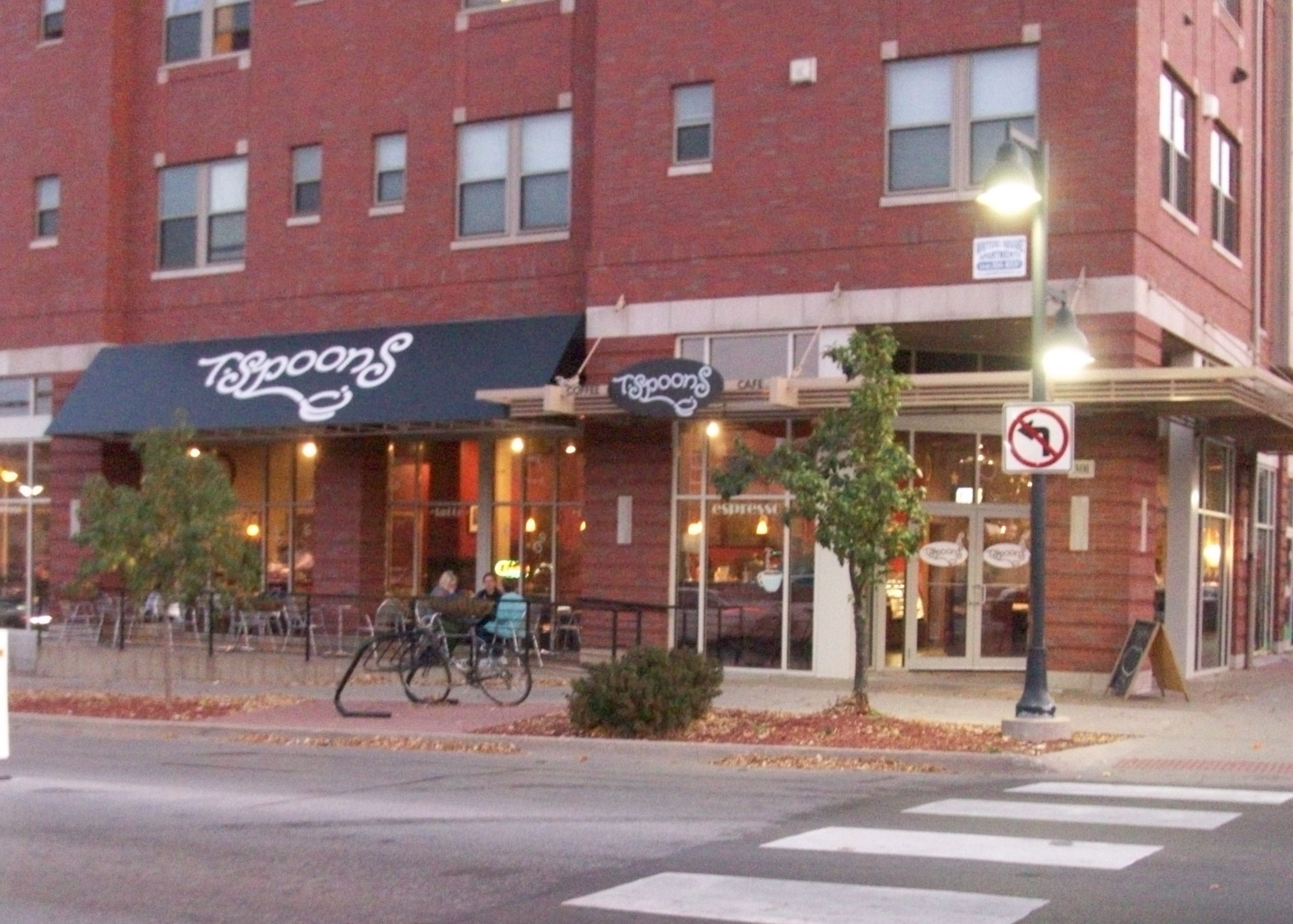
Riverside Theatre and my volunteer ushering for “The Cripple of Inishmaan” was the anchor event. I scheduled a student meeting for 5:30 p.m. at T-Spoons and planned to have dinner and browse the used book stores before I had to be at the theater at 6:45 p.m. I ordered a hazelnut roasted coffee with a shot of hazelnut syrup. My coffee was ready by the time he arrived and he had nothing to drink since he was enroute to a class. We talked about the project and then he left for his 6 p.m. class. I reviewed someone’s resume while I finished my coffee in a faux leather chair.
There are lots of restaurants near the intersection of Market and Linn. Long established ones like Pagliai’s Pizza and Hamburg Inn No. 2, and newer ones like Oasis Falafel, Blue Bird Diner and Linn Street Cafe. I decided to read menus and look inside to see how crowded they were. I ended up going into Oasis: The Falafel Joint where I ordered Falafel, Babba Ganoush, Red Cabbage Salad and Madjadra with pita bread. I sat in the window and ate the tasty meal. It was enough food for two meals, so I took one home in a clam shell, leaving it on the floor of my nearby pick up truck before I going to the book store.
At the Haunted Book Store I asked the attendant for directions to the poetry section. In my current life, I view poetry as an indulgence the same way a smoker views a pack of cigarettes, for consumption and an addiction. It wasn’t always that way. There were many shelves of poetry in the store, and not many people: one gent with a portable typewriter was writing on it at a nearby table. I found Ode to the Cold War: Poems New and Selected by Dick Allen and read a couple of poems. For $4.95 it went home with me. I also picked up An Inconvenient Genocide by Alicia Ghiragossián about the conflict between Turkey and Armenia for seven bucks. Stopping by the Iowa section, there was a copy of a 1918 bibliography titled Iowa Authors and Their Works by Alice Marple. I bought this Historical Department of Iowa book for ten bucks to add to my collection of bibliographies of Iowa authors. Thus far, the evening was a success and it I had not been in town 90 minutes.
Stopping by the truck again, I left the books on the seat, stashed my mobile phone and headed to the theater across the parking lot. I took tickets and got to meet all of the theater-goers. The performance was very good.
Why do I write about this? Partly because other writers have done as much near the corner of Market and Linn Streets, and I hope I too will be famous for my writing. Too, this district of Iowa City is part of my personal history. I lived a few block away on Market, went on dates here, saw politicians and plays, did research for my writing, had meals and coffee with people who are important to me and browsed Murphy Brookfield Book Store and Haunted Book Store (and its predecessor) countless times over the years. I write about it because it is part of who I am and hope that is reason enough.
Ice turned to mush as rain fell Thursday morning. The surfaces of Lake Macbride and the Coralville Lake appeared to remain frozen as I drove on Mehaffey Bridge Road.
When I arrived at the home, farm and auto supply store it continued to rain. By the end of my shift a layer of ice had formed on my windshield and morning slush had frozen.
I started the engine and chipped at the ice. It took half an hour to gain enough visibility to drive. I decided to skip a monthly political meeting, emailed the secretary of my absence, and headed home.
Iowa is a red state now. Voters had an opportunity to return balance to state government in 2018. Instead they chose Republican control of the governor’s office and state legislature. Taking advantage of their mandate, Republicans plan to take more control of the appointment of judges by changing the composition of a commission that selects nominees for Iowa courts. We’re a red state now, and we don’t like it.
We’re not leaving the state. To even consider it would be an anomaly in lives we’ve come to accept. In the end, politics is something, but not everything. It is definitely not important enough to get stuck in the county seat as the world freezes.
I’m interested in what the Congress does to mitigate the impacts of climate change. Yesterday New York Congresswoman Alexandria Ocasio-Cortez introduced a resolution recognizing the federal government has a duty to create a Green New Deal. A draft of the resolution indicates the following goals for a Green New Deal during a ten-year national mobilization period:
to achieve net-zero greenhouse gas emissions through a fair and just transition for all communities and workers;
to create millions of good, high-wage jobs and ensure prosperity and economic security for all people of the United States;
to invest in the infrastructure and industry of the United States to sustainably meet the challenges of the 21st century;
to secure for all people of the United States for generations to come—
(i) clean air and water;
(ii) climate and community resiliency;
(iii) healthy food;
(iv) access to nature; and
(v) a sustainable environment; and
to promote justice and equity by stopping current, preventing future, and repairing historic oppression of indigenous communities, communities of color, migrant communities, deindustrialized communities, depopulated rural communities, the poor, low-income workers, women, the elderly, the unhoused, people with disabilities, and youth (referred to in this resolution as ‘‘frontline and vulnerable communities’’).
Who wouldn’t like these goals? Senator Edward Markey introduced the same resolution in the U.S. Senate.
It doesn’t take an advanced degree to understand a Green New Deal is dead on arrival in Mitch McConnell’s senate. While such goals need to be met to slow global warming, politics has ceased to be an endeavor of doing what needs to be done to ensure our mutual survival. Success of any legislation designed to advance a Green New Deal depends on recognizing the threat the climate crisis poses to society. Today, more people recognize there is a climate crisis. Our politicians, not so much.
Al Gore remained positive in his press release supporting the resolution:
The Green New Deal resolution marks the beginning of a crucial dialogue on climate legislation in the U.S. Mother Nature has awakened so many Americans to the urgent threat of the climate crisis, and this proposal responds to the growing concern and demand for action. The goals are ambitious and comprehensive – now the work begins to decide the best ways to achieve them, with specific policy solutions tied to timelines. It is critical that this process unfolds in close dialogue with the frontline communities that bear the disproportionate impacts today, as this resolution acknowledges. Policymakers and Presidential candidates would be wise to embrace a Green New Deal and commit to the hard work of seeing it through.
Failure to act on climate is the same as denial. I’ll support a Green New Deal while recognizing we can’t place all our hopes on a single, political solution. As we discovered during negotiations leading up to the Paris Agreement under the United Nations Framework Convention on Climate Change, political solutions are far from perfect. They may be inadequate. Yet they are something and have value if they can be achieved.
Seems like I’ve been hunkered down and bunkered in since apple season. I’ve been thoroughly funkified. With 45 days left until spring I’m restless to get out of my lair.
The number of indoor places I spend time is limited: the chair or couch in the living room, the kitchen, the bedroom, the laundry room, the bathrooms, or in my writing room.
It was comfortable early on. Now I’m itching for something.
We live during an assault on reason. I mentioned in my last post the greatest threat to society is a weaponization of ignorance and apathy. Politicians are unable or unwilling to change the status quo, lobbying groups don’t want change, and the public doesn’t seem to care, Matt Field wrote in the Bulletin of the Atomic Scientists. That’s a hell of a sticky mess out of which to gain traction.
Still the light from outside beckons us to go there.
The ambient temperature is 45 degrees, a 73 degree swing since early Thursday morning. Warming is part of the polar vortex, just as the cold was. Temperatures are forecast to return closer to normal after tomorrow.
I had planned to prune trees today but am concerned about rapidly changing temperatures. If the sap starts flowing the purpose of waiting until winter to prune would be defeated. Maybe next week will be better once temperatures stabilize below freezing for a week or so.
Feb. 5 is the Iowa Environmental Council’s lobby day in Des Moines, followed by the Sierra Club’s lobby day the 6th. I noticed IEC scheduled 30 minutes for discussions with legislators. That’s about right because very little gets decided in one-on-one lobbying sessions, regardless of whether one’s legislators are supportive of climate action. What’s needed for change is a broad coalition and a dominant issue.
With the polar vortex we are living in a changed climate. Mitigating its effects is beyond the scope of the Iowa legislature. What can be done?
“In my view, the actions we take over the next 2-3 years are critical,” State Senator Rob Hogg wrote in an email. “The need for climate action has never been more urgent. Please take action personally and in public. Invite more people to get more informed, more involved, and do more.”
Hogg was trained by Al Gore as a Climate Reality Leader in 2008. He enumerated ideas with which to approach legislators for climate action, including “energy efficiency, renewable energy, electric vehicles, forests, prairies, soil conservation, and pre-disaster hazard mitigation to safeguard our people and our property.” Each of these items has its own constituency and many of the groups supporting them will be at Tuesday’s lobby day. What will get done?
There is a stability of operations among IEC members that works against substantial change. Some organizations, including some to which I belong, seem caught in a rut around a specific solution to the climate crisis. These formal, recurring events seem ineffective to me. I wrote about a 2015 trip I made to a similar lobby day in the Iowa City Press Citizen here. I’m not sure what, if anything was accomplished.
Some advocates believe climate denial among members of the legislature and elsewhere stands in the way of changing human behavior regarding climate change. I believe it is something different.
“I’m convinced that the greatest threat we face isn’t climate change denial,” climatologist and geophysicist Michael Mann wrote. “It is the weaponization of ignorance and apathy that is at its core…”
The weaponization of ignorance and apathy is something better to work on than any pet project. How does one do that when calcified lobbyists and citizen advocates petition the legislature for such issues? We need a more diverse group of stake holders than are in the IEC. Something bigger needs to happen to bring people together. I don’t know if the polar vortex is big enough even if it should be. What I know is if we wait to address climate change until it is too late the question will be moot.
This polar vortex is drawing to a close but it’s easy to predict there will be others. Many will have forgotten the polar vortex as they get absorbed in the big football game this afternoon. It is up to us to remind people of our common interest in sustaining our lives in a turbulent world. If we don’t, who will?
One of the first things we did after moving to Lake County, Indiana was register to vote. Being a Democrat, I voted for Michael Dukakis in 1988, which was our first general election as Indiana residents.
I remember complaining about Iowa and the other early states for giving us Dukakis, whose nomination ultimately gave us George H.W. Bush. Indiana is one of the last states to vote in the presidential primary system so we had little say in the matter.
Dukakis placed third in the Feb. 8, 1988 Iowa caucuses with 22 percent of delegates. Dick Gephardt won the most with 31 percent and Paul Simon was second with 27 percent. As the contest illustrates, Iowa isn’t the decider here. We couldn’t even winnow the field of Dukakis.
We are one year away from the 2020 Iowa precinct caucuses and a lot of Democrats are running for president, the winner being determined by number of delegates, not votes. County Supervisor Rod Sullivan posted his top 25 candidates and that’s not even everyone. I don’t intend to spend much energy learning about them this early, mostly because I will vote for the Democratic nominee whoever it is.
I’m low on the strategy totem pole to have much to say about big picture Democratic politics anyway. My role as a member of the county central committee will be to help run our precinct caucus. Increasingly that means making sure the event is accessible, efficient and fair. It’s not about party building because after delegate selection, people want to get the heck out of there. Whoever manages it must create a welcoming environment where people are treated with respect. We had new attendees and a good discussion in 2018. I kept the contact information for everyone who showed up in case we need volunteers in 2020.
I have opinions about presidential candidates and here are a few of them.
We don’t need or want a septuagenarian billionaire. That’s what Republicans are expected to run and former New York City mayor Michael Bloomberg at the top of the Democratic ticket could be disastrous.
Being a current U.S. Senator is not a positive resume point. The biggest challenge Democrats face in 2020 will be regaining a majority in the Senate. We need as many experienced hands there as we can get. The last election in which we won a Senate majority was 2008 and even then, every legislative initiative Democrats pursued was challenging. There are good people among the senators running or considering a run. The only one I have ruled out is Vermont Senator Bernie Sanders who lost the primary in 2016 and is not a registered Democrat. The one I like the most is Minnesota Senator Amy Klobuchar who has not thrown her hat into the ring.
The only potential candidates I met besides some of the U.S. Senators are Joe Biden, John Delaney, Tulsi Gabbard and Julián Castro. Of these I like Castro, former mayor of San Antonio, for president. He sat with us in a darkened room during a power outage to talk policy a couple of days before his formal announcement. The rest of them are okay. Biden seems unlikely to announce a third campaign for president, Delaney has been campaigning in Iowa for a year and has not gained traction, and Gabbard is having problems during her campaign launch.
I don’t know much about the rest of them yet a couple are interesting.
I spent a lot of time in South Bend, Indiana where Pete Buttigieg is now mayor. The city was decimated after Studebaker closed its plant in 1963. There continues to be cultural detritus from that event. I spent time at the former Studebaker proving grounds during my transportation career and recruited truck drivers in the city. I’d like to learn what Buttigieg did to create a more positive cultural and economic environment in South Bend. My interest in economic and cultural change in the rust belt is probably not a reason to support him for president.
The other candidate I find interesting is Marianne Williamson. She talks and acts nothing like a politician. Williamson has her own following after being a New York Times best selling author. In her announcement speech Williamson mentioned proximity to Alan Watts and Ram Dass which places her in an era I thought was long gone. About 70 people attended her Iowa kickoff event in Des Moines last night, which wasn’t covered by our local newspapers. “People sang along with the final song of the opening band and introduced themselves to the people sitting around them.” wrote Des Moines Register reporter Robin Opsahl. I don’t know if caucus-goers will have the patience for the many discussions Williamson proposes we have. She’s likely right we need to have them, but that’s no reason to support her for president.
There is no question the presidential primary season is upon us. The field will hopefully shake out by the end of summer so there will be less homework to do. The fact I’m engaged at all a year out is about living in Iowa again.
Editor’s Note: This email was sent to members of our home owners association at the beginning of the polar vortex of 2019. As I write this note, the outdoors ambient temperature is 26 degrees below zero and one person in the county seat has died from exposure.
Member,
As you likely know, ambient temperatures are forecast to get down to -25 degrees by 8 a.m. tomorrow morning and to -30 degrees overnight tomorrow. After that temperatures are expected to warm through Saturday and Sunday when it is forecast to be in the 40s.
That’s a seventy degree swing in a couple of days, which can be hard on things like water and sewer lines.
19th century British prime minister Benjamin Disraeli said, “Be prepared for the worst and hope for the best.”
We will do everything reasonable to get service back up as soon as possible if it is interrupted. Asking a contractor to work in wind chills like we haven’t seen since we moved here is not reasonable. I plan to contact our main contractor Wednesday and discuss the situation so we know our options in the event of a breakage.
What you can do to prepare for a potential outage is keep a temporary water supply if you don’t already.
In our household we keep a large Rubbermaid beverage container filled with water to use for washing hands and cooking in case we lose water.
We used to buy bottled water to have on hand but quit doing that over the years. It is an option.
If we know there will be an outage ahead of time, we fill up our two stock pots and keep them on the stove to be boiled and used to wash up in lieu of a shower, or as otherwise needed. We have also filled up coolers in the bathtub to use to flush the toilet.
Fingers crossed we will make it through the cold spell without a line breakage.
If something does happen, the procedures for reporting a water problem are below.





 Journey Home
You must be logged in to post a comment.