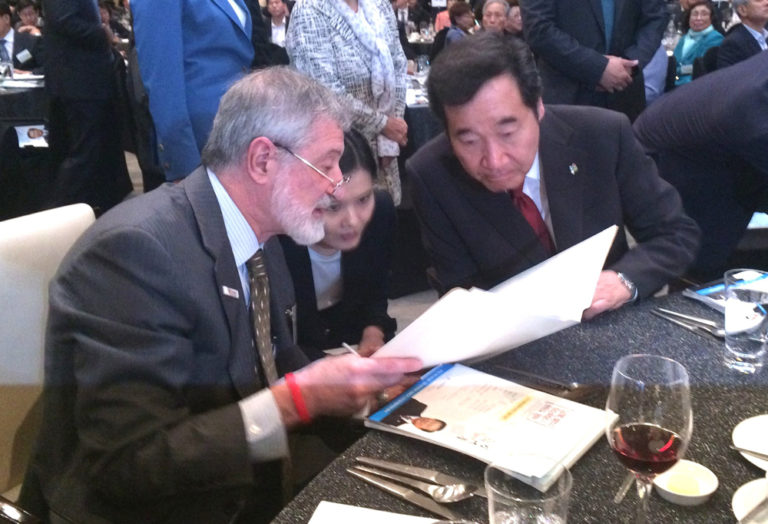
On June 14, 2018 PSR Board member Ira Helfand, MD met with South Korean Prime Minister Lee Nak-yeon in Seoul, urging South Korea to sign and ratify the Treaty on the Prohibition of Nuclear Weapons.
The main nuclear weapons threat on earth is increasing tension between the United States and Russia over Syria, Ukraine, Crimea and other issues. Not far behind is the ongoing dispute between India and Pakistan over Kashmir. Either conflict, if escalated to nuclear war, could end life as we know it.
So what the hell was the Hanoi Summit between Donald J. Trump and Kim Jong Un?
As a drill sergeant in the U.S. Army often described our duty performance when it did not meet his refined standards, it was a “goat screw.”
We don’t know what preparations the North Korean dictator made, in fact we know little about his country except what we might read in books like Barbara Demick’s Nothing to Envy: Ordinary Lives in North Korea. He presumably prepared for the summit, and had a 60-hour train trip from Pyongyang, North Korea to Đồng Đăng, Vietnam, in case last minute changes and consultations were required. Kim traveled by rail for security considerations according to Associated Press.
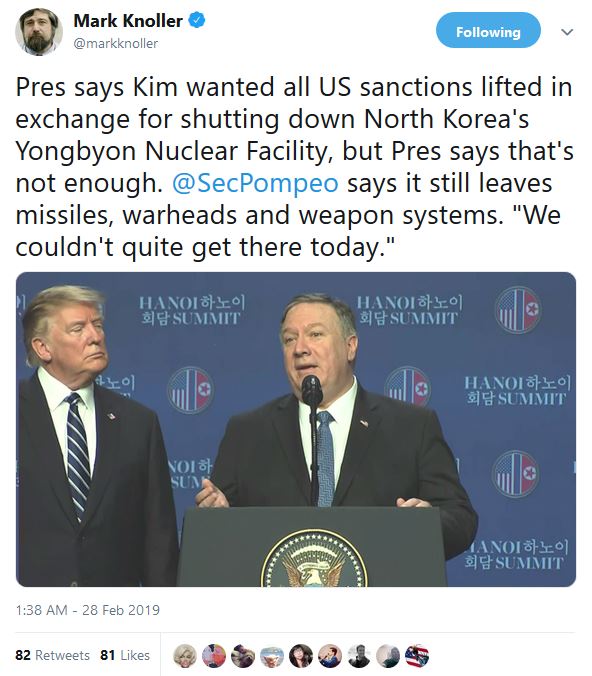
Air Force One’s 20-hour trip to Hanoi, with two refueling stops, was also very long. We don’t know what preparations the U.S. President made either, but it was clear from the news coverage it wasn’t much. Here’s CBS News reporter Mark Knoller:
Couldn’t this have been discovered and vetted long before the actual, expensive in person meet up? Isn’t that why we have diplomats? Why elevate this meeting to a “summit” if we didn’t know the basis for an agreement beforehand?
While Air Force One was enroute home, North Koreans disputed this characterization of the summit. Why cut the meeting short before agreeing what happened and would be said to the press? Seems like basic diplomacy is missing from this administration.
What a bunch of knuckleheads. I’m not referring to the North Korean dictator and his staff. Why would the U.S. elevate this guy to this level of prominence on the world stage? Importantly, it was a staged distraction from Secretary of State Michael Pompeo and National Security Advisor John Bolton’s dismantling of the U.S. – Russia arms control protocol. There is other stuff going on the the country to be distracted from as well. The tail is wagging the dog.
We don’t know but Kim must have been feeling good on the long trip home to Pyongyang after the president failed to find common ground for denuclearization of the Korean peninsula. We do know something about his green, bullet-proof train with yellow trim on the cars.
“Kim Jong Il, who was Kim Jong Un’s father, was known to have hated flying and traveled by train on several trips to China,” Eric Talmadge and Adam Schreck of AP wrote. “He is said to have fitted his train out to accommodate lavish parties and karaoke sessions.”
His father is also said to have kept four female singers on the train when he traveled, referring to them as “lady conductors.” Will lady conductors sing karaoke for Kim Jong Un on the trip home? Since the U.S. president won’t hold him to account, there may be something for a dictator to celebrate.
While eastbound on Highway 382, a large bird lifted from the ground within my headlights and dropped a recently killed rabbit. It hesitated, perhaps wanting to return to its prey, but not long enough for a collision.
I don’t know what species it was, but suspect it was an owl since it was two hours before sunrise. Owls live all around us in Big Grove and at night use the peak of our roof to observe the neighborhood and dine on small rodents.
As I continued around the lakes, then westbound on Mehaffey Bridge Road a deer crossed the road in front of me. I tapped the brakes. It was less dramatic than the bird of prey. I’m used to living with wildlife after so many years. I know what to do.
The lakes are covered with a smooth surface of ice, perfect for skating. With a couple more days of deep freeze, conditions should be excellent. The problem is no one I know ice skates any more and it is not a solitary activity. Time was we would clear a rink and sometimes start a bonfire. Importantly, it was fun. We’re getting older and other things occupy neighbors, busy looking at screens, I cynically suppose.
Wildlife appears to be flourishing. Maybe I’m just noticing. It is possible to step away from the screens and observe nature… a nature adapted to the built environment humans made since settling here in the 1830s. There was no risk of roadkill when there were no motorized vehicles or roads.
I don’t have much to say about the world outside our ecosystem today. Aren’t others saying enough? Suffice it that the 25-minute trip to work provides a window to the world around us.
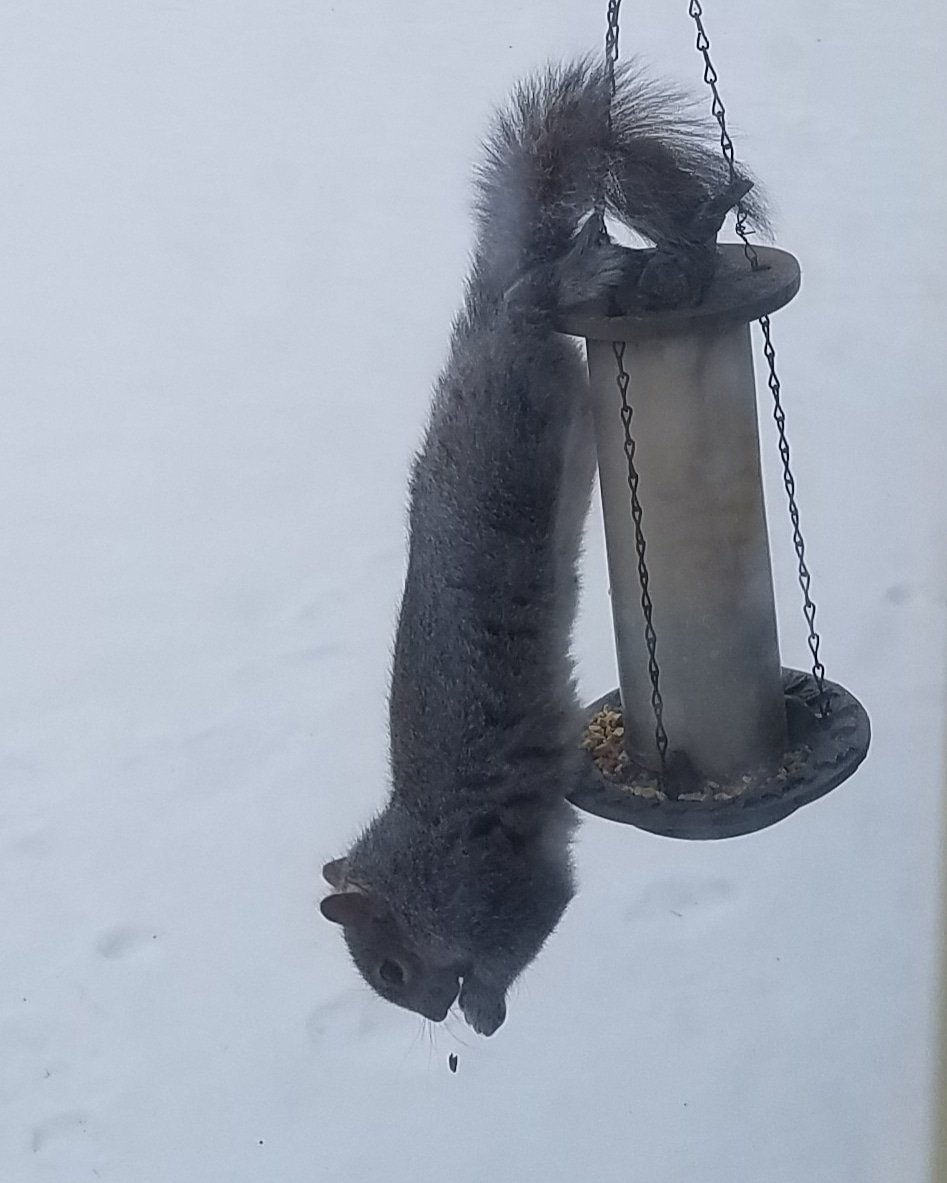
Squirrel Training for Acrobatic Work at Walt Disney World
I opened the door to the garage and turn signals on my car were flashing.
It was the first time in the garage yesterday and I feared having left something turned on, depleting the battery charge. I put the key in the ignition and it started.
At an undetermined point in the night turn signals and some dash lights started a slow blink. I couldn’t turn them off. I started the car and turned it off — still blinking. I started the car and drove it around the block — still blinking. Should I call my mechanic or troubleshoot and fix it myself?
I went to a computer and searched “1997 Subaru Outback lights blink when ignition off.” Some results came back and 83 people recommended a procedure to disconnect the battery, then reconnect it with the ignition turned on. It was simple and it worked. Make that 84 people recommend the procedure to reset the electrical system.
That I drive an old beater is not news. I bought it six years ago and with a good mechanic fixing things as they break, it gets me around. I feel a little like the Mercury astronauts running around Cape Canaveral before Florida car dealerships gave them Corvettes and such to drive, just another guy needing earthly transportation. As long as it is mechanically sound I don’t care what vehicle I drive. The astronaut dreams are extra.
Yesterday’s farm work shift cancelled because of a cold weather forecast the following week. CSA farmers who belong to Practical Farmers of Iowa gathered at a local restaurant to discuss their trade. I am a member but declined to go. I’m more interested in reducing the amount of farm work I do than in engaging more. Since I began earning a living wage last year the economic need for farm work went away. It’s mostly a social event any more despite the well-received work I do at the farms.
I woke early this morning, around midnight, and picked up my mobile device in the dark. There was a Washington Post alert from 11:24 p.m. saying Michael Cohen had prepared a written statement about his testimony today before the House Oversight Committee. In it, Cohen indicated Donald Trump personally signed the check to pay hush money to Stormy Daniels, and that Trump knew Roger Stone was negotiating with WikiLeaks to publish stolen emails from the Democratic National Committee during the run up to the 2016 general election. Trump and another of his attorneys, former New York City mayor Rudy Giuliani, have both accused Cohen of lying since then.
We’ll see what Cohen actually says while I work a shift at the home, farm and auto supply store. Like with Watergate, it would be hard to watch the proceedings live. If what Cohen said is true, the president has been lying to the American people. In today’s corrupt political climate I’m not sure what that means. If Trump were Nixon, we’d already have his resignation on our Resolute desk.
The store manager from the home, farm and auto supply store phoned Sunday afternoon to ask me to work on Monday. The colleague who assumed my full time job last spring was visiting family in Nebraska and bad weather closed roads across the state, including Interstate 80. She couldn’t make it back in time for her shift.
In Iowa, helping out is part of our culture. I said yes I’d work and rearranged my plans so I could.
In addition, the farmer decided the weather was bad enough she didn’t want people venturing out to the farm. The roads were iced over and the wind howled at 30 miles per hour all day. Her sister, the shepherdess, posted social media photos of installing a new anemometer and weather station. Its LED panel displayed the digital message, “hold onto your hat!”
As I was settling in last night, the Washington Post put up an article about White House plans to form an “ad hoc group of select federal scientists to reassess the government’s analysis of climate science and counter conclusions that the continued burning of fossil fuels is harming the planet.”
In other words, the Fourth National Climate Assessment told the story of how dire our future could be without climate action. Rather than doing something, the administration is arguing with their own scientists that global warming is not caused by burning fossil fuels. These are times that will fry men’s souls.
Which part of yesterday’s howling wind was an amplification caused by global warming? The answer doesn’t matter because it’s the wrong question. We know the deleterious effect of burning fossil fuels. We also know thawing permafrost, agriculture, methane releases during oil production, building construction, manufacturing processes, air transport, deforestation, landfill decomposition and other human activities contribute to greenhouse gas emissions and global warming. We can’t get bogged down in details when the bigger picture is we have an obstructionist government led by Republicans and their conservative, dark-moneyed think tanks who would interpret the howling wind as something else. The better question is when will voters do something to fix this?
Yesterday’s wind was the kind that calls for hunkering down until it ends. Eventually we will have a calm, sunny day and the opportunity to work as normal. Or maybe it is something else, as Bob Dylan sang in the 1970s,
Idiot wind, blowing like a circle around my skull
From the Grand Coulee Dam to the Capitol
Idiot wind, blowing every time you move your teeth
You’re an idiot, babe
It’s a wonder that you still know how to breathe.
This weird weather is unsettling. Wild variations in temperature made it a damaging winter… it’s not over.
The driveway buckled a few feet from the garage door because of temperature swings. Water must be trapped underground with inadequate drainage before refreezing. The buckled pavement is directing rain under the door, flooding the car park.
Everything is off the floor as I advance plan for water emergencies. I found all the parts for the wet/dry vacuum and removed about 60 gallons from the floor. I let the water settle for a while, then will go at it again.
I’m supposed to soil block at the farm today. Temperatures are dropping and a coat of ice is expected on roads, on everything, as the wind howls 30 miles per hour until sunset. I’m to text the farmer before leaving for my shift to make sure roads are passable.
With the ground still frozen, snow melt and rain have nowhere to go. It is pooling near the main intersection a few dozen yards south of our home. The culvert under the road must be blocked with snow and ice. There will be river flooding later in the week as everything drains to the Mississippi basin.
I’m not freaking out… yet. I don’t know what to do but mitigate water damage and wait it out. Fixing the cause of this weird weather is not something to address in a day or two.
Media discussion of climate change seems more frequent. I reviewed Google Trends and there was a spike in searches about global warming the first week in February. Every day or so local newspapers carry a story about climate change. A lot of it has to do with the Green New Deal resolution proposed in the U.S. House of Representatives. Who doesn’t like what the resolution says? It seems toothless until a Democratic majority returns to the U.S. Senate. We are at least two years away from the possibility of that happening.
What will the Congress do to act on climate? More importantly, what will they do that the president will not veto? These are dark times if we rely solely on politicians.
Water may have settled in the car park, so it’s time to vacuum up a few more five-gallon buckets. Hopefully spring is on the horizon, even if it hasn’t arrived.
More than at any previous time I feel a goal line was crossed when I left full time work last spring.
So what’s next?
I don’t anticipate buying a fancy television with new, matching easy chairs to put in front of it.
My late aunt and uncle had that. When we visited their Alabama home our conversations turned to the evangelical Christianity their family had undertaken. It was a distance from the socialist and Catholic household in which she grew up with her brothers and sisters. I suspect aunt and uncle watched FOX News, although we talked the entire visit without turning on the T.V. Dinner was a tuna-noodle casserole taking me back to a time I hardly remembered. Mom never made tuna-noodle casserole at home. My uncle died shortly after we left them and she died soon after that. All that’s left are memories.
My fear is if we had a digital television I’d sit back in an easy chair, watch too much, and my mind would succumb to the blather that invades people’s lives from cable news. I’d spend the rest of this life talking about, to and at the television.
There is only one answer to the question, and that’s to stay active physically, emotionally and mentally. That’s really a lie. There are plenty of answers, although doing these three things can form a foundation upon which an answer can be built. Maybe that’s what I’ll do.
Birds eat from the feeder and a freezing rain falls on the county. Snow melt is filling the ditches and running toward the lake. Soon there will be floods in Iowa as the crazy weather continues.
Tomorrow I return to the farm for the first round of soil blocking. They already started seeds in the house, but these will go into the greenhouse despite the coming cold spell. I’m waiting another week to plant celery. At 120 days, celery has the longest plant to pick cycle.
Will farm work bring catharsis to my search for truth and meaning? I don’t know, but I’ll be spending time with friends again and that means something.
I’ll get to see the lambs, those sad but cute creatures destined for someone’s dinner table. I’ll be careful not to get attached but new life is always a pleasure. That’s what I need in the rainy, snowy, flooded Iowa I call home as the cycle of the growing season begins anew.
Moving the goal posts once they are set is not a good option in retirement. We may only get one chance for new goals and it’s important to be sure. I’ll be thinking about that as I make the soil blocks tomorrow morning. I’m looking forward to getting started.
Is there a difference between being a cook and a chef?
An immediate answer has to do with training, tutelage, apprenticeship or working in a professional capacity. I know several chefs, and they are among the best in the area. I eat at their restaurants, appreciate their presentations, and respect what they have learned.
Cooks know their limits. My main goal is to get a satisfying meal on a plate, matched to the individual tastes of diners. Even in a small gathering there is rarely a single taste. Working with well-known diners, attempting the satisfying rather than the sublime, makes me a cook first — a journeyman raw food processor if you will.
Understanding flavors that produce great meals is important and flavor is foremost in the mind of a cook. Will the diners welcome a dish? What from the repertory will please? How do I use a seasonal vegetable? Will diners notice when the flavor stands out? Above all, will they eat it? We worry less about replicating specific dishes and more about the making the routine sublime.
I recently bought a large bag of Mexican oregano on line. Used in many dishes now that it is on hand and convenient, it is mostly an experiment with taco fillings, red sauces and stir fry. I like it because of the mild citrus flavor it imparts. Although I’ve been using it a couple of months, the experimentation is just getting under way. A cook’s process can be quite long.
Cooking has to do with ingredient sourcing, cooking techniques and trying dishes with varying seasonings. I feel little pressure for repeatable tastes so a dish can be listed on a menu. Being a cook is living life in each moment, a prepared dish as its own reward.
If I am a cook, not a chef, then so be it. I’d rather be a journeyman and get the work done.
Thread by thread the fabric of our lives is unraveling.
What we thought was permanent turns out to be fleeting vapors transformed to undue amounts of snow.
Everything about the unraveling is out in the open and more’s the pity.
In a press release yesterday, Governor Kim Reynolds indicated she ended her court battle regarding Iowa Code chapter 146C, otherwise known as the “fetal heartbeat law.”
“This was an extremely difficult decision, however it is the right one for the pro-life movement and the state of Iowa,” Reynolds said. “When I signed the Fetal Heartbeat bill last May, we knew that it would be an uphill fight in the courts that might take us all the way to the U.S. Supreme Court.”
“I think the Iowa Supreme Court got it wrong,” she said in the release, referring to the court’s decision to strike down the 72-hour waiting period included in the law.
Republican legislators plan to do something about the court getting it wrong. They plan to increase politicization of how Iowa judges are nominated to the governor by changing the composition of commissions that make those nominations. House Study Bill 110, and its companion, Senate File 237, have been introduced to that end.
Representative Mary Wolfe (D-Clinton) explained the issue in a Feb. 18 article in the Clinton Herald.
Here’s how our current system works: there are fourteen district court judicial nominating commissions — one for each of Iowa’s fourteen judicial districts. Each district court nominating commission is made up of five local citizens appointed by the governor and five local citizen-attorneys elected by local lawyers; the district’s senior judge acts as the chairperson of the commission. When a judicial vacancy arises in a judicial district, interested attorneys from that district submit applications and the members of the local judicial nominating commission, working together, select the two most qualified candidates to “send up” to the governor; the governor then chooses one of the two attorneys to fill the vacancy.
The Iowa Supreme Court process is similar in that it blends commission members appointed by the governor and chosen by attorneys, sending three nominees to the governor.
“The current system works,” Wolfe wrote. “Iowa’s non-partisan judicial nominating process is considered one of the best in the country, and our judiciary is consistently ranked in the top ten by many organizations (including conservative organizations like the U.S. Chamber of Commerce) in terms of expertise, efficiency and objectivity.”
“Rather than be distracted by a losing legal battle,” Gov. Reynolds said in yesterday’s press release about the abortion bill. “Now is the time to renew our focus on changing hearts and minds and to seek other ways to advance the cause of protecting the unborn in Iowa and around the nation.”
Among those “other ways” is to pack the courts. If the bills were to become law, all commission members would be selected by politicians.
I sent an email to my state representative on Sunday:
Bobby,
I don’t support the changes Rep. Steven Holt from Denison is proposing to the judicial nominating commission and the process for how judges are selected in Iowa.
Iowa Press ran an episode on Friday with Holt and Mary Wolfe from Clinton discussing their views on the matter and Holt did not make a substantial case for changing the process.
Holt repeated himself during the program, coming back to two things: that only 18.45 percent of attorneys vote on commission members selected by attorneys and that the voice of the people needs be heard. I believe the voice of the people has been heard in establishing the current process and it should not be changed without thorough vetting and public input. Most people I know aren’t even aware the change is being discussed. Your colleague Mary Wolfe made the case why Holt’s proposal is not good for Iowa and I agree with her.
I hope you will align yourself with moderates like Wolfe on this issue.
I appreciate hearing the schedule of your listening posts via email, so please keep sending the information. Thanks for your work in the legislature.
Regards, Paul
Kaufmann responded a few hours later, saying he would address judicial nominating reform in a public column in the near future. He is a member of the judiciary committee.
The simple truth is Republicans have the votes to do this and almost anything they want in the legislature. Elections have consequences and in 2018 Democrats fell short of re-taking a majority in the Iowa House and lost ground in the Senate. Republican Governor Kim Reynolds was elected for her first full term.
None of this is a hidden agenda now that the bills have been revealed. If changing the judicial nominating process was not a campaign issue in 2018 it is a legislative issue now.
Thread by thread, beginning in the 87th Iowa General Assembly, Republicans are unraveling the fabric of life in Iowa and this is just one more example. I believe this second two-year bite of the apple, the 88th Iowa General Assembly, will provide them the time they need and want to re-shape Iowa in the image of an insular group that ignores reason and would take our state backward.
Progressives, if we are to be successful, must row against the tide, never losing site of the shoreline, hoping our dreams and values hold together. On this snowy February day, under this governance, the veil of Maya wears thin.
The 2000 presidential election was transformative. It came down to Florida as the U.S. Supreme Court stopped the ballot recount on Dec. 9, 2000, 32 days after the general election. The election was even close in nearby Cedar County, Iowa where Al Gore beat George W. Bush by two votes, according to the secretary of state.
In retrospect, too many people felt like I did. I was no fan of Bill Clinton, although he was more popular — with 65 percent approval at the end of his second term — than any president since Harry Truman. I hadn’t worked for the Gore campaign, figuring he was a shoe-in. We deprived Gore of a substantial victory and changed history.
The work I’d taken on to support our family at the turn of the 21st Century was demanding and kept me from volunteering on political campaigns. I managed private fleets in the Eastern United States for an Eldridge-based trucking company. On election day I left home to visit our main customer, a Chicago-based steel services company, listening to radio coverage of election returns as I drove to a hotel in the western suburbs. After that night, and the Dec. 12, 2000 U.S. Supreme Court decision in Bush v. Gore, politics became personal in a way I hadn’t felt since the 1964 election of Lyndon Baines Johnson.
20 years later politics remains personal, although it has changed. With the rise of personal communications technology how we participate in politics is much different.
Newspapers
Newspapers used to be a primary source of political information and in many ways still are. Our daughter brought a copy of the local newspaper to her first Iowa caucus with the idea information therein would help her decide for whom to caucus. The main benefit of regular newspaper reading is being informed. Reading them on line provides a side benefit of no newsprint to recycle.
With a strong, daily background of what’s going on in the world, there are less surprises, and more opportunity to influence the course of daily events in politics and in everything else. People feel disenfranchised by our political process, but I’m willing to bet if they began reading a newspaper every day that would change.
It is important to support journalists who work for newspapers by paying for a subscription. I have four: the Solon Economist, the Iowa City Press Citizen, the Cedar Rapids Gazette and the Washington Post. The cost is $309 per year, a reasonable amount for the information provided.
In person communication
A lot of society doesn’t appear in newspapers. I’m thinking of key people in the community and how they spend their time. I’m not talking about that nice lady who details events in her clutch of friends for the local society column. When I participate in local events, or sometimes if I just hang out on Main Street, I run into policy makers and local activists who provide insight into contemporary affairs.
There is every reason to meet with people in a community to influence politics. Face to face, it’s harder to take extreme positions. There is a form of personal commitment, the idea we might run into each other again being a social glue that can bind us together. We may not agree on politics, but in person communication can be the main way we identify common interests and work on things together regardless of politics.
Computers and Applications
The first time we logged on the internet from a home computer was April 21, 1996 with an expensive Acer desktop. The three members of our family gathered around it in the kitchen, listening to modem squawk as we connected to an unknown world.
We didn’t know what to expect and I spent time exploring, including discovery of message boards, web sites, and information about corporations and our government. The main change in 23 years is adoption of computers as a fundamental part of life.
Part of what made this possible is the build-out of internet service providers and the advent of the laptop computer. Laptops enabled computer mobility that didn’t previously exist. In a nationwide campaign organizers could tote their devices with them to multiple locations, then connect to their campaigns via a local ISP.
In 1996 software applications were mostly installed on a hard drive. Now on line applications and cloud computing have become prevalent. Developments in the computer itself, internet service providers, and progress in applications, isn’t what changed our politics. How we use them is.
Consider the spreadsheet application — first LOTUS 1 2 3, then Microsoft Excel. They were a boon to the accounting profession. Largely gone are the columnar sheets written in pencil that tracked business revenues and expenses in favor of machine calculated totals and projections. Spreadsheets were rapidly adopted by accountants and businesses because of the labor savings they enabled. Few accountants would argue we return to non-spreadsheet days.
As important as spreadsheet applications have been, relational database applications made rapid headway in many fields, including politics. Combining a number of spreadsheets and establishing links between them, a political organizer could track contact with voters, monetary contributions, events, and demographics in specific geographies. Database applications revolutionized how campaign organizing was done.
After the 2000 election, computers and the internet began to play more significant roles in our politics. A notable innovator was Joe Trippi, author of the book The Revolution Will Not Be Televised: Democracy, The Internet, and The Overthrow of Everything. While working for the 2004 Howard Dean presidential campaign Trippi discovered ways in which the internet could be leveraged to organize and solicit monetary donations from a broad range of voters.
Another innovator and perhaps the most significant to campaign technology was Michael Slaby, chief technology officer of the Barack Obama for America campaign in 2008. His work of creating a relational database that tied campaign data to external demographic information, created voter targeting analyses that contributed significantly to Obama’s election. Slaby went on to develop The Groundwork in 2014, which is “… responsible for the critical functions of modern campaigning by using technological resources to consume digital data about voters, and then developing the technological means to assist presidential campaign target voters for fundraising, advertising, and outreach,” according to Wikipedia. Hillary Clinton was a client of The Groundwork in the run up to the 2016 election.
Telephony
At the 2006 Harkin Steak Fry at the Warren County Fairgrounds near Indianola, Iowa. I took a photo of the keynote speaker, Barack Obama, on my flip phone just before shaking his hand in the rope line. The flip phone was an important development because it freed us from landlines and from being anchored to a specific place while communicating with widespread colleagues. It also provided a low resolution photography function, eliminating the need to carry both a phone and a camera. At the time I had a separate Blackberry for work, which allowed texting and email capability. Many organizers carried a Blackberry during the 2008 Obama campaign.
In 2012, I purchased my first smart phone to support political work for a state house election campaign. Staying in communications with others was important to moving the campaign forward. The smart phone made using applications like text messaging, email and eventually social media wherever we are possible and brought us to today.
Conclusion
In a brief post it is hard to be encyclopedic about technology change that influenced our politics. This analysis is from a Democratic perspective, although Republicans adopted similar technologies. I didn’t discuss the impact of social media on our politics, although it was enabled by the technological developments described, especially the advent of smart phones.
What made the 2000 election significant is it activated a large number of voters like me who had become less active in politics. As technology became more a part of our lives, many of us became insular in our approach to politics to the detriment of broader social interaction. While science drove technology and made it possible, the unintended consequence was a dumbing down of the electorate. Insularity combined with rejection of expertise, facts and even truth has created a society where groups reject science in favor of primitive behaviors. Nothing better characterizes this movement than the 2014 measles outbreak in 21 states and the District of Columbia when vaccines to prevent the disease were ubiquitous.
When I propose reading newspapers to stay informed and interacting with humans in society it sounds old-timey but it’s not. Getting information from reliable sources is more important today than ever. Equally important is having a framework through which to view new information, given the democratization of communications means and ongoing social insularity. Sorting is happening in society that separates the rich from the rest of us, and pits people in one social cohort against others. The rise in communications technology and connectedness is making it worse.
What is the path forward? My initial answer is better education, especially in the K-12 system. Helen Keller gave an apropos path when she said, “The highest result of education is tolerance.” We don’t need to go back to school to learn that.
The farmer sent a long text message. We delayed soil blocking because the forecast is cold overnight temperatures for the next week. The seedlings we might have planted would be at risk.
Lambing at the farm added a complication. Her sister posted a photo of a blanketed newborn near the furnace vent inside the house. If you didn’t know, farmers continue to bring livestock inside the house when needed and lambing is always a stressful time.
My Sunday schedule is now open and it is snowing.
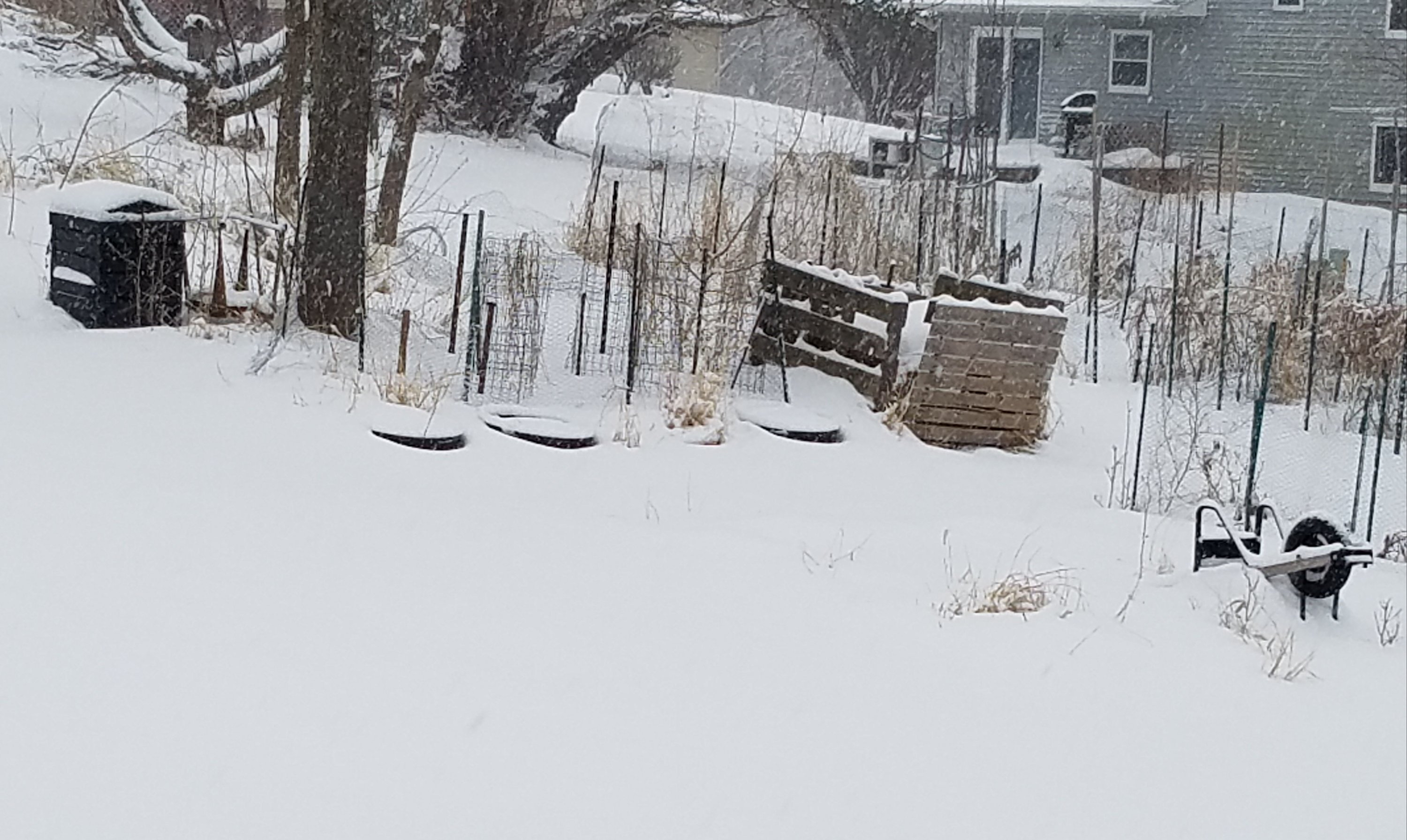
Between two and three inches fell with more coming. I had planned to secure provisions in the county seat, but now I’m not sure. Even if I go, errands can wait until snow stops and roads are cleared in a few hours.
For breakfast I made an omelette using leftover taco filling. Except for the prep work it takes 20-30 seconds to cook an omelette. It’s so easy anyone can do it. On my first cup of hot cocoa, showered, shaved and nourished, I’m ready to turn to another day.
Unintentionally, I spend an early morning hour watching a 2003 documentary titled, Inside the Marx Brothers. The white-washed story recounted historical facts about the six brothers, leaving out the racism inherent in much of their work. I was a fan of the Marx Brothers before I left home to attend university. It wasn’t until later I realized the prejudices toward blacks and women contained in their films. I have VHS copies of most of their films, beginning with Cocoanuts and Animal Crackers, written by George S. Kaufmann and Morrie Ryskind. These were adaptations of the Marx Brothers successful Broadway shows with the same name. I can hardly stand to view them today. Like many of the acts that emerged from vaudeville, neither the actors nor the audiences were cognizant of their biases the way we can be today.
Marx Brothers films aired on television Sunday mornings in the 1960s. We watched the newspaper guide to see when the next one would air and looked forward to them. It was during that ten-year period from 1960 until 1970 that we became a T.V. family, with everything that meant at the time. On the playground before school my friends and I would play marbles or four square and discuss what was on television the previous night. It was formative in a way that moved us from the physicality of neighborhood play to an intellectual approach to abstractions in the world. It made part of who I am.
We didn’t think much about network commentary on current events. The Huntley-Brinkley Report was our daily source of news and we tried not to miss it. Fifteen minutes seemed an adequate amount of time to present the news. Our focus at home was more on the style of the co-anchors and the closure we found in their signature sign off each night, “Good night, Chet. Good night, David. And good night, for NBC News.” The report expanded to thirty minutes on Sept. 9, 1963, following the CBS Evening News with Walter Cronkite which did it first. At the time we didn’t understand how they were going to fill an extra fifteen minutes.
A couple hours after sunrise and snowfall stopped. Time to chart the rest of the day while cultural memories of the Marx Brothers, Walter Cronkite, and the Huntley-Brinkley Report circulate in the tribal background. Considering the role television played in the 1960s, I wonder why we abandoned it, almost never turning a T.V. on, except to watch the weather during a storm.
Food for thought while I dig out a lane to get to the county seat and complete errands.
 Couldn’t this have been discovered and vetted long before the actual, expensive in person meet up? Isn’t that why we have diplomats? Why elevate this meeting to a “summit” if we didn’t know the basis for an agreement beforehand?




 Journey Home
You must be logged in to post a comment.