Categories
Living in Society

Iowa Caucus Contagion

Caucus-goer

In 2000, the year the U.S. Supreme Court stopped vote counting in Florida and made George W. Bush our 43rd president, measles was declared eliminated.

Not so fast.

“From January 1 to April 26, 2019, 704 individual cases of measles have been confirmed in 22 states,” the Centers for Disease Control and Prevention reported last week. “This is an increase of 78 cases from the previous week. This is the greatest number of cases reported in the U.S. since 1994.”

Our political leaders are not solely responsible for a preventable disease outbreak that mostly affects children younger than 18. Concurrently, measles outbreaks are a sign of our political times. Vaccine-preventable diseases belong in history books not in 22 U.S. states.

My interest in the measles outbreak is driven by two terms I served on the county board of health. CDC was politicized under president Bush, whose administration censored its director, Dr. Julie Gerberding. However, if CDC’s army of health professionals reports an outbreak, we should take it seriously. As an Iowa Democrat that means picking smart leadership in the 2020 general election from township trustee to the White House. We have to change a political climate which produces social phenomena like communicable disease outbreaks.

20 Democratic candidates are running for president, with the incumbent the presumed Republican nominee. It’s hard to say who will emerge from the July 2020 Democratic National Convention as the nominee, but know this: there aren’t as many choices as one would think.

Joe Biden is making his third attempt for the nomination, Bernie Sanders his second. A squad of U.S. Senators has announced, as well as current and former mayors and U.S. representatives. There are even outliers like best-selling author Marianne Williamson, businessman Andrew Yang who supports a universal income, and second time aspirant Mike Gravel. With nine months to go until the Iowa Caucuses, most people I know planning to attend have it narrowed down to a few options.

This summer’s Democratic debates should clear some non-viable candidates from the field. The Democratic National Committee set criteria for participation on June 26-27 in Miami and July 30-31 in Detroit as follows:

  • Receiving at least 1 percent support in three DNC-approved polls. Those could be in early state polls — Iowa, New Hampshire, South Carolina or Nevada — or in national polls between the beginning of January 2019 and the two-week mark before the first debate (a candidate could fall short but then qualify for the second debate if they meet the polling threshold two weeks before the July debate).
  • Receiving donations from at least 65,000 unique donors with a minimum of 200 donors in at least 20 different states.

Say what you will about the criteria, they are straight-forward and concise. If a presidential candidate can’t get one percent in the polls or raise money, why would they receive further consideration? That makes July 31 the drop dead date for Democratic presidential candidates.

The challenge in our district is bandwidth. In addition to selecting delegates to the county, district and state conventions by presidential preference groups Feb. 2, 2020, Democrats do not have a stand-out candidate to run against Senator Joni Ernst in her first re-election. We need to find one because without a Democratic majority in the U.S. Senate, any Democratic president’s agenda would be hamstrung out the gate on inauguration day. In addition, Congressman Dave Loebsack announced his retirement at the end of his term. Multiple candidates are expected to announce for congress this spring and summer. Between announcement and the June 2, 2020 primary, name recognition and winning over primary voters will be essential for viable candidates. Even former State Senator Rita Hart, who ran as our 2018 lieutenant governor nominee in the state-wide race is hardly a household name. There is a lot to do to keep this seat in congress Democratic. How does one work on all of that at the same time?

Managing bandwidth is about staying focused on voters in my precinct. I seek to contribute to a welcoming environment at the caucus where I seem likely to be selected as acting chair. If that’s the case, I may not make a pick for president before the caucus. I can even see me throwing my support to a preference group that needs one more member to become viable. As long as the candidate has a “D” after their name, and is selected by the party, I don’t see the relevance of my personal preference. Digging into a shallow pool of colloquialisms, “we have bigger fish to fry.” There are also other, more populous, and impactful states to vote or caucus by Super Tuesday on March 3, 2020.

The number of views on this blog surged when I announced my pick of Hillary Clinton for the 2016 Iowa caucuses. While I’m tempted to try to make a splash again this year, Democrats seem resolute about replacing the incumbent president. It would be foolish to let personality, individualism, or my interest in clicks get in the way of that momentum. If I’m lucky, the party will find someone else to run the caucus and I can work for a presidential campaign during the run up. I’m not holding my breath.

The measles outbreak is unfortunate and we can’t deny the science of communicable disease unless we want to put everything we hold dear at risk. So it is with our politics. The country appears to be under a spell, and the most obvious person is not the witch. It’s time to do what we know is right to recruit and vote for viable candidates to take on the Republicans. We may lose but won’t get anywhere toward a more just society unless we engage and put our best energy to work.

As Hillary Clinton said, “We are stronger together.”
Categories
Kitchen Garden

Cukes, Zukes and Yellow Squash

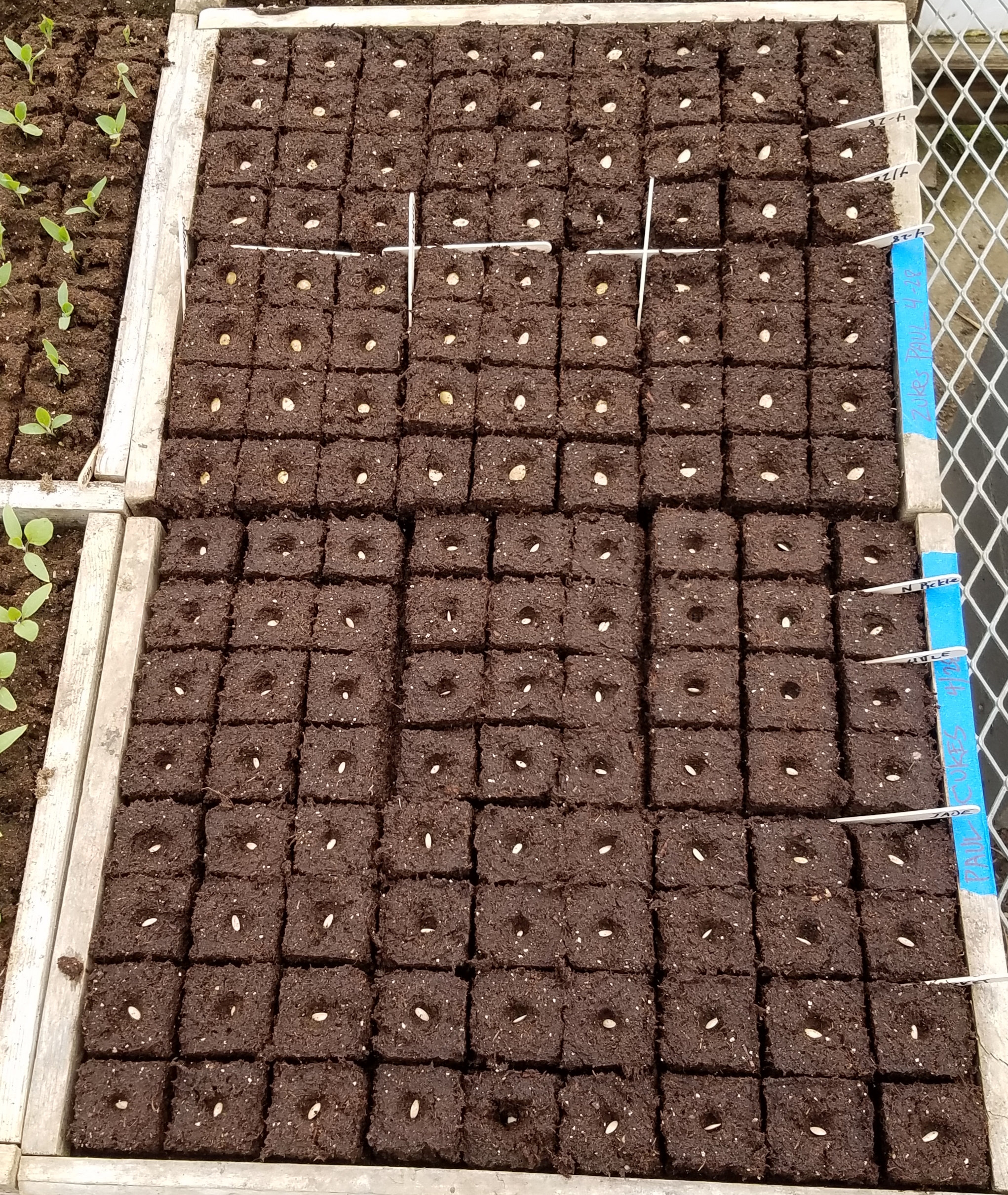
This Year’s Last Seedling Trays, Zucchini, Cucumbers and yellow squash.

When I returned from the farm Sunday afternoon I transplanted a dozen broccoli plants in the garden. Reserving a couple to replace failures, I gave the rest to my neighbor.

Continuing the minimal tilling experiment, I placed broccoli seedlings in a plot where cucumbers produced in abundance last year. I didn’t remove the plastic and used the same holes. The plot is shaded by the locust tree, so I’m not sure how this will turn out. Fingers crossed and hoping for the best.

At the greenhouse I seeded cucumbers, zucchini, and yellow squash, which is likely the last starts. Most everything else will be seeded directly in the ground in May.

I brought home a tray of lettuce and spinach for transplanting.

I seeded,

Cucumbers

Northern Pickling, Johnny’s Selected Seeds, 48 days.
Little Leaf, Johnny’s Selected Seeds, 57 days.
Marketmore 76, Ferry – Morse, 68 days.
Tasty Jade, Johnny’s Selected Seeds, 54 days.

Zucchini

Raven, Johnny’s Selected Seeds, 48 days.
Elite, Ferry – Morse, 55 days.
Dark Green, Ferry – Morse, 55 days.

Yellow Squash

Dixie Hybrid, Ferry – Morse, 41 days.
Early Summer Crookneck, Ferry – Morse, 53 days.
Early Prolific Straightneck, Ferry – Morse, 50 days.

While inspecting the apple blossoms yesterday I spotted leaves growing from the stump where another apple tree was blown over in a straight line wind. I staked and put a cage around it to protect from being eaten by deer and from the mower. Not sure what’s next, but it was a very early apple and I may grow it to maturity if that is what it turns out to be.

The spring share for which I bartered at Local Harvest CSA begins today and runs for five weeks. I’m looking forward to a salad made with fresh, local lettuce and cooking greens for a pasta dish.

The next step in the gardening season is upon us.

Categories
Kitchen Garden

Apple Blossom Worries

Apple Blossoms Before the Frost Click the photo to better see the blooms.

Apple blossoms began to open as news of an overnight freeze arrived.

I woke at 2 a.m. and checked the ambient temperature. 33 degrees — barely in the safe zone.

The impact of losing blooms before pollination would be another two years waiting for a crop.

The overnight forecast was a low of 29 degrees, which means there is a chance most of the buds will survive. These things are iffy, so I’ll go outside as soon as it is light and check the progress. Fingers crossed.

News from my fall job at the apple orchard arrived yesterday. They took out 500 trees from the oldest part of the orchard to be replaced with an as yet unannounced “season extender.” The orchard manager mentioned the challenges of starting a new fruit like raspberries, strawberries or blueberries in March at a Johnson County Food Policy Council panel on specialty crops. From the presentation I understand the new crop won’t be raspberries or strawberries, although I could just pick up the phone and call the owners and ask.

I ran into one of them at the warehouse club last week. Instead of the orchard, we talked about how the retail establishment used to sell dried mangoes of the kind they enjoyed while managing an orchard in China. Sadly, the supplier no longer carries that type, saying it is “unavailable from the distributor.” I confirmed my interest in working another season at the retail barn. She said they had already been discussing my return at a board meeting, so I had to come back. It is nice to feel needed, I think.

I could go another year without home grown apples if I have to. We have plenty of apple sauce, apple butter and apple cider vinegar to last. Working at the orchard is another source should frost take my blooms.

According to my weather app, the forecast changed to a low of 32 degrees since I began writing this post. Sunrise is at 6:06 a.m., in an hour and 20 minutes. As soon as dawn starts to break, I’ll be outside inspecting the blooms, hoping they made it through the night.

Categories
Living in Society

Elizabeth Warren in Tipton

Elizabeth Warren Meet and Greet in Tipton, Iowa. April 26, 2019

TIPTON, Iowa — 125 to 150 people showed for an Elizabeth Warren meet and greet at the Tipton Family Restaurant today.

The side dining room selected for the event usually seats about 25 diners. Staff cleared the tables and most chairs, and we crammed in like the crowded stateroom in the Marx Brothers movie A Night at the Opera. Not everyone fit and after the event I saw about 35 people in an overflow area waiting for their moment with Warren.

It was comfortable inside once everyone settled in place. I worked my way to the back of the room where my 6-foot, 1-inch height enabled me to see the proceedings.

Warren gave a 25-minute stump speech, which Robin Kash with Neighborhood Network News captured here. She took two questions outside before her speech and another four inside afterward. She used a microphone so we could hear all six. The demand for answers was much greater than allotted time. I’m a bit spoiled after hearing Hillary Clinton take 13 unrehearsed questions in Coralville back in 2015. Warren did well with her answers.

My impression of the event was as follows:

I’ve been to political events where there is a lot of excitement and this wasn’t one of them. The air was filled with resolve more than excitement, as if attendees felt we have to do something about the current president and events like this are the path. I knew at least a dozen non-staff people there and they either a). already support Warren, b). represent a constituency and are making candidate rounds asking specific questions, or c). people who want to participate in the caucus process. One attendee characterized her interaction as “dating” before the caucus.

Plenty of Warren staff and volunteers were on hand to register people and put colored identification stickers on our clothing. Except for the potential fire code violation the event was well organized. The Cedar County Democrats, under the leadership of party chair Larry Hodgden, should be proud of their work before and at the event.

Lots of folks wore media badges. I don’t know which outlets, but it was likely the candidate’s press pool. I didn’t see the reporter for the local paper, the Tipton Conservative, although he may have been there. The only blogger I knew was Dave Bradley of Blog for Iowa.

My question, while driving to the event along a gravel road running next to the Cedar River, was whether Warren is in or out for further consideration. I know Warren through her service in the U.S. Senate, and from her involvement in TARP and the Consumer Financial Protection Bureau. Her policy positions are strong and she’s smart. I was concerned more with her current age (69) and whether she displayed evidence of cognitive degeneration in such things as conceptual reasoning, memory and decline in processing speed. I’m not a physician, but I’m satisfied she’s fit to be president after hearing her give a speech and handle questions. In politics this is Kentucky windage more than a medical condition.

The only piece of news that came out of the event pertained to Newman Abuissa, a resident construction engineer with Iowa DOT, who told me he’s running for the Democratic nomination for the open congressional seat in the second district. I asked him, “Are you sure you want me to put this out there now?” He said yes. We scheduled time for an interview next week.

I did the same Gmail search for Abuissa I did for Veronica Tessler, and there were a lot more hits for Abuissa because he has been very active in Democratic politics ever since I’ve known him. I believe he’s the only person to date who said he’s actually running for Dave Loebsack’s seat, although Tessler formed a committee with the Federal Elections Commission and is giving it serious consideration as are Rita Hart, Kevin Kinney, Zach Wahls and others.

As I turned right at the cemetery onto Solon Road, and went past the Suchomel barn, I felt glad I had been to the event and hoped I could get back to a gas station before running out of fuel.

If you’d like to read my typo-laden twitter feed with more photos from the event, click here.

Categories
Reviews

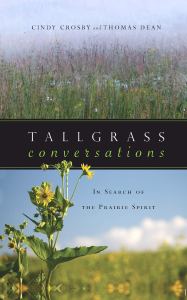
Tallgrass Conversations – Book Review

“Prairie is among the most altered and threatened ecosystems in the world,” Thomas Dean of Iowa City wrote in a new book he co-authored with Cindy Crosby of Glen Ellyn, Ill. “Care of the world is always essential, and care arises from conversation.”

Tallgrass Conversations: In Search of the Prairie Spirit was released April 22 by Ice Cube Press. It is a compilation of Crosby and Dean’s recent writing and photographs of tallgrass prairie in the Midwest. Organized in a series of 26 conversations, the book touches on many of the current issues pertaining to preservation and restoration of tallgrass prairie.

Prairie used to cover more than 85 percent of Iowa land, according to the Neal Smith National Wildlife Refuge. Today less than one tenth of a percent of original tallgrass prairie remains in the state.

“Remnant prairie functions in a way we can’t replicate through planting prairie,” Crosby wrote. “We can educate ourselves about what we are losing. We can care for what remains. We can continue to plant prairie, then research, paint, write about and ensure tallgrass prairie is a part of future conversations about development, agriculture, and conservation.”

If one participates in the experience of tallgrass prairie as Dean and Crosby encourage us to do, it is decidedly cultural. They provide a window into current tallgrass ecosystems and their modern discovery and management. The authors want more writers and artists, poets and photographers to document what’s left of tallgrass prairie and enter into a conversation about what it means and what can be learned. They want to be partners in that conversation and the book serves as an example of how to begin.

“We hope you’ll enjoy seeing the various ways we invite you to think about some of these words and images that showcase the prairie spirit,” Crosby wrote.

To learn more about Cindy Crosby’s work, visit her website, Tuesdays in the Tallgrass: Exploring exterior and interior landscapes through the tallgrass prairie at https://tuesdaysinthetallgrass.wordpress.com.
Thomas Dean is senior presidential writer/editor at the University of Iowa, where he also teaches interdisciplinary courses.

~ First published in Issue 262 of Little Village

Categories
Living in Society

Is He a Socialist?

My Grandfather, the Socialist

My political fate was determined when I was very young.

My grandfather was a socialist, union coal miner who believed the means of production should be owned or regulated by the community as a whole. The very definition of a modern day socialist.

Easter Sunday I telephoned Mother who told me this story.

Grandfather, who had been divorced by Grandmother, came to Davenport to visit one weekend when I was about seven months old.

Holding me, he asked Mother, “Is he a socialist?”

Mother responded, “No Pa, he’s a Democrat like the rest of us.”

At the time I said nothing because I had not learned to speak English. My political future was thus determined without comment. It stuck: A Democrat, not a socialist.

I had coffee with a young reporter yesterday who asked my thoughts about what “socialism” meant to the 2020 election. The idea is that Republicans will hammer Democrats, right or wrong, for being socialists as much as they can, thus gaining traction among unwitting voters. I don’t think people who use the term “socialist” today understand what it means.

Socialism is a system of government like that in the Union of Soviet Socialist Republics which was dissolved in 1991. Most people in the USSR were poor compared to the United States and Europe. Artists and writers were sent to the gulags described by Aleksandr Solzhenitsyn, provisions were rationed, housing was inexpensive but derelict, abortion was encouraged as a method of social planning, and society was described as austere. What American in their right mind wants that?

Karl Marx noted a continuing struggle between the bourgeoisie and the proletariat, class warfare. Another way of describing it today is the difference between those who control the majority of our wealth and means of production, the one percent, and the rest of us. To describe Democrats as socialists is a distraction from the real problem of growing financial inequality. Maybe to distract is the Republican point.

Government working on common problems is a feature, not a bug of it. By the introduction of more money into our politics and elections, the wealthy have been able to control our government. We hope the duration of such control will be short.

Before I could talk, without my input, I was determined to be a Democrat and remained one. Make no mistake. The answer to Grandfather’s question is I am not a socialist, nor are the vast majority of Americans. To say otherwise is part of the problem with our politics: the truth doesn’t matter, and political rhetoric has strayed far from any reasonable form of veracity.

As citizens, we are better than that.

Categories
Environment

Earth Day – 2019

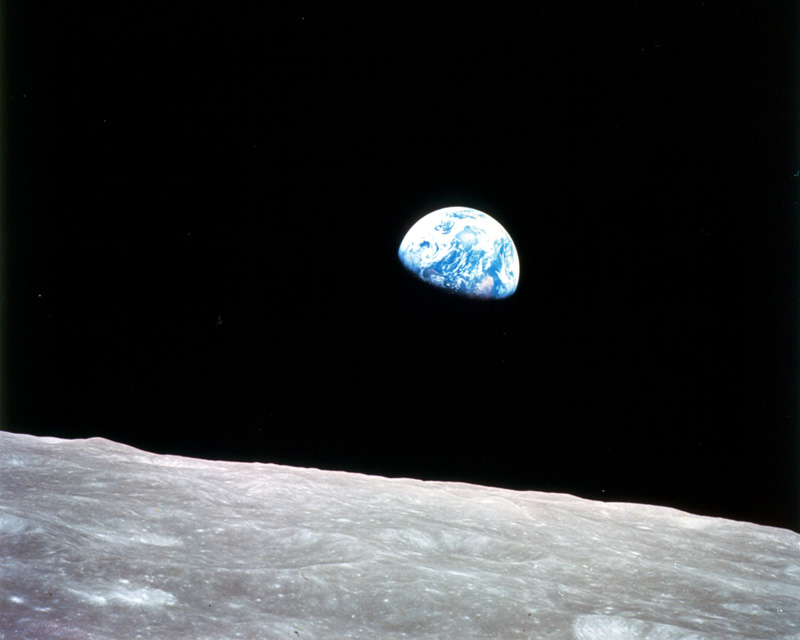
Earthrise by Bill Anders, Dec. 24, 1968

A thin haze dimmed reflected light from the moon. Thin enough to allow dots of starlight to penetrate the atmosphere and with moonlight illuminate the neighborhood.

The haze was just enough to know it was there.

I moved trays of kale, broccoli and parsley seedlings from the garage to a pallet near the driveway in the hazed light of a waxing gibbous moon.

Today is the 50th Earth Day.

Earth Day is less about a view of night’s starry presence than it is about seeing Earth as a whole. Few times in our history has a photo of Earth made such a difference in so many lives as Earthrise taken by astronaut Bill Anders. It sparked the movement that brought us Earth Day which continues to this day.

We humans have not been the best stewards of Earth since April 22, 1970.

Early Years

Vague notions of ascendancy were taught by our grade school teachers. In the seventh grade I was segregated from neighborhood friends to join a college-bound group of peers in a special classroom. I entered the National Honor Society in high school and when I graduated in 1970 had no clue what I wanted to be. I knew I was college bound, not because I wanted that, but because the nuns said I should be. That I finished college at all was miraculous. I felt a sense of relief as President Nixon appeared to heed a shared need to do something about the environment. When he created the Clean Air Act (1970), and then the Clean Water Act (1972) I felt Earth Day had done its job.

Military Service

When I left Iowa in 1976 for basic training at Fort Jackson, S.C. I had little idea of what being a military officer meant. I knew the Vietnam War was over and I wanted to serve as my father had. The context was a paternal grandfather went to prison for draft evasion during World War II. Given a choice, I would serve. Among other things, military service taught me the environmental cost of war.

The environment has long been a silent casualty of war and armed conflict. From the contamination of land and the destruction of forests to the plunder of natural resources and the collapse of management systems, the environmental consequences of war are often widespread and devastating. ~ Ban Ki-moon, UN secretary general

Oil consumption and related carbon emissions are significant contributing factors to degradation of our atmosphere. The use of depleted uranium in military ordnance, notably during the 1991 Gulf War, created a complex array of environmental problems including introduction of carcinogens into the environment. We destroyed Iraqi infrastructure, including water and sewer systems, and contaminated surrounding ecosystems. The use of defoliant Agent Orange in Vietnam created sickness among soldiers and decimated biodiversity in the country’s tropical rain forests. We should include potential use of nuclear weapons which studies have shown, in a limited nuclear war, could create a nuclear winter making 2 billion people food insecure.

Awareness of the military’s environmental problems is a lesson learned.

Worklife

I worked 25 years in the transportation business, including an 18-month stint with Amoco Oil Company in Chicago. What goes almost unnoticed as part of background noise in modern society is the amount of fossil fuels burned by trucking, railroad and ocean-going transport vehicles. When I was maintenance director for a large trucking firm, I spent $25 million per year purchasing diesel fuel for our vehicles. That doesn’t count fuel burned by our affiliate companies which used independent contractors who fueled their own semi-tractor trailers. The fundamental dynamic during this period was I needed a job to support our family and given what I perceived as a lack of opportunity after college and military service I took what I could find, staying there for most of my professional career. I traded the environment for financial security. My main concerns were job performance and getting ahead. The nuns in grade school didn’t adequately prepare me for this kind of worklife. Environmental issues were off the table.

Retirement

When I left transportation ten years ago the climate crisis became more real.

In 2013 I participated in The Climate Reality Project conference in Chicago, taught by former Vice President Al Gore. It made a difference to learn the science of climate change and in the following months I began presenting the information learned in public speaking, in letters and articles in the newspaper and in my daily life.

We entered a period of politicization of everything. Facts ceased to matter. Income inequality worsened and the U.S. government seemed owned by the richest people. The scientific facts about climate change became a political choice: do you or don’t you believe the science of climate change?

Climate change is real and is impacting our lives now. Even banks are seeing how it can impact their business. From an open letter from the Governor of Bank of England Mark Carney, Governor of Banque de France François Villeroy de Galhau and Chair of the Network for Greening the Financial Services Frank Elderson:

The catastrophic effects of climate change are already visible around the world. From blistering heatwaves in North America to typhoons in south-east Asia and droughts in Africa and Australia, no country or community is immune. These events damage infrastructure and private property, negatively affect health, decrease productivity and destroy wealth. And they are extremely costly: insured losses have risen five-fold in the past three decades. The enormous human and financial costs of climate change are having a devastating effect on our collective well being.

The authors call for an orderly transition to a low-carbon economy. “The stakes are undoubtedly high,” the authors wrote. “But the commitment of all actors in the financial system to act on these recommendations will help avoid a climate-driven ‘Minsky moment’ – the term we use to refer to a sudden collapse in asset prices.” In other words, the climate change bubble could burst.

The Future

Less than 24 hours remain in this 50th Earth Day, a brief moment in Earth history. Whatever humans do, the earth will be fine. It’s human life and society that’s at risk. My takeaway from 50 years of considering Anders’ image of Earth against a background of the immensity of space is the same as when I first saw it: we humans are all in this together. It is going to take more than Earth Day to bring political will to act on climate.

Categories
Kitchen Garden

Easter in the Germination Shed

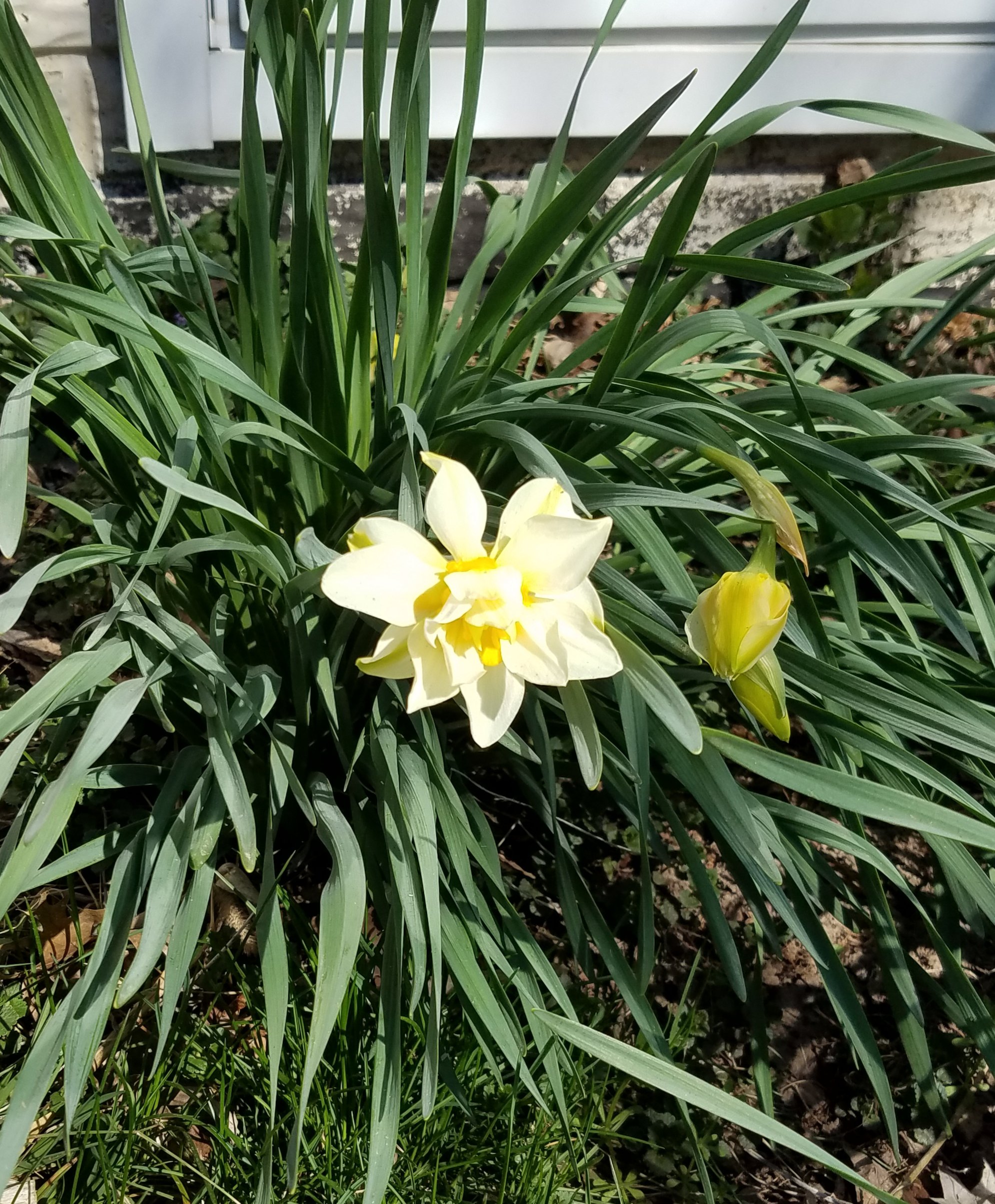
First Spring Flower in Our Yard

Seven of us worked in the germination shed at Sundog Farm on Easter morning.

The farmers were preparing dinner for their extended family. I brought them two quarts of home made vegetable soup for lunch in case they hadn’t thought about it with all the meal preparations. It was well received.

My broccoli is ready to plant, however, I seeded it in a tray with parsley, which is not. I brought the tray home to figure out how to make both plants grow optimally. Marginal planning on my part.

The peppers planted two weeks ago have not germinated which is slightly concerning. Peppers take longer but I’d hoped the plants would be emerging today. Tomatoes planted last week haven’t germinated either. That is to be expected.

Everything else is coming along, and the peppers may be coming along, only I don’t know it.

I planted,

Red Ace Beets, Johnny’s Selected Seeds, 50 days.
De Milpa Tomatillos, Johnny’s Selected Seeds, 70 days.
Bellezia Arugula, Johnny’s Selected Seeds, 51 days.
Fairy Tale Eggplant, Johnny’s Selected Seeds, 65 days.
Galine Eggplant, Johnny’s Selected Seeds, 65 days.

This is the first time planting beets in trays. It is a common practice so I’m giving it a go. There are now eight trays in the germination shed with the next up for planting being spinach and lettuce, maybe next week.

Arugula has tiny seeds. A gust of wind blew through the germination shed taking a batch of arugula seeds with it. Luckily there were more in the packet.

The other experiment this year is tomatillos. I had some from CSA shares last year and they keep in the ice box for a very long time. They are a great alternative to tomatoes for making salsa.

It was a clear, beautiful day, the kind farmers and gardeners want.

Categories
Sustainability

Prevent What We Cannot Cure

Hiroshima, Japan after U.S. Nuclear Attack. Photo Credit: The Telegraph

I’m mad about nuclear weapons spending.

The Trump administration plans to spend far more than President Obama on the U.S. nuclear weapons complex. Depending on time frame, the administration will see Obama’s trillion dollars and raise it another half trillion.

Why do we continue to spend money at all on a weapons system we are required by treaty to eliminate? Why do we spend money on weapons that should never be used?

I’m mad and that’s not the half of it.

I’m mad at President Harry Truman for dropping the atomic bomb on Hiroshima at the end of World War II. I read Truman’s explanation in his memoir, Year of Decisions, and understand he thought it was a good idea. However, after Hiroshima, when our government understood the destructive capacity of nuclear weapons, dropping a second on Nagasaki was criminal.

I’m mad at the greatest generation for failure to comply with Article VI of the Non-Proliferation Treaty which was signed in 1968 and went into effect two years later. By now, we should be finished with nuclear weapons. The treaty binds us as follows:

Each of the Parties to the Treaty undertakes to pursue negotiations in good faith on effective measures relating to cessation of the nuclear arms race at an early date and to nuclear disarmament, and on a Treaty on general and complete disarmament under strict and effective international control.

The United States and Russia continue to hold the largest number of nuclear weapons even though reductions were made through treaty negotiations. Treaties are being dismantled by the current administration. If nuclear states had disarmed as the Non-Proliferation Treaty compels us, we wouldn’t even be having this conversation.

I’m mad at my generation of baby boomers. As the torch of nuclear non-proliferation was passed to us, my cohort chose to focus instead on personal liberation and financial well-being.

There was a resurgence of interest in non-proliferation during the nuclear freeze movement in the 1980s. This global advocacy contributed to negotiation of the INF Treaty between the United States and Soviet Union on the elimination of their intermediate-range and shorter-range missiles. It was signed by President Reagan and Soviet General Secretary Gorbachev on Dec. 8, 1987. The current administration announced plans to abandon the INF Treaty.

Why am I so mad? The problem of the existence of nuclear weapons should have been solved soon after society found their destructive capacity. I don’t want to pass that problem along to our daughter and her generation.

Our community has outgrown our fire station and tax levies aren’t sufficient to build a new one. Fire fighters are determined to raise the funds and implore us to “fill the boot” they leave at local businesses. If we had eliminated nuclear weapons, we might have enough money to build thousands of fire stations. Where are our priorities?

As a society we must create a nuclear weapons free world. There is no cure for a nuclear war. We must prevent what we cannot cure.

~Published on May 5, 2019 as a guest opinion to the Cedar Rapids Gazette

Categories
Kitchen Garden

Kale Planting

2019 Kale Bed with 21 plants ready for mulch and fencing.

Temperatures were ideal for yard work so I prepared the bed for kale.

It is important to get kale right because once established, it will produce leaves until November. Sometimes it even over-winters. It is worth the time to measure and plant according to the package instructions.

I put 21 seedlings in the ground and reserved a dozen in case some don’t survive. A neighbor wants some, and after that, I’ll snip the leaves and make a kale salad or two with the leftovers.

My process has a lot of steps after picking up the seedlings at the greenhouse.

  • I run the lawn mower over the plot to remove any tall grass.
  • This year I did a burn pile on this plot so using a garden rake I spread the ashes evenly over the surface.
  • Turn over the soil in bites the size of the spade. Do this by hand. A long-handled spade works best.
  • Spread fertilizer (composted, granulated chicken manure) evenly over the top. For a 10 x 12-foot plot I used a gallon and a half.
  • Using the garden rake, break up the clods of dirt until they are fine enough to rake somewhat smoothly.
  • Make a slight trench with rows three feet apart. Use a yard stick or measuring tape.
  • Using a hand cultivator, break up the dirt in the trench six inches either side of center.
  • Using a plastering brick laying trowel, knife the blade into the ground and pull the soil back until the seedling will fit in. Put in the seedling, then fill the hole by hand with loose soil. Measure distance to the next hole in the role as length of the trowel plus the length of blade. Finish planting.
  • Next I use six inch sections of field tile to protect the seedlings. These will be removed once the stem grows larger. Press each tile section into the ground. The idea is to prevent ground crawling and walking pests from biting the tender young plants.
  • Use the garden rake to even our the surface and remove compressed areas where the gardener knelt during planting.
  • Using metal fence posts, pound them into the ground with a post-driver.
  • Put up chicken wire ensuring to get the bottom to firmly touch the ground. Be sure to leave a place for a gate so you can access the ripe kale.
  • If mulch is available, mulch deep and completely. Return later if mulch is not available.
  • Finally water the entire plot thoroughly.

Sounds a bit complicated, but the process has served well during the last few years.

It was a great day to be out in the garden.