We don’t know anything new about the 45th president after Thursday’s release of the 448-page Mueller Report. I haven’t taken the time to read it, you?
There may never be time to read the report as it is expected to confirm what we already know: Donald J. Trump and associates are crooked as a three dollar bill.
U.S. Rep. Jerrold Nadler (D-N.Y.), chair of the House Judiciary Committee, subpoenaed a copy of the unredacted report within hours of Attorney General William Barr’s Thursday press conference. In Washington, the move was expected.
In July 1974, a high school friend was interning in Washington, D.C. when the U.S. House filed articles of impeachment against Richard Nixon. He brought a copy of the documents back to Iowa to show us. Key Republicans met with Nixon and convinced him to resign before he was impeached. The difference between 1974 and today is Republican leaders Senator Mitch McConnell (R-KY) and Representative Kevin McCarthy (R-CA) seem unlikely to call for Trump’s resignation. If the U.S. House of Representatives impeaches President Trump, as long as McConnell is Senate Majority Leader there will be no conviction, even if there is a trial as there was with President Bill Clinton.
The American people will determine the fate of the president at the polls during the Nov. 3, 2020 general election if he’s not removed from office before then. Despite his shady activities and transgressions of political norms he could be re-elected.
What’s a gardener to do? Make sure the Congress follows the constitutional process.
What makes this tough is the likelihood the process won’t reach the desired result of removing the president and everyone knows it. What does make sense is following the constitutional process, which begins with hearings in the U.S. House of Representatives.
Much as I dislike it, I need to refresh my memory on the constitution.
Good Friday has been the traditional time to plant potatoes. With weird weather, tradition has been discarded.
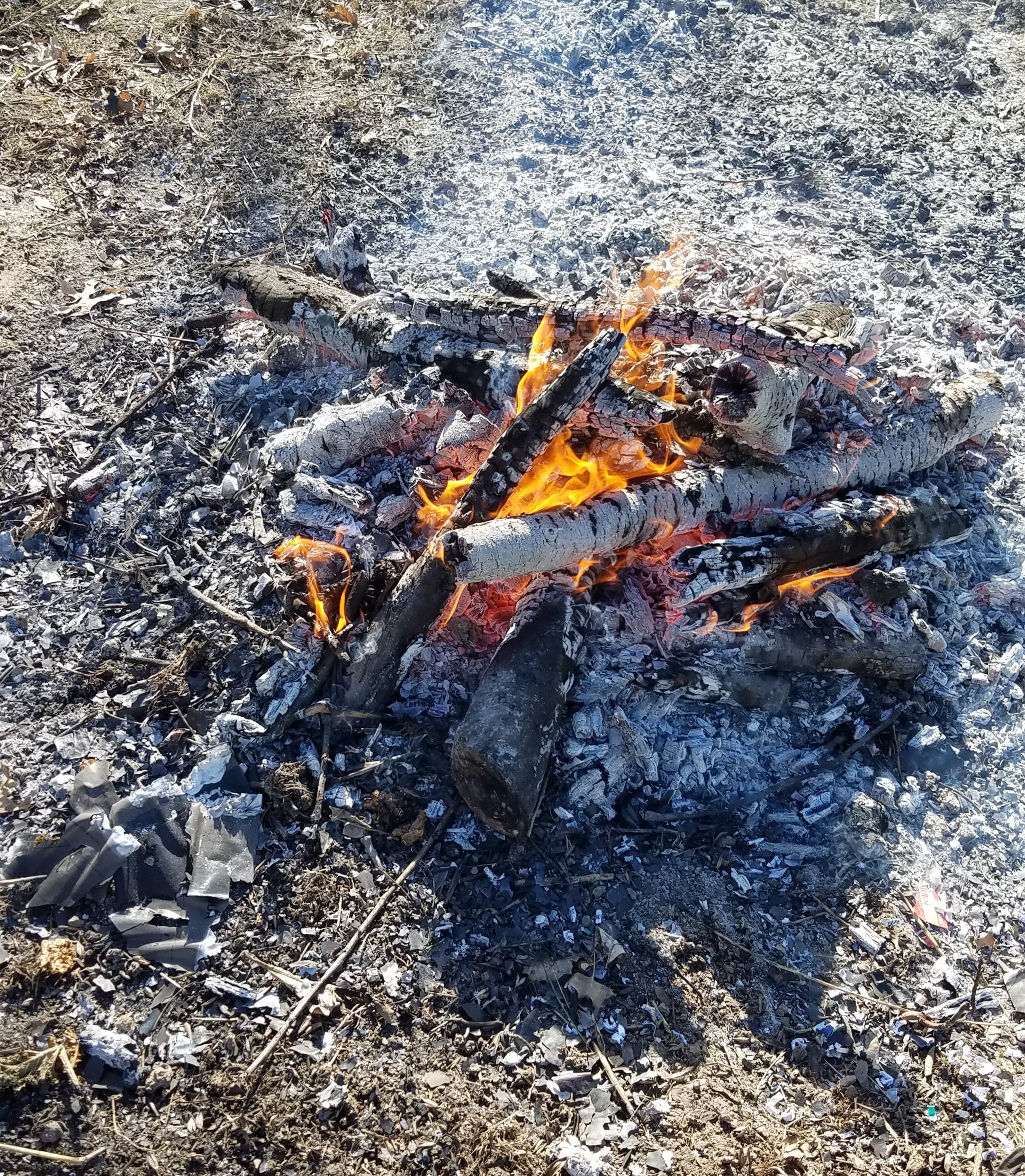
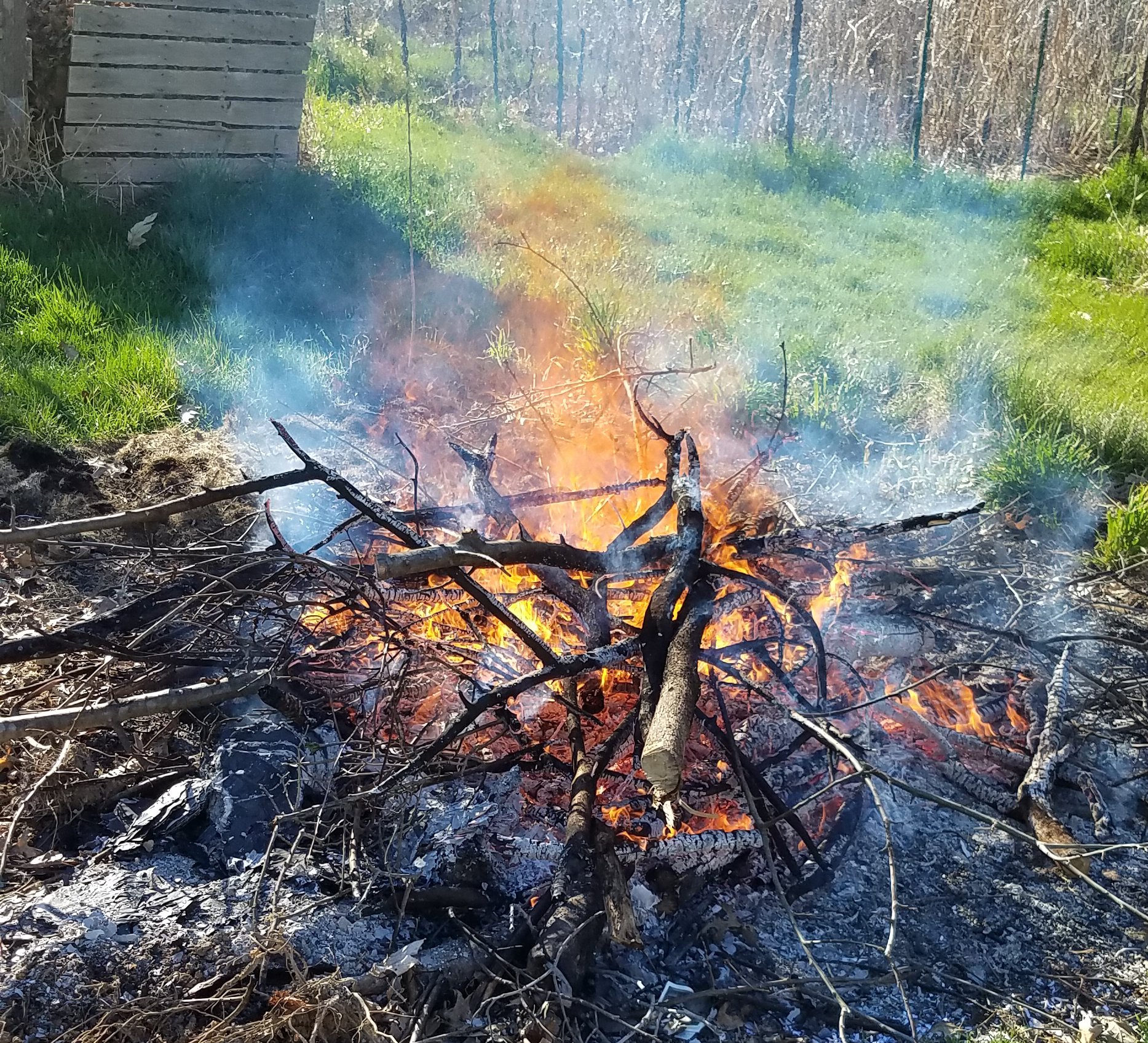
Instead, under a clear sky and cool spring temperatures, I re-stacked the burn pile, lit it, cleaned up around the second garden plot and planted radishes in a container.
I’ll get spuds from local farmers instead of growing my own this year.
In a week, I’ll plant another crop in the next container until the four containers next to the compost heap are filled with rotating crops for as long as intense heat stays within normal seasonal variation.
Lettuce seeds planted in the ground April 10 germinated and display a carpet of tiny green leaves in the first plot. Nothing else has surfaced.
I inspected the apple trees. Flower buds appear to have survived the Polar Vortex. Tips of the emerging leaves seem discolored, but I don’t know if that’s their normal color. They seem far enough along for a normal May bloom.
The plot with the burn pile will be for kale and something else. As I walk the back yard, carrying tools, seeds and fertilizer during multiple trips from the house, a plan for this year’s garden is being revealed.
As a gardener I burn brush on a garden plot a couple times a year, rotating the burns on each of seven plots over time. The idea is the mass of the brush is reduced, carbon dioxide is released, and minerals return to the soil. It’s a common practice.
The alternative is purchasing a wood chipper to turn brush into garden mulch — expensive for the amount of brush accumulated in a single gardening season. For the time being, I plan to continue to burn brush because of the carbon cycle.
In 2015 I discussed carbon release from burning wood and other biomass in fires like mine, for home heating, and in the University of Iowa power plant where they burned a mix of fossil fuels and biomass.
What scientists told me was it was better to burn biomass than fossil fuels, partly because the amount of carbon dioxide released into the atmosphere was less than burning coal in experiments they performed.
Ben Anderson, who operated the University of Iowa power plant said, “It’s still combustion but the carbon cycle is what is important there.”
Biomass takes carbon from the atmosphere and stores it until it is released back into the environment in a cycle as old as time. Mining and burning fossil fuels also releases stored carbon which has been stored for millennia. Given our present ecosystem, it is better to leave fossilized carbon where it is, according to the analysis, because releasing it contributes to global warming.
I wrote about this for the local newspaper. The article below was published on Oct. 7, 2015 in the Iowa City Press Citizen with my by line. Many thanks to my editor Josh O’Leary for improving my initial submission.
Biofuel use is a well-known contributor to meeting sustainability goals at the University of Iowa. Since 2003, UI has used oat hulls sourced from Quaker Oats in Cedar Rapids to generate electricity, heating and cooling on campus.
Several chemistry department faculty and students recently completed a study of gas and particle emissions from co-firing coal and two types of biomass versus straight coal at UI’s main power plant.
Researchers also found that using oat hulls with coal reduced carbon-dioxide emissions by 40 percent and significantly reduced the release of particulate matter, hazardous substances and heavy metals.
“The UI is working toward meeting a goal of using 40 percent renewable energy by 2020,” said Betsy Stone, an assistant professor in UI’s chemistry department. “Part of their plan to achieving that goal is the use of biofuel, which is a renewable source of energy, instead of fossil fuel, in this case coal.”
The group was interested in understanding how using biomass instead of coal changed emissions released into the atmosphere, Stone said.
“When burning 50 percent oat hulls and 50 percent coal, we saw a big reduction in criteria pollutants compared to burning 100 percent coal,” she said. “When I say ‘criteria pollutants,’ I’m talking about things like fossil carbon dioxide, sulfur dioxide and particulate matter.”
Use of the 50/50 mixture reduced the mass of particulate matter by 90 percent, Stone said.
While overall CO2 emissions were constant among the three fuels used in the study — straight coal, 50/50 oat hulls/coal, and 3.8 percent wood chips/96.2 percent coal — the use of plant material makes the process more sustainable, Stone said. Biomass takes CO2 out of the atmosphere and incorporates it into the plant. When it’s burned, CO2 is released.
“It’s considered to be a renewable fuel because we have that carbon cycle going on,” Stone said. “With fossil fuels, we’re releasing fossilized carbon. It goes into the atmosphere and takes millions of years to get back to fossilized form again.”
The major take-home message is there is a significant reduction in fossilized CO2, sulfur dioxide and particulate matter, which is beneficial to people living near the power plant, Stone said.
“I thought the study was definitely encouraging and in line with our thoughts that biomass is good for the environment,” said Ben Anderson, UI power plant manager. “Overall, the results are encouraging and provided assurance we are going the right way with the biomass project.”
The biomass project brings the renewable component to the plant, but is also a component of fuel diversity, he said.
“That’s really important for reliable operations,” Anderson said. “Natural gas markets have been known to spike from a cost perspective. If there is a problem with pipeline transport, we can use the biomass and still keep this plant online.”
Maureen McCue, coordinator for Iowa Physicians for Social Responsibility, noted important considerations of this study, including locally sourced fuel options and the avoided cost of buying and shipping coal. McCue called UI’s biofuel efforts “a good use of a resource that might otherwise go to waste.”
“The mixture avoids some of the known adverse health effects associated with burning more coal,” McCue said in an email. “There is no health benefit to anyone unless you assume burning coal is obligatory/unavoidable and thus count as benefited the person(s) who would have been impacted by more coal.
“It’s like saying not hitting your head with a hammer is a health benefit,” she added. “No one wants to risk their health breathing coal emissions or headaches by hammer if there are alternatives.”
I looked in the recycling bin and there were only eight items in it. Thursday is our day to leave the bin at the end of our driveway and I’m going to wait until next week.
It’s not that we’re throwing more in the trash instead of recycling. The trash bin is completely empty, making the second week in a row it remains in the garage as the trash collector comes through the neighborhood.
We’ve learned to reduce the amount of stuff we use, recycle what is accepted, and reuse what can be. In part we do that because of my participation in the first Earth Day on April 22, 1970.
Do the math. The 50th Earth Day is Monday and the news is that few are aware or interested, based on my personal interactions with people and reading news coverage.
I’ll have more to say on Monday, but a couple things are clear.
In the long run, the Clean Air Act, the Clean Water Act and other environmental laws enacted since the famous Earthrise Photo have run their course. The U.S. Environmental Protection Agency did good work for a time, which included measurable environmental improvements, yet in today’s de-regulatory government their future effectiveness is being gutted in favor of business interests.
The regulatory environment created beginning with President Richard Nixon didn’t do the job. Climate scientists indicate society is in a position where if we don’t de-carbonize and fast, within the next decade or so, there will be dire consequences. The Earth will be fine, but the people on it will not.
We see the effects of global warming everywhere. Vegetable farmers discuss ways to produce a crop that accommodates extreme weather we face. While row-crop farmers know how to a get a crop in the field in record time, the nutritional quality of food they produce is less because of global warming. This is not to mention the flooding in Iowa where 56 counties have been declared a disaster by the governor. We’ve had our share of straight line winds, drought, excessive and heavy rainfall, and flooding during the time we’ve lived in Big Grove Township.
We had good intentions on the original Earth Day. 50 Years later, we need a better, smarter movement to reverse global warming. Even if we do create such a movement, we let the problem go on so long the ecosystem will continue to change in ways that seem totally new and not for the better. There is no going back to some halcyon time when all things were great.
I’m not depressed about our current situation, even if there is cause. Our only hope is to remain engaged, to engage in actions that reduce our carbon foot print and mitigate the effects of damage already being done. With help from friends, I continue to believe that is possible.
Congressman Dave Loebsack in the Solon Beef Days parade
On Wednesday, Feb. 27, 2008, this note came:
Paul:
Dave is interested in stopping by the Fish Fry at the Legion on Friday.
Would you be interested and available to introduce him to a few folks that night?
If you can’t, can you think of someone else who might like to? Probably around 6:00.
Thanks-
David Leshtz
District Representative
Congressman Dave Loebsack
I worked on Dave’s campaign in 2006. During the summer, after the office was first open, I was often the only volunteer making phone calls. There were a lot of calls to make and often the recipient of the call said “Dave who?” The night of the election, I was able to work through the crowd after Dave’s acceptance speech and shake his hand before he went with the press. He said “I’ll be back to talk later.” That night was something else and I guess tonight is later.
Dinner was just Dave and me talking about stuff: the weather, Joensy’s restaurant, RAGBRAI coming through Solon, the Big Grove Caucus and the Minneapolis airport. I introduced Dave to one of our neighbors who ran the 4-H club our daughter joined. She was there with her son. Jean Stinocher stopped by with a 3 by 5 card asking what questions were on the immigration test. She was researching the topic for a presentation. Dave passed it to Dave Leshtz for follow-up. Jean’s husband’s uncle is the person after whom the Stinocher American Legion Post is named. He was among the first in the area to be killed in WWI. We talked about John Edwards and Barack Obama and the hope that if Obama is elected, he could do for the Democrats what Reagan did for the Republicans: go over Congress’ head to the American people and get things done. We hope a Democrat is elected President in November. Jean caucused for John Edwards in Big Grove. Dave supported Obama at his caucus.
I asked Dave why Congress was choosing to spend resources on prosecuting the contempt citations against Harriet Miers and Josh Bolten. He said he favored holding them in contempt and that a lot of Democrats wanted to hold the Bush administration accountable. House Speaker Nancy Pelosi announced that she has given the Judiciary Committee authority to file a lawsuit against Bolten and Miers in federal court. I expressed my concern that there were other, more important areas where the Bush administration could be held accountable.
I finally asked Dave who was running his campaign. He said he was still trying to get things done in Washington and that most of the activity is fundraising. With three Republican opponents, he would let them fight it out for now. I told him I would contact Melanie to help.
And that’s that. One of the good thing about life in Big Grove: dinner with your Congressman.
~ First published on Feb. 29, 2008 in an earlier version of this blog.
Kale Seedlings from the Greenhouse, Ready to Plant
I’m going home.
Yesterday’s fire at Notre Dame Cathedral, on Île de la Cité in Paris, brought that feeling from the darkness.
It is no longer my world.
When I visited Notre Dame I didn’t take photos. I brought a dozen rolls of Kodak film with me on a 12-week trip to Europe. They had been stolen in Calais. I reluctantly bought two to replace them and used them sparingly. Having studied Gothic architecture in art history class, I figured there were enough extant photographs to call up memories without any light I personally exposed to film. It turns out those memories, in light of the fire, remain prominent without external stimulation.
I remember standing below the large stained glass window, made in the 13th century, in awe of the accomplishment. In 1974 the cathedral wanted repairs and there was ongoing work being done. The flying buttresses looked fragile, the stone facings of the church well worn by pollution from acid rain and vehicle exhausts. I marveled that the stained glass survived two world wars and read the story of how they did. A religious service started and I left the cathedral.
News reports this morning say the stained glass window that made an impression on me 45 years ago was saved from the fire. The collapse of the roof and gutting by fire of the interior means any repairs will be costly. With the centuries-old struggle to keep the building up, it’s hard to see how a complete restoration would even be possible. In any case, the 13,000 trees cut to make the roof —an entire forest — can not be replaced after so many centuries.
We are used to landmarks being changed or disappearing. The World Trade Center in New York City and the Bamyan Buddhas in Afghanistan are two different types of examples in my lifetime. How uncaring people can be about preserving history. How fragile is what has been entrusted to us by the past.
When the world you’ve come to know changes, it is time to go home.
According to the Social Security Administration’s life expectancy calculator I can expect to live 17.4 more years. I’ll do my best to live a good life, however, the journey home has already begun.
The worst kept secret in Johnson County is Veronica Tessler is running for the open seat in Iowa’s Second Congressional District in the June 2, 2020 Democratic Primary.
Six distinct sources have told me as much… and there are public Facebook posts, one of which includes a date for her announcement.
On April 12, incumbent Dave Loebsack announced his retirement, making this an open seat. My interest in Tessler began March 17, when I asked a friend, “Who is the progressive woman raising money and recruiting staff for a primary challenge to Dave Loebsack? I don’t see an entry on the FEC website.”
I found out it was Veronica Tessler.
If I met her, I don’t remember it. It turns out she has been on periphery of my life for more than ten years and I didn’t know it. This post is about what I found while searching for her on Google and in my email files.
I was an early adopter of Gmail, and still maintain records back to 2006. A search for Veronica Tessler yielded a couple dozen hits, all of them items where she was mentioned but not the author or recipient.
The earliest hit was the 2008 Second District Delegate list where Tessler was for Obama. She also ran for national delegate, according to the April 26, 2008 email from the Iowa Independent. I don’t know if she made it as I was in the Edwards camp at the convention, where we sent Dave Redlawsk and Ro Foege. I re-circulated this delegate list to various campaigns over the years, so there are other hits as well.
After that, my emails about Tessler are related to her work at the Stanley Foundation. I don’t remember her, even if I met her. When I reached out to David Shorr at Stanley, to help with the Comprehensive Test Ban Treaty ratification campaign, there was no suggestion or mention of her. She did write an Op-Ed to the Des Moines Register advocating for ratification of the CTBT on Feb. 21, 2010, according to an email from our public relations firm.
We were to bring Tessler in to a monthly meeting of Physicians for Social Responsibility in February 2011 to address nuclear proliferation. She was still at the Stanley Foundation and I don’t recall if I attended. In this case, Dunbar’s Number is likely coming into play as I met so many people when I was active with PSR it’s hard to remember.
In the March 22, 2015 issue of the Washington Post Tessler indicated she was politically inactive between 2008 and 2015.
In the basement of the Cedar County courthouse in Tipton, where (Martin) O’Malley spoke to about 40 Democrats, two young women offered Warren signs, buttons and stickers at a “Run Warren Run” table at the back of the room.
One of them, Veronica Tessler, 29, didn’t recognize O’Malley when he arrived but said he gave a decent presentation. Asked if she could see herself supporting him if Warren doesn’t run, she demurred.
“I think it’s way too early to be talking about that,” said Tessler, who owns a frozen yogurt shop in Iowa City. “Right now, we’re 100 percent focused on getting Senator Warren to run. I haven’t seen anyone who inspires me the way Senator Warren does. She’s real. She’s authentic. She’s powerful.”
Tessler said she had not been politically active since Obama’s run for president in 2008 and was drawn back in only because of Warren.
There are multiple news articles where Tessler was quoted about Johnson County’s minimum wage ordinance.
“I agree a raise is the right way to go,” she said. “The challenge for small businesses like mine is that all my employees are part-time and mostly dependent on their parents and don’t have the same financial demands on them as people with children have.”
Tessler said she supports a livable wage, but a higher minimum wage is not a one-size-fits-all solution.
“I am the only full time employee at my shop,” Tessler said. “All of my employees are full time students and part time workers.”
Tessler said her ten employees do rely on paychecks to help pay tuition and bills, but are still dependent on their parents.
“It’s different than an employee with dependents or children, that are looking to make a living wage and really support themselves,” Tessler said. “The difference being they’re still on their parents’ health care.”
Whatever equivocation might appear in the two press statements about minimum wage, Tessler later addressed minimum wage in her frozen yogurt shop in a YouTube video. When you look at everything, it’s clear she supported or came to support the Johnson County increased minimum wage.
Here’s what Johnson County Supervisor Rod Sullivan wrote on Dec. 21, 2016 when he awarded a Salvos Salute to Tessler:
Veronica Tessler: Johnson County has a fantastic group of young professionals on the rise. I am anxious to see what they will do when they take charge! When that happens, I expect Veronica Tessler to be in the center of it all. As the owner of Yotopia, Veronica has put her beliefs into action as a key part of her work. As an activist, Veronica has organized many successful events in Iowa City. Keep your eye on Ms. Tessler; her future is bright!
Tessler launched an Iowa City door knocking event for 2018 gubernatorial primary candidate John Norris from her apartment according to an invitation I received. She was quoted in a below the fold article in the March 31 Cedar Rapids Gazette about the teen gun protest in Iowa City.
On Wednesday, April 3, she lobbied in Des Moines with a group of young farmers. They had a photo taken, including her, Mary Mascher and Bobby Kaufmann. They also met with members of the Iowa Senate. This lobby trip was about the bill to re-write state law regarding who’s eligible for the ag exemption. I had to ask who the person was as I didn’t recognize her. “Someone trying to help,” said a farmer who named her.
So that’s what I found in my files. I recently posted,” To find our way, we need something different, and better. Our hope lies with the thirty-somethings who have arrived — like it or not.” I was thinking in part about her.
If Veronica Tessler does run for congress, she will be doing so against seasoned political veterans in the primary and in the general election. I didn’t see any serious appetite to replace Dave in 2020, but he announced retirement. Given the leaky bucket of rumors this county has become, the surprise will be if Tessler doesn’t announce for congress this month.
Sunday I brought home the kale seedlings I planted March 10 from the farm. They are ready to go into the ground as soon as the soil is prepped, maybe this week. Five weeks from seed to seedling.
In the garden, seeds planted April 9 have not germinated, although temperatures have been cold. Halfway through April, I’m anxious to spend more time in the garden. Looking at the last couple of years I kept records, the garden is where it has been in these days of weird weather.
I planted tomatoes in the greenhouse yesterday, more than I thought, and more than I will use, 360 seedlings.
Here’s what I planted by tray:
Tray One
(Slicers)
Brandywine, Seed Savers Exchange, 80 days from transplant.
Martha Washington, Johnny’s Selected Seeds, 78 days.
German Pink, Seed Savers Exchange, 85 days from transplant.
Beefsteak, Ferry — Morse, 80 days.
Abe Lincoln, Ferry — Morse, 70-77 days.
Early Girl Hybrid, Ferry — Morse, 52 days.
Better Boy Hybrid, Ferry — Morse, 70-75 days.
Big Boy Hybrid, Ferry — Morse, 78 days.
After reading Shortest Way Home: One Mayor’s Challenge and a Model for America’s Future I’m not sure South Bend, Indiana Mayor Pete Buttigieg should be the 46th U.S. president. I learned something different from his book.
My cohort, the baby boomer generation, should let go the reins of power, stop clutching our torches of freedom and snub them out.
As next generations take up leadership in our country — something that’s already going on, like it or not — we may fear younger citizens will become excessively tattooed vaping addicts. It’s not about us and that’s the hardest part of letting go.
The famous American torch speech was made Jan. 20, 1961 by John F. Kennedy.
We dare not forget today that we are the heirs of that first revolution. Let the word go forth from this time and place, to friend and foe alike, that the torch has been passed to a new generation of Americans–born in this century, tempered by war, disciplined by a hard and bitter peace, proud of our ancient heritage–and unwilling to witness or permit the slow undoing of those human rights to which this nation has always been committed, and to which we are committed today at home and around the world.
Mayor Pete is no Kennedy, even as he was a summer intern for Senator Ted Kennedy in Washington, D.C. while attending Harvard. If there is a torch, or a race at all, the relay broke down and the transition became anything but smooth or noble. America today seems less committed to the vision JFK elegantly espoused in his inaugural address. We are getting to the point in our history where young people don’t remember the politics of the late 1950s and 1960s.
Buttigieg’s book is well written, the narrative easily understandable. Shortest Way Home is a story to which almost anyone can relate. While reading I thought of Michelle Obama’s memoir Becoming. I wrote about Obama’s book,
What surprised me was the clarity with which Obama depicted a life on the South Side of Chicago and how it influenced her both while coming up and once she had means to be on her own. The first two sections of the book are by far the strongest. That’s partly because as First Lady events in the third part got plenty of previous play in the media creating a background noise that interfered somewhat with her meticulous and thoughtful narrative.
What makes Buttigieg’s book different is Iowans saw little public history of his work in South Bend, even those of us who spent time there before he came up. Unlike Michelle Obama, about whom we know a lot from her time as First Lady, what you see is what you get with Pete Buttigieg. I don’t doubt the veracity of the facts in his memoir. What worries me about picking him as our next president is there is nothing else there.
There are few things Americans can come together to support any more. We are increasingly on our own as regions, as communities, and as individuals, concerned with making our way as best we can. All the inter-generational torch-passing seems so 1960s.
My advice about Shortest Way Home is read it. Not because Buttigieg should be president but because he illuminates the example of South Bend and what’s possible in creating a more sustainable life in urban centers. If we are to build a new vision of what life here could be, stories of places like South Bend represent something positive. At the same time Buttigieg holds up a torch in his memoir, it is not bright enough to lead us out of the darkness of the post-Obama era by itself.
Yesterday afternoon, when Congressman Dave Loebsack announced his retirement beginning at the end of the 116th Congress, the reality of it hit home.
Dave and I briefly discussed retirement, his and mine, over the last couple of years. He talked with everyone he met about almost anything. Last summer it became clear his days as a U.S. Congressman were numbered. I posted about it here. To put the date Jan. 3, 2021 on it brings to a conclusion an important part of my political life.
Few political events changed me as much as the Nov. 7, 2006 general election which repudiated the George W. Bush administration, changed the tone in Washington and Iowa, and paved the way for Democrats to elect Barack Obama president two years later.
That’s not to say Republicans didn’t become energized. With losses in 2006 and 2008, and after the Patient Protection and Affordable Care Act was signed into law March 23, 2010, they came back. Republicans successfully pushed back the Democratic tide and re-elected Terry Branstad who went on to become the longest-serving governor in U.S. history. Under the leadership of Jeff Kaufmann, who became chair of the Republican Party of Iowa in June 2014, Republicans built a political machine that’s proven hard to beat. Through all of this, Dave Loebsack persisted, continued to win re-election, and remains undefeated.
So what’s next?
Within hours of the press release, people were thanking Loebsack on social media, with some already moving on to the topic of the horse race to replace him. Four names raised yesterday are worth discussing.
Rita Hart (D-Wheatland)
If Rita Hart is interested in running for Congress, she could likely win the June 2, 2020 Democratic primary election. As our candidate for lieutenant governor in 2018, she campaigned throughout the state, including the second congressional district. This experience, and her contact list of district Democrats with whom she has worked, gives her a leg up in fund raising, gaining support, and experience to focus on what matters most in a campaign. She served as state senator in Senate District 49 before accepting a position as Fred Hubbell’s running mate.
Bobby Kaufmann (R-Wilton)
I asked my state representative, Bobby Kaufmann, whether he would challenge Loebsack during the 2016 and 2018 election cycles. He told me he wouldn’t. Yesterday he told Erin Murphy of Lee Enterprises,
“I’ll look at it, but I’m in middle of legislative session and my first responsibility is to my House district,” the Cedar County farmer and business owner said. “It definitely changes the landscape.”
The Republican Party of Iowa will need new blood if they hope to be competitive in the district, rated a toss up by the Cook Political Report without Loebsack in the race. Three-time loser Mariannette Miller-Meeks (R-Ottumwa) went on to become a state senator in District 41. When contacted by Murphy, she said she would give the matter of running consideration. Murphy also contacted two-time loser Christopher Peters (D-Coralville) on vacation in Italy. Peters deferred comment until he returns to Iowa. In an open seat, Republicans would be foolish to run one of these two repeat candidates. The other non-Jim Leach opponent over the years? I met John Archer (R-Bettendorf) in Tipton in 2012 and felt creepy for a couple of days afterward. I doubt he’s interested, and Jeff Kaufmann would likely stop him from running again if he were.
Zach Wahls (D-Coralville)
My state senator Zach Wahls gets mentioned a lot as a potential replacement for Loebsack. Few politicians have as bright a future ahead of them as Wahls appears to. I’m not privy to his plans, although I spend a little time with him at political events like I did with his predecessor, Bob Dvorsky. If one follows Wahls via legislative newsletter, on Medium, on Facebook and Twitter, it is clear he is learning the ropes of being a politician. He has political credibility, beating three opponents in the June 5, 2018 Democratic primary election with 63 percent of votes cast. Janice Weiner ran a serious primary campaign against Wahls, garnering 32 percent. Eric Dirth and Imad Youssif were on the ballot, but not competitive.
Veronica Tessler (D-Iowa City)
Tom Carsner, Group Representative for Our Revolution Johnson County, posted the following on Facebook yesterday: “Veronica Tessler would be a great congresswoman for the Second District.”
I know Tessler only by name and that because of watching her North Liberty operation of Yotopia, Iowa City’s Original Froyo, open then shutter on Pacha Parkway as I drove by to retail jobs in Coralville over the last few years. The Iowa City location has been successful, having opened in 2011. The single time I stopped at the Clinton Street location, I had a frozen yogurt with Carsner. The snack was efficiently delivered and tasty.
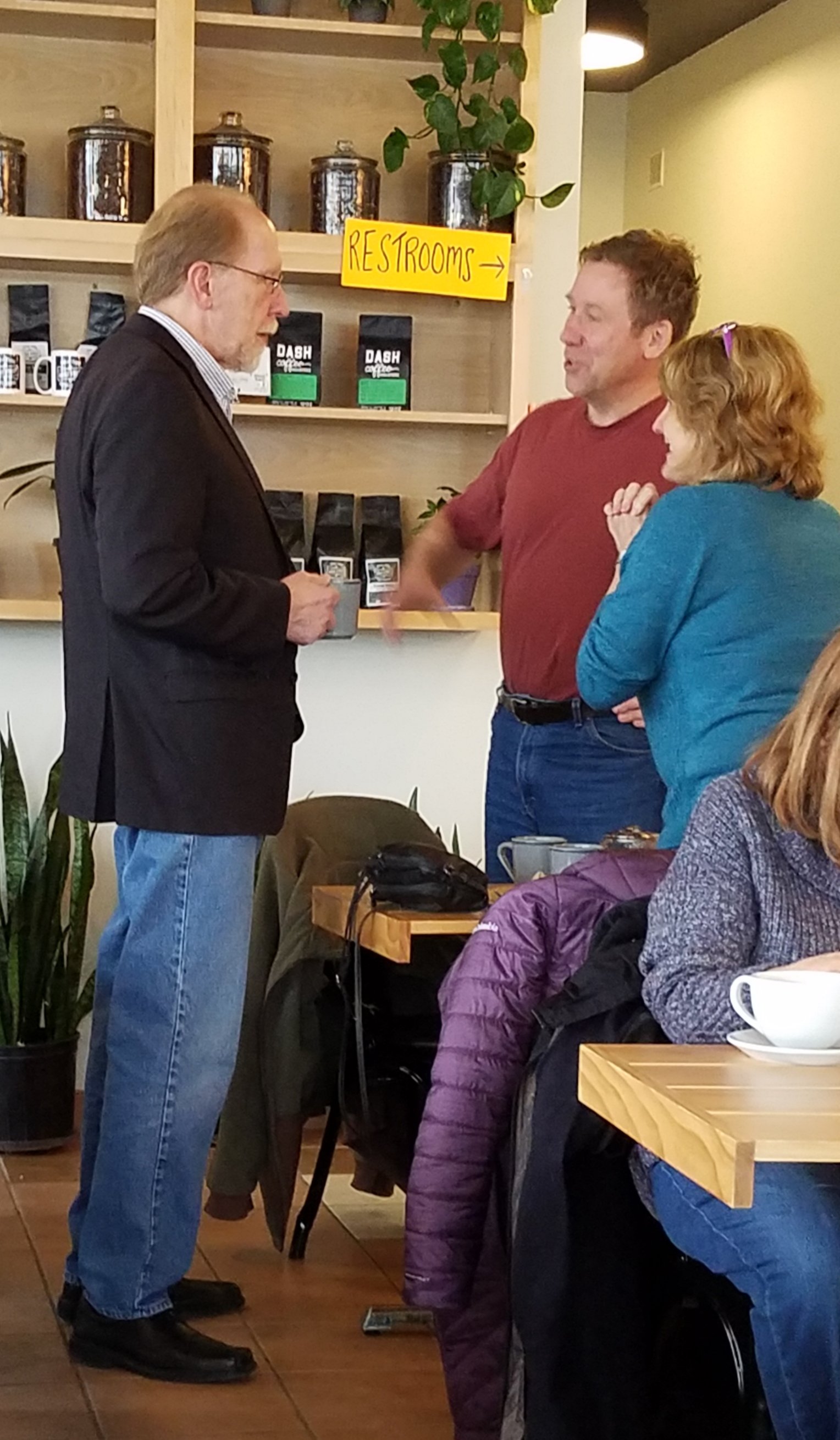
Congressman Dave Loebsack chatting with constituents at Dodge Street Coffee, Iowa City on March 9, 2019.
I was an early adopter of Gmail with records going back to 2006. I searched for Veronica Tessler and came back with 23 distinct hits dating back to when she was a delegate to the 2008 Second District Convention. A google search shows plenty of activity, including support for an Iowa City gun violence protest where she was quoted in a March 31 Cedar Rapids Gazette article. If she announces for Congress, some of that may become relevant.
Other potential candidates have been mentioned in social media since Loebsack’s announcement. Right now, I’m processing what Dave’s departure from the Congress will mean personally and to the district. Loebsack did constituents a favor by timing retirement so there would be an open seat. I expect that if the four mentioned candidates jump into the race, more will follow.
Dave Loebsack has been a dependable part of my life since I first started our dialogue via email in 2005. Seems like I should be saying something besides Woody Guthrie’s line, “So long it’s been good to know ya,” but that’s what I have for now.







 Journey Home
You must be logged in to post a comment.