Reflection under a foot bridge on the state park trail.
This Friday a lot is going on in real life so I’ll leave this photo taken yesterday.
Once the sun comes up, it’s gleaning the garden, mowing, and a big apple harvest. Kitchen work never ends this time of year. I cleaned four half-gallon jars for apple cider vinegar making and am ready to go.
We take moments of peaceful reflection where we find them.
Reverse side: The Pine Barn Inn — Danville, PA 17821 As Featured in ‘Back Roads and Country Inns’ Photo by C.G. Wagner, Jr.
I stayed at The Pine Barn Inn while director of maintenance for a large transportation and logistics company. For many years we bought Fruehauf Trailers built in Fort Madison, Iowa. I was in Danville to evaluate a Strick Corporation trailer manufacturing plant as prelude to picking a new vendor. By 1993 the writing was on the wall that Fruehauf was going out of business.
A leveraged buyout in 1986 by the company’s management left Fruehauf burdened with debt, and in 1989 the company was broken up and sold, though one segment, the truck trailer unit, retained the name Fruehauf Trailer Corporation. That corporation declared bankruptcy in 1996 and was sold to Wabash National the next year.
While many in the truckload segment of the transportation business were buying Wabash National plate trailers, the owner of our privately held company was apparently not a fan. We chose Strick for a non-Freuhauf plate trailer build over others I evaluated.
I traveled a lot during my transportation and logistics career. It came to a point where I would wake on an airplane and not know where I was or where I was going. The job had me traveling to both coasts and from Florida to the Upper Peninsula of Michigan. I had a heavy carbon footprint in those days.
When I supervised a driver recruiting operation I had offices in Iowa, Indiana, Kentucky, Georgia, West Virginia, Pennsylvania and Missouri. We even did driver recruiting in Astoria, New York near LaGuardia Airport. I met people from everywhere and spent a lot of time in transit.
I don’t remember much about The Pine Barn Inn, except it was clean and met my personal needs. That’s what I wanted during business trips. Today I hope most of my traveling is finished. At least I still have this postcard.
The debt ceiling is in the news. Once again, for the same reason: a Republican president ran up the debt on the American people and a Democratic president is left cleaning up the mess.
At the same time, Iowa is participating in its decennial redistricting process. Voters in the Iowa Quad Cities aren’t sure who their member of congress might be. Currently it is Mariannette Miller-Meeks. If the first redistricting map is accepted by the legislature, it could be Ashley Hinson.
Both congresswomen have joined the Republican block to say they will not vote to raise the debt limit. Shame on them. They should focus on solutions, not obstruction.
While neither was in office when the 45th president and the Congress ran up our bill, it is clear from this statement by both and from their voting record earlier this year, their interests lie more with Washington Republicans than with Iowans.
Both voted against the American Rescue Plan Act which benefited many Iowans. One expects them both to vote against the Build Back Better Act when it comes up for a U.S. House vote in the near future.
Regardless of the redistricting outcome, they both need to find other work.
~ Published by the Quad-City Times on Sept. 27, 2021.
Ambient temperatures are forecast to reach the high sixties today. It’s time to plan fall gardening and get to work.
The biggest task ahead is garlic planting. I cleared the plot where I had onions this year. The next work is to spade the soil, fertilize and till it. What’s left of the garlic harvest remains in the rack. It requires trimming, cleaning and sorting. I need about 100 of the best cloves for seeds and the rest will go into storage. It was a good crop and I hope next year will be better.
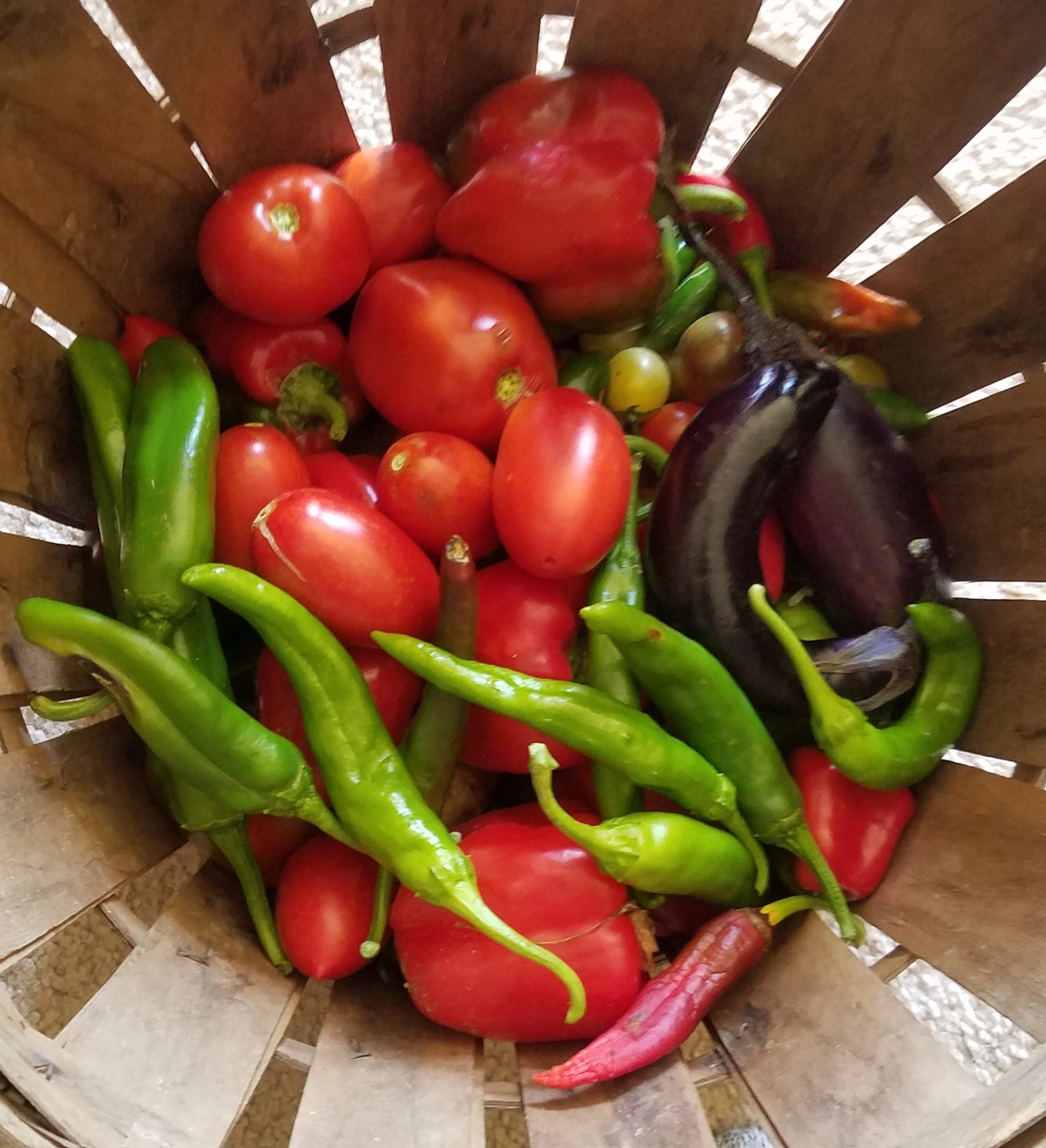
Because there were so many tomato plants the vines are still producing. They are not the best tomatoes yet fresh ones add value in the kitchen. Once frost comes, I will tear down the bed, stack and repair cages, and save the landscaping fabric and fencing for another year’s use.
I made the first pick of Brussels sprouts this week and they will produce into October. The plot where they are is the most diverse and will require gleaning it until frost kills everything. There will likely be tomatillos, peppers, cherry tomatoes and more sprouts. It will be the last plot to be torn down.
The main fall crop is apples. I went through the apple butter in the pantry and there is plenty to last two years and more. The same is true for apple sauce so the question is what to do with the abundance. I offered some of it to a neighbor who is coming next weekend to pick with their family. I plan to take the best fruit, make some baked goods and juice for apple cider vinegar and fresh cider. I also need to prune dead branches while leaves are still on the trees (so I can see what’s what). I don’t know what to do, if anything, about the scar on the Red Delicious tree where the derecho took a couple of big limbs. I’m resigned to eventually losing it. There is a lot of apple work ahead in the garden.
My greens plot was a success this year. We had plenty for the kitchen and the kale and collards will continue to produce into October. Some years kale makes it through November and last year it over wintered. There is landscaping fabric to recycle there along with fencing. Every plot needs work to prepare for winter.
As I organize and reflect on what happened, the overarching feeling is “where did the time go?” I’m thinking about my fall seed order already. Once the pension checks arrive this month I’ll reduce thoughts to an order and place it.
It’s been a great gardening year in a cycle that never ends.
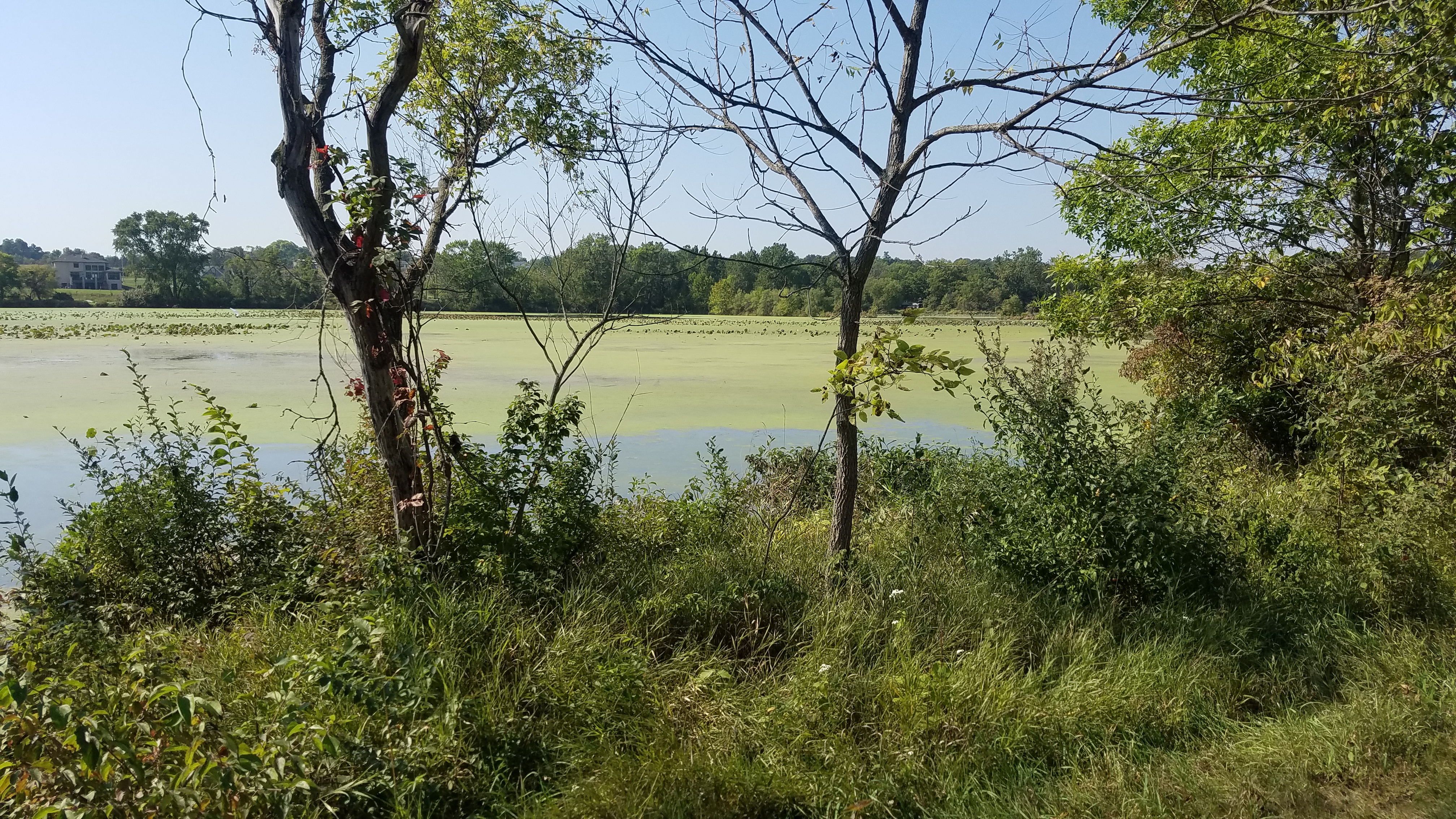
The algae cover is growing on Lake Macbride. Every so often I take a longer daily walk and pass this spot where the trail is close to the lake. I’m not sure anyone is working on algae as a problem here.
The Lake Macbride Watershed is behind the times. Iowa Department of Natural Resources did not have a value for phosphorous entering the watershed on file, so those of us operating wastewater treatment plants participated in a recent study. I don’t know how they evaluated nitrogen and phosphorous coming from farm fields. I can tell you, our community of about 200 people is not the problem with excess nutrients entering the watershed. Our wastewater effluent is cleaner than the lake when it enters it from an unnamed creek.
Something has changed since we moved near the lake in 1993. Algae wasn’t so dominant then. Partly it is due to population growth in unincorporated areas with private septic systems. Partly it is due to runoff from farm fields. I believe the increasing use of field tile on farm fields contributes significantly.
I posted this photo on Twitter and thanks to Mother Jones writer Tom Philpott’s retweet it received 7,230 impressions and 393 engagements so far. That’s a lot for my posts. People are quick to condemn large-scale agriculture for the pollution.
The issue is inadequate regulation of nitrogen and phosphorus application on farms. Both are required nutrients for plants to grow. Since the move from organic soil to chemical applications in crop growing modern farmers are left no short-term option but to apply them. It makes sense that regulation could help us get cleaner water and less algae cover.
The large agricultural lobby groups don’t want regulation. Farm Bureau, Iowa Corn Growers Association, Iowa Soybean Association, Iowa Cattlemen’s Association and Iowa Pork Producers Association are steadfast in buying legislators through campaign contributions to prevent needed regulation for cleaner water. That is how our politics operates, at least until legislators or the governor are willing to change it.
Instead of a calming walk through the state park, the algae-choked lake reminded me of the living hellscape of resource extraction that impacts everyone. It began with the removal of Big Grove Township’s namesake forests after settlement, and continues through development of a policy that has farmers planting fence row to fence row. There is more human settlement, but that’s not the problem as wastewater treatment is well regulated by the state. Much as I yearn for more state parks like the one in our township, Iowa has very little acreage set aside for conservation from development.
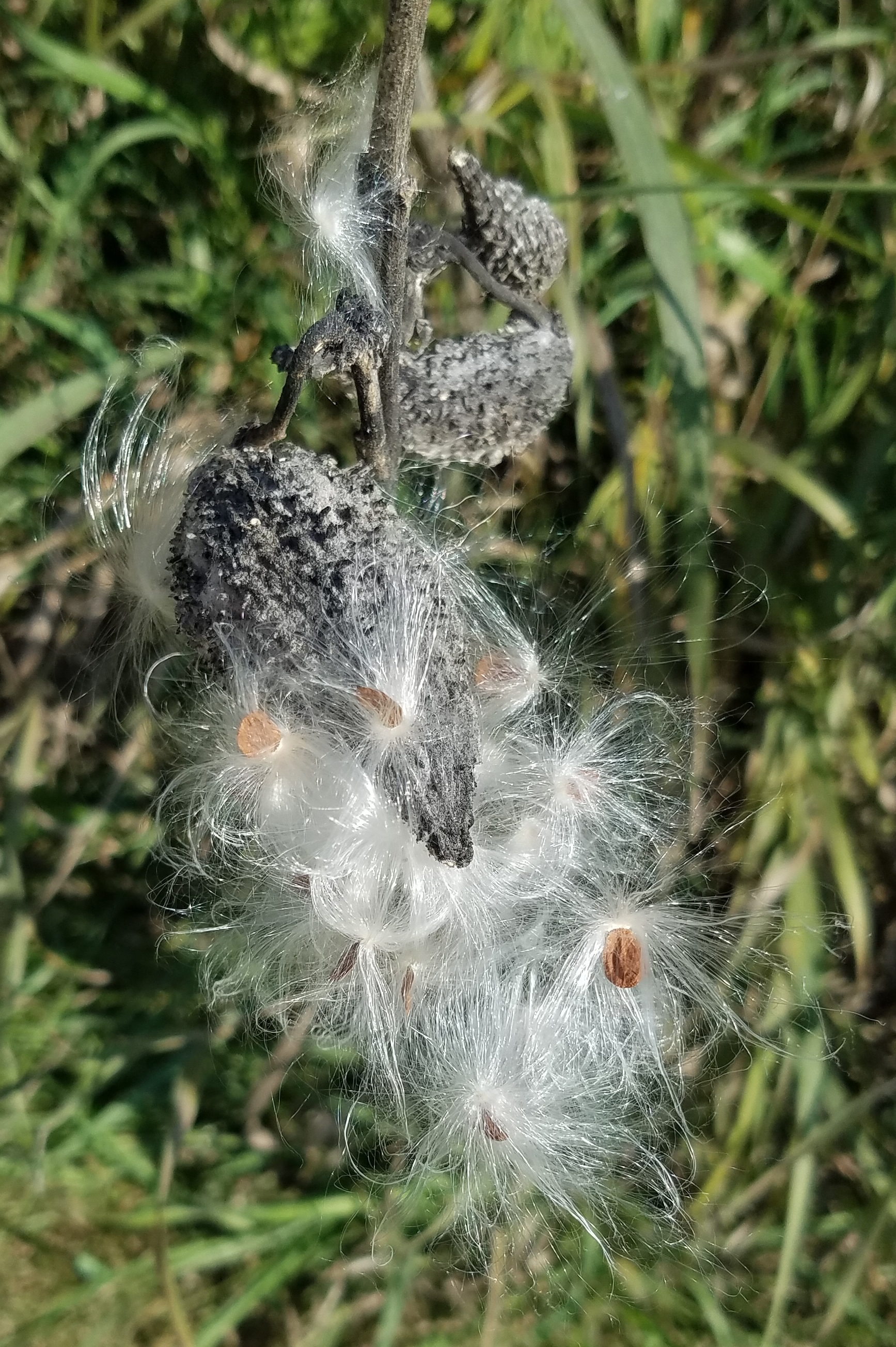
At least I got some exercise along with agitation from my walk… and this photo of milkweed going to seed.
Common milkweed along the state park trail, Sept. 19, 2021.
When the Solon community is unsettled about how K-12 schools are being managed, a lot of candidates run for school board. Thursday, Sept. 16, was the filing deadline for the Nov. 2 election and seven candidates filed for three non-partisan positions. They are:
Erika Billerbeck
Timothy Brown (incumbent)
Dan Coons (incumbent)
Kelly Edmonds
Stacey Munson
Michael Neuerberg
Cassie Rochholz
I have biases in this race based on who and what I know about the candidates and issues. That is part and parcel of living in a community and other voters may feel the same way. I plan to research all seven and lay out their agenda as much as it is spoken in public and knowable. There will be a series of posts to make up for the lack of coverage by major television, radio and print media. I intend to stay neutral although I already know who will get two of my three votes.
My agenda is straight forward. 1). Make sure there is adequate, timely coverage of relevant events in the election process. 2). Include all the candidates. 3). Elect another woman to the board to work toward gender equity. 4). Make sure no political extremists are elected to the board.
The right wing Heritage Foundation and their political action group Heritage Action have a presence in Eastern Iowa. They targeted school boards nationwide in the upcoming elections. Centered primarily on opposition to what they call “critical race theory,” the cadre of their activists includes many anti-vaxxers. In our district I don’t expect there to be a problem, yet I want to evaluate each candidate using this litmus test. As a former chair of the county board of health, I know vaccinations will mitigate the spread of the coronavirus in our community. I have little tolerance for political candidates who are anti-vaxxers. Here’s hoping there aren’t any.
There is dissent about the school district decision to not mandate face coverings on school property after a federal judge put a stay on the recent law prohibiting mask mandates. Signatures were collected on a petition for a mask mandate and submitted at the Sept. 16 school board meeting. The way the coronavirus pandemic was handled by the district will be an election issue.
In 2019 the board’s handling of contract negotiations with the union was not well received. Discontent resulted in six candidates for two board positions. In the end, voters supported the incumbent instead of throwing him out over collective bargaining. If it wasn’t important enough to convince voters to remove the incumbent when it was a hot issue, it becomes part of the background noise. If incumbents Brown and Coons lose this election, it won’t be solely about the collective bargaining agreement.
Post filing deadline, candidates are busy deciding about their campaigns. The main decisions are about budgets, yard signs, a campaign website, and how to win votes. Those that carefully deliberate on these four things and work hard to execute their plan will come out on top.
This is an election about whether dissatisfaction about the way the district is being run will be enough to remove two incumbents, who themselves are strong candidates with a record.
Here is a link to the county auditor site where readers can find contact information for the candidates. Do phone or send them an email with your questions. I hope you’ll follow my posts as we learn more about the community and the seven candidates who seek a position on the Solon Community School District board of directors.
My posts about the 2019 school board election are here.
Click here for all of my 2021 coverage of the Solon School Board Election.
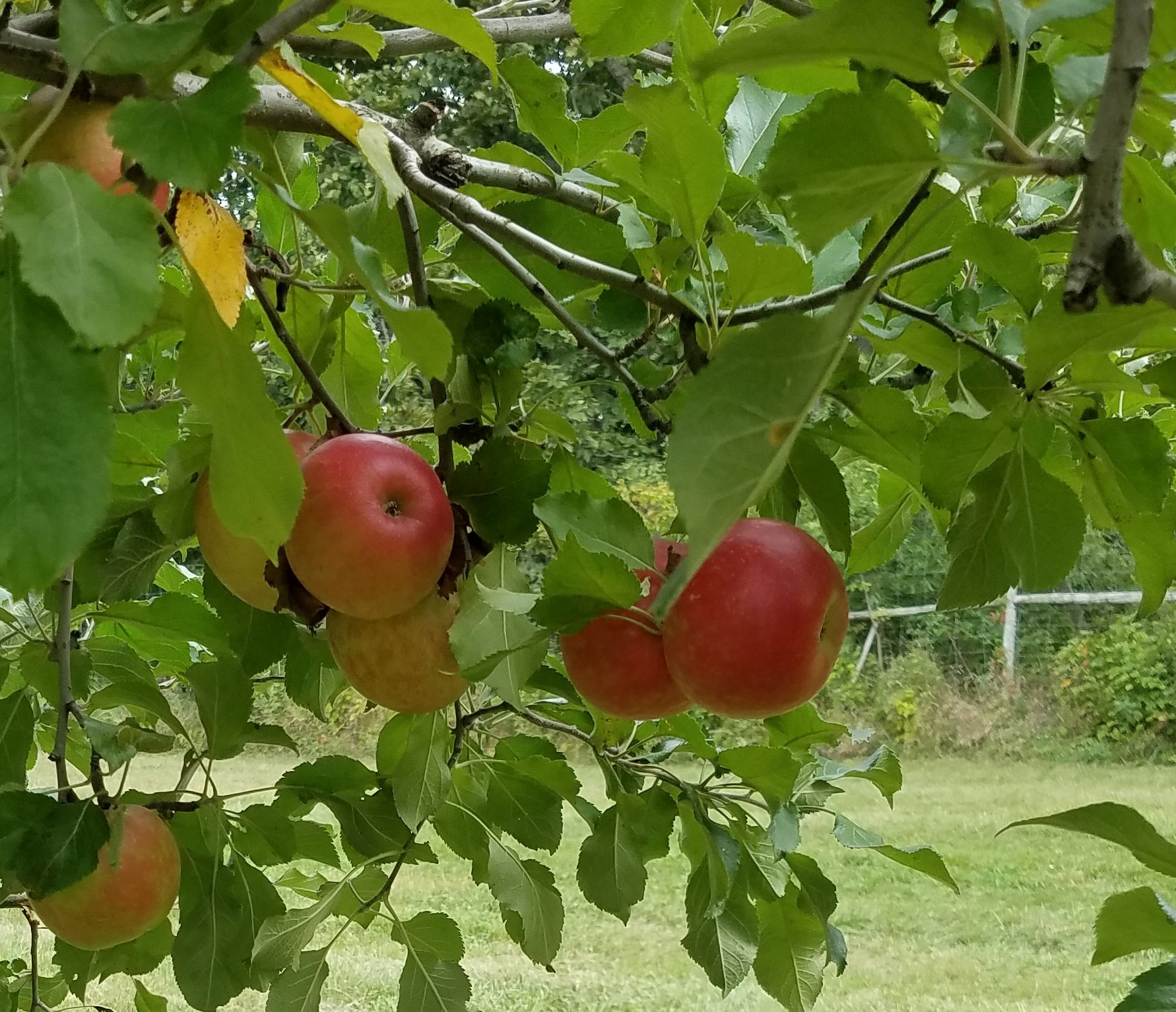
Jonafree apples at Wilson’s Orchard and Farm, Sept. 17, 2021.
Large commercial farms in Iowa don’t grow apples the way they did. Iowa is mostly a corn, soybeans, oats and hay state when it comes to field crops. People don’t often grow apple trees at home either. Apples remain the most significant Iowa fruit crop and there are plenty around if you know where to look.
My backyard apple orchard has five trees. This year two varieties produced, Red Delicious and Earliblaze. Besides eating them fresh, I made apple cider vinegar and applesauce from Earliblaze, which were ready first and are done. I just started the Red Delicious harvest and made apple butter, and apple sauce from them so far. Preserving apples will get us through next year when the harvest is expected to be light. This year we have all the apple nutrition we can use with our own apples. Food in a kitchen garden is about more than nutrition.
To get more variety I went to a local orchard where trees are loaded with fall crop apples. Many varieties are ripe and ready to pick now. It was easy picking as the crowds had not hit them the way they will once autumn arrives Sept. 22.
“The full docket for apples this week includes Crimson Crisp, Jonathon, McIntosh, Cortland, Jonafree, Golden Supreme, Honey Gold, Honeycrisp, Song of September, Blondee, Burgundy, Bonner, Sansa, Cortland, Gala, and Ginger Gold,” according to the weekly marketing email from Wilson’s Orchard and Farm. In addition to apples, the farm began growing pumpkins and flowers which add to the scenic experience. In addition to picking apples I got in my daily exercise walking up and down the hills.
My goal was to come home with six or eight Crimson Crisp apples plus a few other varieties. (I planted a Crimson Crisp apple tree in the back yard and it hasn’t begun to fruit). I came home with a bag full of half a dozen varieties, plus some Honeycrisp for home storage. The flavors are distinctive in each, worth savoring.
People do it all the time yet I don’t know how they eat apples produced in other states and trucked into local grocery stores. Nutritionally they may meet requirements, but OMG! With all the locally grown apples and their diverse, often marvelous qualities why would you? As we eat through the ones I brought home we share and discuss each one. It is an experience of Iowa’s apple season and part of our local culture. At least it can be.
Apple time signals the beginning of autumn and the end of the growing season. It will be a rush to get everything done before snow flies. The main work of food production moves from the vegetable garden to the kitchen as bushels of apples become available. Apple time in Iowa connects us to the cycles of the season. Although the seasons have changed due to planetary warming and the greenhouse effect, we enjoy what persists during apple time.
20 miles east of DeKalb the right rear tire blew out and ruined it. There was a two-inch gash, most likely from hitting something laying on the Illinois Tollway. After the noise, we got off to the shoulder quickly and safely.
When I got out of the car an Illinois Tollway H.E.L.P. truck was already parked behind me with his flashers going. The driver waved me away when I approached the truck, pointing to my car. I got to work cleaning stuff out of the back so I could access the spare tire and tools. The driver said he had a jack and offered it. It was the kind one finds in an auto repair shop and just what was needed. Luckily the spare had enough air pressure to make it to the DeKalb oasis where I fully inflated it.
We made it home safely and Thursday I began calling around for a tire. Ours is a common size and I found one easily. There is a catch. The 2002 Subaru is an all-wheel drive vehicle and to a tire person that means just one shouldn’t be replaced, but all four.
I asked a large tire shop salesperson why all four needed replacement and he said only, “because it is all-wheel drive.” An unsatisfying answer to the former maintenance director of a fleet of thousands of heavy-duty vehicles. He quoted me on a set of Hankook tires, about $600. I told him I had to consider it more as I hadn’t planned on replacing all four. I didn’t like his response to my question.
The next call was to my local mechanic. He took the time to explain why I needed four tires instead of one, having to do with the diameter of all the tires matching when the all-wheel drive function is engaged. He doesn’t keep tires in inventory any longer yet he quoted me two options, including the same Hankook tires the large dealer offered at the same price. “We sell a lot of those,” he said. I scheduled the next available appointment.
It’s good to know as I approach age 70 I can still change a tire while parked on an Interstate Highway. The last time that happened, I was on my way home from work in the Chicago Loop. The Dan Ryan expressway during rush hour can be a scary place to change a tire. They didn’t call them H.E.L.P. trucks back then, but an early equivalent pulled up to alert drivers I was there. I don’t know how the tollway figured the budget for H.E.L.P. trucks yet I’m glad they are there.
Many thanks to the Illinois Tollway H.E.L.P. drivers.
Text on the postcard: Stratford, Ontario, Canada The Festival Theatre viewed from across the Avon River is one of three theatres offering an excellent selection of theatrical performances during the Stratford Festival (May to November). Photo Credit: Robert B. Hicks
When our daughter was in middle school we began taking family vacations. They persisted through the summer between junior and senior year in high school.
It began with a week-long trip to Orlando, Florida where we stayed in a motel and made day trips to theme parks, including Walt Disney World, Universal Studios and Sea World. It was our first air travel together. For me, vacationing was participation in a great American adventure. It had one foot standing on consumerism and the other on a job that consumed much of my life. While we had only a brief sampling of what Orlando has to offer that first year, it was a positive experience. We made summer vacations annual.
Next was a trip to Colorado where we visited friends and did some mountain sight seeing. We drove among the 14,000-foot peaks and spent the rest of the time visiting people. After that, it was trips to Stratford, Ontario for the Stratford Festival of plays, and everything around them. I don’t recall how many plays we saw but our daughter insisted on meeting the actors to get the program autographed after each one. Vacations in Stratford became something else.
I didn’t realize it then, yet it became clear later, vacations were a crucible for making a life from the raw materials of society. They transitioned us through releasing our child to college and then to the greater challenges of living a creative life. Upon reflection, there are not many creative communities like the one in Stratford. We were fortunate to have had those trips.
It’s hard to say whether we will return to Stratford as a family, or take any kind of vacation. We will always have those summers to remember.
Among things that have become harder to manage in the digital age are images. It is easy to take photographs with my Samsung mobile device today. Because it’s so easy, and has been for a while, the quantity of images on file is huge.
Every photograph is not important. Most are geared toward editing and posting on line in one of my social platforms, including WordPress. It is unclear what I should keep longer term. The cheap availability of storage suggests there is no need to sort through and delete some of them. While that may be the default process, I want change as I transfer files to my new CPU.
In August I captured 186 images, which is a typical monthly amount. Most of them are photos of garden produce, cooking, books, artwork, and things that happened or places I went. The best solution to reducing the quantity of files is to delete originals after cropping them for posting. Another is decide on the story a series is to tell. For example, I have 12 images related to donating my 1997 Subaru to Iowa Public Radio. They could be reduced to four. The best time to do this is immediately after I download them from my mobile device.
As I transfer thousands of images I plan to go through them all. To get this done I put an item on my daily outline, “work on file transfer.” I don’t know how long it will take yet I’ll work until it is done, a bit each day.
I don’t know the provenance of many of my photos, especially those with political subjects. In 2006-2008 I was getting used to a digital camera as my main image capturing technology. I felt little restraint about downloading photos by others when my own at a specific event were sub-par. I work harder to give credit today, but some of the older digital images are fond, and I have little idea who made them. I try to avoid using them outside my computer.
A main use of the files is in story telling. Before I deleted my Flickr account it was a great platform for story telling. The problem is how to translate those types of online stories into something more meaningful inside our home. When Yahoo had the problem with personal information security, I killed all the related accounts and downloaded the text from the stories on Flickr. It’s not the same.
Photos are a significant part of my autobiographical research. While ten years later I don’t care what I had for dinner on a given Sunday, those photos play a role in daily life, one that should be explored and developed for the story. A few will go into the final book yet the rest are best stored by editing, printing them out, and placing in an album. That’s as big a project as working through the transfer. The file transfer project will, in part, be designed to set up an album-making project for later.
There is no denying quality varied a lot over the more than 50 years I’ve been taking photographs. Sometimes a blurry image is all one has and it must be used for the album or story to make a point. I hope the formats .bmp, .jpg, .jpeg, .tiff, .png, and .tif persist yet there are no guarantees. The main issue going forward is there are a limited number of commercial outlets to print photos. We are tied to whatever those technologies are. It is too expensive to make our own prints on a home printer, except for on special occasions.
As I approach my seventieth birthday I think more about not leaving a large task of image sorting behind when I die. I may want to keep a couple of photos of tomatoes I grew, yet I don’t need a thousand. Likewise, if I can’t remember the name of a person in a photo, there is little reason to keep it. The recycling bin is already getting full.
I’ll be better off by giving this project some measure of thoughtful approach. Now that I’ve started, I hope to persevere until the work is done. The best part will be in actually completing the transfer so I can devote this time to something new. Wish me luck!







 Journey Home
You must be logged in to post a comment.