Categories
Living in Society

Sprawl is Coming Our Way

View of Trail Ridge Estates on Thursday, Sept. 30, 2021.

It was two weeks before the local newspaper published an explanation of heavy equipment activity on a 130-acre farm field off Highway 382. On Sept. 15, the Watts Group received unanimous approval of a developer’s agreement and preliminary plat from the Solon City Council. The city annexed the area and approved residential zoning this summer, according to Margaret Stevens, editor of the Solon Economist.

The population of the City of Solon grew from 2,037 in 2010 to 3,018 in the 2020 U.S. Census. The new subdivision proposed 220 parcels and 2.43 people lived in an average American household during the Census. Trail Ridge Estates, as it is called, will add population of roughly 535 people once it is built out. I expect the subdivision to be built out quickly.

The farmer who previously owned the field grew commodity crops, mostly corn and soybeans. That agricultural production won’t be missed. The challenge of building rural subdivisions like Trail Ridge Estates is they presume residents will drive for jobs, provisions, church, school and social activities. They further the culture of automobiles.

There will be a multi-use concrete pad installed for basketball and possibly pickle ball, according to the plans. There will be a fenced dog park. The subdivision has access to the state park trail from which I took the photo. Children could conceivably walk to school along the trail, but I predict busing and individual vehicles will provide most of that transportation.

I believe people will spend more time indoors and build generously-sized homes to accommodate indoor activities. Two and three car garages will be popular. The parcels could average about a half acre, which is plenty of room for a vegetable garden. Whatever sociologists call the current pattern of “nesting,” there would be lots of that going on.

The point of describing this subdivision is to say old-style urban sprawl is ongoing. While larger cities slowly work toward sustainable buildings, in rural cities, old-style, inefficient housing continues to be built. There is clearly a market for it. The amenities of a well-maintained K-12 school infrastructure, three churches, a large sports and recreation complex, and proximity to Big Ten sports, an airport, and diverse shopping make it attractive to certain types of young conservative couples. With relatively low gasoline prices ($3.09 per gallon today), commuting for work to Cedar Rapids, Iowa City, the Quad-Cities, and even to Des Moines is affordable if one can tolerate the windshield time.

The area is turning from Democratic to Republican as it grows. That’s true of Iowa’s Democratic enclaves more generally. There is a culture of civic engagement in which people do not discuss party politics, even if it is constantly in the news that comes in from Cedar Rapids, cable television, radio, and beyond. Plenty of Democrats, Republicans, and No-Party voters work side-by-side in organizations that support a variety of social engagement activities. Politics is considered something to discuss only with family and like-minded others. We’ve become insular in our politics and that reinforces a culture that gives rise to urban sprawl like Trail Ridge Estates.

Among the causes to which I dedicate my time, urban sprawl is low on my list of priorities. If farm field owners insist on growing commodity crops and livestock, then one farm more or less doesn’t matter. The better question is whether lives lived in insulated islands like this are worth living. One assumes people who pay a quarter million dollars and more for a home on half an acre would say they are. I guess that’s the reality we have to accept before social change is made.

Like many, I don’t like the build-out of the area to which we moved in 1993. It wasn’t inevitable although the growth is welcomed by the city. The three convenience stores in town do a booming business. The local grocery store has made it thus far, despite big box store competition nearby. We have a vibrant restaurant scene and there are loads of school-related activities. The Catholic and Methodist churches have little risk of consolidation. The annual town festival turns out hundreds of people to watch the parade and hay bale toss.

With the cultural life of Iowa deteriorating under Republican leadership, I know few who would seek out this new subdivision. Maybe I’m just out of touch with that segment of society. As I adjust to post-pandemic life, assuming the pandemic will eventually end, I’ll have to work harder to stay engaged with diverse people. In the meanwhile, observing new construction is an activity as old as human civilization and I’m there for it.

Observing updates in the new subdivision gives me a reason to take my daily exercise walking to town. It’s a longer walk, although sometimes I need that.


Categories
Living in Society

Solon School Board Candidates on Facebook

While working on my election coverage, I found six of seven candidates for three positions on the Solon School Board are campaigning or have pages devoted to school board on Facebook.

Incumbent Dan Coons does not have a public Facebook page, so readers can watch for coverage of his campaign in the Solon Economist or at the upcoming public forum.

Here is an alphabetical list of candidates and their Facebook pages:

Erika Billerbeck: https://www.facebook.com/Billerbeck-for-Solon-School-Board-100985075683571/

Tim Brown: https://www.facebook.com/TimBrownSCSD

Dan Coons: No public Facebook page.

Kelly Edmonds: https://www.facebook.com/Edmonds4Solon/

Stacey Munson: https://www.facebook.com/Stacey-Munson-for-Solon-School-Board-108708788241054/

Michael Neuerburg: https://www.facebook.com/MikeforSolonSchoolBoard/

Cassie Rochholz: https://www.facebook.com/profile.php?id=100055956696963

Give the links a click and learn more about the candidates.

Click here for all of my coverage of the Solon School Board Election.

Categories
Living in Society

Participate in the School Board Election

Editor’s Note: The plan for Solon School Board election coverage is to post at least one weekly article on Saturdays until the election. I am looking at data provided by the county and will have an analysis soon. I’ve been told there will be a candidate forum and like in 2019 I plan to attend and cover it. Both the Solon Economist and Iowa City Press Citizen indicated they will provide some coverage of the campaigns. All of my posts about the 2021 school board election can be found here.

I encourage readers to participate in the Nov. 2 Solon School Board Election. In 2019 we had record voter turnout. It would be great if voter turnout improved this year.

The seven candidates are Erika Billerbeck, Tim Brown, Dan Coons, Kelly Edmonds, Stacey Munson, Michael Neuerburg, and Cassie Rochholz. Their addresses, emails and telephone numbers were posted on the Johnson County Auditor’s website. We increasingly live in a do-it-yourself news environment so I recommend if you have questions about policy, go directly to the candidates.

The main controversy in the district has been handling of the coronavirus pandemic by school administration. The board hired Davis Eidahl as superintendent in 2015 and renewed his contract at least once. Eidahl and his predecessor Sam Miller spent time together as principals in the Davis County school district near Ottumwa. Based on their common background it is clear continuity has been important to the school board. COVID-19 threw administration a curve ball and the fallout has not finished. Will this be a change election? That depends upon participation.

What the school board does is important whether or not we have children of school age. One thing is certain: Solon cares about school board elections.

~ Published by the Solon Economist on Oct. 7, 2021.

Categories
Living in Society

Do Better Democrats

Lettuce harvested Sept. 29, 2021 from the row covered plot.

Democrats either don’t know how or haven’t the will to make Governor Kim Reynolds pay a political price for outrageous and sometimes false statements she makes. As the recent Selzer poll illustrated, Reynolds’ approval rate continues to improve. Democrats sit back and watch the numbers move up while wringing their hands. We can do better than that.

By pay a political price I mean hitting her where she lives among her Iowa political constituencies. I don’t mean posting a mean tweet or writing a blog post for limited circulation. Complaining about the governor’s latest outrage to friends may make us feel better but does little to impact her popularity. We tend to believe no one could support this governor. The fact is many do, enough to re-elect her.

Reynolds does not write her own talking points. She recycles frequently updated Republican political buzzwords. Reynolds now beats the word “inflation” like a drum.

“We have a crisis at the border, a disaster in Afghanistan, and inflation is soaring,” Reynolds said in an Aug. 19 press release. “President Biden is failing on each of these issues… I have had enough, and I know Iowans have too.”

She name checks the president, associating “inflation” with the Biden administration, along with two other talking points. Inflation! Disaster! Crisis! She wasn’t the first to do this.

The Koch network-backed Heritage Foundation rolled out the “inflation” attack seven days earlier in an opinion piece in the Washington Examiner.
“Diminishing the paychecks of the average person with inflation and weak growth will only advance the Chinese narrative that they are outpacing the U.S. free enterprise system,” wrote Jessica Anderson and The Heritage Foundation’s Vice President James Carafano.

Not so fast!

It is not credible to say there is inflation when personal experience doesn’t reflect it. My weekly expenses for groceries and sundries remain unchanged in 2021 compared to 2020. Yes, fuel prices are higher but for Pete’s sake there were two recent hurricanes in the Louisiana-Texas oil patch on the Gulf Coast. Of course this disrupted petroleum product supply and prices spiked. Meat prices are up, yet is that market manipulation among the small number of meat packers? Congress believes so and is investigating. Are these things inflation? No, they are not.

The last paragraph is a perfect example of what Democrats do wrong. We use logic in a culture war. We also set ourselves up to lose.

How do we make Governor Reynolds pay a political price for crying “inflation” along with other right-wing inspired parroting of Heritage Foundation’s current framing? Like most Democrats, I don’t know what will work. What I do know is it is time to figure it out.

Our response cannot be there is no inflation, no crisis at the border, or no disaster in Afghanistan. When we do this the effect is to reinforce Reynolds’ framing of the issues and help her gain popularity. We’re not supposed to be helping her!

The first thing we have to do is accept reality. Three headlines appeared in the Iowa City Press Citizen on Sept. 23:

“Grassley has big lead in possible matchup.”
“Sen. Ernst’s job approval ticks upward slightly.”
“How much longer can we keep doing this?”

The first two refer to politics and the third to employee burnout at University of Iowa Hospitals and Clinics during the coronavirus pandemic. These reflect realities many Democrats seek to dismiss. We must embrace them and work to change the underlying reality.

We can’t use Republican framing to try to advance our causes. A hot topic in Iowa today is mask mandates in schools. Reynolds’ familiar refrain on wearing face masks can be found in a Sept. 13 press release, “…parents’ ability to decide what’s best for their child.”

Don’t get me started. Not because I can’t logically explain the ways this statement is wrong, but because I can. In a culture war we need a different approach from logic because it serves Reynolds more than Democrats.

I hope Democrats will find their way to make Reynolds pay for the misrepresentations and outright lies. If we don’t have the will, we may as well kick back and take it easy while Republicans dominate the state’s politics.

~ First published in the Fall 2021 issue of The Prairie Progressive, Iowa’s oldest progressive newsletter. Prairie Progressive is funded entirely by reader subscription,  available only in hard copy for $12/yr.  Send check to Prairie Progressive, Box 1945, Iowa City 52244. Click here for archived issues.

Categories
Home Life

Soup Night

Fallen apple, September 2021.

I brought a generous pound of potatoes and two pints of canned vegetable broth from downstairs. There was an almost forgotten patch of leeks in the garden so I made leek and potato soup for dinner. With some sliced apples from our tree, spread with peanut butter, it made a meal.

It has taken some work to get the soup right. While sauteing the leeks and diced onion, seasoned with salt, in some of the vegetable broth I peeled and cut the potatoes into a half-inch dice. I added them to the leek-onion mixture with enough broth to just cover them. The Dutch oven simmered on low heat until the potatoes were soft.

Next I added a tablespoon of arrowroot powder mixed with water, then a cup of oat milk, and then two cups of frozen corn. It simmered a half hour. I added sliced chives from the garden and it was ready to serve. We don’t blend the soup to get a smooth texture, although one could. The key is reducing additions of cooking liquid so the soup thickens. Arrowroot helped.

I finished reading Poet Warrior: A Memoir by Joy Harjo this morning. Harjo is poet laureate of the United States. It was moving in a way other memoirs have not been. It had me thinking about my own life and how it differed and was similar to hers. Now that I’ve tended to my mother’s death bed, reading her story about her mother’s death resonated. I had not previously known of her connection to the University of Iowa Writers Workshop. Maybe what she learned there makes it easy to relate to the narrative. Highly recommend.

Our vehicle is in the shop getting a wheel bearing changed. The mechanics work was made difficult by rust formed on the chassis and undercarriage during our 20 years of ownership. They can do this work, but parts are becoming less available. “It’s not a long-term keeper,” my mechanic said of the vehicle. This is the second or third conversation we’ve had about the rust. Now I’m asking the question, “what kind of vehicle does a septuagenarian need to make it until he can no longer drive?” No answers yet, but thoughts.

The future of transportation is electrification, especially for passenger vehicles and light trucks. If I planned to keep a vehicle for a few years, then trade it, I would have no issue going electric now. We didn’t win the lottery last night and can afford to buy just one car to last. Electrification of automobiles is in transition presently, so as technology develops, who knows if what goes on the market today will be eclipsed by newer technology tomorrow? Well we do know. It will be eclipsed because there will be issues. I’ve worked with Original Equipment Manufacturers enough to know this.

I’m leaning toward a new Toyota Prius which operates with excellent fuel economy and has been on the market long enough to have bugs worked out of it. It is the right size for the two of us and I’ve ridden in them with friends on many occasions. We have a dealer in the county seat that posted a starting price of $28,814. Pricing is negotiable and dependent on specifications. I’d rather just keep the car we have but if repair parts are unavailable and the undercarriage rusts through, our hand is forced.

Once the wheel bearing is replaced we should be good to go for a while. A while may be all we have.

Categories
Living in Society

Miller-Meeks: Get a Grip

Mariannette Miller-Meeks on the Iowa State Fair Political Soapbox on Aug. 13, 2010. Photo credit: Wikimedia Commons.

Mariannette Miller-Meeks was an ophthalmologist during military service. How does that qualify her to evaluate the Biden administration on military and foreign affairs? It doesn’t.

Unlike Democrats who are held to a higher standard of truth, Miller-Meeks can spew anything that comes to mind without regard to accuracy. If what she says is unhinged from reality, she thought it, and therefore among Republicans it must be right. As a freshman in congress she’s proving to be little more than a parrot for what the moneyed class seeks: destruction of American democracy.

Whatever flaws the administration may have in military and foreign affairs, Joe Biden himself doesn’t have many vulnerabilities going into the midterm elections. First of all, he’s not on the ballot. More importantly, the man got the most votes of any candidate for president ever, 81,268,924 votes and 7,052,770 more than the next closest candidate. Despite the mad raving of pillow merchants and such, it was the most secure election ever. The results are not in doubt.

A majority of Americans like Biden’s policies. The American Rescue Plan Act, which Miller-Meeks voted against, provided needed relief during the run up to distributing a viable vaccine for the coronavirus. Miller-Meeks did her part to add to quackery about the vaccine, including support for hydroxychloroquine treatment.

We need members of congress with a grip on reality. Not those like Miller-Meeks who would say anything that comes to mind without regard for truth and logic. If she wants to opine about military and foreign affairs, that’s her right. She should stop taking talking points from conservative think tanks like the Heritage Foundation and do her own homework.

Categories
Writing

Local Food Pinnacle

Linn Street in Iowa City. Photo by the author.

As a freelancer for the Iowa City Press Citizen I took any story offered by my editor. I was recommended by her predecessor when the newspaper was short reporters. The P-C was in transition as their parent company Gannett outsourced printing, sold the presses, and moved from spacious offices on North Dodge Street to a walk-up on Linn Street. In all, I wrote about 100 freelance articles for the Press Citizen, Solon Economist and North Liberty Leader during 2014-2015.

The following article about Scott Koepke’s visit to the White House Garden during the Obama administration was one of several front page stories I got. I had been working for a couple of farms tied into the local food movement and Koepke’s experience was as good as local food gets. It is one of my favorite newspaper articles among those I wrote.

Lessons for Iowa from the White House Kitchen Garden

A local food advocate and gardener recently returned from Washington, D.C., where he had the opportunity to visit first lady Michelle Obama’s White House Kitchen Garden.

“I’m still floating from the experience,” said Scott Koepke, education and outreach coordinator for New Pioneer Food Co-op, after the trip. “I’ve been telling folks that I wish I had some grandkids to pass this story on to. It was a once-in-a-lifetime opportunity for a gardener.”

Koepke’s sister, Ann, arranged a formal tour of Obama’s kitchen garden on Oct. 20. While there, he found lessons to apply in Johnson County. “If the president can do it, we can do it,” he said.

“What I appreciate most about Michelle Obama’s influence is that she has not only put nutrition and balanced diets high on the national agenda, but she has shown a creative use of green space for edibles, not just turf grass. As such, the White House garden message advances biodiversity, food security and, as the tagline on my email says, ‘Building community by building soil.’ “

The visit to Washington directly serves Koepke’s work with the Soilmates program, an interactive, organic garden and compost education service for children and adults, offered by the co-op.

He works with area schools to create garden clubs with plots of vegetables on school property. Koepke interacts with more than 33 organizations and 8,000 school children and community members annually, covering gardening, composting, soil science, local foods and life skills.

One of New Pioneer’s primary environmental missions is to stimulate the local production of organic food, Koepke said. Soilmates’ child-driven focus hopes to advance that mission by growing stronger community roots and sprouting the next generation of gardeners and soil-lovers.

“Just like seeds that often lay dormant, sometimes the gardening experience doesn’t manifest itself in transforming a life until years after the initial introduction of getting in the dirt,” Koepke said. “I’ve had folks come back to me many years after they worked with me saying that the lessons learned in the school garden helped them through rough waters. I couldn’t ask for anything more rewarding as a teacher.”

“The White House kitchen garden experience has affirmed even more the work I’m so blessed to do here with children in school gardens,” Koepke said.

Local farmer and school garden advocate Kate Edwards, of Wild Woods Farm, confirmed the didactic nature of the White House Kitchen Garden.
“I think the White House garden is a fantastic example and a wonderful use of space,” Edwards said in a text message. “Growing a garden is a fantastic way to interact with the food system and to take a vested interest in your own health.”

The support comes from other advisers, too.

“I believe Soilmates is on the leading edge in Johnson County to nature-based good health and education,” said Joyce Miller, Kirkwood Elementary School garden adviser. “Demand for this approach is flourishing. I have known Scott Koepke and his work with local school garden programs for years. He developed his Soilmates curriculum to present the delight and benefits of growing soil and food organically, teaching children life skills in the process.”

Mike O’Leary, a retired elementary school principal at Coralville Central, helped oversee their school garden for 15 years. Since retiring, he also has been involved with school gardens at Hills and Hoover elementaries.

“Having a garden space at a school is like having an additional ‘outdoor classroom,'” O’Leary said. “Students don’t need to take a bus or field trip to see first-hand how you can grow your own food. The Soilmates program has been successful.”

Establishing and maintaining a school garden is not without its challenges, Koepke said.

Supporting a garden club places demands on teachers whose plates already are full. If a key teacher leaves and a garden becomes neglected, it could easily be turned back to grass for its easy maintenance.

That’s what happened after first lady Eleanor Roosevelt dug a “victory garden” on the White House lawn during World War II. During the Truman administration, it was converted back to turf — that is, until Michelle Obama’s arrival.

Koepke’s job is to make sure the Soilmates program and the school gardens it engenders is a vibrant and growing element of life in the Cultural Corridor. Visiting the White House garden proved to be an inspiration.

~ First published on Dec. 1, 2014 by the Iowa City Press Citizen.

Categories
Writing

Lookout Park Barricaded

Riverview Terrace Park, Davenport, Iowa postcard. Provenance unknown.

I played at Lookout Park, which was within walking distance of home, before I attended school. The main features are the view of the Mississippi River depicted in this postcard, a long, steep hill in front of the benches, and a stairway from the bottom to the top.

I liked to take a cardboard box up the stairs and then slide down the grassy hill with neighborhood children. After the slide, we would mount the stairs to the benches, take a rest, and then slide down again. It seemed like endless hours of fun in a time when there were few responsibilities.

The city purchased the property in 1894, then known as Lookout Park, and changed the name to Riverview Terrace around 1900. It is listed on the National Register of Historic Places. Despite the official name, we called it Lookout Park.

Tom Barton of the Quad City Times reported the park had been closed by the city with concrete barricades placed so vehicles can’t get in or out. I knew the neighborhood was in decline, yet it’s sad to think of the after hours drinking, littering, prostitution and drug dealing he reported going on in a place with more positive memories.

“This has been an ongoing problem that ebbs and flows, and it began to flow again” this summer, said Ward 3 Alderwoman Marion Meginnis, who represents the area. “The design (of the park) has made it an attractive nuisance.”

Though closed to vehicles, the three-acre site remains open to the public, Meginnis stressed in the article, and is meant as a temporary measure until city staff can decide how best to address and discourage crime.

Sometime we don’t want to know what is happening in the old neighborhoods. At the same time, bad news triggers fond memories. There are days I wish I could forget about everything and slide downhill like we did. Being carefree is a part of youth we didn’t appreciate as we lived it. There is no going back, just remembering.

Categories
Writing

Attending State University

When I arrived at the University of Iowa campus in fall 1970, the university president was Willard Boyd who officed in Old Capitol. The previous term, the president’s office had been occupied by protesters and the academic year ended abruptly. During my freshman year, Boyd held meetings with students and I attended one in Quadrangle dormitory where I lived. He seemed approachable and that surprised me. It proved to be an enduring character trait.

I last spoke to Boyd for an article I wrote for the Iowa City Press Citizen on Oct. 22, 2014. He was much as I remembered him. Following is the piece about the anniversary of the legal name of the State University of Iowa.

50th Anniversary of UI name change — or not

Fifty years ago today, the university in town decided to keep its legal name, “State University of Iowa,” but replaced it with the familiar nickname now in everyday usage. It was not the “Hawkeyes.”

Willard “Sandy” Boyd, currently Rawlings/Miller professor of law and president emeritus, was university provost at the time.

“Virgil Hancher (university president from 1940 until 1964) was a lawyer and said, ‘It is named in the constitution, therefore it shall be ever thus,’ ” Boyd explained. “Howard Bowen (who succeeded Hancher as president) said he ‘wasn’t a lawyer, so we’ll leave it,’ suggesting a nickname, ‘University of Iowa.’ ”

On Oct. 22, 1964, the Iowa state Board of Regents passed a resolution approving the usage of “University of Iowa” to describe the constitutionally named State University of Iowa, keeping the original name for legal purposes.

“I believe the change was intended to reduce confusion between Iowa and Iowa State,” said Mark Schantz, who received his bachelor’s degree from Iowa in 1963 and retired from the College of Law in 2013.

There is less confusion and almost no controversy now, but it wasn’t always so.

Early on, university officials attempted to change the naming convention for the State University of Iowa in practical usage.

In a letter dated Jan. 18, 1918 (available in the University of Iowa Special Collections), C.H. Weller, the university editor, requested permission from University President Walter Jessup to use “University of Iowa” on printed invitations.

“I have been trying for several years to accustom people to the name ‘University of Iowa,’ in harmony with the nomenclature of practically all other great state universities,” he wrote. “The legal name, of course, is ‘State University of Iowa’ (not ‘The State University of Iowa’), but the general use of a shorter term in informal usage is nothing unusual.”

In a Nov. 21, 1963, editorial, the Press-Citizen wrote, “The problem in the names of Iowa’s three state-supported institutions of higher education is that there is a law — the one that says the State University of Iowa is at Iowa City, Iowa State University is at Ames and the State College of Iowa is at Cedar Falls. This may be clear to Iowans, although it’s doubtful, but the plethora of ‘states,’ ‘Iowas’ and ‘universities’ seems to be just too much for those who don’t deal with it frequently.”

The newspaper called for the name to be changed to the University of Iowa.

Has the confusion continued?

The answer is yes, according to University Archivist David McCartney.

“It’s correct to say that our esteemed institution has always been named the State University of Iowa,” he wrote in a December 2010 article for the University of Iowa Spectator. “It’s complicated, as they say. To this day, people still occasionally (and understandably) confuse the names of Iowa’s public universities.”

That’s something today’s Hawkeyes, Cyclones and Panthers will be certain to clarify.

~ First published by the Iowa City Press Citizen on Oct. 21, 2014

Categories
Writing

A Nonpartisan School Board

To run for school board a candidate submits a nominating petition with at least 50 district voters’ signatures on it to the school district office. There is no party affiliation and everyone so nominated is placed on the ballot. I heard on Thursday ballots have been finalized and sent to the printer.

I will analyze the nominating petition signatures when I receive them from the county. They are a public record available by paying a small fee. I won’t be sharing any secrets because nominating petitions aren’t secret.

For now, I have the voter profile for each of the seven candidates for Solon Community School District board of directors. They are Erika Billerbeck, Tim Brown, Dan Coons, Kelly Edmonds, Stacey Munson, Michael Neuerburg, and Cassie Rochholz.

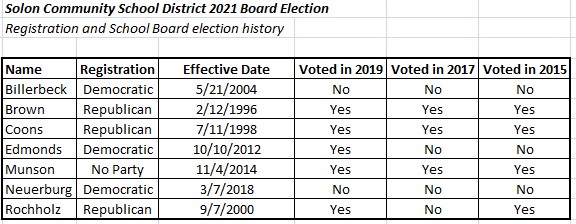
There is a lot of information in these documents, which are also public records. For now, I’m most interested in party registration, the effective date when the candidate registered to vote, and in what recent school board elections they voted. I make no judgment about the candidates by posting this chart. It is data sent by the county, selected and formatted by me.

Data provided by the Johnson County Auditor

Electing someone to the school board is definitely not partisan. More than in other elections a voter seeks the best person for the job. While that seems like an antique idea in a society where everything is politicized, the best board members are not defined by party. Likewise, formal political parties have little influence over school boards.

During the 2019 Solon School Board election there were six candidates for two positions on the board. Three were Republicans, two no party, and one Democratic. Two Republicans won the election, Adam Haluska and Jami Wolf. The dynamic of the race was anti-incumbent because of recently completed collective bargaining between the district and the union. The negotiations drove some to run for school board. I spent as much time as anyone figuring out which candidates would meet my goals for board members. I ended up liking each of the six candidates for different reasons, none of which was party. Party membership played no role in my choice. My sense is it doesn’t for most people voting in a school board election.

Thus far I have spoken with one of the seven 2021 candidates. Like everyone, I’m learning. The dynamic of the election is complicated by the coronavirus pandemic. If the election is a referendum on the school district’s policies regarding COVID-19 and how those policies are implemented, I believe the election favors the two incumbents and another candidate who offers something compelling to voters, the way Jami Wolf did in 2019. It is possible the incumbents could lose the election yet they have broad name recognition within the district and have each been elected multiple times. A challenger will face a steep, difficult summit of the mountain that is incumbency.

Looking at school board candidates through a partisan lens is one factor among many. I don’t recommend making too much of the chart. Do look at it, though, and draw your own conclusions.

Here is a link to the county auditor site where readers can find contact information for the candidates. Do phone or send them an email with your questions. I hope you’ll follow my posts as we learn more about the community and the seven candidates for school board.

All of my posts about the 2021 election can be found here.