One of my part time jobs is working at an orchard for a family with kin in Michigan. Hence, cherries, blueberries and the like find their way to our table. The arrival in Iowa of cherries this weekend marks the beginning of the fresh fruit season and a chance to upgrade from rhubarb. In another week or so there will be early apples and Missouri peaches shouldn’t be far behind. In the cycle of local food seasons it is a welcome turning point.
LAKE MACBRIDE— In a perfect world, friends would come over and we’d share vodka, zakuski and conversation for an evening.
Even though we have a bottle of Stolichnaya Vodka purchased in the 1980s in the basement (an inch or so has evaporated), and the fixings for a dozen or more little plates in the refrigerator and pantry, getting intoxicated by sweet, sour and savory hors d’oeuvres following shots of vodka is not going to happen.
Yet I imagine—damn you frontal lobe, your machinations and your dreams.
But there it is. In chilled small shot glasses, a dose of vodka followed by a homemade multigrain cracker spread with pesto.
An interlude of conversation while the next course is prepared.
A shot of vodka, and a small plate of beets and daikon radishes pickled with jalapeno peppers. More conversation.
A shot of vodka, and a tiny ceramic cup with rhubarb crisp. More conversation and a slight buzzing sensation.
A shot of vodka. A mixture of Kalamata olives, pickled chard stems and capers, served on small plates from the thrift store. And so it would go.
Except it’s not going to happen. The toll of vodka would be too much, though the conversation and releasing of inhibitions tempting. Who in today’s consumer society pays a visit to chat with zakuski? If our doorbell rings at all, it is a canvasser, not friends seeking to share tales of our lives on the Iowa prairie.
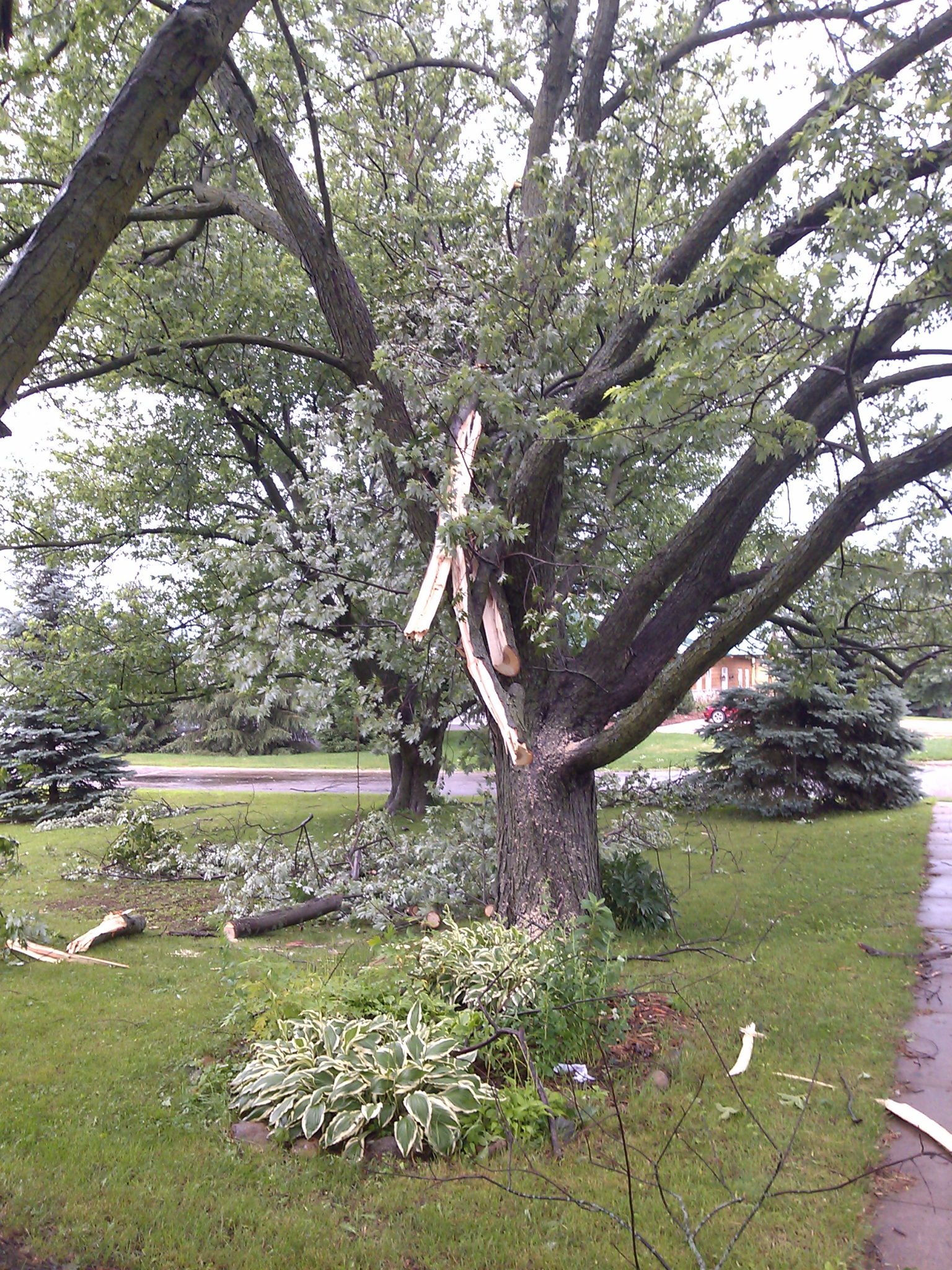
The world outside is of fallen trees and washed out ditches from last night’s extreme weather, part of a bleak day with multi-colored sky.
At a political event in town last night, about a fourth of the attendees cancelled due to the weather.
Trees were down all around the lake. Mill Creek rose up out of its banks.
“Our giant old walnut tree came down in the storm taking my farm’s main power line with it as well as my yard light pole,” came the report from our CSA. “The amazing thing is we still have power but until REC gets out here to shut off the power we have live wires on our driveway and the tree is blocking our road. Given the size of the tree I suspect it will take us several days to get the driveway cleared.”
Two trays of seedlings for the garden blew over, leaving work to salvage them this morning—the least of problems in a storm-wrecked world.
One dreams of zakuski, and lives in the material world with its fallen trees, blocked roads and disruptions, seldom stopping for the human possibilities dreams create.
It’s time to spread the pesto on plain toast and get on with the day.
LAKE MACBRIDE— The Harvard Business Review wrote about the application of mise en place to daily planning. While most of us are not professional chefs, laying out the ingredients of a day and conceptualizing the execution can make us more effective in the way it aides the best chefs.
“What’s the first thing you do when you arrive at your desk?”asked author Rod Friedman. “For many of us, checking email or listening to voice mail is practically automatic. In many ways, these are among the worst ways to start a day. Both activities hijack our focus and put us in a reactive mode, where other people’s priorities take center stage. They are the equivalent of entering a kitchen and looking for a spill to clean or a pot to scrub.”
Like many people, I check my email, the Washington Post, BBC, Guardian and my twitter news feed before turning on the light in the bedroom. The problem is obvious. A friend wrote a note about a meeting next week, which I read around 3 a.m., and have been thinking about since. While interested in the content and potential outcome from the note, it was a disruption that could have been handled differently. The first thing I did after turning on my computer was to write a response.
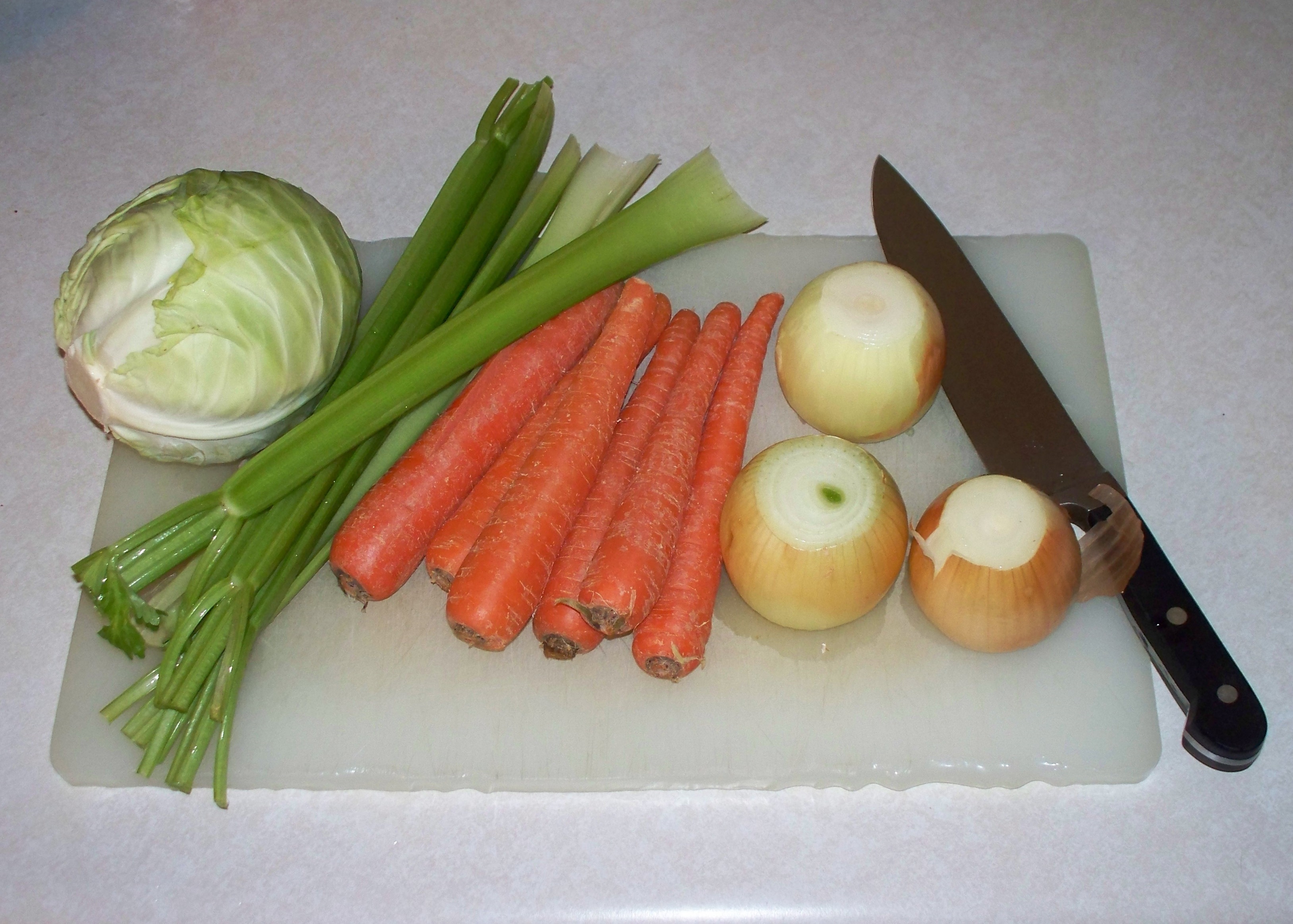
I’ll try mise en place as a planning tool a few times and see if it helps make my days more productive. Today is soup stock day— a perfect place to start.
As a writer, mise en scène is more engaging than mise en place. Borrowed from film theorists, mise en scène is a step ahead of mise en place in that it considers what goes into the camera frame and sound track, which when combined with cinematography and editing tells a specific narrative. Mise en scène sets the time and space of a creative narrative whereas mise en place is prep work to create a specific result. Both have measures of effectiveness, but mise en scène enables better creative possibilities.
It wouldn’t hurt to assemble and think about the elements of a narrative before writing, and to an extent we do that. Yet the process of writing is such that once we go down the rabbit hole of a particular topic, the outcomes have more diverse potential. We often don’t know where we will arrive, or how, at the beginning.
A case could be made that we should begin with the end in mind— not making that case here. Writing is a métier that includes processing diverse experiences and making some sense of them. It is impossible to know the end unless the piece is utilitarian the way a letter to the editor or newspaper article is.
Since writing is a lowly paid occupation— its meager income supplemented by farm and warehouse work— managing time is a must. Some may labor for days over a 500-word essay, but it is more important to crank it out, take the learning and improve during the next piece. Mise en place may help us do that more effectively with better results.
LAKE MACBRIDE— It rained on plans to work in the garden and yard. So now, the long lawn will wait until the next dry, sunny day; weeds are getting respite from being chopped; and the garage is clean enough for one auto. After the last, I went upstairs to the kitchen and processed vegetables for a meal— dinner of fresh asparagus, rice, salad greens with chopped vegetables and a veggie burger. And radishes. And spring onions. And soup stock with vegetables past their prime— mixed greens, asparagus stems, onion, celery, carrot and bay leaves. Simple fare for a simple life.
I have written about 2,000 words in two articles today, making this my third. Writing brings a sense of calm and I need that now. Better medicine than the antibiotics for my frying pan burn or the iced tea with blended whiskey. Writing works through our tension and helps release one’s cares, at least for a brief time. We write to clarify things. To straighten out a turbulent life, and by creating a narrative, yield understanding. That’s what we hope.
It doesn’t always work that way. But for now… rain came, dinner’s ready to cook, and what else is there to do on the Iowa prairie?
When I agreed to fill in as the summer, weekday editor of Blog for Iowa, the decline of newspapers, and substantial changes in corporate media was on my short list of topics to cover.
As I drove to town yesterday, people were collecting their copies of the Cedar Rapids Gazette from the roadside drop boxes. How long they will continue to do so is an open question. Newspaper publishing is a dying industry with 28.6 percent of newspapers closing since 2000. (See Harry Bradford’s article on Huffington Post here).
The Internet is becoming the pipeline for news, information and other content in a way none of us recognized as we first logged in on home computers back in the 1990s. These days, many people I know don’t even own a television set, much less subscribe to a newspaper or to cable TV.
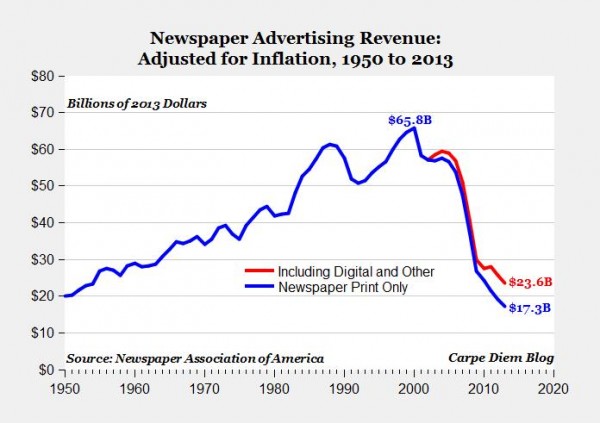
A lot has been written about the decline of newspapers and most readers have probably seen this chart:
“The dramatic decline in newspaper ad revenues since 2000 has to be one of the most significant and profound Schumpeterian gales of creative destruction in the last decade, maybe in a generation,” wrote Mark J. Perry in the Carpe Diem Blog. “And it’s not even close to being over.”
Things have gotten so bad that newspapers have stopped publishing the quarterly results used to make this chart, favoring annual reports. What does that mean? More newspapers will consolidate or go out of business, leaving less writing jobs for those who need it as paid work.
How does Blog for Iowa fit in? As you can see at the bottom of the front page of the blog, we have a benefactor. “Blog for Iowa is paid for privately to the tune of $15 a month by Dr. Alta Price of Bettendorf, Iowa,” it says. As long as people want to work for beer money or less, there will be plenty of opportunities to write. Not that we want to encourage readers to go elsewhere, but just look at the WordPress Freshly Pressed site. There are tens of thousands of well written blogs and those blogs exist and need writers, even if most of them are not for profit.
The point is the world has changed and is changing, and one of my topics this summer will be occasional posts about the changing media and our role in the new world it is creating. Watch for my summer “Friday in Iowa” series to be posted irregularly on Fridays until Labor Day.
Special thanks to my colleagues at Blog for Iowa, Trish Nelson, Dave Bradley, and especially to Dr. Alta Price for making it possible for me to write for Blog for Iowa this summer.
LAKE MACBRIDE— Trish Nelson will be taking the summer off from editing Blog for Iowa, and I’ll be filling in. There is a small stipend, and the work will give me a chance to develop ideas around the 2014 midterm elections, and on other topics.
With the retreat of so many people to no preference voter registration, to say that party affiliation matters a lot misses the point. In my statehouse district, the Iowa Secretary of State May report showed 19,802 active voters, of which 6,275 are registered Democratic, 5,666 Republican, and 7,576 No Party. The Democratic edge is largely irrelevant with so many no party registrants.
Don’t get me wrong, there is a devoted corps of died in the wool Democrats and Republicans. They just make up a minority of the electorate. In my experience, the further down the ticket, the less party affiliation matters, and the more the personality and policies of candidates come into the foreground. This summer will be a time to explore the meaning of this in light of the Nov. 4 general election campaign. It should be fun and interesting. My posts can be seen at this link.
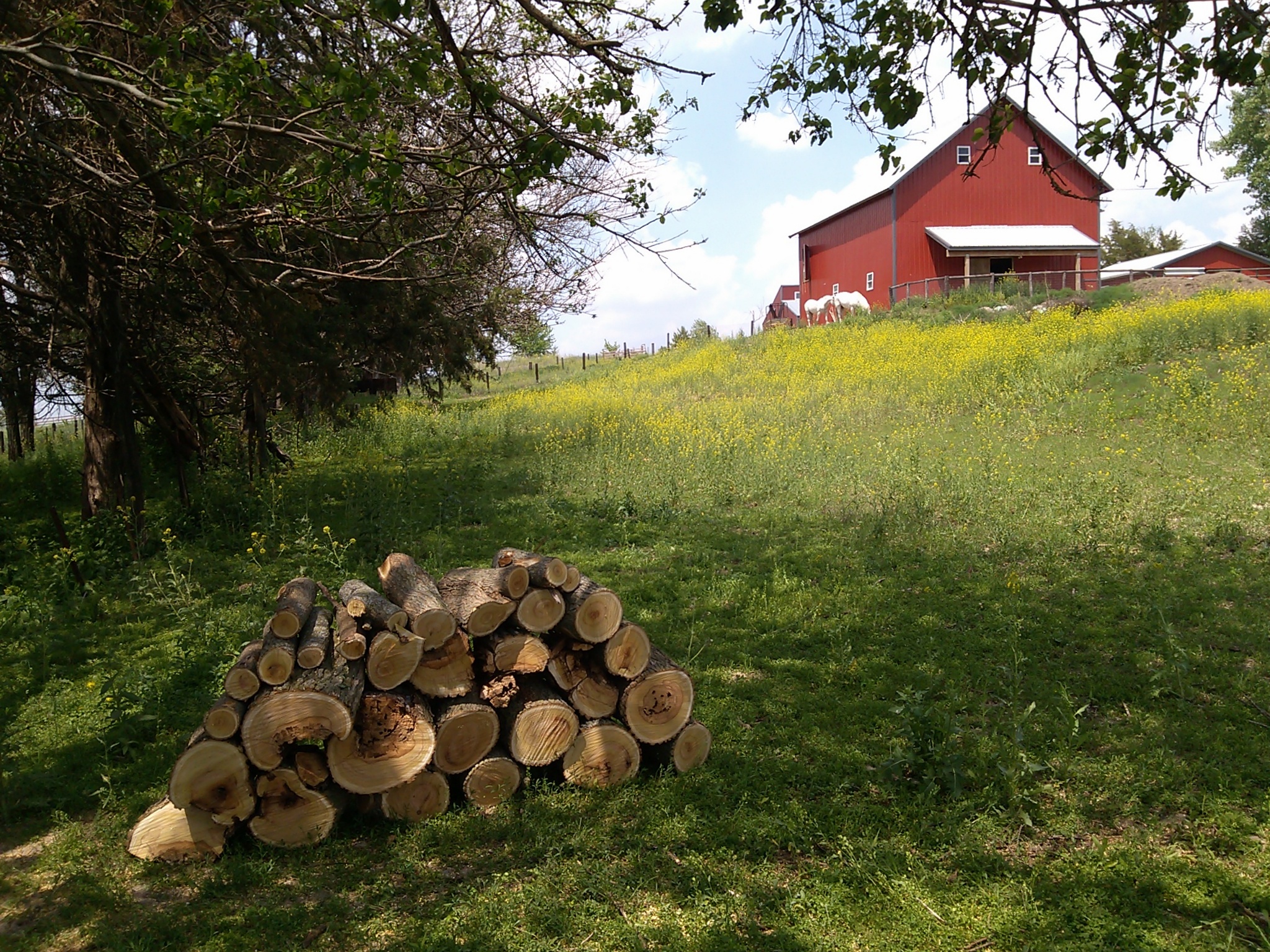
The other new summer job is a woodcutting project in nearby Cedar County. The work has flexible hours, and will add some needed income to the household budget.
Meanwhile, the farm, newspaper and warehouse work will form a base of income upon which I can build. One thing seems certain, with all of the gardening and my share from the CSA, there will be no shortage of good quality food for our pantry and table.
SOLON—My first reaction to Salt Fork Kitchen was accurate— except the part about struggling in the old, well used space. Great food will make the restaurant, even if the old church pews are uncomfortable, and the cheap, stackable restaurant chairs don’t rise to the food’s quality. Bent forks and all, the restaurant has become a popular stopping spot at 112 E. Main St. It’s because of the food.
Breakfast is the foundation of the restaurant according to their website. “Salt Fork Kitchen is a made-from-scratch, locally sourced restaurant that works with area farmers to provide exceptional, in-season food. We believe in quality first at a fair price.” They are open from 7 a.m. until 2 p.m. Tuesday through Sunday. On Saturdays from 9 a.m. until noon they offer a market of farm fresh products which supplements their sales at the nearby Iowa City Farmer’s Market. They also offer farm-to-table dinners on special occasions for a fixed price. A list of their local food sources is here.
Breakfast is a meal best made at home, but from time to time, people want a place to meet, or overnight company needs an easy transition to a road trip home. Salt Fork Kitchen serves these basic needs. If you stop there for breakfast or lunch, don’t expect fancy— just great food.
Read my previous posts about Salt Fork Kitchen here, here, here, and here.
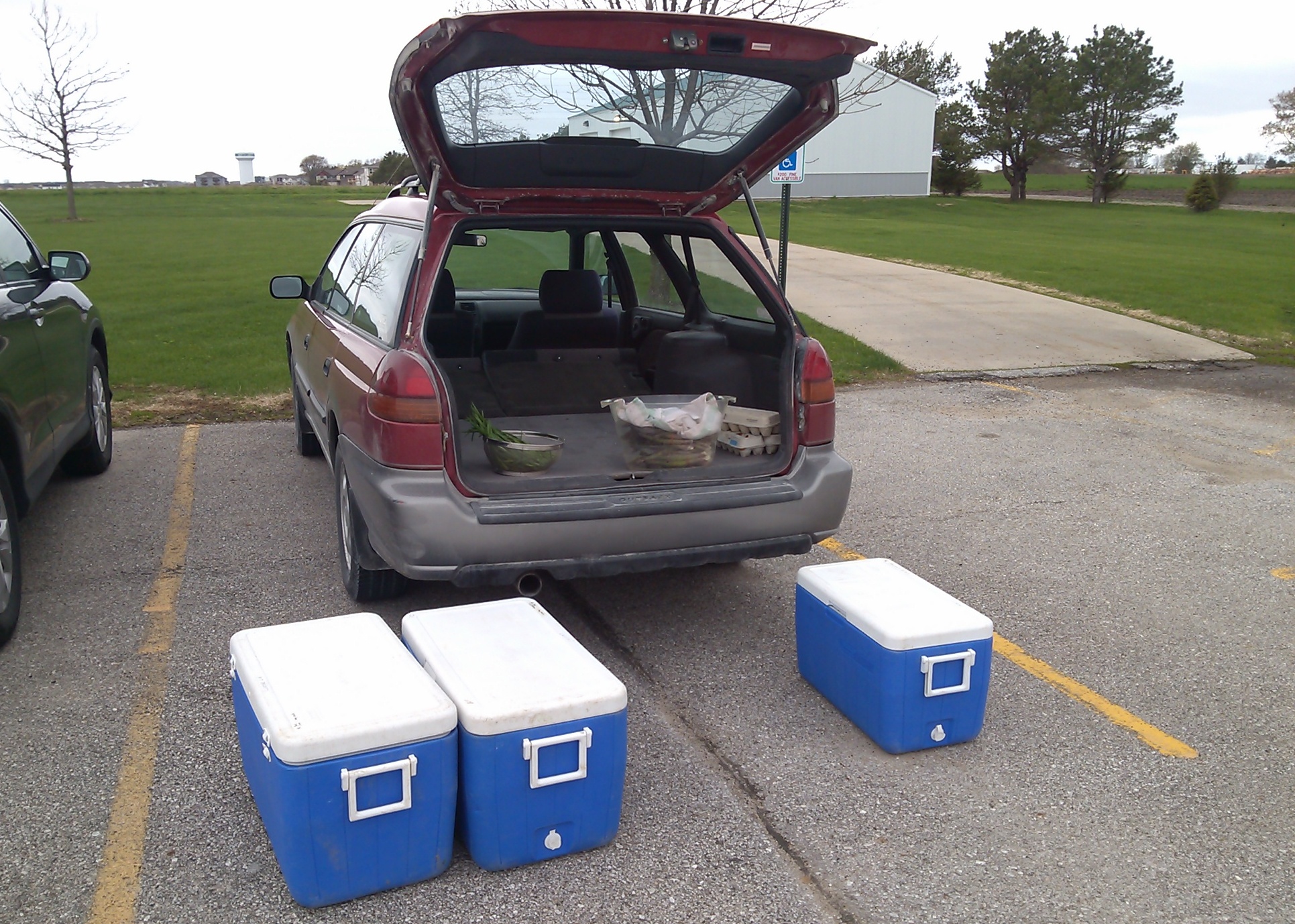
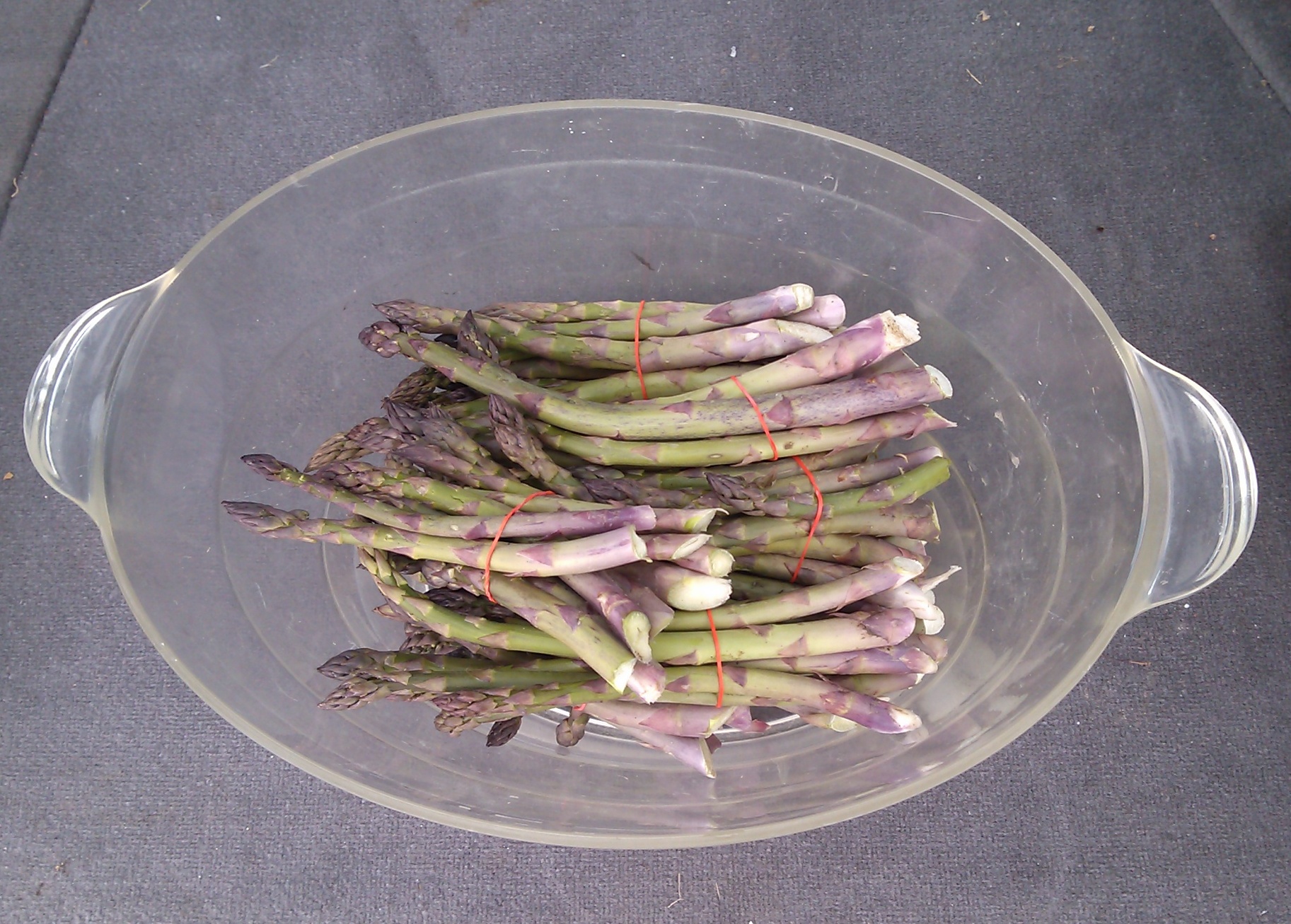
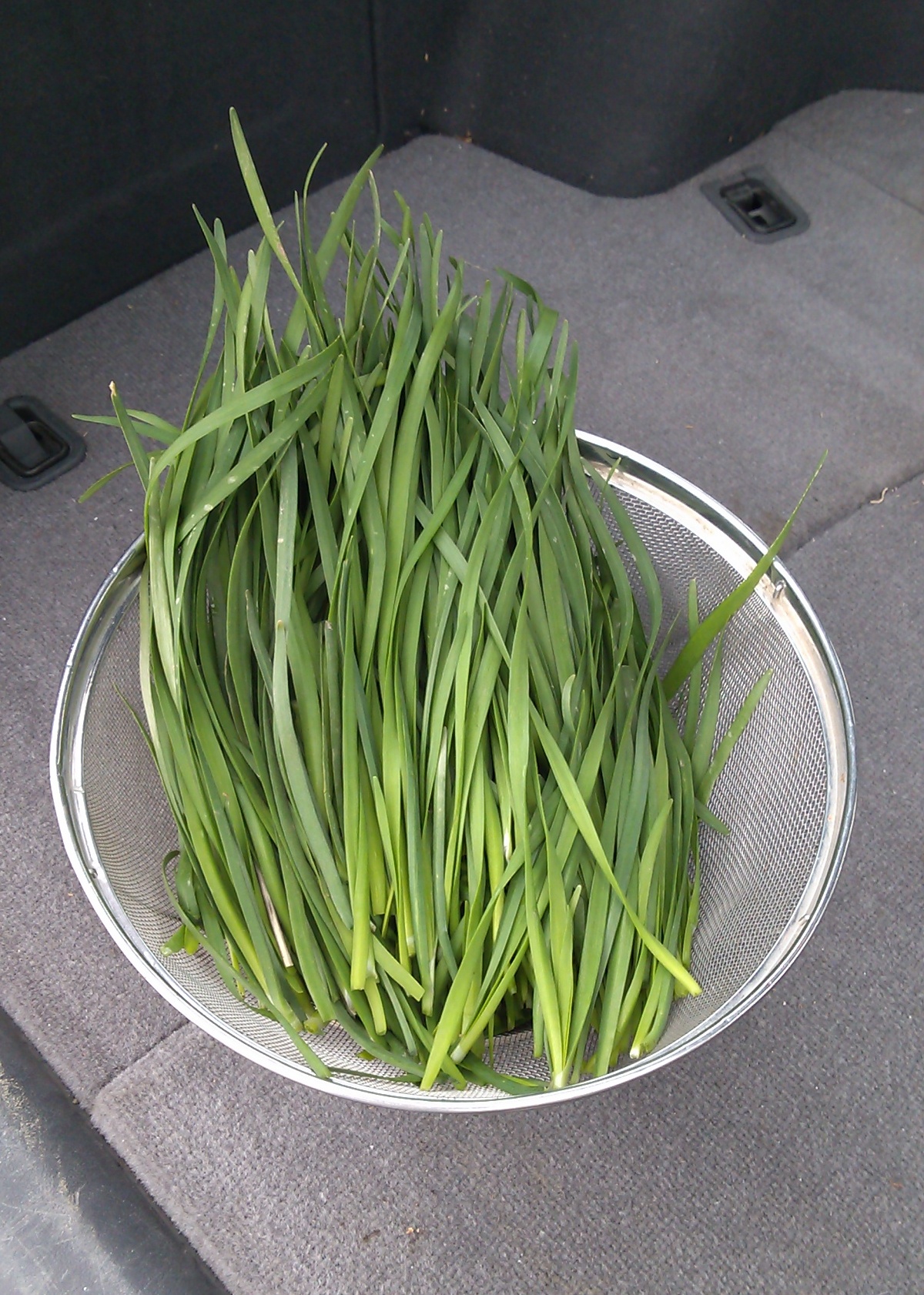
NORTH LIBERTY— One of my part time jobs is working at a Community Supported Agriculture (CSA) farm a few hours each week. The jobs are always interesting. Yesterday I delivered the first shares to customers in the parking lot of the First United Methodist Church. The nearby food pantry receives three shares plus any extra produce or unclaimed shares. This week’s share was baby bok choy, garlic chives, asparagus, lettuce, mixed greens, and for those that ordered them, a dozen eggs. Our customers are always pretty cool, and were talkative last night.
Asparagus
The quality of vegetables is always surprising and consistent. The sorting and packing takes most of a day’s work, and it is remarkable how much of care goes into each weekly share. While field workers in the Central Valley of California, Mexico, Peru or Immokalee, Florida may exercise care in their harvests, it is the personal and special treatment of CSA workers that makes a difference. We know the face of our farmer and that makes it personal.
Garlic Chives
I checked the garden and it is sopping wet still. We have had 1.61 inches of rain during the last seven days. The seeds are germinating, and it looks pretty good so far. However, the ground needs digging up, lettuce and kohlrabi transplanted, and fences put up. It will just have to wait until the ground dries out.
In the meanwhile, our kitchen is active this morning, making a breakfast stir fry that includes some bok choy, mixed greens and other delicious vegetables, mostly from local sources.
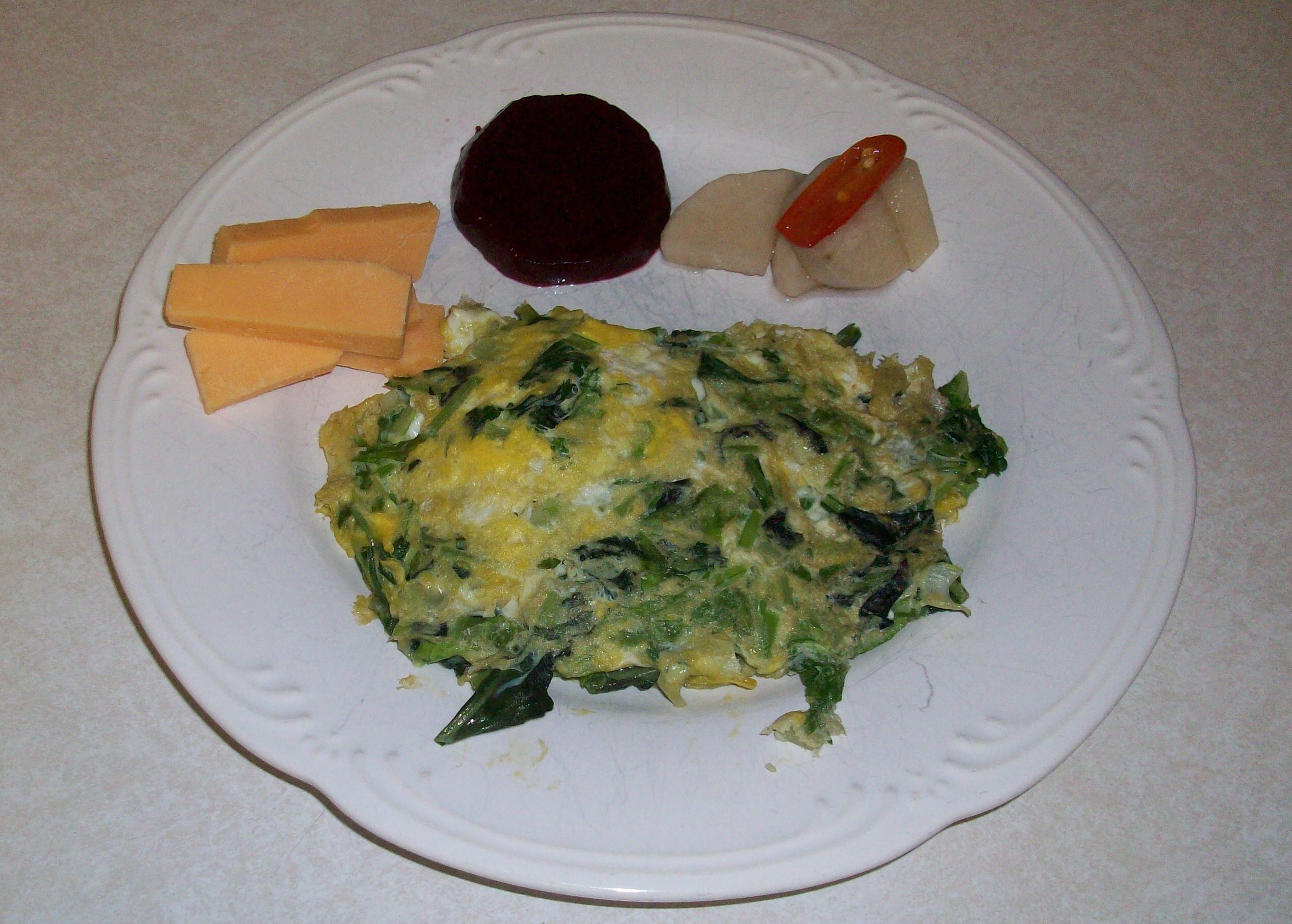
Asian Greens in Scrambled Eggs with Vermont Cheese and Pickled Bits and Pieces
LAKE MACBRIDE— The first share from the Community Supported Agriculture (CSA) farm was ready yesterday— asparagus, lettuce, baby bok choy and Asian greens. Anticipation over spring and summer cooking is building, even if living on bits and pieces from the pantry will continue until the full flow of local produce is unleashed. Picking up the share at the farm was a fine beginning.
We had more than two inches of rain since Earth Day, so outdoor plants are growing. The garden is too wet to work, although as soon as the soil dries, seedlings are ready to go into the ground. Meanwhile I will go on living in society, and that is today’s topic.
The phrase “in society” has a particular usage here. It is part of a spectrum of relationships with people that contrasts with “chez nous,” the French term that refers to “at home” or “with us.” Maybe there is something else on this jumping green sphere (thanks Lord Buckley for this phrase), “outside society” or “foreign,” but most of our lives are spent chez nous or in society. My tag “homelife” could be changed to “chez nous” and sustain the meaning.
Living in society is that set of relationships which sustains a life on the plains. It includes friends, family, neighbors, workplaces, institutions, retail establishments, and organizations with which we associate or interact. The relationships are interpersonal, that is, specific people are associated with each part of society— it is not an abstraction.
When young, we don’t see our life in society this way. We had an ability to live in the moment without a history of interpersonal relationships, anchoring us into something else. As we age, we are more like a character in a William Faulkner novel that must work to suppress the endless flow of memory.
If experience connects us, the way we live in society is based on thousands of previous interactions. For example, someone ran for the U.S. Senate after a long, productive life. If I saw him today in any of a number of settings— at a retail store, at the retirement village, at a literature reading, at a veterans meeting, at a public demonstration— I would think of the courage he displayed by taking on personal debt to challenge an entrenched incumbent politician who would otherwise have run unopposed. I would also think of our many conversations over a period of years. Our relationship is driven by my respect for his courage, and I picture him when I think about the associations we share. When I use the phrase “in society,” it might be referring to an interaction we had, or one like it with someone else.
My usage of the phrase “in society” may have been explained by others who are smarter, but because it is organic there is a peculiar sense to it on this blog. It is personal, but not really, because is it also public.
I am entering one of the richest periods of personal interaction in life. Old enough to have had experience, and young enough to gain new ones. Each day’s potential is vast midst the galaxy of people with whom I interact. Favoring the phrase “in society” enables me to talk about them without revealing where the specific interaction may have occurred. This protects people from unwanted intrusion into their lives, and enables the writing I do for a couple of hours each day.
Chez nous, we would have had breakfast of Asian greens mixed with scrambled eggs, Vermont cheddar cheese and pickled veggies from last season. In society I am part of the local food movement and post photos of my breakfast. Maybe I am drawing a fine line, but it is an important one for a writer.
LAKE MACBRIDE— The ambient outdoor temperature was 50 degrees at 3 a.m., creating a yearning to work in the yard and garden. Other work, however, kept me busy this weekend. So much so, that when each day was done, bedtime couldn’t come soon enough— outdoors had to wait.
I’m okay with that, but I’m not.
When first feeling the urge to be a writer, many years ago, I had no idea what that meant. Now there is a full slate of writing jobs, some paid and some not, and meeting deadlines has become more of an issue. Writing and proof reading our weekly newspaper can’t be described as a stressful job, but beginning on Fridays, it’s crunch time.
The supervisory work at the warehouse also occurs on weekends, so there is little time for extras in the arc from Friday through Monday. The result has been to hang with a new, and very different group of people from the academicians, political activists, public figures, and peace and justice crowd that had become staples of my social life.
American lives move from a fixed point in time toward insularity. Frederick Jackson Turner wrote in 1893,
As each generation of pioneers moved 50 to 100 miles west, they abandoned useless European practices, institutions and ideas, and instead found new solutions to new problems created by their new environment. Over multiple generations, the frontier produced characteristics of informality, violence, crudeness, democracy and initiative that the world recognized as “American.”
The degree to which one takes issue with the frontier thesis asserted by Turner in The Significance of the Frontier in American History, there is no denying the bent toward utopianism that exists in daily life. People don’t care about money as much as they want to be able to pay their bills and live their lives. In doing so, they create an island of utopianism carved out of a complicated society. Perhaps I am corrupting what it means to be utopian, but that too is an American idea.
I heard a woman say she wanted the man to make the decisions for her last week. I was stunned. Only an insular life can espouse such a world view. One that lacks a basic connection to a greater society, and exists in the rarefied air of a peculiar social network.
“Ugggghhhhh. That’s depressing,” said one friend.
“Thank goodness she’s in the minority,” said another.
“A sample of one does not a movement make,” said an activist I know.
Whatever repulsion there is to a woman who wants her man to do the thinking, it is part of the diversity of life which has become a context for my writing.
A writer must necessarily become isolated while working. At the same time, there is a constant want and need for contact with humanity in all of its diversity. Writers must break from the swaddling of the familiar and dive in— it’s as close to utopia as American living gets.




 Journey Home
You must be logged in to post a comment.