I sliced fresh cucumbers on the mandolin and dressed them with a mixture of olive oil, homemade apple cider vinegar, salt and pepper for the potluck.
Not sure how much to take, I used all the Tasty Jade Asian cucumbers I picked in the morning. It made a generous offering.
The dressing took place on the hood of my car in the parking lot for the event. Didn’t want the salad dressing to break, and the possibility of finding more ingredients along the route to the potluck kept options open until the last minute.
An octogenarian friend suggested it’s important to put your name on a potluck dish. I made a card, wrote the ingredients on it, and signed at the bottom. What’s in the dish seems more important than who made it, especially for people with dietary restrictions, but I seldom question my friend’s potluck wisdom. I made my name legible.
On a warm, summer afternoon in a park in North Liberty we gathered and enjoyed each other’s company. The potluck was the July meeting of our county’s Democratic central committee. It was an official meeting, but very informal. This being Iowa, a good percentage of the group included young political organizers for presidential campaigns, the Iowa Democratic Party, and other campaigns. There are a lot of elections between now and Nov. 3, 2020. By the way, Democrats, like most potluck attendees, are a bunch of gossips, the author included.
If people believe the way to learn about candidates and their policies is to attend large town hall meetings, they are wrong. Whatever I learned and continue to learn is done in small bits over a very long time with people I’ve come to know well. I didn’t realize that until I was able to suppress my driving social style and actually listen to people. Most elected officials are real people with real interests of their own. If they come to a potluck at all, that’s a sign they are accessible… and human.
There was no real news out of the potluck. It was the kind of warm summer evening of which there are too few in life. Suffice it there were many positive interactions before I headed home along Mehaffey Bridge Road.
I first heard Rita Hart, candidate for U.S. Congress in Iowa’s second district, speak on Friday, June 26, 2015, at Gil’s Restaurant, Ballroom and Limousine Service in Clinton at the Clinton County Democrats Hall of Fame Dinner. I have no recollection of what she said as the number of speakers was large, and my memory not as good as it used to be.
I’m supporting Hart for Congress for three reasons: she is a two-term former state senator, as our lieutenant governor candidate in 2018 she helped organize the second district for Democrats, and she has an education and farming background. I already sent a small donation.
Of the two announced Democratic candidates, I know the other better, Newman Abuissa of Iowa City. I like Abuissa a lot, and am aware of his contributions to Iowa Democratic politics and the peace and justice movement. However, this is his first campaign for elected office and we need an experienced campaigner to keep this seat Democratic. Hart has a D behind her name, won her two races for state senator, and has the bona fides of a campaigner to support it. That’s enough for this open race, one of many important ones in the 2020 general election.
What about policy, one might ask. I didn’t agree with every vote Dave Loebsack made during his tenure, and don’t expect I will like every vote Rita Hart makes. I no longer seek a perfect candidate and Dave Loebsack’s endorsement of Hart is what I needed to hear before putting a check mark next to her name on the primary ballot.
Sunday afternoon I was getting cabin fever so I drove to Ely, bought gasoline, played Powerball, and bought a pint of mint chocolate chip ice cream.
It is six miles to Dan and Debbie’s Creamery where I shop a couple of times a year. I’d go more often but I keep forgetting they are closed Monday until arriving when the building is locked up. I’m also avoiding sugar and carbohydrates for health reasons or I’d work harder at more frequent visits.
The ice cream was delicious. I debated whether to get a half gallon for $9 or a pint for $5. Economy would have me buying the larger size, but chances are I would have eaten the whole thing in one or two sittings. I managed to split the pint into two dessert-sized servings and fit it into my daily carb budget. I have a carb budget.
Wildflower
Sometimes one has to get out of the house.
My imagination let loose as I drove on Ely blacktop through the Atherton Wetland. So much so I didn’t notice whether flooding has receded, or whether people were using the ATV park.
When I reduced my schedule at the home, farm and auto supply store to leverage Social Security and phase into a slowdown, I had no idea how it would impact me. Mostly, I’m becoming more aware of who I am. It has taken time and I am not sure I fully realize what it means. One thing is certain, I’m not who I was.
This July hiatus is a chance to figure part of that out.
Not certain when it happened, my driving social-style is in remission. It may be gone completely. I no longer need to be in charge. I’m happy to follow the lead of others if they are competent. I take time for things I would not have had the patience. I did not see that coming.
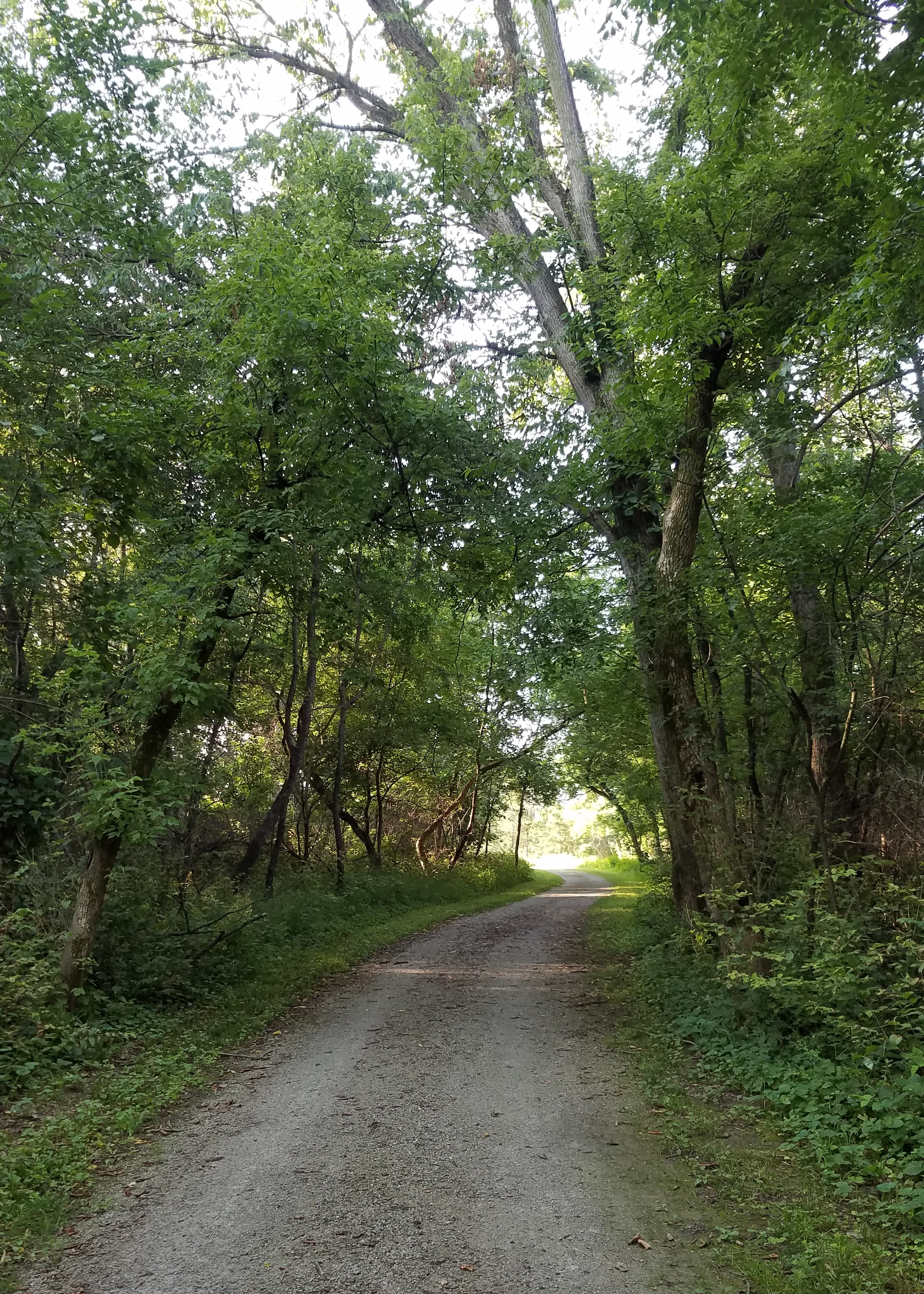
Lake Macbride State Park Trail, July 8, 2019.
With a form of financial security through a pension, the press of bills due without funds to pay them is also in remission (Thanks FDR for Social Security). Our consumer debt is going down: we gained almost $12,500 in net worth since my pension payments began and debt servicing picked up. Once the pressure of nose to the grindstone was relieved new possibilities opened up and there is more than financial improvement.
The biggest change is feeling comfortable staying home and working. I let one of my farmer friends know I would not likely be returning next year. At some point I’ll leave the home, farm and auto supply store to spend even more time at home. There is work here in the form of household repairs, reading, writing, gardening, cooking and such, to fill more time than I have left on this blue-green sphere.
In addition to the work, there’s the occasional chance to buy ice cream and become lost in the wetlands on my way home. I’m learning to see where I live again.
Over the weekend Erin Murphy, a Lee Enterprises Des Moines based reporter, said it was quiet in Iowa’s congressional primary races.
“Perhaps in the coming weeks and months, some of these quieter primary races will become more crowded,” Murphy wrote in the Quad City Times. “For now, though, the fairly low level of interest from candidates has been surprising.”
Murphy recounted the five 2020 congressional delegation races, noted who was in each race, and which were conspicuous by the absence of a declared candidate from one party or the other (a Democrat in Iowa 4 and a Republican in Iowa 2*). It is a long time until the June 2020 primary election, so Murphy’s surprise seems premature, even if he acknowledged the 11 months in the article.
My sense, from talking to Democratic voters, is there is near universal belief “we have to do something.” By that, they mean overturn Republican control of the presidency, keep the U.S. House and retake the U.S. Senate, and win one or both chambers of the state legislature. People are dead serious about it and seem willing to devote resources to making it happen. They will be sure to show up to vote in the general election.
The disconnect, and maybe the premise for Murphy’s article, is between the “we have to do something” feeling and nominees produced by the party. Voters I talk to don’t care that much about who is nominated for Congress and U.S. Senate unless they are an incumbent. They just know what we have now isn’t working.
I know what that’s like. We had to do something toward the end of George W. Bush’s first term. My response was to pick a race, focus, donate money, and volunteer every chance I got. I felt long-time Congressman Jim Leach had to go. While the Democratic challenger Dave Franker wasn’t the best candidate, everyone who volunteered on his campaign worked hard toward his election. “It didn’t work out well,” I mentioned to Dave Loebsack via email when he established an exploratory committee for the Second District Congressional seat in March 2005.
I put 2004 behind me and re-started my effort to ouster the incumbent. Voters I spoke with on the telephone and in person had turned against the once popular Leach. It almost didn’t matter our candidate was Dave Loebsack, because the expressed need for change was so prevalent. We went into election night not knowing if we’d win but hopeful based on the large number of voters who’d had it with the incumbent. As we now know, Loebsack was successful in defeating him.
I haven’t started door knocking or calling voters in 2019. As I mentioned, “we have to do something,” and that’s similar to 2006 which was the beginning of a Democratic wave that culminated in a national trifecta in 2008.
Why is it so quiet in the congressional races in July? I’m not sure that’s an accurate statement. Maybe there are less candidates running, however, the noise, if there is any, is more among rank and file Democrats, particularly those who are normally less active, taking it all in and discussing politics with friends and family. They need space to consider candidates in lives that don’t normally revolve around partisan politics. Outside the presidential preference at the February caucus, most don’t really care who nominees are as long as there is a D behind their name and candidates act like it. People are making room for politics in busy lives, but it hasn’t the high priority that will drive a more exciting race of the kind Murphy was expecting.
Resolved not to let Trump and the Republican policies stand, people seem hunkered down trying to make a go of it in an economy that favors the wealthy and where corporations strive to squeeze regular people out of every last dime. Maintaining the type of resolve needed to change our government takes energy, just a different kind than what’s represented in an active, multi-candidate primary.
People say an open primary and debate between multiple candidates is good for the party. I don’t know about that. Rank and file view it differently and people seem to take stock before declaring candidacy, realizing the financial investment in one of these five races will be significant. Maybe what you see is what you get and others don’t want to run of office.
July 2019 may be the quiet before a political storm that’s brewing next year.
* On July 8, Erin Murphy reported that Bobby Schilling filed paperwork with the Federal Elections Commission to run for Congress in Iowa’s second district as a Republican.
Blaming the woes of society on our K-12 education system is a habit I need to break.
In the post below the target was a failure to teach children about their responsibilities when signing student loan papers. A high school graduate is an adult at age 18 in our culture, so when taking on debt that has the potential to cripple them for decades, they should be equipped to know what they are doing.
Parents also play a key role in educating youth, however my grievance with the way the Iowa legislature funds public schools is they are not spending enough money where it is most needed, and the results show in the form of an ill-educated electorate that makes what I believe are bad decisions.
It is unfair for me to pin this on public schools as State Senator Claire Celsi immediately pointed out:
In the July issue of The Atlantic, author Nick Hanauer addresses the tendency to blame public schools in an article titled, “Better Public Schools Won’t Fix America:”
Long ago, I was captivated by a seductively intuitive idea, one many of my wealthy friends still subscribe to: that both poverty and rising inequality are largely consequences of America’s failing education system. Fix that, I believed, and we could cure much of what ails America.
This belief system, which I have come to think of as “educationism,” is grounded in a familiar story about cause and effect: Once upon a time, America created a public-education system that was the envy of the modern world. No nation produced more or better-educated high-school and college graduates, and thus the great American middle class was built. But then, sometime around the 1970s, America lost its way. We allowed our schools to crumble, and our test scores and graduation rates to fall. School systems that once churned out well-paid factory workers failed to keep pace with the rising educational demands of the new knowledge economy. As America’s public-school systems foundered, so did the earning power of the American middle class. And as inequality increased, so did political polarization, cynicism, and anger, threatening to undermine American democracy itself.
Hanauer assigns blame to our economic system: income inequality and the fact workers are underpaid.
“Allow economic inequality to grow, and educational inequality will inevitably grow with it,” he wrote. “By distracting us from these truths, educationism is part of the problem.”
While sad that my participation on Twitter is sometimes a distraction, eventually I can get around to a more reasonable position thanks to the commentariat. One commentator accused me of adopting the policies of U.S. Senators Chuck Grassley and Joni Ernst. That’s not the case, but at least we didn’t have to invoke Godwin’s Law to resolve the issue. Despite any issues with an ill-educated electorate, hope for a better world remains.
I’ve not been a fan of the Independence Day holiday since military service. It’s not that I paid much attention to it previously. As a military officer I had time to reflect on the meaning of independence while stationed far from home among strangers.
People celebrate the Declaration of Independence and its grievances against the King of England. I don’t mind. While I’m as glad as anyone Elizabeth is not our queen, and Prince Charles will never be our king, Columbus’ “discovery” of the Americas was an affront to human society. 284 years later the damage had been done and the founders were formalizing a relationship with the King as the hegemony of natives had been diminished by disease and warfare.
Few things point out the advancement of pre-Columbian society, and what was lost, as much as the recent book, 1491: New Revelations of the Americas Before Columbus by Charles C. Mann.
The premise of Mann’s book is there were societies in the Americas that were as sophisticated as any on the globe. They endured for multiple millennia, coming and going over time before Columbus arrived, cultures unknown to Europeans. The Declaration of Independence was an insider deal among participants who had no standing to occupy and exploit the Americas. Yet they did.
It was not unusual for Americans to side with natives at the time of independence, especially when compared to living under English rule. I side with Frederick Douglass who said,
Your celebration is a sham; your boasted liberty, an unholy license; your national greatness, swelling vanity; your sounds of rejoicing are empty and heartless; your denunciation of tyrants, brass-fronted impudence; your shouts of liberty and equality, hollow mockery; your prayers and hymns, your sermons and thanksgivings, with all your religious parade and solemnity, mere bombast, fraud, deception, impiety, and hypocrisy-a thin veil to cover up crimes which would disgrace a nation of savages.
If I celebrate anything this day it is the renewed opportunity to get along with neighbors and friends, something I believe is critical to healing our broken Democracy. While we may not agree about the meaning of Independence Day, it is better to find common ground every way we can. We’ll need that in the Anthropocene Age.
For the next five weeks I’ll be covering weekdays for our editor Trish Nelson who is on summer break. This is my seventh year to provide summer posts, and more than ten years since I began posting at Blog for Iowa.
Regular readers know my topics: politics, foreign affairs, the climate crisis, the Iowa legislature and nuclear abolition. I’ll contribute those types of posts and more as I compete to gain your interest in a busy media landscape.
While Iowa lakes struggle to maintain safe water quality for summer activities like boating, low impact water sports, and swimming, Lake Macbride experienced its first-ever public health warnings about microcystins produced by blue-green algae. Department of Natural Resources staff recommended people not swim in the lake because of high levels of toxins in the water. While the swimming ban was lifted, there is another traditional summer activity for those skeptical about the water’s suitability: reading a book. Following is a list of books readers might consider for summer reading.
I know the 720-page Mueller Report published by The Washington Post sounds like a lot and maybe a straight through reading isn’t for everyone. However, read ten pages per day and it can be finished in 2.4 months.
Willard “Sandy” Boyd, the fifteenth president of the University of Iowa, published a memoir this year, A Life on the Middle West’s Never-ending Frontier. He was university president when I was an undergraduate and graduate student. Boyd remains active as Rawlings/Miller professor of Law at the university and is president emeritus. The memoir offers his views of the role of a public university and how it evolved since he first worked at the University of Iowa in 1954. I picked it for my personal connection to Boyd, but there is a lot more to the memoir, especially if your interest is in higher education.
If folks haven’t read a history of the great migration of black citizens fleeing the south in the 20th Century in search of a better life, The Warmth of Other Suns: The Epic Story of America’s Great Migration by Isabel Wilkerson offers an option. After fifteen years of research and writing, Wilkerson published the book in 2010. It “examines the three geographic routes that were commonly used by African Americans leaving the southern states between 1915 and the 1970s, illustrated through the personal stories of people who took those routes,” according to her Wikipedia page. Knowing the history of the Great migration is essential to maintaining progressive values.
What is a single book to better understand the climate crisis? I found an answer in The Uninhabitable Earth: Life After Warming by David Wallace-Wells. Fair warning: there is not much good news within these 310 pages. What the book does do is present a broad array of the effects of the climate crisis and how they impact us now and near term. Wallace-Wells seeks to address denial that climate change poses immediate consequences that are both ever-changing and happening in front of us. Required reading for anyone advocating a sustainable life on Earth. That should include almost everyone.
Democrats expecting a fair fight in the 2020 election aren’t playing by the same rules as Republicans. When we consider how progressive values might again gain dominance in American culture it is important to learn how we arrived at this Trump moment. Two books highlight how we got here and are worth reading: Dark Money: The Hidden History of the Billionaires Behind the Rise of the Radical Right (2016) by Jane Mayer, and Democracy in Chains: The Deep History of the Radical Right’s Stealth Plan for America (2017) by Nancy MacLean. When people talk about getting money out of politics they are just flapping their gums if they don’t understand how it got in. These two books provide that insight and are essential progressive reading.
It seems like yesterday I was having a cup of coffee with Kurt Michael Friese in Iowa City. It’s hard to believe he’s gone. In A Cook’s Journey: Slow Food in the Heartland Friese offers a guided tour of the slow food movement in the Midwest around 2008. While a little dated, the book is worth reading for the landscape of Midwestern local food it presents and people in the local food movement. It’s also a way to remember his work as a chef.
That’s what’s on my summer reading list. Feel free to share what’s on yours in the comments.
Wednesday I worked outside for five hours at the home, farm and auto supply store.
As temperatures reached toward 85 degrees, a colleague and I consolidated the remaining plants and supplies and opened up traffic flow where the garden center had been. I used a lift truck although there was plenty of physical labor. Our permit with the city expires soon and it’s time to make the parking lot a parking lot again.
Lifting numerous bags of mulch, soil and garden products took a toll. I was tired when I clocked out at 4:30 p.m.
Stopping to pick up provisions at the warehouse club, the trip home took an hour and 40 minutes. I followed a large sprayer from North Liberty to Solon and it drove really slowly. There was no way I could make the trip to the county seat for a meeting where a group is coordinating a presidential candidate debate on our issues: nuclear abolition and climate change.
Aware of the televised and webcast first presidential candidate debate, I skipped it for complicated reasons, but mostly because I couldn’t stay awake until it ended at 10 p.m. With a large glass of milk and an appetizer plate for dinner, I retired early and slept through the night.
I woke around 2:45 a.m. and picked up my mobile device without turning on the lights. A friend from one of the farms where I work participated in a CNN discussion panel after the debate and sent me video. She represented our community well in the brief amount of air time.
My main conventional news sources, Associated Press and the Washington Post each had their spin about what was most significant. AP framed health care and immigration as the top issues debated. The Washington Post headlined economic policy, although they presented multiple articles on several topics.
My social media scroll showed partisans supporting their candidate and little else new. What stood out was broad support for Elizabeth Warren’s performance and a breakout for Julián Castro. In the honorable mention category, de Blasio was not as bad as expected and U.S. Senators Cory Booker and Amy Klobuchar came across as knowledgeable and presidential. Of the ten in the first debate, it is time for Bill de Blasio, Tim Ryan, Beto O’Rourke, Tulsi Gabbard, Jay Inslee and John Delaney to make their way to the exits and find other Democratic work needing to be done. If we have too many presidential candidates, there is no shortage of work to regain a Democratic majority in the legislature.
No regrets about missing the debate as I feel rested and ready to start another day. When you get to be a certain age, physical limits are familiar. One hopes to keep our powder dry and live to fight when it really matters. I can’t honestly say sifting through dozens of announced presidential candidates matters that much.
Editor’s Note about June 27 debate: Survivors of the second debate, according to accounts I read similar to those mentioned, and not from watching the debates, are Joe Biden and Bernie Sanders (only for their high ranking in the polls), Kamala Harris (for her discussion of the importance of race relations in 2019), and Pete Buttigieg for his millennial status and as a reminder of the promise of youth. As U.S. Senators Michael Bennet and Kirsten Gillibrand get honorable mention, they should make their exits from the presidential race to work on electing additional Democratic U.S. Senators to secure a majority. Eric Swalwell, Marianne Williamson, Andrew Yang and John Hickenlooper should recognize the exit music and gracefully seek other important work in the Democratic Party to improve our chances of securing majorities in both federal legislative chambers.
Based on this analysis, there are few choices for me: We need to turn the page on Joe Biden and Bernie Sanders even though their current standing in polls is evidence many like them both. That leaves Elizabeth Warren, Kamala Harris, Cory Booker, Pete Buttigieg, Amy Klobuchar and Julián Castro. I’d like to hear more from each of these candidates in the next debate. The field needs to reduce by half again after that process is completed. Of everyone that is running, on June 28 I’m more likely to support Elizabeth Warren than I was. My willingness to listen will decrease as summer continues. Making a decision of who to support should be doable by Labor Day.
It’s time for a brief hiatus to focus on 5:30 a.m. sunrises and clear days in the garden.
I’ve been listening to tracks from the Grateful Dead’s 1989 concert at Alpine Valley in East Troy, Wisc. Uncle John’s Band is a favorite performance.
My main experience with the Dead was during my undergraduate years when I ran a carbon arc spotlight at a 1971 Grateful Dead concert at the University of Iowa Field House, and attended another in 1973. I have many of their albums on vinyl, bought in real time as they were released, although sharing bootleg tapes of concerts became a thing before the internet enabled sharing. Hope you enjoy this video.
During the last couple of years I periodically went under a spell.
I don’t mean something another human (or animal) cast on me, but a time of uneasy dizziness and disorientation when I wake.
After a discussion with my physician, he said not to worry. Okay…
It happened again this morning and I did this: Remedy 1: go back to bed. Remedy 2: eat breakfast. Remedy 3: go outside and harvest garlic scapes, radishes and sugar snap peas for dinner. Remedy 4: take a nap. Remedy 5: Read about the impact of infectious disease on pre-Columbian societies. Remedy 6: eat a bowl of soup. Remedy 7: find a recipe for garlic scape pesto.
By 2:30 p.m. I was feeling more normal. Normal enough to turn on my desktop and maintain some files, deposit a check from a writing gig, and open up WordPress. Normal for a sixty-something is different from when I was a thirty-something. Once I’m done I may go outside to breathe fresh air again and feel a breeze. That seems the most impactful and I could use the exercise. The garden was too wet from last night’s rain to accomplish much there, even if I felt up to it.
I’m trying to keep my blood sugar level within a reasonable range to prevent type two diabetes and that may have prompted today’s episode. According to the Mayo Clinic, a healthy range of daily carbohydrate intake should be between 225 and 325 grams. My estimated average has been 202 since I began the project May 25, ten percent lower than the bottom of the range. In addition I’ve lost 17 pounds since then. I feel better, at least when I’m not under a spell.
The biggest change has been my stomach growls when it is ready for a meal. That hasn’t happened for a very long time. When I hear the sound now, I get a snack if it’s not meal time, or fix a meal if it is. Being mostly retired is the only way this kind of tracking and growl response can work as there are too many distractions in a regular life.
There are always free snacks in the break room of the home, farm and auto supply store to tempt one to give up tracking carbs to enjoy some sweet or salty snacks or baked goods. A recent study of 5,222 employees across the U.S. found we consume an average of 1,300 additional calories per week made up of food at the office, according to Shape.com. Working only two days a week makes a difference for me as the will power struggle is absent when I’m not working at the retail outlet.
This carb counting process continues until August when I get a new blood test and see my practitioner again. We’ll see what we see. According to my ophthalmologist the blood vessels in my eyes look fine and diabetes is absent. I suspect the spell was due to not eating enough before bedtime. I experienced glycogen burnout only once in my life, during a century bicycle ride, and this isn’t it.
I don’t like losing the whole morning and part of the afternoon. But as I finish this post, I’m feeling back to normal: sustaining a life in a turbulent world.






 Journey Home
You must be logged in to post a comment.