Categories
Kitchen Garden

Season’s New Hope

Sundog Farm in Late Winter

My first work day at Local Harvest CSA, was spent organizing for the season and soil blocking for the first seedlings.

I made two trays for myself as part of the barter deal with the farmer.

In one I seeded basil, Conquistador celery and Tall Utah celery. In the other was four kinds of kale: Dwarf Vates Blue Curled Scotch, Scarlet, Darkibor and Starbor. The growing season is here.
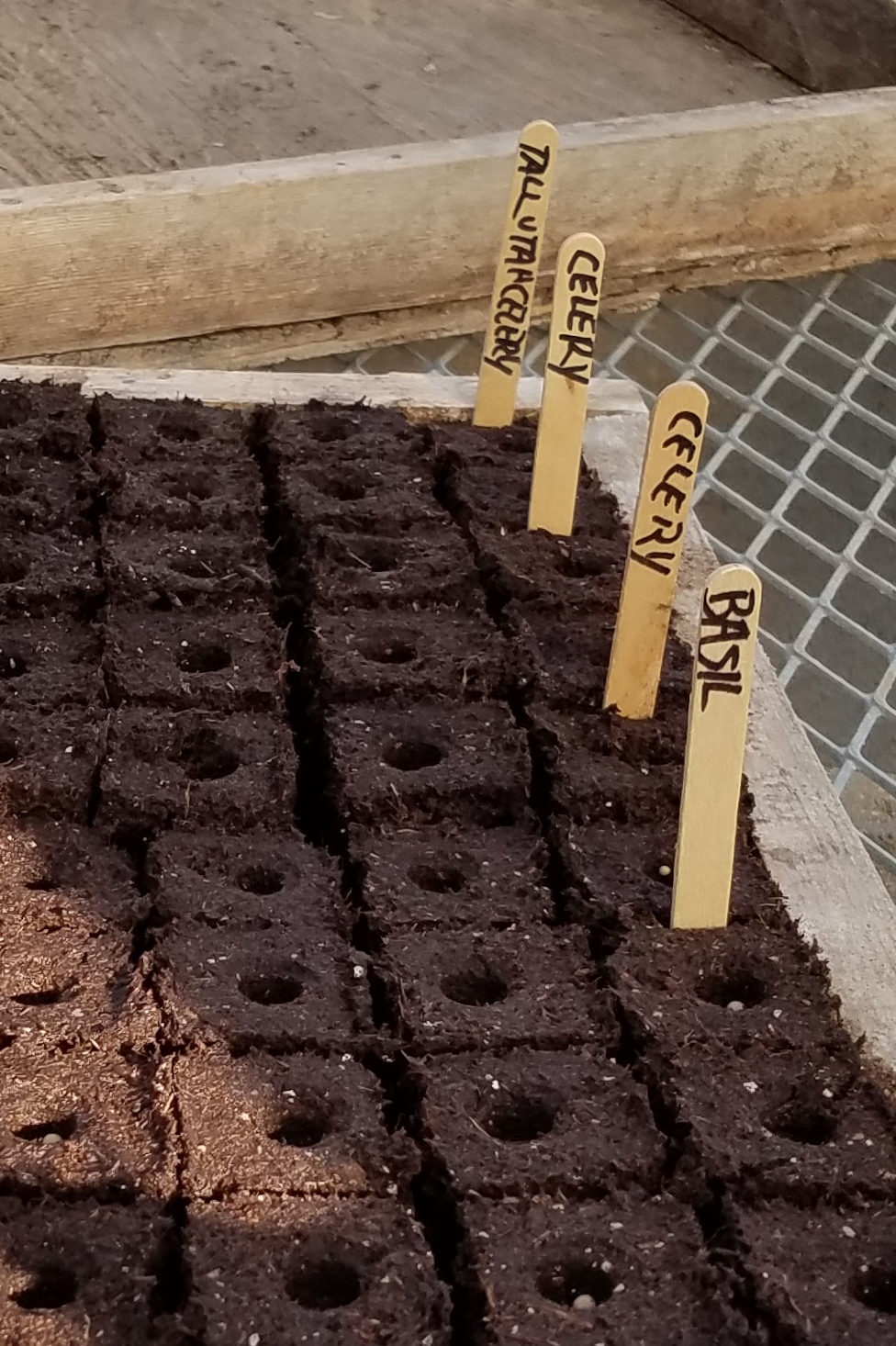
Basil and Celery
Basil and Celery

We never know the outcome of gardening. Tall Utah celery seeds are very small. It was difficult to get only one or two into each dibbled cell — I didn’t. I bought them on special from the Seed Savers Exchange in Decorah, Iowa where they don’t pellet seeds. Like with so much about gardening it is another experiment to see what grows well and tastes delicious. The pelleted Conquistador celery seeds from Johnny’s Selected Seeds in Winslow, Maine were easier to plant. A controlled germination house environment should encourage the best from these seeds. We’ll see how it goes.

3,120 Soil Blocks
3,120 Soil Blocks

Soil blocking is endemic to Community Supported Agriculture projects. Like much of our work, it is done by hand. Getting the moisture content of the soil mix right is a constant challenge. It is dry as it comes out of the bag into a tub. Watering is done in stages, testing the moisture content after each round of turning with a transfer shovel. Moisture management continues as the soil blocks are made. The pressure of the soil block tool squeezes moisture from the mixture as the blocks are made. It makes the soil mix wetter. It took 3.83 hours to get organized and produce the first batch of trays. As the season progresses, I’ll get faster.

The farmer went to town to get some supplies for the germination shed leaving me alone with two dogs and partly cloudy skies. I took a moment to breathe the fresh air and look at the sky. Hope springs from days like this. New hope for a successful season.

Categories
Kitchen Garden

First Weekend of 2017

Seed Catalogues
Seed Catalogues

Temperatures are forecast in the single digits and low teens all weekend — fit weather for beginning the year.

My planned tasks include taking down holiday decorations and meeting with my friend Carmen to discuss a role at her community supported agriculture project this season.

I have a pile to take to our meeting: two seed catalogues and the Practical Farmers of Iowa convention booklet. This will be a year to barter labor for produce.

The year’s primary dynamic will be to conserve expenses and seek alternative ways to generate income. Beginning in 2012 I became more active in the local food movement. I determined that unless I devote more time to producing and marketing local food, it would be difficult to make a living in it.

That said, I hope to maximize production in my garden this year and use weekends to sell extra produce at the town’s farmers market. I had the same idea last year but didn’t get it done. It’s a good idea — turning vegetables and fruit into funds — one I want to put into practice as a sustaining way to generate enough money to pay my garden expenses as a starting point, and pay part of my retirement as an end goal.

If I can get to work this weekend, building a blueprint for this next chapter of my life will become easier.

Categories
Environment Kitchen Garden Sustainability Work Life Writing

On Our Own into 2017

Western Sky at Sunrise

In this final 2016 post it was easier than last year to outline my writing plans.

The work I do to pay bills and support my writing has been tough mentally and physically. To cope with an aging frame and occasionally distracted mind I have had to focus. That meant planning, and then with discipline, working the plan. 2016 was a mixed bag and I expect to do better in 2017.

I seldom post about my personal life and family — at least directly. That leaves issues I confront every day as grist for the keyboard.

There are four broad, intersecting topics about which I’ll write during the coming year.

Low Wage Work and Working Poor

Not only do I earn low wages in all of my jobs, I meet a lot of people who do too. During the last four years I developed a framework for viewing how people sustain their lives without a big job or high salary. A focus on raising the minimum wage, wage theft or immigration status may be timely but most of what I read misses the mark. Stories fail to recognize the complexity with which low wage workers piece together a life. This subject needs more exposition and readers can expect it here.

Food Cultivation, Processing and Cooking

Living on low wages includes knowledge of how to grow, process and prepare some of our own food. My frequent posts on this topic have been intended to tell a story about how the work gets done. I plan to grow another big garden in 2017 and perform the same seasonal farm work. I sent off a membership form to Practical Farmers of Iowa this morning and expect my experience with that group to contribute to food related writing.

Nuclear Abolition

I renewed my membership in Physicians for Social Responsibility. We have a global footprint and as a member I have access to almost everything going on world-wide to abolish one of the gravest threats to human life. The president elect made some startling statements about nuclear weapons this month. The subject should hold interest and perhaps offer an opportunity to get something done toward abolition. The United Nations voted to work toward a new treaty to abolish nuclear weapons. They did so without the support of the United States or any of the other nuclear armed states. In that tension alone there should be a number of posts.

Global Warming and Climate Change

My framework has been membership in the Climate Reality Leadership Corps. Like with Physicians for Social Responsibility we have a global footprint with thousands of Climate Leaders. We have access to the latest information about climate change and its solutions. The key dynamic, however, is how work toward accepting the reality of climate change occurs on a local level. What researchers are finding is skepticism about the science of climate change originates in the personal experience of people where they live. If the weather is very hot and dry they tend to believe in climate change. If it is cold, they tend not to believe. Thing is, climate change and human contributions to it are not a belief system as much as they are facts. Global warming and climate change already affect us whether we believe or doubt.

So that’s the plan. While you are here, click on the tag cloud to find something else to read. I hope you will return to read more in 2017.

Categories
Home Life Kitchen Garden

Cleaning House, Making Soup

Harvest Soup
Harvest Soup

Holiday tradition in our house includes cleaning and decorating beginning mid-December.

Dec. 18 is our wedding anniversary. This year we plan to celebrate 34 years of marriage with a meal at a local restaurant.

Our wedding anniversary is also when the Christmas tree goes up with decorating to be finished by Christmas Eve.

As we cleaned, I made soup using bits and pieces of leftover vegetables and pantry items. It was thick and savory — the way soup is supposed to taste.

The process for soup-making is simple.

Turn the heat to medium high and place a Dutch oven on the burner.

Drain the juice from a pint of canned, diced tomatoes into the Dutch oven and bring to a boil.

Add a generous amount of diced onions (2 cups or more), three or four peeled and sliced carrots, two stalks of sliced celery, and three bay leaves. Salt generously and steam-saute until the vegetables begin to soften.

Add the diced tomatoes.

Next steps depend upon what is on hand.

For this batch I put a quart of turnip broth from the pantry in the blender and added cooked Brussels sprout leaves, and fresh Swiss chard and kale, all from the ice box. I blended thoroughly and added the mixture to the Dutch oven.

Next was a can each of prepared black beans and whole corn from the grocery store.

I found an old box of marjoram in the spice rack and added what was left — about a tablespoon. They don’t sell marjoram loosely packed in boxes any more so it must have been 20 years old or more.

Peeled and diced three red potatoes from the counter and added them to the Dutch oven. I also added the thinly sliced the stalks of kale and Swiss chard.

From the pantry I took a cup of lentils, and a quarter cup each of quinoa and pearled barley and added them.

I submerged the vegetables in filtered water from the ice box.

The rest of the process was to bring to a boil, turn the heat down to a simmer, and cook until it is soup — adjusting seasonings until it tastes good, and making sure the vegetables are covered in liquid.

The effort produced enough for a meal with a gallon stored in the ice box in quart Mason jars. We’ll be eating on that until Christmas day.

Categories
Kitchen Garden

Fall Errands

Bangkok Peppers for Seeds

The last day of Thanksgiving weekend found me working in the yard.

Wearing old sneakers, overalls, a sweatshirt and a stocking cap, I tended the list gardeners carry around in memory.

Empty the water hose and bring it inside, fill the bird feeder, adjust the combination windows, take the compost out, inspect the garden.

There should be more kale and Swiss chard if temperatures stay warm.

It started to drizzle so I cut things short — there is always more to do. Rain is forecast in a couple of hours.

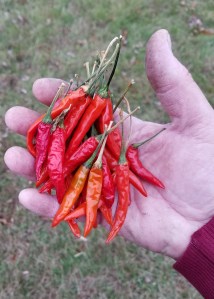
Before going inside I harvested some of the last Bangkok peppers. The frost killed the plants. Points of red on stalks with shriveled leaves. I’ll save the seeds for spring.

Saving seeds is where aging gardeners end up. It’s not a bad life. On the contrary, it is life, as good as it gets.

There is a lot to do between now and year’s end — a lot of errands to run.

Here’s hoping to sustain our lives. Midway through life’s seventh decade it seems less about me and more about what we’ll leave behind.

Categories
Kitchen Garden

Thanksgiving Menu Planning

Vegetarian Thanksgiving 2013

“What do vegetarians have for Thanksgiving dinner?” a colleague at the home, farm and auto supply store asked this week.

The unspoken assertion was it is difficult to imagine Thanksgiving without turkey as the main course.

He noted, being positive, we could still have pumpkin pie for dessert.

We could, but won’t this year.

Our kitchen has been vegetarian since we married. A vegetarian kitchen doesn’t mean we both do without meat. I occasionally consume a meat dish while visiting with friends or at political events.

In 34 years we’ve never stopped at the butcher nor bought anything from the grocery store meat counter. Not even the popular rotisserie chicken has entered our doorway, nor the even more popular pepperoni pizza. By design we eschew meat products at home and haven’t suffered nutritionally.

That’s not to say I don’t know how to cook a chicken. During a stay at our daughter’s apartment in Colorado, I raided her ice box and cooked soup from a rotisserie chicken carcass and roasted chicken breasts with rice and a vegetable for a dinner as the sun set over Pike’s Peak.

My maternal grandmother worked as a cook both as a live-in maid and in the rectory of the Catholic Church where I was baptized. In her later years, she showed me how to bone a chicken. Without practice, it seems doubtful I could do it again without help.

What will Thanksgiving 2016 look like in Big Grove?

This year the CSA where I work offered a vegetable box for $30. That, along with items already around the house, will be the centerpiece for menu planning. Cost wise, that will be our only expense as everything else is on hand. This year’s estimate of the cost of Thanksgiving dinner is $49.87 for ten people, according to the American Farm Bureau Federation, so we will be eating well, but for much less.

If we use all of the menu ideas we came up with it will take us five hours to cook the meal and five hours to eat it. Like anyone with an abundant table, we’ll have plenty of leftovers.

The menu is not final, however, here’s what it looks like the day before the holiday:

Beverages: Wilson’s Orchard apple cider, Martinelli’s Sparkling Cider, Belgian beer, filtered water and coffee.

Appetizers: Baked pumpkin seeds, Crudites (cauliflower, broccoli, carrots), pickled vegetable plate (sweet and sour pickled cucumbers, pickled daikon radish, pickled red onions, pickled jalapeno peppers).

Salad course: Lettuce salad with fresh vegetables, purple cabbage coleslaw.

Bread: Sage-cheddar biscuits.

Main course: Frittata with organic eggs, braising greens, onions, garlic and thyme.

Side dishes: Steamed broccoli, rice pilaf with collard and Swiss chard, Roasted Brussels sprouts, Roasted vegetables (potatoes, carrots, onions, bell peppers), and Butternut squash  sweet potatoes.

Dessert: Apple crisp.

No matter how dark the night, there is plenty to be thankful for this year.

Let it begin with a Happy Thanksgiving.

After Action Report Nov. 26, 2016: The actual menu varied a little from the plan and I’ve annotated the changes by crossing off dishes not prepared and added those not listed in italics. I made the red cabbage coleslaw but forgot to serve it.

Categories
Kitchen Garden

Garden Plot Six 2016

First Tomatoes Ripening

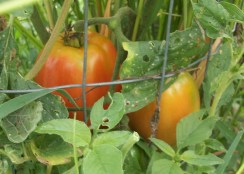
Garden plot six was five varieties of tomatoes — Italian, Amish Paste, Beefsteak, Rose and Kanner Hoell.

It was an abundant crop — about 200 pounds harvested — but most of the crop went bad on the vine due to an inability to spend time harvesting.

The culprit was a busy work schedule that included four jobs during the prime tomato month of August.

Heavy rain produced large sized fruit. When rain was imminent I hurried to harvest — preventing tomatoes from bursting. I didn’t always make it in time.

Lesson learned and applied this year was to give the plants space between them to breathe. So too it is with us. We need freedom from being cloistered to thrive.

Plans for this commodity plot are up in the air until I take a pencil to the 2017 garden plan. Wherever I plant tomatoes, I will give them even more room between plants. In 2016 this paid dividends that made up for my lack of care.

Categories
Kitchen Garden

Garden Plot Five 2016

Cherry Tomatoes from Garden Plot Five

The ambient temperature dropped to 20 degrees last night — a hard frost.

This morning, while raking the remainders of grass clippings in the yard, I found Swiss chard growing in garden plot five.

Chard will be a centerpiece for tonight’s dinner, most likely in a casserole with rice, onions, chopped chard, garlic, eggs, oregano and Parmesan cheese.

While poorly planned — a place for odds and ends of cherry tomatoes, eggplant, cauliflower, hot peppers and a failed section of bell peppers — it produced early with cherry tomatoes and late with aforementioned chard. I pledge to make a better plan next year.

The section of bell peppers took up more than a third of the space. The seedlings went in fine, with protection from ground threats in the form of six-inch sections of four-inch drainage tile, and mulch. Because of working four jobs in August, it got away from me, producing not a single fruit. I can’t recall a year when my bell peppers have done well. Weeding and watering are two important aspects of growing peppers and I didn’t do either one well. But what do I know? A farmer friend gave us adequate seconds from her farm so we are okay with bell peppers for winter.

Four cherry tomato plants is enough for our household. The four different kinds produced before the main tomato crop and were great in salads until the slicers matured and ripened. The cherries were positioned at the edge of the plot for easy picking from the center path.

The eggplant and cauliflower seedlings were gifts stuck in empty rows. Fairy Tale eggplant is great because of its size and length of time producing. Four plants produced more than we could use. I’ve added Fairy Tale eggplant seeds to my December order and will put them in the indoor planting schedule.

Now that frost has come it will be easier to clear the plot. The plan is to clear it and make a burn pile. It was very windy today, so I’ll save these tasks for another day in this unseasonably warm autumn.

Categories
Kitchen Garden

Garden Plot Four 2016

Garden Plot with Kale. Peppers and Tomatoes
Garden Plot Four with Kale. Peppers and Tomatoes

I grew kale, hot peppers and Brandywine tomatoes in plot four this season.

It was a commodity plot in the 2016 rotation, one that received full sunlight most of the day.

Kale is still growing the third week in November, although it won’t be long before the plants are frosted beyond recovery.

Kale has become a reliable mainstay in my garden life. We use it fresh in a variety of dishes throughout the season. I give away more than we use to friends and library workers in town. Word from the library is many smoothies are made using the green and purple leaves. There was plenty this year.

The trouble was with hot peppers, Bangkok particularly. Because of abundant rain they grew and grew until taller than me. Pepper plants crowded out part of the kale rows reducing yield. I harvested Bangkok, Serrano and jalapeño peppers. More than I could use, but not enough to sell to local restaurants. The ice box and freezer are stocked with enough hot peppers to last until next year. I dehydrated more than enough Bangkok peppers to make red pepper flakes for friends who want them.

I settled on Brandywine tomatoes as my commodity producer, planting seven plants in plot four. They produced large, flavorful fruit in abundance. I harvested only a small portion of the crop because I couldn’t make time to get in the garden in August. Working four jobs outside home had a material impact on garden yield. What I did harvest was some of the best tomatoes ever.

Plans for next year: Plot four is a rotation plot so I won’t be sure until I make my seasonal plan toward the end of the year. Kale, peppers and tomatoes will go elsewhere next year.

Categories
Home Life Kitchen Garden

Cooking Away Frustrations

Pumpkin Pancake Topped with Apple Butter and caramelized Apples
Pumpkin Pancake Topped with Apple Butter and Caramelized Apples

The weekend was a chance to get in the kitchen again.

When memories of a god-awful general election campaign persist, work is the best antidote.

I made a lot of dishes.

First up was a big pot of chili. Onion sorting has become a weekly thing and there was a whole tub of the same white onions to dice and cook in canned tomato juice for chili. I’ve written my chili recipe so many times I won’t repeat it here.

I halved and seeded a pie pumpkin and baked it in a 360 degree oven until fork tender. It made about four cups of pumpkin pulp, half of which I used to make pumpkin bread. The bread recipe was from The King Arthur Flour Bakers Companion cookbook except I omitted the nuts and chocolate chips. A slice of pumpkin bread went well with the chili for supper. There is a second loaf to take to the home, farm and auto supply store for the break room.

Roasted pumpkin seeds are crunchy and delicious especially while still warm. I separated seeds from the pumpkin guts and baked them with a little salt. It was hard not to eat them all.

After dropping my spouse at work, I went to the orchard to spend the $50 gift certificate received during our end of season party. I bought 19 pounds of Gold Rush apples, a long keeper and plenty delicious (apple joke). To make room for them in the ice box, I took the bowl of apples already there and peeled and sliced them for a simple caramelized apple dish. When it was done I put it in a plastic tub in the ice box.

Ice Box
Ice Box

Not to show off or anything, but here is what our ice box looked like when I returned from the orchard and put everything away.

The end of this spate of cooking came at breakfast Sunday morning when I made pumpkin pancakes topped with home made apple butter and the apple dish from Saturday warmed in the microwave oven. I made the batter in a bowl just used to bottle ground habañero and jalapeño peppers so the pancake had a kick.

Days of kitchen cooking seem rare as life accelerates toward year’s end. My advice is two things: grind your hot peppers in the garage, and when you feel blue, get to work. You’ll be glad you did both, especially the former.