Categories
Home Life

Perhaps It Was a Sign

Water Damaged Memorabilia Drying

For the first time since we covered our foundation with earth in 1993 we had water downstairs after a heavy rainfall.

Perhaps it was a sign.

As soon as we discovered the problem, we reacted. Later in the day I bought a 20-inch fan at the home, farm and auto supply store to circulate air as the cement floor dries. It’s muffling out every other sound as I write.

Most of our storage items are on pallets, and planning paid off. About half a dozen boxes on the floor did get damp. We caught it soon enough to remove the contents and dry papers out before getting ruined. My musical instruments were also on the floor, but they were dried off before wreckage.

Casualties included a small collection of Franklin Mint items, a box of letters from pre-email days, and a banker’s box full of political memorabilia going back to when I worked on LBJ’s 1964 campaign. It looks like everything will be okay.

We don’t plan to build an ark, and must figure out what is happening then take action. By the end of today, I’ll inspect the wall inside and out and develop an action plan. I’ve learned to pay attention when nature and the forces behind it give us a sign.

The last thing we needed was one more thing on the Big Grove do list. On Thursday I made a schedule at the home, farm and auto supply store during a break. It must now be modified.
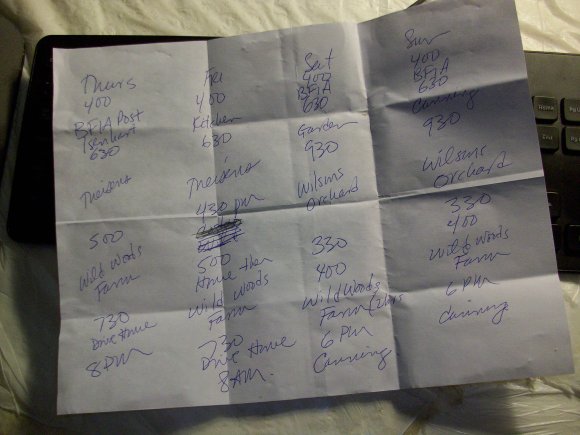
Weekend Schedule Draft

With such a schedule it is hard to relax. In fact, it is easy to see why people turn to methamphetamine to get through everything that needs doing in 24 hours. Maybe I need to pull a couple of all nighters, as a substitute since I eschew meth and stimulants except coffee.

A friend of mine who attended Georgetown University continued the collegiate practice of pulling all nighters well into the 1980s as a way of catching up with things that could not be delayed. The trouble is there is no “next day” for me to crash with my constant schedule through the end of the apple season.

Mine is the situation of any low wage worker, and I don’t see it being fixed in the U.S. by the “fight for $15,” an advocacy effort to raise the minimum wage. I will suck the pap of life dry with constant activities regardless of economic status. What would help from government is hard to accomplish: universal health care; bolster Social Security so our pensions will be there;  and preserve and protect the commons. It doesn’t seem like too much to ask.

Onion Trimming Progress

Meanwhile, the onion trimming is going well. Instead of crossing the lakes after work, I head East on Interstate 80 to Highway One and spend a couple of hours in the nearby greenhouse.

I’m about a third of the way through summer onions, after which I’ll do storage onions. The crates are custom made and have slats in the bottom for aeration. As part of my compensation I keep the seconds, so there are plenty of onions in our house for the next few weeks.

It’s all part of sustaining a life in a turbulent world.

Categories
Environment

Chuck Isenhart Addresses Iowa Clean Water Strategy

Runoff Heading to Lake MacBride

On Wednesday, Aug. 3, State Rep. Chuck Isenhart issued a press release addressing the need for Iowa government to update the state’s clean water strategy.

Following a visit to Louisiana, where he consulted with stakeholders regarding Gulf of Mexico hypoxia, Isenhart wrote a letter to Iowa Secretary of Agriculture Bill Northey urging the Water Resources Coordinating Council to adopt a 20 percent reduction in nitrogen and phosphorus load. Read his July 17 letter here.

Isenhart is ranking member of the House Environmental Protection Committee and a leading voice for the environment and on energy issues in the Iowa legislature. Following is his press release in its entirety.

Time to update state clean water strategy

In light of Gov. Terry Branstad’s renewed call for more funding for water quality initiatives, State Rep. Chuck Isenhart (D-Dubuque) has asked the Iowa Department of Agriculture and Land Stewardship (IDALS) to update Iowa’s nutrient reduction strategy to establish performance goals to be achieved with any new money.

In a letter to the Water Resources Coordinating Council — chaired by Secretary of Agriculture Bill Northey — Isenhart has encouraged the body of state and federal officials to recommend that Iowa adopt the interim milestones endorsed by the Mississippi River/Gulf of Mexico Hypoxia Task Force

Northey is co-chair of that task force. Isenhart is ranking member on the House Environmental Protection Committee and liaison to the state Watershed Planning Advisory Council.

The Gulf task force’s 2015 report to Congress called for a 20 percent nitrogen and phosphorus load reduction at the watershed scale by the year 2025.

“After three years of demonstration projects, we know what works,” Isenhart said. “Time to move to the implementation stage and scale up our efforts with widespread adoption of effective pollution-reduction practices. But first we owe it to Iowa citizens to show them how we will be accountable and what their money will buy: How clean will the water be and when will it happen.”

Isenhart noted that, while the Gulf task force is looking for documented results by 2025, Governor Branstad’s funding plan doesn’t kick in until 2029. “That is a glaring oversight, hopefully not intentional,” he said.

During the last legislative session, Isenhart and State Rep. Marti Anderson (D-Des Moines) offered an “Iowa Clean Water Partnership Plan,” based on their participation in the Greater Des Moines Partnership’s Iowa’s Soil and Water Future Task Force.

If adopted, the plan would create a clean water trust fund comprised of both public and private monies contributed by farm producers through water quality checkoff programs. The legislators plan to improve and re-introduce the bill in 2017.

“In the meantime, we will continue to educate and learn from Iowans during the upcoming election campaign season,” Isenhart continued. “We want to know if we are on the right track. We also want to know if Iowa voters still want us to raise the sales tax by 3/8 cent to fund the Natural Resources and Outdoor Recreation Trust fund they put in the Constitution with a 2010 referendum.

“If Iowans still want it — and surveys indicate that they do — that would bring the greatest, most consistent funding that a long-term enterprise like this requires,” he said.

This week, Isenhart is attending the annual meeting of the National Conference of State Legislatures in Chicago. He serves on NCSL’s Natural Resources and Infrastructure Committee.

Isenhart has offered an amendment to the NCSL water policy directive that would prioritize nitrogen and phosphorus pollution as a water quality improvement objective in the Mississippi River basin and “wherever such pollution from pervasive point and non-point sources creates serious hypoxic conditions in waters of economic, ecological and/or recreational significance.”

The proposal also calls on the federal government to “foster and assist in the financing and support of working groups of state legislators within major watersheds where water pollution is a multi-state responsibility.”

Such working groups or compacts could be formed to “coordinate the development of strategies, policies, statutes, regulations and spending priorities for the attainment of clean water, including goals, timelines and accountability for performance,” Isenhart explained. “Right now, many state legislatures are AWOL when it comes to clean water. We need to get in the boat.”

~ Written for Blog for Iowa

Categories
Living in Society

Kim Weaver For Iowa’s 4th District

Weaver for CongressKim Weaver believes 2016 is the year to retire Republican Steve King from Congress.

What makes her effort different from those of Jim Mowrer, Christie Vilsack, Matt Campbell, Rob Hubler and others?

The political climate of intolerance and hate people like Rep. King foster has reached its limit, creating a backlash among lifelong Republicans.

Weaver hopes to build a coalition using the unique opportunity 2016 presents.

“The other night I had an interesting conversation with a friend who will no longer be voting for Donald Trump, Steve King or any other Republicans,” Weaver wrote in a fundraising email.

“I watched this lifelong member of the GOP burn his Republican National ID while standing around a bonfire. He told me that he feels betrayed by the party and regardless of the outcome he doesn’t know how we will ease the tensions within nation’s polarized political system. To confront the global crises the world looks toward America for leadership and solutions. He said the divisive rhetoric this year short circuits conversations after a few seconds. From across the fire he looked at me and said, ‘All of this intolerance and hate is crazy. It’s gotta stop.'”

Kim Weaver is a proud native Iowan. Born in Des Moines, she graduated from Roosevelt High School and obtained a bachelor’s degree in communications from Iowa State University. After college she married and later moved to Sheldon where she raised her three children and built a career. Weaver appreciates the value of community and the belief in hard work Iowans hold dear. She is dedicated to taking those values to Congress.

We’ve heard it all about Steve King. Isn’t it time we focused on solutions? That’s what Kim Weaver offers.

Issues most important to Weaver include financial stability for families, student loan debt relief, financial stability for seniors, immigration reform, and making higher education more affordable.

As for King, there is little reason for Iowans to talk about his confrontational and outrageous behavior and statements. In fact, one of my friends had something to say about this.Weaver Tweet

For more information about Kim Weaver’s campaign for Congress in Iowa’s 4th District, visit her web site.

~ Written for Blog for Iowa

Categories
Writing

In An Iowa Kitchen

A Gardener's Breakfast
A Gardener’s Breakfast

The local food movement relies more on kitchens than grocery stores; more on gardens than commercial growers.

While use of locally sourced food by many restaurants has changed to include more of it, a local foods movement cannot be sustained by the hodge-podge of farmers, growers and entrepreneurs who sell locally produced food to restaurants, or for that matter, to grocery stores.

The problems include scalability and sustainability.

We are living in a time where demand for local food exceeds supply. Scaling up to meet demand requires a capital investment most small farmers can’t make. Sustainability relies on creating value along with the food in a way that cooks can afford it and farmers can make a reasonable return on their investment.

Someone recently asked if the area was becoming saturated with Community Supported Agriculture projects and if that’s why some are having trouble growing membership. An answer lies elsewhere. The market for local fresh food has grown so big corporations noticed.

Companies like Hy-Vee, have tapped into the fresh food market by increasing their number of suppliers and offering fresh and local food alongside wares from large commercial growers. They are sucking up market share like a vacuum cleaner as their business model is designed to do – putting pressure on small and mid-sized growers.

Corporate involvement in the local food market is a two edged sword. Growers can sell their best wares to companies like Hy-Vee and get a reasonable return. At the same time reliance on companies rather than CSA members can distract a farmer from his or her core business.

A solution? CSAs should stick to their knitting by getting payment up front and sharing the harvest with members… all of it. It may be tempting to sell some on the side to restaurants and grocery stores, but the further away from the model they get, instead of doing one thing well, everything they do can suffer. In addition, the market share they help corporations grow may be detracting from their core business.

There is nothing wrong with a farmer growing organic greens for restaurant salads and stir fries. In the end, each farmer must make ends meet, and operating a farm —even a small one — is an expensive operation with tight margins. My point is to focus on one thing and do it well.

It is one thing for a farmer to disassemble a barn and use the materials to create raised beds for a ten-person CSA. It is quite another to support a couple hundred families with the variety of produce the market demands. If you ask a hundred CSA members, as I have, why they belong, answers are all over the map. Some want assurance of a grower who uses organic methods to produce food. Some want variety unavailable at Aldi’s or Fareway. Others want to create a cooking experience with young children as part of their education. Most want to feel good about what they are doing with their lives.

One hopes we are beyond the discussion of “food miles” and on to the core value of the nascent local food economy: know the face of the farmer. It’s corollary is know how your food is grown. Try as they might with life-size cutouts of farmers in their stores, corporations have a hard time doing that. Their customers are too diverse, and they have to cater to everyone in the community. If a person combines these two ideas, knowing how our food is produced and creating demand for local, fresh food the local food movement has a chance.

A very few people strive to source every food ingredient locally. It is not with them the future of local food lies. The future of local food is within the potential of every Iowa kitchen.

To sustain the local foods movement requires consideration of what it means to belong to a CSA or buy from a farmers market. Can that fit into culinary habits in a way that is not an encumbrance to what most perceive as very busy lives?

Can kitchen cooks grow some of their own produce? Probably yes, even if it means only a large flower pot with some cherry tomatoes or an herb jar on a window ledge. Even these small things may be a step too far for some.

The trend in food includes extensive prep work done by machines and large companies. Heat and serve has become a by-line for many available grocery items. Along with taking the kitchen work out of meals, risks of contamination have been created and along with it the need for recalls from large processors whose products get contaminated by E. coli and listeria.

In a consumer society it will always be tough for small-scale producers to survive and thrive. That’s why I say the future of the local food movement rests in Iowa kitchens where cooks can use less processed foods and more fresh — secured by buying local and growing their own.

It’s work many can’t do because of choices made about careers and family. What may be the saving grace of the local food movement is the idea of taking control of our kitchens, in part by living and eating local as much as we can.

Categories
Environment

What’s After Paris?

Gore ParisLast week, Al Gore reflected on the ten years since he founded The Climate Reality Project. Following is an excerpt from an email he sent to the Climate Reality Leaders he trained.

Ten years ago, I trained the first group of Climate Reality Leaders in my barn in Carthage, Tenn. I asked them to join me in spreading the word about the urgency of the climate crisis, and I was impressed by the commitment and passion they demonstrated. I’m even more impressed now as the work they’ve done in their own communities and beyond has helped to spark a global movement for action on climate change.

In the decade since that first group came together, I’ve trained more than 10,000 Climate Reality Leaders who are just as committed to making the world a better place for future generations. The Climate Reality Leadership Corps is active in more than 130 countries around the world and represents people from all backgrounds and walks of life. I’ve enjoyed working alongside teachers, scientists, community leaders, business owners, students, and so many others who all share a dedication to promoting solutions to the climate crisis.

Ten years of concerted action by the Climate Reality Leadership Corps came together last year when 195 countries committed to working together to reduce greenhouse gas emissions planet-wide as part of the Paris Agreement. Now, it’s time for us to continue our work together and push countries to strengthen and implement their commitments so we can make the promise of Paris a reality.

Even as we look to the future, I want to make sure we take a moment to appreciate the last 10 years and all of the amazing work that you’ve done to help share the truth about the science and solutions of climate change with your friends, family members, colleagues, and everyone else.

I want to thank each and every one of you for what you’ve done in your own communities to bring attention to the most important issue of our time.

It is easier to play a role in the global effort to mitigate the causes of global warming and climate change when thousands of others are doing the same thing, each in their own way. That’s been my personal benefit from The Climate Reality Project.

I joined in Chicago (August 2013) and have no regrets. I learned the story behind Gore’s film An Inconvenient Truth, and the science behind it. Gore presented a broad mix of information about what is happening in our environment because of global warming and how it impacts communities.

Since then, I’ve presented my story to individuals and groups in the area and seek opportunities to do more. I served as a mentor at the Cedar Rapids training last year and have written about the need to act on climate change in my blogs, and in letters to the editor of our local newspaper. When I worked as a freelance correspondent, climate change informed my world-view and was a context in which I framed stories whether they were about farming or forestry, the school board or city council, or about new business openings or individual achievements.

Talking about global warming and climate change has become part of my life.

If the Paris agreement was the culmination of ten years of work, as Gore said it was, the work is not finished.

With a sharp focus on identifying the impact on our climate of CO2 emissions from burning fossil fuels, Gore and many allies made the point about seeking alternatives. As solar and wind-generated electricity reach price parity with fossil fuels (and they are doing so faster than anyone imagined) the coal industry is in disarray and nuclear power is waning.

There is a cloud on the hopeful horizon of renewable energy. Buoyed by exploration and discovery of oil and shale gas reserves, companies like British Petroleum, once green washing us with their interest in renewables, divested their interests in solar and wind energy this decade to focus on oil and gas.

I predict declining prices of solar power will help it dominate the future of municipal and regional electricity generation. Already companies like Central Iowa Power Company (CIPCO) are changing their tune. Not so long ago they were promoting nuclear power at their annual shareholder’s meeting. Today, they are building solar arrays.

If there is a blind spot in Gore’s laser focus on burning fossil fuels it is the impact of greenhouse gas emissions from other sources. He acknowledges them, but they have not taken the spotlight. There’s work to be done regarding manufacturing, agriculture, mining and other aspects of our industrialized global economy.

Every time I talk to an Iowa farmer Gore’s work can be heard in the conversation. Not so much from me, but from farmers. They’ll tell you the hydrology cycle seems different even if they dislike Al Gore and don’t acknowledge it is related to global warming. They don’t have to and I don’t need ratification of my own beliefs.

Like so many others I am focused on the work of mitigating the causes of climate change. You may not know it, but it is baked into everything I do.

What have you done lately to create a better environment for all of us to enjoy?

~ Written for Blog for Iowa

Categories
Home Life

Sleep Came Easily

Cherry Tomatoes from the Garden

Mounds of grass clippings blocked the John Deere’s steering as I mowed part of the lawn.

The temperature was ideal, the sky clear, and I was alert enough to safely operate the equipment.

To engage the steering I backed off and tried again.

Grass clippings lie in wind rows where I mowed last night. Using a rake and wagon I’ll transfer them to the garden for mulch.

In high summer a gardener/low wage worker/family member finds more to do than there is time. I managed to send a box of kale, fairy-tale eggplant and tomatoes to the library for the workers earlier in the day. They were appreciative.

The garden hose was coiled near the house for mowing. While driving past the garden I noticed the cucumber leaves drooping. I stopped, got the hose back out, and watered. I missed a lot of cucumbers during the morning harvest so I picked them. They filled a crate and created another thing to do.

Dinner was sweet corn on the cob and tomatoes with cheese plate, bread, and blueberry yogurt for dessert. The corn and tomatoes were filling, so I didn’t get to dessert.

After dinner I put cucumbers — newly harvested and those already in the ice box — on the counter after washing them. I sorted and found a place to put them. I hadn’t planned another task, but it needed doing. I’d say I’m in a pickle, and that’s more solution than problem.

As a result of my cucumbering, processing peppers and tomatoes got pushed back.

Sleep came easily after my eighteen hour day.

Categories
Environment

Bakken Oil Pipeline Pledge

BakkenPledge_v2_600px(EDITOR’S NOTE: Ed Fallon has long been a friend of Blog for Iowa. Here is his latest on the Bakken Oil Pipeline).

Over the past two years landowners, farmers, tribes and environmentalists have done everything possible to stop the pipeline.

We have pursued legal and legislative channels at great cost of time and money.

We have held forums, rallies, protests, flotillas, press conferences and more.

We have written letters and opinion pieces for our newspapers, spoken with radio stations and TV reporters, and written countless letters to government agencies.

We have learned more about pipelines, climate change, watersheds and eminent domain than we ever imagined we’d need to know. With the knowledge we’ve acquired, we’ve educated others — and public opinion has moved our direction. The most recent Iowa Poll shows less than half of Iowans support the pipeline while three fourths oppose the use of eminent domain to build it.

We await court rulings on a lawsuit filed by ten Iowa landowners and another just filed by Tribal leaders in the Dakotas, and remain cautiously optimistic that the court will decide in our favor. But barring an injunction, those cases may take time.

Meanwhile our land, water, property rights and climate are being trampled.

From the perspective of climate change, it is unconscionable that our government enables this pipeline to go forward. President Obama claims to understand the seriousness of climate change, having said, “No challenge–no challenge–poses a greater threat to future generations than climate change.” Yet he hasn’t lifted a finger to stop this pipeline.

From the perspective of eminent domain, Republican Governor Terry Branstad campaigned against the abuse of eminent domain, yet now has no problem with its use for a powerful, wealthy pipeline company.

From the perspective of our environment, Democratic officials like State Senator Mike Gronstal and Congressman Dave Loebsack either openly support the pipeline or refuse to stand with their constituents against it, despite grave concerns about the potential impact on our land and water.
As with many great struggles before us, when those elected to represent and protect our interests fail to do so, it is incumbent upon the people to challenge an unresponsive government through nonviolent civil disobedience.

In this struggle against the Bakken pipeline, there are two key examples of the failure of law and government to respect and protect our rights.

First is the Army Corps of Engineers’ abdication of its responsibility to assure the safety of our waters. In issuing a permit to Dakota Access, the Corps failed to assess the full range of the pipeline’s probable impacts.

Second, the decision by the Iowa Utilities Board to issue eminent domain to a private company providing no service to Iowans is an assault on the sanctity of our right to own and enjoy property. If government can allow your land to be confiscated for an oil pipeline, where will the assault on liberty strike next?

Yes, it is time to defy an unjust law, time to defend liberty, time to fight the expansion of the fossil-fuel infrastructure and the accompanying destruction of our environment.

In the tradition of other great American struggles for freedom . . .
From the Boston Tea Party to the labor movement struggle to secure rights and freedoms we still enjoy and take for granted;

From the fight for women’s suffrage to the civil rights struggle of the 1960s;

From the Farm Crisis when farmers stood with their neighbors to block foreclosure auctions to the struggles happening now all across the country in opposition to fracking, pipelines and oil drilling;
. . . It is time to step forward and risk arrest.

Over a month ago, a Pledge of Resistance was circulated. The Pledge was initiated by Bold Iowa and supported by Iowa CCI, CREDO Action and 100 Grannies for a Livable Future. To date, over 1,000 people have signed the Pledge, which reads:

“{W}e are the conservatives, standing up for a safe and secure future for our families. It is those we protest, those who profit from poisoning our water, who violate our property rights, and who are radically altering the chemical composition of our atmosphere — and the prospects for survival of humanity — that are the radicals.”

If you are moved, please sign the Pledge and stand with us in a final attempt to stop this pipeline that our planet can’t sustain and most Iowans don’t want.

Ed Fallon
Des Moines

Categories
Home Life

Couple Hours to Myself

Gardener's Breakfast of tomato, salt, pepper and feta cheese.
Gardener’s Breakfast of tomato, salt, pepper and feta cheese.

Hope regular readers are well tolerating my posts from Blog for Iowa. They are different from what I normally write here, but then none of us is one-dimensional — I hope.

I got off work at the orchard a couple hours early. It’s the beginning of the season and we had plenty of staff to cover customers. The apples coming in are mostly tart and useful for baking, apple sauce and apple butter. We had ten varieties available today.

Had a great conversation with a gent who bought a large bag of Dolgo crabs for crab apple jelly. His recipe was basically this one.

“Don’t squeeze the jelly bag,” he cautioned. “The jelly will go cloudy.”

I wished him good luck as he headed for the sales barn exit.

We get a treat for each shift we work. I ate a Zestar apple. Before leaving I bought a 10-pound box of blue berries and on the way home secured a dozen ears of sweet corn at a roadside stand. Tonight’s dinner will be sweet corn on the cob and fresh tomatoes with blueberry yogurt for dessert.

Seconds Bell PeppersPlans for the unexpected mid day gap are to mow the lawn, gather the grass clippings, process bell peppers and Roma tomatoes, fix dinner and freeze some of the blueberries. The freezer is already packed, so I hope the peppers and blue berries will fit. I have no idea if everything will get finished.
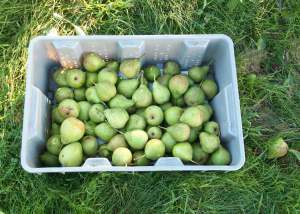
A storm blew down a pear tree branch. After inspecting the damage I picked the unripe fruit then cut the branch cleanly from the trunk. Once they ripen we’ll have more than enough for fresh and maybe some for pureed pear sauce. The tree is still loaded.

Crate of pears.
Crate of pears.

Working three jobs is challenging mentally, physically and every way in between. It’s hard to keep up and a couple of unexpected hours to myself was a welcome surprise.

Categories
Sustainability

Hiroshima Day 2016

Hiroshima, Japan after U.S. Nuclear Attack. Photo Credit: The Telegraph

The Washington, D.C. rumor mill is saying President Barack Obama may “do something” about nuclear weapons before the end of his term.

Among ideas being discussed are early retirement of some of the non-deployed weapons in the arsenal; declaration of a no first use policy; or taking weapons off hair-trigger alert.

The arms control community is pushing for no first use policy, but whatever — any Obama action to reduce the threat of a nuclear weapons exchange near the end of his presidency would be welcome, and largely symbolic.

Saturday, Aug. 6, marks seventy-one years since the United States dropped the first of two nuclear weapons on Japan.

When the Enola Gay dropped “Little Boy” over an unsuspecting Hiroshima, it killed between 60,000 and 80,000 people immediately with a total death toll estimated at 135,000. The bombing of Nagasaki occurred three days later. Men, women and children were killed indiscriminately.

President Harry Truman made the decision to use the bomb. In the end, he had no questions or regrets. Truman believed in the larger picture of World War II, a conflict in which tens of millions of people lost their lives, dropping the bomb would save lives. More than seven decades later we continue to debate whether bombing Hiroshima was necessary or played any significant role in ending the war.

After signing the New START Treaty with Russia, which entered into force in February 2011, the U.S. Congress embarked on a nuclear weapons modernization process expected to spend as much as $1 trillion over the next 30 years. That’s a lot of money for a weapons system we hope never to use.

What’s an Iowan to do? My friend and colleague Peter Wilk speaks for many of us.

Calling for “No First Use” of Nuclear Weapons
Submitted to the Brunswick (Maine) Times Record

This August 6th and 9th we are once again reminded of the atomic bombings of Hiroshima and Nagasaki, which killed an estimated 200,000 women, men and children. This past May, President Obama was the first President to visit the site and to commemorate the bombing victims.

While in Hiroshima, President Obama declared, “Among those nations like my own that hold nuclear stockpiles, we must have the courage to escape the logic of fear and pursue a world without them.” Thousands of members and supporters of Physicians for Social Responsibility completely agree.

Although most of us would rather not think about it, the U.S. and Russia continue to have thousands of nuclear warheads deployed on hundreds of missiles, bombers and submarines. We and the Russians keep over 1,000 of them on so-called “launch on warning” status. These warheads can be launched within minutes and reach their targets around the world within thirty minutes, putting millions of innocent civilians at risk in each of our countries.

The recent military uprising in Turkey reminds us just how unstable our current situation is, with 50 of our nuclear weapons stored in a U.S. airbase there. This airbase was surrounded and cut-off during the most unstable period of that coup attempt.

Perhaps most frightening is that the U.S. maintains a policy of threatening to be the first to use nuclear weapons in a future conflict. Combining this policy with our “launch on warning” stance sets the stage for a potential nuclear war initiated out of fear, anger, miscalculation or accident.

These horrific weapons threaten our own national security rather than enhance it. They are unusable in any meaningful sense of the word, given the global disruption to the world’s climate, food supply and economy that would result. At the same time, they have no value in countering terrorists or cyber-attacks.

Fortunately there are also some positive developments upon which to build. 127 countries have taken the Humanitarian Pledge calling for elimination of nuclear weapons. As a result, the United Nations established an Open-Ended Working Group that has begun meeting to discuss the most promising next steps toward a treaty to ban nuclear weapons around the world.

Meanwhile, the potential humanitarian impact of any use of nuclear weapons is so overwhelming that we in the U.S. must pull ourselves back from the brink by taking an easy step of our own. Since these weapons are in reality unusable, the U.S. should minimize their role in our military planning. President Obama can and should declare that the U.S. is adopting a “no first use” policy – pledging to never again be the first nation to launch nuclear weapons against another.

The U.S led the world into the nuclear age. Now it’s time to lead the world beyond it – to move to safer national security strategies that do not put all that we care about at risk, under the false premise that threatening to use nuclear weapons against others can protect us.

President Obama – your legacy and our lives are at stake. Please complete your presidency by taking a meaningful step to reduce nuclear risks by initiating a “no first use” policy.

On this 71st anniversary of the destruction of Hiroshima, let us all pledge “never again” and commit ourselves to do what we can to help make progress toward a world free of nuclear weapons.

Peter Wilk, MD
Physicians for Social Responsibility — Maine

It’s time to prevent what we cannot cure, and abolish nuclear weapons.

Categories
Living in Society

Plasma Sales and Iowa Politics

Farm Greeting
Farm Greeting

(EDITOR’S NOTE: This post was written for On Our Own: Sustainability in a Turbulent World in 2013 and has been corrected and updated). The Cumulus radio station in Cedar Rapids was advertising how a person could earn up to $340 per month selling their plasma. It’s enough to make it worth a look to see if plasma sales could fit into our budgetary bottom line. Sounds kind of grim, but people do it all the time.

Plasma is the pale, yellow liquid portion of blood that helps our bodies control bleeding and infection. When one donates plasma, blood is removed and the plasma separated and saved before being returned to our body. We generate more plasma within a couple of days so twice a week donations are usually possible.

Donating takes about an hour and plasma collection centers make it easy with a straight forward, step-by-step process. They explain how payment is loaded on a debit card. It is literally using one’s body as an ATM.

Several self-employed and low-wage earners in my circle use plasma sales to supplement monthly income. Got a toothache? Better schedule some sessions at the plasma center to get cash to pay the dentist. One suspects residents of our nearby college town use the cash for cigarettes, salty snacks, sugary drinks and alcohol, but in any case, plasma sales can be a reliable and steady source of income if one meets the requirements for donating.

Plasma money could be put to good use. For example, it could be used for political donations. That way, when a political telemarketer called, knowing my annual budget, I could say, “Yes. I’ll donate $100, which will take me four plasma sessions.” Politics would literally be based on blood money then.

We could go a step further and say that all financial contributions to politicians had to originate in plasma sales. There would be a natural limit to how much a person could donate, and a restriction could be placed on corporations that said something like, corporations can make political contributions, but such contributions must be paid via the plasma of shareholders, imposing a reasonable and well-defined limit to corporate money spent on political campaigns. I bet corporations would exercise their “free speech” differently under such a rule.

If my modest proposal about political contributions seems a bit edgy, I am pretty sure it would work. Having skin in the game would take on a whole new meaning.

Most Americans are asleep at the wheel of politics, and would not contribute, so there is little danger of a glut of plasma on the market.

If times get tough, I’ll re-visit adding a plasma sales income line to our household operating budget. For now, I’m just glad I don’t have to do it.

~ Written for Blog for Iowa