Categories
Kitchen Garden

Moving the Goal Posts

Farm Landscape

More than at any previous time I feel a goal line was crossed when I left full time work last spring.

So what’s next?

I don’t anticipate buying a fancy television with new, matching easy chairs to put in front of it.

My late aunt and uncle had that. When we visited their Alabama home our conversations turned to the evangelical Christianity their family had undertaken. It was a distance from the socialist and Catholic household in which she grew up with her brothers and sisters. I suspect aunt and uncle watched FOX News, although we talked the entire visit without turning on the T.V. Dinner was a tuna-noodle casserole taking me back to a time I hardly remembered. Mom never made tuna-noodle casserole at home. My uncle died shortly after we left them and she died soon after that. All that’s left are memories.

My fear is if we had a digital television I’d sit back in an easy chair, watch too much, and my mind would succumb to the blather that invades people’s lives from cable news. I’d spend the rest of this life talking about, to and at the television.

There is only one answer to the question, and that’s to stay active physically, emotionally and mentally. That’s really a lie. There are plenty of answers, although doing these three things can form a foundation upon which an answer can be built. Maybe that’s what I’ll do.

Birds eat from the feeder and a freezing rain falls on the county. Snow melt is filling the ditches and running toward the lake. Soon there will be floods in Iowa as the crazy weather continues.

Tomorrow I return to the farm for the first round of soil blocking. They already started seeds in the house, but these will go into the greenhouse despite the coming cold spell. I’m waiting another week to plant celery. At 120 days, celery has the longest plant to pick cycle.

Will farm work bring catharsis to my search for truth and meaning? I don’t know, but I’ll be spending time with friends again and that means something.

I’ll get to see the lambs, those sad but cute creatures destined for someone’s dinner table. I’ll be careful not to get attached but new life is always a pleasure. That’s what I need in the rainy, snowy, flooded Iowa I call home as the cycle of the growing season begins anew.

Moving the goal posts once they are set is not a good option in retirement. We may only get one chance for new goals and it’s important to be sure. I’ll be thinking about that as I make the soil blocks tomorrow morning. I’m looking forward to getting started.
Categories
Writing

Market and Linn Streets

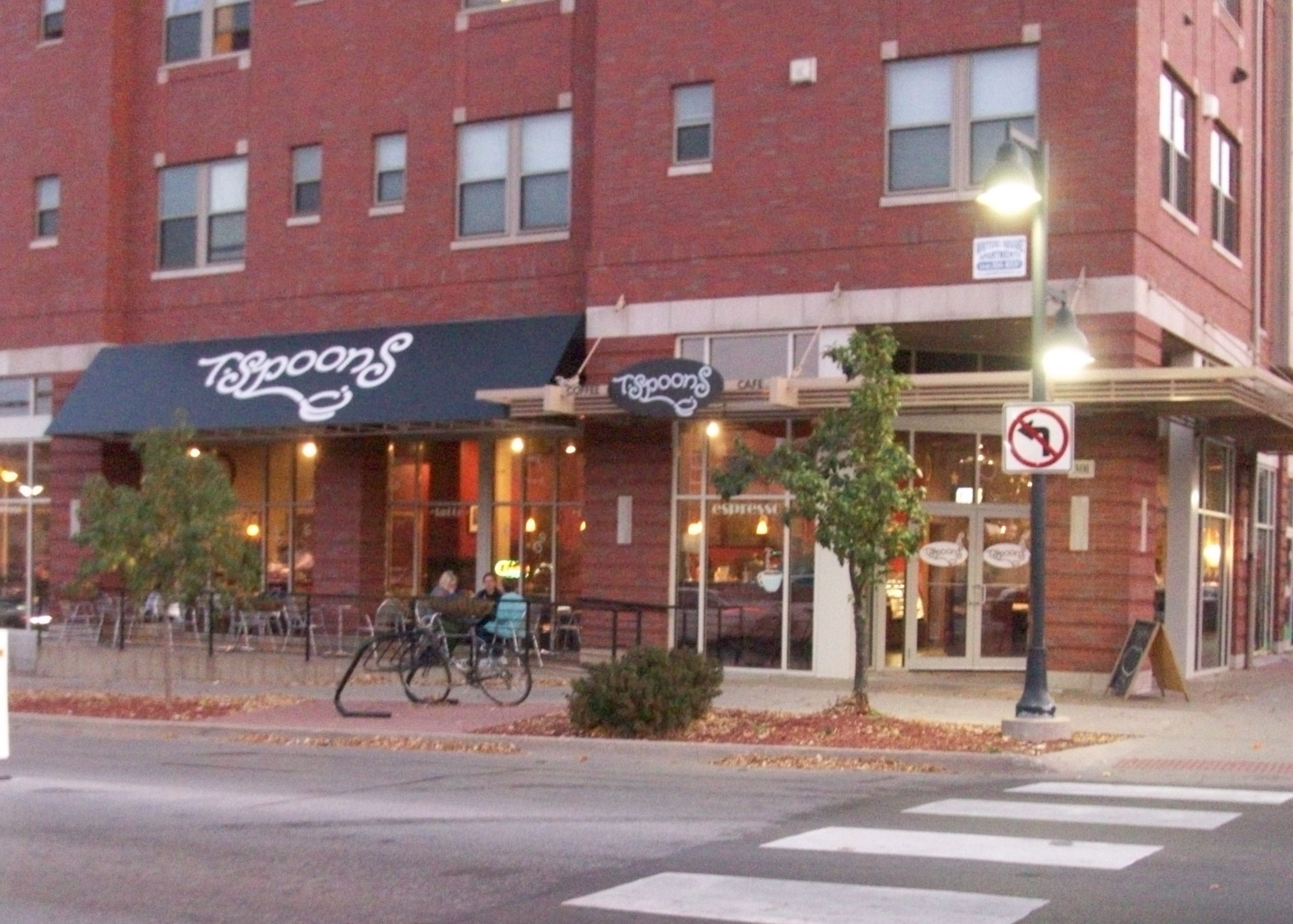
T-Spoons at the Corner of Market and Linn Streets

Editor’s Note: Originally posted on Nov. 4, 2011.

I live in the country, in case this is the first time you are reading this blog. In economic tough times, we have to multitask any resource use, so when I drive to the county seat, I try to combine tasks. I book events and meetings then schedule others around them. This is what I did yesterday when I spent the better part of five hours near the intersection of Market and Linn Streets in Iowa City.

Riverside Theatre and my volunteer ushering for “The Cripple of Inishmaan” was the anchor event. I scheduled a student meeting for 5:30 p.m. at T-Spoons and planned to have dinner and browse the used book stores before I had to be at the theater at 6:45 p.m. I ordered a hazelnut roasted coffee with a shot of hazelnut syrup. My coffee was ready by the time he arrived and he had nothing to drink since he was enroute to a class. We talked about the project and then he left for his 6 p.m. class. I reviewed someone’s resume while I finished my coffee in a faux leather chair.

There are lots of restaurants near the intersection of Market and Linn. Long established ones like Pagliai’s Pizza and Hamburg Inn No. 2, and newer ones like Oasis Falafel, Blue Bird Diner and Linn Street Cafe. I decided to read menus and look inside to see how crowded they were. I ended up going into Oasis: The Falafel Joint where I ordered Falafel, Babba Ganoush, Red Cabbage Salad and Madjadra with pita bread. I sat in the window and ate the tasty meal. It was enough food for two meals, so I took one home in a clam shell, leaving it on the floor of my nearby pick up truck before I going to the book store.

At the Haunted Book Store I asked the attendant for directions to the poetry section. In my current life, I view poetry as an indulgence the same way a smoker views a pack of cigarettes, for consumption and an addiction. It wasn’t always that way. There were many shelves of poetry in the store, and not many people: one gent with a portable typewriter was writing on it at a nearby table. I found Ode to the Cold War: Poems New and Selected by Dick Allen and read a couple of poems. For $4.95 it went home with me. I also picked up An Inconvenient Genocide by Alicia Ghiragossián about the conflict between Turkey and Armenia for seven bucks. Stopping by the Iowa section, there was a copy of a 1918 bibliography titled Iowa Authors and Their Works by Alice Marple. I bought this Historical Department of Iowa book for ten bucks to add to my collection of bibliographies of Iowa authors. Thus far, the evening was a success and it I had not been in town 90 minutes.

Stopping by the truck again, I left the books on the seat, stashed my mobile phone and headed to the theater across the parking lot. I took tickets and got to meet all of the theater-goers. The performance was very good.

Why do I write about this? Partly because other writers have done as much near the corner of Market and Linn Streets, and I hope I too will be famous for my writing. Too, this district of Iowa City is part of my personal history. I lived a few block away on Market, went on dates here, saw politicians and plays, did research for my writing, had meals and coffee with people who are important to me and browsed Murphy Brookfield Book Store and Haunted Book Store (and its predecessor) countless times over the years. I write about it because it is part of who I am and hope that is reason enough.

~ Here’s another post about Market and Linn Streets if you liked this one.

Categories
Environment Living in Society

Freezing Rain and a Green New Deal

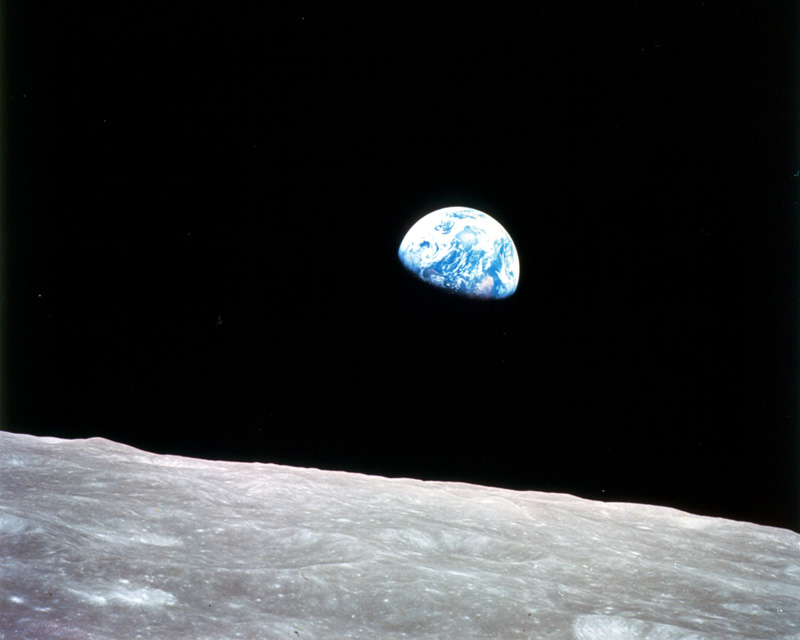
Earthrise by Bill Anders, Dec. 24, 1968

Ice turned to mush as rain fell Thursday morning. The surfaces of Lake Macbride and the Coralville Lake appeared to remain frozen as I drove on Mehaffey Bridge Road.

When I arrived at the home, farm and auto supply store it continued to rain. By the end of my shift a layer of ice had formed on my windshield and morning slush had frozen.

I started the engine and chipped at the ice. It took half an hour to gain enough visibility to drive. I decided to skip a monthly political meeting, emailed the secretary of my absence, and headed home.

Iowa is a red state now. Voters had an opportunity to return balance to state government in 2018. Instead they chose Republican control of the governor’s office and state legislature. Taking advantage of their mandate, Republicans plan to take more control of the appointment of judges by changing the composition of a commission that selects nominees for Iowa courts. We’re a red state now, and we don’t like it.

We’re not leaving the state. To even consider it would be an anomaly in lives we’ve come to accept. In the end, politics is something, but not everything. It is definitely not important enough to get stuck in the county seat as the world freezes.

I’m interested in what the Congress does to mitigate the impacts of climate change. Yesterday New York Congresswoman Alexandria Ocasio-Cortez introduced a resolution recognizing the federal government has a duty to create a Green New Deal. A draft of the resolution indicates the following goals for a Green New Deal during a ten-year national mobilization period:

  1. to achieve net-zero greenhouse gas emissions through a fair and just transition for all communities and workers;
  2. to create millions of good, high-wage jobs and ensure prosperity and economic security for all people of the United States;
  3. to invest in the infrastructure and industry of the United States to sustainably meet the challenges of the 21st century;
  4. to secure for all people of the United States for generations to come—
    (i) clean air and water;
    (ii) climate and community resiliency;
    (iii) healthy food;
    (iv) access to nature; and
    (v) a sustainable environment; and
  5. to promote justice and equity by stopping current, preventing future, and repairing historic oppression of indigenous communities, communities of color, migrant communities, deindustrialized communities, depopulated rural communities, the poor, low-income workers, women, the elderly, the unhoused, people with disabilities, and youth (referred to in this resolution as ‘‘frontline and vulnerable communities’’).

Who wouldn’t like these goals? Senator Edward Markey introduced the same resolution in the U.S. Senate.

It doesn’t take an advanced degree to understand a Green New Deal is dead on arrival in Mitch McConnell’s senate. While such goals need to be met to slow global warming, politics has ceased to be an endeavor of doing what needs to be done to ensure our mutual survival. Success of any legislation designed to advance a Green New Deal depends on recognizing the threat the climate crisis poses to society. Today, more people recognize there is a climate crisis. Our politicians, not so much.

Al Gore remained positive in his press release supporting the resolution:

The Green New Deal resolution marks the beginning of a crucial dialogue on climate legislation in the U.S. Mother Nature has awakened so many Americans to the urgent threat of the climate crisis, and this proposal responds to the growing concern and demand for action. The goals are ambitious and comprehensive – now the work begins to decide the best ways to achieve them, with specific policy solutions tied to timelines. It is critical that this process unfolds in close dialogue with the frontline communities that bear the disproportionate impacts today, as this resolution acknowledges. Policymakers and Presidential candidates would be wise to embrace a Green New Deal and commit to the hard work of seeing it through.

Failure to act on climate is the same as denial. I’ll support a Green New Deal while recognizing we can’t place all our hopes on a single, political solution. As we discovered during negotiations leading up to the Paris Agreement under the United Nations Framework Convention on Climate Change, political solutions are far from perfect. They may be inadequate. Yet they are something and have value if they can be achieved.

Categories
Writing

Rest of the Way Out

Light from Outside

Seems like I’ve been hunkered down and bunkered in since apple season. I’ve been thoroughly funkified. With 45 days left until spring I’m restless to get out of my lair.

The number of indoor places I spend time is limited: the chair or couch in the living room, the kitchen, the bedroom, the laundry room, the bathrooms, or in my writing room.

It was comfortable early on. Now I’m itching for something.

We live during an assault on reason. I mentioned in my last post the greatest threat to society is a weaponization of ignorance and apathy. Politicians are unable or unwilling to change the status quo, lobbying groups don’t want change, and the public doesn’t seem to care, Matt Field wrote in the Bulletin of the Atomic Scientists. That’s a hell of a sticky mess out of which to gain traction.

Still the light from outside beckons us to go there.

Categories
Environment

Out of the Polar Vortex

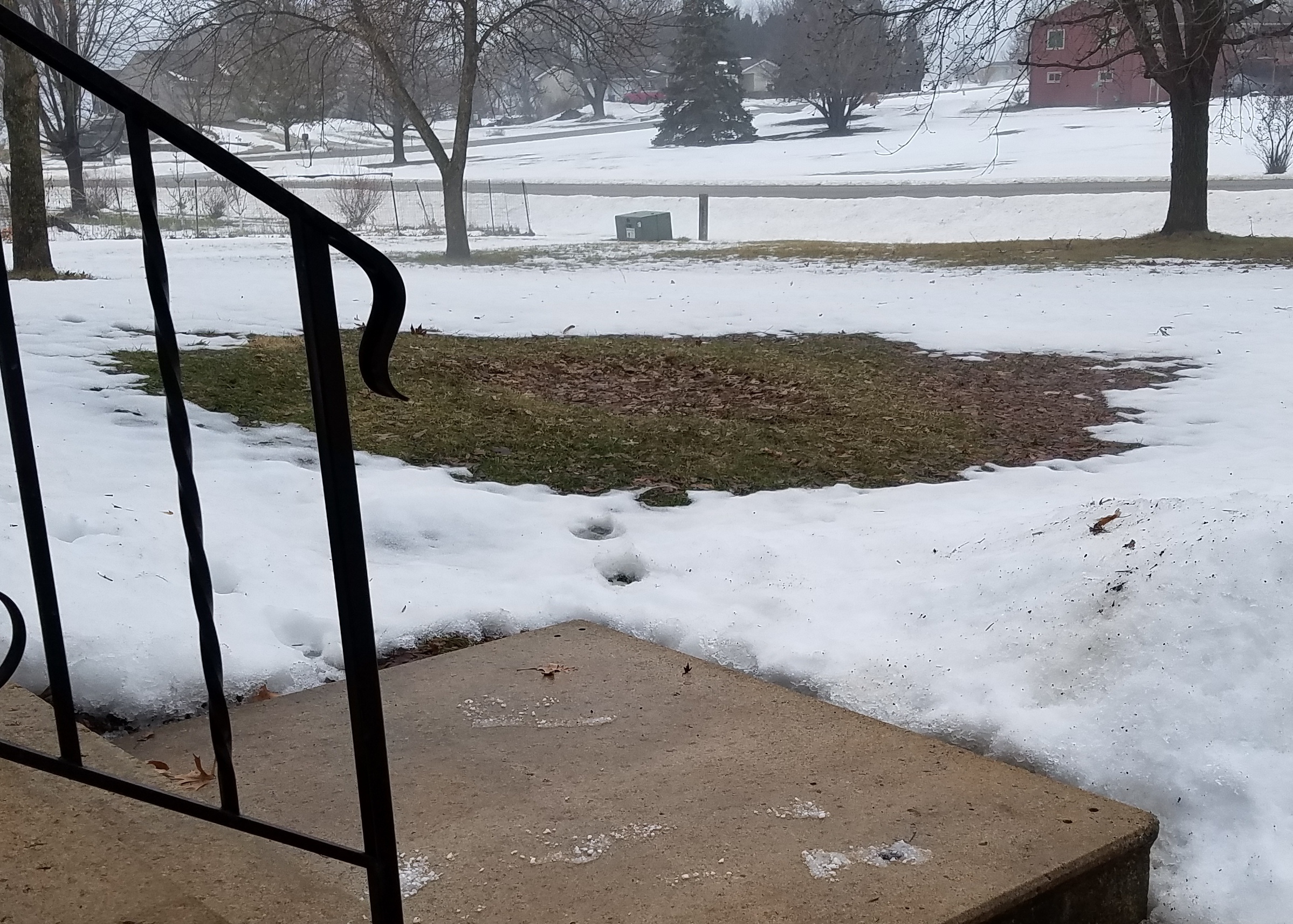
Snow Melted First over the Septic Tank

The ambient temperature is 45 degrees, a 73 degree swing since early Thursday morning. Warming is part of the polar vortex, just as the cold was. Temperatures are forecast to return closer to normal after tomorrow.

I had planned to prune trees today but am concerned about rapidly changing temperatures. If the sap starts flowing the purpose of waiting until winter to prune would be defeated. Maybe next week will be better once temperatures stabilize below freezing for a week or so.

Feb. 5 is the Iowa Environmental Council’s lobby day in Des Moines, followed by the Sierra Club’s lobby day the 6th. I noticed IEC scheduled 30 minutes for discussions with legislators. That’s about right because very little gets decided in one-on-one lobbying sessions, regardless of whether one’s legislators are supportive of climate action. What’s needed for change is a broad coalition and a dominant issue.

With the polar vortex we are living in a changed climate. Mitigating its effects is beyond the scope of the Iowa legislature. What can be done?

“In my view, the actions we take over the next 2-3 years are critical,” State Senator Rob Hogg wrote in an email. “The need for climate action has never been more urgent. Please take action personally and in public. Invite more people to get more informed, more involved, and do more.”

Hogg was trained by Al Gore as a Climate Reality Leader in 2008. He enumerated ideas with which to approach legislators for climate action, including “energy efficiency, renewable energy, electric vehicles, forests, prairies, soil conservation, and pre-disaster hazard mitigation to safeguard our people and our property.” Each of these items has its own constituency and many of the groups supporting them will be at Tuesday’s lobby day. What will get done?

There is a stability of operations among IEC members that works against substantial change. Some organizations, including some to which I belong, seem caught in a rut around a specific solution to the climate crisis. These formal, recurring events seem ineffective to me. I wrote about a 2015 trip I made to a similar lobby day in the Iowa City Press Citizen here. I’m not sure what, if anything was accomplished.

Some advocates believe climate denial among members of the legislature and elsewhere stands in the way of changing human behavior regarding climate change. I believe it is something different.

“I’m convinced that the greatest threat we face isn’t climate change denial,” climatologist and geophysicist Michael Mann wrote. “It is the weaponization of ignorance and apathy that is at its core…”

The weaponization of ignorance and apathy is something better to work on than any pet project. How does one do that when calcified lobbyists and citizen advocates petition the legislature for such issues? We need a more diverse group of stake holders than are in the IEC. Something bigger needs to happen to bring people together. I don’t know if the polar vortex is big enough even if it should be. What I know is if we wait to address climate change until it is too late the question will be moot.

This polar vortex is drawing to a close but it’s easy to predict there will be others. Many will have forgotten the polar vortex as they get absorbed in the big football game this afternoon. It is up to us to remind people of our common interest in sustaining our lives in a turbulent world. If we don’t, who will?

Categories
Environment

Dispatch from the Polar Vortex

Winter in Iowa

Editor’s Note: This email was sent to members of our home owners association at the beginning of the polar vortex of 2019. As I write this note, the outdoors ambient temperature is 26 degrees below zero and one person in the county seat has died from exposure.

Member,

As you likely know, ambient temperatures are forecast to get down to -25 degrees by 8 a.m. tomorrow morning and to -30 degrees overnight tomorrow. After that temperatures are expected to warm through Saturday and Sunday when it is forecast to be in the 40s.

That’s a seventy degree swing in a couple of days, which can be hard on things like water and sewer lines.

19th century British prime minister Benjamin Disraeli said, “Be prepared for the worst and hope for the best.”

We will do everything reasonable to get service back up as soon as possible if it is interrupted. Asking a contractor to work in wind chills like we haven’t seen since we moved here is not reasonable. I plan to contact our main contractor Wednesday and discuss the situation so we know our options in the event of a breakage.

What you can do to prepare for a potential outage is keep a temporary water supply if you don’t already.

In our household we keep a large Rubbermaid beverage container filled with water to use for washing hands and cooking in case we lose water.

We used to buy bottled water to have on hand but quit doing that over the years. It is an option.

If we know there will be an outage ahead of time, we fill up our two stock pots and keep them on the stove to be boiled and used to wash up in lieu of a shower, or as otherwise needed. We have also filled up coolers in the bathtub to use to flush the toilet.

Fingers crossed we will make it through the cold spell without a line breakage.

If something does happen, the procedures for reporting a water problem are below.

I hope this is helpful.

Paul Deaton
President

Categories
Environment

Dealing with Cold Temperatures

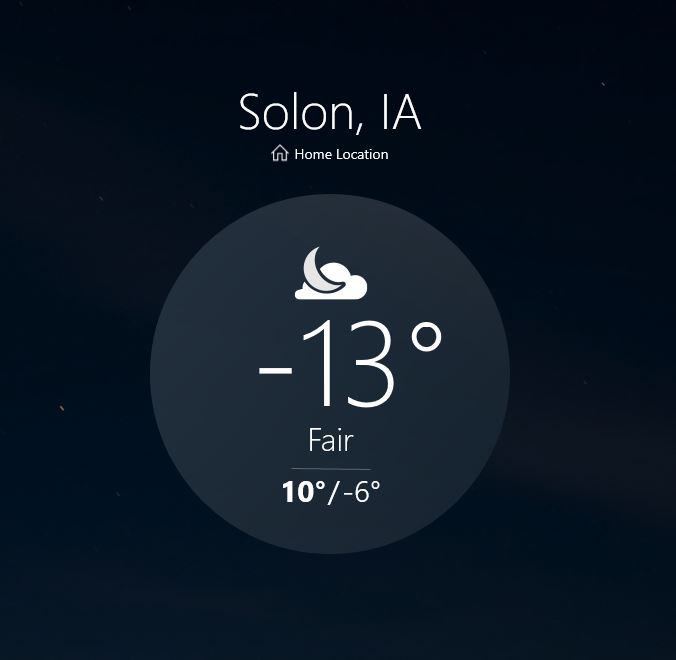
Outdoor ambient temperature Jan. 26, 2019, at 6 a.m.

Images depicting ambient temperature reports have been ubiquitous on social media the last few days.

According to the Weather Channel, temperatures plummet to 25 degrees below zero by Tuesday thanks to a polar vortex.

It’s what I’ve been waiting for to prune apple and pear trees as sap flow is halted by the temperature. Considering the forecast, the best day to prune will be Friday, Feb. 1.

Not everyone likes the cold but I don’t mind. I’ve never had frostbite or chilblains, even while living outdoors in subzero temperatures for a week at a time during military service in Germany. If one takes precautions, risks are minimal.

Once trees are pruned, I’ll be ready for it to warm up.

The cold spell began just as my shifts at the home, farm and auto supply store ended. We are bunkered in with plenty of food, a working furnace and water supply, and an internet connection. As president of our home owners’ association I worry that cold weather will cause a water line break, so fingers crossed. Later today I’ll drive my spouse to work in town so the car doesn’t sit in the snowy cold while she’s there.

Today’s cold weather is like what I recall from childhood. If there is no wind, it is tolerable and welcome. Like every year, winter will turn to spring and everything that means.

Categories
Writing

Newspapers Are Dying – What About Blogs?

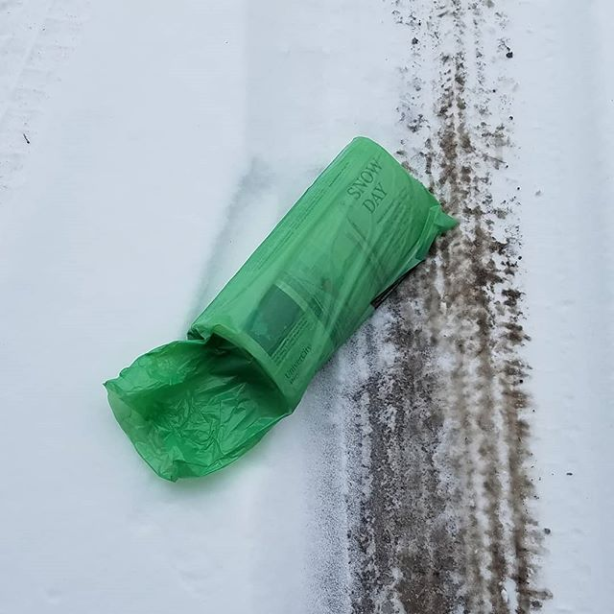
Iowa City Press Citizen Jan. 23, 2019

Every Wednesday evidence newspapers are dying is delivered to the end of our driveway.

I’ve asked the Iowa City Press Citizen to stop this delivery as we get a digital subscription. They can’t. They deliver the paper free on ad days to boost circulation numbers upon which advertising revenue depends.

The whole newspaper business seems to be on life support: advertising revenue diverted on line, subscriptions down, profitability gone. If governments could forego publication of notices, minutes and official announcements, they would. It would sink many low circulation weeklies in small cities. There are no easy answers and in many homes it is not a question: how can newspapers survive?

It is a big commitment to read a daily newspaper. I know because only in semi-retirement could I read two dailies — The Iowa City Press Citizen and the Cedar Rapids Gazette. With life being a time crunch to address other priorities, it is easier and more relevant to read from a score of internet news sites on the go than be restricted to a single newspaper. That’s part of the problem.

It goes deeper than that. Steve Cavendish of the Washington Post wrote today,

Print revenue is down, digital and mobile revenue aren’t nearly enough, and now a hedge fund promising even deeper cuts wants to acquire the company (Gannett). If the future of corporate news operations looks bleak, that’s because it is.

Newspapers have been under pressure since a heyday that ended in the late 1980s. Hedge funds owning newspapers is the final butcher block upon which the pieces get cut up and sold to the highest bidder. People continue to want news, so what is the next evolution?

There is talk about blogs being a potential supplement or replacement for formal news organizations. I doubt it for a couple of reasons.

Part of what makes good reporting possible is the financial backing of a large organization. Even though news organizations are diminished in that regard, a blogger is either self-financed or just barely capitalized. Pat Rynard of Iowa Starting Line took “this month off from writing to handle our financial and administrative side of things.” Rynard is proving the model of blogging as a political news source, however, he is one guy. Whether his operation is scalable to the level of a news organization is an open question. He reported today he should be solvent through the February 2020 Iowa caucuses, which is a positive. As much as I’d like to see him succeed with sustainable funding and revenue, he faces a lonely and uphill struggle compared to a stressed but viable news organization with adequate financing.

Laura Belin, publisher of Bleeding Heartland, is self financed so her struggle is not financing but access. Associated Press reported today she is trying to get a press pass in the Iowa House of Representatives. AP’s Ryan Foley wrote,

Belin applied for formal credentials for the first time to cover this session, which would grant her work space and easier access to briefings with key lawmakers, among other things.

She was denied but is persisting with her request. Judging from the quality of Belin’s previous coverage a press pass would make logistics easier, although her coverage already sets a high journalistic standard. She breaks news and covers topics newspapers don’t. This leads to another issue, readership.

Foley reported Bleeding Heartland gets 1,500 or more unique daily views while in session. That is great exposure for a blog, however, not nearly what a newspaper, with a print circulation of thousands would get between print and on line. Once I got more than 3,500 unique website views when I freelanced for the Iowa City Press Citizen. My average was much lower than that, but print edition plus on line clicks was always more than 10,000: hard to beat for a blogger. While I stop in at Bleeding Heartland and Iowa Starting Line frequently, they do not yet have the general audience penetration to compete with formal news organizations. As political blogs with a devoted following, maybe they don’t need it.

The first job I held was as a paper boy delivering the Des Moines Register. There weren’t many sales and it was a long walk between deliveries. When I ran into customers while making collections I got feedback on what they liked and didn’t like about the newspaper. (Mostly they didn’t like Donald Kaul’s Over the Coffee). Those days are mostly gone.

I hope the Iowa City Press Citizen survives the next acquisition. They already got rid of their big facility off North Dodge Street and are tucked away in rental space above a couple of restaurants. The idea of delivering free papers to boost circulation sounds like it came from an accounting meeting. I’m reminded every Wednesday the newspaper business as I knew it has dim prospects for the future.

Categories
Work Life

Meat Packer Narrative

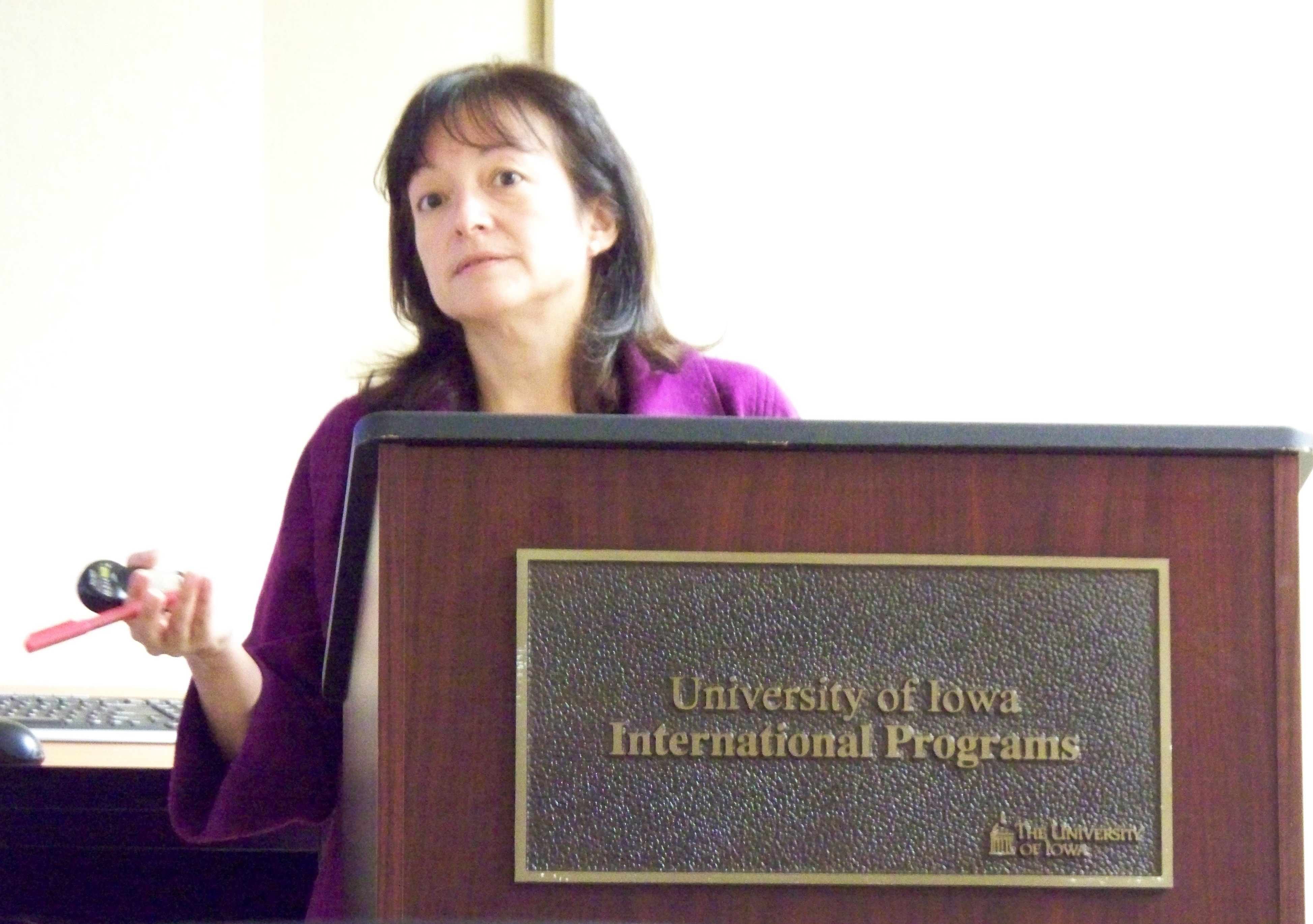
Ana Avendaño, November 2010

Editor’s note: An original version of this post appeared on Nov. 13, 2010. It has been edited because my writing wasn’t as good as I thought back in the day.

Clarity surfaced during a talk by Ana Avendaño, assistant to President Obama and Director of Immigration and Community Action for the AFL-CIO.

She was in Iowa City, talking about the meat packing industry. Her narrative struck me:

Back in the 1970s, meat packing workers were among the highest paid in the country, more highly paid than some auto workers. Multinational corporations, with a strategy of busting unions, began consolidating meat packers, creating a perfect storm for labor and a perfect outcome for themselves. Union workers were replaced with a continuous stream of lowly paid immigrant workers.

“The narrative of the meat packing industry is important to remember,” she said. An emblematic consequence of consolidation has been the immigration raids in Marshalltown and Postville.

Corporate advocacy to break labor unions is a global phenomenon, Avendaño said. “What corporations can’t do in a free market, they are doing through governance,” putting pressure on law makers to make labor law more favorable to their interests. She spoke of the International Monetary Fund and the World Bank as co-conspirators. They hold out loans to countries and “specifically require them to change labor laws in a way that hurts workers,” Avendaño said. “It is the hypocrisy of what we are living through today.”

I worked in a meat packing plant two summers while an undergraduate. It was easy to get a job there. I belonged to a union, the Amalgamated Meat Packers and Butcher Workmen of North America, and at $4.04 per hour, made enough money to get through the next school year. As Avendaño’s narrative suggested, wages were good.

The plant conditions were dangerous and work was physically challenging. My maternal grandmother and father had both worked in the plant and my father died in a plant accident. I never felt in danger, working as a millwright’s assistant in 1971 and on third shift cleanup crew in 1973. I got to see most of what went on throughout the plant and warehouses. It was not pretty.

Avendaño missed something. It’s true low cost operators like Iowa Beef Processors could perform the work cheaper and re-invent how meat processing was done. It’s true unions gave concessions until many of the jobs, especially slaughterhouse jobs, were consolidated in a much smaller number of places. It is also true that at a lower rate of pay, many Iowans no longer wanted to do this work. Enter immigrants.

As Avendaño spoke, adjusting her glasses, and pointing at the PowerPoint on the screen, it hit me. After my father’s death, while rummaging around in his basement workshop, I found a pay stub from his work at Oscar Mayer. He made less than $90 per week.

It was a different world then. How we acquired and made our food was different. Dad shopped at the company butcher because meat was fresher and less expensive. The rise of highly processed foods, farm subsidies that keep prices low, and the invention of a consumer society where we spend more than we earn using credit, had not begun. We made more food from scratch because many of the food items in today’s grocery store aisles did not exist. We lived close to the means of production and $90 per week was a living wage. We were working poor, but didn’t call it that. We had a decent life.

That is where the narrative unravels. Life was not about pay and benefits. It was about what else we did with our time. Even at those wages we couldn’t wait to get out of the plant. We knew we could do better with our lives than work on a production line. Avendaño was advocating improvements in a status quo that while needed for the betterment of workers were no solution to larger problems of corporate hegemony in our lives. It is as if we have stopped trying to improve society, so we can cling to the remaining dregs in a barrel of prosperity long drained by the wealthy class.

That morning, in the darkened room, it seemed a fool’s errand and that was my epiphany.

Categories
Living in Society

Stability Should Matter

Snowfall in Big Grove

Between three and four inches of snow fell overnight. It’s still coming down. I have 80 feet of driveway and a shovel to deal with when the sun comes up. The first buckets of salt and sand were emptied yesterday — there is plenty in reserve.

It’s not our first winter in Big Grove.

I filled the bird feeder for the first time this year and expect birds to find it this morning. Deer, used to the cultural resonance of last year’s seeds, have been stopping by to check the feeder since hunting season began.

Despite the unbroken crystalline sheet of snow it’s not a blanket, that clichéd word. We need a new vocabulary. Neighborhood sounds are muffled in pre-dawn hours yet we know global tensions have increased rendering nothing comforting about newly fallen snow this January.

President Trump’s “America first” slogan and the actions behind it are unraveling what global order existed before his rise to power. We all know it and the dissonant, unwelcome noise of his administration conditions us with its absurdity. Columnist George Will characterized the effect in the Washington Post,

Half or a quarter of the way through this interesting experiment with an incessantly splenetic presidency, much of the nation has become accustomed to daily mortifications. Or has lost its capacity for embarrassment, which is even worse.

I’m interested in U.S. foreign affairs. The last two years have been exhausting.

Step-by-step, we withdrew our leadership from the Trans-Pacific Partnership, the Paris Agreement under the United Nations Framework Convention on Climate Change, and the Joint Comprehensive Plan of Action regarding Iran’s nuclear program.

There’s talk about withdrawal from the INF treaty, the New START treaty, and even from the North Atlantic Treaty Organization which our country helped found.

Trump’s meeting with North Korean dictator Kim Jong-Un was a head scratcher. After decades of unsuccessful negotiations regarding North Korea’s nuclear weapons ambition, the president held a brief meeting in Singapore then declared in social media, “There is no longer a nuclear threat from North Korea.”

It is hard to describe the instability we created in the Middle East where we’ve engaged third string envoys like Mike Pompeo and John Bolton to do our work, in Pomeo’s case, only until the Rapture.

Last week the president introduced his Missile Defense Review which is certain to destabilize relationships with China and Russia, potentially fueling a new nuclear arms race.

By these actions and more, the United States under Trump created a vacuum of leadership which China in particular, but Russia as well, are ready to fill. What is lost in “America first” is the American people benefit from international stability. This president and Republicans who back him apparently could care less.

We understand there will be a 46th president. The U.S. House of Representatives is poised to check this one. The only question is when he will exit the office. In the meanwhile, it is time to clear snow from the driveway and get out in society, to sustain our lives while the absurdity continues.

I don’t like the national disgrace under which we currently live and the instability this president created. Few I know do. Time and good work will cure some of it. At least that’s what I hope now that we’re getting into winter.