A main feature of the vacant lot we bought in 1993 was its proximity to Lake Macbride State Park.
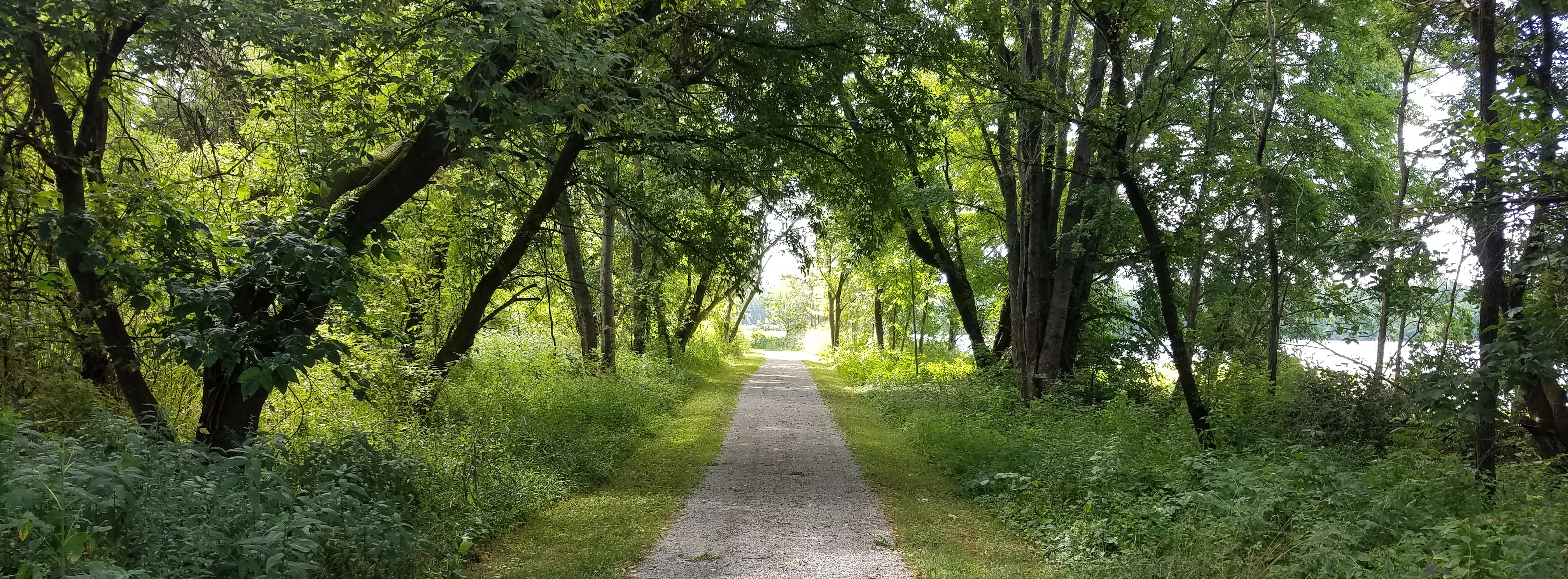
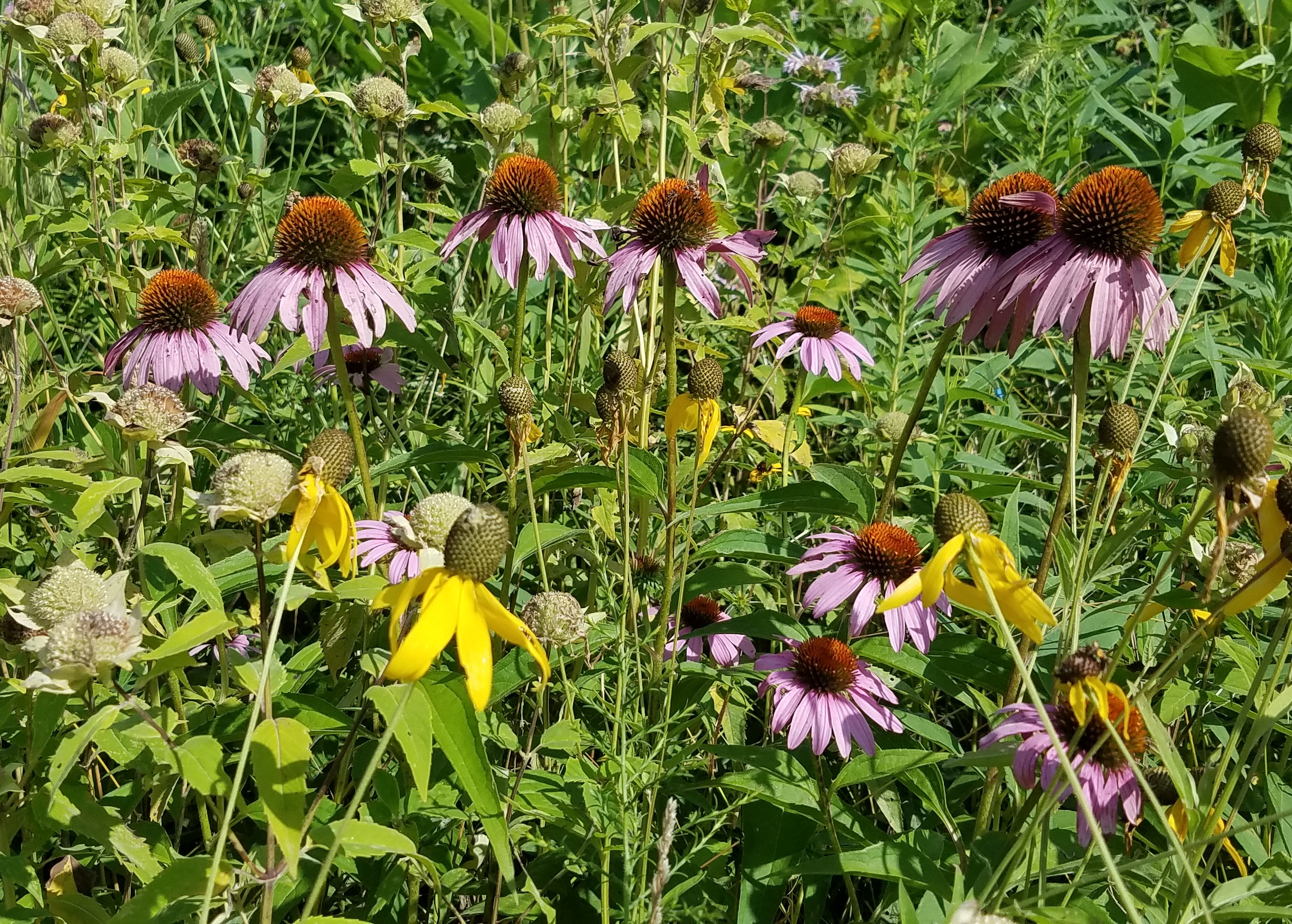
When we need exercise, or just want to get away from the house, it’s a short walk to the trail that runs five miles from our nearby city to the main park entrance. In August the park is filled with wildflowers, insects and other flora and fauna of living in Iowa. There is as much to observe as there is to escape in quotidian life.
A trail walk can reset our lives each time we venture out.
Two weekends into my seventh season at an apple orchard I continue to enjoy the work and its customer engagement.
A family drove over from Chicago, one stopped on their way back to Rochester, Minn., and regulars return with the micro-seasons within a procession of a hundred apple varieties. Every chance we have to converse is a window into lives where with at least one common interest. It is the beginning of something positive.
A trail walk can get us centered and ready for such engagement.
I took five sessions with a nutritionist and wellness professional, once individually and four times as part of a group. I email her questions and she quickly emails answers back.
Based mostly on blood test results, the clinic diagnosed me with Type II diabetes in May and like many, I immediately went into denial.
Listening to the professional — a person with lots of letters following her name on the business card she handed me — I’ve been able to lose 10 percent of body weight, exercise more, and feel better. Monday is a reality check as I have blood drawn for another test and a meeting with my care-giving team the following week.
Whether my diabetes can be controlled through lifestyle changes is an open question, the answer to which is I hope to avoid diabetes’s advancement and physiological deterioration. By finding it early, the diagnosis may be beaten back. Included in this sentiment is a bit of lingering denial that I have it, but I am less worried about that than other things.
When my then septuagenarian grandmother was diagnosed with diabetes I was in the U.S. Army, stationed in Mainz, Germany. One day without warning I received a large box from her with all of the instant pudding and gelatin desserts from her cupboard. She accumulated a trove of these small boxes during her food stamps shopping trips and felt she could no longer eat it and I could. Cookery was not my specialty then. I made and ate some of it, favoring the pudding. I don’t remember how much. I am about ten years younger than she was when she had her diagnosis.
The physician’s assistant made a short list of things I should do. I followed them as best I was able: a diabetes screening from an ophthalmologist, the nutrition classes, more exercise, and regular checkups. I avoided taking regular self-administered blood tests and medication, except for a daily low-dose aspirin. Based on the nutritionist’s recommendation, I started taking vitamin B-12, which seems to have improved my sleep. As a mostly ovo-lacto vegetarian I probably get enough B-12, but the supplement is inexpensive and the downside of taking it minimal. The nutritionist taught us about the USP label for dietary supplements and what it means.
The focus of counseling has been to count carbs and establish a carbohydrate budget for each meal, snacks, and for each day. Enjoy food more, including things culturally favored, but stay within the budget. That means one ear of sweet corn, two ounces of pasta, smaller portions of rice and noodles for meals. Nearly complete avoidance of simple sugars is recommended. When one of the group asked about something else — BMI, protein, weight loss or whatever — she steadfastly returned to the need to control glucose when diagnosed with diabetes. She acknowledged there were other weight and nutrition aspects to life, but we were there to learn about how to eat with our diagnosis. I’m trying to own “my diagnosis” but am not there yet.
I’m modifying my behavior although I could relapse at any moment. It hasn’t been easy. It may continue to be not-easy. As a gardener I have access to fresh vegetables that can fill my plate as in the photo of Friday morning’s breakfast. When I returned to work at the orchard, I told my supervisor I had to refrain from eating almost everything we make with the exception of apples. What will I do when winter comes? Near yesterday’s anniversary of the atomic bombing of Nagasaki, I’m thinking if it’s a nuclear winter I may not have to worry about it. However, using that as an excuse for denial of my diabetes diagnosis is pretty lame.
I’m pretty sure this won’t be the last impactful lifestyle change I have to make as I age. Big picture? I’m okay with that. It’s better than the alternative.
It’s time to move on. Yet… I would linger in this spectacularly Iowa summer.
It is a summer like those remembered from childhood. Long, warm days that stretch into a vanishing point. Cool nights to greet an early riser well before dawn. A never ending chance to find opportunity in a world which lies beyond the work-a-day society in which careers were spent.
No one can meaningfully say how many more of these days we’ll have before the atmosphere turns humid, making outdoors living unbearable. Despite the lack of rain, it’s been a good summer. A time to reap what we sowed and arrive into autumn.
A couple of things.
I’m tasting the first apples from two trees daily, evaluating sweetness and crunch, background color and appearance. While Japanese beetles invaded the leaves, there will be fruit for the kitchen. One doesn’t see apples like mine in grocery stores because they are small and imperfect from living in a pesticide-free environment. Commercial growers would have culled most of them for juice yet they are a main crop for the production of seasonal baked goods, cider vinegar, juice and applesauce if I need it. Picking and processing them will be a bigger project than usual.
Cucumbers, zucchini and yellow squash are winding down in the garden. Soon I’ll pull up the plants, till the soil and plant next year’s crop of garlic. I am only just learning how to cultivate garlic and looking forward to this second year of my own plants.
My bedside table got crowded with too many books so I need to set priorities for the rest of summer reading. Processing garden abundance will take time away from reading, so I expect to complete fewer books this month. I just started the novel Milkman by Anna Burns, which won the Man Booker Prize last year.
Tuesday colleagues from California met with U.S. Representative Adam Schiff (D-CA) who agreed to add his name to the list of sponsors of the No First Use Act introduced in January by Senator Elizabeth Warren (D-MA) and Representative Adam Smith (D-WA). The bill would establish by law it is the policy of the United States not to use nuclear weapons first, which is what most Americans believe. It was a positive step.
As it usually does, writing daily for Blog for Iowa while the editor was on summer hiatus inspired new interest in seeing the world through a progressive lens. The last of those posts appeared here this week, clearing the palate for new topics and better writing.
However, there are six more weeks of summer to enjoy.
Friday will be the anniversary of one of the most sensational mass murders in United States history.
While the Aug. 9, 1945 atomic bombing of Nagasaki, Japan was far worse in terms of premeditation, number of human deaths, and physical destruction, I’m talking about the 50th anniversary of the murders of actress Sharon Tate and friends, followed the next night by the murders of Leno and Rosemary LaBianca.
I’d be willing to bet major news media coverage mentions the Tate-LaBianca murders and not Nagasaki. We’ll see grainy images of the late Charles Manson whose colleagues committed the crimes. Then the narrative will move on, perhaps to one of the president’s posts in social media, or some both-sider discussion of administration policy.
No one was prosecuted for the bombing of Nagasaki, even though it was the greater crime. Who will even remember Nagasaki other than nuclear abolition advocates and the few remaining people who were there?
Here is bomber co-pilot Fred Olivi’s account of his experience dropping the atomic bomb on Nagasaki:
Suddenly, the light of a thousand suns illuminated the cockpit. Even with my dark welder’s goggles, I winced and shut my eyes for a couple of seconds. I guessed we were about seven miles from “ground zero” and headed directly away from the target, yet the light blinded me for an instant. I had never experienced such an intense bluish light, maybe three or four times brighter than the sun shining above us.
I’ve never seen anything like it! Biggest explosion I’ve ever seen…This plume of smoke I’m seeing is hard to explain. A great white mass of flame is seething within the white mushroom shaped cloud. It has a pinkish, salmon color. The base is black and is breaking a little way down from the mushroom.
One would think the “light of a thousand suns” eclipses sensational coverage of a gruesome murder binge fifty years ago. We’ll see if major news outlets see it the same way on Friday.
Is it wrong to collect seeds from a prairie restoration project for use in a home garden or another prairie restoration project?
I posed the question on social media. While the responses weren’t that many, they were a unanimous yes.
Not so fast!
“Stealing is stealing,” Cindy Crosby, author of The Tallgrass Prairie: An Introduction wrote.
A prairie manager I know was out for a stroll on his site when he came across a woman cutting buckets of blooms. Horrified, he said, “Lady, what are you doing?” She replied testily, “Well I tried to cut the flowers up by the visitors center for my party and they wouldn’t let me. So I came out here.”
Wildflowers will replenish themselves, right? Maybe and maybe not.
I asked our local state park ranger for his thoughts about harvesting seeds from prairie restoration areas. His response was speedy and made sense, “You are good to take seeds from the plants but just do not remove the plant itself and you will be ok.”
That’s good enough for me. I’ll be watching the patch of restored prairie for seed formation and try some of the varieties in our home garden.
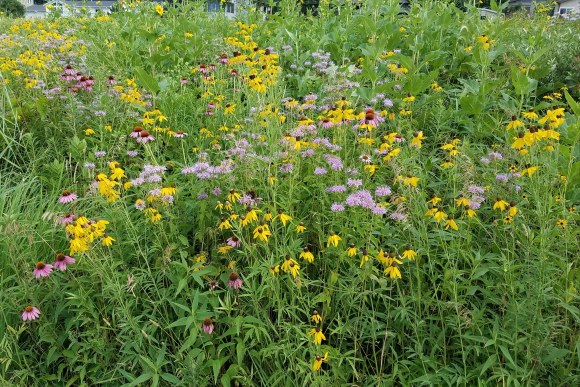
Prairie used to cover more than 85 percent of Iowa land, according to the Neal Smith National Wildlife Refuge. Today less than one tenth of a percent of original tallgrass prairie remains in the state. A prairie restoration project, like the ones at Iowa state parks, is a work of human hands and culture.
People like Cindy Crosby have a personal investment in work they have done to restore prairie. Even if such restorations are anything but natural, and a constant struggle to keep invasive plants like garlic mustard at bay, they add cultural value in the form of habitat for plant and animal species and the narratives spun around them. We should tread lightly in their work, take what we need, and leave the rest.
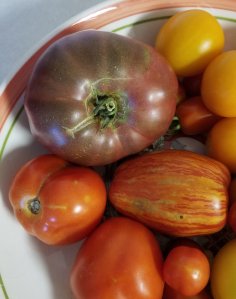
With late planting and heavy spring rain the garden has been a mixed bag. A highlight of every year is arrival of tomato season and planning the use of what I expect will be a good crop.
The first tomatoes have ripened, and now we wait for the slicers and plums.
We eat them fresh, give some away, and prepare canned sauce, juice and diced with the rest.
As my worklife slows down, it seems there is more work to do in the yard and garden. Growing tomatoes doesn’t seem like work.
My last summer post for Blog for Iowa runs Friday and I am ready for what’s next, including a return to my usual topics in this space. I cross post here what I write elsewhere so a trickle of BFIA articles will continue until they all have been posted.
I begin work at the orchard this weekend for the seventh consecutive season. Hopefully we’ll have ripe apples and great conversations with our guests. It is blueberry season in Michigan and this weekend we will offer them fresh for the last time this year. We’re hoping Pristine, Jersey Mac and Viking get ripe by the weekend so our guests can pick them.
In July I signed up for a nutrition class paid for mostly by Medicare. The goal is to watch my blood sugar levels and develop better eating and exercise habits. A by-product of the classes has been losing ten percent of my body weight. I feel better and hope to stave off diseases of aging such as heart disease, stroke, diabetes, eyesight deterioration, influenza, pneumonia and the like. Fingers crossed. I still have a lot I want to do and good health is an important prerequisite.
As the sun ascends on another brilliant Iowa day the garden needs watering, and I want to get a trail walk in before leaving for the home, farm and auto supply store. There is a long to-do list needing attention as well. Thanks for reading.
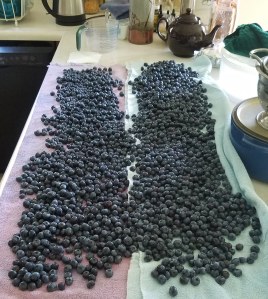
Drying 10 Pounds of Michigan Blueberries for Freezing
There is a strong argument nothing is wrong with our food system.
There is a strong argument everything is wrong with our food system.
To talk about a “food system” at all presumes a lot that may or may not be true.
It’s no secret large corporations increasingly control food production, distribution and marketing. Scalability is a key issue with providing nourishment for billions of people. The hand of large land owners, chemical companies, seed genetics companies, processors, banks, equipment manufacturers and consumer outlets runs throughout each household’s food ecology. Households have a food ecology even if they don’t speak of it using such fancy words. What appears at a meal is influenced at every point in the distribution chain by large corporations.
It’s also no secret farmers, especially small-scale farmers don’t earn a lot of money for their long hours each season. Neither do equipment manufacturing workers, seasonal farm help, truck drivers, grocery store workers, or restaurant workers. Whether one is a contractor for a large international meat-producing corporation or produces heirloom hogs for a meat locker, at the end of the day a diverse and ever changing personal economic structure is needed to ensure viability this year and in the near-term future. People struggle to make a living by farming alone.
At the same time, grocery stores are packed with food and if there remain some food deserts without one, enough food is produced in the United States to feed everyone. I met an executive from a large container manufacturing company when I worked in the Chicago Loop. He said the issue wasn’t having enough food, it was preserving and distributing what we already produce. That remains true, his statement representing another large corporation wanting a piece of the food supply action.
The deck is stacked against young farmers who want to produce food outside the mainstream. I’m thinking of friends that operate Community Supported Agriculture projects or grow specialty crops. Producing meat and vegetables for the local market has been a staple in society at least since medieval times. When there are a lack of well-paying jobs, or capital, if people have access to a piece of land for a season, attractive fruit and vegetables can be produced and sold at a margin that looks better because labor cost is removed from the calculus.
It goes without saying a farmer will work 60 or more hours a week, sometimes turning $100,000 per year in revenue derived from diverse sources (produce, livestock, grazing and retail sales) and living on a fraction of that. Land ownership? Only a small percentage of young farmers can afford to own land.
Consumers can afford a hodge-podgey food system with diverse sourcing, abundant supply, wide variety, and absence of much concern for how food arrived at our table. If corporations own equity in land, equipment and patented seed genetics, it’s hard to see that on our 9-inch dinner plate.
What matters more in this discussion is not whether a food system is good or bad, but whether that is even a thing. If each household develops its own food ecology, including best practices regarding water use, soil conservation, seed genetics and other resource use, that’s not good enough. If a food system exists, what it requires is scalability and that’s where corporations can and likely should play a role. Not evil corporations designed for extraction of resources and cash, but people joined together with common purpose regarding nourishing a growing population.
Asserting there is or isn’t a problem with our food system is itself a problem. It is much more fluid and undefined than that. Like vegetable farmers we need to accept each season for what it teaches us, hoping we can sustain ourselves for another season.
This week I met someone who works with trees for a local municipality while working a shift at the home, farm and auto supply store.
We discussed several topics, including dealing with Japanese Beetles, tree species that thrive in Iowa, and the Emerald Ash Borer. He favored the River Birch tree.
The city had inventoried every ash tree on public property and had a plan to replace them when they inevitably become infected with the insect.
I asked with what species would the city replace ash trees? He mentioned Chestnut and Black Tupelo (a.k.a. Black Gum). We discussed the blight that eradicated the immense population of Chestnut trees in the Eastern United States and how genetics had improved the tree to resist the disease. He also mentioned the Black Gum tree is attractive, with a nice head, and grows comparatively quickly. The conversation drifted off into how people plan trees on their property and the challenges of establishing them on property with a limited number of spots. I returned to the rest of my work.
Growing trees is a long-term commitment. When we built our home only one tree, a mulberry, lived on our lot. We now have 15 with room for more. I’m not sure I want a chestnut, but a Black Gum sounds like a possibility.
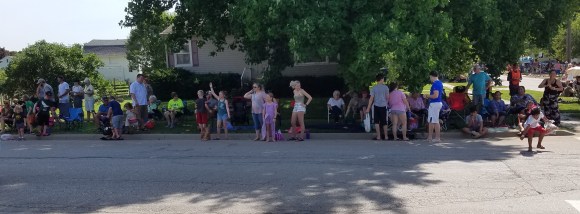
A summer parade in Iowa is a chance to showcase lives for the entire community.
Farmers, restaurateurs, insurance agents, bankers, retailers, construction companies, government organizations and more cleanup their equipment and parade it through town handing out treats and small gifts along the route.
People line the street to watch, sitting on lawn chairs, standing under shade trees and chatting with friends on the sidewalk. It’s mostly for children yet adults get involved as well. Anyone can stand almost anything that marches by in the span of a couple of minutes.
Solon Beef Days Parade Watchers
I.
In 2013 our situation got dire. I had run out of money and held no job that paid enough. Not wanting to return to transportation, I took one low wage job after another to earn enough to get by. Most of the work involved standing on concrete floors, which precipitated a case of plantar fasciitis. Not only did my feet hurt, on a physician’s advice I gave up jogging after 37 years because of it. While the condition is resolved, it persisted until I left full-time work in 2018.
Expenses got delayed during this period, as did preventive health care. It wasn’t clear how tight money had been until I began taking Social Security benefits which brought relief.
II.
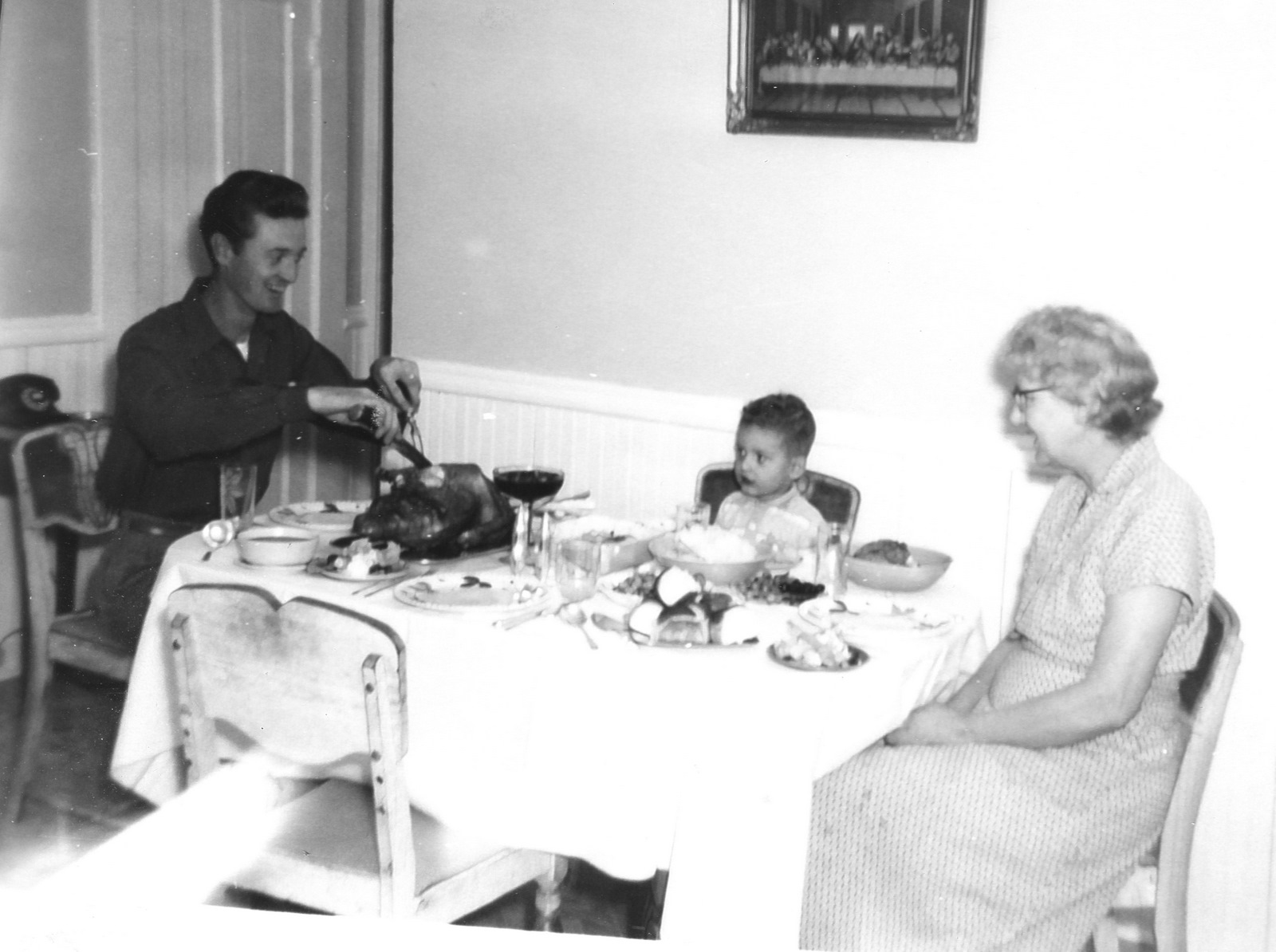
An Early Thanksgiving
The story begins with the proximity of relatives. Our maternal grandmother and grandfather made visits to our home. I never knew my paternal grandparents except in stories and photographs. As much as anything, my grandparent story is about my relationship with Grandmother from my earliest memories until she died Feb. 7, 1991.
We were lucky to have her with us for so long.
Grandmother had five children and 15 grandchildren. She spent more time with our family because of our proximity. She lived with us off and on during my early years, but eventually maintained her own apartment. In later life she lived at the Lend-A-Hand, a residence for women at the time, then moved to the Mississippi Hotel where she lived the last years of her life in an apartment until moving to the Kahl Home for a brief period. Grandmother had many sisters and a brother. We had a lot of relatives, or so it seemed.
III.
I read The Overstory by Richard Powers. It engaged in a way most fiction fails to do. The author must have spent an enormous amount of time researching trees, forests, and the culture around them. He wove them into a spellbinding narrative. I could go on gushing about the book, but just pick it up and read it. If you do, and are interested in the environment, I doubt there will be any regrets.
Ed Fallon is a friend of Blog for Iowa and we support what he does with his radio program and his advocacy against oil and natural gas pipelines in Iowa.
He caught the attention of Democrats in Cedar Rapids last weekend with a performance art piece, staged by his group Bold Iowa, in which three individuals posed in a gallows with a noose around their neck, standing on blocks of melting ice under a sign that said, “As the arctic melts the climate noose tightens.”
While many on social media and in-person viewers of the piece took a dim view of this direct action, if you know Ed at all, not thinking things through is a feature, not a bug of his work. There is no denying deterioration of the Greenland ice sheet, the Arctic, and the Antarctic ice shelves is a planetary problem that could cause environmental disruptions not seen in living human memory. Bold Iowa’s performance piece was successful in that social media was abuzz discussing its meaning and appropriateness. It was unsuccessful in that major media outlets did not appear to be covering it with the notable exception of the Cedar Rapids Gazette which ran a story on Wednesday framing the piece a racially callous because of its use of a noose, invoking for some an association with lynching in American history.
“We underestimated the way it may trigger folks who either are concerned about the rise in racism in this country, in many respects because of Donald Trump,” Fallon said in an interview with the Gazette. “And also people who were affected by a family member who maybe committed suicide by hanging. … Our focus is to get people to understand just how urgent of a situation climate change is. We really are at a point where human extinction is a possibility.”
In a July 16 email, Fallon wrote he planned to write a blog post about the incident while promoting his Fallon Forum podcast, saying,
Pascha Morgan joins (the Fallon Forum) to discuss Bold Iowa’s provocative performance art, which involved a gallows (representing the threat of extinction) and large blocks of ice (representing accelerated ice melt in the polar regions).
Bold Iowa’s action demanded that Democratic presidential candidates make human survival their first act as president. The banner above the gallows declared, “As the Arctic melts, the climate noose tightens.”
The action received some enthusiastic support. Yet despite what organizers thought was clear messaging, it also experienced some strong pushback. In addition to this week’s live on-air discussion, I’ll publish a more in-depth blog later this week, responding to criticism of the action and apologizing to people offended by the imagery.
Thursday, July 18, Fallon made a post titled An Error of Judgement on the Bold Iowa website. In it he apologized to people offended by the imagery of the noose and accepted full responsibility for what he called an error in judgement. The post also ran as an op-ed in this morning’s Cedar Rapids Gazette.
Our support for Ed Fallon’s work continues. If one reads Fallon’s book Marcher Walker Pilgrim: A Memoir from the Great March for Climate Action there is a clear sense of the haphazard way Fallon goes about planning direct action. The fact is people continue to talk about the performance art piece five days after it happened. To the extent fingers are pointing at Ed’s quirky and in this case considered yet somewhat tone-deaf approach to direct action as the problem, the performance art failed.
Listen to the Fallon Forum live Mondays, 11:00 – noon CT on La Reina KDLF 96.5 FM and 1260 AM in central Iowa. The program is also available on podcast later in the day at FallonForum.com.




 Journey Home

You must be logged in to post a comment.